
lovethailand home >Northeastern Travel Attractions >Si Sa Ket Travel Attractions >Khun Han >Si > Wat Pa Maha Chedi Kaew (Wat Larn Kuad)
TL;DR: Wat Pa Maha Chedi Kaew (Wat Larn Kuad) is located at Ban Don, Moo 2, Non Sung Subdistrict, Khun Han District, Si Sa Ket Province 33150, Thailand, open Daily, hours 08.00 - 17.00.
Wat Pa Maha Chedi Kaew (Wat Larn Kuad)
Open Days: Daily
Opening Hours: 08.00 - 17.00
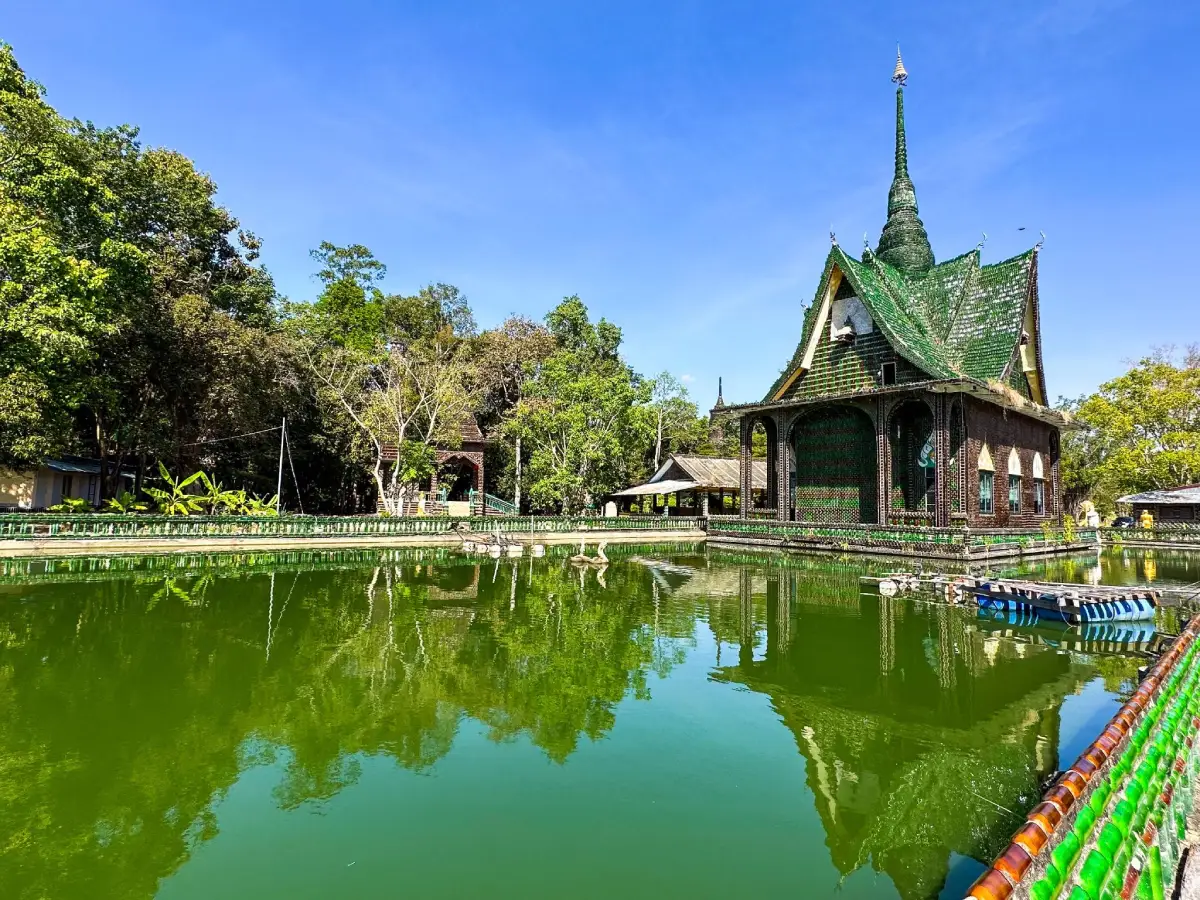
Wat Pa Maha Chedi Kaew, widely known as Wat Lan Khuat or the Million Bottle Temple, is one of the most distinctive Buddhist temples in Si Sa Ket Province. Located in Ban Don, Non Sung Subdistrict, Khun Han District, the temple is famous for its extraordinary use of recycled glass bottles. Buildings throughout the temple grounds, including the entrance gate, walls, halls, ordination hall, bell tower, monks’ residences, crematorium, toilets, and the water-surrounded sim, are decorated with more than 1.5 million glass bottles. This unusual approach has made the temple one of the most memorable faith-based and cultural destinations in Lower Northeastern Thailand.
The importance of Wat Pa Maha Chedi Kaew is not limited to its visual uniqueness. The temple also expresses a Buddhist way of seeing value in what others might discard. Bottles once considered waste were cleaned, collected, sorted, and transformed into sacred architecture. When sunlight touches the glass surfaces, the buildings shine and reflect light in different colors. This visual effect gives the temple a strong symbolic meaning: a clear and purified mind can reflect the light of Dhamma. For visitors, the temple is therefore both a work of recycled architecture and a living Buddhist lesson.
The temple’s origin is closely connected with Phra Khru Wiwek Thammachan, also known locally as Luang Pho Rot or Luang Pu Lot Thirakhuno, the former abbot and founder of the Million Bottle Temple concept. The area was once an old cemetery and had many discarded glass bottles nearby. When Luang Pho Rot came to practice meditation in the area, he saw that the bottles had useful colors, strength, and beauty. He began using them as decorative material for temple buildings, reducing waste while also saving the cost of paint and tiles. From this simple but powerful idea, the temple gradually became one of Thailand’s most unusual Buddhist landmarks.
The construction began with bottles collected from nearby villages. Monks and villagers cleaned the bottles, separated them by color, and gradually used them in temple structures. As the temple became known, devotees from other districts and provinces began bringing bottles to donate. Over time, more than 1.5 million bottles were used throughout the temple. Green, brown, clear, and other colored bottles were arranged into patterns on walls, pillars, roofs, and building edges, creating a surface that changes with light and viewing angle.
Wat Pa Maha Chedi Kaew is therefore a true community-built temple. Its beauty did not come from expensive material but from patience, faith, and shared effort. Every wall and every glass-bottle surface carries the work of monks, villagers, and donors. This makes the temple valuable not only as a place to photograph but also as a record of collective Buddhist devotion. Visitors can see how ordinary objects were elevated into sacred art through discipline and purpose.
The visit usually begins at the bottle-decorated entrance gate. From there, visitors enter a temple compound where many structures share the same glass-bottle identity. The main hall, bell tower, monks’ buildings, crematorium, toilets, walls, and walking areas all show how the bottle concept was applied across the entire temple. The effect is that the whole temple feels like a large open-air Buddhist art installation while still remaining a functioning local temple.
The most important architectural highlight is Sala Than Samo Maha Chedi Kaew, the large hall richly decorated with glass bottles. The structure is admired for the way bottles of different colors are arranged into patterns across the walls and surfaces. In sunlight, the glass reflects and sparkles, giving the hall a jewel-like appearance. Visitors often spend considerable time observing the details of the bottles, the rhythm of the patterns, and the way the building changes under different light conditions.
Another major highlight is the sim nam, or water-surrounded ordination hall. This building stands in the middle of a pond and is one of the most iconic scenes of the temple. Its glass-bottle surfaces, green-toned roofline, reflections on the water, and peaceful setting give it a calm and sacred atmosphere. Inside is a white jade Buddha image, one of the principal sacred objects for visitors to worship. The combination of water, glass, and Buddhist imagery makes this area the spiritual and visual heart of Wat Lan Khuat.
The white jade Buddha image inside the sim nam is a major focus of devotion. Visitors should enter respectfully, remove shoes where required, dress modestly, and keep quiet. The contrast between the stillness of the Buddha image and the sparkling glass-bottle surfaces around it gives the space a distinctive atmosphere. It is a place for prayer, reflection, and appreciation of sacred design.
In addition to bottles, the temple also uses metal bottle caps to create Buddhist narrative images and decorative patterns. From a close distance, these works appear as thousands of small caps arranged one by one. From a suitable distance, they become images from the life of the Buddha. This technique shows the same principle as the glass-bottle architecture: discarded material can become meaningful art when arranged with patience, skill, and faith.
Many other structures in the temple continue the same idea. Monks’ residences, the bell tower, the crematorium, the toilets, and other functional buildings are decorated with bottles so that the entire temple has a unified artistic identity. This is what makes Wat Pa Maha Chedi Kaew different from many other unusual attractions. The bottle concept is not limited to one display building; it is applied throughout the temple grounds.
The temple covers about 18 rai and remains a place of Buddhist worship. It is not merely a tourist attraction. Local people still come to make merit, pay respect, join temple activities, and support the temple. Visitors should therefore approach the site as a Buddhist temple first and a cultural attraction second. The best experience comes from appreciating both the sacred function of the temple and its creative environmental message.
The beauty of the temple depends strongly on natural light. Green bottles create a cool and peaceful visual tone, brown bottles add depth and warmth, and clear bottles help reflect light. In the morning, the temple feels calmer and softer. In the afternoon, sunlight can make the glass surfaces shine more strongly. This changing light makes the temple visually rich and gives visitors different impressions at different times of day.
From an environmental perspective, Wat Pa Maha Chedi Kaew is an important example of creative reuse. Long before recycling became a common tourism theme, the temple had already transformed discarded bottles into Buddhist architecture. This reuse was not only practical; it became a spiritual message. The temple shows that value is not fixed by an object’s former use. With wisdom and intention, something rejected can become something sacred, beautiful, and useful.
The story of Luang Pho Rot remains central to the temple’s identity. He did not only build structures from bottles; he built a way of thinking. An old cemetery and waste area became a place of merit. Discarded bottles became walls and roofs. Bottle caps became Buddhist images. This transformation reflects a Buddhist lesson about purification, intention, and the possibility of renewal.
Today, the temple is cared for by the resident monastic community together with Ban Don villagers and local agencies in Khun Han District. The former abbot and founder, Phra Khru Wiwek Thammachan or Luang Pho Rot, remains deeply respected by devotees. Visitors continue to come from Thailand and abroad to see the bottle-decorated architecture, pay respect to the Buddha image, and learn about the temple’s unique story.
A good walking route begins at the entrance gate, then continues to the main glass-bottle hall, the water-surrounded sim, the white jade Buddha image, the bottle-cap Buddhist images, the bell tower, monks’ residences, crematorium, toilets, and the temple courtyard. This route allows visitors to understand the temple as a complete environment rather than a single photo spot.
Visitors who enjoy photography should allow at least one to two hours. Morning is good for a quieter atmosphere and soft light. Late afternoon brings stronger reflections from the glass surfaces. Photography should be done respectfully. Visitors should not disturb worshippers, climb on temple structures, touch bottle decorations, enter monks’ private areas, or block walking paths while taking photos.
Getting There is convenient by private car or hired local transport. From Si Sa Ket city, travel toward Khun Han District through Phayu and Phrai Bueng, with a road distance of about 61 to 70 kilometers depending on the route. Once in Khun Han, continue to Ban Don in Non Sung Subdistrict. The temple is close to the district area and can be combined with nearby natural attractions, waterfalls, and other temples.
For a half-day trip, visitors can start at Wat Pa Maha Chedi Kaew in the morning, worship the Buddha image, explore the bottle architecture, and then stop at a local café or restaurant in Khun Han. For a full-day route, the temple can be combined with Samrong Kiat Waterfall, Huai Chan Waterfall, Wat Phrai Phatthana and the Luang Pu Suang memorial area, or the route toward Khao Phra Wihan National Park.
The temple can be visited all year. The cool season and rainy-to-early-cool period are pleasant for combining the temple with natural attractions in Khun Han. During hot weather, visitors should bring drinking water, a hat, or an umbrella. During the rainy season, care should be taken around wet walking areas and the pond-side zone near the sim nam.
There is no fixed tourist admission fee for Wat Pa Maha Chedi Kaew. Visitors may enter during opening hours, pay respect, walk around the temple grounds, and admire the bottle architecture. Donations, flowers, garlands, candles, incense, and merit-making offerings are voluntary according to personal faith. This keeps the temple open and accessible to local residents, pilgrims, students, Thai travelers, and international visitors.
Proper etiquette is important. Visitors should dress modestly, remove shoes where required, speak quietly in worship areas, avoid touching Buddha images or ritual objects without permission, avoid climbing on bottle-decorated structures, avoid damaging bottle-cap artwork, keep the temple clean, and respect monks and worshippers. Since the temple’s message is connected with reducing waste, keeping the area clean is especially meaningful here.
For international travelers, Wat Pa Maha Chedi Kaew is one of the clearest examples of contemporary Thai Buddhist creativity. It combines religion, local craftsmanship, environmental awareness, community participation, and unusual architecture. Visitors can see that Thai temples are not limited to gold, mirrors, wood carving, or stone. Here, ordinary glass bottles become a sacred building material and a visual teaching tool.
The temple is more than an unusual attraction. It is a lesson in faith, patience, and transformation. Sala Than Samo Maha Chedi Kaew shows community art. The water-surrounded sim shows sacred architecture. The white jade Buddha image offers a place of worship. The bottle-cap Buddhist scenes demonstrate patience and detail. The story of Luang Pho Rot shows how wisdom can transform waste into beauty. Together, these elements make Wat Pa Maha Chedi Kaew one of the most meaningful and memorable places in Si Sa Ket Province.
Visiting the Million Bottle Temple is therefore best understood with two perspectives. One is the traveler’s eye, which admires color, reflection, and originality. The other is the learner’s eye, which sees the Buddhist message behind the glass. When discarded bottles become temple walls, when bottle caps become sacred images, and when an old cemetery becomes a place of merit, the temple teaches that real value comes from wisdom, intention, and the ability to transform what is ordinary into something meaningful.
| Place Name | Wat Pa Maha Chedi Kaew, Si Sa Ket |
| Common Names | Wat Lan Khuat, Million Bottle Temple, Temple Of A Million Bottles |
| Place Type | Local Buddhist Temple, Faith-Based Cultural Attraction, Recycled Glass-Bottle Architecture Site, Contemporary Buddhist Art Destination, And Landmark Of Khun Han District |
| Location | Ban Don, Moo 2, Non Sung Subdistrict, Khun Han District, Si Sa Ket Province 33150, Thailand |
| Distance From Key Points | About 61 - 70 km from Si Sa Ket city by road and located close to Khun Han town |
| Significance | A famous temple decorated with more than 1.5 million recycled glass bottles, turning discarded material into Buddhist architecture, community art, and a symbolic lesson in purity and transformation |
| Historical Summary | The temple developed from an old cemetery area in Ban Don. Phra Khru Wiwek Thammachan, known as Luang Pho Rot or Luang Pu Lot Thirakhuno, saw discarded bottles nearby and began using them to decorate temple buildings, eventually creating the Million Bottle Temple. |
| Founder | Phra Khru Wiwek Thammachan, also known as Luang Pho Rot / Luang Pu Lot Thirakhuno, former abbot and founder of the temple’s recycled glass-bottle concept |
| Current Caretaker | Resident monastic community of Wat Pa Maha Chedi Kaew, together with Ban Don community, Khun Han District, and related local agencies |
| Current Status | Active Buddhist temple and faith-based cultural attraction where visitors can pay respect, admire glass-bottle architecture, and learn about creative reuse in a Buddhist setting |
| Open Days | Daily |
| Opening Hours | 08.00 - 17.00 |
| Admission Fee | Free Admission For Adults And Children. Donations, flowers, garlands, candles, incense, and merit-making offerings are voluntary according to personal faith. |
| Main Highlights | 1. Sala Than Samo Maha Chedi Kaew 2. Sim Nam / Water-Surrounded Ordination Hall 3. White Jade Buddha Image 4. Bottle-Decorated Halls, Bell Tower, Monks’ Residences, Crematorium, And Toilets 5. Buddhist Narrative Images Made From Bottle Caps 6. More Than 1.5 Million Recycled Glass Bottles Used In Temple Decoration |
| Main Areas / Zones | 1. Glass-Bottle Entrance Gate And Wall Zone 2. Sala Than Samo Maha Chedi Kaew Zone 3. Sim Nam / Water-Surrounded Ordination Hall Zone 4. White Jade Buddha Image Zone 5. Bottle-Cap Buddhist Image Zone 6. Bell Tower And Bottle-Decorated Building Zone 7. Monks’ Residence And Monastic Area 8. Crematorium And Functional Temple Building Zone 9. Temple Courtyard And Merit-Making Zone 10. Glass-Bottle Architecture Photo Zone |
| Facilities | Parking area, worship areas, temple halls, walking areas, toilets, photo areas, and basic services in the nearby Khun Han community |
| Related Contact | Wat Pa Maha Chedi Kaew, Tel. 084-524-3770 Khun Han Subdistrict Municipality, Tel. 045-679-227 Khun Han District Office, Tel. 045-679-035 Si Sa Ket Provincial Office Of Buddhism, Tel. 045-622645 |
| Travel Information | From Si Sa Ket city, travel toward Khun Han District through Phayu and Phrai Bueng. The road distance is about 61 - 70 km depending on route. Once in Khun Han, continue to Ban Don, Non Sung Subdistrict. Private car, van, or hired local transport is most convenient. |
| Visitor Etiquette | Dress modestly, keep quiet, remove shoes where required, do not climb on bottle-decorated structures, do not touch Buddha images or ritual objects without permission, do not litter, and respect monks and worshippers. |
| Nearby Tourist Attractions | 1. Lung Serm Volcano Durian Garden, about 10 km 2. Samrong Kiat Waterfall / Phi Sat Waterfall, about 25 km, Tel. 063-565-9399 3. Huai Chan Waterfall / Kanthrom Waterfall, about 27 km 4. Wat Khian Burapharam, Khukhan, about 24 km 5. Wat Phrai Phatthana / Luang Pu Suang Memorial, about 42 km, Tel. 099-625-3859 6. Pha Ya Kupri Viewpoint, about 45 km 7. Pha Mo I Daeng / Khao Phra Wihan National Park, about 58 km 8. Si Sa Ket City, about 61 - 70 km |
| Nearby Restaurants | 1. BJ Coffee House, Khun Han, about 2 km, Tel. 098-214-6024 2. Cho Cher Coffee & Bakery, Khun Han, about 2 km, Tel. 091-014-0622 3. MOMOCHA Taiwanese Bubble Tea Khun Han, about 2 km, Tel. 064-959-0476, 062-441-9235 4. Indy Coffee Bar & Restaurant, Khun Han, about 2 km, Tel. 099-069-5889 5. Pornsawan Cafe, Khun Han, about 3 km, Tel. 063-497-7625, 088-192-3166 6. Loft House Café, Khukhan, about 24 km, Tel. 086-364-9492 |
| Nearby Accommodations | 1. Peace Pool Resort, Khun Han, about 1 km, Tel. 081-879-5822 2. Rerawadi Resort & Spa, Khun Han, about 2 km, Tel. 087-128-0095 3. Pongsin Resort & Restaurant, Khun Han, about 10 km, Tel. 088-375-5199 4. Cheyenne Resort, Khukhan, about 24 km, Tel. 085-024-4829, 045-966-585 5. Bansuansrisuparb Hotel, Khukhan, about 28 km, Tel. 087-245-9125, 080-240-7090 6. B2 Sisaket Boutique & Budget Hotel, Mueang Si Sa Ket, about 66 km, Tel. 052-009-161, 088-263-2897 |
Frequently Asked Questions (FAQ)
Q: Where is Wat Pa Maha Chedi Kaew located?
A: Wat Pa Maha Chedi Kaew, also known as Wat Lan Khuat or the Million Bottle Temple, is located in Ban Don, Moo 2, Non Sung Subdistrict, Khun Han District, Si Sa Ket Province, Thailand.
Q: What are the opening days and hours?
A: The temple is open daily from 08.00 to 17.00. Visitors can pay respect to the white jade Buddha image, see Sala Than Samo Maha Chedi Kaew, visit the water-surrounded sim, and walk around the bottle-decorated temple grounds during these hours.
Q: Is there an admission fee?
A: There is no fixed admission fee for adults or children. Donations, flowers, garlands, incense, candles, and merit-making offerings are voluntary according to personal faith.
Q: Why is it called the Million Bottle Temple?
A: It is called the Million Bottle Temple because more than 1.5 million recycled glass bottles were used to decorate buildings throughout the temple, including the entrance gate, walls, halls, ordination hall, bell tower, monks’ residences, crematorium, toilets, and water-surrounded sim.
Q: Who founded the Million Bottle Temple concept?
A: The concept was initiated by Phra Khru Wiwek Thammachan, also known as Luang Pho Rot or Luang Pu Lot Thirakhuno, the former abbot who transformed discarded glass bottles into meaningful Buddhist architecture.
Q: What are the main highlights inside the temple?
A: Main highlights include Sala Than Samo Maha Chedi Kaew, the water-surrounded sim, the white jade Buddha image, Buddhist narrative images made from bottle caps, and multiple temple structures decorated with colorful glass bottles.
Q: How can visitors get to Wat Pa Maha Chedi Kaew?
A: From Si Sa Ket city, travel toward Khun Han District through Phayu and Phrai Bueng, then continue to Ban Don in Non Sung Subdistrict. The road distance is about 61 - 70 km depending on route. Private car, van, or hired local transport is the most convenient option.
Q: How should visitors behave at the temple?
A: Visitors should dress modestly, keep quiet in worship areas, remove shoes where required, avoid climbing on bottle-decorated buildings, avoid touching sacred objects without permission, keep the temple clean, and respect monks and other worshippers.
 Category: ●Places of Worship
 Group: ●Temple
Last Update : 2 MonthAgo
 Last Update : 2 MonthAgo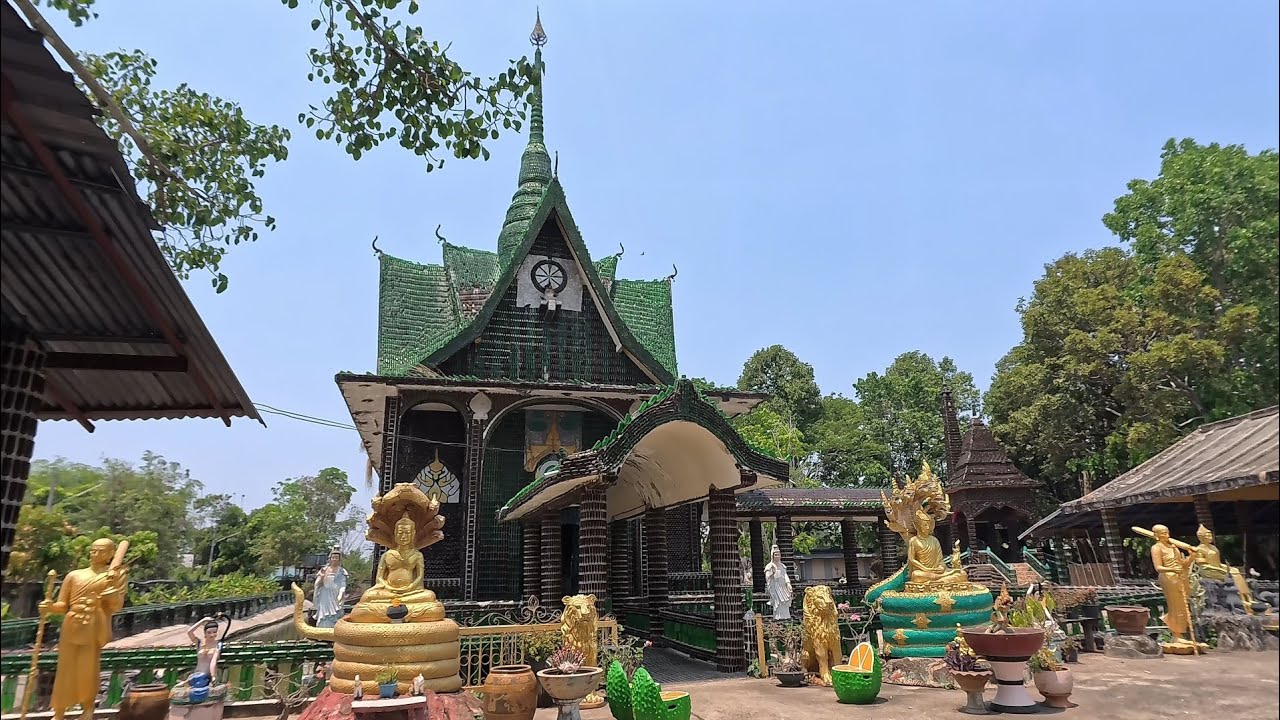
 Click to Access the Navigation Map GPS
Wat Pa Maha Chedi Kaew (Wat Larn Kuad) Map

 Art, Culture and Heritage
 Historical Sites and Monuments(12)
 Landmarks and Memorials(1)
 Art, Craft Centres, Tradition(8)
Temple(13)
Art, Craft Centres, Tradition(8)
Temple(13)
 Other Sacred Sites(3)
 Suburban Living
 Village, Community(2)
 Nature and Wildlife
 National Parks and Marine Reserves(2)
 Dam, Reservoir, Lake(7)
 Waterfalls(5)
 River, Canal(5)
 Bays and Beaches(2)
 Entertainment and Agricultural
 Zoos and Aquariums(1)
 Farms, Parks and Ecotourism(3)


