
lovethailand home >Northeastern Travel Attractions >Nong Bua Lamphu Travel Attractions >Non Sang >Kut Du > Phu Kao-Phu Phan Kham National Park
TL;DR: Phu Kao-Phu Phan Kham National Park is located at Ban Kho Subdistrict, Non Sang District, Nong Bua Lam Phu Province, and connected areas near Ubolratana District, Khon Kaen Province, open Daily, hours 08.30 – 16.30.

Phu Kao-Phu Phan Kham National Park
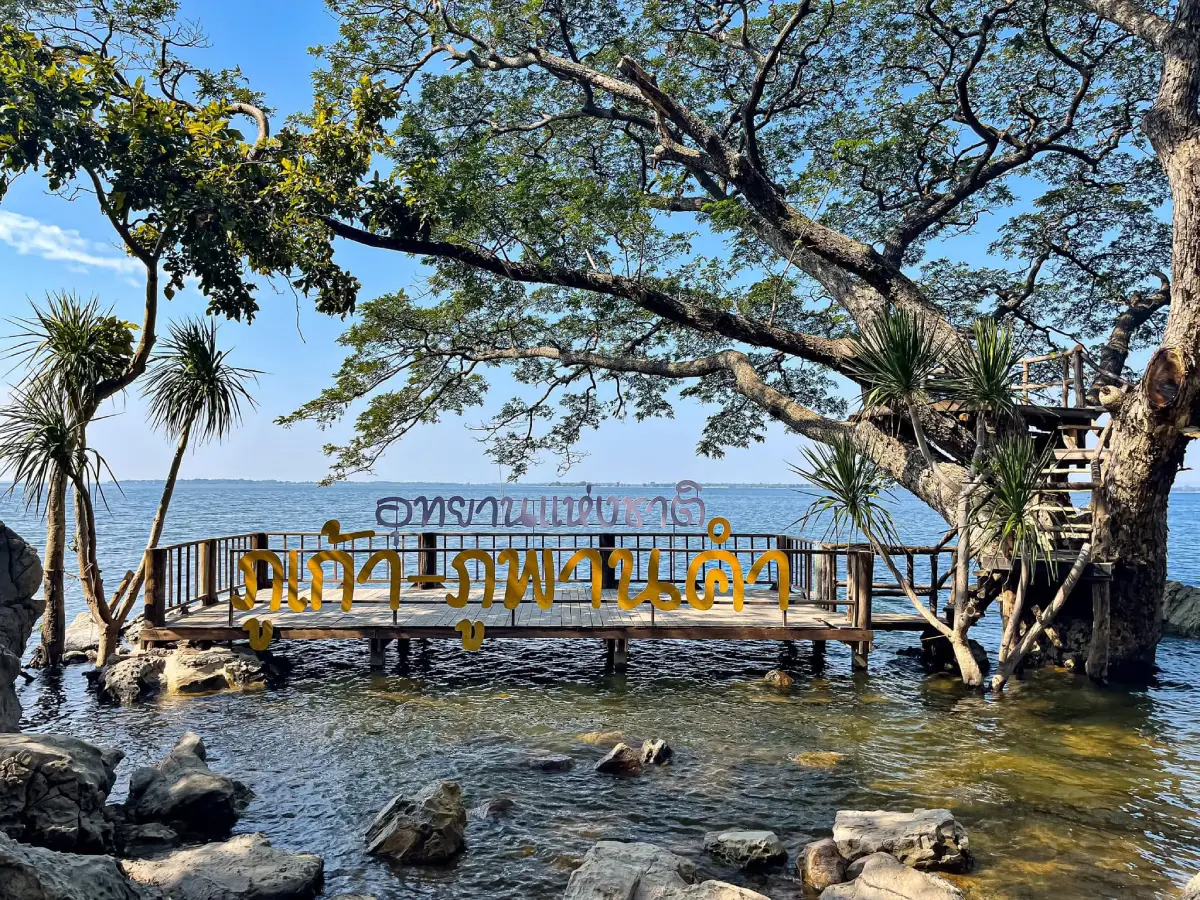
Open Days: Daily
Opening Hours: 08.30 – 16.30
Phu Kao-Phu Phan Kham National Park in Nong Bua Lam Phu Province is one of the most remarkable national parks in the upper northeastern region of Thailand. It combines sandstone mountains, dry dipterocarp forest, mixed deciduous forest, cave archaeology, prehistoric rock paintings, natural rock formations, scenic viewpoints, lakeside landscapes, and the vast reservoir above Ubolratana Dam in one protected area. Officially declared a national park on 20 September 1985, it became Thailand’s 50th national park and covers about 201,250 rai, or approximately 322 square kilometers, across Nong Bua Lam Phu, Khon Kaen, and nearby connected areas.
The park is best understood through its 2 major landscape zones: Phu Phan Kham and Phu Kao. Phu Phan Kham is the more accessible zone for most travelers because the park office is located near the reservoir above Ubolratana Dam. This side is known for broad lake views, gentle mountain scenery, camping areas, sunset viewpoints, and a relaxing lakeside atmosphere. Phu Kao, on the other hand, is a more rugged sandstone mountain area with caves, rock shelters, prehistoric traces, stone terraces, and natural sculptures. Together, these 2 zones make the park far more diverse than a simple viewpoint or lakeside stop.
The name Phu Kao refers to a group of 9 sandstone mountains: Phu Fang, Phu Khum Pun, Phu Han, Phu Moei, Phu Kho Mo, Phu Chan, Phu Phro, Phu Luak, and Phu Wat. This mountain group forms a complex landscape of cliffs, caves, sandstone shelves, forested slopes, and unusual rocks shaped by long natural erosion. The area is especially important because it contains archaeological evidence such as rock paintings, carvings, and traces of prehistoric human activity. For travelers interested in cultural history, Phu Kao is not only a natural site but also an open-air record of ancient human presence in northeastern Thailand.
Phu Phan Kham is a mountain range on the eastern side of the Phong River basin and forms part of the broader Phu Phan mountain system. Its most memorable scenery is the view over the reservoir above Ubolratana Dam. From high viewpoints, visitors can see the wide body of water, surrounding hills, small islands, shoreline communities, and changing light across the lake. The atmosphere is especially beautiful in the early morning and late afternoon, when the water reflects the sky and the mountains appear in layered shades. This makes Phu Phan Kham ideal for photography, camping, short nature breaks, and slow travel.
The natural landscape of the park is dominated by dry dipterocarp forest, a typical forest type of northeastern Thailand. This forest grows well on dry, sandy, and lateritic soils. During the early cool season, parts of the forest begin to change color and shed leaves, creating a distinctive Isan forest atmosphere. The park also contains areas of mixed deciduous forest and dry evergreen forest in wetter gullies, streamside zones, and sheltered valleys. This mixture of habitats gives the park a varied character, with open woodland, shaded forest patches, rocky terrain, and seasonally changing vegetation.
Geologically, Phu Kao-Phu Phan Kham National Park is highly interesting because its sandstone formations reveal a long natural history. Many rocks have been shaped by wind, water, heat, and time into unusual forms. Some appear like natural sculptures, while others create wide stone terraces or balanced rock features. Places such as Sao Hin Ham Tang, also known as the balanced or mushroom-like stone formation area, show how erosion can create striking natural shapes. Travelers who enjoy geology and landscape photography will find many details to observe beyond the main scenic viewpoints.
Chong Khao Khat Viewpoint is one of the most popular viewpoints in the Phu Phan Kham zone. From this point, visitors can look across the reservoir above Ubolratana Dam and see the lake spreading between hills. The view is wide, open, and peaceful, giving the impression of standing above a large inland sea. It is a suitable place for sunset photography, quiet rest, and panoramic landscape viewing. On clear days, the contrast between water, sky, forest, and hills creates one of the most memorable scenes in the park.
In the Phu Kao zone, Wat Phra Phutthabat Phu Kao is one of the important cultural sites. It is associated with sacred footprints, a hunter’s footprint, and a dog-like footprint carved or impressed into the sandstone surface. Local stories connect these traces with the legend of Phra Suphrom Wimonkha and the nine-tailed dog. This connection between natural stone, local legend, and religious belief gives the area a deeper meaning. Visitors are not simply looking at marks on rock; they are entering a landscape where nature and storytelling have shaped local faith.
The cave and rock shelter sites in Phu Kao are among the most significant features of the park. Caves such as Tham Muem, Tham Achan Sim, Tham Suea Tok, Tham Phlan Hai, and other shelters contain rock paintings, engravings, or archaeological traces connected with prehistoric communities. These sites suggest that people used caves, cliffs, and sandstone shelters for habitation, ritual, or social activity long before the present day. For travelers, these places create a rare opportunity to connect with the deep human history of northeastern Thailand while standing in the natural setting where that history remains visible.
Ho Sawan is another scenic point in the Phu Kao area. It is known as a viewpoint on a large rock near a high cliff, with a pavilion or resting point that allows visitors to look out over the surrounding landscape. The experience here is very different from the lakeside view at Phu Phan Kham. Instead of looking across water, visitors stand among sandstone, forest, and sky. This gives Ho Sawan a rugged and elevated feeling, suitable for travelers who enjoy high viewpoints, natural rock platforms, and open forest scenery.
Tat Fa Waterfall is a small waterfall within the park. It flows through a forest stream and drops over stone layers into a pool below. It is not a large waterfall, but it has a quiet natural charm, especially during the rainy season or when water levels are sufficient. The forest around the waterfall adds shade and freshness to the area. Travelers planning to visit waterfall sites should check conditions with park staff before going, because seasonal water levels and route conditions can change.
The park office area at Phu Phan Kham acts as the main visitor hub. Travelers can begin their visit here, ask about routes, camping, park accommodation, viewpoints, seasonal conditions, and safety information. The lakeside setting near the office is one of the easiest places to enjoy the atmosphere of the park without long walking. For those who wish to stay overnight, the park has camping areas and some accommodation options, but visitors should contact the park in advance because availability and conditions can change by season.
The park suits many types of travelers. Nature lovers can enjoy forest, lake views, cliffs, and stone formations. History-oriented travelers can explore caves, rock paintings, and archaeological traces. Families may prefer the more accessible Phu Phan Kham side, while adventurous visitors can plan a more detailed route into the Phu Kao side. Because the attractions are spread out, visitors should plan routes carefully according to available time, vehicle type, weather, and the physical condition of everyone in the group.
The best time to visit is from the late rainy season to the cool season. During this period, the forest is greener, the reservoir scenery is more attractive, the air is more comfortable, and camping becomes more pleasant. The rainy season brings fresh vegetation and stronger seasonal streams, but some roads and rocky paths may become slippery or difficult. The dry season offers clearer skies and easier road conditions, although some waterfalls may have less water. Each season has its own appeal, but the cool season is generally the most comfortable for first-time visitors.
For photographers, Phu Kao-Phu Phan Kham National Park offers a wide range of subjects. Morning light works well around the lakeside, camping areas, and forest edges. Late afternoon is excellent for reservoir views, especially from viewpoints overlooking Ubolratana Dam. The Phu Kao side offers sandstone terraces, caves, rock shelters, forest textures, Ho Sawan, Sao Hin Ham Tang, and prehistoric sites. Because many surfaces are rocky or uneven, visitors should wear suitable shoes and avoid risky positions when taking photographs.
Popular activities include viewing the reservoir above Ubolratana Dam, watching the sunset, hiking short nature routes, photographing landscapes, studying prehistoric rock art, visiting caves, camping, and connecting the park with nearby attractions such as Ubolratana Dam, Wat Phra Phutthabat Phu Phan Kham, Bang Saen 2, Hat Chom Thong, and other lakeside destinations. Visitors with only 1 day should focus on Phu Phan Kham and nearby viewpoints. Those who want to understand both Phu Kao and Phu Phan Kham should allow at least 2 days.
Access from Khon Kaen is convenient. Travelers can take the Khon Kaen – Ubolratana Dam route, then continue along the Ubolratana – Non Sang road for about 7 km to reach the park office. Public transport is also possible by taking the Ubolratana Dam – Non Sang bus from the market area in Ubolratana District. From Nong Bua Lam Phu, travelers can use Highway 2146 toward Non Sang for about 40 km to Ban Sok Chan intersection, then turn left onto the Ban Sok Chan – Ubolratana Dam route for about 14 km to reach the park office.
A private car or rental car is the most practical way to explore the park because the attractions are spread across a wide area. Some points are easy to reach, while others require more time, local guidance, or route checking. In the rainy season, unpaved sections and sandstone surfaces can become slippery. Before heading to remote points, visitors should ask park staff about road conditions and whether a high-clearance vehicle or special caution is needed.
Visitors who plan to camp should prepare carefully. Useful items include a tent, groundsheet, sleeping bag, flashlight, warm clothing in the cool season, mosquito repellent, drinking water, and personal trash bags. The lakeside camping atmosphere can be very pleasant, especially in the evening and early morning, but wind can be stronger near the reservoir and temperatures may drop at night. Campers should follow park regulations, use only designated areas, avoid open fire in prohibited zones, keep noise low, and take all trash out of the area.
Safety is important in a park with cliffs, caves, sandstone terraces, and seasonal streams. Visitors should not climb dangerous rocks, step beyond barriers, enter caves without information, or touch ancient paintings and carvings. Prehistoric traces are fragile and cannot be replaced once damaged. Responsible travel protects both personal safety and the cultural value of the park. In natural and archaeological areas, quiet and careful behavior is part of respecting the site.
Families with children may find the Phu Phan Kham side easier and safer for a first visit. Children can learn about reservoirs, forests, mountains, rocks, and national park protection in a real setting. Parents should supervise children near cliffs, water edges, rocky viewpoints, and uneven surfaces. Families who want to include archaeological sites should choose accessible routes and avoid paths that are too difficult for young children.
For international travelers, Phu Kao-Phu Phan Kham National Park offers a different image of Thailand. It is not a tropical beach or a northern high mountain destination. Instead, it represents the sandstone landscapes, dry forest, reservoir scenery, prehistoric traces, and local belief systems of northeastern Thailand. This makes it especially valuable for travelers who want to understand Isan beyond major cities and famous temples.
The surrounding area also allows flexible trip planning. From the Khon Kaen side, visitors can combine the park with Ubolratana Dam, Wat Phra Phutthabat Phu Phan Kham, Bang Saen 2, and lakeside restaurants. From the Nong Bua Lam Phu side, the route can be combined with Wat Tham Klong Phen, the 150 Million Years Stone Shell Museum and Dinosaur Non Than, and Nong Bua Lam Phu town. This flexibility makes the park useful for both day trips and overnight nature routes.
The entrance fee follows the national park rate for this group: Thai adults 20 baht, Thai children 10 baht, foreign adults 100 baht, and foreign children 50 baht. Vehicle fees may apply depending on vehicle type. Visitors should carry some cash, especially when traveling in groups or using park services in areas where digital payment may not always be available.
The greatest value of Phu Kao-Phu Phan Kham National Park is its diversity. In one protected area, visitors can find mountains, forest, caves, rock art, sandstone formations, reservoir views, camping areas, temples, legends, and archaeological evidence. It can be visited as a relaxing lakeside park, a scenic photography destination, a camping site, or a serious cultural and natural learning route. The more time visitors spend here, the clearer it becomes that the park is not only a viewpoint but a layered landscape of nature, history, and local identity.
Getting There from Khon Kaen, take the Khon Kaen – Ubolratana Dam route, then continue on the Ubolratana – Non Sang road for about 7 km to the park office. Travelers using public transport can take a local bus on the Ubolratana Dam – Non Sang route from the market area in Ubolratana District. From Nong Bua Lam Phu, take Highway 2146 toward Non Sang for about 40 km to Ban Sok Chan intersection, then turn left onto the Ban Sok Chan – Ubolratana Dam route for about 14 km to the park office. Traveling by private car is the easiest option because it allows visitors to stop at viewpoints, camping areas, Ubolratana Dam, and nearby attractions along the way.
In summary, Phu Kao-Phu Phan Kham National Park is one of the most important natural and historical destinations in Nong Bua Lam Phu and the Khon Kaen border area. Its highlights include the lake views of Phu Phan Kham, the 9 sandstone mountains of Phu Kao, prehistoric cave paintings, archaeological traces, natural rock formations, Ho Sawan, Chong Khao Khat Viewpoint, and camping areas near the reservoir. The park is open daily from 08.30 to 16.30 and is suitable for families, photographers, campers, nature travelers, and visitors interested in the cultural history of northeastern Thailand.
| Name | Phu Kao-Phu Phan Kham National Park |
| Location | Ban Kho Subdistrict, Non Sang District, Nong Bua Lam Phu Province, and connected areas near Ubolratana District, Khon Kaen Province |
| Address | Phu Kao-Phu Phan Kham National Park Office, Ban Tha Sila, Ban Kho Subdistrict, Non Sang District, Nong Bua Lam Phu Province 39140, Thailand |
| Highlights | Reservoir views above Ubolratana Dam, Chong Khao Khat Viewpoint, Phu Kao sandstone mountains, caves, prehistoric rock paintings, stone terraces, Ho Sawan, and camping areas |
| History | Declared a national park on 20 September 1985 as Thailand’s 50th national park, covering about 201,250 rai or 322 square kilometers |
| Name Origin | The name combines Phu Kao, a group of 9 sandstone mountains, and Phu Phan Kham, the mountain range overlooking the reservoir above Ubolratana Dam |
| Distinctive Features | Sandstone mountains, dry dipterocarp forest, mixed forest, reservoir scenery, caves, ancient rock art, carvings, unusual rock formations, and lakeside viewpoints |
| Travel Information | From Khon Kaen, travel via Ubolratana Dam and continue about 7 km on the Ubolratana – Non Sang route. From Nong Bua Lam Phu, take Highway 2146 toward Non Sang for about 40 km, then turn at Ban Sok Chan and continue about 14 km toward Ubolratana Dam |
| Current Status | Open for sightseeing, nature study, photography, camping, and overnight stays in designated areas |
| Open Days | Daily |
| Opening Hours | 08.30 – 16.30 |
| Fees | Thai Adults 20 Baht, Thai Children 10 Baht Foreign Adults 100 Baht, Foreign Children 50 Baht Vehicle Fees Apply By Type |
| Facilities | Visitor center, camping area, limited park accommodation, viewpoints, parking areas, nature trails, and resting areas near the reservoir above Ubolratana Dam |
| Main Areas / Zones | Phu Phan Kham Zone, Phu Kao Zone, Park Office Area, Chong Khao Khat Viewpoint, Reservoir View Area, Wat Phra Phutthabat Phu Kao, Ho Sawan, Sao Hin Ham Tang, Tham Muem, Tham Achan Sim, Tham Suea Tok, Tham Phlan Hai, Tat Fa Waterfall |
| Caretaker / Responsible Agency | National Parks Office, Department of National Parks, Wildlife and Plant Conservation, and Phu Kao-Phu Phan Kham National Park Office |
| Main Contact Number | 042-956-528, 063-648-4821, 081-221-0764 |
| Official Website / Official Page | Phu Kao-Phu Phan Kham National Park and the Department of National Parks, Wildlife and Plant Conservation information system |
| Nearby Tourist Attractions | 1. Chong Khao Khat Viewpoint, about 2 km 2. Ubolratana Dam, about 7 km 3. Wat Phra Phutthabat Phu Phan Kham, about 9 km 4. Bang Saen 2 And Hat Chom Thong, about 12 km 5. Wat Tham Klong Phen, about 35 km |
| Nearby Restaurants | 1. Little Box, about 4 km, Tel. 043-306-815 2. U-Khao U-Nam Farm Stay Ubolratana Dam, about 4 km 3. Varee Valley, about 5 km, Tel. 043-446-281, 089-777-1400 4. Chao Khuean Restaurant, about 5 km, Tel. 043-446-231 5. Ruean Phan Kham, about 5 km |
| Nearby Accommodations | 1. Phu Kao-Phu Phan Kham National Park Accommodation And Camping Area, about 0 km, Tel. 063-648-4821 2. Little Box Hotel, about 4 km, Tel. 043-306-815 3. Varee Valley Resort And Restaurant, about 5 km, Tel. 089-777-1400 4. U-Khao U-Nam Farm Stay Ubolratana Dam, about 4 km 5. Suan Chet Phi Nong Resort, about 12 km |
Frequently Asked Questions (FAQ)
Q: Where is Phu Kao-Phu Phan Kham National Park located?
A: The park is located mainly in Non Sang District, Nong Bua Lam Phu Province, with connected areas near Ubolratana District, Khon Kaen Province. The park office is near the reservoir above Ubolratana Dam.
Q: What are the opening days and hours?
A: The park is open daily from 08.30 to 16.30.
Q: How much is the entrance fee?
A: Thai adults pay 20 baht and Thai children pay 10 baht. Foreign adults pay 100 baht and foreign children pay 50 baht. Vehicle fees may apply by type.
Q: What are the main highlights of the park?
A: Highlights include the reservoir above Ubolratana Dam, Chong Khao Khat Viewpoint, Phu Kao sandstone mountains, caves, prehistoric rock paintings, Ho Sawan, natural rock formations, and camping areas.
Q: When is the best time to visit Phu Kao-Phu Phan Kham National Park?
A: The late rainy season and cool season are the best periods because the forest is green, the weather is comfortable, the reservoir scenery is beautiful, and camping is more pleasant.
Q: Can visitors camp inside the park?
A: Yes. Camping is available in designated areas, and limited park accommodation may also be available. Visitors should contact the park office before traveling.
Q: How do travelers get there from Khon Kaen?
A: Travel from Khon Kaen to Ubolratana Dam, then continue along the Ubolratana – Non Sang road for about 7 km to the park office. Local buses also operate on the Ubolratana Dam – Non Sang route from Ubolratana market.
Q: What nearby attractions can be visited on the same trip?
A: Nearby attractions include Ubolratana Dam, Wat Phra Phutthabat Phu Phan Kham, Bang Saen 2, Hat Chom Thong, Wat Tham Klong Phen, and attractions around Non Sang District.
 Category: ●Nature and Wildlife
 Group: ●National Parks and Marine Reserves
Last Update : 2 MonthAgo
 Last Update : 2 MonthAgo
 Click to Access the Navigation Map GPS
Phu Kao-Phu Phan Kham National Park Map

 Art, Culture and Heritage
 Historical Sites and Monuments(4)
 Landmarks and Memorials(1)
 Art, Craft Centres, Tradition(1)
 Museums(3)
 Places of Worship
 Temple(10)
 Other Sacred Sites(6)
 Suburban Living
 Village, Community(3)
National Parks and Marine Reserves(3)
Village, Community(3)
National Parks and Marine Reserves(3)
 Mountain (Doi)(5)
 Dam, Reservoir, Lake(5)
 Waterfalls(1)
 Caves(6)
 River, Canal(2)
 Bays and Beaches(1)
 Other natural attractions(3)


