
lovethailand home >Northeastern Travel Attractions >Mukdahan Travel Attractions >Muang Mukdahan >Mukdahan > The Elephant Splashing Ceremony Thai Tradition
TL;DR: The Elephant Splashing Ceremony Thai Tradition, Mukdahan attractions : Art, Culture and Heritage, Art, Craft Centres, Tradition.
The Elephant Splashing Ceremony Thai Tradition
Open Days: The Ti Chang Nam Nong Ceremony is held once a year during the Mukdahan Ok Phansa Boat-Racing Festival around the full moon of the 11th lunar month. Ok Phansa in 2026 falls on 26 October 2026, while the actual ceremony and race dates must follow the annual announcement issued by Mukdahan Town Municipality.
Opening Hours: The ceremony has no fixed annual opening or closing time. According to the latest fully published official program, the 2025 ceremony was held on the morning of 6 October, with activities beginning from 09.00.
At a Glance: Ti Chang Nam Nong is Mukdahan’s distinctive pre-race water ceremony within the annual Thai–Lao Ok Phansa longboat festival. Paddlers aboard numerous boats raise and strike their paddles against the surface of the Mekong in a synchronized movement, creating powerful sounds and columns of spray that resemble a herd of elephants entering the water and spraying it into the air. The ceremony expresses strength, unity, respect for the river, confidence before competition, and a collective wish for safety, good fortune, and freedom from obstacles.
The Ti Chang Nam Nong Ceremony of Mukdahan is one of the most recognizable elements of the province’s annual End of Buddhist Lent boat-racing festival. It is performed along the Mekong River embankment in central Mukdahan before racing begins. Numerous longboats gather on the water, and their paddlers lift, drive, and pull their paddles in coordinated movements. The resulting spray rises around the hulls while drums, gongs, calls from the crews, and cheers from spectators echo across the river. The movement evokes elephants bathing together and throwing water into the air, giving the ceremony its memorable name.
Ti Chang Nam Nong is not simply a spectacle designed to excite the crowd. It forms part of a larger cultural system involving the Mekong, guardian spirits, sacred shrines, traditional boats, temple communities, and the historic relationship between Mukdahan in Thailand and Savannakhet in Laos. People in Mukdahan have long depended on the river for food, transportation, commerce, communication, and ceremonial life. Entering the Mekong for an important communal competition therefore requires order, ritual preparation, and an acknowledgement of the natural and spiritual forces associated with the water.
The festival takes place around Ok Phansa, the full moon of the 11th lunar month and the conclusion of the three-month Buddhist Rains Retreat. Buddhist merit-making, temple activities, family gatherings, cultural performances, and river celebrations come together during this period. Ti Chang Nam Nong represents a transition from the solemnity of prayer and the ceremonial opening of the river to the physical energy of competition. Although it is lively and visually dramatic, it retains the underlying purposes of respect, protection, and auspicious preparation.
Mukdahan is situated on the western bank of the Mekong opposite Kaysone Phomvihane City in Savannakhet Province, Lao PDR. Communities on the two banks share closely related languages, food traditions, music, textiles, beliefs, and river customs. The festival is consequently described as a Thai–Lao tradition of the two Mekong banks. It is not limited to determining which racing crew is fastest. It also gives Thai and Lao participants an opportunity to meet, exchange cultural expressions, and renew a relationship that existed long before the modern international boundary was established.
From the Mukdahan riverfront, the Mekong may appear to separate Thailand from Laos, but culturally it has served as a corridor linking related populations. Boats were once essential for fishing, transporting agricultural produce, carrying goods, visiting relatives, and traveling between riverside settlements. The ability to read currents, recognize changes in the water level, maintain balance, and control a longboat developed through practical experience. When these skills are displayed in a festival race, the boat becomes more than sporting equipment. It represents local knowledge, community memory, and collective dignity.
The regional term “Suang Huea” is associated with traditional boat racing. “Huea” means boat in Isan and Lao speech, while “suang” conveys the idea of racing or testing strength. Historically, riverside communities maintained boats connected with their village or temple neighborhood. After the Buddhist Rains Retreat, crews trained and brought the boats together for competition and celebration. Skills once needed for everyday transportation were transformed into a public activity that strengthened solidarity and gave each community an opportunity to express pride.
Traditional racing boats were commonly fashioned as long dugout vessels from a single tree trunk. Takhian hardwood was valued because of its strength and resistance to moisture. Selecting a suitable tree, shaping the hull, hollowing the interior, balancing the boat, and finishing its surface required highly experienced craftsmen. Every vessel consequently developed its own proportions, movement, decorative identity, and history. The name of a boat could become closely associated with the temple community or settlement responsible for maintaining it.
Using a single takhian tree involved more than obtaining durable timber. Within many local traditions, large takhian trees are associated with protective spiritual beings. Permission and ritual respect were therefore important before the wood was transformed into a boat. Once completed, the vessel was treated as communal property, given a name, maintained carefully, and honored through appropriate ceremonies. A single boat could thus embody a relationship among the forest, the craftsman, the paddling team, the community, and the river.
A long racing boat requires many paddlers. Speed is not generated by the strongest individual but by everyone lifting, entering, pulling, and recovering the paddle at the same moment. The rhythm leader, bow crew, and steersmen must communicate continuously with the paddlers. A mistimed stroke can slow the vessel or force it away from its racing line. Synchronization is therefore the most important quality of a crew and the foundation of the powerful collective image created during Ti Chang Nam Nong.
Before the water performance, the community begins the festival with offerings to the sacred guardians of Mukdahan. These rites are connected with the Opening of the Waters Ceremony, conducted before the racing boats enter the course. Chao Fa Mung Mueang and the Two Sister Goddesses are honored, and blessings are requested for calm water, safe crews, orderly proceedings, and a successful festival. The sequence demonstrates that human strength must remain accompanied by respect for the Mekong and for the beliefs inherited by the community.
The Chao Fa Mung Mueang Shrine is an important center of local faith. Chao Fa Mung Mueang is revered as a guardian of the city and its residents. During the boat festival, temple neighborhoods and community groups take part in a procession that carries offerings, music, local dress, paddlers, and ritual participants toward the river. Moving from the sacred urban shrine to the Mekong physically connects Mukdahan’s spiritual center with the water on which the races depend.
The Chao Mae Song Nang Phi Nong Shrine, dedicated to the Two Sister Goddesses, is another major sacred place associated with the festival. The goddesses are honored as protective beings connected with the city and its riverside population. Offerings presented before the boats enter the water seek compassion and protection for paddlers, steersmen, event officials, and spectators. The inclusion of both shrines illustrates how longboat racing remains integrated with Mukdahan’s traditional spiritual life.
During the Opening of the Waters Ceremony, Chao Fa Mung Mueang is invited aboard the first ceremonial boat, known as Chao Fa Mukda Sawan or simply Mukda Sawan. The guardian spirit is represented through a local ritual medium, called a cham or jam, who sits at the bow. The bow symbolically opens the route into the river. When the ceremonial boat moves away from the bank, it marks the formal request for permission and creates a protected path for the traditional procession and racing boats that follow.
The ritual medium serves as a recognized connection between the community and its guardian spirit. This role follows local customary practice and is treated with seriousness by participants. The embodiment of Chao Fa Mung Mueang is not staged as entertainment for visitors. Spectators should remain quiet, keep the route clear, avoid entering the ceremonial area, and refrain from taking intrusive close-up photographs without permission.
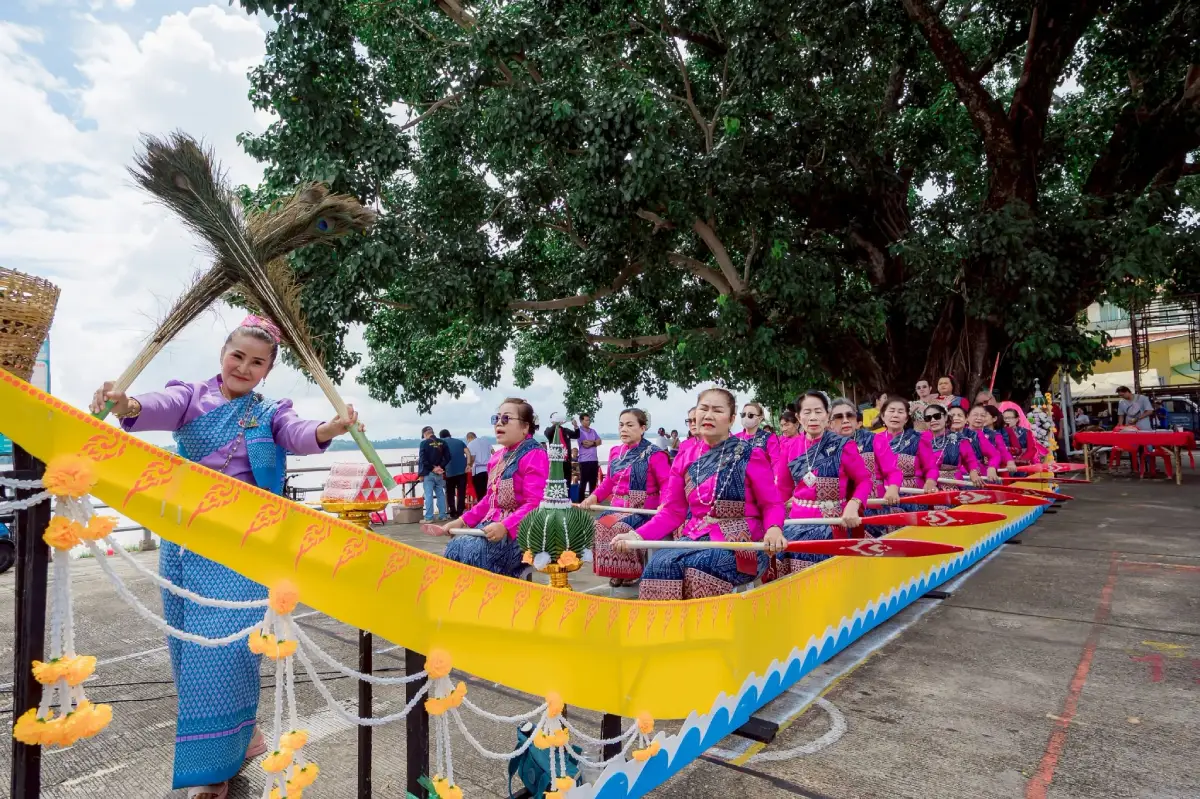
Traditional procession boats follow Chao Fa Mukda Sawan. Women paddlers wear coordinated local clothing and move their paddles in a graceful rhythm. In the customary formation, two men occupy positions at the bow and three at the stern, helping control direction, maintain balance, and protect the crew. The arrangement reflects generations of knowledge concerning how a long ceremonial boat should be managed on the Mekong.
The participation of women demonstrates their central role in cultural transmission. The women are not present only to create an attractive scene. They train for strength and endurance, learn the correct paddling rhythm, prepare clothing, memorize songs, and represent their communities. The elegance seen by spectators is the result of sustained discipline and cooperation rather than decoration alone.
A young woman traditionally performs a peacock-tail dance at the bow of a procession boat. Her movements must correspond with the paddling rhythm and the changing balance of the vessel. Performing while the boat is moving requires concentration, physical control, and complete trust in the crew. The opened peacock-tail form creates a vivid silhouette against the Mekong, adding grace and color to the procession.
Paddlers sing, perform serng rhythms, and recite phaya as the boats move. Serng is an energetic form of northeastern Thai and Lao song and movement, while phaya includes poetic language, proverbs, courtship verses, moral observations, and improvised wit. Performers may praise their community, describe the river, welcome visitors, or exchange humorous lines. Spoken language becomes a living art that changes according to the people, place, and atmosphere of the day.
According to the traditional route, the procession paddles upstream from the riverfront in front of Wat Si Bun Rueang toward Wat Si Mongkhon Tai. Boats stop at points where residents wait with rice liquor, flowers, incense, candles, and marigolds. Receiving the offerings allows households along the bank to participate directly. The riverfront, temples, roads, shrines, boats, and local homes temporarily become parts of a single ceremonial landscape.
Rice liquor belongs to the customary vocabulary of offerings made to guardian spirits. Flowers and marigolds communicate respect, prosperity, and auspicious intention, while incense and candles express reverence and remembrance. These objects should not be treated as festival decorations. They are ritual forms through which residents express gratitude, respect, and a wish that every boat return safely.
Once the Opening of the Waters and the traditional procession have been completed, Ti Chang Nam Nong announces the strength and readiness of the paddling crews. The two ceremonies are connected but distinct. The Opening of the Waters centers on offerings, Chao Fa Mung Mueang, and ceremonial permission to use the Mekong. Ti Chang Nam Nong centers on the coordinated physical action of numerous paddlers immediately before the competitive phase.
The traditional starting area for Ti Chang Nam Nong is described as the section of the Mekong in front of Wat Si Mongkhon Nuea, where boats assemble before racing. At the signal, participating crews move together. Paddlers raise their blades and strike the water with full force, following commands and drum rhythms. When many paddles enter the river simultaneously, large quantities of water rise around the boats and the combined sound travels across the riverfront.
The resulting image resembles elephants entering a river together. Some elephants spray water through their trunks, while others strike the water with their legs and bodies. When hundreds of paddlers disturb the Mekong in a synchronized movement, the comparison becomes immediately understandable. The word “ti,” or striking, in the name does not refer to harming elephants. It refers to producing a powerful patterned movement reminiscent of a herd joyfully bathing.
“Nam Nong” conveys the image of water spreading, surging, or rising broadly. Combined with the image of elephants, the expression communicates both movement and abundance. The name emerges from close observation of animals and nature. Elephants symbolize strength, endurance, dignity, and cooperation in Thai culture, while water represents fertility and life. Together they provide an effective metaphor for the power of a coordinated paddling crew.
Sound is as important as visual movement. The strike of paddles, beat of drums, ring of gongs, calls of paddlers, and cheers of spectators merge into a dense soundscape. The rhythm motivates the crews and gives thousands of people on shore a shared emotional experience. Spectators are not entirely separate from the performance because their applause and calls become part of the energy surrounding the boats.
The paddles must be controlled precisely. If individuals strike the water without following the established rhythm, the boat can become unstable and the spray loses its synchronized form. Rhythm leaders deliver signals understood by the entire crew, while steersmen maintain sufficient distance from neighboring boats. Ti Chang Nam Nong is consequently a demonstration of genuine boat-handling skill rather than unstructured splashing.
Paddlers use their torso, shoulders, arms, and legs to lift and drive the blades. Repeating the action on a moving river requires considerable strength. A longboat carrying dozens of people responds to every movement, and a small inconsistency can affect the entire hull. Practicing the ceremony strengthens the crew’s shared timing before racing and helps each paddler recognize the movement of the people around them.
After the water performance, racing boats move into the course in the order assigned by officials. The traditional race description begins in front of Wat Si Mongkhon Nuea and continues downstream toward a finish line in front of Wat Si Bun Rueang, covering approximately 1,800 meters. Crews must maintain rhythm and power throughout the distance. A successful performance requires a strong start, controlled speed in the middle section, and sufficient remaining energy for the final approach.
The Mekong is a large river whose width, current, and water level change seasonally. Organizers must inspect conditions, position course markers, determine lanes, and deploy safety personnel before racing. The Wat Si Mongkhon Nuea–Wat Si Bun Rueang route remains important to the history of the tradition, but the operational starting point, finish line, and distance may be adjusted according to current water and safety requirements. Travelers must use the official map issued for the year they attend.
Wat Si Mongkhon Nuea, Wat Si Bun Rueang, and Wat Si Mongkhon Tai appear repeatedly in descriptions of the ceremonial and racing routes. These temples stand within or near historic riverside communities and have long functioned as local reference points. Expressions such as “in front of the temple” refer to the corresponding section of the river rather than the interior of the temple grounds. Using temples as geographic markers reflects a period when religious centers structured community space before modern street numbering and digital coordinates.
Longboat racing creates intense excitement because boats can remain close throughout the course. A crew accelerates through the resistance of the water at the start, settles into a sustainable rhythm in the middle, and increases power again before the finish. The bow rises and falls with each stroke, spectators raise their voices as the boats approach, and a very small distance can determine the result.
Although the event produces winners and losers, sportsmanship remains fundamental. Every crew follows the same rules and must place safety above victory. After crossing the finish line, paddlers slow the vessel and return to a designated recovery area. The deeper success of the festival is measured not only by trophies but by every crew reaching shore safely, spectators enjoying the occasion, and the host communities completing the program in an orderly manner.
Ti Chang Nam Nong strengthens morale before racing. By producing a powerful image and sound together, paddlers become more conscious of their identity as a team and as representatives of a community. The synchronized strike announces readiness and unity. It is not intended to threaten competitors or express aggression.
Requests for blessing and good fortune do not replace human preparation. Crews must still train, maintain physical health, inspect equipment, wear required safety gear, and follow instructions. Ritual belief provides emotional stability and connects contemporary paddlers with their ancestors, while modern sporting knowledge and rescue planning enable the event to proceed responsibly. Both systems support the same objective of a safe and meaningful festival.
Preparation begins weeks before the public event. Communities inspect hulls, repair damage, clean and decorate boats, and organize paddling equipment. Crews develop fitness on land and then practice on the river. Positions are assigned according to experience, physical characteristics, and skill. This process creates relationships across age groups and teaches each participant to accept responsibility for the larger team.
Elders transmit boat histories, names, offering practices, knowledge of currents, and rules for caring for a communal vessel. Younger people learn by helping with equipment, watching practice, and joining a crew when ready. The boathouse, riverbank, temple, shrine, and training course all become educational environments. Cultural knowledge is preserved through action rather than through classroom instruction alone.
Women contribute by preparing offerings and food, maintaining costumes, practicing dances, and paddling the traditional procession boats. Children and young people participate in performances, processions, and cultural activities. Local businesses provide food, accommodation, transport, and community products, while public officers manage traffic, sanitation, emergency services, and crowd safety. A single festival therefore depends on the labor of a much wider population than the racing crews alone.
The presence of Savannakhet gives the event an international dimension. Lao crews and cultural representatives contribute to the program, and the closely related languages and songs allow participants to communicate without a strong sense of distance. Racing displays the ability of each crew, while welcoming ceremonies and shared activities reveal a broader cultural kinship. The Mekong operates simultaneously as a competition venue and a meeting place.
The Second Thai–Lao Friendship Bridge supports modern road travel between Mukdahan and Savannakhet, whereas the boat festival renews emotional and historical connections. The existence of a contemporary bridge does not diminish the boat’s cultural importance. Boats represent an earlier period when the river was the principal route of life. Together, the bridge and the festival illustrate how Mukdahan combines historical memory with present-day cross-border movement.
Ti Chang Nam Nong is currently promoted as a water performance unique to Mukdahan and the only ceremony of its kind in Thailand. Its distinctiveness cannot be reduced to the creation of spray. It emerges from the combination of traditional longboats, a royal-trophy procession, sacred beliefs, music, community participation, and Thai–Lao relations. Safeguarding the tradition therefore requires preserving its meaning and practitioners rather than copying only the paddle movement outside its cultural context.
The latest fully published official festival program was for 2025. The Mukdahan Ok Phansa Boat-Racing Festival took place from 4 to 7 October along the Mekong embankment. The Opening of the Waters and the first racing activities were scheduled for 5 October. On 6 October, the royal trophy was carried in a water procession together with Ti Chang Nam Nong before the second day of racing. The ceremony began in the morning around the Indochina Market festival area.
Ok Phansa in 2026 falls on 26 October, but the Mukdahan festival may cover several days before or after the lunar observance. Travelers must not assume that the religious date is automatically the date of Ti Chang Nam Nong. The municipal announcement should be checked for the ceremony date, procession time, assembly point, racecourse, road closures, and spectator map.
The principal festival area is around the Mekong embankment, Indochina Market, and the municipal cross-river ferry terminal in central Mukdahan. Savannakhet is clearly visible across the river. Indochina Market provides a convenient reference point for visitors and supports food, shopping, exhibitions, and public facilities. Some sections of the riverfront are reserved for boats, paddlers, officials, rescue teams, and emergency access.
Festival zones normally include the royal-trophy procession area, the boat assembly and Ti Chang Nam Nong area, the racecourse and finish line, an ancient-boat exhibition, local-food and food-truck areas, music and youth stages, and the Loy Krachut ceremonial zone when included in the annual schedule. The layout can change according to water level, crowd size, and safety planning, so the current event map should always be used.
Viewing from the official public areas is free of charge. Visitors pay only for food, beverages, transport, accommodation, merchandise, private parking, or other optional services. No payment should be made to individuals claiming that they can provide access to the launching area or restricted ceremonial space, which is reserved for authorized crews, ritual practitioners, and officials.
The best viewing locations are along sections of the embankment opened by the organizers. Photographers should choose a position with a clear view without blocking pedestrian movement or extending equipment beyond safety barriers. Medium and telephoto lenses can record the water spray without approaching the boats. Sun, wind, rain, and river spray can affect equipment, so cameras and mobile phones should be protected.
Spectators must remain away from the water’s edge and follow instructions from safety personnel. The Mekong is deep and its current can change rapidly. Barriers should not be climbed, and boat-launching ramps must remain clear. Children require constant supervision. Older visitors and people with limited mobility should arrive early enough to find a position that does not require prolonged standing or movement through a dense crowd.
Drums, amplified announcements, paddles, and cheering can create very high noise levels. Families with young children or noise-sensitive travelers may benefit from hearing protection. Because the crowd becomes dense during processions and important race rounds, groups should establish a meeting point, exchange telephone numbers, and avoid moving strollers through the main pedestrian flow while boats are being launched.
Ok Phansa occurs during the transition from the late rainy season toward cooler weather. Conditions can change quickly on the open riverfront. Visitors should carry water, sun protection, a compact raincoat, and secure footwear suitable for wet surfaces. Large umbrellas should be used carefully. During thunderstorms, strong wind, or an official evacuation notice, the riverfront must be left immediately.
Ceremonial etiquette is as important as physical safety. Conversation should be reduced during offerings, the invitation of Chao Fa Mung Mueang, and the royal-trophy procession. Visitors should not cross the route or touch offerings. Consent should be requested before taking close photographs of ritual mediums, elders, paddlers preparing for competition, or performers in private staging areas.
Spirit-medium practices, naga beliefs, and offerings should never be mocked. Foreign visitors are not expected to share every local belief, but they should recognize that the ceremonies form part of the community’s understanding of the river, protection, and inherited memory. Listening respectfully to local explanations provides insight into the emotional and social functions of the tradition.
Environmental responsibility is another form of respect for the Mekong. Large events produce food packaging, bottles, and other waste. Visitors should use designated collection points, reduce disposable plastic, and never throw anything into the river. Expressions of gratitude to the water are meaningful only when the festival does not leave unnecessary pollution behind.
The festival supports Mukdahan’s local economy. Restaurants, hotels, transport operators, market traders, and producers of community goods experience increased demand. Local cuisine reflects Thai, Isan, Lao, and Vietnamese influences, including Mekong fish, som tam, larb, khao piak sen, Vietnamese sausage, naem nueang, and numerous regional dishes. Using local services helps return festival income to the communities responsible for sustaining the tradition.
Indochina Market stands immediately beside the main festival area and is convenient for shopping before or after the ceremony. The district sells everyday goods, clothing, souvenirs, and products reflecting cross-border commerce. Walking access to the embankment is easy, although entrances and exits may be redirected during the procession to preserve emergency routes and controlled event zones.
A one-day visitor should reach central Mukdahan at least one hour before the ceremony to locate parking and walk to the riverfront. The morning can be used for the procession and Ti Chang Nam Nong, followed by Indochina Market and a local lunch. Racing can be watched in the afternoon, while the evening may include Mekong views, cultural stages, music, or Loy Krachut when scheduled.
Staying overnight allows travelers to add Mukdahan Tower, Wat Roi Phra Phutthabat Phu Manorom, the Chao Mae Song Nang Phi Nong Shrine, and temples in the town center. Mukdahan Tower provides an overview of the urban area, while Phu Manorom offers a high viewpoint over the Mekong plain and Savannakhet. These sites help visitors understand the physical and spiritual setting of the boat festival.
Getting There is straightforward because the event is held in central Mukdahan around the Mekong embankment, Indochina Market, and the municipal ferry terminal. Drivers can use Samran Chai Khong Road or Song Nang Sathit Road. Vehicles should be left only in official municipal or private parking areas because riverfront streets may be closed or restricted during the procession and races.
Interprovincial bus passengers can disembark at Mukdahan Bus Terminal and continue by local taxi or other public transport. “Indochina Market,” “the Mekong embankment,” and “the Mukdahan municipal ferry terminal” are useful destination names to show a driver. Additional travel time must be allowed for checkpoints, temporary closures, and festival traffic.
Visitors arriving from Laos must cross through the authorized border checkpoint and the Second Thai–Lao Friendship Bridge in accordance with the immigration rules applying on their travel date. They can then continue from the border area to central Mukdahan. Border-opening hours, travel documents, and international bus services should be confirmed directly with the relevant authorities.
Mukdahan Town Municipality is the principal coordinating organization, working with Mukdahan Province, the Provincial Administrative Organization, cultural agencies, temple communities, paddling teams, safety officers, residents, and partners from Savannakhet. Their responsibilities include the racecourse, traffic plan, rescue system, boat areas, processions, local-food activities, public services, and international coordination. The municipality’s current announcement is the primary source for practical event information.
Ti Chang Nam Nong communicates Mukdahan’s identity with unusual clarity. Within a short period, the viewer encounters the Mekong, ancient-style boats, disciplined paddlers, music, spiritual belief, collective movement, and community cooperation. The spectacular spray is immediately memorable, but a deeper understanding reveals the weeks of training, boat maintenance, ritual preparation, and shared knowledge behind the scene.
Tourism development must not separate the ceremony from its cultural meaning. Contemporary stages, food areas, and entertainment can help the festival serve a wider audience, but sacred spaces and the voices of the host community must remain central. Ritual procedures should never be rushed or altered merely to produce a convenient photograph or promotional performance.
Long-term safeguarding requires attention to both boats and people. Wooden vessels need appropriate maintenance and storage. New paddlers need safe training opportunities, while experts in offerings, boat control, serng, phaya, and local history need opportunities to teach. Modern life jackets, rescue boats, weather monitoring, and communication systems must develop alongside the older knowledge. Preservation therefore means enabling the tradition to live safely in the present rather than freezing it in the past.
The ceremony provides a direct lesson in unity. No individual paddle can create a wall of spray around an entire longboat. The effect appears only when every crew member moves at the same moment. When numerous boats participate together, cooperation expands from the individual to the crew, community, and city. The image demonstrates how collective power emerges from people performing different positions in a shared rhythm.
For Mukdahan residents, Ti Chang Nam Nong is a shared memory linking generations. Elders remember earlier boats and stories, adults organize the festival and support the crews, young people learn paddling and performance, and children see the tradition taking place before them. Annual participation keeps cultural knowledge active rather than confining it to written records or museum displays.
For visitors, the ceremony explains why Mukdahan’s boat race does not begin only with a starting signal. It is preceded by permission requested from the river, offerings to the city’s guardians, ceremonial boats, gifts received from residents, and a coordinated display of communal power. This sequence gives the sporting competition cultural roots that distinguish it from an ordinary race.
The Thai–Lao relationship visible during the festival also demonstrates that a border consists of more than checkpoints and documents. Communities on both banks share speech, songs, food, and beliefs. Welcoming crews and visitors from Savannakhet renews an existing cultural relationship. The festival allows local pride and respect for neighboring communities to grow together rather than compete.
Ti Chang Nam Nong is therefore not an optional performance that can be removed without changing the meaning of the festival. It connects the Opening of the Waters with the race, sacred respect with physical strength, and spectators on land with paddlers on the river. The strike of the paddles announces that the crews are ready, while the rising spray makes the Mekong itself the central performer.
As long as communities continue maintaining the boats, training paddlers, honoring the river’s guardians, and giving younger generations meaningful roles, the ceremony will remain alive. Locations, stage arrangements, and safety technology may change, but the core values remain synchronized effort, respect for the Mekong, protection of participants, and friendship among communities.
Ti Chang Nam Nong ultimately represents Mukdahan itself: a city shaped by the Mekong, traditional river knowledge, protective spiritual beliefs, longboat craftsmanship, and close relations with Laos. When hundreds of paddles strike the surface together, the sound and spray announce more than the beginning of a race. They affirm that the living heritage of the two Mekong banks continues to be practiced and transmitted in the present.
| Tradition Name | Ti Chang Nam Nong Ceremony, Mukdahan |
| Tradition Type | A synchronized water ceremony and performance before the Thai–Lao Ok Phansa longboat races |
| Main Location | Mekong River embankment around Indochina Market and the municipal cross-river ferry terminal, Mukdahan |
| Address | Mukdahan Subdistrict, Mueang Mukdahan District, Mukdahan Province 49000, Thailand |
| Reference Coordinates | Indochina Market and the central Mekong embankment area: approximately 16.5425, 104.7320 |
| Event Period | Held annually during the Mukdahan Ok Phansa Boat-Racing Festival around the full moon of the 11th lunar month; the operational dates are announced each year |
| Opening Hours | No fixed annual hours. The latest official ceremony began during the morning of 6 October 2025, with activities from 09.00. |
| Latest Published Program | The 2025 festival was held from 4–7 October, with Ti Chang Nam Nong on 6 October. The 2026 date must be confirmed through Mukdahan Town Municipality. |
| Highlight | Paddlers aboard numerous boats strike the water together, producing powerful sounds and high spray resembling elephants bathing in a river. |
| Name Origin | The water and sound created by the paddles evoke a herd of elephants splashing and spraying water while bathing. |
| Cultural Significance | Expresses respect for the Mekong, requests safety and good fortune, strengthens crew morale, demonstrates unity, and preserves the river culture of Mukdahan. |
| Traditional Boats | Associated with the regional Suang Huea tradition. Traditional longboats were dug from a single trunk, with durable takhian hardwood commonly valued for boat construction. |
| Related Ceremonies | Offerings to sacred guardians, the Opening of the Waters, the invitation of Chao Fa Mung Mueang aboard Chao Fa Mukda Sawan, traditional boat processions, and the royal-trophy water procession |
| Sacred Guardians | Chao Fa Mung Mueang, Chao Mae Song Nang Phi Nong, and guardian beings associated with Mukdahan and the Mekong River |
| Main Ceremonial Boat | Chao Fa Mukda Sawan, the leading Opening of the Waters boat, with Chao Fa Mung Mueang represented through a ritual medium seated at the bow |
| Traditional Procession | Women paddlers in local dress, male crew members at the bow and stern, a peacock-tail dancer, serng performances, folk songs, and phaya poetry |
| Traditional Offerings | Rice liquor, flowers, incense, candles, and marigolds presented by residents along the riverbank |
| Traditional Ceremony Starting Area | The Mekong section in front of Wat Si Mongkhon Nuea before the boats enter the racing course |
| Traditional Racing Route | From the area in front of Wat Si Mongkhon Nuea downstream to the finish in front of Wat Si Bun Rueang, approximately 1,800 meters. The operational route may change annually. |
| Main Areas / Zones | 1. Royal-trophy and ceremonial procession zone 2. Boat assembly and Ti Chang Nam Nong zone 3. Racecourse and finish-line zone 4. Ancient-boat exhibition 5. Local-food and food-truck zone 6. Music, entertainment, and youth-performance zone 7. Loy Krachut zone when included in the annual program |
| Admission Fee | Free viewing from the public areas opened by the organizers. Food, transport, accommodation, merchandise, and private services are charged separately. |
| Facilities | Official riverfront viewing areas, event-service points, food and shopping around Indochina Market, designated parking, toilets in service areas, and businesses in central Mukdahan |
| Visitor Guidelines | Remain quiet during sacred rites, keep the procession clear, do not touch offerings, stay away from the water’s edge, request permission for close photographs, and follow officials’ instructions. |
| Travel Information | Drivers can use Samran Chai Khong Road or Song Nang Sathit Road toward Indochina Market. Bus passengers can take local transport from Mukdahan Bus Terminal. |
| Organizer / Caretaker | Mukdahan Town Municipality with Mukdahan Province, the Provincial Administrative Organization, the Provincial Cultural Office, temple communities, residents, paddling crews, and partners from Savannakhet, Laos |
| Main Contact Numbers | Mukdahan Town Municipality: +66 42 611 227 Mukdahan Provincial Cultural Office: +66 42 613 684 |
| Current Status | An active ceremony within the annual Mukdahan Ok Phansa Boat-Racing Festival. The latest complete official program was published for 2025; the 2026 program must be confirmed through the municipality. |
| Nearby Tourist Attractions | 1. Indochina Market, approximately 0 km 2. Chao Mae Song Nang Phi Nong Shrine, approximately 0.5 km 3. Wat Si Mongkhon Tai, approximately 1 km 4. Wat Si Bun Rueang, approximately 2 km 5. Mukdahan Tower, approximately 3 km 6. Wat Roi Phra Phutthabat Phu Manorom, approximately 9 km |
| Nearby Restaurants | 1. Nut Pob Rim Khong, approximately 2 km, Tel. +66 86 459 6263 2. Mum Sabai Rim Khong Mukdahan, approximately 2 km, Tel. +66 81 864 6883 3. Sae Rim Khong, approximately 3 km, Tel. +66 97 051 7988 4. Narin Garden Restaurant, approximately 3 km, Tel. +66 81 545 5188 5. Good View Rim Khong Restaurant, approximately 3 km, Tel. +66 95 956 5324 |
| Nearby Accommodations | 1. Riverfront Hotel Mukdahan, approximately 0.5 km, Tel. +66 42 612 948–9 2. Submukda Grand Hotel, approximately 1 km, Tel. +66 42 633 444 3. Hotel de Ladda, approximately 1 km, Tel. +66 42 611 499 4. B2 Mukdahan Boutique & Budget Hotel, approximately 2 km, Tel. +66 42 040 123 5. Ploy Palace Hotel, approximately 2 km, Tel. +66 42 614 988 |
Frequently Asked Questions (FAQ)
Q: What is the Ti Chang Nam Nong Ceremony?
A: It is a synchronized water ceremony performed before the Mukdahan Ok Phansa longboat races. Paddlers aboard numerous boats strike the Mekong together, creating powerful sound and spray to express unity, readiness, and a collective wish for an auspicious competition.
Q: Why is the ceremony called Ti Chang Nam Nong?
A: The water thrown up by many paddles resembles a herd of elephants bathing and spraying water into the air. Nam Nong conveys the image of water spreading, surging, or rising broadly.
Q: When is Ti Chang Nam Nong held?
A: It is held annually during the Mukdahan Ok Phansa Boat-Racing Festival around the full moon of the 11th lunar month. The exact date and time are announced each year by Mukdahan Town Municipality.
Q: How is Ti Chang Nam Nong different from the Opening of the Waters Ceremony?
A: The Opening of the Waters invites Chao Fa Mung Mueang aboard Chao Fa Mukda Sawan and ceremonially requests permission to use the river. Ti Chang Nam Nong is the synchronized physical display performed by numerous paddling crews before racing.
Q: What does Suang Huea mean?
A: Suang Huea is a regional Isan–Lao expression associated with boat racing. Traditional racing boats were long dugout vessels, commonly fashioned from strong timber such as takhian.
Q: Where is the traditional racing route?
A: The traditional description begins in front of Wat Si Mongkhon Nuea and runs downstream to a finish in front of Wat Si Bun Rueang, covering approximately 1,800 meters. The operational route may change according to the river level and annual safety plan.
Q: Is there an admission fee?
A: Viewing from the public riverfront areas opened by the organizers is free. Visitors pay only for optional food, transport, accommodation, merchandise, and private services.
Q: How should foreign visitors behave during the ceremony?
A: Visitors should remain quiet during sacred rites, keep the procession route clear, avoid touching offerings, request permission before taking close photographs, remain away from the water’s edge, and follow event officials’ instructions.
 Category: ●Art, Culture and Heritage
 Group: ●Art, Craft Centres, Tradition
Last Update : 2 MonthAgo
 Last Update : 2 MonthAgo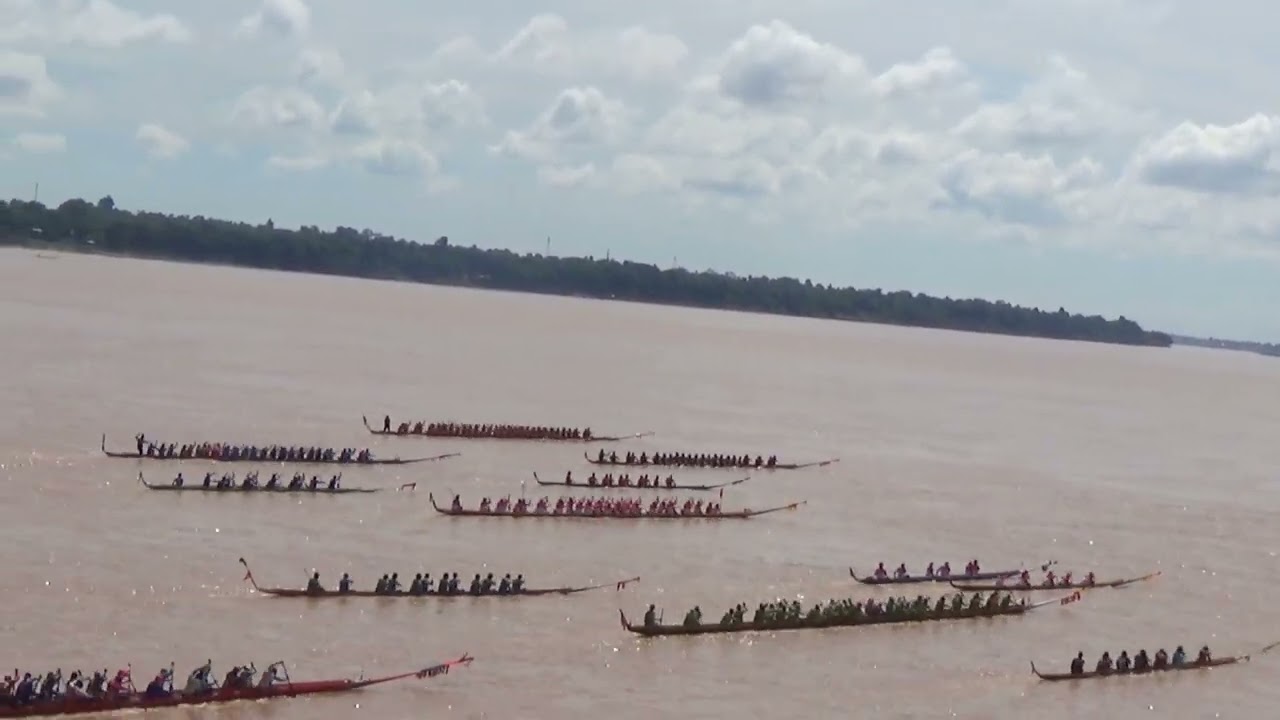

 Historical Sites and Monuments(2)
 Landmarks and Memorials(3)
Art, Craft Centres, Tradition(2)
Landmarks and Memorials(3)
Art, Craft Centres, Tradition(2)
 Museums(1)
 Places of Worship
 Temple(17)
 Other Sacred Sites(3)
 Suburban Living
 Village, Community(4)
 Local Market(2)
 Nature and Wildlife
 National Parks and Marine Reserves(4)
 Mountain (Doi)(5)
 Dam, Reservoir, Lake(3)
 Waterfalls(5)
 Caves(2)
 River, Canal(2)
 Bays and Beaches(1)
 Other natural attractions(1)
 Entertainment and Agricultural
 Farms, Parks and Ecotourism(1)


