
lovethailand home >Northeastern Travel Attractions >Kalasin Travel Attractions >Kuchinarai >Nong Hang > Phu Thai Nong Hang Handicraft Centre
TL;DR: Phu Thai Nong Hang Handicraft Centre is located at Inside Nong Hang Credit Union Cooperative, Ban Nong Hang, Nong Hang Subdistrict, Kuchinarai District, Kalasin Province, open Daily, hours 08.30 – 16.30.

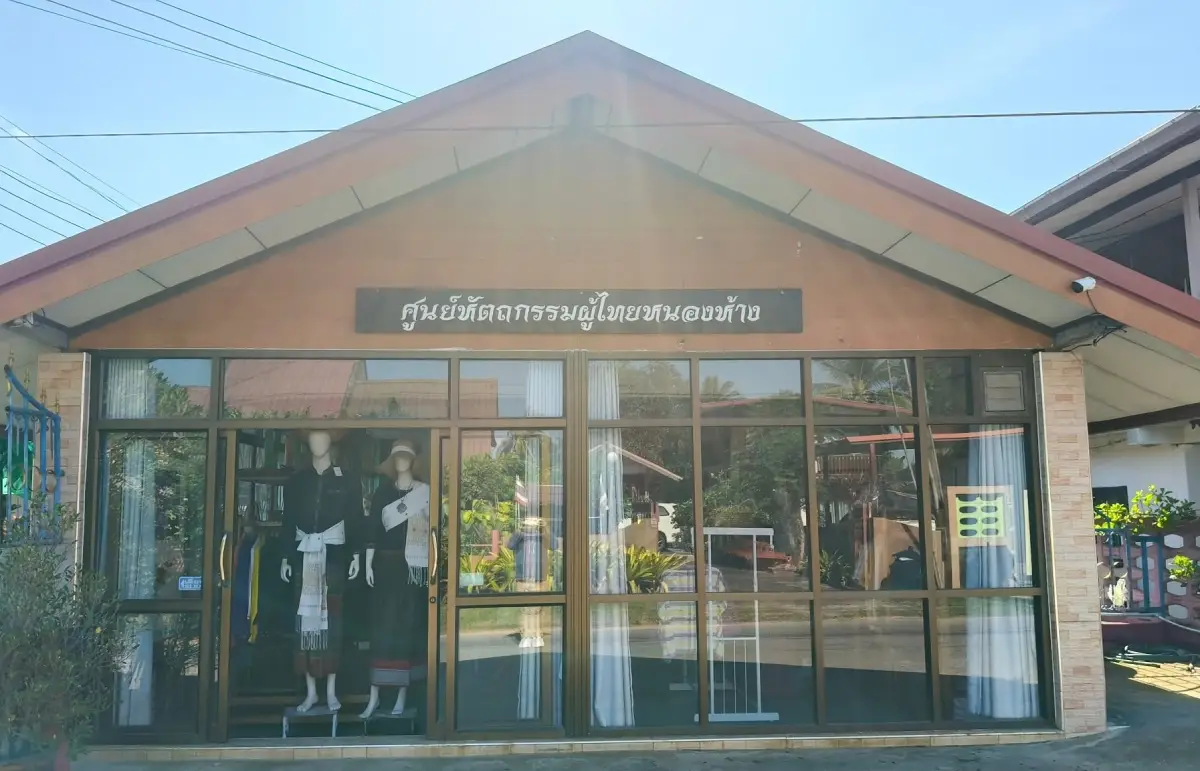
Phu Thai Nong Hang Handicraft Centre
Open Days: Daily
Opening Hours: 08.30 – 16.30
Phu Thai Nong Hang Handicraft Centre in Kalasin Province is a community-based cultural attraction dedicated to the craft heritage of the Phu Thai people of Ban Nong Hang. Located inside Nong Hang Credit Union Cooperative in Nong Hang Subdistrict, Kuchinarai District, the centre is known for handwoven cotton, silk textiles, and bamboo basketry decorated with traditional Khit patterns. It is a valuable stop for travelers who want to understand local craftsmanship, support community products, and experience the living culture of the Phu Thai people in northeastern Thailand.
This centre is more than a place to buy souvenirs. It is a living space where local knowledge, household skills, natural materials, and community economy come together. Ban Nong Hang is a Phu Thai village with a strong cultural identity, and its handicrafts reflect the way villagers have long lived with rice fields, bamboo groves, silk, cotton, and traditional household objects. Visitors can find woven fabrics, bamboo sticky-rice baskets, handbags, small woven containers known locally as krato, and other handmade items that have evolved from daily utensils into refined community products.
The value of Phu Thai Nong Hang Handicraft Centre lies in its connection with real village life. Many local families have agricultural roots, working in rice fields, gardens, and small farms. During free periods outside the main farming season, villagers continue traditional crafts such as silk weaving, cotton weaving, and bamboo basketry. These skills are passed down through families and community groups, creating both supplementary income and a strong sense of cultural continuity. For foreign travelers, this makes the centre a meaningful introduction to rural craftsmanship in Isan rather than a conventional tourist shop.
The signature craft of Ban Nong Hang is bamboo basketry decorated with Khit-inspired patterns. Khit is a traditional patterned textile technique that requires careful counting, rhythm, and control of repeated motifs. At Nong Hang, this visual logic has been adapted into bamboo weaving. Craftspeople cut, split, smooth, and prepare bamboo strips before arranging them into geometric patterns that echo the elegance of woven textiles. The result is a distinctive form of basketry that combines utility, strength, and local artistry.
Bamboo has long been part of daily life in Nong Hang. It provides food through bamboo shoots and materials for household tools, baskets, steamers, fish traps, and containers. In the past, bamboo weaving was mainly done for household use, but over time the skill developed into a source of community income. The best-known products include kratip sticky-rice baskets, woven handbags, krato containers, and decorative household items. Each item shows the patience of the maker and the practical wisdom of people who understand both material and function.
For many Thai visitors, the kratip immediately represents the everyday culture of Isan, where sticky rice is a staple food. A good kratip keeps rice warm while allowing steam to escape, preserving the texture of sticky rice throughout the day. For foreign travelers, it is one of the easiest objects through which to understand how design and daily life meet in northeastern Thailand. At Nong Hang, the kratip is not just a basket; it is a cultural object tied to food, family meals, farming life, and local identity.
The textile side of the centre is equally important. Local cotton fabrics are valued for their softness and simplicity, while silk fabrics carry a sense of refinement and ceremonial beauty. The patterns, colours, and woven textures show the aesthetic sensibility of Phu Thai craftswomen. A handwoven cloth records the knowledge of preparing threads, setting up the loom, controlling tension, and maintaining rhythm through long hours of work. For visitors interested in textile culture, the centre offers a direct way to appreciate the effort behind each piece of fabric.
The development of the handicraft centre became more formal in the late 1990s. The community and Nong Hang Credit Union Cooperative played an important role in bringing local products together in one place. In 1998, the cooperative received support through a social investment fund project, and in 1999 the handicraft centre building was established inside the cooperative area. This gave the village a dedicated space for displaying, selling, and promoting local crafts in a more organized way.
The role of Nong Hang Credit Union Cooperative is central to the identity of the centre. The cooperative functions not only as a community financial institution but also as a structure that helps strengthen local occupational groups. Because the centre is located within the cooperative, visitors can see the link between local finance, household production, and community enterprise. The crafts sold here are therefore part of a broader community system rather than isolated products.
The name Nong Hang also reflects the memory of the landscape. The word nong refers to a natural pond or water source, while hang is associated with raised hunting platforms once used near places where animals came to drink and feed. The name preserves a glimpse of the local environment and older ways of life. When combined with the Phu Thai identity, the name of the handicraft centre expresses both ethnicity and place: Phu Thai people of Ban Nong Hang and their craft heritage.
One reason this centre is worth visiting is that the products are easy to understand when seen in their community context. A bamboo bag is not merely a decorative item; it begins with bamboo selection, splitting, smoothing, drying, shaping, and weaving. A piece of cloth is not simply a souvenir; it begins with thread preparation, dyeing, loom setting, and many hours of careful hand movement. Seeing these products in the village area helps visitors recognize the value of time, skill, and cultural knowledge embedded in handmade objects.
The atmosphere at the centre is quiet and local, very different from a commercial shopping mall. Travelers should take time to look closely at the patterns, texture, weight, finishing, and shape of each item. The best way to enjoy the visit is to walk slowly, ask polite questions, and choose products that match real use. Cotton cloth can be used for clothing or home decoration, silk is suitable for special occasions, and bamboo baskets or handbags are useful gifts that still retain a strong sense of place.
Phu Thai Nong Hang Handicraft Centre is especially suitable for cultural travelers, families, students, and anyone interested in community-based tourism. Children can learn how raw bamboo becomes useful objects, while adults can appreciate the patience required to weave textiles and baskets by hand. The centre also demonstrates that traditional crafts are not frozen in the past. They can be adapted into modern lifestyle products while keeping their cultural roots intact.
A visit to the centre can be combined with other sites in Nong Hang and Kuchinarai District. Nearby places include Wat Pho Chai Ban Nong Hang, Wat Sila At Chit Rat Rangsan or Wat Nuea Nong Hang, Tham Fa Mue Daeng or the Red Handprint Cave, and Phu Pha Phueng. These destinations add religious, archaeological, and natural dimensions to the trip. Together, they show that Ban Nong Hang is not only a craft village but also a community with deep cultural and landscape history.
Wat Sila At Chit Rat Rangsan is significant because sandstone boundary stones related to Dvaravati-style Buddhist art have been found there. Wat Pho Chai Ban Nong Hang is associated with a historic single-pillar pulpit more than 150 years old. Tham Fa Mue Daeng preserves red handprint imagery on rock surfaces, while Phu Pha Phueng is a sandstone mountain area within the Phu Si Than landscape. Travelers who combine these places with the handicraft centre will gain a broader view of local history, religious culture, traditional craft, and natural heritage.
The best time to visit is during the daytime, when the road into the village is convenient and the details of handmade products can be seen clearly. Visitors should carry some cash for purchasing community products. Even though modern payment options may be available in some local areas, cash remains practical when visiting rural craft communities. Travelers should also allow enough time to talk with local sellers or craftspeople, as the stories behind the objects often make the visit more meaningful.
When buying textiles, look at the consistency of the weave, the softness of the fabric, the colour harmony, and the finishing at the edges. When choosing bamboo basketry, check the tightness of the weave, the smoothness of the edges, the balance of the shape, and the strength of handles or lids. Small differences in handmade products are part of their charm, not defects. Respectful purchasing supports the continuity of local craft and helps keep community skills alive for the next generation.
For travelers exploring Kalasin beyond the better-known dinosaur and archaeological attractions, this centre offers a different and quieter view of the province. Kalasin is also a land of Phu Thai culture, handwoven textiles, bamboo crafts, and village traditions. Visiting Ban Nong Hang reveals the human side of the province: people who transform local materials into meaningful objects, maintain inherited knowledge, and create income through skills that remain deeply rooted in community life.
A practical itinerary can begin in Kuchinarai town in the morning, continue to Phu Thai Nong Hang Handicraft Centre, then include nearby temples and cultural sites in Nong Hang. If time allows, travelers can extend the route to Tham Fa Mue Daeng or Phu Pha Phueng in the afternoon. This route works best by private car, rental car, or a local vehicle with a driver, as it allows flexible stops and easier access to village and natural attractions.
Getting There from Kuchinarai District Office, take Highway No. 2042 for about 2 km, then turn left onto a paved local road and continue for about 6 km to Ban Nong Hang. The centre is located inside Nong Hang Credit Union Cooperative, around 10 km from Kuchinarai town. Travelers coming from Kalasin city should plan their travel time in advance, especially if they intend to continue to natural attractions in the Phu Si Than area.
Phu Thai Nong Hang Handicraft Centre is best appreciated slowly. Its importance does not come from a grand building but from the people, skills, and cultural memory it represents. Every woven basket, cotton cloth, silk fabric, and bamboo container reflects the patience of local hands and the resilience of Phu Thai community knowledge. Visiting the centre is therefore a cultural experience, a learning opportunity, and a direct way to support local livelihoods in Kalasin Province.
| Name | Phu Thai Nong Hang Handicraft Centre |
| Location | Inside Nong Hang Credit Union Cooperative, Ban Nong Hang, Nong Hang Subdistrict, Kuchinarai District, Kalasin Province |
| Address | 223 Moo 1, Ban Nong Hang, Nong Hang Subdistrict, Kuchinarai District, Kalasin 46110, Thailand |
| Coordinates | 16.564566, 104.103758 |
| Highlights | Handwoven cotton, silk textiles, and bamboo basketry with traditional Khit patterns by the Phu Thai community of Ban Nong Hang |
| History | The community developed its handicraft group through Nong Hang Credit Union Cooperative, and the handicraft centre building was established in 1999. |
| Name Origin | The name refers to the Phu Thai identity of the community and Ban Nong Hang, whose name is linked to a local pond and raised hunting platforms used in the past. |
| Distinctive Features | Traditional Khit textile patterns are adapted into bamboo basketry, creating distinctive sticky-rice baskets, small containers, handbags, and household items. |
| Travel Information | From Kuchinarai District Office, take Highway No. 2042 for about 2 km, then turn left onto a paved road for about 6 km. The centre is about 10 km from Kuchinarai town. |
| Current Status | Open as a community learning and product centre for Phu Thai handicrafts of Ban Nong Hang. |
| Open Days | Daily |
| Opening Hours | 08.30 – 16.30 |
| Facilities | Community product area, handicraft learning area, and Nong Hang Credit Union Cooperative building |
| Main Areas / Zones | Nong Hang Credit Union Cooperative area, woven textile product area, Khit-pattern bamboo basketry area, and Ban Nong Hang community area |
| Caretaker | Nong Hang Credit Union Cooperative Ltd. |
| Main Contact Number | 043-602130 |
| Nearby Tourist Attractions | 1. Wat Pho Chai Ban Nong Hang, 1 km 2. Wat Sila At Chit Rat Rangsan or Wat Nuea Nong Hang, 2 km 3. Nong Hang Subdistrict Agricultural Technology Transfer Centre, 3 km 4. Tham Fa Mue Daeng or Red Handprint Cave, 5 km 5. Phu Pha Phueng, 7 km 6. Phu Thai Khok Kong Cultural Tourism Village, 24 km |
| Nearby Restaurants | 1. Saengchai Braised Duck Noodle and Made-to-Order Food, 11 km, Tel. 081-296-9004 2. Hug Coffee, 12 km, Tel. 095-949-9942 3. Tia Kim Seng, 11 km, Tel. 095-150-4494 4. Alala Cafe, 11 km, Tel. 093-189-4111 5. Hianhome Salad Cafe Kuchinarai, 12 km, Tel. 085-879-5664 6. Yield Specialty Coffee, 12 km, Tel. 092-845-5287 |
| Nearby Accommodations | 1. Chatrudee Park View Hotel Kuchinarai, 11 km, Tel. 043-013332, 094-826-4951 2. Deva Grand Resort Kuchinarai, 12 km, Tel. 064-882-4616 3. Bua Rim Pao Apartel, 11 km, Tel. 082-515-4051 4. P2 Natural Boutique Hotel, 19 km, Tel. 082-365-5661 5. HomeHug Huai Muang, 28 km, Tel. 083-971-5381 |
Frequently Asked Questions (FAQ)
Q: Where is Phu Thai Nong Hang Handicraft Centre located?
A: It is located inside Nong Hang Credit Union Cooperative in Ban Nong Hang, Nong Hang Subdistrict, Kuchinarai District, Kalasin Province.
Q: What is Phu Thai Nong Hang Handicraft Centre known for?
A: The centre is known for handwoven cotton, silk textiles, and bamboo basketry decorated with traditional Khit patterns, including sticky-rice baskets, handbags, krato containers, and household items.
Q: How do I get to Phu Thai Nong Hang Handicraft Centre from Kuchinarai town?
A: From Kuchinarai District Office, take Highway No. 2042 for about 2 km, then turn left onto a paved local road and continue for about 6 km. The centre is about 10 km from Kuchinarai town.
Q: What are the opening days and hours?
A: The centre opens daily from 08.30 to 16.30.
Q: What products should visitors look for?
A: Recommended products include Khit-pattern bamboo basketry, cotton cloth, silk textiles, sticky-rice baskets, small woven containers, handbags, and handmade household items.
Q: Who should visit this handicraft centre?
A: It is suitable for cultural travelers, families, students, textile enthusiasts, craft lovers, and visitors who want to support authentic community products.
Q: What attractions can be visited nearby?
A: Nearby attractions include Wat Pho Chai Ban Nong Hang, Wat Sila At Chit Rat Rangsan, Tham Fa Mue Daeng, Phu Pha Phueng, and Phu Thai Khok Kong Cultural Tourism Village.
Q: What should travelers prepare before visiting?
A: Travelers should come by private car or rental car, bring cash for community products, and allow at least 1 hour to explore the crafts and speak with local sellers.
 Category: ●Suburban Living
 Group: ●Village, Community
Last Update : 3 MonthAgo
 Last Update : 3 MonthAgo
 Click to Access the Navigation Map GPS
Phu Thai Nong Hang Handicraft Centre Map

 Art, Culture and Heritage
 Historical Sites and Monuments(2)
 Landmarks and Memorials(3)
 Art, Craft Centres, Tradition(4)
 Museums(3)
 Art Gallery(1)
 Educational Places
 Educational Gardens, Farm(1)
 Places of Worship
 Temple(21)
 Other Sacred Sites(7)
Village, Community(3)
Other Sacred Sites(7)
Village, Community(3)
 Nature and Wildlife
 National Parks and Marine Reserves(3)
 Mountain (Doi)(2)
 Dam, Reservoir, Lake(5)
 Waterfalls(4)
 Caves(2)
 River, Canal(3)
 Bays and Beaches(1)
 Other natural attractions(2)
 Entertainment and Agricultural
 Animal camps and shows(1)
 Farms, Parks and Ecotourism(2)
 Travel Articles, Recipes
 Travel Review, Food Review(1)


