
lovethailand home >North Travel Attractions >Lamphun Travel Attractions >Pa Sang >Nakhon Chedi > Erawan Cave
TL;DR: Erawan Cave is located at Moo 6, Nakhon Chedi Subdistrict, Lamphun Province, Thailand, open Open depending on conditions and forest authority supervision, hours 08:00 – 16:30 recommended.

Erawan Cave
Open Days: Open depending on conditions and forest authority supervision
Opening Hours: 08:00 – 16:30 recommended
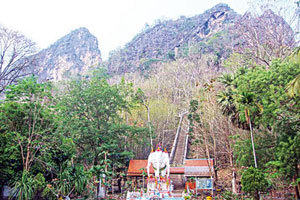
Erawan Cave, Lamphun is a remarkable natural cave located in Moo 6, Nakhon Chedi Subdistrict, Lamphun Province, within the Mae Ao Forest Conservation Unit. Surrounded by dense forest and mountainous terrain, the cave remains largely untouched by commercial tourism, making it an ideal destination for travelers seeking an authentic and immersive natural experience.
The cave entrance is relatively small and slopes downward, requiring visitors to carefully enter the passage before reaching the inner chambers. This initial transition from the outside world into the cave creates a strong sense of discovery. Once inside, the cave opens into a large main chamber, forming a spacious hall with uneven terrain and natural rock formations that extend in multiple directions.
Within the main chamber, sunlight penetrates only partially, illuminating certain areas near the entrance while leaving deeper sections in darkness. This contrast between light and shadow creates a visually dramatic environment, enhancing the overall atmosphere of exploration. As visitors move deeper into the cave, artificial lighting becomes necessary due to the absence of electricity.
The internal structure of Erawan Cave is highly diverse. The large central hall is further divided into multiple smaller chambers, each with distinct geological features. Some chambers are wide and open, allowing for easier movement, while others are narrow and require careful navigation. This variation makes the exploration experience dynamic and continuously engaging.
One of the most significant highlights of the cave is the presence of stalactites and stalagmites, which have formed over thousands of years through the gradual deposition of minerals carried by dripping water. These formations vary in shape, size, and density, ranging from thin needle-like structures to large column-like formations where stalactites and stalagmites have merged together.
The formation process of these mineral structures is extremely slow, often taking centuries or even millennia to develop. As a result, they are highly sensitive to human impact. Visitors are encouraged to avoid touching these formations, as even minor contact can disrupt their natural growth and permanently damage their appearance.
The cave environment is characterized by a consistently cool and humid climate. This stable temperature makes it a comfortable place to explore throughout the year, especially during the hot season when outdoor temperatures can be significantly higher. However, the humidity and uneven surfaces require visitors to exercise caution while walking inside the cave.
Safety is an essential consideration when visiting Erawan Cave. Due to the lack of installed lighting and the complex internal structure, it is strongly recommended that visitors bring a reliable flashlight and wear appropriate footwear with good grip. Additionally, having a guide or forest officer accompany the visit is highly advisable to ensure safe navigation and prevent getting lost.
The surrounding forest area plays an important role in shaping the overall experience. The journey to the cave involves traveling through natural landscapes, including paved and unpaved roads, followed by a short trekking section. This approach allows visitors to experience both above-ground and underground natural environments, making the trip more comprehensive and rewarding.
Getting There involves traveling along Highway 1106 to approximately kilometer 124, where a sign indicates the turnoff toward the cave. From there, visitors continue along a paved road for about 4 kilometers, followed by an additional 7 kilometers of unpaved road leading to the Mae Ao Forest Conservation Unit. This location serves as the starting point for accessing the cave, after which a short walk is required to reach the entrance.
Erawan Cave is not just a sightseeing destination but also an opportunity to explore geological history, observe natural processes, and experience a sense of isolation and tranquility rarely found in modern tourist locations. The cave’s combination of physical challenge, natural beauty, and scientific significance makes it a compelling destination for adventurous travelers.
| Name | Erawan Cave |
| Location | Moo 6, Nakhon Chedi Subdistrict, Lamphun Province, Thailand |
| Address | Mae Ao Forest Conservation Unit Area |
| Highlights | Large cave chamber, multiple smaller rooms, stalactites and stalagmites |
| Distinctive Features | Small sloping entrance, wide interior hall, natural cave divisions, no electricity |
| Travel Information | Highway 1106 km 124, 4 km paved road + 7 km unpaved road |
| Current Status | Accessible under supervision |
| Caretaker | Mae Ao Forest Conservation Unit |
| Nearby Tourist Attractions | 1. Mae Ao Reservoir — 5 km 2. Nakhon Chedi Temple — 10 km 3. Li District — 20 km 4. Mountain Viewpoint — 15 km 5. Local Community Attractions — 12 km |
| Nearby Restaurants | 1. Li Phochana Restaurant — 20 km 2. Local Noodle Shop — 20 km 3. Northern Thai Cuisine Restaurant — 18 km 4. Community Food Stall — 12 km 5. Made-to-order Food Shop — 15 km |
| Nearby Accommodations | 1. Li Resort — 20 km 2. Li Homestay — 18 km 3. Community Lodging — 15 km 4. Local Resort — 17 km 5. Lamphun City Hotels — 40 km |
Frequently Asked Questions (FAQ)
Q: Do I need a flashlight to explore the cave?
A: Yes, there is no electricity inside the cave, so a flashlight is essential.
Q: Is a guide necessary?
A: It is strongly recommended to have a guide or forest officer for safety.
Q: Is the cave difficult to access?
A: The route includes paved and unpaved roads followed by a short walk, so preparation is required.
Q: What is the main highlight of the cave?
A: The large chamber and the diverse stalactite and stalagmite formations.
Q: Who is this destination suitable for?
A: It is ideal for nature lovers and adventure travelers.
 Category: ●Nature and Wildlife
 Group: ●Caves
Last Update : 7 MonthAgo
 Last Update : 7 MonthAgo
 Click to Access the Navigation Map GPS

 Art, Culture and Heritage
 Historical Sites and Monuments(2)
 Landmarks and Memorials(8)
 Art, Craft Centres, Tradition(9)
 Museums(3)
 Historic Homes and Cities(1)
 Places of Worship
 Temple(91)
 Mosque(1)
 Other Sacred Sites(7)
 Research and Development
 Royal Project(1)
 Suburban Living
 Village, Community(13)
 Local Market(3)
 National Parks and Marine Reserves(2)
 Mountain (Doi)(1)
 Dam, Reservoir, Lake(13)
 Waterfalls(3)
Caves(4)
 River, Canal(1)
 Other natural attractions(1)
 Entertainment and Agricultural
 Farms, Parks and Ecotourism(2)
 Waterpark(1)
 Travel Articles, Recipes
 Travel Review, Food Review(1)


