
lovethailand home >Northeastern Travel Attractions >Buri Ram Travel Attractions >Chaloem Phrakiat >Charoen Suk > Khao Phra Angkhan
TL;DR: Khao Phra Angkhan is located at Ban Charoen Suk, Charoen Suk Subdistrict, Chaloem Phra Kiat District, Buriram Province, open Daily, hours 08.00 – 18.00.
Khao Phra Angkhan
Open Days: Daily
Opening Hours: 08.00 – 18.00
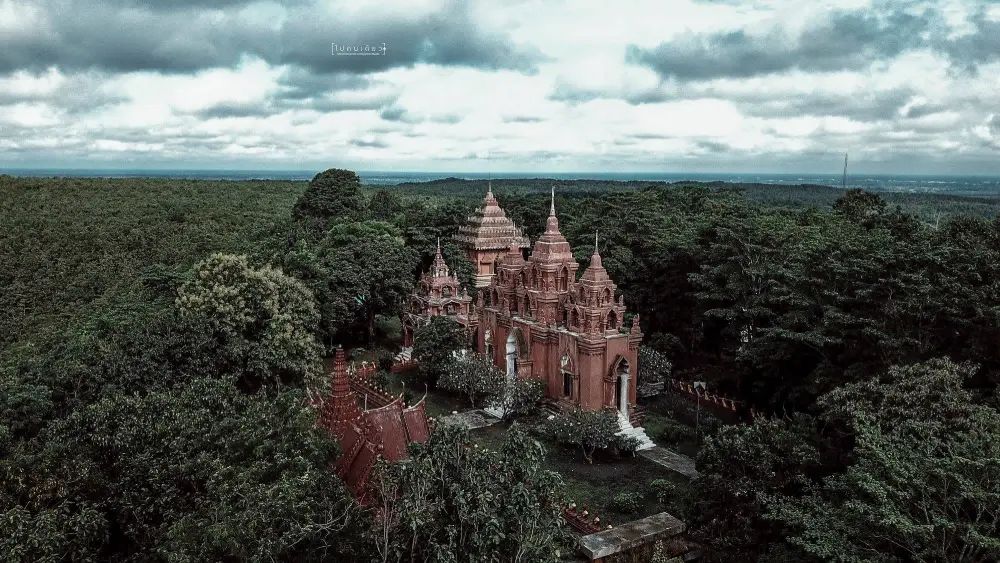
Wat Khao Phra Angkhan, often called Wat Khao Angkhan, is one of the most distinctive temples in Buriram Province. Located at Ban Charoen Suk, Charoen Suk Subdistrict, Chaloem Phra Kiat District, the temple stands on the summit of Khao Phra Angkhan, an extinct volcano rising about 320 meters above sea level. It is known for its striking reddish-brown ordination hall, mixed architectural influences, Dvaravati-period basalt boundary stones, Buddhist murals with English captions, a large reclining Buddha, rows of seated Buddha images, and panoramic views over the volcanic landscape of southern Buriram. For foreign travelers, this temple offers a rare combination of Buddhist art, archaeology, volcanic geology, local legend, and peaceful hilltop scenery.
Wat Khao Phra Angkhan is not simply a beautiful temple on a hill. It is a layered cultural landscape where nature, religion, archaeology, and local belief meet in one place. The temple is located about 3 km from Ban Charoen Suk village, in a quiet rural setting away from the main town. As visitors arrive, the first impression is usually the unusual color and form of the temple buildings. The red-toned structures, tall spires, decorative arches, and rows of Buddha images create an atmosphere that feels different from ordinary Thai temples in the central region. The temple’s visual identity is deeply connected with the volcanic land on which it stands.
Khao Phra Angkhan is an extinct volcano with a basalt lava dome formation. Geological studies describe it as a volcano that has been inactive for more than 700,000 years. The hill has an oval shape, aligned roughly north to south, with old lava flow channels found along some of its slopes. The crater area has collapsed in layered forms, creating a distinctive volcanic landform. This natural setting gives the temple an identity that goes beyond architecture. Visitors are not only seeing a religious site, but also standing on one of Buriram’s ancient volcanic landscapes.
Before the present temple buildings were constructed, the area of Khao Phra Angkhan was already a sacred place. The most important archaeological evidence is a group of Dvaravati-period basalt boundary stones, known in Thai as bai sema. A total of 15 pieces have been recorded from Khao Phra Angkhan. Some are now placed around the ordination hall, while others are kept inside nearby buildings. These stones are important because they show that the hill was associated with Buddhist sacred space long before the modern temple was built.
The boundary stones of Khao Phra Angkhan are carved from fine-grained basalt. Their imagery includes standing figures, lotus flowers, wheels of Dharma, stupas, ritual vessels, and other symbolic motifs. Some stones show a single standing figure holding a lotus, placed beneath a royal umbrella and flanked by ceremonial emblems. Other stones show figures with distinctive supernatural forms or multiple arms. These carvings reflect Dvaravati-period Buddhist art with Khmer artistic influence, making them valuable evidence for understanding the cultural history of southern Isan.
The Dvaravati boundary stones are generally dated to around the 12th to 16th Buddhist centuries, more than a thousand years ago. Their discovery on a high volcanic hill is especially meaningful. Most Dvaravati boundary stones are associated with lowland sacred sites, but Khao Phra Angkhan shows a different pattern: a sacred Buddhist landscape on a mountain. This may reflect the idea of a holy mountain, a concept found in several religious traditions across Southeast Asia. For travelers interested in archaeology, the stones are one of the most important reasons to visit the temple carefully rather than treat it only as a photo stop.
Local tradition also connects Khao Phra Angkhan with the relics of the Buddha. The name Phra Angkhan is associated with the belief that the Buddha’s cremation relics, or ashes, were enshrined on this hill in ancient times. Whether visitors approach this story as faith, legend, or local memory, it adds another layer of meaning to the site. The hill is not only a volcanic formation and archaeological location; it is also remembered by the community as a sacred mountain.
The most visually impressive structure at the temple is the reddish-brown ordination hall. It is a modern building that combines several architectural styles rather than following one strict historical model. Its form recalls Khmer-inspired architecture, Buddhist stupas, Thai decorative elements, and other regional influences. The layered roofline, tall spires, arched entrances, carved decorations, and terracotta color make it one of the most unusual temple buildings in Buriram. The building stands out beautifully against the open hilltop environment.
Around the ordination hall are many seated Buddha images, often described as 108 images arranged around the building. This creates a strong visual rhythm and a calm devotional atmosphere. Walking around the hall, visitors see the repeated forms of Buddha images set against the red-toned architecture and the open sky. The result is both peaceful and photogenic. The rows of Buddha images also help frame the ordination hall, making the entire area feel like a carefully composed sacred space.
Inside the ordination hall, visitors can see murals depicting scenes from the life of the Buddha and Buddhist Jataka stories. A notable feature is that the murals include English descriptions, making the temple more accessible to international visitors. Instead of simply viewing the images as decoration, foreign travelers can understand the stories, moral lessons, and Buddhist context behind the paintings. This makes Wat Khao Phra Angkhan particularly useful for cultural travelers who want to learn, not just look.
The temple grounds also include several important religious and cultural features, such as a large reclining Buddha, a shrine to Phra Khantharat, a replica of the Buddha’s footprint, buildings connected with local devotion, and areas where ancient boundary stones are preserved. The reclining Buddha is often one of the first major images visitors notice on arrival. It adds variety to the sacred landscape and provides another place for worship before walking toward the main ordination hall.
The atmosphere of Wat Khao Phra Angkhan is one of its strongest qualities. Although the temple buildings are large and visually striking, the hilltop setting remains quiet and open. The breeze, the wide views, and the distance from busy town areas create a peaceful feeling. Visitors can walk slowly, take photographs, pay respect, study the old boundary stones, and enjoy the surrounding landscape without the crowded atmosphere found at some major tourist sites.
Wat Khao Phra Angkhan is a Thai Buddhist temple under the Mahanikaya monastic order. The current abbot is Phra Khru Phanom Thammabhinan. As the temple is still an active religious site, visitors should dress respectfully and behave with care. Shoulders should be covered, clothing should be appropriate for temple grounds, and shoes should be removed before entering sacred buildings. Around ancient boundary stones and murals, visitors should not touch, climb on, or move anything.
For travelers interested in archaeology, the basalt boundary stones deserve close attention. They are not just decorative objects. They represent the older sacred identity of the mountain and show how Buddhism was practiced in the region long before the current buildings were constructed. The carvings of lotus flowers, Dharma wheels, stupas, and standing figures reveal religious ideas and artistic influences that link Khao Phra Angkhan with the wider cultural world of early Buddhism in northeastern Thailand.
In the travel context of Buriram, Wat Khao Phra Angkhan fits very well with Phanom Rung Historical Park and Prasat Muang Tam. Phanom Rung presents the grandeur of a Khmer Hindu temple on an extinct volcano. Muang Tam shows the refinement of a Khmer sanctuary in a lowland setting. Wat Khao Phra Angkhan adds another layer: a Buddhist temple on an extinct volcano with Dvaravati boundary stones and modern mixed-style Buddhist architecture. Visiting all three gives travelers a richer understanding of the religious and cultural landscape of southern Buriram.
The route to the temple is part of the experience. The road passes through rural landscapes, agricultural areas, and the Charoen Suk community before climbing toward the hill. Private car, rental car, or a hired vehicle is the most convenient way to visit. Public transport is limited, and having your own transport allows you to combine the temple with Phanom Rung, Muang Tam, local restaurants, cafés, and nearby accommodations in the same day.
Getting There from Buriram city, travelers can use Highway 24 on the Buriram–Nang Rong–Ban Tako route, the same general route used for Phanom Rung Historical Park. At Ban Tako junction in Chaloem Phra Kiat District, turn right and continue for about 6 km to Ban Ta Pek junction. From there, turn right toward Ban Charoen Suk for about 13 km, then take the road leading to Wat Khao Phra Angkhan for another 7 km. Travelers coming from Phanom Rung can descend toward Ban Ta Pek, then follow the route toward Charoen Suk and the temple. The temple is about 20 km from Phanom Rung.
The best times to visit are morning and late afternoon. The light is softer, the temperature is more comfortable, and the red architecture photographs beautifully. Midday visits are possible, but the temple grounds include open areas where the sun can be strong. Visitors who want to study the murals and boundary stones should allow enough time to walk slowly and avoid rushing. Flash photography and touching the murals should be avoided.
A quick visit can take about 1 hour if travelers only want to pay respect, photograph the ordination hall, and enjoy the view. A more meaningful visit should take 2 to 3 hours, allowing time to walk around the ordination hall, study the boundary stones, view the murals, visit the reclining Buddha, and absorb the atmosphere of the volcanic hilltop. Comfortable shoes, drinking water, sun protection, and respectful clothing are recommended.
For international travelers, Wat Khao Phra Angkhan is especially valuable because it helps explain the diversity of Buddhist art in Thailand. It is not a central Thai temple, nor is it purely Khmer, Dvaravati, or modern Thai in style. Instead, it brings together several layers of art and belief in one place. The English captions inside the ordination hall make the temple more approachable, while the surrounding archaeological evidence gives the site historical depth.
The temple also helps travelers understand Buriram as a province shaped by extinct volcanoes. Khao Phanom Rung, Khao Kradong, and Khao Phra Angkhan are all connected with volcanic landforms, but each has a different cultural role. Phanom Rung became a great Khmer sanctuary, Khao Kradong became a Buddhist and geological landmark near Buriram city, and Khao Phra Angkhan became a Buddhist temple associated with Dvaravati boundary stones and sacred mountain beliefs. Visiting these places together gives a deeper picture of Buriram’s landscape and identity.
The best way to experience Wat Khao Phra Angkhan is to slow down. The temple rewards careful observation. Details appear in the carved boundary stones, the murals, the shape of the ordination hall, the arrangement of Buddha images, and the changing light on the red walls. In the morning, the site feels calm and fresh. In the afternoon, the warm light makes the architecture more dramatic. Both times offer different photographic and spiritual moods.
What makes Wat Khao Phra Angkhan special is the way it tells several stories at once. The first story is geological: an ancient volcano that shaped the land. The second is archaeological: Dvaravati boundary stones marking an early Buddhist sacred area. The third is artistic: Khmer-influenced motifs and modern mixed-style architecture. The fourth is religious: a living temple where people still come to worship. The final story is local identity: a sacred mountain that remains meaningful to the people of Charoen Suk and Buriram.
For travelers planning a cultural route in Buriram, Wat Khao Phra Angkhan should be combined with Phanom Rung Historical Park, Prasat Muang Tam, and Charoen Suk village. This route connects extinct volcanoes, ancient sanctuaries, Buddhist devotion, and local community life. It gives visitors a more complete picture of southern Buriram than visiting only the famous historical park.
Wat Khao Phra Angkhan is therefore one of the most rewarding temples in Buriram for travelers who appreciate history, art, faith, and landscape. Its beauty is immediate, but its deeper value comes from the layers beneath the surface: ancient boundary stones, volcanic land, sacred memory, Buddhist murals, and a hilltop temple that continues to serve both local worshippers and curious visitors. Anyone who wants to understand Buriram beyond its famous stone castles should include this temple in the itinerary.
| Name | Wat Khao Phra Angkhan |
| Location | Ban Charoen Suk, Charoen Suk Subdistrict, Chaloem Phra Kiat District, Buriram Province |
| Address | GRMM+PQH, Charoen Suk Subdistrict, Chaloem Phra Kiat District, Buriram 31170, Thailand |
| Coordinates | Approximately 14.5332, 102.8344 |
| Highlights | Reddish-Brown Mixed-Style Ordination Hall, Dvaravati Basalt Boundary Stones, Buddhist Murals With English Captions, Reclining Buddha, Rows Of Buddha Images, And Views From An Extinct Volcano |
| History | The temple stands on an extinct basalt lava-dome volcano that has been inactive for more than 700,000 years. The site contains Dvaravati-period basalt boundary stones dated around the 12th–16th Buddhist centuries |
| Name Origin | The name is linked with local belief in the Buddha’s cremation relics and the sacred identity of Khao Phra Angkhan, an ancient volcanic hill |
| Distinctive Features | A Buddhist temple on an extinct volcano, known for unusual mixed-style architecture, ancient Dvaravati boundary stones, murals, Buddha images, and hilltop scenery |
| Travel Information | Use Highway 24 on the Buriram–Nang Rong–Ban Tako route. From Ban Ta Pek junction, continue toward Ban Charoen Suk for about 13 km, then take the road to the temple for about 7 km. The temple is about 20 km from Phanom Rung |
| Current Status | Open To Visitors As An Active Buddhist Temple And A Cultural, Archaeological, Artistic, And Geological Attraction In Buriram Province |
| Open Days | Daily |
| Opening Hours | 08.00 – 18.00 |
| Fees | No Admission Fee |
| Facilities | Parking Area, Worship Areas, Ordination Hall, Pavilions, Viewpoints, And Walking Areas Around The Temple |
| Main Areas / Zones | Reddish-Brown Ordination Hall, Large Reclining Buddha, Rows Of Buddha Images, Basalt Boundary Stones, Pho Pu Wiriya Mek Building, Phra Khantharat Shrine, Replica Buddha Footprint, Khao Phra Angkhan Viewpoint, Parking Area |
| Abbot / Caretaker | Phra Khru Phanom Thammabhinan |
| Main Contact Number | 093-529-5671 |
| Official Website / Official Page | Wat Khao Angkhan, Charoen Suk, Chaloem Phra Kiat, Buriram Angkarn Temple Official Page |
| Nearby Tourist Attractions | 1. Phanom Rung Historical Park, About 20 km, Tel. 044-666-251 2. Prasat Muang Tam, About 28 km, Tel. 044-666-251, 044-666-252 3. Ban Charoen Suk Community, About 3 km 4. Buriram Basalt Stone Columns, About 24 km 5. Wat Pa Khao Noi, About 48 km 6. Khao Kradong Forest Park, About 55 km, Tel. 044-637-349 |
| Nearby Restaurants | 1. Phu Lava Café, About 5 km 2. Ban Na Thawon, About 13 km, Tel. 099-364-7469 3. Café de Phanomrung, About 16 km, Tel. 096-563-9935 4. Kai Yang Suan Saeng Sawang Near Phanom Rung, About 18 km, Tel. 087-421-6170 5. AERY Coffee&Space Buriram, About 25 km, Tel. 096-361-9666 6. Goody n’ Bakey, About 32 km, Tel. 094-297-8999 |
| Nearby Accommodations | 1. Smart Resort, About 8 km 2. Don Ngam Resort, About 10 km 3. Sohground Boutique Resort, About 30 km, Tel. 080-488-3183 4. Hotel de l’amour Buriram, About 32 km, Tel. 044-651-555, 098-102-7809 5. Eireann Boutique Hotel, About 34 km, Tel. 087-493-9919, 044-666-199 6. Phanomrungpuri Boutique Hotel And Resort, About 45 km, Tel. 044-632-222, 086-336-6618 |
Frequently Asked Questions (FAQ)
Q: Where is Wat Khao Phra Angkhan located?
A: Wat Khao Phra Angkhan is located at Ban Charoen Suk, Charoen Suk Subdistrict, Chaloem Phra Kiat District, Buriram Province, on the summit of an extinct volcano.
Q: What are the opening hours of Wat Khao Phra Angkhan?
A: The temple is open daily from 08.00 to 18.00. Morning and late afternoon are the most comfortable times for walking and photography.
Q: Is there an admission fee for Wat Khao Phra Angkhan?
A: No. There is no admission fee for visiting the temple, ordination hall, boundary stones, murals, Buddha images, and viewpoints.
Q: What are the main highlights of Wat Khao Phra Angkhan?
A: Highlights include the reddish-brown ordination hall, Dvaravati basalt boundary stones, Buddhist murals with English captions, reclining Buddha, rows of Buddha images, and views from the extinct volcanic hill.
Q: Why are the boundary stones at Wat Khao Phra Angkhan important?
A: They are Dvaravati-period basalt boundary stones dated around the 12th–16th Buddhist centuries, showing that Khao Phra Angkhan was a sacred Buddhist area more than a thousand years ago.
Q: How far is Wat Khao Phra Angkhan from Phanom Rung Historical Park?
A: The temple is about 20 km from Phanom Rung Historical Park, making it easy to combine both places in one cultural day trip.
Q: What should visitors wear when visiting Wat Khao Phra Angkhan?
A: Visitors should dress respectfully, cover shoulders, wear suitable trousers or skirts, remove shoes before entering sacred buildings, and avoid touching murals or ancient boundary stones.
Q: How long should travelers spend at Wat Khao Phra Angkhan?
A: A quick visit may take about 1 hour, but travelers who want to study the murals, boundary stones, architecture, and viewpoints should allow 2 to 3 hours.
 Category: ●Nature and Wildlife
 Group: ●Mountain (Doi)
Last Update : 3 MonthAgo
 Last Update : 3 MonthAgo
 Click to Access the Navigation Map GPS
 Art, Culture and Heritage
 Historical Sites and Monuments(14)
 Landmarks and Memorials(2)
 Art, Craft Centres, Tradition(6)
 Museums(3)
 Educational Places
 Museum for Study(1)
 Places of Worship
 Temple(74)
 Other Sacred Sites(5)
 Suburban Living
 Village, Community(3)
 National Parks and Marine Reserves(2)
Mountain (Doi)(1)
National Parks and Marine Reserves(2)
Mountain (Doi)(1)
 Dam, Reservoir, Lake(14)
 River, Canal(1)
 Bays and Beaches(1)
 Other natural attractions(2)
 Entertainment and Agricultural
 Animal camps and shows(1)
 Stadium(2)
 Farms, Parks and Ecotourism(2)
 Waterpark(1)


