
lovethailand home >North Travel Attractions >Nakhon Sawan Travel Attractions >Muang Nakhon Sawan >Pak Nam Pho > The University of Central Thailand
TL;DR: The University of Central Thailand is located at Nakhon Sawan Tok Subdistrict, Mueang Nakhon Sawan District, Nakhon Sawan Province, Thailand, open Tuesday – Sunday, hours 08:30 – 16:30 (Office hours published by the university).

The University of Central Thailand
Open Days: Tuesday – Sunday
Opening Hours: 08:30 – 16:30 (Office hours published by the university)
The University of Central Thailand (UCT) is a private university located in Nakhon Sawan Province, Thailand. Established on February 13, 1986, by Dr. Sophit Sathirangkul and Suree Sathirangkul under the name Central College, the institution was officially elevated to university status on October 31, 2002. Its principal campus is located at 932/1 Moo 9, Nakhon Sawan Tok Subdistrict, Mueang Nakhon Sawan District, Nakhon Sawan Province. The university was founded to expand access to higher education for people living in Thailand's upper Central and lower Northern Regions, particularly in the fields of business administration, accounting, law, computer science, and public administration. Its current admissions website identifies 4 undergraduate faculties: the Faculty of Accounting, Faculty of Business Administration, Faculty of Law, and Faculty of Science. It also operates a Graduate School offering master's degree programs in Business Administration and Public Administration. The university emphasizes academic qualifications, quality education, ethical conduct, professional competence, and entrepreneurial skills, alongside research, community academic services, regional development, and the preservation of Thai arts and cultural traditions.
The University of Central Thailand occupies an important position in the history of private higher education in Nakhon Sawan Province. It emerged from a growing regional demand for university education and professional qualifications outside Bangkok. Nakhon Sawan is situated at the junction between Central and Northern Thailand and has long been significant in trade, transportation, and agriculture. As the province developed economically, demand increased for professionals trained in business administration, accounting, law, and technology. Establishing a higher education institution in the province therefore helped secondary school and vocational graduates pursue advanced studies closer to home without necessarily relocating to the capital.
The university's origins are closely connected with the educational work of Dr. Sophit Sathirangkul and Suree Sathirangkul, who had experience in providing education in Nakhon Sawan before the university's establishment. The university's English-language institutional history traces their educational activities to 1964, beginning with vocational certificate programs and later expanding into higher-level vocational education. This experience enabled the founders to develop a deeper understanding of the educational aspirations of students and families, as well as the professional needs of regional employers. Their long-term objective was to establish a private institution combining professional knowledge, practical skills, ethical values, and social responsibility.
On February 13, 1986, Central College received authorization to operate as Thailand's 19th private higher education institution. Its primary objective was to provide university-level educational opportunities for students from the upper Central and lower Northern Regions while helping reduce pressure on the public higher education system. The institution was developed during a period of expanding demand for university places in Thailand. From the beginning, its founders emphasized business administration and modern technology as fields closely connected with local economic development and the increasing need for skilled professionals.
During its initial stage, Central College began with the Faculty of Business Administration as its principal academic unit. This choice reflected the regional need for personnel trained in finance, banking, management, and commercial activities. June 19, 1986, was another important milestone in the institution's academic development. The university's English-language history identifies Accounting and Money and Banking as its first two undergraduate fields of study, establishing the foundations for subsequent expansion into business-related disciplines.
Business education was particularly relevant to Thailand's changing economy during the late twentieth century. As commercial activities, services, and manufacturing grew alongside traditional agriculture, both private companies and public organizations needed personnel with knowledge of financial management, accounting systems, and administrative processes. Nakhon Sawan's role as a transportation and trading center for agricultural products made these skills especially valuable. Central College responded by developing academic programs designed to help students apply professional knowledge to real organizational and economic situations.
Following its establishment, Central College gradually expanded into additional academic disciplines. By 1994, its historical academic structure had developed to include 5 faculties: Accounting, Business Administration, Law, Economics, and Science. This expansion reflected its transition from a primarily business-oriented institution into a multidisciplinary college capable of serving a wider range of professional needs. The historical five-faculty structure should be distinguished from the university's present admissions website, which identifies 4 undergraduate faculties and does not separately list a Faculty of Economics among its currently advertised admissions units.
The Faculty of Science played an important role in developing computer and information technology education at the university. According to the faculty's institutional history, it was established in 1994 to provide opportunities for students wishing to pursue further education in science and computing. The development of Computer Science created educational pathways in programming, systems analysis, and software development at a time when computers were becoming increasingly important to business operations and public administration. This academic direction allowed the institution to respond to technological changes affecting professional work throughout Thailand.
In the mid-1990s, Central College also expanded its educational activities in law. The Faculty of Law traces its establishment to 1995, reflecting growing demand for individuals with legal knowledge and professional qualifications. Legal education provided opportunities for students interested in government service, legal advisory work, private organizations, and professions associated with the justice system. It also contributed to public understanding of legal rights, responsibilities, and the importance of lawful conduct within a democratic society.
The year 1996 marked an important new stage in the institution's development with the establishment of its Graduate School and the introduction of the Master of Business Administration (MBA) program. This postgraduate program focused on organizational management, business analysis, and advanced administrative decision-making. In 1997, the institution introduced the Master of Public Administration (MPA) program, providing opportunities for individuals interested in public sector management, public policy, and the administration of organizations serving society.
The development of graduate education enabled the institution to serve working professionals seeking advanced qualifications and specialized knowledge. Postgraduate studies offer opportunities to strengthen research skills, analytical thinking, strategic planning, and the management of complex organizational problems. Professionals working in business enterprises, government agencies, and local administrative organizations could therefore use graduate education as a means of improving their knowledge and preparing for greater responsibilities in their careers.
On October 31, 2002, Central College was officially reclassified as The University of Central Thailand. The change was authorized through a Ministry of University Affairs announcement published in the Royal Thai Government Gazette, Volume 119, Special Section 100 Ngor, page 20. This institutional transformation represented a major milestone in the university's history, reflecting the development of its academic programs, administrative systems, and capacity to undertake the broader responsibilities of a university.
Following its elevation to university status, the institution continued pursuing its principal missions of graduate education, research, academic services, and cultural preservation. Historical records also identify the introduction of doctoral-level education in Higher Education Administration in 2008, demonstrating the expansion of advanced academic studies during an earlier period. However, the university's admissions information for the 2026 academic year primarily advertises bachelor's and master's degree programs. Its historical doctoral programs must therefore be distinguished from the programs currently listed for new admissions.
The University of Central Thailand places particular emphasis on academic qualifications, educational quality, and moral values. Its institutional philosophy supports the development of graduates who possess both theoretical knowledge and practical abilities, demonstrate honesty and ethical conduct, analyze problems effectively, and apply their knowledge to changing social and economic circumstances. The university's educational objectives extend beyond professional competence to include personal responsibility, good citizenship, and contributions to organizations and communities.
One of the university's stated institutional identities is its ambition to become a university that produces leading entrepreneurs. This goal is closely related to its historical foundations in business administration and professional education. Entrepreneurial development involves more than preparing individuals to establish their own businesses. It also includes initiative, planning, financial awareness, risk assessment, resource management, and the ability to identify opportunities for creating economic and social value. These qualities are relevant to business owners, organizational managers, and professionals working in many different industries.
The university emblem consists of three interlocking circles, a candle with a flame, rays of light, and a candle stand. Each component carries symbolic meaning. The three circles represent social bonds and the importance of the nation, religion, and monarchy. The burning candle symbolizes the light of life, while the rays of light represent the flourishing of wisdom. The candle stand signifies the stability of moral values. Together, these elements express the idea that education illuminates human life and should be firmly grounded in ethical principles.
The university's official color is emerald green, which forms an important part of its visual identity and is referenced in its institutional song. The Inthanin tree is recognized as the university's symbolic tree, associated with greenery and a connection to nature. Historical institutional information also records the Thai motto "Chai Ching, Ying Chiab," which may be interpreted as an expression celebrating capable, determined, and distinguished men and women. These symbols and traditional expressions form part of the institution's cultural memory, connecting students and alumni through shared experiences and university traditions.
The university song refers to candlelight, emerald green, the Inthanin tree, moral values, and unity among students. These images communicate the aspiration that students should develop wisdom, preserve ethical conduct, and work together to build the institution's reputation. As a cultural expression of university identity, the song helps transmit institutional ideals and reinforces the emotional connections shared by students and graduates from different generations.
The Faculty of Accounting is closely connected with the university's earliest educational development because accounting was among the fields offered during its founding period. The faculty provides education in accounting principles, financial reporting, financial analysis, and professional ethics. Accounting knowledge is essential for private businesses, public organizations, and small enterprises because it supports reliable financial management, recordkeeping, accountability, and informed decision-making. Graduates with accounting expertise can apply their knowledge across a wide range of economic sectors.
Accounting education also increasingly involves information systems and technology-based financial processes. Students must understand both established accounting principles and the practical use of digital tools in professional environments. The university's academic approach emphasizes applying theoretical knowledge to real problems while maintaining honesty, accuracy, and responsibility, which are essential qualities in accounting practice and financial management.
The Faculty of Business Administration provides education in Financial and Investment Management, Marketing and Logistics Management, Business and Personnel Management, and Business Computer. These fields reflect the relationship between organizational management and the modern economy, particularly the growing importance of data and technology in planning and decision-making. Financial and Investment Management develops knowledge related to capital management, financial analysis, investment assessment, and risk. Marketing and Logistics Management addresses consumer needs, distribution systems, supply chains, and the movement of products from producers to markets.
Business and Personnel Management focuses on organizational planning, human resource development, and the management of business operations. Business Computer combines commercial knowledge with information technology, including digital systems used for data management, transactions, communication, and administrative work. The skills developed in these fields are relevant to large organizations, small and medium-sized enterprises, and local entrepreneurs seeking to improve business efficiency and adapt to changing economic conditions.
The Faculty of Law develops students' understanding of legal principles, the justice system, individual rights and duties, and the legal responsibilities of organizations and citizens. Legal studies require the ability to interpret legislation, examine evidence, analyze facts, and apply logical reasoning. This field prepares students for further professional development in law and for employment in government agencies, private organizations, and positions requiring legal knowledge. It also contributes to broader awareness of justice, accountability, and respect for the legal framework of society.
The Faculty of Science offers education in Computer Science, covering programming, system design, data analysis, and the application of computing to practical problems. Computer science plays an increasingly important role in an economy shaped by digital services, information systems, and technological innovation. Knowledge in this field can be applied in businesses, public institutions, manufacturing, and technology enterprises. The university emphasizes technical competence alongside responsible professional conduct and ethical awareness in the use of technology.
The Graduate School supports advanced education for individuals wishing to strengthen their expertise in management and research. Its Master of Business Administration program focuses on business operations, organizational management, problem analysis, and strategic planning. The Master of Public Administration program emphasizes government administration, public policy, and the effective management of organizations delivering services to citizens. These graduate programs offer opportunities for professionals from both public and private sectors to develop knowledge relevant to their career responsibilities.
Graduate-level education at the university has included study plans involving thesis research and independent study, depending on the curriculum and program requirements. Prospective applicants should examine the current admission qualifications, study formats, credit requirements, and graduation conditions published by the Graduate School. Different curriculum versions and study plans may have different requirements, making it important to choose a program that aligns with individual professional or academic objectives.
Research is another central responsibility of The University of Central Thailand. The university emphasizes the generation of knowledge that can contribute to economic, social, and technological development, especially within its surrounding region. Its research activities have been associated with cooperation among public organizations, private enterprises, and higher education institutions in Thailand's lower Northern Region. Such collaboration helps connect academic knowledge with practical needs and contributes to a deeper understanding of challenges facing communities and organizations.
The Office of Research and Innovation supports research activities, academic publications, creative work, and institutional projects. Knowledge from business administration, accounting, law, and technology can be applied to questions involving organizational efficiency, entrepreneurial development, and professional practices. Cooperation with external organizations provides opportunities for academic work to produce practical outcomes and strengthens the relationship between university education and the needs of regional society.
Community academic services form another important part of the university's mission. The institution has organized training activities, seminars, and knowledge-sharing programs aimed at improving quality of life and strengthening professional skills. Its historical institutional information records more than 30 memoranda of understanding with basic education schools, government agencies, and private businesses. Such partnerships help establish networks connecting university education with schools, workplaces, and communities, making it possible to develop activities suited to the needs of different population groups.
One particularly important initiative was the Higher Education Institution Mentoring Program for Educational Quality and Local Development, undertaken through cooperation with Thailand's higher education authorities. The program began in the 2016 academic year with one project at Wat Wang Phai School in Ban Wang Phai Community, Nakhon Sawan Tok Subdistrict. It subsequently expanded to 10 projects in 10 communities, followed by 14 projects in 14 communities during fiscal year 2018 and 20 projects in 20 communities during fiscal year 2019. This expansion illustrates the university's role in supporting basic education and community development through a structured academic service program.
The university's achievements in this educational quality and local development initiative were recognized as a Best Practice by the Lower Northern Higher Education Network. The university was selected to represent the network in presenting its work at a national-level event in Bangkok. This recognition demonstrates how academic expertise from a regional higher education institution can be applied to practical community development, providing benefits to learners, teachers, educational institutions, and residents.
In the field of arts and culture, The University of Central Thailand established an Arts and Culture Hall to preserve and disseminate knowledge concerning Thai cultural heritage. Its collections and activities have included objects and equipment associated with traditional occupations, helping students understand the relationship between local history, craftsmanship, everyday life, and community knowledge. The preservation of such materials contributes to cultural education by providing tangible examples of how people worked, lived, and developed skills in earlier generations.
The university's Cultural Courtyard Project has supported activities involving music, Thai classical dance, handicrafts, painting, and cultural performances. Its format has included exhibitions and demonstrations intended to make cultural learning more accessible. By incorporating arts and traditional knowledge into university activities, the institution provides students with opportunities to experience culture beyond classroom discussions. These activities also encourage appreciation of local wisdom and the role of creative expression in building connections between people and communities.
The university has also publicized activities associated with Buddhist traditions and Thai cultural practices, including Buddhist Lent candle processions, meditation activities, and ceremonies marking important national occasions. Such activities can support ethical development, cooperation, and awareness of traditions that have been passed down through Thai society. Cultural programs also provide opportunities for students from different academic fields to cooperate in planning and organizing events, strengthening their social relationships and practical organizational skills.
The Buddhist Lent candle procession has its origins in the custom of offering candles or lighting materials to Buddhist monks during the annual rains retreat. In Thailand, the tradition has developed into an important expression of religious devotion and cultural craftsmanship. Activities connected with the candle procession can introduce students to Buddhist customs and traditional decorative arts. Meditation activities, meanwhile, are associated with the development of concentration, self-awareness, and ethical reflection within the particular context of each program.
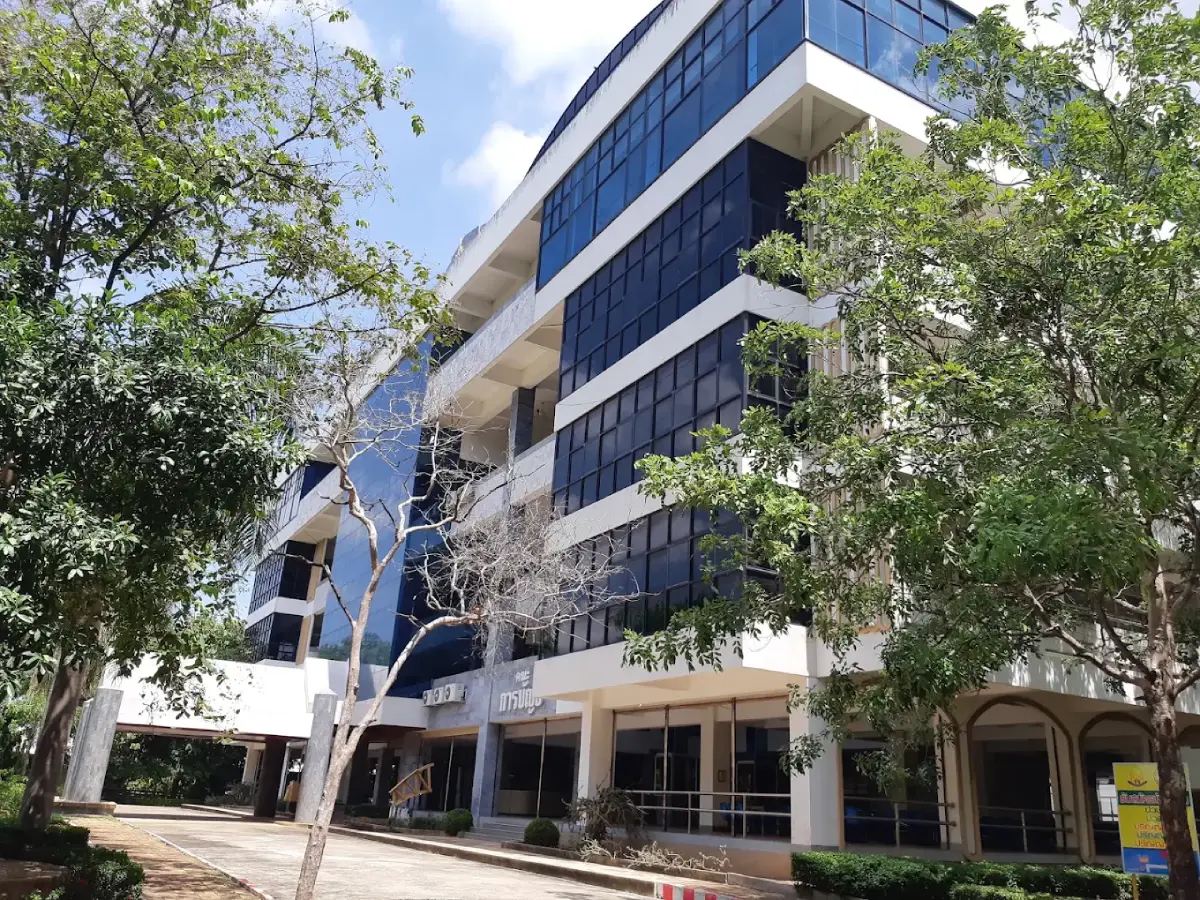
Important spaces on the university campus include its academic and administrative buildings, which accommodate teaching activities and institutional operations. The main university building is recognizable by its central blue-glass facade, connected to adjoining academic wings, with a fountain and landscaped areas in front. This architectural setting appears in the university's promotional photographs and forms part of the institution's recognizable physical identity within Nakhon Sawan.
The Arts and Culture Promotion Center is an important space for learning about traditional knowledge, particularly through the preservation of tools and objects associated with local occupations. These materials help visitors understand changes in everyday life, craftsmanship, and occupational practices. Studying cultural artifacts alongside historical information provides a broader understanding of the social and economic development of Thai communities over time.
Library facilities and study spaces are also essential components of the university's academic environment. Higher education requires students to consult textbooks, academic publications, and reliable research materials beyond regular classroom instruction. Developing independent research skills is particularly important for undergraduate students preparing academic assignments and projects and for graduate students conducting advanced study. Public access to library services and specialized learning areas is subject to the operating regulations and service hours of the responsible university departments.
The University of Central Thailand is also connected with vocational education through its wider network of educational institutions. The university's website advertises information about vocational certificate and higher vocational certificate pathways alongside university-level admissions. Providing information about multiple educational levels can help learners consider opportunities for continued academic and professional development. However, vocational certificates and higher vocational certificates should be distinguished from university degrees because they represent separate educational qualifications with different administrative and curricular requirements.
For prospective undergraduate students, the university advertises regular study programs and arrangements intended to accommodate learners who wish to continue their education while working, depending on the academic program and admission period. Flexible study opportunities are valuable for employees, vocational graduates, and adults with professional responsibilities. Applicants should review class schedules, program requirements, credit transfer regulations, and financial obligations before enrolling to ensure that their selected study plan is compatible with their circumstances.
For the 2026 academic year, the university published scholarship opportunities for applicants holding upper-secondary and higher vocational qualifications who wished to pursue bachelor's degrees. These included academic achievement scholarships and the Sathirangkul Scholarship, with different eligibility requirements and financial support arrangements. Scholarship programs are intended to reduce financial barriers to higher education and expand access for qualified students. Applicants must follow the deadlines and conditions specified in the official announcement for each scholarship application period.
The university provides direct communication channels and online admissions information to help prospective students inquire about programs and application procedures. Applicants should prepare their previous academic qualifications, identification documents, academic transcripts, and any additional materials required by their chosen program. Those seeking postgraduate education should also review the specific admission criteria and academic requirements of the Graduate School because expectations differ between undergraduate and graduate levels.
The university's strategic development framework covers five major responsibilities: developing academic programs that produce graduates suited to labor market needs, encouraging research and creative work that generates economic and social value, providing academic services that improve community well-being, preserving arts and culture, and strengthening institutional governance. These priorities reflect an effort to balance professional education with broader responsibilities to society. Such an approach is especially relevant for a regional university whose graduates and academic projects have direct connections with surrounding communities.
The relationship between the university and Nakhon Sawan Province is reflected in its role as an educational resource for residents of the city and neighboring provinces. Because Nakhon Sawan functions as a regional commercial and transportation center, university programs aligned with the needs of businesses and government agencies can support local workforce development. Education in accounting, law, business administration, and computer science provides a foundation for professional opportunities across a range of economic sectors, reinforcing the relationship between higher education and regional prosperity.
For visitors interested in educational tourism, The University of Central Thailand offers an opportunity to learn about the history of private higher education in Nakhon Sawan and the relationship between professional education and regional development. Its main academic building, historical institutional identity, and cultural education activities provide perspectives on the university's development. Visitors who wish to arrange a study tour or enter academic buildings, meeting rooms, libraries, and other specialized facilities should contact the university in advance and follow the requirements established by the responsible departments.
Getting There to The University of Central Thailand is convenient by private vehicle. Its official address is 932/1 Moo 9, Nakhon Sawan Tok Subdistrict, Mueang Nakhon Sawan District, Nakhon Sawan 60000, Thailand. The campus is situated within the urban area of Nakhon Sawan and can be approached using major roads connected with Phahonyothin Road. Travelers coming from Bangkok can use the Asian Highway or Phahonyothin Road toward Nakhon Sawan before continuing into the city. Those arriving by public transportation may travel to Nakhon Sawan and then use a taxi or available local transportation service to reach the university. When using digital maps, visitors should check the university name against its official address at 932/1 Moo 9 because some online listings provide different local road names or map pins.
For administrative inquiries, the university's official website lists operating days from Tuesday to Sunday, 08:30–16:30. Visitors seeking information about admissions, registration, academic documents, or educational study tours should use these hours when planning their visit and contact the responsible office beforehand. Individual course schedules and special university events may differ from the general office service hours. Confirming arrangements before traveling is particularly helpful for visitors coming from other provinces.
The surrounding urban area provides convenient access to restaurants, cafes, accommodation, and shopping facilities, making it practical for students, families, and visitors to arrange university-related trips. Nakhon Sawan also contains several important historical, cultural, and natural attractions that can be included in a broader educational travel itinerary. Exploring these destinations helps visitors understand the geographical and cultural identity of Pak Nam Pho and the province's longstanding role as a meeting point between Central and Northern Thailand.
One of Nakhon Sawan's best-known recreational attractions is Sawan Park, a large public green space with a lake and areas for exercise and relaxation. Wat Khiriwong and Nakhon Sawan Observation Tower offer opportunities to enjoy panoramic views and observe the city's geographical setting. Pasan, the architectural landmark at the beginning of the Chao Phraya River, is another important destination representing the meeting of the Ping and Nan rivers. Together, these places help explain why Nakhon Sawan is known as a city closely connected with the origins of one of Thailand's most significant rivers.
Wat Woranat Banphot, commonly known as Wat Khao Kop, is another important historical and religious landmark in Nakhon Sawan. Located on a hill overlooking the city, the temple is associated with Buddhist architecture, local history, and scenic viewpoints. Combining visits to temples, parks, and river landmarks can create a varied educational travel experience that complements a visit to the university. Such an itinerary provides opportunities to learn about religion, geography, cultural heritage, and community life within the same province.
From its establishment on February 13, 1986, to 2026, The University of Central Thailand has completed 40 years of institutional history. Beginning as Central College with a focus on business administration, it gradually expanded its academic activities into accounting, law, computer science, and postgraduate education. Its elevation to university status in 2002 marked an important stage in that development. The university's wider significance lies not only in its identity as a private higher education institution in Nakhon Sawan but also in its contributions to educational access, professional development, ethical learning, entrepreneurial skills, community academic services, and the preservation of cultural heritage in Thailand's upper Central and lower Northern Regions.
| University Name | The University of Central Thailand (UCT) |
| University Type | Private University |
| Address | 932/1 Moo 9, Nakhon Sawan Tok Subdistrict, Mueang Nakhon Sawan District, Nakhon Sawan 60000, Thailand |
| Location | Nakhon Sawan Tok Subdistrict, Mueang Nakhon Sawan District, Nakhon Sawan Province, Thailand |
| Original Establishment Date | February 13, 1986 |
| University Status Granted | October 31, 2002 |
| Institutional Age | 40 Years as of 2026, Calculated from the Establishment of the Original Institution |
| Former Name | Central College (Witthayalai Phak Klang) |
| Founders | Dr. Sophit Sathirangkul and Suree Sathirangkul |
| President Listed on University Website | Dr. Saranphat Sathirangkul |
| University Council Chairman Listed on University Website | Associate Professor Dr. Chalo Wongwatthanaphikun |
| Institutional Values | Academic Qualifications, Quality, and Moral Values |
| Institutional Identity | A University Dedicated to Developing Leading Entrepreneurs |
| University Color | Emerald Green |
| University Tree | Inthanin Tree |
| Historical University Motto | Chai Ching, Ying Chiab |
| University Emblem | Three Interlocking Circles, a Burning Candle, Rays of Light, and a Candle Stand, Symbolizing Social Bonds, Knowledge, Wisdom, and Moral Stability |
| Faculties Listed on Current Admissions Website | 1. Faculty of Accounting 2. Faculty of Business Administration 3. Faculty of Law 4. Faculty of Science |
| Graduate Academic Unit | Graduate School, Offering MBA and MPA Programs According to the University Admissions Website |
| Advertised Degree Levels | Bachelor's and Master's Degrees, with Separate Vocational Education Pathways Advertised Through the Wider Educational Network |
| Academic Strengths | Business Administration, Accounting, Law, Computer Science, Public Administration, Entrepreneurship, and Community Academic Services |
| Important Academic Units | Graduate School, Arts and Culture Promotion Center, Office of Academic Services, Office of Research and Innovation, and Faculty Academic Units |
| Previously Publicized Cultural Activities | Cultural Courtyard Project, Buddhist Lent Candle Processions, Meditation Activities, and Thai Arts and Cultural Programs |
| Community Development Achievement | Higher Education Institution Mentoring Program for Educational Quality and Local Development, Recognized as a Best Practice by the Lower Northern Higher Education Network |
| Open Days | Tuesday – Sunday (As Published on the University Website) |
| Opening Hours | 08:30 – 16:30 |
| Campus Visits and Study Tours | Contact the University or Responsible Department in Advance Before Visiting Academic Buildings or Specialized Facilities |
| Getting There | Travel to Central Nakhon Sawan and Use the Official Destination at 932/1 Moo 9, Nakhon Sawan Tok Subdistrict. Accessible by Private Car or Local Transportation |
| Tourist Attractions in Nakhon Sawan City | 1. Wat Woranat Banphot (Wat Khao Kop) 2. Sawan Park (Utthayan Sawan) 3. Wat Khiriwong 4. Nakhon Sawan Observation Tower 5. Pasan, The Landmark at the Beginning of the Chao Phraya River |
| Restaurants and Cafes in Nakhon Sawan City | 1. Markinny Cafe, Soi Watchara 2. Kae Dam Coffee – Tel. +66 90 919 2499 3. Tangyu DEE Restaurant – Tel. +66 82 982 2445 4. If Come Khonwan Restaurant – Tel. +66 84 259 9899 5. Khao Tom Nai Jeau, Nong Somboon – Tel. +66 92 328 2646 |
| Hotels in Nakhon Sawan City | 1. B2 Nakhon Sawan Premier Hotel – Tel. +66 56 000160 2. GO Hotel Nakhon Sawan – Tel. +66 56 006188 3. 24Rooms Nakhonsawan – Tel. +66 99 2393941 4. The Paradiso JK Design Hotel – Tel. +66 56 313555 5. 42C The Chic Hotel – Tel. +66 56 225000 |
| University Telephone | +66 61 204 0562 |
| rujaka@gmail.com | |
| Official Website | https://www.tuct.ac.th |
| Current Status | Operating as a Private University and Publishing Admissions Information for the 2026 Academic Year |
Academic Programs and Fields of Study at The University of Central Thailand, Academic Year 2026 (B.E. 2569)
| Faculty / Academic Unit | Published Degree Programs and Fields of Study |
| Faculty of Accounting | Bachelor's Degree Program 1. Bachelor of Accountancy – Accounting |
| Faculty of Business Administration | Bachelor's Degree Program 1. Bachelor of Business Administration, With the Following Published Fields or Study Concentrations: 1.1 Financial and Investment Management 1.2 Marketing and Logistics Management 1.3 Business and Personnel Management 1.4 Business Computer |
| Faculty of Law | Bachelor's Degree Program 1. Bachelor of Laws – Law |
| Faculty of Science | Bachelor's Degree Program 1. Bachelor of Science – Computer Science |
| Graduate School | Master's Degree Programs 1. Master of Business Administration (MBA) 2. Master of Public Administration (MPA) |
Frequently Asked Questions (FAQ)
Q: Where is The University of Central Thailand located?
A: The University of Central Thailand is located at 932/1 Moo 9, Nakhon Sawan Tok Subdistrict, Mueang Nakhon Sawan District, Nakhon Sawan 60000, Thailand.
Q: What are the opening days and hours of The University of Central Thailand?
A: The university's website lists operating days from Tuesday to Sunday, 08:30–16:30. Visitors wishing to contact a specific department should confirm the department's service schedule before traveling.
Q: When was The University of Central Thailand established?
A: The institution was established on February 13, 1986, under the name Central College. It was officially elevated to university status on October 31, 2002.
Q: Who founded The University of Central Thailand?
A: The university was founded by Dr. Sophit Sathirangkul and Suree Sathirangkul, who played important roles in the development of private education in Nakhon Sawan Province.
Q: Is The University of Central Thailand a public or private university?
A: The University of Central Thailand is a private higher education institution located in Nakhon Sawan Province, Thailand.
Q: How many faculties does The University of Central Thailand have?
A: Its current admissions website lists 4 undergraduate faculties: the Faculty of Accounting, Faculty of Business Administration, Faculty of Law, and Faculty of Science. The university also operates a Graduate School for master's degree programs.
Q: Does The University of Central Thailand offer master's degree programs?
A: Yes. The university advertises the Master of Business Administration (MBA) and Master of Public Administration (MPA) through its Graduate School.
Q: Can members of the public arrange an educational study visit to The University of Central Thailand?
A: Interested visitors may contact the university to inquire about study tours and campus visits. Access to academic buildings, libraries, and specialized facilities is subject to the regulations and approval of the responsible university departments.
 Category: ●University
 Group: ●Private University
Last Update : 1 WeekAgo
 Last Update : 1 WeekAgo
 Click to Access the Navigation Map GPS
The University of Central Thailand Map
Recommend

 Art, Culture and Heritage
 Historical Sites and Monuments(3)
 Landmarks and Memorials(4)
 Art, Craft Centres, Tradition(9)
 Museums(3)
 Educational Places
 Museum for Study(1)
 Autonomous Universities(2)
 Rajabhat University(1)
Private University(2)
 Places of Worship
 Temple(34)
 Other Sacred Sites(5)
 Research and Development
 Royal Project(1)
 Suburban Living
 Village, Community(4)
 Local Market(2)
 Floating Market(1)
 Nature and Wildlife
 National Parks and Marine Reserves(3)
 Mountain (Doi)(3)
 Dam, Reservoir, Lake(6)
 Waterfalls(3)
 Caves(8)
 River, Canal(6)
 Other natural attractions(3)
 Entertainment and Agricultural
 Zoos and Aquariums(2)
 Animal camps and shows(1)
 Farms, Parks and Ecotourism(6)
 Accommodation
 Hotel(1)
 Travel Articles, Recipes
 Travel Review, Food Review(3)


