
lovethailand home >North Travel Attractions >Uttaradit Travel Attractions >Phichai >Nai Muang > Phichai City Wall
TL;DR: Phichai City Wall is located at Nai Mueang Subdistrict, Phichai District, Uttaradit Province, open Daily, hours 08.00 – 17.00.

Phichai City Wall
Open Days: Daily
Opening Hours: 08.00 – 17.00
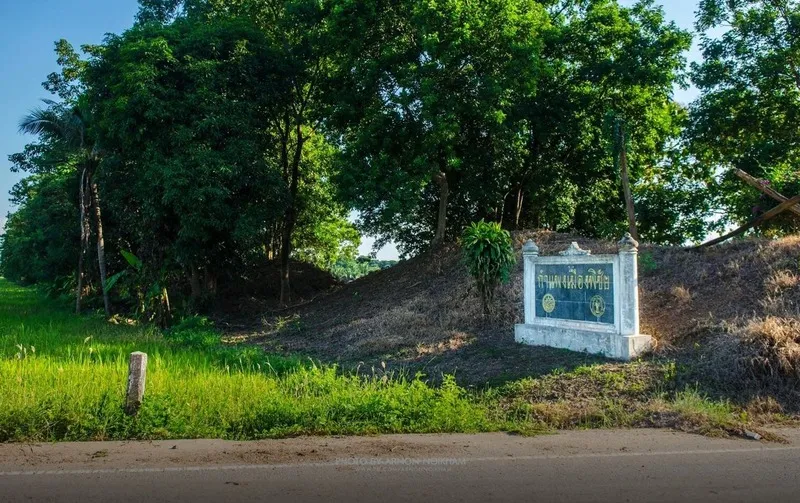
Phichai City Wall is an important historical site in Phichai District, Uttaradit Province. Located in Nai Mueang Subdistrict, the site preserves the remains of the old city wall of Phichai, one of the historically significant towns in the lower northern region of Thailand. Today, the wall appears not as a high brick structure, but as a broad lateritic earth mound covered with grass, trees, and natural vegetation. Its quiet appearance may seem modest at first, yet it is a meaningful trace of an old fortified town and a valuable reminder of Phichai’s long history.
This site is suitable for travelers who are interested in local history, archaeology, old city planning, and cultural landscapes. Phichai City Wall is not a conventional tourist landmark with large buildings or decorative monuments. Instead, it requires careful observation and historical imagination. Visitors need to look at the shape of the land, the raised earth line, the surrounding vegetation, and the relationship between the wall and nearby historic sites in order to understand how this landscape once formed part of an old town.
Phichai is widely known in Thai history because of Phraya Phichai Dap Hak, the heroic warrior of the Thonburi period. However, the history of Phichai is deeper than the story of one hero. Long before that famous episode, the area was already connected with settlement, religious sites, local communities, and defensive structures. The city wall helps visitors understand Phichai as an old town with its own historical depth, rather than only as the hometown associated with a national hero.
The present appearance of Phichai City Wall as an earth mound reflects the way many old towns in Thailand were fortified. In several historic settlements, city walls were built with compacted earth, lateritic soil, or earthen ramparts rather than entirely with brick or stone. These materials were locally available and could be used to create defensive boundaries. Over centuries, such walls naturally eroded, settled, and became covered with vegetation. What remains today is therefore not a ruin in the usual sense, but a surviving earthwork embedded in the landscape.
To understand Phichai City Wall properly, it should be seen as part of an old urban system. A city wall did not merely separate inside from outside. It protected people, defined the boundary of the town, helped organize space, and expressed the importance of the settlement. A town with a wall was a place of strategic value, population, resources, and administrative significance. The remaining earth mound is therefore an important physical clue to the former status of Phichai.
Phichai lies within the historical geography of the lower northern river basin region. This area was connected with older towns such as Sukhothai, Sawankhalok, Phitsanulok, and Uttaradit. The location of Phichai placed it within a network of movement, defense, agriculture, and political control. In such a setting, a city wall would have been essential for protecting the settlement and marking its place within the wider regional order.
The wall also helps visitors understand how geography shaped old towns. Ancient settlements were not placed randomly. They were usually located where water, farmland, transport routes, and defensive advantages could be combined. Over time, the landscape of Phichai has changed with modern roads, villages, agriculture, and district development. Yet the remaining city wall still works as a line of memory, showing where the old urban landscape once stood.
When walking around the area, visitors may notice that some parts of the earth mound are clearer than others. Some sections show a raised line of lateritic soil, while other parts blend into the surrounding ground. This type of archaeological site is different from temples, stupas, or brick ruins. It demands slower viewing. Visitors must observe the ground surface, the slope, the vegetation, and the direction of the earthwork in order to appreciate its form and meaning.
The beauty of Phichai City Wall is quiet and understated. It is not the beauty of elaborate decoration, but the beauty of time. Grass-covered earth, trees growing along the old line, and the calmness of the site create an atmosphere of historical depth. For travelers who enjoy meaningful places rather than crowded attractions, this is a valuable stop in Phichai District.
From an archaeological perspective, the wall is important because earthen city walls and moats can reveal much about ancient urban planning. Archaeologists can study the wall line, the soil formation, the relationship with nearby religious sites, and the surrounding landscape to understand how the old town was organized. Even when the visible remains seem simple, they may still hold important information about settlement history and local defense systems.
Phichai City Wall also connects with the identity of Phichai as a heroic town. Many visitors come to the district because of the story of Phraya Phichai Dap Hak, but the city wall shows the deeper context of the town itself. It reminds visitors that the heroic story developed within a place that already had historical foundations, defensive structures, religious sites, and community life.
Nearby sites help complete the historical picture. Wat Na Phra That in Nai Mueang Subdistrict is one of the important nearby historical and religious sites. When viewed together, the city wall and the temple area help visitors imagine the components of the old town: defensive boundaries, sacred spaces, water sources, and settlement zones. A route combining these places provides a richer understanding of Phichai’s past.
Travelers can also combine Phichai City Wall with Phraya Phichai Dap Hak Monument, Phichai Railway Station, Poramin Bridge at Ban Dara, Khao Bandai Ma, and Wat Phra Borommathat Thung Yang. This makes it possible to plan a cultural route that connects old urban history, heroic memory, railway heritage, Buddhist sites, and local landscapes in one trip.
Getting There is most convenient by private car or rental car. From Uttaradit city, travel toward Phichai District and continue to Nai Mueang Subdistrict. The distance is about 45 km and usually takes around 40–60 minutes depending on road conditions. Since parts of the wall are earthworks that may blend with the surrounding area, visitors may need to use a navigation map and ask local residents for the most suitable access point.
The best time to visit is in the morning or late afternoon, when the weather is cooler and the light is better for photography. During the rainy season, the area may look greener but the ground may be damp or covered with taller grass. During the dry season, walking is generally easier and the shape of the earth mound may be more visible. Visitors should wear comfortable shoes and bring drinking water if they plan to walk around the area.
Visitors should treat the site with care. They should not dig, remove soil, move stones, burn grass, leave litter, or drive vehicles onto the earth mound. Earthen archaeological sites are more fragile than they may appear. Repeated trampling or vehicle movement can damage the structure and destroy archaeological information. Responsible behavior helps preserve the site for future visitors and researchers.
For photography, Phichai City Wall is best approached as a documentary landscape rather than a dramatic monument. Good images may show the line of the earth mound, trees growing along the wall, lateritic soil, surrounding fields, and the quiet character of the old town area. Such photos may be subtle, but they communicate the authentic condition of a historical site that has survived through time.
As a learning site, Phichai City Wall is useful for students and visitors interested in old city planning. It can help explain how towns were selected, how defensive earthworks were built, how natural materials were used, and how landscapes change over centuries. It also shows why not all important historical sites look like buildings. Some are preserved as earth, lines, and traces in the landscape.
In cultural tourism, Phichai City Wall helps extend the story of Phichai beyond its best-known heroic associations. It reveals that the district contains older historical layers, including settlement, fortification, religion, and regional connections. Travelers who visit the wall gain a deeper understanding of the town and its long-term development.
The value of Phichai City Wall lies in continuity. It connects the old town with the present community, the physical landscape with historical memory, and local heritage with broader regional history. With appropriate care and interpretation, the site can become an important educational stop in Phichai District and a meaningful part of Uttaradit’s cultural tourism network.
In summary, Phichai City Wall is a modest but valuable archaeological site. Although it now appears as a lateritic earth mound covered with grass and trees, it remains a real trace of the old town of Phichai. Visitors should approach the site with respect, patience, and historical awareness, because every section of the old wall is part of the continuing memory of Phichai and Uttaradit Province.
| Name | Phichai City Wall |
| Location | Nai Mueang Subdistrict, Phichai District, Uttaradit Province |
| Address | Old Town Area, Nai Mueang Subdistrict, Phichai District, Uttaradit Province 53120, Thailand |
| Highlights | Ancient City Wall Remains Visible As A Broad Lateritic Earth Mound Covered With Grass, Trees, And Natural Vegetation |
| History | Part Of The Old Town Of Phichai, A Historically Important Settlement In The Lower Northern Region Of Thailand |
| Key Evidence | Remaining Lateritic Earth Mound Believed To Mark The Former City Wall, Connected With The Old Town Area And Nearby Historical Sites Such As Wat Na Phra That |
| Name Origin | Named For Its Former Role As The City Wall Of Old Phichai, An Important Historic Town In Uttaradit Province |
| Distinctive Features | An Earthen City Wall Site Rather Than A Tall Brick Structure, Suitable For Learning About Old Town Planning And Historical Landscapes |
| Travel Information | About 45 km From Uttaradit City; Drive Toward Phichai District And Continue To Nai Mueang Subdistrict. Private Car Or Rental Car Is Recommended |
| Current Status | A Historical Site Of Phichai District; The Present Remains Are Earth Mounds Covered With Vegetation And Should Be Visited Carefully Without Damaging The Area |
| Open Days | Daily |
| Opening Hours | 08.00 – 17.00 |
| Facilities | Located Near Nai Mueang Community And Phichai District Town, With Access To Local Shops, Restaurants, And Accommodation In Phichai |
| Main Areas / Zones | 1. Former City Wall Earth Mound 2. Old Town Area In Nai Mueang Subdistrict 3. Vegetation Along The Wall Line 4. Nearby Local Community Area 5. Route Connecting To Wat Na Phra That And Other Phichai Historical Sites |
| Caretaker | Nai Mueang Subdistrict Administrative Organization, Phichai District, Uttaradit Province |
| Main Contact Number | Nai Mueang Subdistrict Administrative Organization, Tel. 055-456-189 |
| Official Website / Official Page | Nai Mueang Subdistrict Administrative Organization: www.naimuangphichai.go.th |
| Nearby Tourist Attractions | 1. Wat Na Phra That, about 2 km 2. Phraya Phichai Dap Hak Monument In Phichai, about 3 km 3. Phichai District Town, about 3 km 4. Phichai Railway Station, about 4 km 5. Poramin Bridge Or Ban Dara Bridge, about 12 km 6. Khao Bandai Ma Or Khao Phi Thon, about 18 km 7. Wat Phra Borommathat Thung Yang, about 32 km |
| Nearby Restaurants | 1. CAFE DE FIELD, Phichai District, about 3 km 2. Fellas Cafe, Phichai District, about 3 km 3. Nam Ngiao Chiang Rai, Phichai District, about 3 km 4. Moo Tun Ya Jeen Kru Keng, Phichai District, about 3 km 5. Noen Thong Restaurant, Phichai District, about 4 km 6. Ban Pak Khlong Restaurant, Phichai District, about 8 km, Tel. 087-256-4600 |
| Nearby Accommodations | 1. Phet Siam Resort Hotel, Phichai District, about 3 km, Tel. 082-491-6659, 061-982-9455 2. HostelBed and Art Space Phichai, about 3 km 3. Daily Rental Rooms In Phichai District Town, about 3 km 4. Ton Thong Hotel, Ban Dara Subdistrict, about 12 km, Tel. 083-623-7117 5. 99 Park & Resort, Uttaradit Province, about 35 km, Tel. 080-848-3848 6. Hotels In Uttaradit Town, about 45 km |
Frequently Asked Questions (FAQ)
Q: Where Is Phichai City Wall Located?
A: Phichai City Wall is located in Nai Mueang Subdistrict, Phichai District, Uttaradit Province. It is a historical site connected with the old town of Phichai.
Q: What Does Phichai City Wall Look Like Today?
A: Today, the remains appear as broad lateritic earth mounds covered with grass, trees, and natural vegetation along the former wall line.
Q: Why Is Phichai City Wall Important?
A: It is evidence of the old town of Phichai, showing the former defensive system, settlement history, and historical importance of Phichai District in Uttaradit Province.
Q: Who Should Visit Phichai City Wall?
A: The site is suitable for travelers interested in local history, archaeology, old town planning, cultural tourism, and the deeper historical layers of Phichai.
Q: How Should Visitors Prepare For A Visit?
A: Visitors should wear comfortable walking shoes, bring drinking water, visit during the morning or late afternoon, and avoid digging, removing objects, or driving onto the earth mound.
Q: What Nearby Attractions Can Be Visited With Phichai City Wall?
A: Nearby places include Wat Na Phra That, Phraya Phichai Dap Hak Monument, Phichai Railway Station, Poramin Bridge, Khao Bandai Ma, and Wat Phra Borommathat Thung Yang.
Q: Is There An Admission Fee?
A: No official admission fee information is confirmed. Visitors should enter respectfully and follow local guidance when visiting the site.
Q: Why Does The City Wall Remain As An Earth Mound?
A: Many ancient city walls were built from compacted earth. Over centuries, erosion, settlement, and vegetation transformed the wall into the earth mound seen today.
 Category: ●Art, Culture and Heritage
 Group: ●Landmarks and Memorials
Last Update : 4 MonthAgo
 Last Update : 4 MonthAgo
 Click to Access the Navigation Map GPS
Phichai City Wall Map
Recommend

 Historical Sites and Monuments(2)
Landmarks and Memorials(8)
Historical Sites and Monuments(2)
Landmarks and Memorials(8)
 Art, Craft Centres, Tradition(3)
 Museums(1)
 Historic Homes and Cities(1)
 Places of Worship
 Temple(42)
 Other Sacred Sites(5)
 Suburban Living
 Village, Community(4)
 Nature and Wildlife
 National Parks and Marine Reserves(4)
 Mountain (Doi)(3)
 Dam, Reservoir, Lake(3)
 Waterfalls(11)
 Caves(3)
 River, Canal(3)
 Other natural attractions(3)
 Entertainment and Agricultural
 Farms, Parks and Ecotourism(1)


