
lovethailand home >North Travel Attractions >Phrae Travel Attractions >Muang Phrae >Nai Wiang > Wat Sa Bo Kaeo
TL;DR: Wat Sa Bo Kaeo is located at Nam Khu Road, beside the city moat, Nai Wiang Subdistrict, Mueang Phrae District, Phrae Province, open Daily, hours 08:00 - 17:00.
Wat Sa Bo Kaeo

Open Days: Daily
Opening Hours: 08:00 - 17:00
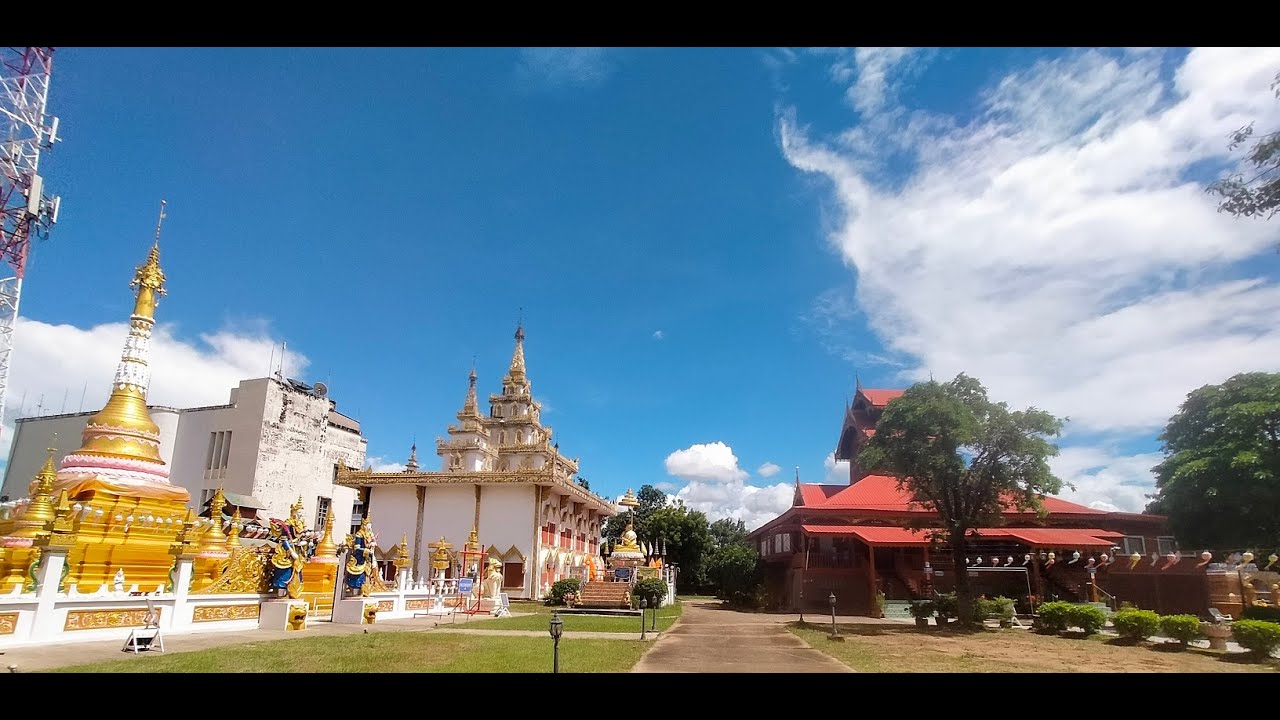
Wat Sa Bo Kaeo is one of the most distinctive temples in Phrae city and offers travelers a broader understanding of the city beyond the familiar image of traditional Lanna temples. It shows clearly that Phrae is not defined only by Lanna heritage, but also by traces of Burmese art and the Tai Yai community that have long been woven into the city’s history. The temple stands on Nam Khu Road along the city moat in Nai Wiang Subdistrict, Mueang Phrae District. Its location is highly convenient for an in-town trip because it is close to the old town area, Yantrakit Kosol Road, Wat Chom Sawan, Wat Phra Non, Wat Phong Sunan, Khum Chao Luang, and Vongburi House. For travelers who want to see Phrae in a deeper dimension rather than simply visiting teakwood houses or cafés, Wat Sa Bo Kaeo is an excellent place to begin understanding the city through a living religious site that still remains active today.
The most important charm of Wat Sa Bo Kaeo lies in its identity as a Burmese-style temple that looks strikingly different from the surrounding Thai temples. In the past, this temple was known as Wat Chong Klang, and it was also called Wat Sam Pho because it was connected with three Burmese families bearing the surname “Pho” who helped build and restore the temple according to local information. As a result, the temple is not simply another old temple in Phrae. It is an important cultural record of the Burmese or Tai Yai communities who once settled, traded, and left their cultural imprint along Nam Khu Road and Yantrakit Kosol Road. This is highly significant because it reveals that Phrae in the past was much more deeply connected to ethnic communities and regional trade than many people realize today.
The temple’s importance does not rest only in its old name or in its relationship with the Burmese community. It is also reflected clearly in the architecture itself. The sermon hall, ordination hall, and pagoda all show obvious Burmese artistic characteristics. From the outside, visitors can notice the layered roof forms, decorative Burmese woodwork, and architectural elements that create an atmosphere distinctly different from the local Lanna-style temples found elsewhere in Phrae. This difference makes Wat Sa Bo Kaeo especially rewarding for travelers who enjoy photography, craftsmanship, and architectural details, because every angle, whether from the front, the side, or near the pagoda, reveals graceful lines and a calm but highly distinctive Burmese character.
According to community information and local tourism sources, Wat Sa Bo Kaeo was built around the same era as Wat Chom Sawan and is regarded as one of the important Burmese temples of Phrae. This makes both temples valuable when read together in historical terms, because they reflect the settlement patterns and religious devotion of Burmese or Ngiao communities in Phrae during the period when the city played a major role in trade and the teak industry. For travelers who want to understand why Phrae contains temples with forms so different from traditional Lanna temples, Wat Sa Bo Kaeo provides one of the clearest answers. The temple stands as physical evidence of how people from different cultural backgrounds once lived together in the same city.
Another major highlight of Wat Sa Bo Kaeo is its Burmese-style marble Buddha image in royal attire, which is often mentioned in tourism information about the temple. This Buddha image is a refined piece of craftsmanship that feels clearly different from typical Thai Buddha images in both style and presentation. The ornamented form, the delicacy of the carving, and the overall artistic atmosphere all reflect Burmese aesthetic traditions. Because of this, Wat Sa Bo Kaeo is not only a place for viewing buildings, but also a space where visitors interested in Buddhist art can see cultural differences expressed through an authentic sacred object.
For those who enjoy visiting temples with a strong historical story, Wat Sa Bo Kaeo is also highly interesting because it once served as a residence for Burmese monks who came to study Buddhist teachings in Thailand. This detail gives the temple a role beyond that of a local place of worship. It also functioned as a spiritual link between the Burmese community and Phrae. The fact that Burmese monks stayed here and studied the Dharma confirms that the temple was once a true spiritual center for the Burmese network living in Phrae, rather than merely a temple influenced by Burmese architecture from the outside.
Local information from DASTA and the Nai Wiang Subdistrict Non-Formal Education Center adds more depth to the temple’s history by stating that the person who initiated the temple’s construction was Maung Pho Aun, and that the temple was restored by Burmese groups from Bago, Yangon, and Mandalay. This greatly strengthens the temple’s historical weight because it shows that its creation did not happen in isolation, but grew out of networks of people and faith crossing regional borders during the time when Phrae was an important economic and transportation center in the North. The presence of named individuals and specific cities of origin makes the history of the temple feel concrete and human, rather than merely decorative or symbolic.
In the past, Wat Sa Bo Kaeo went through a period of decline after the Burmese monks who had once resided there were no longer present, and the temple became abandoned for some time before it was revived again around 1965–1966 according to local information. Its return to life reflects the strength of community faith and the determination not to let one of the city’s important cultural sites disappear. For this reason, the temple is not only a story of construction, but also a story of preservation and revival. Visitors interested in urban history will find that Wat Sa Bo Kaeo holds an especially meaningful narrative of continuity through change.
The temple’s significance is not limited to architecture or the history of Burmese settlement. It is also connected to local traditions that continue in the present. The Phrae Provincial Office of Buddhism has published news about activities held at Wat Sa Bo Kaeo on several occasions, including the Fuen Heet Hoi Peng Pud Wai Sa Phra Upakhut Chao ceremony, an important local tradition in Phrae city. The continued presence of this event at the temple shows clearly that Wat Sa Bo Kaeo is not simply an old monument or a temple visited only to admire art. It remains a living venue for rituals and community gatherings. Travelers who enjoy visiting temples while also experiencing local traditions should pay attention to festival periods, because the atmosphere then reveals another dimension of the temple filled with people, devotion, and the continued movement of local culture.
The atmosphere of Wat Sa Bo Kaeo has a very particular charm because it stands along the city moat on Nam Khu Road, one of the historic areas of Phrae. This setting allows the temple to remain naturally connected with the surrounding urban fabric. Once inside the temple grounds, visitors can feel a sense of calm that separates the space from the outside road, yet the temple never feels disconnected from everyday life. This quality is one of the reasons many old-town temples in Phrae are so appealing. Travelers feel that they are visiting a real city and a real community, not a space created purely for tourism.
From the perspective of architecture, Wat Sa Bo Kaeo is especially suitable for people who like to examine details of craftsmanship. Burmese-style religious buildings often contain more delicate and elaborate ornamentation than some forms of Thai architecture, especially in the rooflines, gables, eaves, and pagoda elements. Looking closely, visitors will see that the temple’s beauty does not rely on monumental scale, but on fine detail and on an unusual atmosphere rarely encountered in other temples of Northern Thailand. This makes Wat Sa Bo Kaeo one of the places that temple enthusiasts, architecture lovers, and old-town content creators should not miss, because it offers both visual richness and a narrative that clearly differs from more famous temples in Phrae.
Compared with Wat Chom Sawan, which is more widely known as a Burmese temple in Phrae, Wat Sa Bo Kaeo gives a different feeling. Wat Chom Sawan is famous for its teakwood architecture and for landmark features that stand out immediately, while Wat Sa Bo Kaeo has its own charm in the way it quietly preserves Burmese traces in a more community-based setting. This makes it especially appropriate for travelers who want to understand the diversity of Burmese temple art in Phrae rather than seeing only the best-known site. It helps reveal that Burmese art in Phrae appears in different forms, at different scales, and in different relationships with community life.
The location of Wat Sa Bo Kaeo makes trip planning very easy because it lies in the city center and connects smoothly with several major attractions. Starting from this temple, travelers can continue to Wat Chom Sawan, Wat Phra Non, Wat Luang, Wat Phong Sunan, Khum Chao Luang, Vongburi House, or Kad Kong Kao without spending much time on the road. Even visitors with only half a day can organize a well-balanced route that combines old temples, heritage houses, and cafés within a compact urban area. This is one of the advantages of traveling in Phrae, and Wat Sa Bo Kaeo is one of the sites that makes such an itinerary more complete.
In terms of visitor experience, Wat Sa Bo Kaeo is a temple that gradually reveals itself. At first glance, it may simply appear to be an unusual and beautiful Burmese-style temple. But once visitors spend more time reading its story and observing its details, they begin to discover greater depth: the Burmese community in Phrae, the Burmese monks who once studied here, the change of the temple’s name from Wat Chong Klang to Wat Sa Bo Kaeo, the restoration after a period of abandonment, and the continuation of the Phra Upakhut tradition today. It is therefore a place that deserves time rather than a quick photo stop.
Photography enthusiasts will find this temple especially rewarding because Burmese-style buildings create lines and silhouettes that differ strongly from ordinary Thai temples. The wide views of the sermon hall, the shape of the ordination hall, the angles of the pagoda, and the temple’s setting beside the moat all offer unique photographic compositions. In the morning or during the softer light of late afternoon, the roof details and decorative patterns become especially expressive. Those who enjoy old-town photography can also naturally connect the temple with Nam Khu Road and the surrounding neighborhood, making Wat Sa Bo Kaeo a compelling place for both architectural and urban atmosphere photography.
The temple is also valuable for travelers interested in ethnicity and the coexistence of cultures in the Lanna region. Wat Sa Bo Kaeo clearly shows that the identity of Phrae is not purely a single Lanna identity, but the result of many groups settling and creating things together over time. As a Burmese temple, it has real interpretive value for understanding the city. Travelers who want to see beyond a standard checklist of popular attractions will find that this temple opens a much wider picture of Phrae.
Travel Information Reaching Wat Sa Bo Kaeo is very convenient because it is located in Phrae city on Nam Khu Road beside the moat. Starting from Phrae City Hall or the Khum Chao Luang area, visitors can drive or take local transport to the temple in a short time. Travelers who enjoy walking through historic neighborhoods can also include the temple as one stop along a route connecting Nam Khu Road, Yantrakit Kosol Road, and Kad Kong Kao, since the distances between these points are not too great. A private car is the most convenient option, but visitors without one can still use local transport services or combine the temple with other important temples in Phrae quite easily.
For those planning a half-day or full-day trip in Phrae, Wat Sa Bo Kaeo fits well in the same route as Burmese temples and old temples within the city, such as Wat Chom Sawan, Wat Phra Non, and Wat Phra Bat Ming Mueang Worawihan. After that, travelers can continue to Khum Chao Luang, Vongburi House, and local restaurants or cafés in town. This kind of itinerary provides a balanced way to experience religion, art, ethnicity, and old-town life within a single day.
Another interesting point is that Wat Sa Bo Kaeo is still not discussed as widely as some of the more famous temples in Phrae. Because of that, it retains a peaceful atmosphere and is not overly crowded during normal visits. Travelers who enjoy discovering places with real cultural value but less commercial pressure often find this kind of temple especially memorable. Walking slowly, reading its history, and absorbing the meaning of each architectural element becomes part of the value of visiting Wat Sa Bo Kaeo.
In conclusion, Wat Sa Bo Kaeo is one of the temples in Phrae city that deserves serious attention from anyone interested in Burmese art, the history of the Burmese community in Phrae, and meaningful old-town travel. The temple brings together the story of its former name Wat Chong Klang, the beauty of its Burmese-style sermon hall, ordination hall, and pagoda, the exquisite marble Buddha image in Burmese royal attire, its former role as a residence for Burmese monks, and its present role as a venue for important local traditions. For travelers who want to see a different side of Phrae beyond the usual list of famous places, Wat Sa Bo Kaeo is a destination well worth including in the itinerary.
| Name | Wat Sa Bo Kaeo |
| Place Summary | An important Burmese-style temple in Phrae city, formerly known as Wat Chong Klang or Wat Sam Pho, distinguished by its Burmese-style sermon hall, ordination hall, pagoda, and an exquisite marble Buddha image in Burmese royal attire. |
| Location | Nam Khu Road, beside the city moat, Nai Wiang Subdistrict, Mueang Phrae District, Phrae Province |
| Address | 138 Nam Khu Road, Nai Wiang Subdistrict, Mueang Phrae District, Phrae Province 54000 |
| Highlights | Burmese-style sermon hall, ordination hall, and pagoda, Burmese-style marble Buddha image in royal attire, a Burmese temple in the heart of Phrae, and a scenic setting beside the city moat |
| History / Period / Era | Built in the same era as Wat Chom Sawan by Burmese or Tai Yai communities in Phrae. Formerly called Wat Chong Klang, it was later restored and revived in the modern era. |
| Name Origin | The temple was originally called Wat Chong Klang and was also known as Wat Sam Pho because it was associated with three Burmese Pho families who helped build and restore the temple before it became known as Wat Sa Bo Kaeo. |
| Distinctive Features | A Burmese-style temple with unusual beauty in its roof forms, decorative work, and pagoda, clearly reflecting Burmese cultural traces within Phrae city. |
| Important Features Inside the Temple | Burmese-style marble Buddha image in royal attire, Burmese-style sermon hall, Burmese-style ordination hall, Burmese-style pagoda, and the ceremonial area used for the Phra Upakhut worship tradition |
| Travel Information | Located on Nam Khu Road beside the city moat in central Phrae. It is easy to reach by private car, local transport, or as part of an old-town route linking nearby temples and heritage attractions. |
| Current Status | Still active and continuously used for religious ceremonies and local community traditions |
| Open Days | Daily |
| Opening Hours | 08:00 - 17:00 |
| Admission Fee | No admission fee |
| Current Abbot | Phra Athikan Sakon Suddhiko |
| Main Contact Number | 093-384-5802 |
| Official Website / Official Page | Amazing Thailand, TAT Phrae, and activity news from the Phrae Provincial Office of Buddhism |
| Nearby Tourist Attractions | 1. Wat Chom Sawan, about 0.6 km, Tel. 081-951-6103 2. Wat Phra Non, about 0.9 km, Tel. 093-1366523 3. Khum Chao Luang, about 1.2 km, Tel. 054-524158 4. Vongburi House, about 1.4 km, Tel. 054-620153, 054-511189 5. Wat Phra Bat Ming Mueang Worawihan, about 1.5 km, Tel. 054-511722, 096-6971616 |
| Nearby Restaurants | 1. Sugar Bites Café & Homemade Bakery, about 0.1 km 2. Le Kong Kao de Phraeris, about 0.8 km, Tel. 090-3324189 3. Slope Coffee Baan Beawww, about 0.9 km, Tel. 087-1461412 4. Na Buri Phrae, about 1.0 km, Tel. 093-2876677, 099-2920256 5. Gingerbread House Gallery, about 1.4 km, Tel. 054-523671 |
| Nearby Accommodations | 1. Huen Him Kong Hotel Phrae, about 0.7 km, Tel. 054-533777, 093-2185533 2. Huern Na Na Boutique Hotel Phrae, about 1.4 km, Tel. 054-524800, 088-5477002 3. Taris Art Hotel Phrae, about 1.6 km, Tel. 054-511122, 088-2523098 4. Hug Inn Phrae Hotel, about 1.7 km, Tel. 062-5720077 5. B2 Phrae Boutique & Budget Hotel, about 2.2 km, Tel. 1328, 054-060633 6. Phrae Nakara Hotel, about 2.3 km, Tel. 054-521321 |
Frequently Asked Questions (FAQ)
Q: Where is Wat Sa Bo Kaeo located?
A: The temple is located at 138 Nam Khu Road, Nai Wiang Subdistrict, Mueang Phrae District, Phrae Province, beside the city moat in central Phrae.
Q: What was the temple’s former name?
A: It was formerly called Wat Chong Klang, and it was also known as Wat Sam Pho before becoming known as Wat Sa Bo Kaeo.
Q: What is the main highlight of Wat Sa Bo Kaeo?
A: Its most notable highlights are the Burmese-style architecture of the sermon hall, ordination hall, and pagoda, as well as the exquisite Burmese-style marble Buddha image in royal attire.
Q: How is Wat Sa Bo Kaeo connected with the Burmese community?
A: The temple was built by Burmese or Tai Yai communities living along Nam Khu Road and Yantrakit Kosol Road, and it once served as a residence for Burmese monks who came to study Buddhist teachings in Thailand.
Q: What time does Wat Sa Bo Kaeo open?
A: Public visitor information consistently indicates opening hours of approximately 08:00 - 17:00.
Q: Is there an entrance fee at Wat Sa Bo Kaeo?
A: No. There is no admission fee, and visitors can enter the temple to pay respects and admire its architecture as usual.
Q: Does Wat Sa Bo Kaeo host any important local tradition?
A: Yes. The temple is a venue for the Fuen Heet Hoi Peng Pud Wai Sa Phra Upakhut Chao tradition, which is an important local ceremony in Phrae city.
Q: What places can be visited together with Wat Sa Bo Kaeo?
A: Visitors often combine a trip here with Wat Chom Sawan, Wat Phra Non, Khum Chao Luang, Vongburi House, and Wat Phra Bat Ming Mueang Worawihan as part of a Phrae old-town itinerary.
 Category: ●Places of Worship
 Group: ●Temple
Last Update : 7 MonthAgo
 Last Update : 7 MonthAgo
 Click to Access the Navigation Map GPS
Wat Sa Bo Kaeo Map
Recommend

 Art, Culture and Heritage
 Historical Sites and Monuments(4)
 Landmarks and Memorials(5)
 Art, Craft Centres, Tradition(3)
 Museums(6)
 Historic Homes and Cities(2)
 Educational Places
 Museum for Study(1)
 Educational Gardens, Farm(2)
 University
 Public university(2)
 Autonomous Universities(1)
Temple(31)
 Other Sacred Sites(8)
 Suburban Living
 Village, Community(6)
 Local Market(1)
 Nature and Wildlife
 National Parks and Marine Reserves(4)
 Dam, Reservoir, Lake(14)
 Waterfalls(6)
 Hot Springs(1)
 Caves(5)
 River, Canal(3)
 Islands(1)
 Other natural attractions(5)
 Entertainment and Agricultural
 Farms, Parks and Ecotourism(5)
 Outdoor and Adventure Activities(1)
 Travel Articles, Recipes
 Travel Review, Food Review(2)


