
lovethailand home >Northeastern Travel Attractions >Bueng Kan Travel Attractions >Si Wilai >Na Saeng > Wat Jetiyakhiri Wihan (Wat Phu Tok)
TL;DR: Wat Jetiyakhiri Wihan (Wat Phu Tok), Bueng Kan attractions : Places of Worship, Temple.

Wat Jetiyakhiri Wihan (Wat Phu Tok)
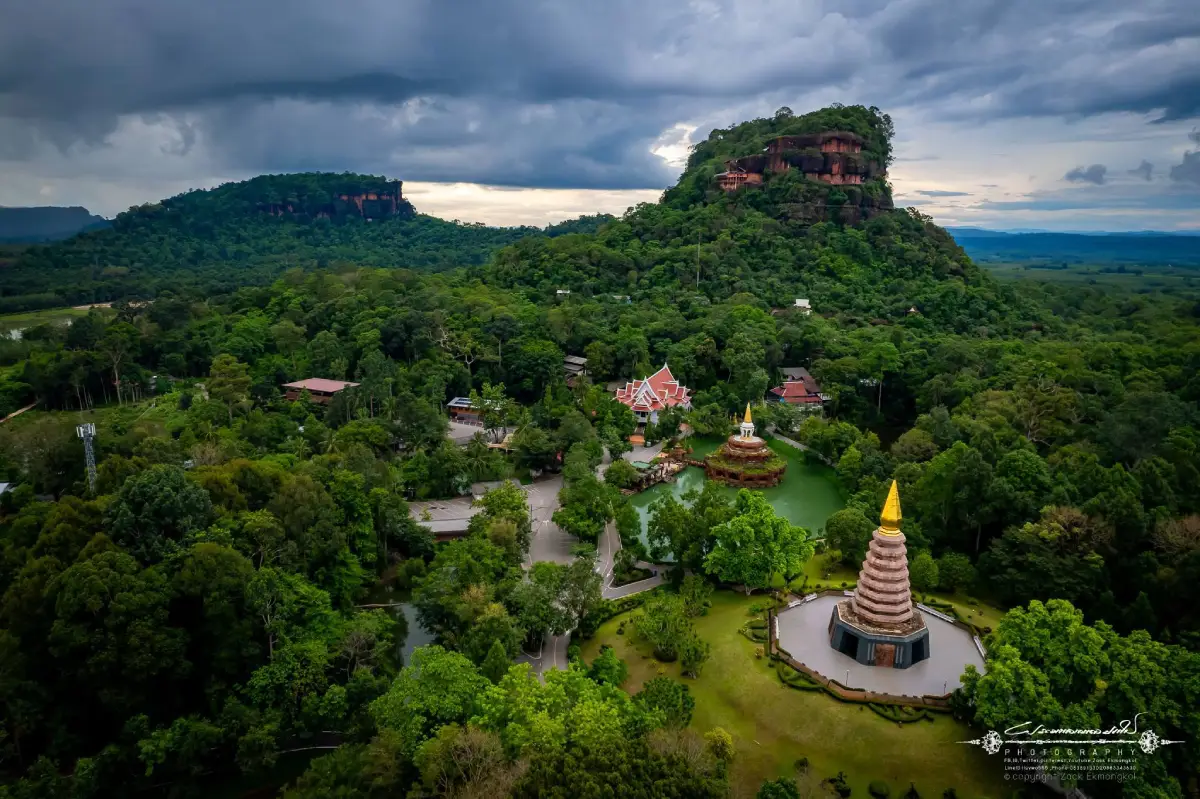
Open Days: Daily, except April 10–16 each year, when tourists are not permitted to climb Phu Tok.
Opening Hours: 8:30 AM – 5:00 PM
Wat Jetiyakhiri Wihan (Wat Phu Tok), Bueng Kan Province, is one of northeastern Thailand's most extraordinary forest monasteries and Buddhist cultural destinations. Located at Ban Na Kham Khaen Phatthana, Moo 6, Na Saeng Subdistrict, Si Wilai District, Bueng Kan Province, the temple occupies a dramatic sandstone mountain rising above the surrounding forests and plains. Its most recognizable feature is a remarkable network of wooden staircases and cliffside walkways extending across seven levels of the mountain. These paths connect meditation areas, Buddhist shrines, natural caves, monks' residences, a sacred sanctuary, and panoramic viewpoints. A visit combines spectacular natural scenery with the history of Thailand's forest meditation tradition, traditional craftsmanship, Buddhist devotion, and the peaceful atmosphere of a working monastery.
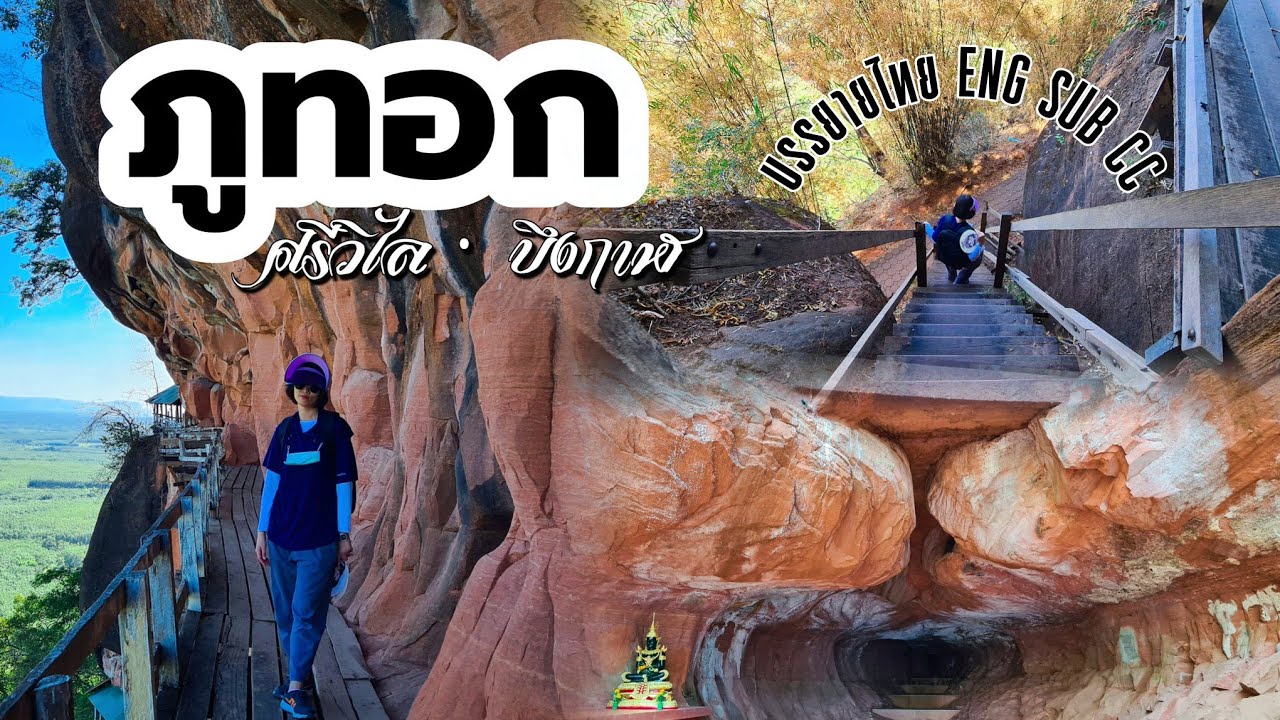
Phu Tok is especially famous for its wooden walkways that follow the contours of steep cliffs, with some sections suspended high above the forest floor and others passing beneath enormous overhanging sandstone formations. The experience is unlike an ordinary mountain hike. Nevertheless, Wat Phu Tok was not originally developed as an adventure attraction or a destination for testing one's courage. It was established as a place for Buddhist meditation under the guidance of Phra Ajahn Juan Kulachettho, a respected teacher in the Thai forest meditation tradition associated with Luang Pu Mun Bhuridatta. The wooden bridges that have become a symbol of Bueng Kan originated from the determination of monks, novices, and local villagers to create practical routes connecting secluded places for meditation and religious practice.
In the northeastern Thai language, the name Phu Tok means "isolated mountain," an appropriate description of the sandstone formation standing prominently apart from the surrounding landscape. The area consists of two principal mountains, Phu Tok Yai and Phu Tok Noi. Phu Tok Noi, the smaller mountain, is home to Wat Jetiyakhiri Wihan and the famous seven-level wooden walkway system accessible to religious pilgrims and ordinary visitors. Phu Tok Yai is a separate mountain that is not developed as a general sightseeing route in the same way. Understanding this distinction is important because most photographs and travel descriptions of the wooden cliffside bridges refer specifically to Phu Tok Noi.
The mountain is composed of sandstone formations characterized by steep cliffs, rock overhangs, crevices, caves, and naturally forested areas. The sandstone displays shades ranging from reddish brown to darker earth tones, depending on mineral composition, weathering, and the condition of the exposed surface. Over a long geological period, natural erosion created cavities, recessed sections, and projecting rock masses. These geological features contribute to Phu Tok's distinctive appearance and have also influenced the arrangement of the monastery. Monks adapted the natural environment for meditation and walking practice, while wooden paths were constructed to connect individual areas without fundamentally changing the character of the mountain.
Phu Tok also possesses significant environmental value. On November 7, 1989, it was designated a natural site worthy of conservation under a resolution of the Thai Cabinet. This recognition reflects the importance of the mountain's geology, landscape, surrounding ecosystem, and connection with Buddhist cultural heritage. Protecting Phu Tok therefore involves more than maintaining its wooden bridges and religious buildings. Conservation also concerns the sandstone cliffs, forest vegetation, natural habitats, and environmental conditions that support both the landscape and the monastery's contemplative atmosphere. The mountain is consequently an important natural and cultural asset for Bueng Kan Province.
The history of Wat Jetiyakhiri Wihan is closely connected with Phra Ajahn Juan Kulachettho, a highly respected meditation monk in the tradition of Luang Pu Mun Bhuridatta. Born Juan Noramas on July 10, 1920, in Ban Lao Man Kaeo in the former Ubon Ratchathani administrative area, now part of Amnat Charoen Province, he grew up in a rural northeastern Thai community. He later entered the Buddhist monastic life and dedicated himself to meditation, simplicity, renunciation, strict observance of monastic discipline, and continuous spiritual practice. His teachings and way of life became important influences on the development of Phu Tok as a forest meditation monastery.
Phra Ajahn Juan's approach to Buddhist practice was shaped by the teachings of Luang Pu Mun Bhuridatta, one of the most influential masters of Thailand's Dhammayut forest tradition. This tradition emphasizes disciplined monastic conduct, meditation, mindfulness, simplicity, and the cultivation of wisdom through direct practice. Forest monks have historically sought quiet places such as mountains, caves, and remote woodland areas where they can concentrate on spiritual development with fewer distractions. Phu Tok provided precisely this environment, combining relative isolation with natural rock shelters and areas suitable for walking and seated meditation.
Before developing Phu Tok, Phra Ajahn Juan traveled and practiced in several parts of northeastern Thailand, including the forests around the Phu Wua area. Traditional accounts associated with the monastery describe a vision of two beautiful palace-like structures near Phu Tok Noi that inspired him to investigate the mountain. Upon reaching the area, he found a peaceful landscape of sandstone cliffs, caves, overhanging rocks, and dense vegetation. These natural characteristics made the mountain particularly suitable for meditation. The vision remains part of the temple's religious history and helps explain the spiritual significance attached to the site by his disciples.
An important stage in the monastery's development began in January 1969, when Phra Ajahn Juan arrived at Phu Tok with Phra Khru Siri Thammawat and a small group of companions. At that time, the surrounding area was still covered by dense forest and was home to considerable wildlife. Transportation was difficult, and there were few permanent buildings or facilities. The monks initially lived near the base of the mountain, using simple shelters and natural surroundings for their daily activities and meditation practice. Their living conditions reflected the traditional forest monastic ideal of accepting a simple lifestyle and adapting to the environment rather than seeking material comfort.
The nearby community of Ban Na Kham Khaen was small during the monastery's early years. Historical accounts describe approximately ten households living in the area at that time. The monks depended on the generosity of these residents for daily alms food, which was limited by the agricultural economy and available resources of the community. This created a close relationship between the monks and the villagers. The local population supported the monks with essential necessities, while the monastery provided a place for religious practice, merit-making, and spiritual guidance. The connection established during these early years became a lasting part of Phu Tok's history.
One of the greatest difficulties during the early period was the shortage of water, particularly during the dry season. Natural water sources on the mountain were limited, and the monks sometimes relied on rainwater collected in rock depressions. During 1970–1971, Phra Ajahn Juan encouraged the local community to construct two water-retaining dams and develop a system for storing and distributing water within the monastery. This practical improvement made everyday life more sustainable and demonstrated the cooperation between the monastic community and local residents. Water management became an essential foundation for the continued development of the forest monastery.
Construction of the mountain's wooden access routes began in earnest in 1969 through the combined efforts of Phra Ajahn Juan, monks, novices, and villagers. The original paths followed steep natural terrain and were difficult to use for routine monastic activities. Wooden staircases and bridges were therefore created to connect the lower monastery with caves, religious halls, and secluded meditation locations higher up the mountain. The purpose was to make these areas usable for Buddhist practice while preserving the essential character of the surrounding cliffs and forest. The resulting structures eventually became one of Thailand's most recognizable examples of religious architecture integrated into a natural mountain environment.
The construction process was particularly remarkable because the workers lacked many of the engineering tools and technologies available today. They had to operate on steep rock faces, secure hardwood structural components, and place wooden planks section by section over exposed areas. Temporary supports and wooden frameworks were attached to the sandstone to establish passages across difficult terrain. The work required great care because some sections overlooked deep drops and others passed through narrow spaces between rocks. The completed walkways therefore represent not only a technical achievement but also the perseverance, cooperation, and religious devotion of the people who built them.
The development of the wooden staircase and walkway system took approximately five years, with improvements introduced throughout the construction period. In 1970, portions of the fifth-level route were leveled and widened. Further improvements to the sixth-level walkway and the fourth-level route were carried out in 1974. In 1976, additional water-storage facilities and monastic accommodation were developed around the fifth level. These successive projects gradually transformed Phu Tok into a functioning meditation monastery with interconnected areas at different elevations. Each stage of development responded to practical needs while adapting to the irregular sandstone terrain.
Alongside the construction of the bridges, the monastic community developed dining halls, shelters, monks' residences, and other essential facilities. Historical accounts also record the donation of a large cast Buddha image for installation as the principal sacred image in the fifth-level hall. Various organizations and supporters contributed equipment, materials, and resources to the project. The objective was not to cover the mountain with elaborate buildings but to provide the necessary spaces for daily monastic life, religious study, meditation, and worship. Natural rock formations remained an important part of the monastery's architectural arrangement.
Phra Ajahn Juan established the spiritual foundations of Wat Phu Tok through an emphasis on disciplined practice, mindfulness, perseverance, and strict observance of Buddhist monastic rules. He taught the importance of simplicity and the reduction of attachment to material comfort. Although the mountain was remote and difficult to reach during the early years, he and his disciples continued developing the monastery. Phu Tok gradually became known among practitioners of the Thai forest meditation tradition and Buddhist devotees interested in the teachings associated with Luang Pu Mun Bhuridatta.
April 27, 1980, marked a tragic moment in the monastery's history when Phra Ajahn Juan Kulachettho died in an aircraft accident at the age of 59. His passing deeply affected his disciples and supporters. Nevertheless, his influence continued through the monastery he helped develop and the teachings transmitted to later generations. His reputation as a dedicated meditation master remains central to Phu Tok's religious identity. Memorial structures and collections associated with his life were subsequently developed to preserve his legacy and help visitors understand his contribution to Buddhist meditation in northeastern Thailand.
One of the monastery's most important structures is the Phra Ajahn Juan Kulachettho Chedi Museum, situated in the lower temple area. Built in 1986, the reinforced-concrete monument is decorated with marble and measures approximately 31 meters in height and 16 meters in width. It serves as a memorial to the revered monk and a place associated with the preservation of his life story and legacy. Visitors can begin their exploration here before ascending the mountain, gaining an understanding of Phra Ajahn Juan's importance and the spiritual purpose behind the creation of the wooden walkways.
The significance of the Chedi Museum extends beyond its architectural form. It represents the continued relationship between Phra Ajahn Juan, his disciples, and the wider Buddhist community. Objects and historical materials associated with forest monks provide insight into a lifestyle centered on simplicity, discipline, and meditation. Preserving the memory of an important spiritual teacher is also a meaningful aspect of the Thai forest tradition, in which knowledge and examples of monastic conduct are transmitted from one generation to another. The museum therefore provides a valuable historical context for the mountain experience.
Wat Jetiyakhiri Wihan is currently under the religious leadership of Phra Khru Sunthon Wihantham, also known as Luang Ta Yaeng Sukhakamo, the temple's abbot. His responsibilities include overseeing the monastery and continuing its established tradition of Buddhist meditation. The temple remains involved in religious activities and collaborative projects with the surrounding community, including forest conservation and environmental protection. These activities demonstrate that Phu Tok is not merely a historical monument preserved for sightseeing but a living religious institution that continues to serve Buddhist practitioners and local residents.
On January 19, 2024, a religious ceremony was held at Wat Jetiyakhiri Wihan to celebrate the 84th birthday anniversary of Phra Khru Sunthon Wihantham. Provincial officials, Buddhist clergy, and members of the public attended the occasion to offer respect and participate in merit-making activities. The event reflected the strong relationship between the monastery, Buddhist administrative organizations, and the people of Bueng Kan. It also demonstrated the continuing importance of the abbot in maintaining the temple's spiritual traditions and community connections.
The temple has also played an active role in environmental conservation. On July 14, 2026, Bueng Kan Province organized the second tree-planting project at Wat Jetiyakhiri Wihan, attended by the provincial governor, Phra Khru Sunthon Wihantham, monks, government officials, community leaders, young people, and residents. The activity demonstrated how a Buddhist monastery can contribute to the protection of local forests and natural resources. It also reinforced the connection between the temple's spiritual mission and the preservation of the surrounding mountain environment.
Another significant provincial activity took place on September 26, 2026, when a ceremony involving the installation of the Buddhist Dharma Wheel flag and the Thai national flag was held at Wat Jetiyakhiri Wihan. The event formed part of a forest planting and maintenance initiative dedicated as a Buddhist offering. This combination of religious ceremony and environmental action illustrates the monastery's continuing importance as both a place of worship and a center for community cooperation. Forest conservation helps protect the distinctive landscape of Phu Tok while encouraging collective responsibility for the area's natural heritage.
The defining experience at Wat Phu Tok is the seven-level network of wooden staircases and walkways ascending Phu Tok Noi. The levels are often understood symbolically as stages in the development of spiritual awareness, perseverance, and the gradual overcoming of worldly attachment. Progressing from one level to the next requires patience, attention, and physical effort. These qualities relate directly to Buddhist meditation, in which steady practice and mindfulness are fundamental. The ascent therefore offers more than changing views of the countryside; it provides an opportunity to experience the importance of deliberate movement and attention to the present moment.
The first level begins near the base of the mountain, where natural vegetation surrounds the initial ascent. Here, visitors gradually leave the relatively open grounds of the monastery and enter a steeper forest environment. Trees, plants, and exposed rock formations characterize this stage. It is an appropriate place to establish a comfortable walking rhythm and become familiar with the terrain. The route becomes more demanding higher up, so a steady beginning allows visitors to conserve energy and appreciate the forest atmosphere before reaching the more exposed cliffside sections.
The second level consists of wooden staircases connecting the lower forest path with a higher part of the mountain. The increasing gradient begins to reveal the character of Phu Tok's construction, with timber structures arranged along the slope and attached to the surrounding rock. Vegetation continues to provide shade in some areas, while gaps between the trees offer the first broader glimpses of the landscape. This stage forms a transition between the enclosed woodland near the base and the open cliffside walkways for which Phu Tok is famous.
The third level introduces the recognizable wooden walkways that follow the mountain's contours. The terrain consists of sandstone outcrops, natural rock terraces, forest vegetation, and constructed pathways extending around the cliff. Some sections pass beneath sheltered rock formations, while others reveal views of the surrounding countryside. The changing relationship between rock, vegetation, and open space makes this level particularly interesting for observing the mountain's natural structure. Visitors begin to appreciate how the wooden paths were designed to use the terrain rather than replace it with a conventional staircase.
At the third level, the route divides into two important directions. One path provides a steep shortcut toward the fifth level and passes through a dark rock passage or tunnel. The other continues along the regular route toward the fourth level. These alternatives reflect the complex arrangement of the mountain's natural crevices and cliffs. The normal route through the fourth level provides a more continuous experience of the wooden walkways and their surrounding views, while avoiding the more demanding shortcut through steep and enclosed terrain.
The fourth level features an elevated wooden walkway that curves around the mountain and opens up broader views of the surrounding landscape. Visitors can look across forested areas, low hills, and the plains extending away from Phu Tok. A recognizable feature of the scenery is Dong Chomphu, an area of undulating hills and natural vegetation. The walkway around this level extends for approximately 400 meters and includes places where visitors can pause. The route provides a valuable opportunity to observe the relationship between the isolated sandstone mountain and the larger natural environment surrounding it.
Parts of the fourth level are also associated with accommodation and meditation areas for Buddhist nuns. Visitors should therefore maintain a particularly quiet and respectful manner while passing through. This aspect of the mountain demonstrates that the wooden walkways are not merely facilities for tourists. They also connect places used for daily religious life and spiritual practice. Respecting the privacy of residents and avoiding unnecessary disturbances is an important part of experiencing Wat Phu Tok appropriately.
The fifth level is among the most significant areas of the monastery from a religious perspective. It contains a Buddha image hall, monks' residences, natural caves, and several meditation locations. The arrangement reflects the character of a Thai forest monastery, with buildings positioned among rock formations and along the cliff rather than organized around the formal courtyards commonly found in urban temples. Visitors can observe how natural features have been incorporated into monastic architecture. Rock overhangs provide shelter, while caves and secluded areas offer environments suitable for meditation.
A principal Buddha image and worship hall are located on the fifth level. Historical accounts of the monastery record the donation of a large cast Buddha image for installation in this area. The image serves as an important focus of Buddhist devotion and religious observance. Paying homage here differs from worship in a conventional urban temple because the hall is surrounded by sandstone cliffs and forested slopes high above the surrounding plains. The combination of religious architecture and natural scenery creates an atmosphere of quiet reflection.
The fifth level also contains natural caves formed within the sandstone, including places known as Tham Kaeo, Tham Ruesi, and Tham Lek Lai. These caves are associated with the mountain's geological features and local traditions. Some have been used as secluded places for meditation, reflecting the long-standing relationship between cave environments and the Thai forest monastic tradition. The sheltered conditions offer opportunities for spiritual practice with fewer external distractions. Visitors should respect any restrictions on access, particularly where caves or rock shelters are reserved for monks and other practitioners.
One of the most extraordinary landmarks on the fifth level is the Buddhist sanctuary built on a separate-looking sandstone outcrop. The structure can be seen from a natural rock bridge extending away from the main mountain. The sanctuary is associated with the enshrinement of sacred Buddha relics and occupies a particularly dramatic position. A massive rock formation appears to balance above a narrower supporting section, creating the impression of an enormous boulder suspended over the cliff. This unusual geological composition has long attracted attention because of its remarkable appearance and setting.
The natural stone bridge leading toward the sanctuary follows the contours of the projecting rock, with an additional wooden bridge connecting sections of the route. This area clearly demonstrates the relationship between naturally formed sandstone and structures created by human effort. The rock masses developed through geological processes, while the walkways and supporting elements were added to make selected areas accessible for religious purposes. The result is an unusual combination of natural formation, spiritual significance, and traditional construction techniques.
The sanctuary and the area containing the Buddha relics are sacred spaces where visitors must follow the monastery's access restrictions carefully. Some sections are reserved for religious activities or are not open for close public entry. Visitors can pay their respects from the permitted areas without attempting to enter every part of the structure. Respecting these boundaries preserves the peaceful conditions needed by religious practitioners and reduces the risks associated with movement along narrow rock and wooden passages high above the forest.
The fifth level is especially valuable for understanding the daily life of forest meditation monks. Some residences and meditation shelters are positioned close to rock walls or within naturally protected areas. Their simplicity reflects the monastic emphasis on reducing attachment to possessions and unnecessary comforts. The arrangement allows monks to study, meditate, and practice walking meditation in a relatively quiet environment. Observing these spaces helps visitors understand that Phu Tok is primarily a place for spiritual discipline rather than simply a mountain attraction with impressive viewpoints.
The sixth level is the most famous part of the ascent. Here, wooden walkways follow exposed sandstone cliffs and provide expansive views of the surrounding region. Some sections pass beneath large overhanging rock faces, while the outer side of the walkway opens directly toward the forest far below. The contrast between the massive sandstone walls and the relatively narrow wooden path creates a memorable experience. Walking through this section requires concentration, steady movement, and appropriate use of the handrails. It is particularly important to avoid rushing or becoming distracted by photography.
From the sixth level, visitors can enjoy panoramic views of forests, farmland, villages, and distant hills, with Phu Tok Yai forming a prominent feature of the surrounding landscape. On clear days, the different patterns of vegetation and cultivated land are visible across the plains. During parts of the cool season, mist may gather above valleys and forested areas, creating a peaceful atmosphere. These elevated views reveal why Phu Tok is described as an isolated mountain: the sandstone formation stands prominently above the landscape, offering broad perspectives in several directions.
Several cliff features along the route have traditional names, including Pha Thep Nimit, Pha Hua Chang, and Pha Thep Sathit. These names are associated with the distinctive appearance of particular rock formations and stories connected with the mountain. Each area has different shapes, viewpoints, and environmental characteristics. Observing these features provides an opportunity to appreciate the variety of sandstone formations and how vegetation changes according to sunlight, moisture, and the orientation of the cliff face.
The sixth-level wooden walkway is also an important example of traditional construction adapted to difficult terrain. Wooden beams, supports, and planks are arranged along the rock wall to form a continuous passage. These structures are exposed to sunlight, rainfall, humidity, and strong winds, all of which affect the condition of timber over time. Maintaining the walkways is therefore an essential responsibility of the monastery. Regular inspection, replacement of worn materials, and restrictions during repair work are necessary to preserve the historic character of the structures while supporting visitor safety.
The route continuing from the sixth toward the seventh level includes approximately 400 meters of wooden walkway and sections associated with local Naga beliefs. One notable area lies behind a Buddha image in the Naga-protected posture, where pale marks can be seen on the rock surface near a small natural pool. Local stories associate this location with an entrance to the mythical realm of the Nagas, serpent-like beings important in northeastern Thai folklore and Buddhist tradition. The marks and water feature form part of the physical landscape, while the surrounding legends represent the cultural interpretations developed by local communities.
These Naga traditions illustrate the close relationship between Buddhism and regional beliefs in northeastern Thailand. Naga imagery appears frequently in Buddhist art and stories, particularly in depictions of the serpent king Mucalinda protecting the Buddha. At Phu Tok, the association between the rock formations, the Naga-protected Buddha image, and local narratives adds a cultural dimension to the mountain. The stories are valuable as expressions of regional faith and cultural memory, while the physical formations can also be understood through their natural geological characteristics.
The seventh level forms the uppermost part of the ascent and differs noticeably from the exposed cliffside walkways below. The summit contains relatively open woodland, natural ground, and vegetation covering an area of approximately five rai. Access involves stairs and paths that require additional attention, particularly near steep sections and junctions. One route is more demanding, while a longer alternative follows a gentler approach before rejoining the main path. The summit provides an opportunity to experience the natural environment of the mountain's upper surface, where forest vegetation becomes more prominent than the wooden structures.
Although the seventh level is the highest part of the route, the sixth level is more widely recognized for its spectacular views. The sixth-level walkways provide open perspectives over the plains, whereas the summit contains more trees and naturally enclosed areas. This distinction is important because reaching the highest point is not the only meaningful objective of a visit. Each level offers something different, including geological features, religious structures, architectural history, and opportunities for quiet reflection. Visitors with limited mobility or physical stamina can still appreciate the monastery by exploring the lower areas rather than attempting the entire ascent.
The seven-level route is often interpreted as a symbolic journey of spiritual development, reflecting perseverance and the gradual overcoming of attachment. Moving upward requires patience, awareness, and the willingness to proceed carefully. These qualities are closely related to Buddhist meditation, which depends on sustained attention and disciplined effort. Walking slowly on the mountain also demonstrates that mindfulness does not require complete physical stillness. It can be practiced through deliberate movement and continuous awareness of one's surroundings and actions.
Because Wat Jetiyakhiri Wihan remains an active forest monastery, its atmosphere differs significantly from that of a conventional nature attraction. Monks and meditation practitioners use the site for religious observances, study, and spiritual development. Visitors should speak quietly, maintain a respectful manner, and avoid disturbing people engaged in meditation. Photography and conversation are particularly sensitive near monks' residences, caves, and worship halls. Respecting the religious purpose of these areas is essential for preserving the monastery's distinctive character.
The religious life of Wat Phu Tok is associated with merit-making, food offerings to monks, listening to Buddhist teachings, meditation, and respect for teachers of the Thai forest tradition. These activities reflect the monastery's continuing role in Buddhist education and community life. The temple also participates in conservation and maintenance activities involving local residents and public organizations. Such cooperation allows people to contribute to the protection of a place that holds both spiritual and environmental significance for the province.
The monastery's relationship with Ban Na Kham Khaen and Na Saeng Subdistrict began during its earliest period of development. Local villagers provided daily necessities, helped construct the wooden walkways, contributed to water-storage facilities, and supported the establishment of monastic buildings. These activities created a lasting connection between the monastery and the surrounding communities. The temple offered religious guidance and opportunities for merit-making, while the residents participated in maintaining the monastery and passing down stories of its creation to future generations.
Within the broader culture of northeastern Thailand, Wat Phu Tok illustrates the close relationship between rural communities and Buddhist monastic institutions. Traditional village life has long been connected with agriculture, natural resources, and local religious observances. Monks have frequently played important roles in spiritual education and the organization of community activities. The construction of the wooden bridges through the combined efforts of monks and villagers is an exceptional example of collective devotion producing a lasting cultural achievement. The structures remain important reminders of the community's participation in the monastery's history.
Wat Phu Tok is also connected with the administrative history of Bueng Kan Province. Before Bueng Kan was established as Thailand's 77th province in 2011, the area belonged to Nong Khai Province. Consequently, older historical records and biographies of Phra Ajahn Juan identify the monastery as being situated in Nong Khai. Today, Wat Jetiyakhiri Wihan lies within Si Wilai District, Bueng Kan Province, and has become one of the province's most recognizable cultural and natural landmarks. Its history therefore spans both the period of provincial administration under Nong Khai and the development of Bueng Kan as a separate province.
Access to Phu Tok has improved considerably since the monastery's early years. Modern roads now connect Bueng Kan town with Si Wilai District and Na Saeng Subdistrict. Thailand's Department of Rural Roads has been involved in improving and maintaining the road network serving local communities and attractions in the area. These developments make it easier for pilgrims and travelers to reach the temple while also supporting transportation and economic activities for residents. The improved accessibility contrasts sharply with the remote forest conditions encountered by Phra Ajahn Juan and his companions in 1969.
The appearance of Phu Tok changes throughout the year. During the rainy season, the surrounding forest becomes lush and green, while humid conditions occasionally produce mist and low clouds around the mountain. The combination of reddish sandstone, weathered wooden walkways, and dense vegetation creates particularly atmospheric scenery. However, rain also increases the risk of slipping on wooden steps and exposed rock surfaces. During the cool season, temperatures are generally more comfortable for walking, especially in the morning, when soft natural light emphasizes the forest and mountain landscape.
The hot season presents different conditions. Temperatures can become high during the middle of the day, particularly on exposed sections of the cliffside walkways. Ascending the mountain in strong sunlight requires considerable physical effort, and some sections offer limited shade. Visitors should therefore choose appropriate walking times, carry enough drinking water, and rest when necessary. The route includes steep staircases, narrow passages, and prolonged uphill walking, making a comfortable pace more important than speed.
Safety is one of the most important considerations when visiting Phu Tok. Many sections of the wooden walkway run alongside steep cliffs, with open views toward the ground far below. Visitors should wear secure footwear with good traction, avoid loose sandals or high heels, and move carefully on the stairs. Using handrails where appropriate and maintaining sufficient distance from other people can reduce the risk of losing balance. Extra attention is necessary during busy periods, on narrow sections of the route, and whenever surfaces are damp.
Running, jumping, shaking railings, or gathering in large groups on narrow bridges should be avoided. Photographs should be taken only where doing so does not obstruct the passage of other visitors. Leaning beyond railings or adopting dangerous positions to obtain dramatic images is inappropriate. Any signs indicating restricted access or maintenance work must be respected, because individual sections may be temporarily closed for the replacement of wooden planks or structural repairs. Following these rules protects visitors while supporting the monastery's responsibility to maintain its historic walkways.
For people uncomfortable with heights, some parts of the route can feel particularly exposed. This is especially true of the fifth and sixth levels, where narrow wooden paths follow steep sandstone cliffs. Visitors who feel insecure should stop at a safe resting point and assess whether to continue. There is no requirement to reach the highest level to appreciate Phu Tok. The lower monastery, Chedi Museum, and accessible portions of the ascent provide meaningful experiences in their own right. Choosing a route appropriate to personal confidence and physical ability is more important than completing the climb.
Older travelers, young children, and visitors with reduced mobility should carefully consider the physical demands of the ascent. Although the lower grounds and museum area are more accessible, the mountain route involves steep wooden stairs, narrow walkways, and exposed sections that require balance and leg strength. The full ascent is not suitable for wheelchairs or people unable to climb stairs. Families and groups should plan their visit around the capabilities of all participants, allowing those who cannot undertake the climb to enjoy the monastery's lower religious and historical areas.
Morning is the most suitable time to begin the ascent because temperatures are generally cooler and there is sufficient daylight for a careful return. Visitors should allow approximately two to three hours for the climb and the principal viewpoints, although the actual duration depends on walking speed, rest stops, weather conditions, and personal fitness. Those planning to pay homage, explore the museum, or spend additional time appreciating the scenery should allow a longer visit. Avoiding a rushed descent near closing time is particularly important on a mountain route with steep and narrow sections.
Wat Jetiyakhiri Wihan welcomes religious pilgrims and visitors during its published visiting hours of 8:30 AM to 5:00 PM. Tourists are not permitted to climb Phu Tok from April 10 to April 16 each year. Access to individual sections is also subject to the monastery's safety requirements and maintenance arrangements. Visitors should observe notices displayed at the entrance and follow instructions issued by the monks or temple staff, particularly when weather conditions or the state of the wooden walkways require additional restrictions.
There is no admission fee to visit Wat Phu Tok. Buddhist devotees and travelers may make voluntary donations to support the monastery, its religious facilities, and the maintenance of the wooden walkways. Free entry allows people from different backgrounds to experience the site's religious and cultural heritage, whether they come to pay homage, learn about Phra Ajahn Juan, explore the history of Thai forest Buddhism, or appreciate the natural sandstone landscape. Donations remain a matter of personal choice and religious faith.
Visitors should dress modestly and choose clothing suitable for climbing wooden stairs. Comfortable garments that cover the body appropriately, trousers or other practical walking attire, and secure shoes are the best choices. Respectful dress is important because the destination is an active Buddhist monastery, not simply a hiking attraction. Practical clothing also reduces the risk of loose fabric becoming caught on wooden structures or railings. Visitors planning to ascend the higher levels should avoid cumbersome accessories and clothing that restrict movement.
The monastery's visitor rules emphasize peace, cleanliness, and respect for religious practice. Visitors should avoid loud behavior, alcohol consumption, littering, damaging vegetation, and writing or carving on rocks or wooden structures. Monks' residences and meditation areas should not be disturbed, and restricted sections must remain undisturbed. These rules are especially important because the mountain contains narrow access routes and areas where people come specifically for spiritual practice. Responsible behavior protects both the safety of visitors and the ecological and religious character of the site.
The cultural value of Phu Tok lies partly in the way it makes the relationship between faith and perseverance visible. The bridges built by monks and villagers demonstrate an extraordinary commitment to creating a place for meditation. Meanwhile, walking the route requires patience, balance, and sustained attention. Together, these qualities give the mountain a meaning that extends beyond its scenery. The history of construction and the physical experience of ascending the walkways both illustrate principles closely associated with Buddhist practice and spiritual discipline.
Conserving Phu Tok's wooden structures is essential to protecting the identity of Bueng Kan Province. The walkways are inseparable from the monastery's history and the distinctive sandstone environment in which they were built. Without appropriate maintenance, deterioration could affect both safety and cultural value. Preservation therefore requires attention to the condition of timber, the strength of supporting structures, their connections with the rock, and their impact on the surrounding environment. Temporary closures during repair work or unsuitable weather are part of protecting the site for future generations.
Phu Tok is also an important place for studying traditional construction methods adapted to exceptionally difficult terrain. Rather than following level ground, the walkways were designed around steep cliffs, natural rock passages, and irregular slopes. Their builders needed to understand the relationship between timber and sandstone while working with limited tools and resources. The resulting structures demonstrate resourcefulness and cooperation within a challenging environment. For visitors interested in architecture and engineering history, this aspect of the monastery offers an additional perspective beyond its religious importance.
Geographically, Phu Tok provides an excellent example of the isolated sandstone mountains found in northeastern Thailand. These formations differ from the limestone mountains common in several other parts of the country. Sandstone responds to weathering and erosion in ways that produce distinctive overhangs, cavities, and cliff surfaces. Some areas develop deep recesses and sheltered caves, while others remain as massive exposed rock walls. These geological features have shaped the monastery's appearance and influenced the design, construction, and maintenance of its pathways.
The surrounding forest plays an important role in maintaining the mountain's ecosystem. Trees and other vegetation help retain moisture, reduce soil erosion, and provide habitats for local wildlife. During the rainy season, lush vegetation contributes significantly to the scenery visible from the wooden bridges. In drier periods, the exposed rock formations and contours of the landscape become more prominent. Protecting the forest therefore supports ecological stability, scenic quality, and the peaceful atmosphere needed for meditation. Environmental conservation is closely connected with the monastery's long-term future.
Photography enthusiasts will find different subjects at each level of the ascent. The lower grounds provide opportunities to photograph the entire sandstone mountain and the wooden structures visible against the cliffs. The fourth level offers views over Dong Chomphu and surrounding forest. The fifth level contains religious buildings and unusual rock formations, while the sixth level presents the most dramatic combinations of wooden walkways, steep cliffs, and panoramic scenery. Photography should always remain secondary to safety and respect for those practicing meditation within the monastery.
A visit to Phu Tok can also be combined with an exploration of local culture in Si Wilai District. The surrounding area includes agricultural villages, Buddhist temples, small restaurants, and communities whose everyday lives reflect the traditions of northeastern Thailand. Traveling through these settlements provides a broader understanding of the region beyond the famous mountain. The historical relationship between Wat Phu Tok and Ban Na Kham Khaen is especially meaningful, demonstrating how collective efforts by local people can create a religious and cultural landmark that continues to be appreciated across generations.
Phu Sing and the Three Whale Rocks are among the most appealing natural attractions to combine with a visit to Phu Tok. The Three Whale Rocks consist of three enormous sandstone formations resembling a family of whales when viewed from a distance. They are located within the Phu Sing forest area and are famous for their distinctive appearance and broad natural views. Visiting both destinations allows travelers to appreciate different expressions of sandstone geology: the isolated mountain and religious wooden walkways of Phu Tok, and the extraordinary natural rock formations of Phu Sing.
Phu Wua Wildlife Sanctuary is another important natural area in Bueng Kan Province. It contains extensive forests, sandstone terrain, and waterfalls associated with the region's natural ecosystems. Travelers interested in exploring nature can extend their itinerary to Chet Si Waterfall and Tham Phra Waterfall, two well-known destinations whose appearance and accessibility depend partly on seasonal conditions. Together with Phu Tok, these attractions provide opportunities to experience elevated cliffs, forest landscapes, cascading water, and the ecological diversity of northeastern Thailand.
Chet Si Waterfall is known for its flowing water, rocky terraces, and forest environment. Its scenery varies according to rainfall and seasonal water levels. Tham Phra Waterfall offers another distinctive setting, where water flows through natural rock formations in a landscape associated with local religious traditions. Visiting these waterfalls requires attention to weather, access conditions, and the time needed to reach the viewing areas. Unlike a monastery with established daily visiting hours, natural waterfall attractions are influenced more directly by seasonal environmental conditions.
Bueng Khong Long is another destination that can be included in a longer journey through Bueng Kan. This extensive wetland is significant for its ecology, natural scenery, and connections with local communities. Its open water landscape offers a striking contrast to the steep sandstone cliffs of Phu Tok. Combining the two areas in a multi-day itinerary reveals the diversity of the province, from mountains and forest monasteries to wetlands, natural habitats, and communities whose livelihoods are connected with the surrounding environment.
For a day trip from Bueng Kan town, Wat Phu Tok is best visited as the first major destination because the climb requires physical effort and is more comfortable in the morning. After exploring the monastery, visitors can enjoy lunch or refreshments in Si Wilai District before continuing to another nearby attraction. Travelers hoping to experience Phu Sing, the waterfalls, and Bueng Khong Long should consider spending more than one day in the area. A longer itinerary allows sufficient time for travel, sightseeing, and rest without rushing between destinations.
Restaurants near Wat Phu Tok range from small local eateries close to the temple entrance to cafés and family-run establishments along the surrounding roads. Yai Som Jit Restaurant is a convenient local dining option near the monastery, serving northeastern Thai and other everyday dishes. Phu Tok Coffee is another establishment on the approach to the temple. Additional restaurants and cafés can be found around Si Wilai, providing opportunities to rest after the climb and experience local food. Because the upper mountain has no continuous commercial food service, meals are best arranged before or after the ascent.
Overnight accommodation is available in Si Wilai District and neighboring areas. Travelers can choose from small resorts, daily rental rooms, and simple garden-style properties. The Little Garden Resort, located in Si Wilai, is one example of accommodation suited to visitors exploring the surrounding countryside. Other properties can be found in Seka District and Bueng Kan town, where the selection of hotels and services is broader. Staying in Si Wilai reduces travel time to the monastery in the morning, while accommodation in the provincial town offers easier access to a wider variety of restaurants and urban facilities.
The choice between staying near Phu Tok and staying in Bueng Kan town depends on the type of travel experience desired. Rural accommodation in Si Wilai generally provides a quieter environment and closer proximity to the mountain. Hotels in the provincial town offer more options for dining, shopping, and transportation. Visitors planning an early climb may prefer a property in Si Wilai, while those exploring several districts can select accommodation based on the overall driving route. Both options provide convenient starting points when the day's activities are planned appropriately.
Getting There is most convenient by private car or rental vehicle. From Bueng Kan town, take Highway 222 toward Si Wilai District. At the main traffic-light intersection in Si Wilai, turn onto Rural Road BK 3032 and continue for approximately 12 kilometers to the Ban San Sai Ngam junction. Then turn onto Rural Road BK 5019 and continue approximately 8 kilometers toward Wat Phu Tok. This route connects the surrounding communities with the monastery and is part of the rural road network maintained to improve accessibility. The destination can also be entered into a navigation system using Wat Jetiyakhiri Wihan or Wat Phu Tok, Bueng Kan.
The drive from Bueng Kan town to Wat Phu Tok is approximately 45–50 kilometers, depending on the route, and generally takes around 50 minutes to one hour under normal traffic conditions. Travelers arriving from neighboring provinces can follow the principal highways into Bueng Kan before continuing toward Si Wilai. Those traveling from Nong Khai can use Highway 212 through the districts along the route toward Bueng Kan, then connect with Highway 222 and the local roads leading to the monastery.
Visitors without private transportation can reach Bueng Kan by interprovincial bus and arrange a rental vehicle or hired driver for the onward journey. A prearranged return trip is particularly useful because the monastery is located in a rural area outside the main commercial center of Si Wilai, and regular public transportation directly to the entrance is limited. Arranging the return journey before beginning the climb helps avoid transportation difficulties after spending several hours at the monastery.
At the base of the mountain, visitors will find a parking area, the entrance to the ascent, worship spaces, and basic facilities such as restrooms, shelters, and places to rest. The Phra Ajahn Juan Kulachettho Chedi Museum provides a meaningful starting point for exploring the history of the monastery. Visitors can learn about the spiritual teacher associated with Phu Tok before deciding how far to proceed along the wooden staircases. This approach emphasizes the temple's religious significance rather than treating the mountain exclusively as a viewpoint.
Facilities along the upper mountain are limited by the natural terrain. Much of the ascent follows steep staircases and narrow walkways, and there are no restaurants or continuous commercial services at higher elevations. Visitors should carry essential supplies, particularly drinking water, while keeping their belongings light enough to move safely. Large bags and unnecessary equipment can interfere with balance or obstruct narrow passages. After descending, meals and extended breaks can be enjoyed in the lower area or at nearby community businesses.
From a cultural heritage perspective, Wat Phu Tok demonstrates how natural geography and human devotion can combine to create an exceptional religious landscape. The sandstone mountain developed over geological time, while the wooden walkways emerged from the determination of Phra Ajahn Juan, the monks, and local villagers to establish places for meditation. Over the decades, the structures have become historical evidence of religious cooperation and practical craftsmanship. Their importance lies not only in their unusual appearance but also in the traditions and community efforts they represent.
Wat Phu Tok has also become one of the defining attractions of Bueng Kan Province. Its wooden bridges curving around steep sandstone cliffs create a distinctive image unlike that of most conventional Thai temples. This remarkable landscape attracts visitors interested in Buddhist history, nature, photography, and cultural exploration. Tourism also supports businesses in neighboring communities, including restaurants, shops, and accommodation providers. The destination therefore contributes to regional recognition and economic activity while retaining its primary identity as a functioning meditation monastery.
Nevertheless, the monastery's greatest value remains its role as a place for Buddhist spiritual practice. Ascending the mountain requires care, determination, and awareness, qualities that parallel the discipline needed in meditation. The quiet environment and demanding natural route provide reminders of mindfulness, perseverance, and the importance of acting without carelessness. Visitors can experience these principles directly through the rhythm of walking and the attention required on each wooden step. In this sense, the ascent itself becomes part of the spiritual meaning of Phu Tok.
Wat Jetiyakhiri Wihan, or Wat Phu Tok, in Bueng Kan Province is a remarkable destination combining the history of Thai forest Buddhism, traditional wooden architecture, sandstone geology, and the enduring relationship between a monastery and its surrounding communities. Since Phra Ajahn Juan Kulachettho began developing the site as a meditation retreat in 1969, Phu Tok has grown into an important religious and cultural landmark. Its seven-level wooden walkway system, Phra Ajahn Juan Chedi Museum, sandstone sanctuary, sacred Buddha relics, spectacular sixth-level viewpoints, and forested summit create an experience found nowhere else in Thailand. Visiting Phu Tok is therefore more than an opportunity to admire dramatic scenery. It is a journey through Buddhist history, community devotion, natural heritage, and the practice of careful, mindful movement.
| Name | Wat Jetiyakhiri Wihan (Wat Phu Tok) |
| Attraction Type | Buddhist Forest Monastery, Meditation Center, Religious Landmark, and Natural and Cultural Attraction |
| Location | Phu Tok Noi, Ban Na Kham Khaen Phatthana, Na Saeng Subdistrict, Si Wilai District, Bueng Kan Province, Thailand |
| Address | Moo 6, Ban Na Kham Khaen Phatthana, Na Saeng Subdistrict, Si Wilai District, Bueng Kan 38210, Thailand |
| Coordinates | Latitude 18.131858, Longitude 103.880645 |
| Natural Landscape | An isolated sandstone mountain characterized by steep cliffs, caves, overhanging rocks, and natural forest. The mountain group includes Phu Tok Yai and Phu Tok Noi. |
| Founder and Spiritual Pioneer | Phra Ajahn Juan Kulachettho, a respected meditation master in the tradition of Luang Pu Mun Bhuridatta |
| Beginning of Monastery Development | Phra Ajahn Juan began residing and developing the meditation retreat in January 1969. |
| Wooden Walkway Construction | Construction began in 1969 and continued for approximately five years. |
| Number of Levels | Seven levels; Level 5 is particularly significant for Buddhist worship and meditation, while Level 6 is the best-known panoramic viewpoint. |
| Important Structures | Phra Ajahn Juan Kulachettho Chedi Museum, seven-level wooden stairs and walkways, Buddha image hall, monks' residences, Buddha relic sanctuary, and meditation facilities |
| Chedi Museum | Phra Ajahn Juan Kulachettho Chedi Museum, built in 1986; approximately 31 meters high and 16 meters wide |
| Important Buddhist Objects | Buddha relics enshrined in the sanctuary, the principal Buddha image on Level 5, a Naga-protected Buddha image, and memorial objects associated with Phra Ajahn Juan |
| Main Areas and Zones | 1. Phra Ajahn Juan Kulachettho Chedi Museum 2. Lower Monastery Grounds and Mountain Entrance 3. Wooden Staircases on Levels 1–2 4. Cliffside Walkway and Path Junction on Level 3 5. Dong Chomphu Viewpoint Walkway on Level 4 6. Buddha Hall, Monks' Residences, Caves, and Sanctuary on Level 5 7. Cliffside Wooden Walkway and Panoramic Viewpoints on Level 6 8. Naga-Protected Buddha Image and Associated Traditional Sites 9. Forested Summit Area on Level 7 |
| Abbot | Phra Khru Sunthon Wihantham (Luang Ta Yaeng Sukhakamo) |
| Monastic Tradition | Dhammayut Buddhist Monastic Tradition |
| Religious Activities | Merit-making, food offerings to monks, paying homage to Buddha images and sacred relics, Buddhist study, meditation, and conservation-related community activities |
| Conservation Status | Phu Tok was designated a natural site worthy of conservation by a Thai Cabinet resolution on November 7, 1989. |
| Open Days | Daily, except April 10–16 each year when tourists are not permitted to climb Phu Tok |
| Opening Hours | 8:30 AM – 5:00 PM |
| Admission Fees | Free admission; voluntary donations are welcome. |
| Recommended Visiting Duration | Approximately 2–3 hours for the ascent, descent, and principal viewpoints |
| Best Time to Visit | Morning, especially during the cooler season when temperatures are comfortable and mist sometimes appears over the surrounding forests |
| Visitor Guidelines | Dress modestly, remain quiet, avoid alcohol and littering, do not damage rocks or wooden structures, respect meditation areas, and observe all restricted-access and maintenance signs. |
| Facilities | Parking area, worship areas, Chedi Museum, religious halls, resting points along the route, designated restrooms, and nearby local restaurants |
| Getting There | From Bueng Kan town, follow Highway 222 toward Si Wilai, then take Rural Road BK 3032 for approximately 12 km to Ban San Sai Ngam. Continue along BK 5019 for approximately 8 km to Wat Phu Tok. |
| Distance from Bueng Kan Town | Approximately 50 km, depending on the route |
| Contact Number | +66 87 505 3448 |
| Current Status | An active Buddhist monastery and meditation center welcoming visitors during published visiting hours; access to wooden walkways remains subject to monastery rules and safety arrangements |
| Nearby Tourist Attractions | 1. Phra Ajahn Juan Kulachettho Chedi Museum, within the monastery 2. Three Whale Rocks and Phu Sing, approximately 35 km 3. Chet Si Waterfall, approximately 45 km 4. Tham Phra Waterfall, approximately 50 km 5. Phu Wua Wildlife Sanctuary, approximately 50 km 6. Bueng Khong Long, approximately 55 km |
| Nearby Restaurants and Cafés | 1. Yai Som Jit Restaurant, approximately 1 km 2. Phu Tok Coffee, approximately 9 km, Tel. +66 65 816 8814 3. Tha Ruea 2 Made-to-Order Restaurant, approximately 12 km 4. Nakee Mee Mon Café, approximately 17 km 5. Café Phu Wua, approximately 17 km 6. Phu Sing Coffee, approximately 18 km 7. Khem Khon Cake, Si Wilai, approximately 22 km, Tel. +66 82 508 2131 |
| Nearby Accommodations | 1. The Little Garden Resort, Si Wilai District, approximately 25 km, Tel. +66 98 296 5196 2. Seka Resort, Seka District, approximately 42 km, Tel. +66 64 535 7457 3. Wan Resort Hotel, Seka District, approximately 45 km 4. Yoga Homestay Seka, approximately 46 km 5. BK Place Hotel, Bueng Kan, approximately 50 km, Tel. +66 99 638 0988 6. The Wisdom Residence, Bueng Kan, approximately 50 km, Tel. +66 42 086 977 |
Frequently Asked Questions (FAQ)
Q: Where is Wat Jetiyakhiri Wihan, or Wat Phu Tok, located?
A: Wat Jetiyakhiri Wihan is located at Ban Na Kham Khaen Phatthana, Moo 6, Na Saeng Subdistrict, Si Wilai District, Bueng Kan Province, Thailand. It is a Buddhist forest monastery on Phu Tok Noi, renowned for its seven levels of wooden staircases and cliffside walkways.
Q: Is Wat Phu Tok open every day?
A: Wat Phu Tok normally welcomes visitors daily during its published opening hours. However, tourists are not permitted to climb the mountain from April 10 to April 16 each year. Individual sections may also be restricted for safety or maintenance.
Q: What are the opening hours and entrance fees at Wat Phu Tok?
A: Visiting hours are 8:30 AM to 5:00 PM. There is no admission fee. Visitors may make voluntary donations to support the monastery and the maintenance of its wooden walkways.
Q: How many levels does Wat Phu Tok have, and which is the most scenic?
A: The mountain route has seven levels. Level 5 contains important Buddhist worship and meditation areas, including a Buddha hall, caves, monks' residences, and a sacred sanctuary. Level 6 is the most famous scenic area, featuring wooden walkways along steep cliffs and expansive panoramic views.
Q: Who founded Wat Phu Tok and built its wooden walkways?
A: Phra Ajahn Juan Kulachettho, a respected meditation monk in the tradition of Luang Pu Mun Bhuridatta, initiated the development of Phu Tok as a meditation retreat in 1969. Working with monks, novices, and local villagers, he oversaw the creation of the wooden staircase and walkway system, which took approximately five years to develop.
Q: Who is the current abbot of Wat Jetiyakhiri Wihan?
A: The abbot is Phra Khru Sunthon Wihantham, also known as Luang Ta Yaeng Sukhakamo. He oversees the monastery and continues its tradition of Buddhist meditation and religious practice.
Q: Is climbing Phu Tok difficult, and what should visitors bring?
A: The route includes steep wooden stairs and narrow cliffside walkways that require physical effort and careful movement. Visitors should wear secure non-slip shoes, dress modestly, carry drinking water, and allow approximately two to three hours. Climbing during rain or when surfaces are slippery should be avoided. Completing all seven levels is not necessary for visitors with limited mobility or concerns about heights.
Q: What attractions can travelers visit near Wat Phu Tok?
A: Nearby destinations include Three Whale Rocks, Phu Sing, Chet Si Waterfall, Tham Phra Waterfall, Phu Wua Wildlife Sanctuary, and Bueng Khong Long. A multi-day itinerary is suitable for travelers who wish to explore several of these natural attractions without rushing.
 Category: ●Places of Worship
 Group: ●Temple
Last Update : 1 WeekAgo
 Last Update : 1 WeekAgo
 Click to Access the Navigation Map GPS
Wat Jetiyakhiri Wihan (Wat Phu Tok) Map
Recommend

 Art, Culture and Heritage
 Landmarks and Memorials(1)
 Museums(1)
Temple(13)
 Other Sacred Sites(4)
 Suburban Living
 Local Market(1)
 Nature and Wildlife
 National Parks and Marine Reserves(1)
 Mountain (Doi)(3)
 Waterfalls(5)
 Caves(1)
 River, Canal(4)
 Bays and Beaches(1)
 Islands(1)
 Entertainment and Agricultural
 Waterpark(1)
 Shopping
 Shopping and Night Market(1)
 Travel Articles, Recipes
 Travel Review, Food Review(1)


