
lovethailand home >South Travel Attractions >Surat Thani Travel Attractions >Ban Na San >Lamphun > Kamin Cave
TL;DR: Kamin Cave, Surat Thani attractions : Nature and Wildlife, Caves.

Kamin Cave
Open Days: Open daily, subject to current conditions and visitor management by Tai Rom Yen National Park. Cave entry is conducted with park staff or an authorized guide.
Opening Hours: Cave access is currently approximately 09:00–15:30. Confirm the day's access conditions before traveling, particularly during periods of heavy rain.
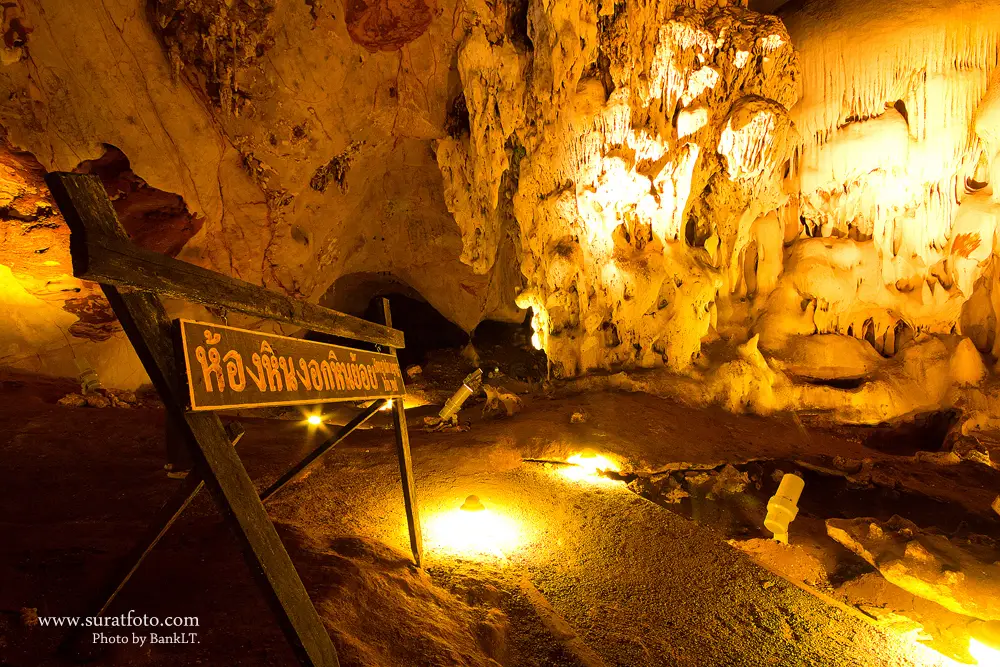
Khamin Cave in Surat Thani is a major limestone cave within Tai Rom Yen National Park in Ban Na San District. Historically known as Tham Men, or “Smelly Cave,” it once operated as a concession area for collecting bat guano for agricultural fertilizer. Remains of equipment and transport activity from that period can still be associated with the cave today. The total known cave system is approximately 2 kilometers long, while the developed nature-study route for visitors covers about 1,250 meters. The cave contains large chambers, stalactites, stalagmites, flowstone curtains, natural ceiling openings, a substantial bat colony and traces of its guano-harvesting history. Named points along the visitor route include the Jeep Courtyard, Apollo Court or Mak Khum Court, Princess Chamber, Than Khun Court, Chong Fa, Pink Curtain and Sky Curtain. Khamin Cave is also important for archaeology, religion, geology and zoology. Visitors must remain on the designated route, avoid touching formations, keep noise low, never light fires or smoke, take no natural or historical material, bring no food into the cave and follow ranger instructions at all times.
Khamin Cave in Surat Thani is one of the most important natural attractions in Ban Na San District and a significant limestone cave within Tai Rom Yen National Park. Its value extends far beyond attractive stalactites and stalagmites. The cave contains evidence of earlier resource extraction, a substantial underground ecosystem, a long developed visitor route and geological features that reveal how water gradually transformed ancient limestone into a complex system of underground chambers. Ranger Unit RY.5, commonly associated with Khamin Cave, manages visitor access and provides the most practical point of coordination for a cave visit.
Khamin Cave remains an active tourism and educational site in 2026. In July 2026, Thailand's Department of Mineral Resources held a workshop in the Khamin Cave system focusing on understanding geoheritage and improving collaborative management of the site. This continuing activity demonstrates that the cave is not an abandoned attraction but an actively managed natural heritage area where tourism, scientific interpretation and long-term conservation are being developed together.
A useful reference coordinate for the cave entrance is approximately 8.83023, 99.37945. Vehicles can reach the visitor parking area before visitors continue up steps toward the cave entrance. This makes Khamin Cave considerably easier to approach than remote caves requiring long jungle treks, although easy road access should not be confused with an entirely level or engineered interior. The cave remains a natural underground environment with humidity, uneven rock and sections where careful footing is essential.
Before the name Khamin Cave became widely used, local communities knew the site as Tham Men, meaning “Smelly Cave.” The old name was associated with the large bat colony and substantial accumulations of bat guano inside. The smell was a familiar characteristic for people living near the cave and was closely connected with one of the most important chapters in the site's human history: the commercial collection of bat guano.
Bat guano was once a valuable agricultural resource because it could be used as natural fertilizer. Before 1957, the cave was already an important source of guano for local agriculture and regional trade. Material collected inside the cave was used in the Ban Na San area and transported to other agricultural communities in southern Thailand. The cave was therefore linked directly with livelihoods and farming rather than being understood only as a scenic natural attraction.
Early guano collection depended heavily on manual labor. Workers entered the cave, filled sacks and carried the material from deeper chambers toward the entrance. The trade was connected with transportation networks in Ban Na San, including the railway, allowing guano to move from the cave to agricultural markets beyond the immediate community. This history gives Khamin Cave an unusual cultural dimension because its underground landscape was also once a workplace.
After 1974, transportation inside the cave became more mechanized. Local historical accounts describe small Jeep components being brought into the cave and assembled for transporting guano from deeper sections toward the entrance. This reduced the need to carry every sack manually over long underground distances. Traces of that working period remain one of the distinctive interpretive elements of the cave today.
The area known as the Jeep Courtyard is therefore more than an unusual name. It reflects an industrial phase in the cave's history and shows how workers adapted technology to an underground environment. Remaining equipment and traces should be treated as historical evidence rather than abandoned objects that can be moved or collected. Keeping such material in context allows future visitors to understand how people once worked inside the cave.
The transition from guano extraction to nature tourism illustrates a major change in how the cave is valued. Earlier economic value was partly measured by material removed from the cave. Today, value increasingly depends on keeping the cave intact: preserving formations, bats, historical traces, underground processes and scientific information. A designated visitor route allows people to experience the cave while limiting human movement to areas that can be managed safely.
The limestone mountain containing Khamin Cave dates to the Permian Period, approximately 280 million years ago. It is important to distinguish the age of the limestone from the age of the present cave passages. The rock itself is extremely ancient, while the cavities and chambers developed later as water dissolved and enlarged fractures. This distinction helps explain the geological history more accurately than simply describing the entire cave as 280 million years old.
Khamin Cave is a solution cave formed in carbonate rock, specifically limestone rich in calcite or calcium carbonate. Rainwater absorbs carbon dioxide from the atmosphere and additional carbon dioxide while passing through soil containing decomposing organic material. This creates weak carbonic acid, which can react with calcium carbonate in limestone.
When mildly acidic water moves into joints and fractures in the mountain, it begins dissolving tiny amounts of limestone. A large chamber does not appear suddenly. Existing cracks are enlarged gradually as water repeatedly follows the same structural weaknesses. Over long periods, small fractures can develop into underground channels and increasingly large voids.
Cave formation is more complicated than a single chemical reaction. Tectonic uplift, rock fractures, groundwater levels, rainfall and drainage routes all influence the development of underground space. Some areas become large chambers while other passages remain narrow. These interacting processes help explain the variety of underground spaces found throughout the Khamin Cave system.
The entire known cave system extends for approximately 2 kilometers, while the developed nature-study route used by visitors is approximately 1,250 meters. These figures describe different things and should not be confused. The longer figure refers to the cave system as a whole, whereas the 1,250-meter figure represents the controlled visitor route. Restricting tourism to a defined section protects more sensitive areas and allows rangers to manage visitor safety.
Once underground chambers become air-filled, mineral-rich water can begin creating the formations visitors see. Water carrying dissolved calcium reaches the cave atmosphere and releases some carbon dioxide, allowing calcium carbonate to precipitate again as solid mineral. Repeated deposition from the ceiling creates stalactites, while mineral left where droplets strike the floor can build stalagmites upward.
When upward and downward formations eventually meet, they can form columns. Water flowing across a broad rock surface can also create flowstone and curtain-like formations. Variations in water supply, mineral composition, humidity and flow direction produce very different shapes throughout the cave, including massive columns, delicate curtains and surfaces that visitors may imagine as familiar objects or animals.
The shrine associated with Than Khun near the cave area represents another dimension of the site. Khamin Cave is not only significant in natural science but is also connected with local beliefs and religious interpretations. Visitors should respect designated religious areas and should never rearrange offerings or objects associated with community practice.
Apollo Court, also referred to in local visitor material as Mak Khum Court, is another named section along the nature route. Such names turn the underground journey into a sequence of recognizable landscapes rather than an anonymous series of rocks. Listening to ranger explanations adds considerable value because names may originate from shape, past use or stories associated with a particular chamber.
The Princess Chamber is another identified section of the visitor route. Named chambers help visitors orient themselves and recognize changes in the underground environment. Groups should move together and avoid stepping outside the route simply to obtain photographs, as apparently solid areas beyond the path may contain uneven surfaces or delicate formations.
Than Khun Court contains substantial limestone formations associated with names such as Sao Ek and Lak Chai. Giving imaginative names to cave formations is common in Thai cave interpretation and helps visitors relate natural shapes to cultural ideas. The formations themselves, however, remain natural structures created through extremely slow mineral deposition and should never be climbed or used as props.
Chong Fa is a natural opening in the cave ceiling through which daylight can reach the underground space. The contrast between a dark chamber and natural light makes the architecture of the cave especially visible. Ceiling openings also illustrate that a cave continues to change through natural processes. Visitors should observe from the designated path rather than moving beneath unstable or restricted sections.
The Pink Curtain is one of Khamin Cave's visually distinctive mineral formations. Differences in mineral composition and deposition create bands and color variations on the rock surface. Some visitors interpret part of the formation as resembling a seated Buddha. Such visual comparisons are part of the cultural experience of a cave, while the physical structure itself remains a natural result of mineral precipitation.
Sky Curtain is characterized by broad curtain-like limestone growth. Light from different angles reveals layers and textures within the formation. It is a useful location for understanding that cave decoration is not produced only by individual vertical droplets. Water can move as thin films across rock, depositing mineral over wide surfaces and gradually creating large flowstone structures.
Other formations are sometimes imagined as animal shapes, including an elephant's head. Such interpretations depend strongly on viewpoint and lighting and may differ from one visitor to another. This imaginative element is part of cave tourism and requires no modification of the rock itself. Nature has already provided the form; visitors only supply the interpretation.
Khamin Cave supports a substantial bat colony. Bats use the dark and relatively stable underground environment for roosting, making the cave an ecosystem rather than simply a geological cavity. Bat guano, historically valued as fertilizer, is also part of the cave's nutrient cycle and can support smaller organisms living on the cave floor.
Visitors should not attempt to identify bat species solely from distant visual observation. Reliable identification requires zoological evidence, and cave systems may support more than one species. Khamin Cave is recognized as a site of zoological interest and cave fauna has been scientifically recorded, but tourism should remain observational rather than involving capture or close disturbance.
In 2026, Thailand's Department of National Parks issued precautionary guidance for cave and natural attractions containing bats. Recommended measures include an effective mask such as an N95, long sleeves, long trousers and closed footwear, while avoiding direct contact with bat saliva, urine and guano. These are general national preventive measures and do not indicate that Khamin Cave itself is experiencing a disease outbreak.
When bats are roosting overhead, keep voices low and never clap, shout or throw objects to make the animals fly. Such disturbance forces bats to change their behavior and expend energy unnecessarily. Repeated close-range flash photography and powerful continuous lighting directed at a colony should also be avoided.
The cave is relevant to several fields of study, including archaeology, religion, geology and zoology. Its geological importance is visible in Permian limestone, solution processes and speleothems. Zoological value comes from its cave fauna and bat colony. Human use, beliefs and the guano-extraction period add cultural dimensions. Archaeological significance should be discussed only on the basis of verified research rather than inventing artifacts or discoveries not supported by evidence.
The most appropriate visitor activity is walking the designated nature-study route with a ranger or guide, observing formations, learning about the former guano concession and understanding cave ecology. The approximately 1,250-meter route provides access to many different aspects of the system without requiring visitors to enter every underground passage.
Visitors should not enter the cave independently. Ranger or guide supervision is part of current visitor management even though the cave entrance itself is relatively accessible. A knowledgeable guide helps with safety and interpretation, identifies fragile areas, explains the historical remains and ensures that visitors do not disturb important bat-roosting sections.
Local visitor information also indicates that cave groups are normally organized from approximately four people. Solo travelers and very small groups should therefore contact the cave unit before departure to ask about joining a group and the next available entry time. Advance contact is also useful for checking weather and staff availability.
One of the most important rules is not to touch the cave formations. Human skin carries oils, sweat and other material that can contaminate actively mineralizing surfaces. Repeated contact by large numbers of visitors can alter delicate surfaces and interfere with natural deposition. Formations should therefore be observed and photographed without being handled.
The Thai tourism expression “dead rock” is sometimes used to describe cave formations that are no longer actively receiving mineral deposits. A single touch does not literally cause every formation to stop growing immediately, but contamination and repeated disturbance remain genuine conservation concerns. The correct practical rule is therefore simple: do not touch stalactites, stalagmites or flowstone unnecessarily.
Writing, scratching, hitting or tapping rock is prohibited. Tapping formations to test sound or hardness can cause damage, while graffiti may remain visible underground for an extremely long time. A natural cave should never become a place where visitors leave names or dates behind.
Fires, fireworks, incense, candles and smoking are also inappropriate inside the cave. Smoke and soot can coat rock surfaces, open flames create hazards in an enclosed environment and loud explosions can severely disturb bats. Any religious observance associated with a shrine should follow the method and location designated by park staff.
Visitors must not remove stones, mineral fragments, guano, old equipment or any other material from the cave. Objects that appear unimportant may have historical, environmental or research value when left in their original context. Removing small items repeatedly over time gradually destroys information that cannot be reconstructed.
Urination and defecation are prohibited inside the cave. Apart from hygiene, human waste alters a specialized underground environment. Visitor toilets are available outside the cave, so all personal needs should be handled before beginning the underground route.
Food should not be consumed inside the cave. Food scraps can attract animals and alter the behavior of cave organisms, while packaging creates difficult-to-remove waste. Eat before entry or after returning to the visitor area. Any necessary items carried inside must leave with the visitor.
Every piece of rubbish must be carried out, including water bottles, tissues, masks, plastic packaging and batteries. Small waste items can disappear into cracks and become extremely difficult to retrieve. Visitors should check their immediate area before leaving each stop.
Remaining on the designated path protects both people and the cave. Areas beyond the route may contain fragile surfaces, drops, active mineral deposition or wildlife habitat. Walking off route for a photograph can destroy small formations that are difficult to notice under limited lighting.
Wear clothing suitable for a humid underground environment. Long sleeves and long trousers reduce skin contact with rock and contaminated surfaces. Closed shoes with reliable traction are strongly preferable to sandals. An N95 mask is a practical option around large bat and guano concentrations, particularly for travelers sensitive to dust and odor.
Carry a flashlight or headlamp as backup even though the managed route has lighting at visitor points. Personal light is useful for inspecting footing or during any temporary lighting problem. A mobile phone should not be the group's only light source because its battery may also be required for communication.
People with asthma, respiratory conditions or strong sensitivity to dust and odor should speak with park staff before entering. Anyone who develops breathing difficulty, chest tightness, dizziness or another unusual symptom should inform the guide and return to an open-air area rather than forcing themselves to complete the route.
Access to the cave entrance involves steps, and the full natural route is not suitable for continuous wheelchair access. Older travelers and people with knee, ankle or balance limitations should assess their condition before beginning. A 1,250-meter cave walk may require more effort than the same distance on a level road because of humidity, uneven surfaces and changes in elevation.
Families with children should keep them close throughout the route. Children should not run, climb formations or touch cave surfaces. For older children, Khamin Cave can be an excellent outdoor classroom because they can directly connect geological processes, bats and conservation practices with features visible around them.
Photography should never take priority over safe movement. Do not walk backward without checking the floor and do not step beyond the route to obtain an empty background. Repeated flash should be avoided around bats, while side lighting and existing cave lighting can reveal the texture of limestone without touching the formations.
Ban Na San and Tai Rom Yen National Park receive substantial seasonal rainfall. Although Khamin Cave is managed as a year-round attraction, heavy weather can affect access or visitor schedules. Check the forecast and contact the cave unit when significant rain is expected. Published opening hours do not override a ranger's decision to restrict access for safety.
The visitor area outside the cave provides parking, toilets and a drinking-water outlet. Use these facilities before beginning the route and minimize the amount of equipment carried underground. Large bags make movement more difficult and increase the chance of striking rock surfaces.
Current admission is 40 baht for Thai adults and 20 baht for Thai children, and 200 baht for foreign adults and 100 baht for foreign children. No separate official Khamin Cave admission charge was identified beyond the relevant national-park visitor fee. Travelers should nevertheless reconfirm current rates before future trips because protected-area fees can change.
Current cave visiting hours are approximately 09:00–15:30, which are shorter than the general operating hours of the national-park area. This is practical because the cave route extends for more than a kilometer and groups need sufficient time to complete it under supervision. Arriving shortly before the closing time should not be interpreted as permission to begin the entire route.
The current contact number listed for Khamin Cave is +66 93 480 7188. Tai Rom Yen National Park can be contacted at +66 93 574 8422. Calling before leaving accommodation is the most efficient way to confirm guide availability, current access, weather conditions and group arrangements.
Getting There from Surat Thani city, follow Highway 4009 toward Ban Na San for approximately 35 kilometers. After passing Ban Na San Hospital by about 1 kilometer, take the turn toward Khamin Cave and continue for approximately 1.5 kilometers to the visitor parking area. The cave lies roughly 5 kilometers north of central Ban Na San and has relatively convenient road access.
Drivers can use “Khamin Cave” or the reference coordinate approximately 8.83023, 99.37945 in navigation systems. If a digital map suggests a minor agricultural track that differs from official roadside signs, follow the signposted visitor route instead. A designated tourism access road is preferable to a shorter but inappropriate local track.
Travelers arriving by rail can use Na San Railway Station and arrange local road transport for the remaining journey. The railway is also historically relevant because guano from the cave was once moved through the Ban Na San transportation network. The final section from the station still requires local transportation.
Khamin Cave works well as a half-day activity. A morning arrival allows time for registration, preparation, a guided cave walk and lunch in Ban Na San afterward. This schedule avoids rushing through the 1,250-meter route and leaves flexibility if the group needs additional time.
With a full day, the cave can be combined with other Ban Na San and Tai Rom Yen National Park attractions. Nearby options include the Khlong Chawang riverside area and Noen Sai Mueang Kae. Travelers wanting more forest scenery can continue toward Mueang Thuat Waterfall, Dat Fa Waterfall or the main Tai Rom Yen National Park area, subject to current conditions.
Dat Fa Waterfall provides a useful contrast with Khamin Cave because visitors can experience two different water-shaped environments in the same national-park system: underground limestone dissolution and mineral deposition in the morning, followed by surface streams and waterfalls later in the day. Both involve walking, so sufficient rest and weather flexibility should be built into the itinerary.
Ban Na San has a good selection of restaurants and cafes within a few kilometers of the cave. The summary table uses the cave as the reference point for approximate distances and includes current public phone numbers where available. Eating locally before or after the cave visit also avoids the need to carry food underground.
Accommodation is also available close to the cave and central Ban Na San. Several current resorts and small lodging properties lie within roughly 1.5–4 kilometers of the cave, making an early cave visit practical without traveling from Surat Thani city before dawn. Ban Na San can also serve as a base for exploring more of Tai Rom Yen National Park.
For students and nature enthusiasts, Khamin Cave functions as an exceptional field classroom. One site can demonstrate Permian limestone, carbonic-acid dissolution, underground drainage, speleothem development, bat ecology and the social history of guano extraction. Seeing these relationships in the field makes it easier to understand that geology, biology and human history are deeply interconnected.
The 2026 geoheritage management workshop at Khamin Cave also illustrates a contemporary approach to tourism in which success is not measured only by visitor numbers. Long-term management depends on shared understanding, controlled use and protection of geological and ecological resources. The more popular a fragile cave becomes, the more important clear paths, visitor rules and guided access become.
The remains of the guano-concession period are especially useful for connecting past and present. Jeep traces, transport routes and working history show that this underground environment once functioned as a workplace. Today's nature-study route represents a different relationship with the cave, in which knowledge can be taken away while the physical resources remain in place.
Bat guano itself can also be understood differently today. Historically valued for agriculture, it is simultaneously part of the underground nutrient cycle and can support many small organisms. Conservation therefore involves more than protecting visually attractive stalactites. Less glamorous parts of the cave ecosystem can be equally important to ecological function.
Darkness, humidity and quiet are natural characteristics of the cave rather than deficiencies to be eliminated. Lighting only key visitor areas allows people to move safely while retaining the character of the underground environment. A responsible cave experience should not require every chamber to be illuminated as brightly as an indoor building.
First-time visitors should listen carefully to the pre-entry briefing. Understanding the history of the Jeep Courtyard explains why mechanical traces remain underground. Learning about mineral deposition makes the limestone curtains more meaningful. Knowing about bat ecology explains why quiet behavior matters. Interpretation transforms a cave walk from a sequence of photographs into a coherent story.
If time is limited, make the cave the principal activity of either the morning or afternoon rather than squeezing it between multiple fixed appointments. Walking 1,250 meters underground with interpretation and observation takes more time than walking the same distance outdoors. An unhurried pace is also safer and less damaging.
Save both contact numbers before departure: Khamin Cave at +66 93 480 7188 and Tai Rom Yen National Park at +66 93 574 8422. Larger groups should contact the site in advance so rangers can manage entry appropriately. Holiday periods may bring more visitors, making extra scheduling flexibility useful.
After leaving the cave, check personal equipment and ensure no rubbish has been left behind. Wash hands with soap and water before eating, particularly if shoes or clothing have contacted cave soil or guano. Basic hygiene complements conservation practices and makes cave tourism safer without encouraging unnecessary fear of wildlife.
Khamin Cave is therefore far more than a large chamber filled with attractive stalactites and stalagmites. Ancient Permian limestone forms the geological foundation of a cave system carved later by water. Inside are mineral formations, bats and evidence of generations of human work. Almost every part of the visitor route can be read as a layer of geological, ecological or cultural history.
The cave also illustrates changing social attitudes toward natural resources. It moved from a period when value was measured partly by guano removed for fertilizer, through the growth of tourism, to modern geoheritage and ecosystem management. Preserving evidence from each stage allows the cave to function simultaneously as a natural landscape and a historical record.
If every visitor follows the basic rules—not touching formations, not breaking or writing on rock, not creating fire or smoke, not disturbing wildlife, not leaving human waste, carrying all rubbish out, bringing no food into the cave and remaining on the designated route—the cumulative human impact can be greatly reduced. These rules are what allow future visitors to experience the same natural and historical features.
For travelers exploring inland Surat Thani, Khamin Cave is suitable for general nature travelers, geology enthusiasts, families with older children, students and visitors interested in local history. It is only about 5 kilometers from central Ban Na San and can be reached conveniently from Highway 4009, making it an accessible addition to an inland Surat Thani itinerary.
The best visit begins with confirming the entry schedule, wearing secure footwear and protective clothing, carrying an appropriate mask and backup light, listening carefully to ranger instructions and allowing enough time to understand what is being seen. Approached in this way, Khamin Cave becomes more than an underground attraction: it becomes a place where hundreds of millions of years of geological history, community livelihood and a living cave ecosystem can be experienced together.
| Name | Khamin Cave |
| Former Local Name | Tham Men |
| Type | Limestone solution cave, geoheritage site, natural attraction and research location |
| Location | Ranger Unit RY.5 (Khamin Cave), Tai Rom Yen National Park, Ban Na San District, Surat Thani 84120, Thailand |
| Reference Coordinates | Approximately 8.83023, 99.37945 |
| Managing Authority | Tai Rom Yen National Park, Department of National Parks, Wildlife and Plant Conservation |
| Current Status | Active natural attraction and nature-study site with continuing geoheritage management activities in 2026 |
| Open Days | Daily, subject to current park and weather conditions |
| Cave Visiting Hours | Approximately 09:00–15:30; advance confirmation is recommended |
| Total Cave-System Length | Approximately 2 km |
| Developed Nature-Study Route | Approximately 1,250 m |
| Limestone Age | Permian limestone, approximately 280 million years old |
| Historical Importance | Former bat-guano concession area where guano was collected for agricultural fertilizer; traces of small-Jeep transport and related equipment remain part of the cave's history |
| Research Value | Archaeology, religion, geology, zoology, local history and geoheritage management |
| Named Features | Than Khun Shrine, Jeep Courtyard, Apollo/Mak Khum Court, Princess Chamber, Than Khun Court, Sao Ek, Lak Chai, Chong Fa, Pink Curtain and Sky Curtain |
| Wildlife | Bat colony and associated cave fauna |
| Visitor Access | Guided or ranger-supervised access on the designated visitor route |
| Admission | Thai: Adult 40 baht, Child 20 baht / Foreign Visitor: Adult 200 baht, Child 100 baht |
| Facilities | Parking, toilets and drinking-water outlet outside the cave |
| Recommended Equipment | Closed non-slip footwear, long sleeves, long trousers, N95 mask and backup flashlight or headlamp |
| Key Rules | Do not touch formations, write or strike rock, make fires, use fireworks, burn incense or candles, smoke, remove objects, disturb wildlife, urinate or defecate, leave rubbish, bring food into the cave or leave the designated route. |
| Getting There | From Surat Thani city, take Highway 4009 toward Ban Na San for about 35 km. Continue about 1 km beyond Ban Na San Hospital, turn toward Khamin Cave and travel approximately 1.5 km to the parking area. The cave is roughly 5 km north of central Ban Na San. |
| Khamin Cave Contact | +66 93 480 7188 |
| Tai Rom Yen National Park Contact | +66 93 574 8422 |
| Nearby Attractions | 1. Khlong Chawang Riverside, Ban Na San – about 2.8 km 2. Noen Sai Mueang Kae – about 3.3 km 3. Mueang Thuat Waterfall – about 11.2 km 4. Tai Rom Yen National Park area – about 11.5 km, Tel. +66 93 574 8422 5. Dat Fa Waterfall – about 11.6 km |
| Nearby Restaurants and Cafes | 1. Teaw Kwam Cham by Jae Cream – about 2.7 km, Tel. +66 95 036 6348 2. Krua Nasan & Baan Cha – about 4.1 km, Tel. +66 93 575 4459 3. Mr. Roadteeb & Cafe – about 4.2 km, Tel. +66 89 292 2266 4. Humble Coffee Nasan – about 5.3 km, Tel. +66 83 645 5398 5. Nacha Cafe – about 6.3 km, Tel. +66 80 701 4290 |
| Nearby Accommodations | 1. Ploynampech Resort Ban Na San – about 1.5 km, Tel. +66 87 474 0015 2. The Mountain Camp by ATV – about 1.8 km, Tel. +66 81 537 2141 3. Blue Sky Resort @ Nasan – about 2.0 km, Tel. +66 77 310 813 4. Nang FA Resort – about 3.0 km, Tel. +66 93 743 8353 5. OK Resort Nasan – about 3.9 km, Tel. +66 86 947 0202 |
Frequently Asked Questions (FAQ)
Q: Where is Khamin Cave in Surat Thani?
A: Khamin Cave is managed as part of Tai Rom Yen National Park in Ban Na San District, Surat Thani. Ranger Unit RY.5 manages the cave area. A useful cave-entrance reference coordinate is approximately 8.83023, 99.37945.
Q: Is Khamin Cave open every day and what are its opening hours?
A: The cave is currently open daily, with visitor access approximately 09:00–15:30. Access remains subject to ranger management and current conditions, so calling +66 93 480 7188 before traveling is recommended.
Q: How much is admission to Khamin Cave?
A: Current admission is 40 baht for Thai adults and 20 baht for Thai children, and 200 baht for foreign adults and 100 baht for foreign children. No separate official cave fee has been identified beyond the applicable national-park admission.
Q: How long is Khamin Cave?
A: The known cave system is approximately 2 kilometers long, while the developed nature-study route for visitors covers about 1,250 meters. Visitors must remain on the designated route and enter under ranger or guide supervision.
Q: Why was Khamin Cave once called Tham Men?
A: The former local name was associated with the large bat colony and accumulated guano inside the cave. The cave was once used commercially for collecting bat guano as agricultural fertilizer, and small Jeep transport was later introduced to help move material from deeper sections.
Q: What can visitors see inside Khamin Cave?
A: Highlights include large limestone chambers, stalactites, stalagmites, flowstone curtains, a natural ceiling opening, bats and remains connected with the former guano concession. Named sections include the Jeep Courtyard, Apollo or Mak Khum Court, Princess Chamber, Than Khun Court, Chong Fa, Pink Curtain and Sky Curtain.
Q: Can visitors enter Khamin Cave without a guide?
A: Independent entry is not recommended. Current visitor management uses ranger or guide supervision and a designated route. Solo travelers and small groups should contact the cave unit in advance to ask about group arrangements and entry times.
Q: What should visitors bring to Khamin Cave?
A: Bring closed footwear with good traction, long sleeves, long trousers, an N95 mask and a backup flashlight or headlamp. People with asthma or respiratory conditions should discuss current cave conditions with park staff before entering.
 Category: ●Nature and Wildlife
 Group: ●Caves
Last Update : 2 MonthAgo
 Last Update : 2 MonthAgo
 Click to Access the Navigation Map GPS
Kamin Cave Map
Gellery
Recommend

 Art, Culture and Heritage
 Landmarks and Memorials(1)
 Art, Craft Centres, Tradition(8)
 Museums(5)
 Educational Places
 Educational Gardens, Farm(1)
 Places of Worship
 Temple(32)
 Other Sacred Sites(8)
 Research and Development
 Royal Project(1)
 Suburban Living
 Village, Community(6)
 Local Market(1)
 National Parks and Marine Reserves(8)
 Mountain (Doi)(2)
 Dam, Reservoir, Lake(8)
 Waterfalls(34)
 Hot Springs(7)
Caves(18)
Hot Springs(7)
Caves(18)
 River, Canal(11)
 Bays and Beaches(30)
 Islands(16)
 Other natural attractions(10)
 Entertainment and Agricultural
 Animal camps and shows(6)
 Farms, Parks and Ecotourism(7)
 Outdoor and Adventure Activities(2)
 Shopping
 Shopping and Night Market(1)
 Travel Articles, Recipes
 Travel Review, Food Review(1)
 Southern Food Menu, Southern Food Recipes(1)


