
lovethailand home >South Travel Attractions >Surat Thani Travel Attractions >Phanom >Khlong Sok > Khao Sok National Park
TL;DR: Khao Sok National Park is located at Phanom, Ban Ta Khun, and Khiri Rat Nikhom districts, Surat Thani Province, Thailand, open Open Daily In Areas Not Affected By Seasonal Recovery Closures, hours 08.30 – 16.30.

Khao Sok National Park
Open Days: Open Daily In Areas Not Affected By Seasonal Recovery Closures
Opening Hours: 08.30 – 16.30
Khao Sok National Park in Surat Thani Province is one of Thailand’s most celebrated rainforest destinations. The park covers areas of Phanom, Ban Ta Khun, and Khiri Rat Nikhom districts and spans about 461,712.50 rai, or 738.74 square kilometres. Its landscape combines rugged earth mountains, dramatic limestone cliffs, tropical evergreen forest, natural streams, waterfalls, caves, nature trails, and the vast reservoir above Ratchaprapha Dam. Together, these features make Khao Sok one of the most complete inland nature destinations in southern Thailand.
Khao Sok is important not only as a tourist destination but also as a protected watershed and biodiversity-rich forest. The main park headquarters area in Khlong Sok is suitable for hiking, waterfall visits, streamside walks, and nature trails. The Ban Ta Khun side connects with Ratchaprapha Dam, also known as Cheow Lan Lake, a large reservoir surrounded by limestone mountains and floating raft houses. Visitors can therefore experience Khao Sok in two different ways: forest trails and waterfalls on the Khlong Sok side, or boat trips and lake scenery on the Cheow Lan side.
The park’s terrain is especially distinctive because it combines limestone mountains with dense evergreen rainforest. Some limestone cliffs rise sharply from the forest or lake, while other areas are covered by high, humid forest and natural streams. Important waterways such as Khlong Sok, Khlong Bang Len, and other forest streams form part of the watershed system connected with Khlong Saeng, Khlong Phum Duang, and the Tapi River. This relationship between forest, mountains, streams, and communities makes Khao Sok both a scenic destination and a crucial conservation landscape.
The forest of Khao Sok is a tropical evergreen rainforest that remains shaded and humid through much of the year. Visitors walking along the nature trails will notice the coolness of the forest, large trees, flowing streams, and bird calls. Rare plants found in the park include the white-backed palm and Rafflesia. Rafflesia is a large parasitic flower that grows on the forest floor and blooms for only a short period. Seeing it requires the right season, careful timing, and updated information from park staff.
Rafflesia is one of the symbols of Khao Sok and the rainforest of Surat Thani. The flower is large, reddish-orange, patterned, and has a distinctive natural scent. Its blooming season is usually around the late rainy season to early dry season. The Rafflesia trail at kilometre 111 or 112 is one of the best-known routes. However, in 2026, the Rafflesia viewing site at kilometre 111 closes from 1 April to 30 November, and the Bang Man ranger-unit Rafflesia site is closed throughout the year. Visitors should check the latest park announcement before planning a Rafflesia trip.
Khao Sok National Park supports a wide range of wildlife, including wild elephants, gaur, deer, muntjac, serow, tapirs, monkeys, langurs, gibbons, squirrels, hornbills, forest birds, reptiles, amphibians, and freshwater species. Rare species often associated with the area include the giant river toad and the Asian arowana. The presence of such wildlife reflects the health of the rainforest, streams, and freshwater ecosystems. Visitors should travel quietly, avoid feeding animals, stay on designated trails, and respect all park rules.
One of the most popular attractions near the park headquarters is Bang Hua Raet Waterfall, located about 3 kilometres from the headquarters. It is a 2-tier waterfall that is not very high but is shaded, scenic, and accessible by forest trail. The first tier flows from Bang Hua Raet into Khlong Sok, while the second tier lies within the stream channel. This area is a good introduction to the forest trail system on the Khlong Sok side of the park.
About 120 metres beyond Bang Hua Raet Waterfall is Wing Hin Waterfall, where water flows down to meet Khlong Sok. Around 40 metres farther upstream is Wang Yao, a natural pool suitable for resting and, when conditions are safe, swimming. This short section shows the character of Khlong Sok very well: small waterfalls, clear streams, natural pools, and shaded rainforest all connected within walking distance.
Tang Nam is one of the most distinctive natural sites on the walking route. It is about 6 kilometres from the park headquarters and about 3.2 kilometres from Wing Hin Waterfall. The site is formed by a mountain that has been cut through by water erosion, leaving two facing cliffs with Khlong Sok flowing below. The deep pool, rock walls, and stream passage make Tang Nam one of the park’s most memorable rainforest formations.
Ton Kloi Waterfall is about 9 kilometres from the park headquarters. It is a single-tier waterfall formed by Khlong Sok and has a rock platform suitable for resting near the falls. Ton Kloi is often the final major destination on the route from Bang Hua Raet Waterfall through Wing Hin Waterfall, Wang Yao, Than Sawan Waterfall, and Tang Nam. The full route is about 9 kilometres and is suitable for visitors who have time, proper footwear, and enough preparation for a humid forest walk.
Ton Sai Waterfall lies in the Khlong Sok stream system, about 11 kilometres from the park headquarters and about 2 kilometres from Ton Kloi Waterfall. It is not a very high waterfall, but it is quiet, shaded, and located deeper along the natural trail. Visitors planning to walk to Ton Sai should allow enough time, carry drinking water, and check trail conditions with park staff, especially during or after heavy rain.
Than Sawan Waterfall is known for water that flows down a steep cliff and curves like a rainbow before reaching Khlong Sok. It is about 9 kilometres from the park headquarters and about 3 kilometres from Tang Nam. This waterfall is suitable for visitors who enjoy forest waterfalls and want to see a more unusual water formation. Access requires walking, and weather conditions should be checked before setting out.
Sip Et Chan Waterfall is about 4 kilometres from the park headquarters. It descends in 11 step-like tiers along a cliff channel, with a natural pool at the lowest level when conditions are safe. The trail is steep and requires care. In 2026, Sip Et Chan Waterfall is closed throughout the year, so visitors should not include it as a main destination unless the park later announces a reopening.
Mae Yai Waterfall is one of the easiest waterfalls to reach in Khao Sok. It is about 4.5 kilometres from the park headquarters and is located beside the Surat Thani-Takua Pa road near kilometre marker 113. The waterfall is a single drop of about 30 metres and can be reached by car. It is a good choice for travelers with limited time or those who prefer a roadside waterfall rather than a deep forest walk.
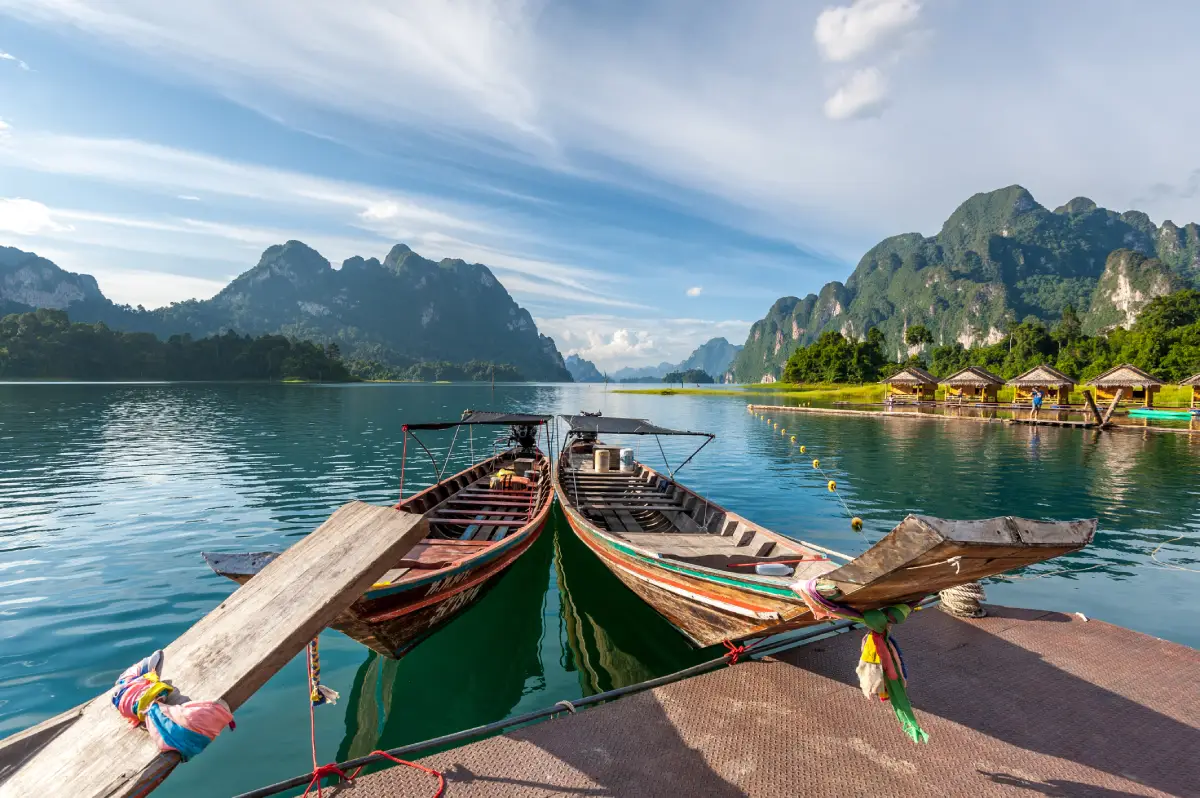
Beyond the forest trails and waterfalls, the Ratchaprapha Dam or Cheow Lan Lake zone is another iconic part of Khao Sok National Park. The northern side of the park includes a large reservoir surrounded by limestone peaks, emerald water, and floating raft houses. The most famous landmark is Khao Sam Kloe, a group of 3 limestone towers rising from the water. Popular activities in this area include boat sightseeing, kayaking, staying on floating raft houses, watching morning mist, and visiting seasonal caves.
Travelers should understand that the Khlong Sok headquarters zone and the Cheow Lan Lake zone are separate travel areas. The road distance between the two is significant, so visitors who want to experience both should plan at least 2 days and 1 night. The Khlong Sok side is best for forest trails, streams, and waterfalls. The lake side is best for boat trips, floating raft stays, and limestone scenery. Planning by zone helps reduce unnecessary travel time and creates a smoother itinerary.
Tham Nam Thalu Cave is an important cave in the Cheow Lan Lake zone. It has a stream flowing through it and is an adventurous route that requires more preparation than a typical cave visit. Safety depends heavily on rainfall and water levels. In 2026, Tham Nam Thalu is closed from 1 June to 30 November. Visitors to Cheow Lan Lake during this period should choose boat sightseeing, viewpoint stops, or floating raft stays in areas that remain open instead.
Khao Sok has several nature trails with different levels of difficulty. Route 1, from Bang Hua Raet Waterfall to Ton Kloi Waterfall, is about 9 kilometres long. It begins from the park headquarters, crosses Khlong Bang Len, and continues past Bang Hua Raet Waterfall, Wing Hin Waterfall, Wang Yao, Than Sawan Waterfall, Tang Nam, and Ton Kloi Waterfall. This route combines several streams and waterfalls into one continuous forest walk and is one of the most useful ways to understand the Khlong Sok rainforest landscape.
Route 2 is the trail to Sip Et Chan Waterfall, about 4 kilometres long, and involves a steep climb. Route 3 is a circular nature trail that partly follows the same direction as the Sip Et Chan route and covers about 2 kilometres, with steps and interpretation signs. These routes should always be checked with park staff before starting because some areas may close seasonally for safety or forest recovery.
Getting There from Surat Thani city is straightforward. Take Highway 401, the Surat Thani-Takua Pa route, toward Phanom District. At kilometre marker 109, turn into the access road and continue about 1.5 kilometres to the park headquarters. Travelers arriving by train can get off at Surat Thani railway station in Phunphin District, then take a bus or van on the Phunphin-Phuket or Surat Thani-Khao Sok route and get off near kilometre marker 109 before taking local transport to the park headquarters.
The best overall period to visit Khao Sok is from December to April, when rainfall is lower and trails are generally safer. The rainy season makes the forest lush and waterfalls powerful, but it also brings slippery trails, leeches, flash-flood risks, and seasonal closures. Visitors who want to see Rafflesia should follow park updates carefully because the flower blooms briefly and the viewing trails are subject to annual recovery closures.
Preparation should match the activity. For short visits near the headquarters, visitors should bring non-slip footwear, drinking water, a dry bag, insect repellent, and quick-drying clothing. For longer hikes, a flashlight, snacks, rain protection, and basic personal medicine are recommended. For Cheow Lan Lake, book boats or floating accommodation in advance, check the weather, wear a life jacket during boat travel, and follow all instructions from boat operators and park officers.
Responsible travel is essential in Khao Sok. Do not feed wildlife, collect plants, touch Rafflesia, write on rocks or cave walls, break cave formations, litter, make loud noise in the forest, or leave designated trails. Tropical rainforest and limestone caves are fragile ecosystems. Cave formations take a long time to form, and wildlife depends on undisturbed habitat. A good visit to Khao Sok means enjoying the scenery while leaving as little impact as possible.
Khao Sok National Park is suitable for many types of travelers: short-stay nature visitors, hikers, waterfall lovers, rare-plant enthusiasts, birdwatchers, lake travelers, and those who want to stay on floating raft houses. For the most complete experience, divide the trip into the Khlong Sok zone for trails and waterfalls and the Ratchaprapha Dam zone for boat trips and lake accommodation. This gives visitors a fuller view of Khao Sok as both a rainforest watershed and a limestone lake landscape.
| Name | Khao Sok National Park |
| Location | Phanom, Ban Ta Khun, and Khiri Rat Nikhom districts, Surat Thani Province, Thailand |
| Address | Moo 6, Khlong Sok Subdistrict, Phanom District, Surat Thani 84250, Thailand |
| Coordinates | 8.9430375, 98.533738 |
| Highlights | Rainforest, limestone mountains, Ratchaprapha Dam, Khlong Sok, Bang Hua Raet Waterfall, Wing Hin Waterfall, Wang Yao, Tang Nam, Ton Kloi Waterfall, Than Sawan Waterfall, Mae Yai Waterfall, Tham Nam Thalu Cave, Rafflesia, and white-backed palm |
| History | Thailand’s 22nd national park, with the current protected area covering about 461,712.50 rai, or 738.74 square kilometres |
| Name Origin | Named after the Khao Sok and Khlong Sok landscape, a rainforest and stream system in Phanom District, Surat Thani Province |
| Distinctive Features | Complex earth and limestone mountains, tropical evergreen forest, watershed streams, waterfalls, caves, and the reservoir above Ratchaprapha Dam |
| Travel Information | From Surat Thani city, take Highway 401 toward Takua Pa. At kilometre marker 109, turn into the access road and continue about 1.5 km to the park headquarters |
| Current Status | Open in areas not affected by seasonal recovery closures. Some attractions close during specific periods each year |
| Open Days | Open daily in areas not affected by seasonal recovery closures |
| Opening Hours | 08.30 – 16.30 |
| 2026 Seasonal Closures | 1. Rafflesia viewing site at km 111 or km 112 closes from 1 April – 30 November 2. Tham Nam Thalu Cave closes from 1 June – 30 November 3. Sip Et Chan Waterfall is closed throughout the year 4. Bang Man ranger-unit Rafflesia site is closed throughout the year |
| Fees | Thai adult 40 baht, Thai child 20 baht Foreign adult 200 baht, foreign child 100 baht 4-wheel vehicle 30 baht, motorcycle 20 baht |
| Facilities | Visitor centre, accommodation, camping area, welfare restaurant, restrooms, nature trails, boat-tour access, and floating raft accommodation services in the Ratchaprapha Dam zone |
| Main Areas / Zones | 1. Headquarters And Khlong Sok Zone 2. Bang Hua Raet, Wing Hin, And Wang Yao Zone 3. Tang Nam, Than Sawan, And Ton Kloi Zone 4. Mae Yai Waterfall Zone 5. Rafflesia Trail Zone 6. Ratchaprapha Dam And Cheow Lan Lake Zone 7. Tham Nam Thalu And Lake Cave Zone 8. Floating Raft House And Boat Route Zone |
| Caretaker | Chanakorn Aksornphet, Chief of Khao Sok National Park |
| Main Contact Number | 077-395-155, 077-395-139 |
| Official Website / Official Page | Khao Sok National Park official page and the Department of National Parks, Wildlife and Plant Conservation website |
| Nearby Tourist Attractions | 1. Bang Hua Raet Waterfall, about 3 km 2. Wang Yao, about 3 km 3. Wing Hin Waterfall, about 3 km 4. Mae Yai Waterfall, about 5 km 5. Tang Nam, about 6 km 6. Ton Kloi Waterfall, about 9 km 7. Ratchaprapha Dam, about 65 km |
| Nearby Restaurants | 1. Chao Italian Ristorante Pizzeria And Thai Food, about 0.1 km 2. Rafflesia Cafe, about 1 km, Tel. 091-037-6244 3. Khao Sok Bistro & Bar, about 1 km, Tel. 061-414-9097 4. The Misty Restaurant At Morning Mist Resort, about 1 km, Tel. 062-337-0607 5. Khao Sok Italian Thai Bistro, about 1 km, Tel. 082-277-8397 6. Khaosok Restaurant Khaosok Homestay Resort, about 2 km, Tel. 089-201-8994 |
| Nearby Accommodations | 1. Khao Sok Morning Mist Resort, about 1 km, Tel. 062-337-0607 2. Khao Sok Rainforest Resort, about 1 km, Tel. 064-224-9654 3. Khao Sok River & Jungle Resort, about 1 km, Tel. 086-945-9587 4. Khao Sok Cabana Resort, about 1 km, Tel. 081-273-6450 5. Our Jungle House, about 3 km 6. Khao Sok Boutique Camps, about 15 km |
Frequently Asked Questions (FAQ)
Q: Where is Khao Sok National Park located?
A: Khao Sok National Park is in Surat Thani Province, covering parts of Phanom, Ban Ta Khun, and Khiri Rat Nikhom districts. The main headquarters is in Moo 6, Khlong Sok Subdistrict, Phanom District.
Q: Is Khao Sok National Park open all year?
A: The park opens in areas not affected by seasonal recovery closures. Some attractions, such as Tham Nam Thalu, the Rafflesia trails, and Sip Et Chan Waterfall, close during specific periods each year.
Q: How much is the entrance fee?
A: The entrance fee is 40 baht for Thai adults, 20 baht for Thai children, 200 baht for foreign adults, and 100 baht for foreign children. Vehicle fees may also apply.
Q: What are the main highlights of Khao Sok?
A: The main highlights include tropical rainforest, limestone mountains, Ratchaprapha Dam, Khlong Sok, waterfalls, Tham Nam Thalu Cave, Rafflesia, white-backed palm, and diverse wildlife.
Q: Which zone should travelers choose?
A: Choose the Khlong Sok headquarters zone for trails, waterfalls, and streams. Choose the Ratchaprapha Dam or Cheow Lan Lake zone for boat trips, floating raft houses, and limestone lake scenery.
Q: When is the best time to visit Khao Sok?
A: December to April is generally best for hiking and boat trips because rainfall is lower and trails are safer. The rainy season is greener but requires closer attention to weather and closure announcements.
Q: When can visitors see Rafflesia in Khao Sok?
A: Rafflesia usually has a chance to bloom from the late rainy season to the early dry season, but the flower blooms briefly and the viewing trails have seasonal closures. Visitors should check updates from the park before traveling.
Q: How do travelers get to Khao Sok National Park?
A: From Surat Thani city, take Highway 401 toward Takua Pa. At kilometre marker 109, turn into the access road and continue about 1.5 kilometres to the park headquarters. Public buses and vans can drop travelers near the kilometre marker.
 Category: ●Nature and Wildlife
 Group: ●National Parks and Marine Reserves
Last Update : 2 MonthAgo
 Last Update : 2 MonthAgo
 Click to Access the Navigation Map GPS
Khao Sok National Park Map
Gellery
Recommend

 Art, Culture and Heritage
 Landmarks and Memorials(1)
 Art, Craft Centres, Tradition(8)
 Museums(5)
 Educational Places
 Educational Gardens, Farm(1)
 Places of Worship
 Temple(32)
 Other Sacred Sites(8)
 Research and Development
 Royal Project(1)
 Suburban Living
 Village, Community(6)
 Local Market(1)
National Parks and Marine Reserves(8)
Local Market(1)
National Parks and Marine Reserves(8)
 Mountain (Doi)(2)
 Dam, Reservoir, Lake(8)
 Waterfalls(34)
 Hot Springs(7)
 Caves(18)
 River, Canal(11)
 Bays and Beaches(30)
 Islands(16)
 Other natural attractions(10)
 Entertainment and Agricultural
 Animal camps and shows(6)
 Farms, Parks and Ecotourism(7)
 Outdoor and Adventure Activities(2)
 Shopping
 Shopping and Night Market(1)
 Travel Articles, Recipes
 Travel Review, Food Review(1)
 Southern Food Menu, Southern Food Recipes(1)


