
lovethailand home >South Travel Attractions >Songkhla Travel Attractions >Muang Songkhla >Koh Yo > Wat Phra Non Laem Pho
TL;DR: Wat Phra Non Laem Pho is located at Ban Suan Thurian, Moo 4, Ko Yo Subdistrict, Mueang Songkhla District, Songkhla Province, open Daily, hours 06.00–18.00.
Wat Phra Non Laem Pho
Open Days: Daily
Opening Hours: 06.00–18.00
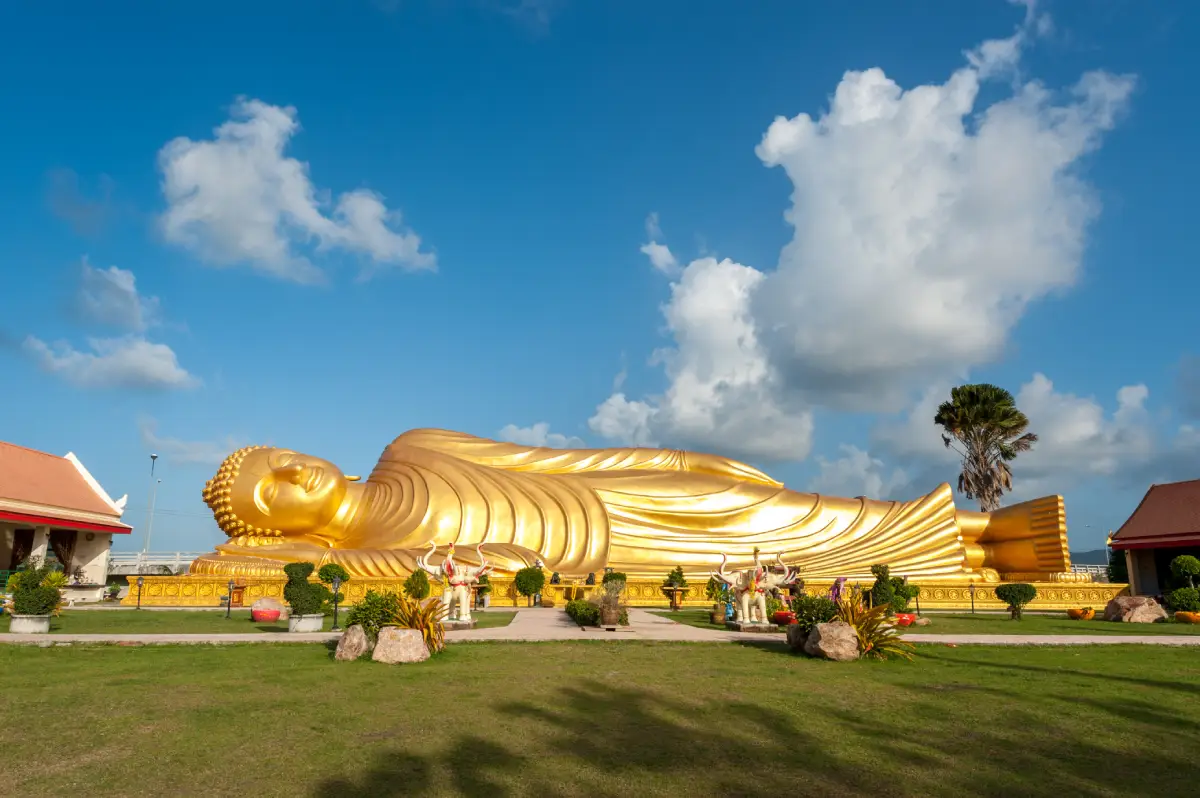
Wat Phra Non Laem Pho, also known as Wat Laem Pho, is a historic Buddhist temple in Ban Suan Thurian, Moo 4, Ko Yo Subdistrict, Mueang Songkhla District, Songkhla Province. Set beside Songkhla Lake near the Ko Yo side of Tinsulanonda Bridge, the temple is one of the most recognizable cultural landmarks on Ko Yo. Its most striking feature is the large golden reclining Buddha image, formally associated with the name Phra Non Laem Pho, which stands close to the main road and can be seen clearly by travelers crossing the bridge. Beyond this famous image, the temple also preserves an old ordination hall, a chedi, a bell tower, a Brahma shrine, a Guanyin shrine, and Phra Somdet Chao Ko Yo, making it a worthwhile stop for travelers who want to understand Ko Yo through Buddhism, local history, lake scenery, and community culture.
Wat Phra Non Laem Pho is best experienced slowly rather than as a brief photo stop. Visitors can pay respect to the reclining Buddha, observe the historic buildings, walk around the temple compound, and enjoy the open lake atmosphere. The temple stands on a flat piece of land that forms a natural cape extending toward Songkhla Lake. This position gives the temple a breezy lakeside setting and connects it naturally with other attractions around Ko Yo, including Wat Thai Yo, the Institute for Southern Thai Studies, Ko Yo viewpoints, and local seafood restaurants.
The name Wat Laem Pho comes from the landscape. The temple area forms a cape, or laem, and the area was once associated with many pho or kraphor palm trees. Local residents therefore called the temple Wat Laem Pho. After the large reclining Buddha image was built, travelers and local people increasingly referred to the temple as Wat Phra Non Laem Pho, meaning the temple of the reclining Buddha at Laem Pho. Both names refer to the same place. Wat Laem Pho preserves the older local identity, while Wat Phra Non Laem Pho reflects the temple’s modern landmark status.
The temple’s history dates back to the early Rattanakosin period. It is believed to have been founded around 1817 by Phra Khru Thipphawasi, also known as Phrom Kaeo, from Wat Thai Yo. This connection places Wat Laem Pho within the old network of Buddhist temples on Ko Yo and around Songkhla Lake. The surrounding community has long been shaped by lake fishing, fruit orchards, Ko Yo woven cloth, local food, and religious sites, all of which give the temple strong cultural context.
Wat Laem Pho received its royal grant of consecrated boundary, or wisungkhamasima, on 20 February 1888. This marked its formal religious importance as a temple where monks could perform official monastic acts. Later, important parts of the temple, especially the ordination hall and chedi, were registered as historic monuments. The temple is therefore important not only as a place of worship but also as evidence of early Rattanakosin architecture and southern local craftsmanship on Ko Yo.
The old ordination hall is one of the most valuable features of Wat Laem Pho. Its architecture reflects artistic preferences of the reign of King Rama III, interpreted through southern local craftsmanship. The building is simple, balanced, and dignified. It has a surrounding veranda, a single-tier roof with side eaves, clay roof tiles, and stucco decoration on the pediments. The front pediment depicts Indra riding the Erawan elephant, while the rear pediment depicts Vishnu riding Garuda. Around door and window frames, stucco figures of thephanom appear among floral patterns. These details show how Buddhist symbolism, royal artistic taste, and local craft traditions came together in a modest but culturally important building.
The beauty of the ordination hall lies in restraint. It does not compete with the large reclining Buddha image but adds depth to the temple experience. Wat Phra Non Laem Pho therefore has 2 layers of appeal. The first is the immediate visual impact of the golden reclining Buddha seen from the road. The second is the quieter historical value of the ordination hall, chedi, and bell tower, which rewards visitors who take time to walk through the compound and look closely.
The old chedi stands to the north of the ordination hall. It is a brick-and-plaster structure on a square base measuring about 9 x 9 meters. The base connects to short steps and a raised terrace-like area that allows visitors to walk around the structure. Small chedis decorate the corners, while the main bell-shaped upper section rises in tiers. At the lower part of the base are niches with stucco Buddha images. This chedi is an important architectural element that helps explain the historic layout of Buddhist temples around Songkhla Lake.
The bell tower is another significant feature. Built of brick and plaster, it has a square form with a tiered pyramidal top, side stairs, railing openings, green tile decoration, and stucco floral patterns. Seen together, the ordination hall, chedi, and bell tower show that Wat Laem Pho is not only a temple with a large reclining Buddha. It is also a historic temple complex with valuable old structures connected to local artistry.
The reclining Buddha image is the temple’s most famous landmark today. The image is 42.45 meters long, was constructed from 1994, and took 14 years to complete. It is enshrined on a relatively low base near the Ko Yo side of Tinsulanonda Bridge, making it highly visible to people traveling across Songkhla Lake. The golden Buddha rests in the parinibbana posture, with a serene expression and decorative patterns on the feet. Visitors often stop here to pay respect, take photographs, and begin or end a Ko Yo day trip.
The reclining Buddha should be understood as both a religious image and a community landmark. Its location near the road makes the temple easy to access, while its open-air setting connects the sacred image with the sky, sunlight, and lake atmosphere. This combination makes Wat Phra Non Laem Pho one of the most memorable temple stops in Songkhla for both Thai visitors and international travelers.
Inside the temple compound, visitors will also find a Brahma shrine, a Guanyin shrine, and Phra Somdet Chao Ko Yo, a Buddha image in the subduing Mara posture. These sacred areas reflect the layered religious culture of southern Thailand, where Buddhist devotion, local revered monks, and Chinese-influenced worship often exist within the same temple environment. Many visitors pay respect to the reclining Buddha first, then continue to other shrines around the compound.
The legend of Somdet Chao Ko Yo, also known as Phra Ratchamuni Khao Kut, adds another cultural layer to the temple. Local tradition connects this revered monk with Ko Yo’s sacred landscape and hilltop worship. This story helps visitors understand that Wat Laem Pho is part of a wider network of sacred places on Ko Yo, not an isolated roadside temple. The island contains several temples and cultural landmarks whose stories are connected through local memory, faith, and geography.
Wat Laem Pho’s lakeside setting gives it a strong sense of place. From the temple area, visitors can experience the atmosphere of Songkhla Lake, local life on Ko Yo, and the nearby line of Tinsulanonda Bridge crossing the water. The lakeside environment is especially pleasant in the morning and late afternoon when the light is softer. A visit to the temple can therefore combine merit-making, architectural observation, lake views, and a short cultural walk.
Ko Yo itself is one of Songkhla’s most distinctive communities. The island is known for fishing, sea bass raised in fish cages, fruit orchards, Ko Yo woven cloth, local food, and old temples. Wat Phra Non Laem Pho should be seen as part of this larger cultural landscape. Travelers can combine the temple with the Institute for Southern Thai Studies, Wat Thai Yo, Ko Yo viewpoints, and lakeside seafood restaurants that serve local dishes using ingredients associated with the island.
One of the main advantages of Wat Phra Non Laem Pho is accessibility. Visitors with limited time can stop for about 30 minutes to pay respect to the reclining Buddha and take photographs. Those who want a fuller cultural visit should allow at least 1 hour to see the ordination hall, chedi, bell tower, shrines, and lakeside atmosphere. Morning and late afternoon are the most comfortable times to visit because the open temple area can be hot during midday.
Visitors should follow proper temple etiquette. Dress modestly, speak quietly, do not climb onto the base of the Buddha image, avoid touching historic structures unnecessarily, and do not take disrespectful photographs in sacred areas. If entering the ordination hall or other religious buildings, remove shoes and follow any instructions provided by the temple.
The temple provides practical facilities such as parking, restrooms, shops, and food areas. These make it suitable for families, older travelers, and visitors who want an easy stop on Ko Yo. Because parts of the temple are outdoors, visitors should bring a hat, umbrella, or drinking water on sunny days. Extra care is recommended around lakeside areas and after rain, when surfaces may become slippery.
Getting There is easiest by private car or local hired transport. From Songkhla city or Hat Yai, follow the route toward Tinsulanonda Bridge and cross onto Ko Yo. The temple is located near the bridge on the Ko Yo side and is easy to recognize because of the large golden reclining Buddha. From the Songkhla–Hat Yai route, turn toward Ko Yo at Ban Nam Krachai, cross Tinsulanonda Bridge, and continue to Ban Suan Thurian, Moo 4, Ko Yo Subdistrict.
A practical Ko Yo route can begin at Wat Phra Non Laem Pho, continue to Tinsulanonda Bridge viewpoints, Wat Thai Yo, the Institute for Southern Thai Studies, and lakeside restaurants, then loop around the island to see local community scenery. Travelers with more time can return to Songkhla city and continue to Samila Beach, Khao Tang Kuan, Songkhla National Museum, and Songkhla Old Town. This makes Wat Phra Non Laem Pho suitable for both a short stop and a full-day cultural itinerary.
Wat Phra Non Laem Pho brings together several strengths in one place: a large reclining Buddha image, historic early Rattanakosin architecture, lakeside scenery, easy access from Tinsulanonda Bridge, and close links to Ko Yo’s community culture. For travelers who want to go beyond the beach side of Songkhla, this temple is one of the best starting points for understanding the relationship between Buddhism, local craft, Songkhla Lake, and island life.
| Name | Wat Phra Non Laem Pho, also known as Wat Laem Pho |
| Location | Ban Suan Thurian, Moo 4, Ko Yo Subdistrict, Mueang Songkhla District, Songkhla Province |
| Address | 55 Moo 4, Ko Yo Subdistrict, Mueang Songkhla District, Songkhla 90100, Thailand |
| Coordinates | 7.15807655, 100.55617665603 |
| Highlights | Large golden reclining Buddha image measuring 42.45 meters, historic monuments, and Songkhla Lake scenery near Tinsulanonda Bridge |
| History | Believed to have been founded around 1817 in the early Rattanakosin period by Phra Khru Thipphawasi, or Phrom Kaeo, from Wat Thai Yo. The temple received its wisungkhamasima on 20 February 1888. |
| Name Origin | The temple stands on a cape extending into Songkhla Lake and was associated with many pho palm trees. The name Wat Phra Non Laem Pho became popular because of the large reclining Buddha image. |
| Distinctive Features | Early Rattanakosin ordination hall, stucco pediments, old chedi, bell tower, open-air reclining Buddha, and a lakeside setting |
| Travel Information | Accessible by private car or local hired transport via Tinsulanonda Bridge. The temple is close to the bridge on the Ko Yo side and is easy to identify from the large golden reclining Buddha. |
| Current Status | An active local Buddhist temple under the Mahanikaya order and an important cultural attraction on Ko Yo |
| Open Days | Daily |
| Opening Hours | 06.00–18.00 |
| Fees | Free admission |
| Facilities | Parking, restrooms, shops, and food areas |
| Main Areas / Zones | Reclining Buddha image, ordination hall, chedi, bell tower, Brahma shrine, Guanyin shrine, Phra Somdet Chao Ko Yo, and lakeside area |
| Abbot / Caretaker | Phra Khru Wathithamwiphat, also known as Suchat, abbot of Wat Laem Pho |
| Main Contact Number | 074-450-438 |
| Nearby Tourist Attractions | 1. Tinsulanonda Bridge, about 1 km 2. Ko Yo Viewpoint, about 4 km 3. Wat Thai Yo, about 5 km 4. Institute for Southern Thai Studies, about 6 km 5. Wat Khao Bo, about 7 km 6. Samila Beach, about 15 km |
| Nearby Restaurants | 1. Rai Thong Restaurant Ko Yo, about 2 km, Tel. 062-359-9963 2. Nam Kieng Din Ko Yo, about 3 km, Tel. 082-179-9709 3. Mahadsajan Ko Yo, about 4 km, Tel. 095-632-4466 4. Koh Yor De Lagoon, about 5 km, Tel. 090-676-2404 5. Khunjit Seaview, about 5 km, Tel. 074-591-556 6. Sirada Ko Yo, about 6 km, Tel. 074-450-235, 081-963-8135 |
| Nearby Accommodations | 1. Sri Ko Yo Resort, about 0.5 km, Tel. 074-450-301 2. The Lake House Ko Yo, about 3 km, Tel. 086-965-2382 3. Rueanraek Homestay Ko Yo, about 5 km, Tel. 081-898-3341 4. Greenery Hill Resort @ Koyo, about 6 km, Tel. 082-889-9941 5. Laguna Grand Hotel & Spa Songkhla, about 11 km, Tel. 074-272-100 6. Kaoseng Rockhill Hotel, about 14 km |
Frequently Asked Questions (FAQ)
Q: Where is Wat Phra Non Laem Pho located?
A: Wat Phra Non Laem Pho, or Wat Laem Pho, is located in Ban Suan Thurian, Moo 4, Ko Yo Subdistrict, Mueang Songkhla District, Songkhla Province, near the Ko Yo side of Tinsulanonda Bridge.
Q: Is Wat Phra Non Laem Pho open daily?
A: Yes. Wat Phra Non Laem Pho is open daily from 06.00 to 18.00.
Q: Is there an admission fee?
A: No. Admission is free, and visitors may make donations voluntarily.
Q: What is Wat Phra Non Laem Pho best known for?
A: The temple is best known for its large golden reclining Buddha image measuring 42.45 meters, along with its old ordination hall, chedi, bell tower, and lakeside setting beside Songkhla Lake.
Q: Are Wat Phra Non Laem Pho and Wat Laem Pho the same temple?
A: Yes. Wat Laem Pho is the older local name, while Wat Phra Non Laem Pho is the popular name associated with the large reclining Buddha image.
Q: Who is the abbot of Wat Laem Pho?
A: Phra Khru Wathithamwiphat, also known as Suchat, is the abbot of Wat Laem Pho.
Q: How long should travelers spend at Wat Phra Non Laem Pho?
A: A short visit takes about 30 minutes, but travelers interested in the ordination hall, chedi, bell tower, shrines, and lakeside atmosphere should allow at least 1 hour.
Q: What nearby places can travelers visit after Wat Phra Non Laem Pho?
A: Nearby places include Tinsulanonda Bridge, Ko Yo Viewpoint, Wat Thai Yo, the Institute for Southern Thai Studies, lakeside restaurants on Ko Yo, Samila Beach, and Songkhla Old Town.
 Category: ●Places of Worship
 Group: ●Temple
Last Update : 3 MonthAgo
 Last Update : 3 MonthAgo
 Click to Access the Navigation Map GPS
Wat Phra Non Laem Pho Map
Recommend

 Art, Culture and Heritage
 Historical Sites and Monuments(2)
 Landmarks and Memorials(7)
 Royal Palace(1)
 Art, Craft Centres, Tradition(4)
 Museums(4)
 Art Gallery(1)
 Educational Places
 Library(1)
 Educational Gardens, Farm(3)
 University
 Public university(2)
 Autonomous Universities(1)
 Rajamangala University of Technology(1)
 Rajabhat University(1)
 Private University(1)
Temple(52)
 Mosque(2)
 Other Sacred Sites(11)
 Suburban Living
 Village, Community(4)
 Local Market(3)
 Floating Market(2)
 Nature and Wildlife
 National Parks and Marine Reserves(5)
 Mountain (Doi)(7)
 Dam, Reservoir, Lake(5)
 Waterfalls(12)
 Caves(4)
 River, Canal(2)
 Bays and Beaches(13)
 Islands(3)
 Other natural attractions(2)
 Entertainment and Agricultural
 Zoos and Aquariums(2)
 Animal camps and shows(1)
 Farms, Parks and Ecotourism(6)
 Waterpark(1)
 Shopping
 Department Store(3)
 Travel Articles, Recipes
 Travel Review, Food Review(1)
 Southern Food Menu, Southern Food Recipes(2)


