
lovethailand home >South Travel Attractions >Songkhla Travel Attractions >Muang Songkhla >Bo Yang > Pak Nam Laem Sai Fort
TL;DR: Pak Nam Laem Sai Fort is located at Bo Yang Subdistrict, Mueang Songkhla District, Songkhla Province, open Daily, hours 08.30 – 16.30.
Pak Nam Laem Sai Fort
Open Days: Daily
Opening Hours: 08.30 – 16.30
Pak Nam Laem Sai Fort, also known as Laem Sai Estuary Fortress or Pak Nam Laem Sai Cannon Fort, is an important historical monument in Bo Yang Subdistrict, Mueang Songkhla District, Songkhla Province. The fort stands near Laem Sai Road, behind the Mueang Songkhla Provincial Police Station and close to the Provincial Police Region 9 area. It is one of the surviving traces of Songkhla’s defensive system after the city developed on the Bo Yang side, the area that later became present-day Songkhla city. Although the fort is compact in size, it carries strong historical value as evidence of Songkhla’s role as a fortified port city in the early Rattanakosin period.
Pak Nam Laem Sai Fort helps visitors understand Songkhla beyond its beaches, old town streets, and lake scenery. The fort is connected with the historical shift of Songkhla from the Hua Khao Daeng side to the Bo Yang side. When a new urban center was established, the city required fortifications, defensive points, and control over the estuary. The fort was therefore not an isolated structure. It formed part of a wider urban and maritime landscape shaped by trade, navigation, defense, and local administration.
The name Pak Nam Laem Sai reflects both function and geography. “Pak Nam” refers to the estuary or river mouth area, while “Laem Sai” refers to the sandy cape landscape associated with the Bo Yang side of Songkhla. In the past, estuary zones were crucial for coastal cities because ships, official vessels, traders, and local boats moved through these waters. A port city needed defensive structures to monitor and protect the approach to the town. Pak Nam Laem Sai Fort served that strategic purpose.
The fort is associated with Chao Phraya Wichian Khiri, also known as Bunsang Na Songkhla, who governed Songkhla during the period around 1847–1859. This timeframe covers the late reign of King Rama III and continues into the reign of King Rama IV. Cultural and historical references identify the fort as a defensive cannon fort built to guard the boundary and estuary of Songkhla on the Bo Yang side. This links the monument with the Na Songkhla family’s role in local governance and city development during an important period in southern Thai history.
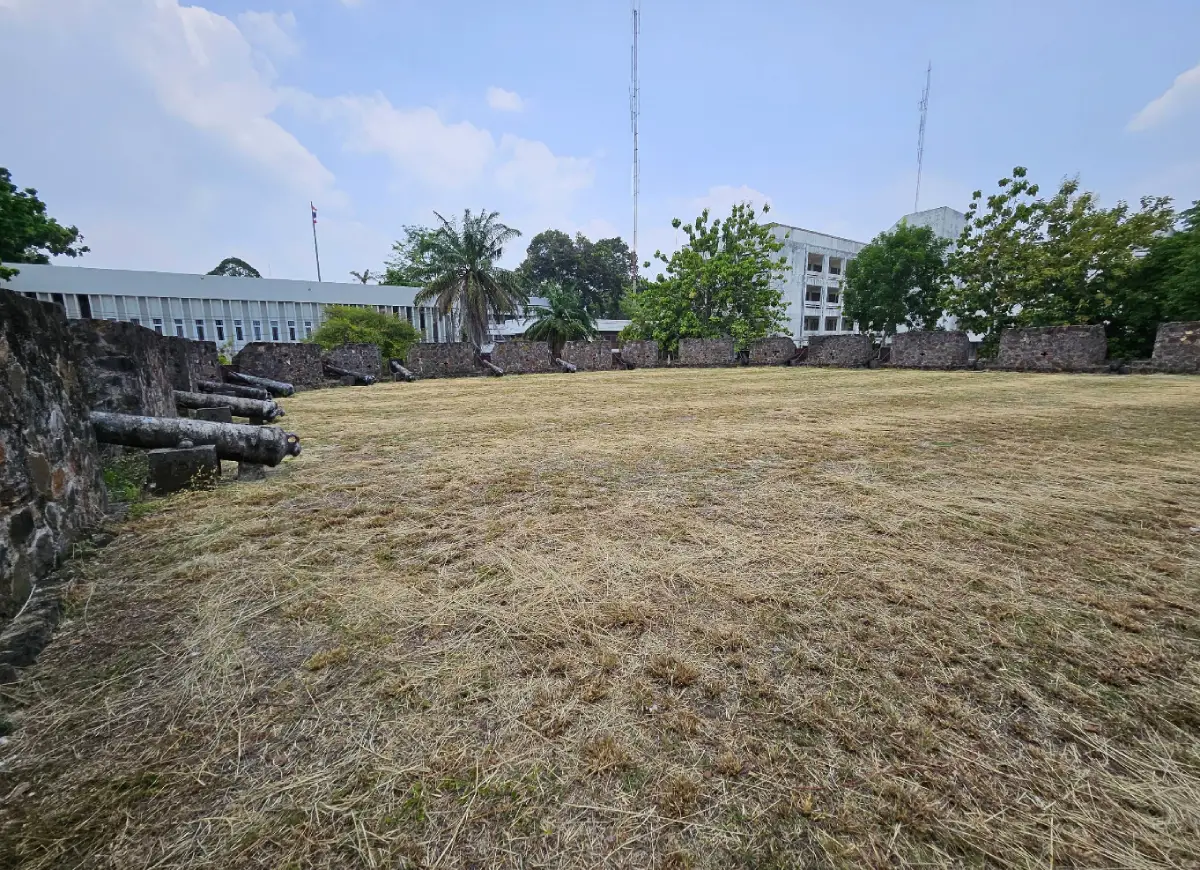
The architectural form of Pak Nam Laem Sai Fort is one of its most distinctive features. The structure is an octagonal fort, formed from a rectangular plan with all 4 corners cut away to create 8 sides. It was built of stone, brick, and mortar. The fort is about 5 sok high and roughly more than 10 wa in both width and length. Its shape reflects practical military planning, giving the fort multiple defensive angles and positions for cannon fire. It was not designed for decorative grandeur; its importance lies in function, strength, and strategic placement.
The fort is known by several names, including Pak Nam Laem Sai Fort, Laem Sai Estuary Fortress, Pak Nam Laem Sai Cannon Fort, and Songkhla Fort. In Songkhla historical chronicles, it was referred to as a boundary-defense fort. The official name used in heritage registration is Pak Nam Laem Sai Fort. These different names show how one place can hold several layers of meaning: military function, administrative memory, local identity, and national heritage status.
Pak Nam Laem Sai Fort is also linked with King Mongkut’s royal visit to Songkhla in 1859. During that journey, the king traveled by the royal vessel Mani Mekhala and stayed at a pavilion in the Laem Sai area. Historical accounts mention the fort and the cannon positions in the surrounding defensive landscape. This connection places the fort within a wider historical setting that reached beyond local memory and into the royal records of the Rattanakosin period.
During the period when Songkhla functioned as an important southern port town, the estuary was a strategic zone that needed careful protection. Songkhla was linked with maritime trade, coastal administration, and communication between regional communities. A cannon fort at the estuary reflected both security needs and the economic importance of the port. Pak Nam Laem Sai Fort therefore helps visitors understand that Songkhla grew not only from scenic geography but also from deliberate urban planning and coastal defense.
The Fine Arts Department registered Pak Nam Laem Sai Fort as a national ancient monument in the Government Gazette, Volume 52, Part 75, dated 18 March 1935. Later announcements defined and revised the protected land boundary in 1987 and 2000. The monument area covers about 7 rai and 63 square wah. These registrations confirm the fort’s status as a nationally recognized heritage site and an important cultural asset of Songkhla Province.
The Fine Arts Department also carried out restoration work at the fort during 1972–1973. Additional cannons were installed, together with surviving older cannons, so that the cannon positions were more complete. This restoration helped preserve not only the wall structure but also the visual character of the fort as a cannon defense point. For visitors, these elements make it easier to understand the original purpose of the site.
Pak Nam Laem Sai Fort should be viewed together with other historical places in Songkhla city. It is connected with Laem Sai Road, Wat Laem Sai, Songkhla Old Town, the old city wall landscape, Hub Ho Hin Red Rice Mill, Songkhla City Pillar Shrine, and the communities along Songkhla Lake. Together, these places tell the story of Songkhla as a port town, trading town, fortified town, and multicultural urban center influenced by Thai, Chinese, Malay, Buddhist, and maritime traditions.
Today, the fort is located within or near an official police compound behind the Mueang Songkhla Provincial Police Station. This makes visiting different from visiting an open public park or a beach attraction. Travelers should visit during daytime hours, dress politely, avoid disturbing official work, and coordinate with the local officers before entering the fort area. The site should be treated as both a heritage monument and an official-area landmark.
For history and archaeology travelers, the fort rewards careful observation. Visitors should look at the octagonal plan, stone and brick construction, cannon positions, wall height, and the fort’s relationship with the estuary and old urban area. These details reveal that the fort was not built merely as a landmark. It was planned around geography, defensive visibility, and the need to protect Songkhla’s maritime entrance.
The fort also fits well into a historical walking or driving route around Songkhla city. Travelers can begin at Pak Nam Laem Sai Fort and continue to Songkhla National Museum, Songkhla City Pillar Shrine, Nakhon Nok Road, Nakhon Nai Road, Hub Ho Hin Red Rice Mill, Tang Kuan Hill, Laem Son On, and Samila Beach. This route shows Songkhla as a port city, defensive city, religious city, trading town, and seaside destination in one itinerary.
In landscape terms, Pak Nam Laem Sai Fort connects Songkhla Old Town with the estuary, Songkhla Lake, and the coastal edge of the city. In the past, the area was linked with boat movement and the control of the water entrance. Today, it sits within an urban setting of roads, official buildings, communities, and nearby tourist sites. This contrast makes the fort valuable because it preserves a fragment of the older city inside the modern urban fabric.
Visitors interested in defensive architecture will find Pak Nam Laem Sai Fort especially meaningful. The octagonal plan and stone-brick construction are practical, strong, and restrained. The fort does not rely on ornate decoration. Its beauty lies in structure, purpose, material, and historical function. Looking at the fort this way helps visitors read it as an urban defense monument rather than simply as a photo stop.
For students and cultural travelers, the fort helps answer important questions about Songkhla’s past. Why did the city need a fort near the estuary? How was the new Bo Yang town protected? What role did Chao Phraya Wichian Khiri play in the city’s development? How did defense, trade, and administration overlap in a southern port town? These questions turn a visit to the fort into a structured lesson in local history.
General travelers may spend only a short time at the fort, but the experience becomes much richer when the historical background is understood. The monument is not large, yet it is dense with meaning. It connects city relocation, coastal defense, royal travel records, Fine Arts Department restoration, and national heritage registration. With this context, the compact fort becomes one of the clearest historical clues to how Songkhla became the city seen today.
Getting There is straightforward from Songkhla city. From Tang Kuan Hill or Laem Son On, drive toward Laem Sai Road and the Mueang Songkhla Provincial Police Station area. The fort is located behind or near the police compound in Bo Yang Subdistrict. From Songkhla Old Town, travelers can use Nakhon Nok Road, Nakhon Nai Road, or connecting city roads toward Laem Sai Road. Visitors arriving by private car should park only where permitted and avoid blocking official operations.
Travelers without a private car can use local transport from Songkhla Old Town, Tang Kuan Hill, Samila Beach, or the city transport area. Ask for Mueang Songkhla Provincial Police Station on Laem Sai Road, then continue to the fort area according to local access permission. Because the site is close to major city attractions, it is easy to include in a broader Songkhla city heritage route.
The best time to visit is from morning to afternoon, when there is enough daylight to see the structure clearly. Travelers who plan to continue into Songkhla Old Town can begin at the fort in the morning, then visit Songkhla National Museum, Songkhla City Pillar Shrine, Hub Ho Hin Red Rice Mill, and Nang Ngam Road for local food. This creates a compact and meaningful cultural route through the city.
Visitors should treat the fort with care. Do not climb on the structure, move cannons or heritage elements, write on the walls, litter, or use the area in ways that disturb officials or damage the monument. Pak Nam Laem Sai Fort is best experienced as a learning site that preserves the memory of Songkhla’s estuary defense and early urban history.
Pak Nam Laem Sai Fort is ideal for travelers who want to see a deeper side of Songkhla. It is especially suitable for those interested in old towns, defensive architecture, cannon forts, ancient monuments, and the history of Songkhla’s relocation to the Bo Yang side. Although the site is inside an official-area setting and must be visited respectfully, its historical value makes it a significant stop in a cultural travel plan around Songkhla city.
Pak Nam Laem Sai Fort is a compact ancient monument with a large meaning. It connects the history of Songkhla as a port town, the defense of the estuary, the Na Songkhla governors, the relocation of the city to Bo Yang, and the wider heritage landscape of Songkhla Old Town. A visit here shows that local history is not found only in museums or written records. It also remains in old walls, stonework, brickwork, and cannon positions that continue to tell the story of Songkhla today.
| Name | Pak Nam Laem Sai Fort / Laem Sai Estuary Fortress |
| Location | Bo Yang Subdistrict, Mueang Songkhla District, Songkhla Province |
| Address | Laem Sai Road area, near Mueang Songkhla Provincial Police Station, Bo Yang Subdistrict, Mueang Songkhla District, Songkhla 90000, Thailand |
| Coordinates | 7.2127130268, 100.58367497 |
| Highlights | Octagonal cannon fort built of stone, brick, and mortar; a surviving trace of Songkhla’s defensive system on the Bo Yang side |
| History / Period | Built during 1847–1859 in connection with the development of Songkhla on the Bo Yang side during the early Rattanakosin period |
| Builder / Historical Figure | Chao Phraya Wichian Khiri, also known as Bunsang Na Songkhla, governor of Songkhla |
| Name Origin | The name refers to the fort’s location near the estuary and Laem Sai area of Songkhla’s Bo Yang side |
| Distinctive Features | Octagonal plan, about 5 sok high and more than 10 wa wide and long, with cannon positions and stone-brick-mortar construction |
| Main Areas / Zones | Octagonal fort structure, cannon positions, area behind the Mueang Songkhla police compound, and Laem Sai Road historical setting |
| Heritage Registration | Registered as a national ancient monument in the Government Gazette, Volume 52, Part 75, dated 18 March 1935, with protected land boundary announcements in 1987 and 2000 |
| Travel Information | From Songkhla Old Town, Tang Kuan Hill, or Laem Son On, travel toward Laem Sai Road and the Mueang Songkhla Provincial Police Station area, then enter the fort area according to local access permission |
| Current Status | National registered ancient monument located within an official-area setting near Mueang Songkhla Provincial Police Station |
| Open Days | Daily |
| Opening Hours | 08.30 – 16.30 |
| Fees | No Admission Fee |
| Caretaker / Related Agencies | The Fine Arts Department, Songkhla Natural and Cultural Environment Conservation Unit, and Mueang Songkhla Provincial Police Station |
| Main Contact Numbers | Mueang Songkhla Provincial Police Station, Tel. 074-307-092 Songkhla Natural and Cultural Environment Conservation Unit, Tel. 0-7426-0280 |
| Nearby Tourist Attractions | 1. Tang Kuan Hill, 1 km 2. Songkhla National Museum, 1 km 3. Phathammarong Museum, 1 km 4. Laem Son On, 1 km 5. Hub Ho Hin Red Rice Mill, 2 km 6. Songkhla City Pillar Shrine, 2 km 7. Samila Beach, 2 km |
| Nearby Restaurants | 1. Lyn’s The Shanghai Cafe, 2 km, Tel. 083-243-9977 2. Khao Stu Kiat Fang, 2 km, Tel. 074-311-998 3. Ban Lee Heng Ancient Mung Bean Ice Cream, 2 km, Tel. 091-847-4450, 064-070-9559 4. Grilled Meatballs Laem Sai, 1 km, Tel. 064-859-8912 5. Sirada Restaurant Ko Yo, 9 km, Tel. 074-450-235, 081-963-8135 6. Nam Kieng Din Ko Yo, 9 km, Tel. 082-179-9709 |
| Nearby Accommodations | 1. The Luxury Residence Songkhla, 1 km, Tel. 074-321-977 2. The Singora Hotel, 1 km, Tel. 074-314-555 3. Montana Hotel Songkhla, 1 km, Tel. 074-300-614 4. Pavilion Songkhla Hotel, 2 km, Tel. 074-441-850 5. Green World Palace Hotel, 4 km 6. Club Tree Hotel, 2 km |
Frequently Asked Questions (FAQ)
Q: Where is Pak Nam Laem Sai Fort located?
A: Pak Nam Laem Sai Fort is located near Laem Sai Road and the Mueang Songkhla Provincial Police Station in Bo Yang Subdistrict, Mueang Songkhla District, Songkhla Province.
Q: Why was Pak Nam Laem Sai Fort built?
A: The fort was built as a cannon defense point to protect the boundary and estuary of Songkhla on the Bo Yang side during the development of the new Songkhla town.
Q: When was Pak Nam Laem Sai Fort built?
A: The fort was built during 1847–1859, a period covering the late reign of King Rama III and continuing into the reign of King Rama IV, and is associated with Chao Phraya Wichian Khiri.
Q: What is distinctive about the fort?
A: The fort has an octagonal plan and was built of stone, brick, and mortar. It is about 5 sok high and roughly more than 10 wa wide and long, with cannon positions around the structure.
Q: Can visitors enter Pak Nam Laem Sai Fort?
A: The fort is located within an official-area setting near Mueang Songkhla Provincial Police Station. Visitors should go during daytime operating hours and coordinate with local officers before entering the fort area.
Q: Is there an admission fee?
A: No. There is no admission fee for visiting the fort as a historical learning site.
Q: Which nearby attractions pair well with the fort?
A: Good nearby stops include Tang Kuan Hill, Songkhla National Museum, Phathammarong Museum, Hub Ho Hin Red Rice Mill, Songkhla City Pillar Shrine, Laem Son On, and Samila Beach.
Q: How do travelers get to Pak Nam Laem Sai Fort?
A: From Songkhla Old Town, Tang Kuan Hill, or Laem Son On, travel toward Laem Sai Road and the Mueang Songkhla Provincial Police Station area, then enter the fort area according to local access permission.
 Category: ●Art, Culture and Heritage
 Group: ●Landmarks and Memorials
Last Update : 3 MonthAgo
 Last Update : 3 MonthAgo
 Click to Access the Navigation Map GPS
Pak Nam Laem Sai Fort Map
Recommend

 Historical Sites and Monuments(2)
Landmarks and Memorials(7)
 Royal Palace(1)
 Art, Craft Centres, Tradition(4)
 Museums(4)
 Art Gallery(1)
 Educational Places
 Library(1)
 Educational Gardens, Farm(3)
 University
 Public university(2)
 Autonomous Universities(1)
 Rajamangala University of Technology(1)
 Rajabhat University(1)
 Private University(1)
 Places of Worship
 Temple(52)
 Mosque(2)
 Other Sacred Sites(11)
 Suburban Living
 Village, Community(4)
 Local Market(3)
 Floating Market(2)
 Nature and Wildlife
 National Parks and Marine Reserves(5)
 Mountain (Doi)(7)
 Dam, Reservoir, Lake(5)
 Waterfalls(12)
 Caves(4)
 River, Canal(2)
 Bays and Beaches(13)
 Islands(3)
 Other natural attractions(2)
 Entertainment and Agricultural
 Zoos and Aquariums(2)
 Animal camps and shows(1)
 Farms, Parks and Ecotourism(6)
 Waterpark(1)
 Shopping
 Department Store(3)
 Travel Articles, Recipes
 Travel Review, Food Review(1)
 Southern Food Menu, Southern Food Recipes(2)


