
lovethailand home >South Travel Attractions >Songkhla Travel Attractions >Krasae Sin >Choeng Sae > Wat Ek Choeng Sae
TL;DR: Wat Ek Choeng Sae is located at Ban Choeng Sae, Moo 3, Choeng Sae Subdistrict, Krasae Sin District, Songkhla Province, open Daily, hours 08.00 – 17.00.
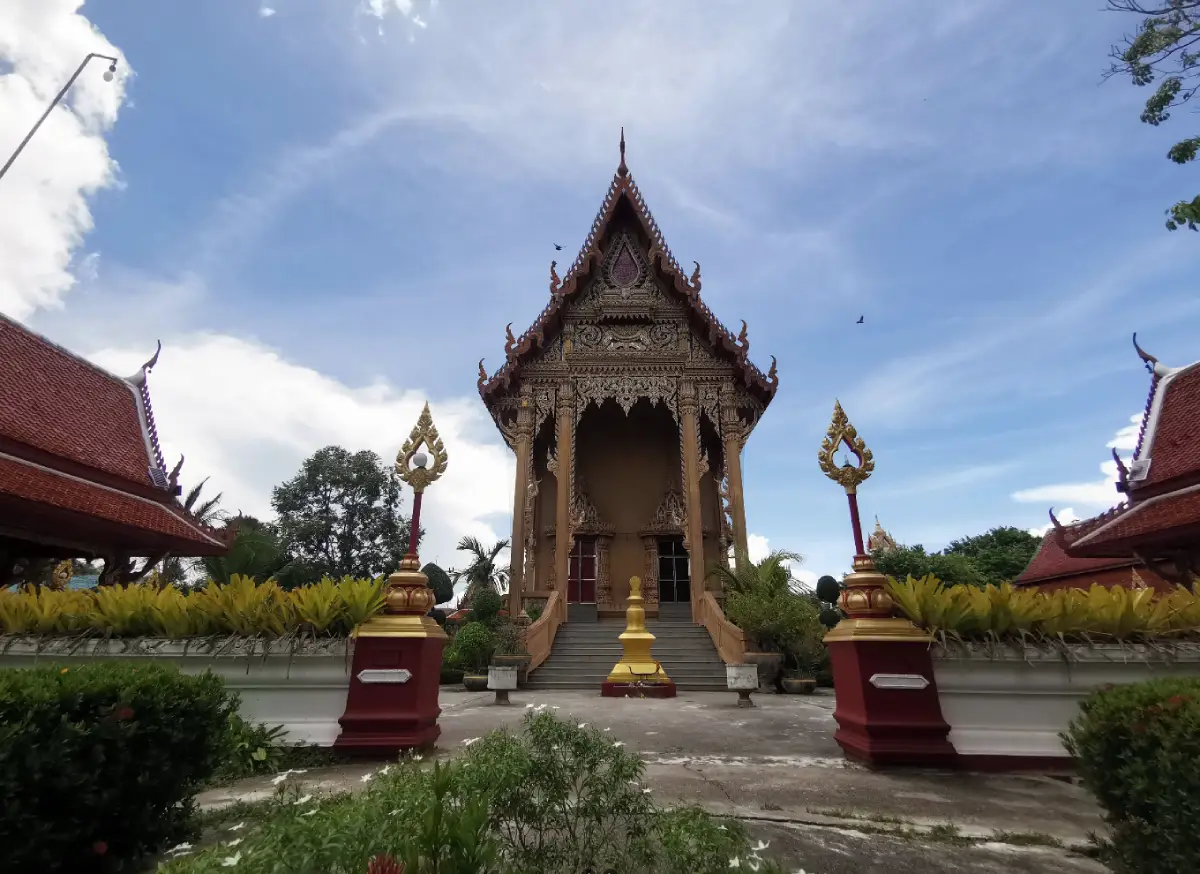
Wat Ek Choeng Sae
Open Days: Daily
Opening Hours: 08.00 – 17.00
Wat Ek Choeng Sae, also known as Wat Ek, is an old Buddhist temple in Choeng Sae Subdistrict, Krasae Sin District, Songkhla Province. Located on lowland community ground within the Songkhla Lake cultural landscape, the temple is best known for Luang Pho Derm, the principal Buddha image in the ordination hall. The original image was made from coral stone and later covered with cement. It measures about 70 centimeters across the lap and about 120 centimeters high. The temple also preserves a carved wooden replica of the Buddha’s footprint, about 80 centimeters wide and 120 centimeters long, together with a local legend about Luang Pho Derm floating on a raft and arriving at Wat Ek through the canal. Wat Ek Choeng Sae is suitable for worship, merit-making, local history study, and a cultural route linking Wat Phra Chedi Ngam, Wat Si Yang, Wat Choeng Sae Klang, Wat Choeng Sae Tai, and the sacred well at Wat Laem Bo Tho.
Wat Ek Choeng Sae is located in Choeng Sae Subdistrict, Krasae Sin District, Songkhla Province. In temple records and local cultural databases, the temple is commonly listed as Wat Ek. Some sources also connect it with older names such as Wat Choeng Sae Nuea or Wat Choeng Sae Phra Khru Ek. The temple stands on lowland ground in Ban Choeng Sae, a significant community in Krasae Sin District. The surrounding landscape includes village areas, local roads, rice fields, and routes connecting Ranot, Sathing Phra, and Phatthalung. This makes Wat Ek Choeng Sae both a religious site and a meaningful local historical landmark.
Travel to Wat Ek Choeng Sae is usually made via Highway 408, followed by Highway 4196 into Krasae Sin District. This route connects northern Songkhla with lakeside communities and the wider Songkhla Lake cultural basin. The temple is most convenient to visit by private car, rental car, or local hired vehicle, especially for travelers who plan to continue to other old temples and cultural sites nearby.
The name Wat Ek has historical interest. Some local explanations connect the word “Ek” with an old monastic title, while the name Wat Choeng Sae Phra Khru Ek appears in older local temple contexts. The name therefore preserves memory of monks, temple leadership, and the older temple network of Choeng Sae, which included Wat Choeng Sae Nuea, Wat Choeng Sae Klang, and Wat Choeng Sae Tai.
Wat Ek Choeng Sae is a local Buddhist temple under the Maha Nikaya order. It has temple land measuring 3 rai, 2 ngan, and 80 square wah. The temple stands on lowland ground and includes key monastic buildings such as the ordination hall, sermon hall, and monks’ residences. Although the compound is not large, its value lies in long-term devotion, ancient temple memory, and the importance of Luang Pho Derm as a spiritual center for Choeng Sae and nearby communities.
The temple is believed to have been founded during the Ayutthaya period and to have received its royal monastic boundary around 1557 CE. In the past, Wat Ek was said to have been prosperous, but later became neglected when no monks resided there for a period. Around 1937, monks returned to reside at the temple and restored it. Since then, Wat Ek has continued to serve as an active Buddhist temple for the community.
The most important sacred object at Wat Ek Choeng Sae is Luang Pho Derm, the principal Buddha image in the ordination hall. Luang Pho Derm is a seated meditation Buddha image. The original image was made from coral stone and was later covered with cement. It measures about 70 centimeters across the lap and about 120 centimeters high. The use of coral stone is significant because it reflects the relationship between local Buddhist art and natural materials from the Sathing Phra Peninsula and the Songkhla Lake region.
Luang Pho Derm is not only the principal image of the ordination hall. It is the spiritual center of the temple. Local people come to pay respect, make wishes, and seek blessings for success. This devotion has continued across generations. During Buddhist Lent, many people come to ordain before Luang Pho Derm as an act of faith or as a way of fulfilling vows. This shows that Wat Ek Choeng Sae has deep meaning in local religious life, not merely architectural or historical value.
A major local legend says that Luang Pho Derm, also associated with Phra Maha Thera Langka Derm, once floated on a raft together with a wooden Buddha-footprint replica. Villagers found the image and first brought it to a temple to the east, often linked in local memory with Wat Phra Chedi Ngam. Later, when villagers tried to invite the image to other temples in Choeng Sae, they pulled the raft with 3 strands of thread, but the image did not move in the direction they expected. When they lit incense and invited it to Wat Choeng Sae Nuea, now Wat Ek, the raft moved through the canal and the image came to rest at this temple. This legend gives Luang Pho Derm a strong and distinctive sacred identity.
The canal connected with this legend is remembered locally as Khlong Phae or Khlong Phra. Although parts of the canal have become shallow over time, the name preserves the memory of Luang Pho Derm’s journey in the actual landscape of Choeng Sae. Understanding this story makes worship at Wat Ek more meaningful because the temple’s sacredness is linked not only to a Buddha image but also to a canal, a raft, local faith, and community memory.
Another important sacred object at the temple is the carved wooden replica of the Buddha’s footprint. It measures about 80 centimeters wide and 120 centimeters long. Local tradition says that it floated together with Luang Pho Derm. Visitors should observe it respectfully because old wooden sacred objects require care and represent local religious craftsmanship rather than ordinary decorative art.
The ordination hall is the main sacred area of Wat Ek Choeng Sae. Luang Pho Derm is enshrined there as the principal Buddha image, and the calm atmosphere of the hall reflects the character of an old community temple. Visitors who come to make wishes or pay respect should do so quietly and respectfully. Photography should not disturb people who are praying.
The temple also has an interesting consecrated boundary and old boundary elements. These are important in Thai Buddhism because they define the area where monks perform formal Sangha acts. The presence of an ordination hall and consecrated boundary confirms Wat Ek’s status as a functioning Buddhist temple with full ritual significance.
Although Wat Ek was once neglected, the faith surrounding Luang Pho Derm helped keep the temple alive in community memory. When monks returned and restoration began, the temple gradually regained its religious role. In more recent periods, the temple buildings and surroundings have been improved, making Wat Ek better known as one of the important temples of Krasae Sin District.
In 2007, Wat Ek Choeng Sae was selected as a model temple under the Ministry of Culture’s Khon Rak Wat project. This recognition highlights its role not only as a sacred place for worship but also as an example of temple care, landscape improvement, and the use of temple space for moral and community learning.
Today, Wat Ek Choeng Sae functions as a center for Buddhist learning and self-development. The temple supports meditation and Buddhist-practice activities on important religious days, helping promote morality, ethics, and religious participation among local Buddhists. A temple with this kind of role should be understood as a living religious space, not just an old temple with a famous Buddha image.
Recent Kathin data for 2025 lists Wat Ek as an active local temple in Choeng Sae Subdistrict, Krasae Sin District, Songkhla Province, with 5 resident monks and Phra Siriphatthanodom Khunadhammo as the abbot. This confirms that the temple remains active today, with monks, merit-making, and Buddhist ceremonies continuing in the present.
Wat Ek Choeng Sae is also connected with the broader history of Krasae Sin District. The district name combines elements from Ko Yai, Choeng Sae, and Rong, and carries a meaning associated with flowing water and abundance. The temple stands in Choeng Sae, one of the root communities of the district name. This gives the temple local significance beyond its function as a place of worship.
When Wat Ek Choeng Sae is placed within the cultural map of Songkhla Lake, it connects with Wat Phra Chedi Ngam, Wat Si Yang, Wat Pha Kho, Wat Di Luang, and Wat Khian Bang Kaeo through stories, faith, and older temple networks. The legend of Luang Pho Derm especially links Wat Ek with Wat Phra Chedi Ngam and the old canal route. This makes Wat Ek one of the important points in the religious-historical landscape of lower southern Thailand.
For visitors interested in Buddhist art, the original coral-stone material of Luang Pho Derm is especially important. Even though the image is now covered with cement, the memory of its original material remains significant. Coral stone appears in some ancient religious structures and sacred objects around the Sathing Phra Peninsula and Songkhla Lake basin. Its use reflects local craftsmanship and adaptation to available natural materials.
For visitors interested in vow-making and ordination traditions, Wat Ek Choeng Sae is a clear example of how personal faith becomes part of community ritual. People who believe in Luang Pho Derm’s sacred power come to pray and later return to make merit when their wishes are fulfilled. Ordaining before Luang Pho Derm is a meaningful form of returning gratitude through religious discipline and practice.
A good visit should begin with paying respect to Luang Pho Derm in the ordination hall. Visitors can then see the wooden Buddha-footprint replica, the consecrated boundary area, the sermon hall, monks’ residences, and the surrounding temple grounds. Those interested in local stories should also consider the temple’s position in Choeng Sae and its relationship with Khlong Phae or Khlong Phra and Wat Phra Chedi Ngam.
Visitors should follow proper temple etiquette. Dress modestly, remove shoes where required, speak quietly, avoid disturbing monks or worshippers, and do not touch sacred or old objects unnecessarily. Photography should be done respectfully and should never interrupt people who are praying.
The best time to visit is in the morning or late afternoon, when the weather is more comfortable. Krasae Sin is a lowland district, and daytime heat can be strong. During the rainy season, travelers should check weather and road conditions because the Songkhla Lake basin and rice-field areas may have water in some sections. Allowing enough time makes it easier to combine the temple with nearby cultural attractions.
Getting There is easiest by private car, rental car, or local hired vehicle. From Songkhla city or Hat Yai, travel toward Sathing Phra and Ranot before entering Krasae Sin via routes connected with Highway 408 and Highway 4196. From Phatthalung, travelers can use lake-side routes through Khao Chaison, Thale Noi, or other connecting roads depending on the starting point.
Wat Ek Choeng Sae works well as a half-day or full-day cultural itinerary. For a temple-focused route, combine it with Wat Choeng Sae Klang, Wat Choeng Sae Tai, Wat Phra Chedi Ngam, and Wat Si Yang. For a broader Krasae Sin route, continue to the sacred well at Wat Laem Bo Tho, Ko Yai, and lakeside community areas. These routes help visitors understand the relationship between temples, water, community life, and local history.
Families can use Wat Ek Choeng Sae as a learning stop for children and young travelers. The site helps explain why local communities respect certain Buddha images, how temples support ordination and merit-making, and why the legend of Luang Pho Derm’s raft still matters to local people. A temple visit here can therefore become both a merit-making activity and a cultural lesson.
For photography, interesting points include the temple gate, the ordination hall, the Luang Pho Derm worship area, and the quiet atmosphere of the temple compound. Morning and afternoon light usually gives a softer quality to the scene. However, the most meaningful images of Wat Ek Choeng Sae are those that convey faith, calmness, and the temple’s relationship with the local community.
The strength of Wat Ek Choeng Sae as a destination is its clear and layered story. The temple has ancient status, Luang Pho Derm as its sacred center, a wooden Buddha-footprint replica, the raft legend, Khlong Phae, a history of restoration after decline, recognition as a model temple, and an active monastic community today. These elements make Wat Ek Choeng Sae a complete faith-based cultural attraction rather than only a local village temple.
In summary, Wat Ek Choeng Sae in Songkhla Province is a valuable old temple in Krasae Sin District and the Songkhla Lake cultural landscape. It is centered on Luang Pho Derm, the sacred coral-stone Buddha image covered with cement, and preserves a local legend connected with a raft, a canal, and Wat Phra Chedi Ngam. The temple remains open for worship, merit-making, and Buddhist activities today. For travelers who want to understand Songkhla through religion, community, and local history, Wat Ek Choeng Sae is a meaningful stop.
| Name | Wat Ek Choeng Sae, or Wat Ek |
| Location | Ban Choeng Sae, Moo 3, Choeng Sae Subdistrict, Krasae Sin District, Songkhla Province |
| Address | No. 12, Ban Choeng Sae, Moo 3, Choeng Sae Subdistrict, Krasae Sin District, Songkhla 90270, Thailand |
| Coordinates | 7.6308604, 100.3323701 |
| Map Code | J8PM+PXQ |
| Temple Type | Local Buddhist temple under the Maha Nikaya order |
| Temple Land Area | 3 Rai, 2 Ngan, and 80 Square Wah |
| Highlights | Luang Pho Derm, the sacred coral-stone Buddha image; carved wooden Buddha-footprint replica; raft legend; Khlong Phae or Khlong Phra; and recognition as a model temple under the Khon Rak Wat project |
| Former / Related Names | Wat Ek, Wat Choeng Sae Nuea, and Wat Choeng Sae Phra Khru Ek |
| History | Ancient temple believed to have been founded during the Ayutthaya period, granted its royal monastic boundary around 1557 CE, later neglected, and restored after monks returned around 1937 |
| Distinctive Features | Located on lowland community ground in Choeng Sae, with an ordination hall, consecrated boundary, sermon hall, monks’ residences, and an important faith role in Krasae Sin District |
| Important Sacred Objects / Areas | Luang Pho Derm in the ordination hall, carved wooden Buddha-footprint replica, consecrated boundary, ordination hall, sermon hall, monks’ residences, and Buddhist-practice area |
| Important Buddha Image | Luang Pho Derm, a seated meditation Buddha image originally made from coral stone and later covered with cement, about 70 cm across the lap and 120 cm high |
| Buddha-Footprint Replica | A carved wooden replica of the Buddha’s footprint, about 80 cm wide and 120 cm long, traditionally said to have floated together with Luang Pho Derm |
| Key Legend | The legend of Luang Pho Derm floating on a raft and being invited to Wat Choeng Sae Nuea or Wat Ek, remembered through the local names Khlong Phae and Khlong Phra |
| Abbot / Caretaker | Phra Siriphatthanodom Khunadhammo |
| Resident Monks | 5 Monks |
| Main Areas / Zones | Ordination hall and Luang Pho Derm area, Buddha-footprint replica area, consecrated boundary, sermon hall, monks’ residences, temple courtyard, and Buddhist-practice area |
| Traditions / Key Activities | Worship of Luang Pho Derm, ordination connected with vows and Buddhist Lent, Buddhist holy days, major Buddhist festivals, Kathin, robe-offering events, and meditation or Buddhist-practice activities |
| Travel Information | Use Highway 408 and turn onto Highway 4196 toward Krasae Sin District. Private car, rental car, or local hired vehicle is recommended |
| Current Status | Open for visits, merit-making, worship of Luang Pho Derm, and Buddhist activities as a local temple in Choeng Sae Subdistrict, Krasae Sin District, Songkhla Province |
| Open Days | Daily |
| Opening Hours | 08.00 – 17.00 |
| Main Contact Number | +66 74 399 075 |
| Facilities | Worship areas, ordination hall, sermon hall, temple courtyard, monks’ residences, Buddhist-practice area, and parking inside the temple compound |
| Recommended Visit Duration | About 45 Minutes – 1.5 Hours, or half a day when combined with Wat Phra Chedi Ngam, Wat Si Yang, and the sacred well at Wat Laem Bo Tho |
| Nearby Tourist Attractions | 1. Wat Choeng Sae Klang, About 1 km 2. Wat Choeng Sae Tai, About 1 km 3. Wat Phra Chedi Ngam, About 7 km 4. Wat Si Yang, About 10 km 5. Sacred Well at Wat Laem Bo Tho, About 12 km 6. Khlong Ranot Floating Market, About 22 km |
| Nearby Restaurants | 1. Pa Jad Restaurant, About 4 km, Tel. +66 83 168 0798 2. Lung Kaew Restaurant, Choeng Sae, About 4 km 3. BAAN Burger & Coffee, About 15 km, Tel. +66 89 463 0250 4. 595 Home Cafe Ranot, About 18 km, Tel. +66 95 065 9169 5. Baan Bua Ranot, About 18 km, Tel. +66 82 429 3451 6. Sea Beach Bar@Ranot, About 23 km, Tel. +66 86 368 3547 |
| Nearby Accommodations | 1. Mountain View Resort Kohyai, About 12 km 2. Rabeangkoh Resort, About 15 km 3. Pakbang Lake Resort, About 23 km, Tel. +66 93 756 7001 4. Tarin Hotel Ranot, About 24 km, Tel. +66 74 392 538 5. Nisa Resort Ranot, About 25 km, Tel. +66 81 541 5592 6. Cheewaporn Resort Ranod, About 27 km, Tel. +66 91 319 4197 |
Frequently Asked Questions (FAQ)
Q: Where is Wat Ek Choeng Sae located?
A: Wat Ek Choeng Sae is located in Ban Choeng Sae, Moo 3, Choeng Sae Subdistrict, Krasae Sin District, Songkhla 90270, Thailand.
Q: What are the opening days and hours of Wat Ek Choeng Sae?
A: Wat Ek Choeng Sae is open daily from 08.00 to 17.00.
Q: What makes Wat Ek Choeng Sae special?
A: The temple is special because of Luang Pho Derm, the sacred Buddha image originally made from coral stone, the carved wooden Buddha-footprint replica, the raft legend, and its long-standing role as a spiritual center of the Choeng Sae community.
Q: What is Luang Pho Derm at Wat Ek Choeng Sae like?
A: Luang Pho Derm is a seated meditation Buddha image originally made from coral stone and later covered with cement. It measures about 70 centimeters across the lap and about 120 centimeters high.
Q: Does Wat Ek Choeng Sae have a Buddha-footprint replica?
A: Yes. The temple has a carved wooden Buddha-footprint replica measuring about 80 centimeters wide and 120 centimeters long, traditionally said to have floated with Luang Pho Derm.
Q: Who is the abbot of Wat Ek Choeng Sae?
A: The abbot of Wat Ek Choeng Sae is Phra Siriphatthanodom Khunadhammo.
Q: How can travelers get to Wat Ek Choeng Sae?
A: Travelers can use Highway 408 and then turn onto Highway 4196 toward Krasae Sin District before continuing to Choeng Sae Subdistrict. Private car, rental car, or local hired vehicle is recommended.
Q: What nearby attractions can be visited after Wat Ek Choeng Sae?
A: Nearby places include Wat Choeng Sae Klang, Wat Choeng Sae Tai, Wat Phra Chedi Ngam, Wat Si Yang, the sacred well at Wat Laem Bo Tho, and Khlong Ranot Floating Market.
Tel : 074399075
 Tel : 074399075
 Category: ●Places of Worship
 Group: ●Temple
Last Update : 3 MonthAgo
 Last Update : 3 MonthAgo
 Click to Access the Navigation Map GPS

 Art, Culture and Heritage
 Historical Sites and Monuments(2)
 Landmarks and Memorials(7)
 Royal Palace(1)
 Art, Craft Centres, Tradition(4)
 Museums(4)
 Art Gallery(1)
 Educational Places
 Library(1)
 Educational Gardens, Farm(3)
 University
 Public university(2)
 Autonomous Universities(1)
 Rajamangala University of Technology(1)
 Rajabhat University(1)
 Private University(1)
Temple(52)
 Mosque(2)
 Other Sacred Sites(11)
 Suburban Living
 Village, Community(4)
 Local Market(3)
 Floating Market(2)
 Nature and Wildlife
 National Parks and Marine Reserves(5)
 Mountain (Doi)(7)
 Dam, Reservoir, Lake(5)
 Waterfalls(12)
 Caves(4)
 River, Canal(2)
 Bays and Beaches(13)
 Islands(3)
 Other natural attractions(2)
 Entertainment and Agricultural
 Zoos and Aquariums(2)
 Animal camps and shows(1)
 Farms, Parks and Ecotourism(6)
 Waterpark(1)
 Shopping
 Department Store(3)
 Travel Articles, Recipes
 Travel Review, Food Review(1)
 Southern Food Menu, Southern Food Recipes(2)


