
lovethailand home >South Travel Attractions >Songkhla Travel Attractions >Sa Dao >Pa Dang Besa > Wat Tham Khao Rup Chang
TL;DR: Wat Tham Khao Rup Chang is located at Ban Na Tham, Moo 6, Padang Besar Subdistrict, Sadao District, Songkhla Province, open Daily, hours 08.00 – 18.00.
Wat Tham Khao Rup Chang
Open Days: Daily
Opening Hours: 08.00 – 18.00
Wat Tham Khao Rup Chang, also known as Wat Khao Rup Chang, is an important cave temple in Padang Besar Subdistrict, Sadao District, Songkhla Province. The temple is located at Ban Na Tham, Moo 6, about 13 km from Padang Besar Market. Its main distinction is the use of a natural cave as a Buddhist sacred space. Inside the cave, several chambers contain Buddha images, a reclining Buddha, Guanyin, and other sacred figures, while some rooms feature stalactites, stalagmites, a stream, and atmospheric lighting that creates a peaceful setting for worship, meditation, and cultural sightseeing.
This temple is one of the most distinctive attractions in Padang Besar and Sadao District. It is different from many conventional Thai temples because it combines a limestone cave landscape, a hillside setting in the Khao Kaew mountain range, Thai-Chinese Buddhist art, and a history shaped by monks and devotees from Singapore. Visitors can see a marble stupa inspired by the Mahabodhi Temple in Bodh Gaya, a cave shrine, Buddha images, a shaded temple compound, flowing water, and green mountain scenery near the Thai-Malaysian border.
Wat Tham Khao Rup Chang is located in Padang Besar, a border area of Songkhla with a strong multicultural character. The town brings together Thai Buddhist, Thai Muslim, Thai-Chinese, Malaysian, and Singaporean influences. Because of this location, the temple is not only a local Buddhist temple, but also a cross-border pilgrimage and travel destination. Thai visitors, Malaysian travelers, and Singaporean devotees often come here to pay respect, meditate, and admire the temple’s unusual architecture.
The modern history of Wat Tham Khao Rup Chang began in 1968, when the Singaporean monk Phra Mongkhonyanakhun, also known as Chuang Chia Yasaro, traveled through Padang Besar and practiced meditation in the Khao Rup Chang cave area. From a quiet natural cave, the site gradually developed into a Buddhist sanctuary through the faith and support of monks, disciples, Thai devotees, and Singaporean followers. Over time, the temple became a well-known religious and cultural attraction of Songkhla Province.
Phra Mongkhonyanakhun is central to the temple’s story because he was the first abbot and the person who laid the foundation for developing the cave into an organized and beautiful sacred site. He passed away on 21 November 2010, but the faith he inspired remains visible in the marble stupa, the cave shrine, and the continuing relationship between the temple and devotees from Singapore and Malaysia. This gives Wat Tham Khao Rup Chang a rare identity as a Thai Buddhist temple shaped by cross-border devotion.
The current abbot is Phra Athikan Ho Chi Chantako, a Singaporean monk who continues the temple’s long connection with Singaporean Buddhist faith. This continuity is one of the temple’s defining features. It shows how Buddhism, Thai culture, Chinese artistic influence, and regional travel networks meet naturally in this borderland setting.
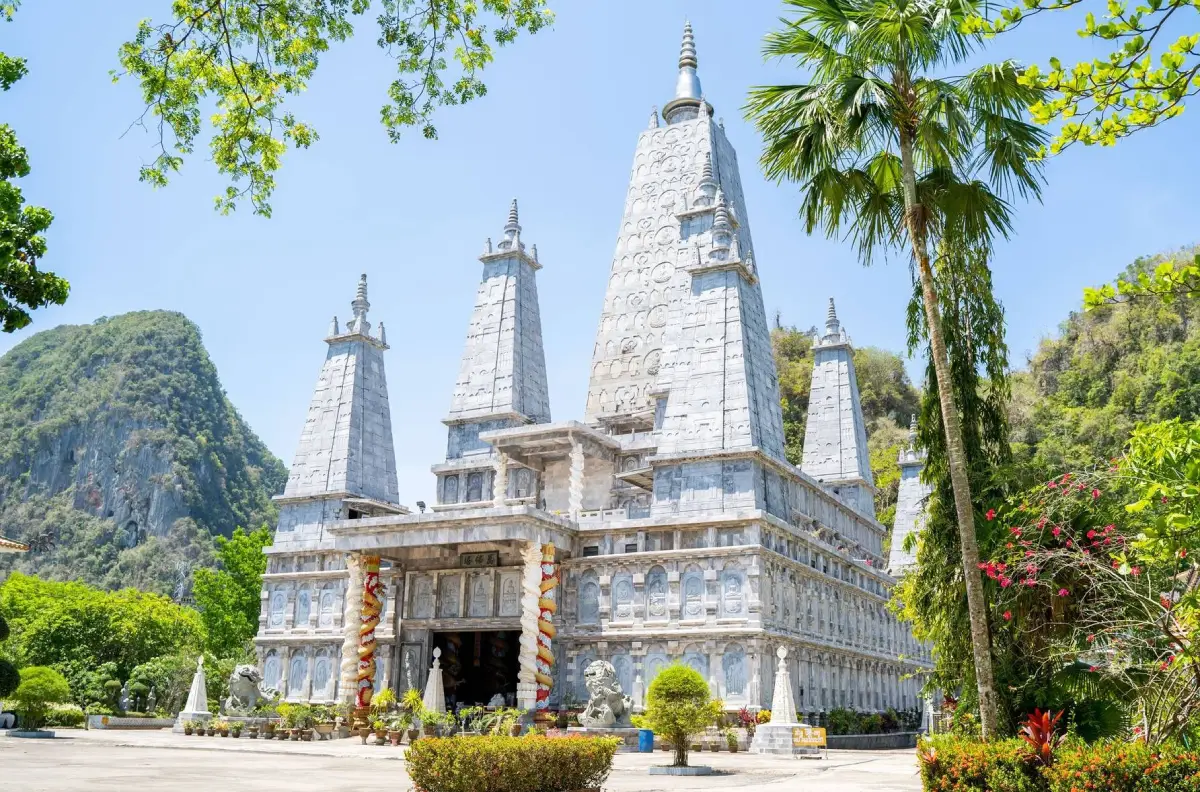
The most striking structure at the temple is the grey marble stupa inspired by the Mahabodhi Temple in Bodh Gaya, India. Standing against a backdrop of green hills, the stupa gives the temple a strong visual identity and makes it one of the most memorable Buddhist landmarks in southern Songkhla. It is not only a photogenic structure, but also a place of worship connected with the symbolism of the Buddha’s enlightenment.
The stupa has 2 main levels. The lower level houses Buddha images and the main Buddha image, with red columns wrapped by sculpted dragons, Chinese-style murals, and decorative reliefs. Small Buddha images line the interior walls, creating a calm and orderly sacred atmosphere. The visual language is clearly Thai-Chinese, making the temple distinct from many standard Thai Buddhist temples.
The upper level is reached by stairs decorated with murals along the way. At the top, visitors can walk around the stupa area and view the Khao Kaew mountain range. This level combines architecture and landscape, allowing visitors to experience both the religious structure and the natural scenery around Padang Besar. Morning and late afternoon are especially good times for photography because the light softens the marble and brings out the shape of the surrounding hills.
The cave remains the original heart of Wat Tham Khao Rup Chang. The interior is divided into several chambers, each with its own atmosphere. Some areas contain Buddha images in different postures, some contain the reclining Buddha, and others are dedicated to Guanyin. In certain chambers, natural limestone formations add depth and texture to the spiritual setting. Walking through the cave feels like moving from the outside world into a quieter, more contemplative space.
The reclining Buddha inside the cave is one of the temple’s main sacred images. In Buddhist symbolism, a reclining Buddha is associated with calmness, letting go, and reflection on the Buddha’s teachings. Placed inside the cool and quiet cave, the image feels different from one housed in a conventional hall. The cave’s echo, stone walls, and subdued lighting create a setting that supports quiet worship and meditation.
Guanyin, also enshrined inside the cave, reflects the presence of Mahayana Buddhist and Chinese devotional traditions in this border area. Many visitors come to ask for compassion, protection, and peace. The coexistence of Thai-style Buddha images, the reclining Buddha, and Guanyin makes Wat Tham Khao Rup Chang welcoming to different groups of Buddhist devotees.
The stalactites and stalagmites inside the cave are an important natural feature of the temple. These limestone formations developed slowly over a long period of time, and the lighting inside the cave helps reveal their shapes and surfaces. Visitors should not touch or damage the formations, as they are fragile natural features and part of the temple’s environmental value.
The temple grounds are spacious and shaded, with greenery and flowing water that make the area feel cooler and calmer than many open-air sites in southern Thailand. Around the temple, visitors can also see statues, marble carvings, and Buddha images in different postures. These outdoor features extend the worship experience beyond the cave and stupa.
Wat Tham Khao Rup Chang is popular with both Thai and Malaysian visitors because it is located near Padang Besar Market and the border route. From Hat Yai, the temple can be visited as a day trip. The drive passes through Sadao District, agricultural areas, local communities, and mountain scenery before reaching the quieter hillside area where the temple stands.
Visitors should allow more time than a quick photo stop. The temple includes the marble stupa, cave shrine, reclining Buddha, Guanyin shrine, viewpoint, and shaded grounds. A comfortable visit usually takes about 1 to 2 hours. Morning and late afternoon are the best times because the weather is more comfortable and the light is better for viewing the architecture.
For photography, the most interesting scenes include the stupa against the mountains, the red dragon columns, Chinese-style murals, the stairway to the upper level, and the cave chambers with illuminated limestone formations. Photography should be done respectfully. Avoid flash in sensitive areas, do not disturb people who are praying or meditating, and never pose disrespectfully with Buddha images or sacred objects.
The temple is also associated with meditation, observance of precepts, and vegetarian practice among some devotees, especially visitors from Singapore and Malaysia during certain periods. This gives the temple a quieter and more devotional atmosphere than an ordinary tourist attraction. Visitors should keep their voices low and respect those who come for religious practice.
From a geographical point of view, Wat Tham Khao Rup Chang is valuable because the temple is built around a natural cave and hillside setting. The cave creates a sacred interior space that feels deeper and more atmospheric than a fully man-made structure. Moving from chamber to chamber allows visitors to experience a gradual transition from the outside world into a calmer space of worship.
Comfortable footwear is recommended because the temple includes outdoor paths, stairs, and cave areas. Some sections inside the cave may be damp or slippery, so elderly visitors and children should walk carefully. Those who plan to go up to the viewpoint on the stupa should assess their physical condition before climbing the stairs. Bringing drinking water and visiting during daylight hours will make the trip more comfortable.
Getting There from Hat Yai is straightforward by private car or rental car. The distance is about 50 to 60 km, and the drive usually takes a little over 1 hour. Follow the route toward Sadao and Padang Besar, then continue to Wat Khao Rup Chang or Wat Tham Khao Rup Chang. The temple is about 13 km from Padang Besar Market, and the final section leads into a local hillside area. A private car is the most convenient option, especially for travelers who want to combine the temple with Padang Besar town or the border area.
Travelers using the train can get off at Padang Besar railway station on the Thai side, then continue by local transport, hired vehicle, or taxi to the temple. This route suits travelers who want to explore Padang Besar slowly, including the border town, local market, Chinese shrine, mosque, restaurants, and the cave temple in the same day.
For a one-day itinerary from Hat Yai, start at Wat Tham Khao Rup Chang in the morning to pay respect and explore the cave before the weather becomes hot. Then return to Padang Besar town for food and a walk around the border community. Nearby stops can include Hok Tek Phaek Kong Shrine, Musafireen Al-Pattaniyah Mosque, Padang Besar Market, and Padang Besar railway station before returning to Hat Yai in the evening.
Travelers who prefer to stay overnight can choose accommodation in Padang Besar or Sadao. Padang Besar is convenient for those who want to focus on the border town and temple, while Hat Yai is better for travelers who prefer a wider choice of restaurants, shopping, and transport connections. Either option can work well depending on the travel style.
Because Wat Tham Khao Rup Chang is both a tourist attraction and an active religious site, visitors should dress modestly and behave respectfully. Avoid touching Buddha images, climbing on sculptures, writing on cave walls, or damaging limestone formations. These simple practices help preserve the temple’s sacred atmosphere and natural beauty for future visitors.
The appeal of Wat Tham Khao Rup Chang lies in its rare combination of natural cave, marble stupa, Thai-Chinese Buddhist art, Singaporean and Malaysian devotional links, meditation atmosphere, and borderland mountain scenery. For travelers looking for a peaceful and meaningful destination in Songkhla, this temple offers more than a quick sightseeing stop. It is a place where faith, nature, architecture, and regional history meet in one memorable setting.
| Name | Wat Tham Khao Rup Chang / Wat Khao Rup Chang |
| Location | Ban Na Tham, Moo 6, Padang Besar Subdistrict, Sadao District, Songkhla Province |
| Address | Moo 6, Padang Besar Subdistrict, Sadao District, Songkhla 90240, Thailand |
| Coordinates | P78H+32, Padang Besar, Sadao, Songkhla / 6.7154, 100.2777 |
| Highlights | Natural cave temple, marble stupa inspired by the Mahabodhi Temple in Bodh Gaya, reclining Buddha, Guanyin, stalactites, stalagmites, stream, and Khao Kaew mountain viewpoint |
| History | The cave area was developed into a Buddhist sanctuary from 1968 by Phra Mongkhonyanakhun, or Chuang Chia Yasaro, a Singaporean monk, with support from disciples and devotees. |
| Name Origin | The name is connected with the Khao Rup Chang cave and hill area around Ban Khao Rup Chang, the key natural landscape of the temple. |
| Distinctive Features | A Maha Nikaya Buddhist temple with Thai-Chinese art, a cave sanctuary, a hillside setting, and strong popularity among Thai, Malaysian, and Singaporean visitors |
| Travel Information | Drive from Hat Yai toward Sadao and Padang Besar, about 50–60 km and a little over 1 hour. The temple is about 13 km from Padang Besar Market. Train travelers can get off at Padang Besar railway station on the Thai side and continue by local transport. |
| Current Status | Open to visitors and continues to function as a maintained Buddhist temple and worship site |
| Open Days | Daily |
| Opening Hours | 08.00 – 18.00 |
| Fees | No admission fee |
| Facilities | Worship areas, parking area, walking areas, cave shrine, stupa, viewpoint, and shaded temple grounds |
| Main Areas / Zones | Cave shrine, Buddha image chambers, reclining Buddha, Guanyin shrine, limestone formation chambers, marble stupa, lower stupa level, upper stupa level, Khao Kaew mountain viewpoint, and stream area |
| Abbot / Caretaker | Phra Athikan Ho Chi Chantako |
| Main Contact Number | 074-444-400 |
| Nearby Tourist Attractions | 1. Padang Besar Market, about 13 km 2. Padang Besar Railway Station, Thai side, about 13 km 3. Hok Tek Phaek Kong Shrine, Padang Besar, about 13 km 4. Musafireen Al-Pattaniyah Mosque, about 13 km 5. Sadao Border Checkpoint / Dannok, about 40 km |
| Nearby Restaurants | 1. Five Star PTT Padang Besar Branch, about 13 km, Tel. 089-466-1951 2. Ho Fa Restaurant Padang Besar, about 13 km 3. Je Muay Braised Duck Noodles Padang, about 13 km 4. Jungle Cafe Tesco Lotus Express Padang Besar Branch, about 13 km 5. Je Ai Original Pua Ta Tum, Khlong Ngae, about 33 km, Tel. 091-167-8559 |
| Nearby Accommodations | 1. Berlin Guesthouse Padang Besar, about 13 km, Tel. 074-521-901 2. Siam Orchid Padang Besar, about 13 km, Tel. 074-521-478, 074-521-961 3. Light House Padang Besar, about 13 km, Tel. 074-521-233, 074-521-017 4. Royal Inn Padang Besar, about 13 km, Tel. 074-521-430, 074-521-721 5. Padang Besar Border Private Room & Hostel, about 13 km |
Frequently Asked Questions (FAQ)
Q: Where is Wat Tham Khao Rup Chang located?
A: Wat Tham Khao Rup Chang is located at Ban Na Tham, Moo 6, Padang Besar Subdistrict, Sadao District, Songkhla Province, about 13 km from Padang Besar Market.
Q: What is special about Wat Tham Khao Rup Chang?
A: The temple is known for its natural cave sanctuary, marble stupa inspired by the Mahabodhi Temple in Bodh Gaya, reclining Buddha, Guanyin shrine, stalactites, stalagmites, stream, and Khao Kaew mountain viewpoint.
Q: What are the opening days and hours?
A: The temple is open daily from 08.00 to 18.00.
Q: Is there an admission fee?
A: No. There is no admission fee, though visitors may make merit or donate voluntarily.
Q: Why is the marble stupa important?
A: The stupa is inspired by the Mahabodhi Temple in Bodh Gaya, India. It has 2 levels, Buddha images, dragon columns, murals, and an upper area that offers views of the Khao Kaew mountain range.
Q: How can I travel from Hat Yai to Wat Tham Khao Rup Chang?
A: Drive from Hat Yai toward Sadao and Padang Besar, a distance of about 50–60 km. The trip takes a little over 1 hour. Train travelers can get off at Padang Besar railway station on the Thai side and continue by local transport.
Q: What is the best time to visit?
A: Morning or late afternoon is best because the weather is more comfortable, the light is good for photography, and visitors have enough time to explore the stupa, cave, and temple grounds.
Q: How should visitors behave inside the temple?
A: Visitors should dress modestly, speak quietly, avoid touching Buddha images or sacred objects, and avoid damaging limestone formations inside the cave.
 Category: ●Places of Worship
 Group: ●Temple
Last Update : 3 MonthAgo
 Last Update : 3 MonthAgo
 Click to Access the Navigation Map GPS
Wat Tham Khao Rup Chang Map
Recommend

 Art, Culture and Heritage
 Historical Sites and Monuments(2)
 Landmarks and Memorials(7)
 Royal Palace(1)
 Art, Craft Centres, Tradition(4)
 Museums(4)
 Art Gallery(1)
 Educational Places
 Library(1)
 Educational Gardens, Farm(3)
 University
 Public university(2)
 Autonomous Universities(1)
 Rajamangala University of Technology(1)
 Rajabhat University(1)
 Private University(1)
Temple(52)
 Mosque(2)
 Other Sacred Sites(11)
 Suburban Living
 Village, Community(4)
 Local Market(3)
 Floating Market(2)
 Nature and Wildlife
 National Parks and Marine Reserves(5)
 Mountain (Doi)(7)
 Dam, Reservoir, Lake(5)
 Waterfalls(12)
 Caves(4)
 River, Canal(2)
 Bays and Beaches(13)
 Islands(3)
 Other natural attractions(2)
 Entertainment and Agricultural
 Zoos and Aquariums(2)
 Animal camps and shows(1)
 Farms, Parks and Ecotourism(6)
 Waterpark(1)
 Shopping
 Department Store(3)
 Travel Articles, Recipes
 Travel Review, Food Review(1)
 Southern Food Menu, Southern Food Recipes(2)


