
TL;DR: Wat Khuat is located at Moo 5, Ban Khlong Han, Tambon Khae, Chana District, Songkhla Province, open Daily, hours 08.00 – 17.00.
Wat Khuat
Open Days: Daily
Opening Hours: 08.00 – 17.00
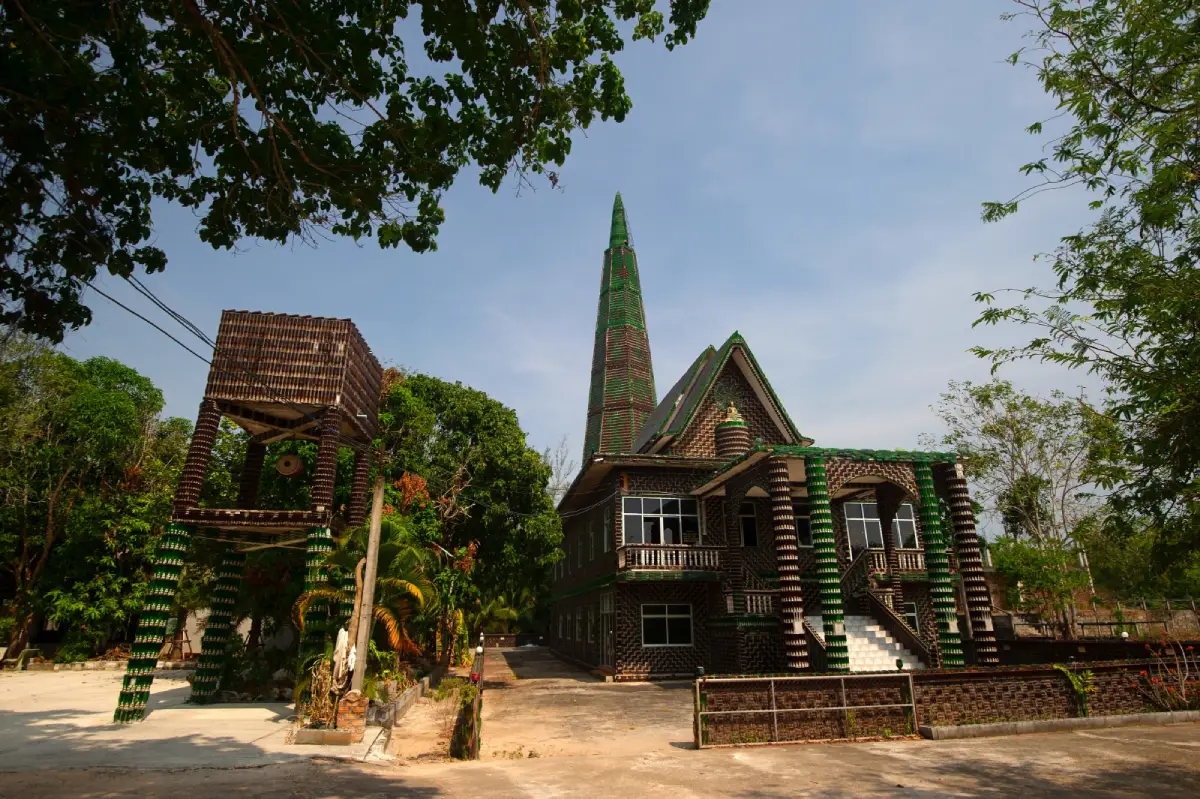
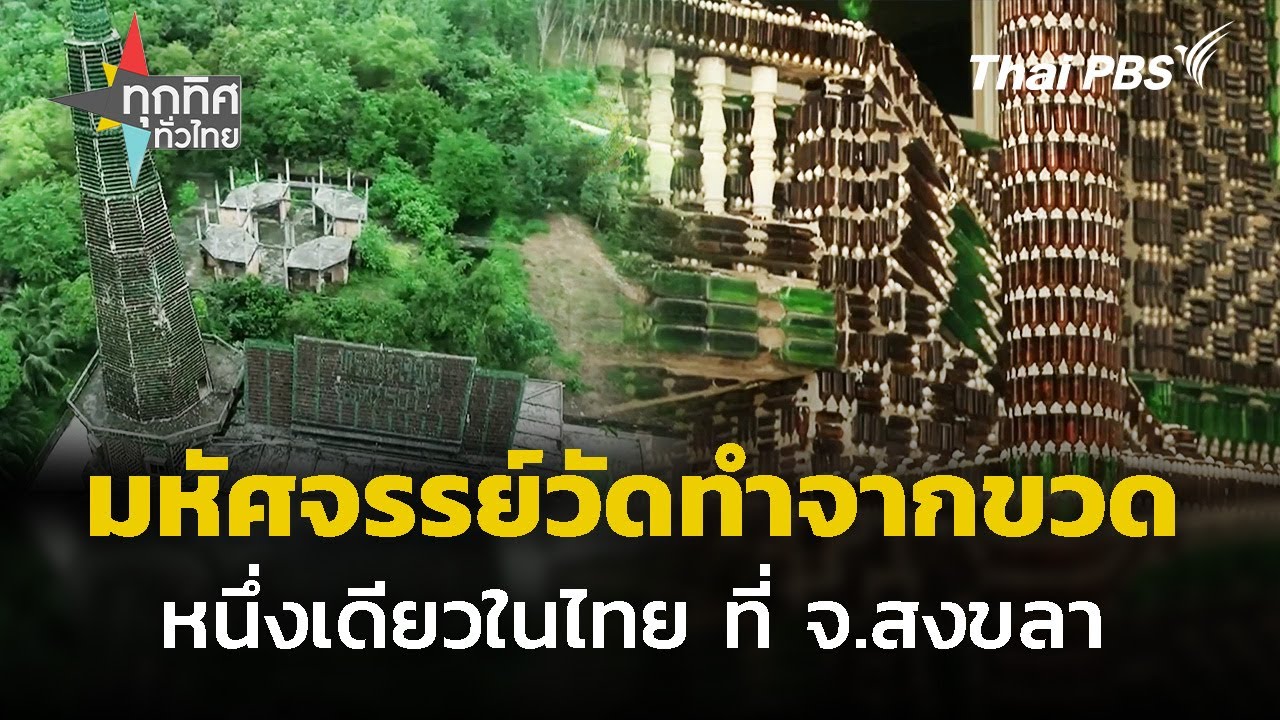
Wat Khuat, also known as Khok Sak Meditation Center, is one of the most distinctive Buddhist sites in Songkhla Province. Located in Moo 5, Ban Khlong Han, Tambon Khae, Chana District, about 50 kilometers from Hat Yai, the temple is known for its creative use of old glass bottles donated by local villagers. Visitors can come daily from 08.00 to 17.00, and there is no admission fee. The main appeal of Wat Khuat is its recycled-glass architecture, where colorful bottles are used to build and decorate religious structures such as the ordination hall, dhamma hall, monks’ quarters, chedi, walls, and other temple features.
The temple is widely known by the nickname Wat Khuat, which means Bottle Temple, but its registered temple name is Wat Thammasiri Chindaram. The name Khok Sak Meditation Center reflects the site’s earlier role as a peaceful place for Buddhist practice. The popular name Wat Khuat comes directly from what visitors see throughout the temple grounds: glass bottles arranged across walls, buildings, gateways, and religious structures. This is not a decorative gimmick added to attract visitors; it is the defining architectural language of the temple and the reason the site has become memorable among travelers exploring Chana and southern Songkhla.
Wat Khuat stands in the Ban Khlong Han community, in the rural area of Chana District. The surrounding atmosphere is calm and local, far from the busy commercial areas of Hat Yai and the coastal attractions of Songkhla city. This setting gives the temple a different character from many mainstream destinations in the province. A visit here offers travelers a look at a local Buddhist community where faith, resourcefulness, environmental awareness, and craftsmanship come together in one place.
The temple became known for using donated glass bottles in the construction and decoration of its religious buildings. Key records describe the temple’s development in 1993, when bottles of different colors and shapes were collected from local donations and used to create the ordination hall, dhamma hall, monks’ quarters, chedi, and walls. The result is a temple with surfaces unlike ordinary plaster or concrete structures. Green, brown, clear, and colored bottles form repeating patterns, and when natural light falls on the glass during the morning or late afternoon, the buildings show subtle color, texture, and depth.
The importance of Wat Khuat lies not only in the large number of bottles used, but also in the idea behind them. Ordinary glass containers, once considered waste, have been transformed into Buddhist architecture. The temple demonstrates how discarded materials can gain new value when placed within a meaningful social and spiritual context. In this sense, the bottles are more than construction material. They become a visible teaching about resourcefulness, moderation, community participation, and the ability to create something lasting from everyday objects.
A key figure in the temple’s history is Phra Khru Sunthorn Thammasiri, also known as Luang Pho Kham Sai, who played an important role in developing the Khok Sak area into a temple and meditation site with a clear identity. Historical accounts connect the bottle-building idea to the practical benefits of glass bottles: they were easy for villagers to donate, durable, visually distinctive, and useful for reducing construction costs. Over time, the combined effort of the monks and local community turned donated bottles into real religious spaces used for worship, practice, and public visits.
The most memorable parts of Wat Khuat are the religious buildings and architectural details decorated with glass bottles. Visitors can notice the concept from the entrance and boundary walls before walking deeper into the temple. Inside the grounds are structures used for Buddhist activities, including the main worship hall, dhamma hall, monks’ quarters, chedi, and other religious areas. The bottles are not used in the same way everywhere. Some sections use them as wall patterns, some expose the rounded bottoms of the bottles as repeated decorative points, and some rely on bottle colors to create rhythm and visual texture. This makes the temple rewarding to explore slowly, not just as a quick photo stop.
The chedi and Thai-style structures inside the temple show how recycled materials can be blended with familiar Buddhist architectural forms. Glass bottles appear on walls, columns, roofs, and decorative surfaces, creating a contrast between traditional religious shapes and materials taken from daily life. This contrast gives Wat Khuat an identity that is neither purely old nor conventionally modern. It is a living temple, a meditation site, a community project, and a creative example of recycling-based architecture.
For photography, Wat Khuat offers strong visual details. The best areas to observe are the bottle-patterned walls, the gateway, the boundary walls, the rounded bottle-bottom textures, and the corners of buildings where light reflects off the glass. Morning and late afternoon are usually the most comfortable times to photograph the surfaces because the light is softer. Since the temple remains a religious site, visitors should take photos respectfully, avoid disturbing monks or people practicing dhamma, and stay only within areas open to visitors.
Wat Khuat is also valuable as a learning destination. It shows how reused materials can become part of real architecture rather than just exhibition pieces. Glass bottles are heavy, breakable, and difficult to arrange properly, so their use across many temple structures reflects both technical effort and community support. Walking around the temple slowly helps visitors understand that the site’s appeal is not simply that it looks unusual. Its deeper value comes from faith, patience, local cooperation, and the gradual transformation of discarded objects into a meaningful Buddhist place.
Culturally, Wat Khuat is a community temple with functions beyond tourism. It is a place for merit-making, Buddhist practice, local gatherings, and cultural learning. The temple has attracted both Thai and international visitors, including travelers passing through the Hat Yai and southern Songkhla route. This makes Wat Khuat a bridge between the local community and outside visitors who want to understand a quieter, less commercial side of Songkhla Province.
Most travelers can comfortably visit Wat Khuat in about 1 to 2 hours. This is enough time to pay respect, walk around the main structures, take photos, and study the details of the bottle work. Because the temple is about 50 kilometers from Hat Yai, it works well as a half-day trip or as part of a wider route through Chana and Na Thawi. Travelers should allow enough time for the drive, the local road leading to the temple, and a meal stop in Ban Khae, Chana, or Na Thawi.
Visitors should follow normal temple etiquette. Dress modestly, remove shoes where required, speak quietly, and keep the temple clean. Because many surfaces are made or decorated with glass bottles, visitors should not pull, hit, climb, or remove any part of the structures. Respecting the buildings helps preserve Wat Khuat as both a religious site and a local heritage attraction for future visitors.
Getting There is most convenient by private car, rental car, or hired vehicle from Hat Yai. The main route is Highway 408, the Chana – Na Thawi road. At around kilometer marker 43 near Ban Khae School, turn onto the local road leading to Wat Khuat for about 6 kilometers. The last section passes through a rural community road, so drivers should proceed carefully, especially during rainy weather or when the road is narrow. Using a navigation map together with local signs around Ban Khae and Ban Khlong Han is recommended.
From Hat Yai, the distance is about 50 kilometers, which makes Wat Khuat suitable for a same-day return trip. Travelers without their own vehicle should plan transport in advance, as the temple is not located in a dense urban area with frequent public transportation directly to the entrance. The most practical options are renting a car in Hat Yai, hiring a local driver, or arranging transport through accommodation. Planning the return journey is especially useful for travelers who need to get back to Hat Yai before evening.
A visit to Wat Khuat can be combined with other places in Chana and Na Thawi. A relaxed route may begin with the temple in the morning, followed by nearby stops such as Khuan Thong, Wat Na Thawi, Wat Khun Tat Wai, Wat Nai Wang Royal Temple, Liwong Chana, or Bo Tao Waterfall. This route is suitable for travelers who want to explore Songkhla beyond Hat Yai city and the coastal areas.
For families, Wat Khuat is a useful place to introduce children to recycling, art, and community participation. Children can observe bottle colors, repeated wall patterns, and the way ordinary objects are turned into architecture. The visit can therefore become more than a temple stop. It can be a simple lesson in environmental awareness, visual design, and local cooperation.
For travelers interested in Buddhism and meditation, Wat Khuat offers a quieter atmosphere than many urban temples. Its location away from the city center supports a slower pace of travel. The name Khok Sak Meditation Center also reminds visitors that the site’s identity is connected to calmness and spiritual practice, not only to unusual architecture. Visitors should match the pace of the place by walking respectfully and allowing time to absorb the details.
Compared with other temples in Songkhla, Wat Khuat has a highly recognizable identity. Some temples are known for ancient relics, murals, important Buddha images, or seaside locations. Wat Khuat is known for turning glass bottles into the main architectural feature of the site. This places it at the intersection of Buddhist faith, community creativity, recycling, and responsible local tourism.
One of the most interesting things to observe is the rhythm of colors and repeated shapes. Green, brown, and clear glass each create a different feeling when arranged together. Some bottles are placed horizontally, some expose their circular bases, and others are grouped into decorative patterns. These details show how simple materials can become visually powerful when repeated with intention.
Wat Khuat is best appreciated slowly. Visitors should not only look for wide-angle photos but also spend time noticing the smaller details: how the bottles are arranged, how the surfaces catch the light, and how recycled materials are integrated into Buddhist architecture. Its beauty does not come from luxury. It comes from simplicity, thrift, patience, and collective effort.
Before visiting, check the weather, especially during the rainy season in southern Thailand. The final approach is a local road through a rural area. Bring drinking water, a hat, or an umbrella on hot days, and avoid arriving too late in the day if you are returning to Hat Yai. For group visits, keep parking and walking arrangements orderly so that the temple and nearby community remain undisturbed.
In summary, Wat Khuat, or Khok Sak Meditation Center, is one of Songkhla’s most distinctive religious and cultural attractions. Visitors do not come only to see a temple covered with bottles. They come to see how ordinary discarded materials can be transformed into a place of worship, how a local community can support a creative Buddhist project, and how a quiet temple in Chana District can offer a meaningful travel experience close to Hat Yai. For travelers looking for an unusual temple and a deeper local route in Songkhla, Wat Khuat is a destination worth adding to the itinerary.
| Name | Wat Khuat, or Khok Sak Meditation Center |
| Official Name | Wat Thammasiri Chindaram |
| Location | Moo 5, Ban Khlong Han, Tambon Khae, Chana District, Songkhla Province |
| Address | Ban Khlong Han, Moo 5, Tambon Khae, Chana District, Songkhla 90130, Thailand |
| Coordinates | 6.818933, 100.655483 |
| Highlights | A Buddhist temple and meditation site built and decorated with colorful old glass bottles donated by local villagers |
| History | The temple became known for its glass-bottle architecture in 1993, when donated bottles were used to build and decorate the ordination hall, dhamma hall, monks’ quarters, chedi, walls, and other temple structures |
| Name Origin | The nickname Wat Khuat, meaning Bottle Temple, comes from the temple’s extensive use of glass bottles in its buildings and decorations. The name Khok Sak Meditation Center reflects the site’s earlier role as a place for Buddhist practice |
| Distinctive Features | Recycled-glass architecture, colorful bottle-patterned walls, a rural temple setting, and a strong concept of turning discarded materials into meaningful religious space |
| Key Figure | Phra Khru Sunthorn Thammasiri, also known as Luang Pho Kham Sai, played an important role in initiating and developing Wat Khuat |
| Travel Information | From Hat Yai, take Highway 408 on the Chana – Na Thawi route. At around kilometer marker 43 near Ban Khae School, turn onto the local road and continue for about 6 km to the temple |
| Current Status | Open daily as a Buddhist temple, meditation site, and religious-cultural attraction in Chana District, Songkhla Province |
| Open Days | Daily |
| Opening Hours | 08.00 – 17.00 |
| Fees | No Admission Fee |
| Facilities | Worship areas, walking areas for viewing the buildings, and toilets inside the temple |
| Main Areas / Zones | Entrance gateway, boundary walls, main worship hall, dhamma hall, monks’ quarters, chedi, bottle-decorated walls, and Buddhist activity areas |
| Recommended Visit Duration | About 1 – 2 Hours |
| Nearby Tourist Attractions | 1. Khuan Thong, About 3 km 2. Wat Na Thawi, About 8 km 3. Wat Khun Tat Wai, About 12 km 4. Wat Nai Wang Royal Temple, About 16 km 5. Liwong Chana, About 20 km 6. Bo Tao Waterfall, About 25 km |
| Nearby Restaurants | 1. Yam Yua Nam Lai Taek, About 6 km, Tel. +66 98 017 9561 2. Good Day Café, About 13 km, Tel. +66 74 801 970 3. Kin Sen Chana, About 15 km, Tel. +66 84 997 4000, +66 88 783 5319 4. Nan Yuan Na Thawi, About 15 km, Tel. +66 74 371 753 5. Kampai Resort & Restaurant Natawee, About 16 km, Tel. +66 74 373 074 6. Baan Ye Food Garden Na Thawi, About 16 km, Tel. +66 74 371 216 |
| Nearby Accommodations | 1. Kampai Resort & Restaurant Natawee, About 16 km, Tel. +66 74 373 074 2. Chom View Resort, About 18 km, Tel. +66 81 678 6644 3. The White House Na Thawi Resort, About 18 km, Tel. +66 99 403 0822 4. Ban Kaew Resort, About 19 km, Tel. +66 91 818 4290 5. Wang Nuea Resort, About 20 km, Tel. +66 89 599 6169 |
Frequently Asked Questions (FAQ)
Q: Where is Wat Khuat, or Khok Sak Meditation Center, located?
A: Wat Khuat is located in Moo 5, Ban Khlong Han, Tambon Khae, Chana District, Songkhla Province, about 50 kilometers from Hat Yai.
Q: What are the opening days and hours of Wat Khuat?
A: Wat Khuat is open daily from 08.00 to 17.00.
Q: Is there an admission fee for Wat Khuat?
A: No. Visitors can enter the temple, pay respect, walk around the buildings, and take photos in permitted areas without an admission fee.
Q: What makes Wat Khuat special?
A: The temple is special because old colorful glass bottles donated by local villagers are used to build and decorate its religious structures, including the ordination hall, dhamma hall, monks’ quarters, chedi, and walls.
Q: How do travelers get from Hat Yai to Wat Khuat?
A: Take Highway 408 on the Chana – Na Thawi route. At around kilometer marker 43 near Ban Khae School, turn onto the local road and continue for about 6 kilometers to the temple.
Q: How long should visitors spend at Wat Khuat?
A: Most visitors should allow about 1 to 2 hours for worship, walking around the buildings, taking photos, and observing the bottle-decorated details.
Q: What should visitors wear to Wat Khuat?
A: Visitors should dress modestly, follow normal temple etiquette, remove shoes where required, and avoid touching, pulling, climbing, or damaging any part of the bottle-decorated structures.
Q: What nearby places can be visited after Wat Khuat?
A: Nearby places include Khuan Thong, Wat Na Thawi, Wat Khun Tat Wai, Wat Nai Wang Royal Temple, Liwong Chana, and Bo Tao Waterfall.
 Category: ●Places of Worship
 Group: ●Temple
Last Update : 3 MonthAgo
 Last Update : 3 MonthAgo
 Click to Access the Navigation Map GPS

 Art, Culture and Heritage
 Historical Sites and Monuments(2)
 Landmarks and Memorials(7)
 Royal Palace(1)
 Art, Craft Centres, Tradition(4)
 Museums(4)
 Art Gallery(1)
 Educational Places
 Library(1)
 Educational Gardens, Farm(3)
 University
 Public university(2)
 Autonomous Universities(1)
 Rajamangala University of Technology(1)
 Rajabhat University(1)
 Private University(1)
Temple(52)
 Mosque(2)
 Other Sacred Sites(11)
 Suburban Living
 Village, Community(4)
 Local Market(3)
 Floating Market(2)
 Nature and Wildlife
 National Parks and Marine Reserves(5)
 Mountain (Doi)(7)
 Dam, Reservoir, Lake(5)
 Waterfalls(12)
 Caves(4)
 River, Canal(2)
 Bays and Beaches(13)
 Islands(3)
 Other natural attractions(2)
 Entertainment and Agricultural
 Zoos and Aquariums(2)
 Animal camps and shows(1)
 Farms, Parks and Ecotourism(6)
 Waterpark(1)
 Shopping
 Department Store(5)
 Travel Articles, Recipes
 Travel Review, Food Review(1)
 Southern Food Menu, Southern Food Recipes(2)


