
lovethailand home >South Travel Attractions >Satun Travel Attractions >Muang Satun >Koh Sarai > Mu Ko Dong and Koh Hin Son
TL;DR: Mu Ko Dong and Koh Hin Son, Satun attractions : Nature and Wildlife, Islands.
Mu Ko Dong and Koh Hin Son
Open Days: Koh Hin Son and Koh Dong’s Ao Ling-Ao Panan area are temporarily closed under the 2026 Tarutao National Park announcement from 1 June–30 September 2026; seasonal access resumes only when the park reopens the area
Opening Hours: When open, access depends on boat schedules, weather, waves, currents, tide level, and outer-zone boat routing from Koh Lipe
Mu Ko Dong and Koh Hin Son in Satun Province form part of the Adang-Rawi island group within Tarutao National Park, Ko Sarai Subdistrict, Mueang Satun District. This outer-zone marine route lies beyond Koh Lipe and Koh Adang, giving travelers a more remote Andaman Sea experience. The area is known for open-sea scenery, clear water during the travel season, shallow and deep coral areas, and the unmistakable natural landmark of Koh Hin Son, where large boulders appear stacked on top of one another in the middle of the sea.
Mu Ko Dong is located farther from the main Koh Lipe travel base and is often described in older travel information as about 1 hour from Koh Adang. The area is not an overnight tourism base. It is a boat-based marine route for sightseeing, photography, snorkeling, diving, and observing the underwater ecosystem. The surrounding sea contains soft corals, hard corals, sea anemones, feather stars, giant clams, and many reef fish. Its distance from Koh Lipe gives the route a more natural, open-water character than the easier inner-zone trips.
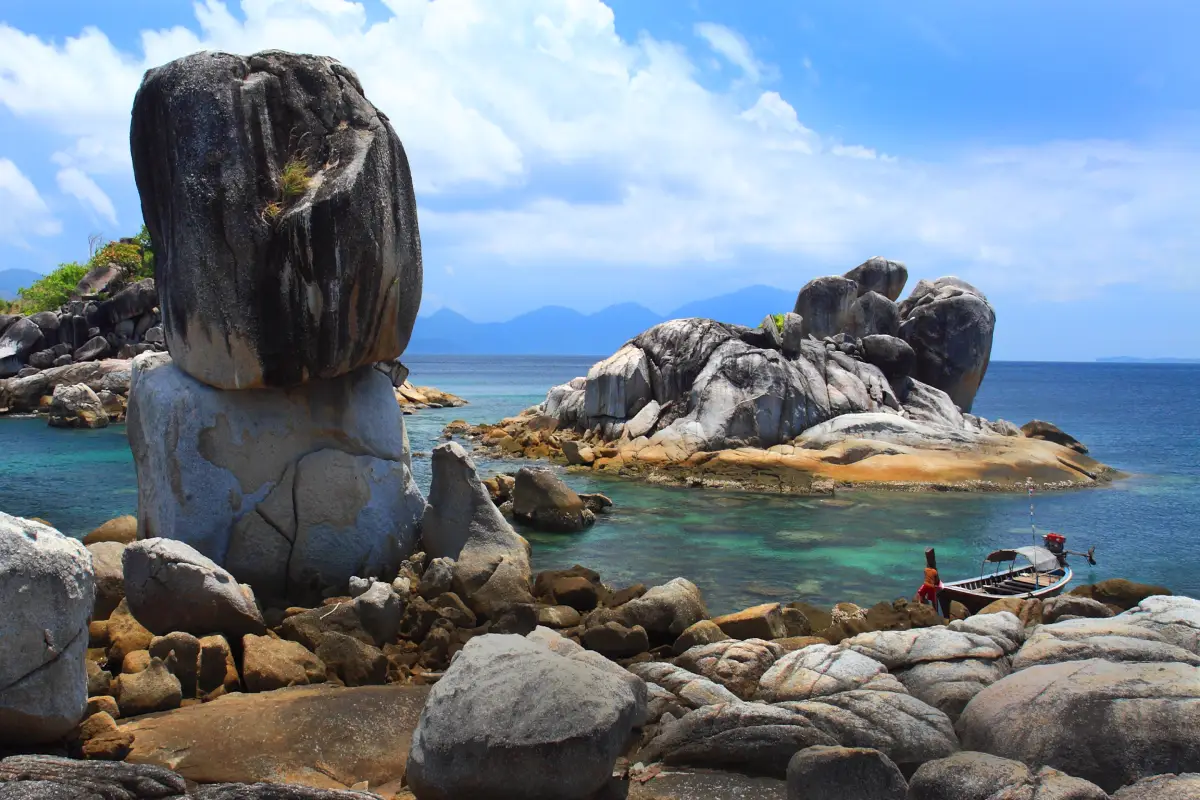
Koh Hin Son is the most recognizable landmark in this group. Its defining feature is a pair of large rocks stacked vertically, with the upper boulder resembling a massive cube balanced on a lower rock base. The formation looks almost arranged by hand, yet it is a natural structure shaped by geological and coastal processes. Some visitors say it resembles a submarine, while others compare it to an unusual natural sculpture. In travel terms, Koh Hin Son is best known as a boat-based photography stop and a nearby snorkeling or diving area rather than a beach where visitors spend a long time ashore.
Koh Hin Son does not have a wide sandy beach like Koh Rawi or Koh Lipe, and it is not designed for long walks on land. Its main appeal is the stacked-rock formation and the underwater world around it. Visitors should understand from the beginning that this is an outer-zone sightseeing and snorkeling site, not an island resort or beach-stay destination. Most travelers view and photograph the rocks from the boat, then continue to suitable snorkeling or diving areas according to sea conditions.
The waters around Koh Hin Son and Mu Ko Dong contain several forms of coral habitat. Shallow areas can be suitable for snorkeling when the sea is calm, while deeper areas are more appropriate for experienced divers. Soft corals add color and movement to the underwater scenery, while hard corals create reef structure and shelter for smaller marine life. This makes the outer-zone route different from inner-zone sites such as Jabang Channel and Koh Yang, because it combines open-sea conditions with reef diversity farther from Koh Lipe.
Koh Dong is an important island in this outer area, with known stops such as Ao Ling and Ao Panan. The surrounding waters are associated with diverse hard corals and reef life, including feather stars and giant clams. When conditions are suitable, a Mu Ko Dong trip gives travelers a quieter, farther, and more adventurous view of the southern Andaman Sea than the more frequently visited points close to Koh Lipe.
The Mu Ko Dong and Koh Hin Son route is usually called an outer-zone snorkeling trip from Koh Lipe. It is farther than the inner-zone route that includes Jabang Channel, Koh Hin Ngam, Koh Yang, and Koh Adang. Because of the longer distance, the route requires calmer seas, better timing, and careful planning. Waves, currents, departure time, return time, and the condition of all passengers matter more on this route. If the sea is unsafe, boat operators may change or cancel some stops.
Travelers who choose Mu Ko Dong and Koh Hin Son are often those who have already visited the inner-zone highlights or want to see a more remote side of Koh Lipe’s marine landscape. The value of the route is not convenience, restaurants, or long beach landings. Its value lies in open sea, natural rock formations, coral reefs, and small islands scattered near the Thailand-Malaysia maritime border. Visiting this area helps travelers understand that the Adang-Rawi islands are more complex than a few popular beaches.
Koh Hin Son is highly photogenic because the stacked rocks are visually unique. When a boat approaches from the right angle, the boulders appear balanced above turquoise water, with sky and surrounding islands in the background. The best way to photograph the landmark is from the boat at a safe distance. Visitors should not climb the rocks or insist on approaching too closely when the sea is rough because the area is rocky, exposed, and affected by waves and currents.
The best period to visit Mu Ko Dong and Koh Hin Son is during the Andaman travel season, generally from November to May. November to April usually offers the best chance of calm sea, clear water, and successful outer-zone boat trips. However, outer-zone travel depends strongly on daily weather. Even during the high season, strong wind, high waves, or continuing rain can make the route unsuitable.
Under the 2026 Tarutao National Park announcement, several Adang-Rawi areas are closed from 1 June to 30 September 2026, including Koh Hin Son and Koh Dong’s Ao Ling-Ao Panan area. The closure is used for visitor safety during monsoon conditions and for ecological recovery. Travelers planning this route should always check the latest national park announcement before departure, especially near the beginning or end of the marine season.
Seasonal closure should be understood as part of responsible marine management. The coral reefs, underwater rocks, and marine life around Mu Ko Dong and Koh Hin Son already face natural seasonal pressure from waves and weather. If boats and visitors continue to enter sensitive areas all year, the ecosystem has less time to recover. A temporary rest period helps reduce tourism pressure, lower accident risk, and protect the long-term value of the dive sites.
Getting There to Mu Ko Dong and Koh Hin Son usually begins on Koh Lipe. Travelers first go to Pak Bara Pier in La-ngu District, Satun Province, take a boat to Koh Lipe, and then hire a local longtail boat or join an outer-zone snorkeling trip. The Tourism Authority of Thailand describes Koh Hin Son as part of the outer-zone water route from Koh Lipe, about 30 minutes by longtail boat. Older route descriptions also place Mu Ko Dong about 1 hour from Koh Adang. Actual travel time depends on boat type, departure point, route sequence, and sea conditions.
Pak Bara Pier is the main mainland gateway for Koh Lipe and Tarutao National Park destinations. Published pier schedules list departures to Koh Lipe in late morning and early afternoon, such as 11:30 a.m. and 1:30 p.m., with key return times from Koh Lipe including 9:30 a.m. and 11:30 a.m. Travelers should confirm the current schedule before traveling because boat services may change according to season, weather, passenger demand, and safety notices.
Travelers from Bangkok or other provinces commonly fly to Hat Yai Airport, continue by van, taxi, or rental car to Pak Bara Pier, and then take a boat to Koh Lipe. Travelers driving by road can use southern routes into Satun and La-ngu District. Train travelers can get off at Hat Yai Railway Station and continue by road to Pak Bara. Timing the land transfer with the boat schedule is important because missing the last boat may require an overnight stay on the mainland.
After arriving on Koh Lipe, travelers should ask local operators specifically about the outer-zone route to Mu Ko Dong and Koh Hin Son. Because the route is farther than inner-zone snorkeling, they should confirm the number of stops, departure time, return time, open snorkeling sites, life jackets, snorkeling gear, food, drinking water, route-change conditions, and refund or postponement rules in case of rough sea.
Mu Ko Dong and Koh Hin Son are inside Tarutao National Park, so visitors should prepare for the national park entrance fee. Published rates are 40 baht for Thai adults and 20 baht for Thai children, while foreign adults pay 200 baht and foreign children pay 100 baht. Other expenses such as boats from Pak Bara to Koh Lipe, outer-zone longtail trips, snorkeling gear, meals, and accommodation depend on operator, season, and group size.
There are no permanent restaurants, accommodations, or visitor facilities at Mu Ko Dong and Koh Hin Son. Koh Lipe is the most practical base because it has accommodation, restaurants, dive shops, tour operators, local boats, and visitor services. Travelers planning an outer-zone trip should stay on Koh Lipe for at least 2 nights so they have flexibility if weather changes.
Useful items for the trip include drinking water, seasickness tablets, personal medicine, a hat, sunglasses, a towel, a dry bag, suitable footwear, sun protection, and camera protection with straps or waterproof cases. Since the outer-zone route involves longer boat travel, preparation is more important than for short inner-zone trips, especially for travelers prone to seasickness or traveling with children and older adults.
Main activities include photographing the stacked boulders at Koh Hin Son, viewing the open-sea scenery, snorkeling over shallow reef areas, diving in suitable deeper sites, observing sea anemones, feather stars, giant clams, and reef fish, and enjoying sunset light when conditions allow. This route is best for travelers who want a stronger marine experience rather than a short beach stop.
For snorkeling, visitors should wear life jackets, stay near the boat, avoid entering the water when currents are strong, and never dive down too close to coral for photographs. Responsible snorkeling means floating above the reef at a safe distance and observing marine life without touching anything. Coral and sea anemones can be damaged by a single careless contact.
For scuba diving, Mu Ko Dong and Koh Hin Son are better suited to experienced divers or visitors using qualified operators. The area is exposed to open-sea conditions and can have currents. Divers should check equipment, listen to the site briefing, stay with the group, and avoid chasing photo opportunities at the expense of safety.
Environmental rules are essential. Visitors should never step on coral, touch coral, collect shells or coral fragments, feed fish, leave trash in the sea, or disturb marine animals. Feeding fish may seem harmless but can alter natural behavior and affect reef balance. Plastic waste and lost fishing gear are also direct threats to marine animals. Responsible travel begins on the boat and continues underwater.
Mu Ko Dong and Koh Hin Son suit travelers who enjoy open-sea routes, snorkeling, diving, natural rock formations, and more remote island scenery. They are not suitable for visitors who want a very short trip, long beach time, island restaurants, or resort-style facilities at the destination itself. The route depends heavily on boat access and natural conditions.
A practical itinerary is to stay on Koh Lipe for at least 3 days and 2 nights. On the first day, travel from Pak Bara to Koh Lipe and rest. On the second day, take an outer-zone route to Mu Ko Dong, Koh Hin Son, Koh Ro-Kloi, and nearby snorkeling sites if conditions are suitable. On the third day, relax on Koh Lipe, visit Koh Adang, or return to Pak Bara. This itinerary avoids rushing and allows flexibility if weather changes.
Travelers with more time should separate inner-zone and outer-zone trips. The inner-zone route is better for Jabang Channel, Koh Hin Ngam, Koh Yang, and Koh Adang. The outer-zone route is better for Mu Ko Dong, Koh Hin Son, Koh Ro-Kloi, and more remote snorkeling points. Separating the routes makes the trip more comfortable and helps visitors appreciate the different character of each marine area.
Restaurants and accommodations for this trip are based mainly on Koh Lipe. Pattaya Beach is convenient for transport and Walking Street. Sunrise Beach is good for morning views and Koh Adang scenery. Sunset Beach is quieter in the evening. Meals should be planned before or after the boat trip, with enough drinking water and snacks carried responsibly during the excursion.
Compared with nearby destinations, Mu Ko Dong and Koh Hin Son have a clear identity. Koh Lipe is the service base. Koh Adang offers forest, mountains, and viewpoints. Jabang Channel is famous for soft coral. Koh Hin Ngam is known for black stones. Koh Rawi has white sand and clear water. Mu Ko Dong and Koh Hin Son represent open-sea adventure, distinctive rock formations, and remote reef scenery. Including them in a Koh Lipe trip gives travelers a more complete understanding of Satun’s marine landscape.
In summary, Mu Ko Dong and Koh Hin Son are outer-zone marine highlights of the Adang-Rawi islands. The route is known for Koh Hin Son’s stacked boulders, Mu Ko Dong’s coral areas, shallow and deep reefs, marine life, and open Andaman Sea atmosphere. The relevant areas are temporarily closed under the 2026 Tarutao National Park announcement from 1 June to 30 September 2026, but when the park reopens and sea conditions are suitable, this remains one of the most memorable outer-zone snorkeling and diving routes from Koh Lipe.
| Name | Mu Ko Dong And Koh Hin Son |
| Location | Adang-Rawi Islands, Tarutao National Park, Ko Sarai Subdistrict, Mueang Satun District, Satun Province |
| Address | Tarutao National Park, Ko Sarai Subdistrict, Mueang Satun District, Satun 91000, Thailand |
| Reference Coordinates | Ko Dong 6.529000, 99.169600 Koh Hin Son 6.502510, 99.182150 |
| Place Type | Outer-Zone Islands / Snorkeling And Diving Route / Shallow And Deep Coral Area / Natural Rock Landmark |
| Highlights | Stacked boulders at Koh Hin Son, outer Adang-Rawi seascape, soft corals, hard corals, sea anemones, feather stars, giant clams, reef fish, and open-sea scenery |
| Distinctive Features | An outer-zone route from Koh Lipe with Koh Hin Son as a major photo landmark and Mu Ko Dong as a coral-rich marine area |
| Main Areas / Zones | Ko Dong, Ao Ling, Ao Panan, Koh Hin Son, Koh Ro-Kloi, Koh Phai, Koh Sawang, Koh Palai, and outer-zone snorkeling sites permitted by the park seasonally |
| Current Status | Koh Hin Son and Koh Dong’s Ao Ling-Ao Panan area are temporarily closed under the 2026 Tarutao National Park announcement from 1 June–30 September 2026 |
| Open Days | Open seasonally outside the closure period according to Tarutao National Park announcements |
| Opening Hours | Subject to boat schedules, weather, waves, currents, tide level, and outer-zone routing from Koh Lipe |
| Best Travel Season | November–May, especially November–April when the sea is generally calmer and outer-zone boat trips are more practical |
| National Park Entrance Fee | Thai Adults 40 Baht, Thai Children 20 Baht Foreign Adults 200 Baht, Foreign Children 100 Baht |
| Travel Information | Travel to Pak Bara Pier in La-ngu District, Satun, then take a boat to Koh Lipe. From Koh Lipe, use a local longtail boat or outer-zone snorkeling trip to Mu Ko Dong, Koh Hin Son, and nearby sites. |
| Facilities | No permanent facilities at the actual sites. Accommodation, restaurants, dive shops, longtail boats, and visitor services are based mainly on Koh Lipe. |
| Caretaker / Related Authority | Tarutao National Park, Department Of National Parks, Wildlife And Plant Conservation, and Ko Sarai Subdistrict Administrative Organization |
| Head Of Tarutao National Park | Mr. Surachai Thathes |
| Main Contact Number | Tarutao National Park Visitor Center, Tel. 0-7478-3485 Tarutao National Park Office, Tel. 0-7478-3597 Ko Sarai Subdistrict Administrative Organization, Tel. 074-750905 Pak Bara Pier, Tel. 074-712380 Ext. 1111 |
| Nearby Tourist Attractions | 1. Koh Ro-Kloi, about 1.5 km from Koh Hin Son, Tel. 0-7478-3485 2. Koh Sawang, about 3 km by sea, Tel. 0-7478-3485 3. Koh Palai, about 4 km by sea, Tel. 0-7478-3485 4. Koh Dong Ao Ling-Ao Panan, about 5 km by sea, Tel. 0-7478-3485 5. Koh Adang, about 15 km by sea, Tel. 0-7478-3485 6. Koh Lipe, about 15 km by sea, Tel. 074-750905 7. Koh Hin Ngam, about 30 minutes by boat from Koh Lipe, Tel. 0-7478-3485 8. Jabang Channel, about 20 minutes by boat from Koh Lipe, Tel. 0-7478-3485 |
| Nearby Restaurants | 1. Elephant Cafe & Bar, Koh Lipe, about 15 km by sea, Tel. 089-657-2178 2. Papaya Mom, Koh Lipe Walking Street, about 15 km by sea, Tel. 062-997-9492, 062-365-6195 3. On The Rocks Restaurant At Serendipity, Koh Lipe, about 15 km by sea, Tel. 088-395-5158, 082-734-8633 4. Bundhaya Restaurant, Koh Lipe, about 15 km by sea, Tel. 084-722-6699, 089-451-4599 5. Elephant Beach Bar & Restaurant At Lipe Beach Resort, Koh Lipe, about 15 km by sea, Tel. 099-265-0808 |
| Nearby Accommodations | 1. Akira Lipe Resort, Koh Lipe, about 15 km by sea, Tel. 074-750777, 091-301-3012, 091-301-3013 2. Bundhaya Resort, Koh Lipe, about 15 km by sea, Tel. 084-722-6699, 089-451-4599 3. Serendipity Beach Resort, Koh Lipe, about 15 km by sea, Tel. 088-395-5158, 082-734-8633 4. Zodiac Seesun Resort, Koh Lipe, about 15 km by sea, Tel. 084-996-6179, 081-767-5764 5. Idyllic Concept Resort, Koh Lipe, about 15 km by sea, Tel. 088-227-5389 6. Lipe Beach Resort, Koh Lipe, about 15 km by sea, Tel. 099-265-0808 |
Frequently Asked Questions (FAQ)
Q: Where are Mu Ko Dong and Koh Hin Son located?
A: Mu Ko Dong and Koh Hin Son are in the Adang-Rawi island group within Tarutao National Park, Ko Sarai Subdistrict, Mueang Satun District, Satun Province. They are part of the outer-zone snorkeling route from Koh Lipe.
Q: What is Koh Hin Son famous for?
A: Koh Hin Son is famous for two large boulders stacked naturally in the sea, creating a distinctive rock landmark associated with Mu Ko Dong and the outer-zone marine route.
Q: Is Mu Ko Dong good for snorkeling and diving?
A: Yes, when the park opens the area and sea conditions are safe. The area is known for shallow and deep coral habitats, soft corals, hard corals, sea anemones, feather stars, giant clams, and reef fish.
Q: When are Mu Ko Dong and Koh Hin Son open?
A: The best travel season is generally November to May, especially November to April. Under the 2026 announcement, Koh Hin Son and Koh Dong’s Ao Ling-Ao Panan area are temporarily closed from 1 June to 30 September 2026.
Q: How do travelers get to Mu Ko Dong and Koh Hin Son?
A: Travelers usually go to Koh Lipe first by boat from Pak Bara Pier, then use a local longtail boat or join an outer-zone snorkeling trip to Mu Ko Dong, Koh Hin Son, and nearby sites.
Q: Are there restaurants or accommodations on Mu Ko Dong or Koh Hin Son?
A: No. There are no permanent restaurants or accommodations at the actual sites. Travelers should use Koh Lipe as the base for accommodation, food, dive shops, longtail boats, and tours.
Q: Is there a national park entrance fee?
A: Yes. Published Tarutao National Park entrance fees are 40 baht for Thai adults, 20 baht for Thai children, 200 baht for foreign adults, and 100 baht for foreign children. Boat and activity costs vary by operator.
Q: What should visitors be careful about?
A: Visitors should check park announcements and weather before departure, wear life jackets, avoid traveling in rough seas, never step on or touch coral, avoid feeding fish, never collect natural objects, never litter, and follow boat-crew and park guidance.
 Category: ●Nature and Wildlife
 Group: ●Islands
Last Update : 2 MonthAgo
 Last Update : 2 MonthAgo

 Click to Access the Navigation Map GPS
Mu Ko Dong and Koh Hin Son Map
Recommend

 Art, Culture and Heritage
 Historical Sites and Monuments(1)
 Landmarks and Memorials(1)
 Art, Craft Centres, Tradition(5)
 Museums(3)
 Places of Worship
 Temple(3)
 Mosque(27)
 Other Sacred Sites(1)
 Suburban Living
 Village, Community(1)
 Local Market(2)
 National Parks and Marine Reserves(7)
 Mountain (Doi)(1)
 Dam, Reservoir, Lake(2)
 Waterfalls(9)
 Hot Springs(1)
 Caves(9)
 Bays and Beaches(10)
Islands(16)
 Other natural attractions(5)
 Entertainment and Agricultural
 Zoos and Aquariums(1)
 Farms, Parks and Ecotourism(4)
 Outdoor and Adventure Activities(1)
 Travel Articles, Recipes
 Travel Review, Food Review(1)


