
lovethailand home >South Travel Attractions >Satun Travel Attractions >Muang Satun >Phi Man > Satun Central Mosque (Mambang Mosque)
TL;DR: Satun Central Mosque (Mambang Mosque) is located at Corner Of Buriwanich Road And Satun Thani Road, Phiman Subdistrict, Mueang Satun District, Satun Province, open Daily, hours 09.00 - 16.00 For General Visits; Visitors Should Avoid Prayer Times.

Satun Central Mosque (Mambang Mosque)
Open Days: Daily
Opening Hours: 09.00 - 16.00 For General Visits; Visitors Should Avoid Prayer Times
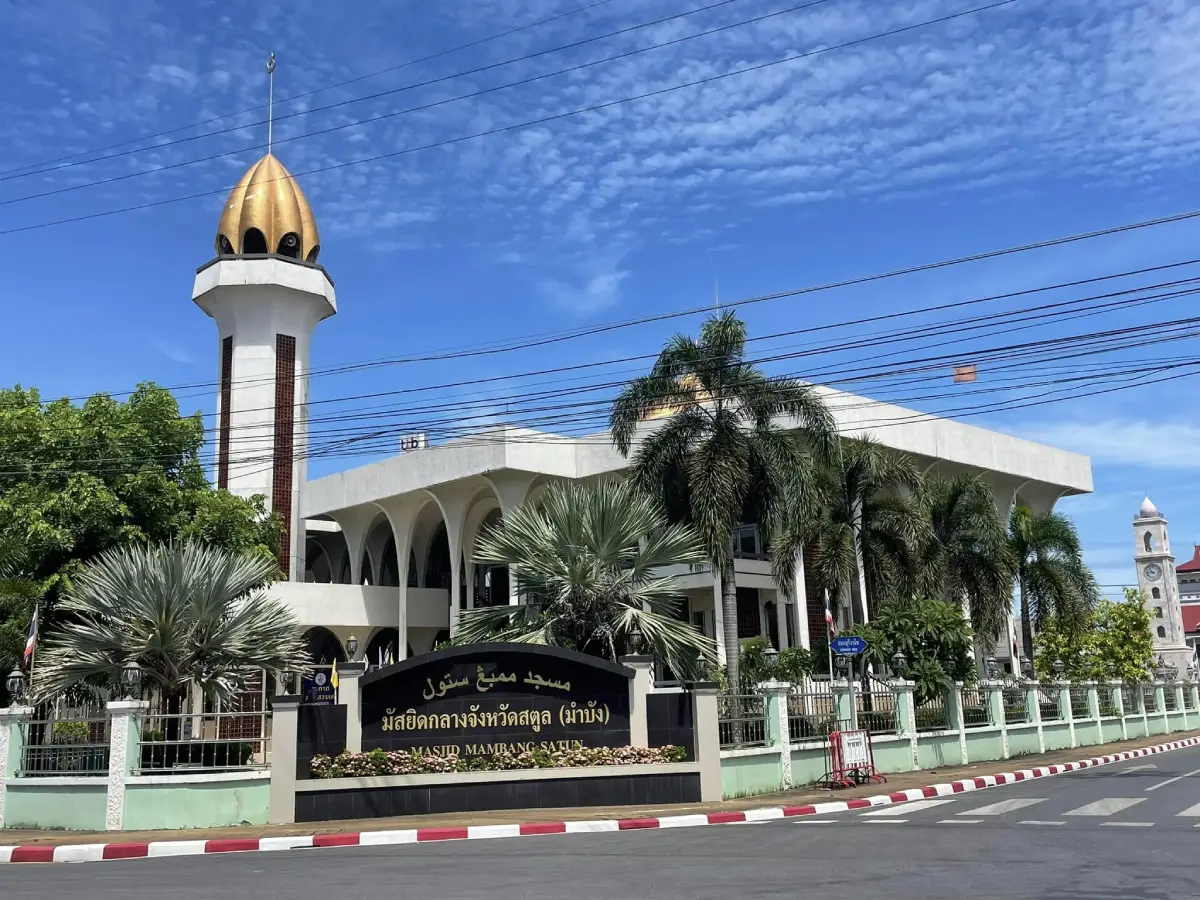
Satun Central Mosque, also known as Masjid Mambang, is one of the most important religious and cultural landmarks in the heart of Satun town. It stands at the corner of Buriwanich Road and Satun Thani Road in Phiman Subdistrict, Mueang Satun District, Satun Province. With its white building, golden dome, and visible minaret, the mosque is immediately recognizable from the surrounding streets. It is not only the central mosque of the province, but also a major symbol of Satun’s multicultural identity, where Muslim, Buddhist, Chinese, Malay, and Thai cultural influences have long existed together within the same urban landscape.
The name “Mambang” carries strong historical meaning. It is linked with the older name of Satun, often associated with “Mambang Nakhara,” a historic name connected with the town before it developed into the modern provincial center seen today. For this reason, Masjid Mambang is more than a mosque name. It preserves a memory of old Satun, its waterways, its trading links, and its cultural roots in the Malay world of the southern peninsula. Visiting the mosque therefore allows travelers to understand Satun through history, faith, and place identity at the same time.
The mosque was first established during the period of Phraya Samantharat Burin, also known as Tunku Muhammad Akeb, one of the most important early rulers of Satun. At that time, Satun did not yet have a central mosque that could serve as the main religious gathering place for local Muslims. Phraya Samantharat Burin consulted Wan Omar bin Wan Hadi and local officials to raise funds and build a permanent mosque. The early construction story is closely connected with maritime trade. Craftsmen from Malacca were brought in to help with the design, and construction materials were obtained through boat-based trade with Kedah and nearby Malay ports.
This background shows that Satun was historically connected to a wider maritime world. It was not an isolated border town, but a small coastal center linked with Kedah, Malacca, Penang, and the Malay Peninsula through religion, trade, language, movement, and culture. The first mosque on this site reflected that setting. It was a single-storey building surrounded by a wall, with a three-tiered roof, square interior, wooden posts, and tiled floor. It served as the main place for Muslim worship and community life in Satun for more than a century.
When the original mosque became structurally worn after long use, the Islamic Committee of Satun Province led the construction of a new mosque on the same site. Construction began on 7 April 1974, using public support and donations from local devotees, with a total construction budget of 11,930,000 baht. The new building was designed in a modern architectural style, using reinforced concrete as the main structure. Its white exterior, marble-like glazed tiles, clear glass, and golden dome gave the mosque a new appearance while preserving the sacred role of the original site.
King Bhumibol Adulyadej, King Rama IX, officially opened Masjid Mambang on 20 September 1979. This royal visit is deeply remembered in Satun. On the same day, the King also presided over the chofah-raising ceremony at Wat Dulyaram in Chalung before opening Masjid Mambang in Satun town. The sequence of these events reflects one of Satun’s defining qualities: different religious landmarks belonging to the same civic and cultural landscape. It is an important example of how Satun’s Buddhist and Muslim communities form part of the province’s shared public memory.
The current mosque building is organized for both worship and community functions. The exterior area includes a terrace and access points leading toward the minaret, which is topped with a golden dome. The interior contains the main prayer hall used for daily prayers, Friday prayers, and important religious gatherings. The lower level includes rooms used for meetings and study. This makes the mosque not only a prayer space, but also a place for community coordination, learning, religious leadership, and social activities.
The mosque’s architectural beauty comes from the contrast between its clean white structure and the striking golden dome. Its modern form differs from the original local mosque, but Islamic identity remains visible through the dome, minaret, arches, geometric elements, and use of glass. The overall impression is formal, calm, and dignified. The building suits its role as the central mosque of Satun Province, while also serving as one of the most photographed landmarks in the town center.
The golden dome is the most memorable visual feature of the mosque. Its form can be seen clearly from Buriwanich Road and Satun Thani Road. The crescent and star symbol at the top reflects Islamic religious identity and the spread of Islam in southern Thailand. When sunlight falls on the golden surface, the white building and surrounding greenery create a strong visual image of Satun. For many visitors, this is one of the clearest architectural symbols of the town.
The minaret is also important because it gives the mosque a strong presence in the townscape. It helps make Masjid Mambang visible from nearby streets and reinforces the mosque’s role as a central religious landmark. In the past, the tower area was associated with views over Satun town. This shows that the mosque is not separated from the city around it. It is part of Satun’s visual, social, and cultural landscape.
Inside the building, the prayer hall is the spiritual heart of the mosque. It is used for daily worship, Friday congregational prayer, and major Islamic occasions. Non-Muslim visitors may respectfully view the exterior and, when appropriate and permitted, some interior areas outside prayer times. However, visitors should remember that this is an active mosque, not a museum. They should avoid walking through worship areas during prayer, keep their voices low, dress modestly, and follow the guidance of mosque caretakers.
Masjid Mambang continues to function as the central Islamic institution of Satun town. Mosque registry information identifies it as the central mosque of Satun Province in Phiman Subdistrict, Mueang Satun District. The mosque has an organized committee structure including an imam, khatib, bilal, secretary, registrar, treasurer, education officer, academic officer, halal officer, zakat and social welfare officer, public relations officer, building officer, and women and youth officer. This structure shows that the mosque serves religious, educational, administrative, welfare, and community roles.
The mosque registry identifies the imam of Masjid Mambang as Yusop Salam, the khatib as Kho Chem Tamad, and the bilal as Che Aad Tamad. These roles are important in Islamic community life. The imam leads prayers and religious guidance, the khatib delivers sermons, and the bilal calls or supports the prayer function. Together with the mosque committee, they help maintain the religious and community life of the mosque.
The mosque is also connected with the wider Islamic Committee of Satun Province, which coordinates religious leadership across the province. Recent public information identifies Ya-at Lingalah as the chairman of the Islamic Committee of Satun Province. The committee plays a role in religious affairs, Islamic education, halal tourism, mosque coordination, and community strengthening across Satun’s seven districts. This broader structure helps explain why Masjid Mambang is not only a local landmark, but also part of the province’s Islamic institutional network.
The mosque’s location is especially valuable for travelers. It is near Satun Clock Tower, Buriwanich Road, Satun Night Market, Satun Municipality, Satun National Museum at Kuden Mansion, Wat Chanathip Chaloem, and Satun Street Art. These places can be combined into a short walking or driving route through the old town area. For visitors who want to understand Satun beyond beaches and islands, Masjid Mambang is an ideal starting point.
A visit to Masjid Mambang is particularly rewarding for travelers interested in multicultural cities. Within a short distance, visitors can see the mosque, Wat Chanathip Chaloem, Chinese shrines, old commercial streets, traditional food shops, local markets, and government buildings. These places show that Satun’s identity is not built around one culture alone. It is shaped by coexistence, trade, religion, local food, architecture, and daily life shared by different communities.
For general sightseeing, the best features to observe are the mosque sign, front fence, terrace, golden dome, minaret, arched forms, and the surrounding streetscape. The front corner of the mosque is a good place for respectful photography because it captures both the name sign and the dome. Morning and late afternoon light are usually better than midday sunlight. Visitors should avoid photographing people during worship or taking close interior photographs without permission.
Respectful conduct is essential when visiting. Men and women should dress modestly, covering shoulders and knees. Tight, transparent, or overly casual clothing should be avoided. Shoes must be removed before entering designated interior areas. Women who wish to enter the prayer hall should prepare a head covering or ask the mosque caretakers for appropriate guidance. Visitors who are not attending prayer should avoid Friday midday prayer and major religious periods, when the mosque is primarily reserved for worshippers.
Getting to Masjid Mambang is very easy from central Satun. From Satun Clock Tower, the mosque is only a short walk or drive away. Travelers staying near Buriwanich Road, Satun Thani Road, or the old town area can include the mosque in a walking route that also covers Satun National Museum at Kuden Mansion, Satun Street Art, Wat Chanathip Chaloem, and Satun Night Market. Visitors arriving by car should park only in appropriate areas and avoid blocking mosque entrances or nearby local traffic.
Travelers arriving from other provinces commonly reach Satun from Hat Yai in Songkhla Province or from the La-ngu and Pak Bara routes. Once in Satun town, the mosque can be found at the corner of Buriwanich Road and Satun Thani Road, close to the clock tower and commercial district. It is therefore convenient to visit before exploring the old town, before dinner, or before continuing toward Pak Bara and the island routes.
A good half-day route can begin at Masjid Mambang to learn about Islamic architecture and religious life in Satun. Visitors can then walk or drive to Satun Clock Tower, Satun Street Art, Buriwanich Road, Satun National Museum at Kuden Mansion, and Wat Chanathip Chaloem. In the evening, the route can end at Satun Night Market or a local restaurant. This compact route gives a clear overview of Satun’s old town, religious diversity, food culture, and civic identity.
From an architectural perspective, Masjid Mambang is a good example of the shift from an older local mosque form to a reinforced-concrete modern mosque built in the 1970s. The present building uses a clean white surface, glazed tiles, glass, a strong dome, and a formal layout. Standing among commercial buildings, old roads, and civic spaces, the mosque acts both as a functioning religious building and as an architectural landmark of modern Satun.
From a historical perspective, the mosque reveals how Satun developed from a small maritime settlement connected with the Malay world into a modern Thai province. The story of craftsmen from Malacca, trade links with Kedah, the old name Mambang, and the rebuilding of the mosque in the 1970s all show how Satun’s identity was shaped by movement, exchange, faith, and adaptation. Visiting the mosque helps travelers understand the Andaman coast through people, religion, and urban history.
From a social perspective, Masjid Mambang represents the strength of Satun’s Muslim community. It is a place of prayer, a meeting point, a community organization, and a symbol of provincial Islamic identity. Because it stands in the town center rather than being separated from daily life, visitors can clearly see how religion, markets, schools, restaurants, government offices, temples, and old streets function together in Satun’s urban environment.
One important detail for readers is the year of the royal opening. Reliable local historical sources state that construction of the new mosque began on 7 April 1974 and that King Rama IX officially opened it on 20 September 1979. Some older tourism texts show inconsistent years, so the 1979 date is the more carefully supported year used in this article.
Visitors should also understand that Masjid Mambang is an active place of worship, not a tourist attraction with unrestricted access to every area. The exterior can be appreciated respectfully, while interior access depends on timing, prayer schedules, and caretaker guidance. A respectful visit allows travelers to experience the mosque’s beauty without disturbing the religious life that gives the building its real meaning.
Overall, Satun Central Mosque, or Masjid Mambang, is one of the most worthwhile cultural stops in Satun town. It combines the history of early Satun, the older name Mambang, the role of Phraya Samantharat Burin, modern Islamic architecture, the royal opening by King Rama IX in 1979, and the continuing religious role of the Muslim community. A visit here gives travelers a deeper understanding of Satun as a city of faith, architecture, local memory, and peaceful multicultural coexistence.
| Name | Satun Central Mosque / Masjid Mambang |
| Other Names | Masjid Mambang, Masjid Mambang Satun |
| Place Type | Provincial Central Mosque, Islamic Religious Site, And Satun Town Landmark |
| Location | Corner Of Buriwanich Road And Satun Thani Road, Phiman Subdistrict, Mueang Satun District, Satun Province |
| Address | 3 Buriwanich Road / Satun Thani Road, Phiman Subdistrict, Mueang Satun District, Satun 91000, Thailand |
| Coordinates | 6.614935, 100.06606 |
| Highlights | White Mosque Building, Golden Dome, Minaret, Main Prayer Hall, Modern Architecture, And Its Role As The Religious Center Of Satun’s Muslim Community |
| History | The original mosque was established during the period of Phraya Samantharat Burin, also known as Tunku Muhammad Akeb. The present building began construction on 7 April 1974 and was officially opened by King Rama IX on 20 September 1979 |
| Name Origin | The name Mambang is linked with the old name of Satun and reflects the town’s historical roots in the Malay cultural world of the southern peninsula |
| Architectural Features | White reinforced-concrete building decorated with marble-like glazed tiles and clear glass, with an exterior terrace, dome-topped minaret, main prayer hall, and lower-level meeting and study areas |
| Main Areas / Zones | Front Courtyard And Terrace, Dome-Topped Minaret, Prayer Hall, Lower-Level Meeting Room, Library Or Study Area, And Mosque Activity Spaces |
| Facilities | Prayer Area, Mosque Courtyard, Meeting Area, Study Area, Front Photo Spot, And Mosque Committee Contact Channel |
| Travel Information | Easy to reach from Satun town center. The mosque is near Satun Clock Tower, Buriwanich Road, Satun Night Market, and Satun National Museum. Visitors can come by private car, motorcycle, local hired transport, or on foot from the old town area |
| Current Status | An active provincial central mosque used for Islamic worship and Muslim community activities in Satun town |
| Open Days | Daily |
| Opening Hours | 09.00 - 16.00 For General Visits; Visitors Should Avoid Prayer Times |
| Fees | Free Admission |
| Imam | Yusop Salam |
| Khatib | Kho Chem Tamad |
| Bilal | Che Aad Tamad |
| Main Contact Number | 081-328-2735 |
| Nearby Tourist Attractions | 1. Satun Clock Tower, About 0.1 km 2. Satun Street Art, About 0.1 km 3. Satun National Museum, Kuden Mansion, About 0.5 km 4. Wat Chanathip Chaloem Royal Monastery, About 0.6 km 5. Satun Night Market, About 0.2 km 6. Buriwanich Road, About 0.1 km 7. Khao To Phaya Wang Park, About 1.6 km |
| Nearby Restaurants | 1. Nergara Restaurant Satun, About 0.1 km 2. @On's Satun Thailand, About 0.4 km, Tel. 074-724-133 3. Keith Homemade Bakery Since 2008, About 0.5 km, Tel. 074-832-369 4. Che Daeng Restaurant, About 0.7 km, Tel. 074-732-225 5. Blues Cup Coffee, About 0.8 km, Tel. 089-652-2787, 090-991-1291 6. Prikthai Satun, About 1 km, Tel. 091-938-5569 7. Nong Nee Restaurant Satun, About 1.2 km, Tel. 074-723-012, 091-979-9826 |
| Nearby Accommodations | 1. Sinkiat Thani Hotel, About 0.2 km, Tel. 074-711-336 2. SinKiat Buri Hotel, About 0.5 km, Tel. 074-721-055 3. Satun Thani Hotel, About 0.7 km, Tel. 074-711-010 4. The One Boutique Hotel, About 1.5 km, Tel. 095-536-5622 5. Satun Boutique Resort, About 1.7 km, Tel. 074-740-188 6. V Valley Resort, About 2 km, Tel. 084-241-4159 |
Frequently Asked Questions (FAQ)
Q: Where is Satun Central Mosque, or Masjid Mambang, located?
A: The mosque is located at the corner of Buriwanich Road and Satun Thani Road in Phiman Subdistrict, Mueang Satun District, Satun Province, near Satun Clock Tower, Satun Night Market, and Satun National Museum at Kuden Mansion.
Q: What does the name Mambang mean?
A: The name Mambang is linked with the old name of Satun and reflects the town’s historical roots in the Malay cultural world of the southern peninsula.
Q: When was Masjid Mambang built?
A: The original mosque was established during the period of Phraya Samantharat Burin, also known as Tunku Muhammad Akeb. The present building began construction on 7 April 1974 and was officially opened by King Rama IX on 20 September 1979.
Q: What is special about Satun Central Mosque?
A: Its key features include the white mosque building, golden dome, minaret, modern Islamic architecture, main prayer hall, and its role as the provincial central mosque of Satun’s Muslim community.
Q: What are the visiting hours for Masjid Mambang?
A: General visits are best made between 09.00 and 16.00. Visitors should avoid prayer times, especially Friday midday prayer and important religious occasions.
Q: Is there an admission fee?
A: Admission is free. Visitors should dress modestly, keep quiet, and ask permission from caretakers before entering interior areas.
Q: Can non-Muslim visitors enter Masjid Mambang?
A: Non-Muslim visitors can respectfully view the exterior and learn about the mosque. Interior access should be requested from caretakers, and visitors should follow mosque etiquette, remove shoes where required, and avoid disturbing worshippers.
Q: What nearby attractions can be visited after Masjid Mambang?
A: Nearby places include Satun Clock Tower, Satun Street Art, Buriwanich Road, Satun Night Market, Satun National Museum at Kuden Mansion, Wat Chanathip Chaloem, and Khao To Phaya Wang Park.
 Category: ●Places of Worship
 Group: ●Mosque
Last Update : 1 WeekAgo
 Last Update : 1 WeekAgo
 Click to Access the Navigation Map GPS
Satun Central Mosque (Mambang Mosque) Map
Recommend

 Art, Culture and Heritage
 Historical Sites and Monuments(1)
 Landmarks and Memorials(1)
 Art, Craft Centres, Tradition(5)
 Museums(3)
 Temple(3)
Mosque(27)
Temple(3)
Mosque(27)
 Suburban Living
 Village, Community(1)
 Local Market(2)
 Nature and Wildlife
 National Parks and Marine Reserves(7)
 Mountain (Doi)(1)
 Dam, Reservoir, Lake(2)
 Waterfalls(9)
 Hot Springs(1)
 Caves(9)
 Bays and Beaches(10)
 Islands(16)
 Other natural attractions(5)
 Entertainment and Agricultural
 Zoos and Aquariums(1)
 Farms, Parks and Ecotourism(4)
 Outdoor and Adventure Activities(1)


