
lovethailand home >South Travel Attractions >Ranong Travel Attractions >Muang Ranong >Ngao > Wat Ban Ngao
TL;DR: Wat Ban Ngao is located at Ngao Subdistrict, Mueang Ranong District, Ranong Province 85000, open Daily, hours 08.00 – 17.00.
Wat Ban Ngao
Open Days: Daily
Opening Hours: 08.00 – 17.00
Wat Ban Ngao in Ranong Province is one of the most meaningful cultural stops in Ngao Subdistrict, Mueang Ranong District. The temple is known for its ornate two-storey ordination hall, Luang Pho Dibuk — the world’s largest tin Buddha image — the shaded Wang Matcha fish park, and its scenic setting near Phu Khao Ya and Namtok Ngao. Open daily from 08.00 to 17.00, Wat Ban Ngao is suitable for merit-making, Buddhist worship, cultural sightseeing, photography, and learning how Ranong’s tin-mining heritage is reflected through Buddhist art.
Wat Ban Ngao is located in Ngao Subdistrict, Mueang Ranong District, Ranong Province, not far from Phetkasem Road. Its setting gives visitors a clear sense of how religion, local community life, and nature meet in one place. On one side, the temple is connected to Ban Ngao community; on another, mountains, waterfall scenery, and green surroundings form a natural backdrop. This makes Wat Ban Ngao different from many urban temples in Ranong. It is not only a place for Buddhist ceremonies, but also a cultural landmark where faith, local history, tin heritage, community identity, and natural scenery come together.
The original information about Wat Ban Ngao highlights Wang Matcha, the fish park inside the temple compound. This shaded area is covered by large trees and provides a cool, peaceful atmosphere for visitors. It is home to many freshwater fish and aquatic species, making it a relaxing stop for families and travelers who want to experience more than the ordination hall alone. Visitors often enjoy watching and feeding the fish in the designated area, while the surrounding greenery adds a gentle natural rhythm to the temple visit.
The history of Wat Ban Ngao began with a monastic residence in the Ban Ngao community before it was formally elevated to temple status on 30 January 1987. Its early story is associated with Luang Por Khiat, a wandering monk from Pattani Province who came to practice meditation in the Ban Thung Ngao area. Local residents developed deep faith in him and built a simple shelter for him to stay. From that modest beginning, Wat Ban Ngao gradually developed into an important Buddhist center for the people of Ngao and Ranong.
The development of Wat Ban Ngao reflects strong community participation. The temple was not shaped only by monks, but also by local residents, community leaders, and people of faith who supported its growth. It has become part of the Thai community model often described as the cooperation of home, temple, and public institutions. Through this relationship, Wat Ban Ngao supports Buddhism, education, ethics, cultural activities, and community-based tourism. This broader social role is one reason the temple is more than a local place of worship.
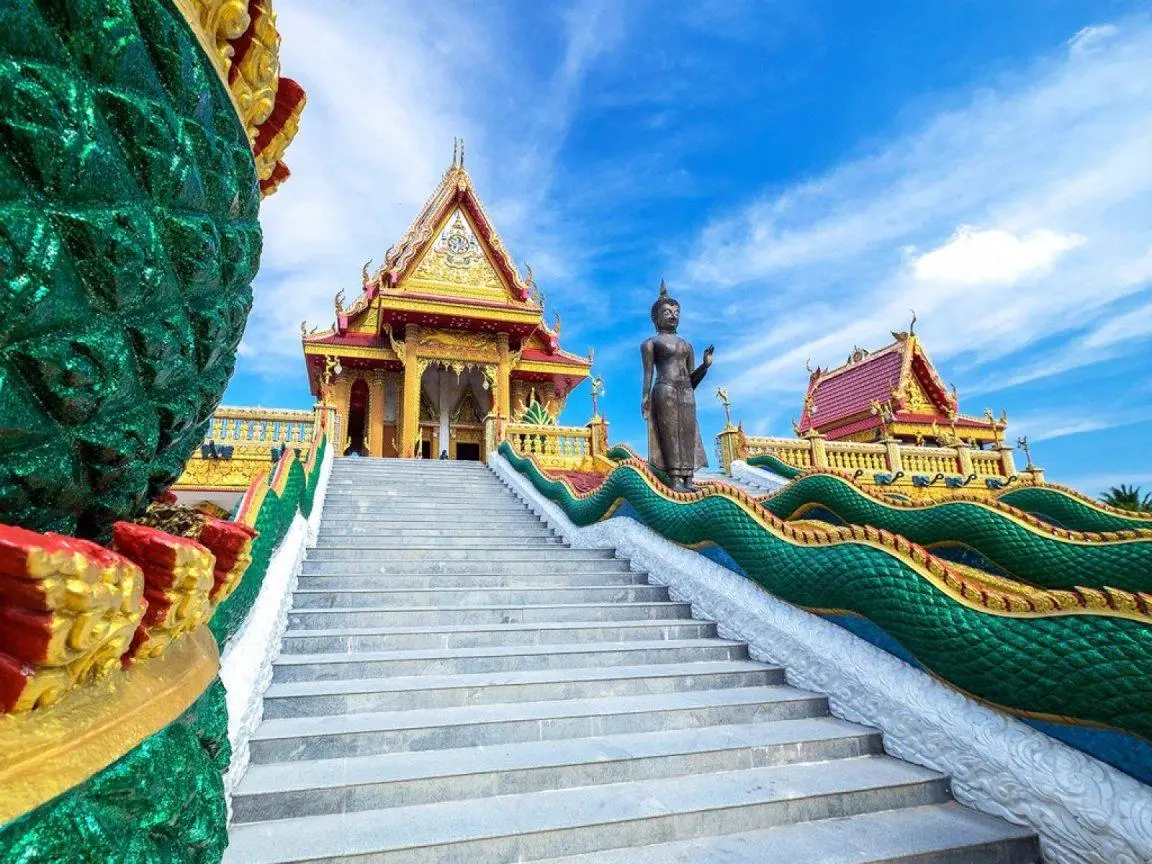
The most striking structure at Wat Ban Ngao is its two-storey ubosot, also known as the commemorative elevated ordination hall. It was initiated under the leadership of Phra Khru Prachak Suttasan, also known as Phra Ajarn Maha Thiam, the temple’s abbot. The foundation stone was laid on 16 August 2007. The ordination hall stands prominently with stairways, a spacious surrounding platform, and highly decorative Thai-style details in gold, red, and traditional motifs. Its elevated form and vivid ornamentation make it one of the most memorable architectural sights in Ranong.
Inside the ubosot is Luang Pho Dibuk, the temple’s principal Buddha image. Its formal name is Phra Tipuka Phuttha Maha Sakyamuni Si Ranang, which refers to a large tin Buddha image that brings auspiciousness and dignity to Ranong. The image is in the Mara Victory posture, cast from tin, approximately 4 metres high, and about 9 feet across the lap. Luang Pho Dibuk is not only a sacred image for worshippers; it is also a powerful symbol of Ranong’s long relationship with tin mining.
Ranong has a deep historical connection with tin. For generations, tin was one of the province’s major resources, shaping local livelihoods, trade, and economic development along the Andaman coast. The creation of a large tin Buddha image at Wat Ban Ngao transforms this local resource into Buddhist art and spiritual meaning. Luang Pho Dibuk therefore represents faith, craftsmanship, and the memory of Ranong’s mining era in one sacred object.
In addition to Luang Pho Dibuk, the ordination hall also contains another tin Buddha image commonly known as Luang Pho Dam. This darker image reflects the appearance of tin that has not been completely refined or separated from impurities. The contrast between the two images allows visitors to see how local material, Buddhist devotion, and craftsmanship are expressed in different visual forms. For travelers interested in culture, Wat Ban Ngao is one of the best places in Ranong to understand how local identity enters sacred art.
The area around the ubosot rewards slow observation. Visitors can appreciate the naga stairways, gables, ornamental details, and the raised platform surrounding the building. The lower level has been used as a hall for activities and community functions, showing that the ordination hall serves not only ritual purposes but also the practical needs of the local community. This dual function strengthens the temple’s identity as both a sacred place and a living community space.
Wang Matcha is another important feature inside Wat Ban Ngao. This freshwater area is home to many fish, including large species that visitors can see at close range. The shade of mature trees makes the area pleasant for walking and resting between temple activities. Families with children and older visitors often find this part of the temple especially enjoyable because it offers a gentle, easy activity in a calm natural setting.
The fish park also reflects the temple’s role as a small community learning space. By maintaining a freshwater habitat and allowing visitors to feed fish responsibly, the temple connects merit-making with environmental care. Feeding fish should be done only in the area provided by the temple and in suitable amounts, helping maintain water quality and the health of the aquatic life.
Wat Ban Ngao is also admired for its surrounding landscape. Behind and around the temple are elevated areas and scenic viewpoints that open toward Ngao’s natural surroundings. Some visitors climb the stairway to reach a higher viewpoint, where the surrounding hills, Phu Khao Ya, and the wider landscape of Ranong can be appreciated. This makes the temple appealing not only to Buddhist worshippers, but also to photographers and travelers who enjoy temple scenery framed by mountains.
The temple’s location near Phu Khao Ya and Namtok Ngao National Park makes it easy to include in a half-day route. A practical itinerary can begin with paying respect to Luang Pho Dibuk at Wat Ban Ngao, continue with a walk around Wang Matcha, include a meal or local product stop in Ban Ngao, and then continue to Phu Khao Ya or Namtok Ngao. This route is comfortable for travelers who want to experience Ranong slowly, with short transfers between cultural and natural attractions.
Phu Khao Ya, also called the Grass Hill or Bald Hill, is one of Ranong’s best-known natural landmarks. Its grass-covered slopes change color with the seasons, turning bright green in the rainy season and golden brown in drier months. When visited together with Wat Ban Ngao, travelers can experience two major impressions of Ranong in one area: Buddhist faith and open natural scenery. Namtok Ngao National Park adds another layer, with the famous Ngao Waterfall standing against the mountain backdrop near the temple area.
Culturally, Wat Ban Ngao is connected with Ban Ngao moral community, which supports religious, artistic, cultural, and community tourism activities. Ban Ngao has stories related to traditional tin panning, local food, souvenirs, and warm community hospitality. Travelers who want to go beyond sightseeing can plan community-based activities such as learning about the mining heritage or joining tin-panning experiences. These activities should be arranged in advance through the community so that local coordinators can prepare the program properly.
Phra Khru Prachak Suttasan, or Phra Ajarn Maha Thiam, is the abbot associated with the temple’s modern development. His work includes the creation of the elevated ordination hall and the strengthening of the temple as a spiritual and community center. Under this leadership, Wat Ban Ngao has become a place where religious practice, local identity, and visitor experience support one another.
Important temple activities follow the Buddhist calendar and local merit-making traditions, including Buddhist holy day merit-making, offerings to monks, Kathin ceremonies, robe-offering activities, and community events. Visitors who come during major merit-making periods can see the temple functioning as a true gathering place for local residents, monks, elders, youth, public agencies, and travelers who wish to experience local Buddhist culture.
Visitors should dress modestly and behave respectfully, especially when entering the ubosot. Shoes should be removed where required, voices should be kept low, and areas used by monks or worshippers should be respected. Photography is generally part of the visitor experience, but travelers should follow temple signs and avoid inappropriate poses or disruption during religious activity. Respectful behavior helps preserve the calm and sacred atmosphere of the temple.
A visit to Wat Ban Ngao usually takes about 1 to 2 hours. A shorter stop is enough for paying respect to Luang Pho Dibuk, but visitors who want to admire the ubosot, walk to Wang Matcha, take photos, and enjoy the viewpoint should allow more time. Morning and late afternoon are the most comfortable periods for walking around the temple, as the light is softer and the heat is lower than at midday.
Getting There is convenient by private car, rental car, or local taxi. From Ranong town, take Phetkasem Road toward Ngao Subdistrict and follow the route into the Wat Ban Ngao area. The temple is close to the main road and can easily be combined with Phu Khao Ya and Namtok Ngao. Travelers arriving from Ranong Airport can also include the temple as a stop before entering town or before continuing south through the province.
Travelers without a private vehicle can hire local transport from Ranong town and arrange a route covering Wat Ban Ngao, Phu Khao Ya, and Namtok Ngao in one trip. This is a practical option for families or small groups because it avoids complicated transfers and allows flexible timing for photography, meals, and sightseeing. Staying in Ngao Subdistrict is also convenient for those who want to explore the southern side of Mueang Ranong at a slower pace.
The area around Wat Ban Ngao includes restaurants, souvenir stops, and several accommodation options. Travelers can find local food and places to stay in Ban Ngao and along nearby sections of Phetkasem Road. From the temple area, it is also convenient to continue to Ngao Mangrove Forest Research Center, Phu Khao Ya, Namtok Ngao, and Ranong Airport. This makes Wat Ban Ngao a useful anchor point for planning a cultural and nature-based route in Ranong.
Wat Ban Ngao is best for travelers who want to understand Ranong beyond hot springs, rain, and islands. The temple reflects the province’s tin-mining past, the faith of Ban Ngao community, the role of Buddhist temples in local development, and the natural beauty of Ranong’s mountain landscape. A single visit reveals how one community temple can function as a spiritual refuge, cultural classroom, resting place, and travel landmark at the same time.
Overall, Wat Ban Ngao is a highly worthwhile stop for anyone visiting Ranong, especially travelers passing along Phetkasem Road or planning to visit Phu Khao Ya, Namtok Ngao, and Ban Ngao community in one day. Its value lies not only in the beauty of the ubosot or the fame of Luang Pho Dibuk, but also in the complete experience it offers: Buddhist faith, tin heritage, freshwater ecology, community life, and peaceful scenery. For a calm, meaningful, and locally grounded travel experience in Ranong, Wat Ban Ngao deserves a place on the itinerary.
| Name | Wat Ban Ngao |
| Location | Ngao Subdistrict, Mueang Ranong District, Ranong Province 85000 |
| Address | Charoen Rat Road, Ngao Subdistrict, Mueang Ranong District, Ranong Province 85000 |
| Coordinates | 9.85586, 98.61511 |
| Place Type | Buddhist Temple, Religious Site, And Cultural Attraction In Ranong Province |
| Highlights | Luang Pho Dibuk, the world’s largest tin Buddha image; the elevated two-storey ubosot; Wang Matcha fish park; and scenery near Phu Khao Ya and Namtok Ngao |
| History / Period | Originated as a monastic residence in Ban Ngao, formally elevated to temple status on 30 January 1987, with the foundation stone of the elevated ordination hall laid on 16 August 2007 |
| Important Figures | Luang Por Khiat, a wandering monk from Pattani Province; and Phra Khru Prachak Suttasan, the abbot associated with the temple’s modern development |
| Abbot / Caretaker | Phra Khru Prachak Suttasan |
| Main Buddha Image | Phra Tipuka Phuttha Maha Sakyamuni Si Ranang, or Luang Pho Dibuk, a Mara Victory posture Buddha image cast from tin, about 4 metres high and 9 feet across the lap |
| Distinctive Features | Ornate two-storey ordination hall, shaded fish park with many freshwater fish, and scenic viewpoints over the natural landscape of Ngao |
| Main Areas / Zones | Elevated ordination hall, Luang Pho Dibuk, Luang Pho Dam, Wang Matcha fish park, merit-making areas, temple courtyard, and viewpoint stairway |
| Recommended Activities | Paying respect to Buddha images, merit-making, seeing Luang Pho Dibuk, visiting the fish park, photography, and learning about Ranong’s tin heritage |
| Current Status | Open as an active Buddhist temple with ongoing monastic, community, and visitor activities |
| Open Days | Daily |
| Opening Hours | 08.00 – 17.00 |
| Fees | No Admission Fee |
| Facilities | Parking Area, Merit-Making Areas, Fish-Feeding Area, Temple Courtyard, And Nearby Restaurants Or Souvenir Shops |
| Main Contact Number | 077-812-142 |
| Travel Information | From Ranong town, take Phetkasem Road toward Ngao Subdistrict and continue to Charoen Rat Road or the temple entrance. The temple is accessible by private car, rental car, or local taxi. |
| Nearby Tourist Attractions | 1. Watcharee OTOP Souvenir Center, about 0.4 km 2. Namtok Ngao National Park, about 2 km 3. Phu Khao Ya / Bald Hill, about 2 km 4. Ngao Mangrove Forest Research Center, about 4 km 5. Phon Rang Hot Spring, about 10 km |
| Nearby Restaurants | 1. Isan Ban Hao Ngao, near Wat Ngao entrance, about 0.4 km, Tel. 089-170-5147, 065-123-2963 2. Rotee Nisara, about 1 km, Tel. 086-574-4324 3. Suan Ahan View, about 1 km, Tel. 081-719-5911 4. Ngao Smoothie & Pork Noodles Ranong, about 0.3 km, Tel. 082-288-3822 5. Kun Lin Restaurant, about 18 km, Tel. 077-822-863, 081-892-3455 |
| Nearby Accommodations | 1. Baroque Boutique Resort, about 0.4 km, Tel. 065-496-2239, 065-493-2642 2. ST Resort Siamese Tin Park Ranong, about 1 km, Tel. 062-445-3509 3. The White Village Ranong Resort, about 2 km, Tel. 082-729-9229 4. Mee Farm Suk Hostel, about 6 km, Tel. 085-928-2469 5. Ranong Adventure Resort & Park, about 6 km, Tel. 061-390-0179 |
Frequently Asked Questions (FAQ)
Q: Where is Wat Ban Ngao located?
A: Wat Ban Ngao is located in Ngao Subdistrict, Mueang Ranong District, Ranong Province, near Phu Khao Ya and Namtok Ngao National Park.
Q: What are the opening days and hours of Wat Ban Ngao?
A: Wat Ban Ngao is open daily from 08.00 to 17.00.
Q: Is there an entrance fee for Wat Ban Ngao?
A: No. Wat Ban Ngao has no admission fee.
Q: What is Luang Pho Dibuk?
A: Luang Pho Dibuk is the principal Buddha image of Wat Ban Ngao. Its formal name is Phra Tipuka Phuttha Maha Sakyamuni Si Ranang. It is a Mara Victory posture Buddha image cast from tin, about 4 metres high and 9 feet across the lap.
Q: What is interesting about Wang Matcha at Wat Ban Ngao?
A: Wang Matcha is the temple’s shaded fish park, home to many freshwater fish. Visitors can walk, rest, and feed fish in the designated area.
Q: Who is the abbot of Wat Ban Ngao?
A: The abbot of Wat Ban Ngao is Phra Khru Prachak Suttasan, also known as Phra Ajarn Maha Thiam.
Q: What attractions can be visited with Wat Ban Ngao?
A: Wat Ban Ngao can be combined with Phu Khao Ya, Namtok Ngao National Park, Ngao Mangrove Forest Research Center, Watcharee OTOP Souvenir Center, and Phon Rang Hot Spring.
Q: How much time should travelers spend at Wat Ban Ngao?
A: Most travelers should allow about 1 to 2 hours to pay respect to Luang Pho Dibuk, see the ubosot, visit Wang Matcha, take photos, and enjoy the temple atmosphere.
 Category: ●Places of Worship
 Group: ●Temple
Last Update : 3 MonthAgo
 Last Update : 3 MonthAgo
 Click to Access the Navigation Map GPS
Wat Ban Ngao Map
Recommend

 Art, Culture and Heritage
 Historical Sites and Monuments(4)
 Landmarks and Memorials(1)
 Royal Palace(1)
 Art, Craft Centres, Tradition(4)
 Educational Places
 Educational Gardens, Farm(1)
Temple(12)
 Other Sacred Sites(2)
 Suburban Living
 Village, Community(2)
 Nature and Wildlife
 National Parks and Marine Reserves(6)
 Mountain (Doi)(4)
 Waterfalls(15)
 Hot Springs(3)
 Caves(4)
 River, Canal(2)
 Bays and Beaches(10)
 Islands(8)
 Other natural attractions(3)
 Travel Articles, Recipes
 Travel Review, Food Review(1)


