
lovethailand home >South Travel Attractions >Ranong Travel Attractions >Muang Ranong >Sai Daeng > Mangrove Resource Development Station 11
TL;DR: Mangrove Resource Development Station 11 is located at Moo 1, Sai Daeng Subdistrict, Mueang Ranong District, Ranong Province, open Daily, hours 08.30 – 16.30.
Mangrove Resource Development Station 11
Open Days: Daily
Opening Hours: 08.30 – 16.30
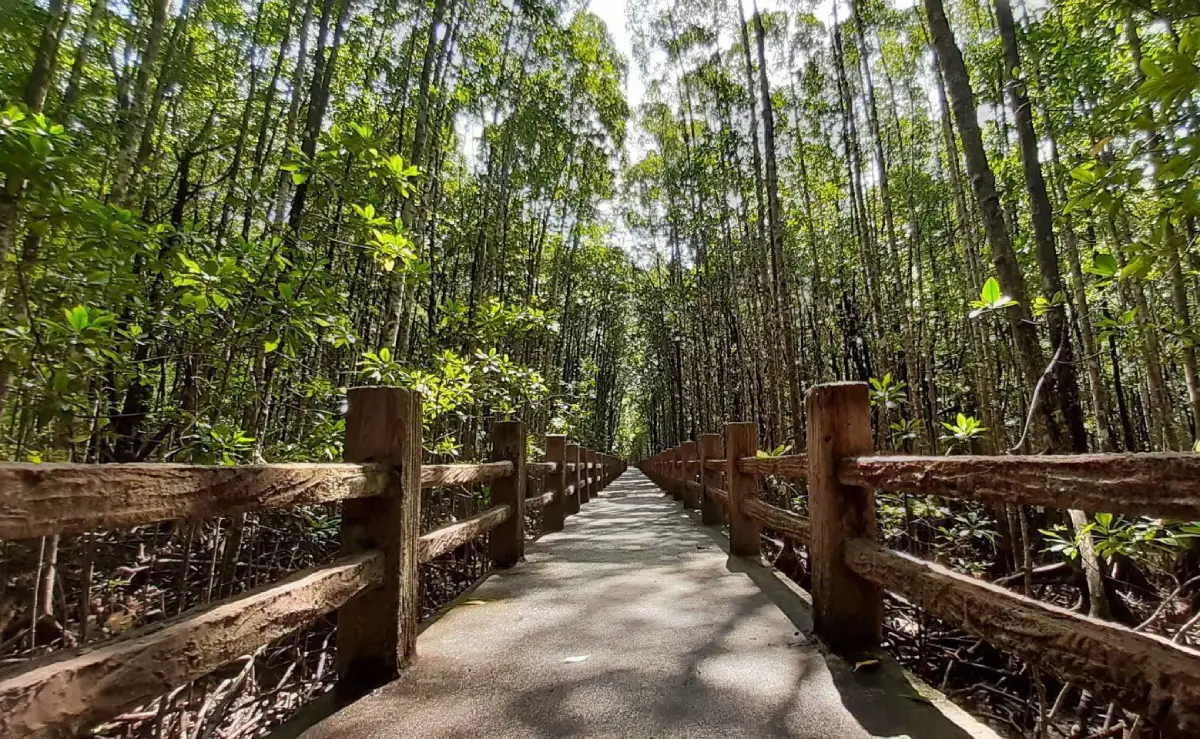
Mangrove Resource Development Station 11, also known as Khlong La-Un Mangrove Arboretum, is an important mangrove learning destination in Sai Daeng Subdistrict, Mueang Ranong District, Ranong Province. The site is located within the Khlong Lam Liang–La-Un National Reserved Forest and forms part of the Khlong La-Un mangrove project. Mangrove planting began here in March 1983, and in 1985 the area was improved into a mangrove arboretum with a nature-study walkway for students, study groups, local residents, and travelers. Its main highlights include a mangrove nature trail of about 1,500 metres, interpretive signs, diverse mangrove plant species, a giant black mangrove tree over 200 years old, abundant mangrove wildlife, and a shaded wetland atmosphere that reveals the ecological richness of Ranong’s coastal forests.
This destination is best understood as a living outdoor classroom rather than a simple sightseeing stop. Visitors can learn how mangrove roots, muddy soil, brackish water, crabs, fish, birds, macaques, and coastal communities form one connected ecosystem. The site is suitable for families, student groups, environmental study trips, nature photographers, birdwatchers, and travelers who want to understand Ranong through its mangrove landscape, one of the province’s most valuable natural resources.
Older tourism information refers to the site as Mangrove Resource Development Station 11, while current Department of Marine and Coastal Resources information identifies the responsible local unit as Mangrove Forest Resource Conservation Center 7 (La-Un, Ranong) in Sai Daeng Subdistrict. These names reflect the site’s development from a mangrove planting and restoration area into a conservation, education, and public learning space for coastal resource management.
The history of the site began in March 1983, when mangrove species were planted under the Khlong La-Un mangrove project. In 1985, the area was improved into a mangrove arboretum, and an elevated study route was constructed to make the forest accessible for educational visits. The 1,500-metre nature walkway allows visitors to enter the mangrove environment without walking directly through mud, reducing damage to fragile root systems and making ecological learning safer and easier.
The core value of Khlong La-Un Mangrove Arboretum is its role as an outdoor learning space. Visitors can walk through mangrove zones affected by tides, observe prop roots and breathing roots, and see how trees adapt to muddy, saline, and waterlogged conditions. Mangrove forests may look still at first glance, but closer observation reveals a highly active ecosystem with fiddler crabs, mudskippers, shellfish, juvenile fish, insects, birds, and small animals using the root systems as feeding grounds, shelters, and nursery habitats.
The area contains more than 25 mangrove plant species, with some tourism sources recording around 30 species. One of the most important highlights is the giant black mangrove, a tree over 200 years old. Black mangrove is a strong mangrove species with distinctive roots and a high tolerance for coastal wetland conditions. Seeing an old giant mangrove here is not only a botanical experience; it is evidence of a coastal forest that has endured for generations.
The study route helps visitors compare different mangrove plant forms along the way. Interpretive signs explain plant species, ecological adaptation, and the importance of mangroves. This makes the experience more effective than learning from books alone. Visitors can directly see how root shapes differ, how mud records animal movement, how tides influence the ground, and how each species occupies a position related to salinity, moisture, and tidal flooding.
In addition to the main concrete walkway, the site includes a 38-metre bridge across a canal, an additional mangrove walking route of about 200 metres, resting pavilions, and a canopy watch tower. The tower allows visitors to view the mangrove from above, understand the forest structure at canopy level, and observe birds or forest movement more easily. These facilities create a layered nature experience, from muddy ground and roots to walkway level and upper canopy views.
An exhibition room near the viewpoint area provides information about mangrove plants and animals. This helps visitors understand the wider ecological context before or after walking the trail. The exhibition supports learning about mangrove species, wildlife, conservation, sustainable use, and the relationship between coastal forests and nearby communities.
Wildlife in the mangrove area includes long-tailed macaques, shrimp, shellfish, crabs, fish, otters, monitor lizards, and various birds such as raptors, cormorants, egrets, and kingfishers. This biodiversity shows that a mangrove forest is not merely a group of trees. It is a transitional ecosystem linking land and sea and supporting many levels of the coastal food web.
A normal visit should take at least 1 hour if visitors want to walk the main route and read the interpretive signs carefully. Study groups should allow 2 hours or more so there is time for a guided explanation, plant observation, photography, and knowledge review after the walk. The site does not need dramatic activities to be meaningful; the mangrove ecosystem itself provides enough detail for a rich learning experience.
Groups that require a guide can contact the responsible unit in advance. Advance coordination of about 7 days is recommended for guided nature interpretation. A guide can explain mangrove species, plant adaptation, wildlife, tides, conservation value, and safety precautions more completely than a self-guided walk.
The broader context of Ranong Province makes Mangrove Resource Development Station 11 especially important. Ranong has extensive mangrove forests across several districts, including Mueang Ranong, Kapoe, La-Un, Suk Samran, and Kra Buri. Mangroves support local fisheries, protect coastlines, function as nurseries for marine life, and preserve the province’s coastal biodiversity.
Ranong is also connected with the Ranong Biosphere Reserve, designated by UNESCO in 1997. The reserve contains mangrove forests, tropical evergreen forests, open sea, seagrass beds, agricultural land, and community areas, with mangroves as the most representative ecosystem. Although Khlong La-Un Mangrove Arboretum is not the main welcome centre of the biosphere reserve, it helps explain the same larger story: Ranong is a nationally and internationally significant province for mangrove ecology.
A visit to Khlong La-Un Mangrove Arboretum should therefore be seen as an ecological learning experience. Mangroves reduce wave energy, protect coastlines from erosion, store carbon, provide nursery grounds for juvenile aquatic animals, serve as feeding grounds for birds and shoreline wildlife, and support nearby communities. A 1,500-metre walk here can show how forest, water, soil, animals, and people are connected in one coastal system.
The Khlong La-Un mangrove project is also connected with nearby communities that depend on mangrove resources for small-scale fisheries, shrimp paste production, coastal food gathering, and local livelihoods. Boat routes to surrounding villages can help visitors understand how mangroves support daily life. Places such as Hat Sai Khao Village, Khlong Tam Hong, and nearby coastal communities show how mangrove forests are linked with food, income, and local knowledge.
Recommended activities include walking the nature trail, observing mangrove roots and plants, photographing the forest, birdwatching, joining a guided interpretation session, visiting the exhibition room, and arranging educational group visits. For conservation-minded visitors, the site is a useful case study in how mangrove restoration, elevated walkways, and public education can allow people to learn from a natural area while reducing impact on sensitive habitats.
The best times to visit are morning and late afternoon. Temperatures are more comfortable, the light is better for photography, and wildlife observation may be easier than during the hottest part of the day. Visitors should bring drinking water, a hat, comfortable walking shoes, and clothing suitable for humid conditions. During the rainy season, the walkway may be wet, so visitors should walk carefully and follow all site instructions.
Mangrove travel requires more care than a normal public park visit. Visitors should stay on the designated walkway, avoid climbing over railings, avoid collecting plants or animals, avoid feeding wildlife, keep noise low, and never leave rubbish in the forest or waterways. Small amounts of waste can become trapped in root systems or flow out to sea. Responsible travel is therefore part of mangrove conservation.
A practical half-day route can begin at Khlong La-Un Mangrove Arboretum in the morning, followed by nearby natural attractions in the Ngao area such as Ranong Mangrove Research Centre, Ranong Biosphere Reserve, Phu Khao Ya, or Ngao Waterfall. Travelers with a full day can continue into Ranong town for Ranong City Pillar Shrine, Rattanarangsan Palace, Raksa Warin Hot Spring, or the Ruangrat Road old-town area. This route combines mangrove forest, mountain scenery, waterfall, hot spring, and town culture in one day.
Phu Khao Ya, also known as Khao Hua Lan, is a good nearby attraction to combine with the mangrove arboretum because its open grass-covered hills contrast sharply with the shaded wetland forest. During the rainy season the hill turns green, while in the dry season it becomes golden brown. Visiting both sites helps travelers understand the geographical variety of Ranong more clearly.
Ngao Waterfall is another suitable natural stop after the mangrove trail. Located in Ngao Subdistrict, it represents Ranong’s forested mountain ecosystem. Combining Khlong La-Un Mangrove Arboretum with Ngao Waterfall allows visitors to experience a natural sequence from coastal mangrove wetlands to upland forest and waterfall landscapes.
Raksa Warin Hot Spring is a good way to end the day after walking through the mangrove forest. The hot spring is one of Ranong’s best-known natural wellness sites and is suitable for foot soaking and relaxation. A route that begins with mangrove learning and ends with a hot spring experience gives travelers both ecological understanding and physical rest.
Getting There is easiest by private car, rental car, local taxi, or chartered van. From Ranong town, take Highway 4, or Phetkasem Road, toward Sai Daeng Subdistrict and the Khlong La-Un area. The route works well for self-drive travel because visitors can continue to Ngao, Phu Khao Ya, Ngao Waterfall, or return to Ranong town in the same day. Study groups should contact the responsible unit in advance to arrange guided interpretation and suitable timing.
Travelers without a private vehicle should arrange local transport from Ranong town. Public transport to nature-study sites is less convenient than private or hired transport. A chartered vehicle is especially useful for groups that want to complete the full trail, visit nearby viewpoints, and continue to several attractions in one route.
Overall, Mangrove Resource Development Station 11 or Khlong La-Un Mangrove Arboretum is one of Ranong’s most valuable nature-learning sites. It combines the history of mangrove restoration beginning in 1983, development as a mangrove arboretum in 1985, a 1,500-metre nature trail, diverse mangrove species, a giant black mangrove over 200 years old, mangrove wildlife, an exhibition room, a canopy watch tower, and a strong role as an outdoor classroom for coastal ecology. A visit here shows that Ranong is not only about islands, waterfalls, hot springs, and beaches, but also about mangrove forests that sustain coastal life and deserve careful learning and protection.
| Name | Mangrove Resource Development Station 11 / Khlong La-Un Mangrove Arboretum |
| Current Related Unit | Mangrove Forest Resource Conservation Center 7 (La-Un, Ranong) |
| Place Type | Mangrove Learning Site, Arboretum, Nature Trail, And Coastal Resource Conservation Area |
| Location | Moo 1, Sai Daeng Subdistrict, Mueang Ranong District, Ranong Province |
| Local Unit Address | 34/3 Sai Daeng Subdistrict, Mueang Ranong District, Ranong Province 85130 |
| Forest Area | Khlong Lam Liang–La-Un National Reserved Forest And Khlong La-Un Mangrove Project Area |
| History / Period | Mangrove planting began in March 1983, and the area was improved into a mangrove arboretum in 1985. |
| Highlights | A 1,500-Metre Mangrove Nature Trail, Giant Black Mangrove Over 200 Years Old, Diverse Mangrove Species, Mangrove Wildlife, Interpretive Signs, Resting Pavilions, And Canopy Watch Tower |
| Important Plants | Black Mangrove, Rhizophora, Avicennia, Ceriops, Sonneratia, Bruguiera, Xylocarpus, And Other Brackish-Water Mangrove Species |
| Wildlife | Long-Tailed Macaques, Shrimp, Shellfish, Crabs, Fish, Otters, Monitor Lizards, Raptors, Cormorants, Egrets, Kingfishers, And Small Mangrove Animals |
| Main Zones | Concrete Nature Walkway, Canal Bridge, Additional Mangrove Walking Route, Resting Pavilion, Canopy Watch Tower, Exhibition Room, And Khlong La-Un Mangrove Area |
| Recommended Activities | Nature Trail Walking, Mangrove Ecology Learning, Birdwatching, Nature Photography, Guided Interpretation, Plant And Wildlife Study, And Educational Group Visits |
| Group Visit Contact | Groups requiring a nature guide should contact the responsible unit about 7 days in advance. |
| Contact Numbers | 077-828-540, 077-847-217 |
| Current Status | Open As A Mangrove Learning Site, Nature Trail, And Coastal Resource Conservation Area In Ranong Province |
| Open Days | Daily |
| Opening Hours | 08.30 – 16.30 |
| Facilities | Nature Walkway, Interpretive Signs, Canal Bridge, Resting Pavilions, Canopy Watch Tower, Exhibition Room, And Resting Points Along The Trail |
| Visitor Etiquette | Stay On The Designated Walkway, Do Not Collect Plants Or Animals, Do Not Feed Wildlife, Do Not Litter, Watch For Slippery Surfaces In The Rainy Season, And Follow Staff Instructions. |
| Travel Information | From Ranong town, take Highway 4 / Phetkasem Road toward Sai Daeng Subdistrict and the Khlong La-Un area. Private car, rental car, chartered van, or local hired transport is recommended. |
| Nearby Tourist Attractions | 1. Khlong La-Un Mangrove Project Area, about 0 km 2. Khlong La-Un And Sai Daeng Area, about 1 km 3. Ranong Mangrove Research Centre And Ranong Biosphere Reserve, about 18 km 4. Phu Khao Ya / Khao Hua Lan, about 22 km 5. Ngao Waterfall, about 23 km 6. Raksa Warin Hot Spring, about 35 km 7. Ranong City Pillar Shrine And Old Town Area, about 35 km |
| Nearby Restaurants | 1. Dao Rung Sai Daeng, about 15 km, Tel. 085-797-9501, 085-797-9516 2. Tin Cafe Ngao, about 19 km, Tel. 065-403-5959 3. Ngao Smoothie & Pork Noodles, about 20 km, Tel. 082-288-3822 4. Isan Ban Hao Ngao, about 21 km, Tel. 089-170-5147, 065-123-2963 5. Somtam Phu Khao Ya Jae Jim, about 22 km, Tel. 064-058-9415, 086-560-3299 6. Ngao Valley, about 22 km, Tel. 065-568-7643 |
| Nearby Accommodations | 1. Ranong Adventure Resort & Park, about 18 km, Tel. 061-390-0179 2. The White Village Ranong Resort, about 20 km, Tel. 082-729-9229 3. Mee Farm Suk Hostel, about 20 km, Tel. 085-928-2469 4. Siamese Tin Park Ranong, about 21 km, Tel. 062-445-3509 5. Baroque Boutique Resort, about 22 km, Tel. 065-496-2239, 065-493-2642 |
Frequently Asked Questions (FAQ)
Q: Where is Mangrove Resource Development Station 11 located?
A: Mangrove Resource Development Station 11, also known as Khlong La-Un Mangrove Arboretum, is located in Moo 1, Sai Daeng Subdistrict, Mueang Ranong District, Ranong Province, within the Khlong Lam Liang–La-Un National Reserved Forest.
Q: What are the opening days and hours?
A: The site is open daily from 08.30 to 16.30.
Q: What are the main highlights of Khlong La-Un Mangrove Arboretum?
A: The highlights include a 1,500-metre mangrove nature trail, diverse mangrove species, a giant black mangrove over 200 years old, mangrove wildlife, interpretive signs, resting pavilions, and a canopy watch tower.
Q: Do groups need to contact the site in advance?
A: Yes. Groups that require a guided nature interpretation should contact the responsible unit about 7 days in advance.
Q: What wildlife can visitors observe in the mangrove area?
A: Visitors may observe long-tailed macaques, shrimp, shellfish, crabs, fish, otters, monitor lizards, raptors, cormorants, egrets, kingfishers, and small animals living around mudflats and root systems.
Q: How long should visitors spend at the site?
A: A normal visit should take at least 1 hour. Study groups should allow 2 hours or more for guided interpretation, plant observation, photography, and knowledge review.
Q: What nearby places can be visited with Mangrove Resource Development Station 11?
A: Nearby places include Ranong Mangrove Research Centre, Ranong Biosphere Reserve, Phu Khao Ya, Ngao Waterfall, Raksa Warin Hot Spring, and Ranong town attractions.
Q: How do travelers get there?
A: From Ranong town, take Highway 4 or Phetkasem Road toward Sai Daeng Subdistrict and the Khlong La-Un area. Private car, rental car, chartered van, or local hired transport is the most convenient option.
Tel : 077847217
 Tel : 077847217
 Category: ●Nature and Wildlife
 Group: ●National Parks and Marine Reserves
Last Update : 3 MonthAgo
 Last Update : 3 MonthAgo
 Click to Access the Navigation Map GPS
Mangrove Resource Development Station 11 Map
Recommend

 Art, Culture and Heritage
 Historical Sites and Monuments(4)
 Landmarks and Memorials(1)
 Royal Palace(1)
 Art, Craft Centres, Tradition(4)
 Educational Places
 Educational Gardens, Farm(1)
 Places of Worship
 Temple(12)
 Other Sacred Sites(2)
 Suburban Living
 Village, Community(2)
National Parks and Marine Reserves(6)
 Mountain (Doi)(4)
 Waterfalls(15)
 Hot Springs(3)
 Caves(4)
 River, Canal(2)
 Bays and Beaches(10)
 Islands(8)
 Other natural attractions(3)
 Travel Articles, Recipes
 Travel Review, Food Review(1)


