
lovethailand home >South Travel Attractions >Ranong Travel Attractions >Kra Buri >Lam Liang > Tham Phra Khayang Cave
TL;DR: Tham Phra Khayang Cave is located at Lam Liang Subdistrict, Kra Buri District, Ranong Province 85110, Thailand, open Daily, hours 08.30 – 16.30.
Tham Phra Khayang Cave
Open Days: Daily
Opening Hours: 08.30 – 16.30
Tham Phra Khayang Cave in Ranong Province is a small but culturally rich cave in Lam Liang Subdistrict, Kra Buri District. It is known for its local legend of Pho Ta Luang Kaeo, its sacred Buddha image area, its short cave route of about 40 meters, its upper stairway leading toward the hilltop area, and the annual Tham Phra Khayang tradition held around Chinese New Year. The cave is part of the wider landscape connected to Lam Nam Kraburi National Park, the Kra Buri River, mangrove ecology, local herbal knowledge, and the old stories of Kra Buri town.
Tham Phra Khayang is located in the mountain area of Lam Liang Subdistrict, Kra Buri District, Ranong Province. The cave lies under the responsibility of Lam Nam Kraburi National Park. Travelers using Phetkasem Road between Ranong and Chumphon can turn off around kilometer markers 563 – 564 and continue for about 1 kilometer to reach the cave area. From the Kra Buri District Office, the cave is about 18 kilometers away, making it suitable for a cultural and nature route in northern Ranong.
The cave was formerly known as Tham Khao Yang or Tham Kha Yang before the name evolved into Tham Phra Khayang. This older name is tied to local oral traditions, especially stories connected with the early formation of Kra Buri town and the revered figure known as Pho Ta Luang Kaeo. The name of the cave is therefore not just a geographic label; it is a trace of local memory, belief, and community identity in the Kra Buri area.
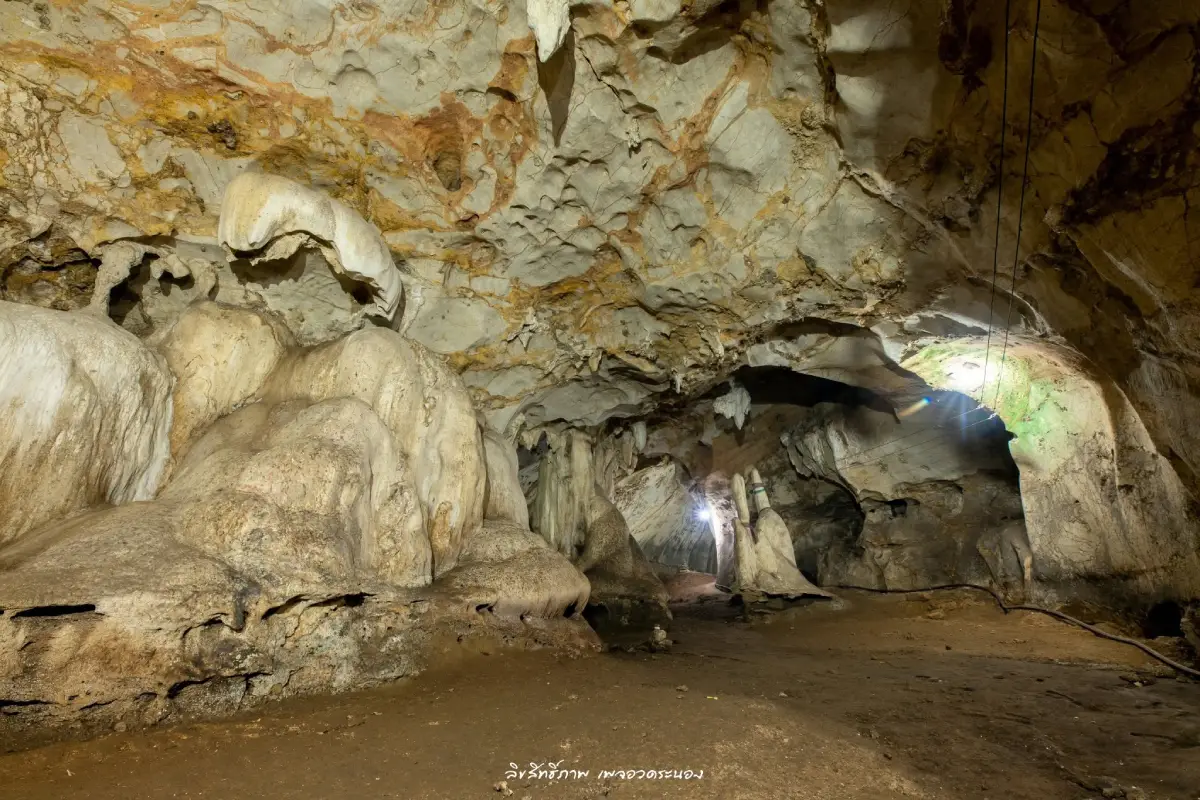
Although Tham Phra Khayang is not a large cave, it has several layers of significance. The cave is a natural limestone cave with stalactites and stalagmites, humid interior conditions, dim sections, and many bats. It has also been mentioned in connection with ancient traces such as old-style wall paintings and pottery fragments, giving the cave an additional historical dimension beyond its natural character.
From the cave entrance, visitors can walk inward for about 40 meters. Inside the cave route, there is a stairway that leads upward toward the top section of the hill. This upper area is associated with local belief about rare herbs once planted or preserved on the hill. Because of this, Tham Phra Khayang is not only a cave attraction but also a place that reflects traditional knowledge about plants, forest use, and the long relationship between local communities and the mountain landscape.
The right side of the cave entrance is known as the Buddha image area, or Tham Phra, because several Buddha images are enshrined there. Local residents and visitors come to pay respect, especially during the annual festival around Chinese New Year. The combination of cave scenery, Buddha images, local legend, and community ritual gives Tham Phra Khayang its distinctive identity.
The most important story associated with the cave is the legend of Pho Ta Luang Kaeo, a revered figure linked with the founding history of Kra Buri. Local narratives connect the cave, the mountain, and the old town through stories of travel, settlement, and sacred protection. For visitors, this legend helps explain why the cave matters to the community. It is not simply a natural cave; it is a cultural memory site for Kra Buri District.
Tham Phra Khayang becomes especially lively during the annual Chinese New Year period. The local tradition, often called the Tham Phra Khayang Cave Fair or the gilding ceremony at Tham Phra Khayang, has been held since 1961. The event usually continues for about 3 – 7 days and brings together religious worship, community celebration, cultural performance, local products, and tourism activities.
During the festival, visitors can pay respect to sacred objects, gild Buddha images, explore the cave, learn about the surrounding herbs and natural landscape, and experience local performances such as Manohra. In different years, the fair has included processions, light-and-sound presentations, local product stalls, agricultural product contests, sports activities, and community exhibitions related to the cave and Kra Buri traditions.
The annual cave tradition is important because it keeps local belief and community history active. It is a gathering point for residents, local authorities, cultural groups, and travelers. During the festival period, the cave area is usually better prepared for visitors, with lighting, staff support, and activity zones arranged for the event schedule of that year.
On normal visiting days, Tham Phra Khayang is best suited to travelers who appreciate quiet places, local legends, and nature-based cultural tourism. Visitors should walk carefully because the cave floor can be damp, the interior is humid, and some sections have limited light. A flashlight is strongly recommended. Travelers should avoid loud noise, touching natural formations, disturbing bats, or leaving waste inside the cave.
The surrounding area adds another important layer to the visit. Around the cave, there is a nature trail of about 1 kilometer through nipa palm and mangrove environments. This trail allows visitors to observe local plants, ferns, mangrove ecology, and the landscape connected to Khlong Lam Liang and the Kra Buri River. At low tide, small coastal creatures such as crabs, fish, and mudskippers may be seen around the wetland environment.
Khlong Lam Liang is part of the natural setting that gives the cave area its special character. The stream connects the local landscape with the Kra Buri River, a riverine border area between Thailand and Myanmar. This makes Tham Phra Khayang more than a cave destination; it is part of a wider ecological and cultural landscape shaped by mountains, waterways, mangroves, and borderland life.
Visitors can understand Tham Phra Khayang as a destination with three main layers: the natural limestone cave, the sacred Buddha image area, and the mangrove-nipa nature trail around the cave. These layers make the visit more meaningful than simply walking into a cave. The site presents a compact but complete picture of northern Ranong’s natural environment and local belief system.
For travelers interested in local history, Tham Phra Khayang is a good example of how legend and landscape can exist together. The story of Pho Ta Luang Kaeo gives the cave social meaning, while the cave formations, ancient traces, and surrounding waterways show that the Kra Buri area has long been connected with settlement, movement, and local identity.
The belief about rare herbs on the upper hill also reflects older forms of local knowledge. Communities in Ranong’s borderland landscape have long depended on forests, streams, and mountains. The herbal association of the cave area therefore adds depth to the site, connecting it with traditional plant knowledge and the practical relationship between people and nature.
A useful visit to Tham Phra Khayang should take at least half a day. Travelers can begin at the cave entrance and Buddha image area, continue along the safe interior route, and then explore the surrounding nature trail. If the trip falls during the Chinese New Year festival, visitors should allow more time because the area becomes busier and additional ceremonies, performances, and community activities are held.
The best time of day to visit is from morning to early afternoon. This gives enough daylight for the route, reduces the risk of returning late, and makes it easier to combine the cave with other attractions in Kra Buri District. Ranong is known for its long rainy season, so travelers should check the weather before visiting, especially when planning to enter damp cave areas or walk along the nature trail.
Getting There is easiest by private car or rental car. From Ranong town, follow Phetkasem Road north toward Kra Buri District. Around kilometer markers 563 – 564, turn onto the side road leading toward the cave and continue for about 1 kilometer. From the Kra Buri District Office, the cave is about 18 kilometers away. This route can be combined with other northern Ranong attractions.
Travelers using public transport can take a bus or van on the Ranong – Kra Buri route and arrange local transport to the cave entrance area. Because the cave is about 1 kilometer from the main road junction, arranging the final transfer in advance makes the trip smoother, especially for those visiting outside the festival period or returning in the late afternoon.
Tham Phra Khayang is suitable for travelers who want to experience a different side of Ranong. Instead of beaches, islands, or hot springs, this destination highlights mountains, cave ecology, riverine landscapes, Buddhist devotion, and local borderland traditions. It is especially suitable for cultural travelers, nature lovers, families who can walk carefully, and visitors interested in small but meaningful local attractions.
Visitors should prepare a flashlight, shoes with good grip, drinking water, and clothing suitable for humid cave conditions. People who are sensitive to musty air or who are uncomfortable around bats should prepare accordingly. Responsible behavior is important: do not write on cave walls, do not touch stalactites or stalagmites, do not disturb animals, and do not leave trash in the natural area.
In cultural terms, Tham Phra Khayang shows how community faith can be rooted in a natural place. The cave is not only a scenic site but also a ritual space, a story site, and a community landmark. This is why the annual festival continues to matter to Kra Buri residents and why the cave remains an important cultural attraction in Ranong Province.
For trip planning, Tham Phra Khayang can be the main destination of a half-day route. Travelers can continue to Ban Thap Li to try the well-known local steamed buns, visit the Kra Isthmus viewpoint, or add Bok Krai Waterfall and Lam Nam Kraburi National Park headquarters to a longer nature route. This makes the cave a useful anchor point for exploring Kra Buri District more deeply.
Ban Thap Li is a convenient food stop along the wider route because it is famous for Thap Li steamed buns, one of Kra Buri’s best-known local foods. Pairing the cave with a local food stop makes the trip more complete, combining history, nature, belief, and regional cuisine in one itinerary.
For learning-focused travel, Tham Phra Khayang offers insight into several ecosystems at once. The cave is a habitat for bats, the surrounding mangrove and nipa areas support aquatic life and birds, and the hill area is connected with local herbal knowledge. Travelers who observe carefully will find that this small destination contains more detail than its size suggests.
One of the strongest qualities of Tham Phra Khayang is its quiet character on ordinary days. It is less crowded than Ranong’s more famous attractions, making it appropriate for travelers who want a calm cultural stop. During the festival, the mood changes completely as the cave becomes a lively community space filled with worship, performance, and local activity.
Photographers should prepare for low-light conditions inside the cave. A camera or phone with good low-light performance is useful, but flash should be used carefully to avoid disturbing bats or worshippers. The cave entrance, Buddha image area, mangrove trail, and Khlong Lam Liang surroundings all offer different photographic subjects.
Families can visit Tham Phra Khayang, but children should remain under adult supervision at all times. Elderly visitors or travelers with mobility limitations may prefer the entrance area, Buddha image area, and outer surroundings rather than walking deeper into the damp cave sections. The site is best enjoyed with slow movement and attention to safety.
Keeping the area clean and respectful is essential because Tham Phra Khayang is both a natural cave and a place of faith. Noise, litter, wall markings, and careless contact with cave formations can damage the value of the site. Travelers should treat the cave as a living natural and cultural space.
Recent annual activities at Tham Phra Khayang show that the cave remains an active tourism and cultural site. Provincial and local agencies continue to use the area for traditional events, tourism promotion, and community product activities. This confirms the cave’s continuing role as one of Kra Buri District’s important cultural landmarks.
Overall, Tham Phra Khayang brings together several layers of Ranong in one destination: the legend of Pho Ta Luang Kaeo, Buddha images inside the cave, stalactites and stalagmites, ancient traces, a short cave route, herbal associations, bats, a mangrove-nipa trail, and the annual Chinese New Year cave tradition. For travelers who want to understand Ranong beyond its coast and hot springs, this cave is a worthwhile stop.
A good visit begins with checking the operating hours of Lam Nam Kraburi National Park, preparing the right gear, choosing a morning or early afternoon schedule, and pairing the cave with other Kra Buri attractions. During Chinese New Year, joining the Tham Phra Khayang tradition offers the fullest experience, when nature, legend, religion, and community life come together in the same place.
| Name | Tham Phra Khayang Cave |
| Location | Lam Liang Subdistrict, Kra Buri District, Ranong Province 85110, Thailand |
| Address | In the Lam Liang mountain area under Lam Nam Kraburi National Park; turn from Phetkasem Road around kilometer markers 563 – 564 and continue for about 1 km |
| Coordinates | 10.326425, 98.765159 |
| Highlights | Small cave linked with the legend of Pho Ta Luang Kaeo, Buddha images, a cave route of about 40 meters, an upper stairway, and a surrounding nature trail |
| History | An old cave associated with Kra Buri local legend and ancient traces such as old-style paintings and pottery fragments |
| Name Origin | Formerly known as Tham Khao Yang or Tham Kha Yang before becoming widely known as Tham Phra Khayang |
| Distinctive Features | Small limestone cave with humid interior conditions, many bats, stalactites and stalagmites, and a route leading toward the hilltop area |
| Travel Information | Use Phetkasem Road between Ranong and Chumphon; turn in around kilometer markers 563 – 564 for about 1 km. The cave is about 18 km from Kra Buri District Office |
| Current Status | Open as a tourist attraction and still used for the annual Tham Phra Khayang tradition during Chinese New Year |
| Open Days | Daily |
| Opening Hours | 08.30 – 16.30 |
| Fees | Lam Nam Kraburi National Park adult fee: Thai adult 20 THB, foreign adult 100 THB |
| Facilities | Access route, Buddha image worship area, nature trail, and additional visitor support during the annual festival |
| Main Areas / Zones | 1. Main cave and cave-walking route 2. Buddha image area 3. Nipa palm and mangrove nature trail around the cave |
| Caretaker | Lam Nam Kraburi National Park, with local agencies in Kra Buri District supporting the annual festival period |
| Main Contact Number | Lam Nam Kraburi National Park, Tel. 077-989-817 |
| Official Website / Official Page | Department of National Parks, Wildlife and Plant Conservation website |
| Nearby Tourist Attractions | 1. Nipa Palm and Mangrove Nature Trail Around Tham Phra Khayang, about 1 km 2. Wat Lam Liang, about 6 km 3. Ban Thap Li Steamed Bun Area, about 15 km 4. Kra Isthmus / Kio Kra, about 18 km 5. Bok Krai Waterfall, about 18 km 6. Lam Nam Kraburi National Park Headquarters, about 35 km |
| Nearby Restaurants | 1. PunThai Coffee Kra Buri 2, about 8 km, Tel. 092-275-2827 2. Khao Man Kai And Thap Li Steamed Buns, about 15 km, Tel. 086-280-6869 3. Han Yok Yuan Original Thap Li Steamed Buns, about 16 km, Tel. 081-891-1900 4. Thap Li Steamed Buns Je Toi, about 16 km, Tel. 081-333-4493 5. Rim Khlong Kra Buri Restaurant, about 18 km, Tel. 086-739-7696 6. Gong Valley, about 22 km, Tel. 087-268-1285 |
| Nearby Accommodations | 1. Mulberry Resort, about 12 km, Tel. 093-740-5151, 088-753-9842 2. Khung Nam Resort, about 20 km, Tel. 083-692-6938, 086-279-0075 3. Tahualan Cafe And House, about 20 km 4. Junkaew Resort, about 22 km, Tel. 089-292-7454 5. Thabli Resort, about 24 km, Tel. 098-351-6564 |
Frequently Asked Questions (FAQ)
Q: Where is Tham Phra Khayang Cave located?
A: Tham Phra Khayang Cave is located in Lam Liang Subdistrict, Kra Buri District, Ranong Province, within the area managed by Lam Nam Kraburi National Park.
Q: What are the opening hours of Tham Phra Khayang Cave?
A: The cave is open daily from 08.30 to 16.30.
Q: Is there an entrance fee for Tham Phra Khayang Cave?
A: The listed adult fee for the Lam Nam Kraburi National Park area is 20 THB for Thai adults and 100 THB for foreign adults.
Q: Why is Tham Phra Khayang Cave important?
A: The cave is important for its natural cave features, local legend of Pho Ta Luang Kaeo, Buddhist worship area, and the annual cave tradition held during Chinese New Year.
Q: What can visitors see inside Tham Phra Khayang Cave?
A: Visitors can see a short cave route of about 40 meters, Buddha images, stalactites and stalagmites, an upper stairway, humid cave chambers, and many bats.
Q: What should visitors bring to Tham Phra Khayang Cave?
A: Visitors should bring a flashlight, shoes with good grip, drinking water, and clothing suitable for humid cave conditions.
Q: When is the Tham Phra Khayang Cave festival held?
A: The annual Tham Phra Khayang tradition is held around Chinese New Year and usually includes Buddha image gilding, sacred ceremonies, cave visits, folk performances, and community activities.
Q: What nearby places can be combined with a visit to Tham Phra Khayang Cave?
A: Travelers can combine the cave with Ban Thap Li, Kra Isthmus, Bok Krai Waterfall, Wat Lam Liang, and Lam Nam Kraburi National Park Headquarters.
Tel : 025620760
 Tel : 025620760
 Category: ●Nature and Wildlife
 Group: ●Caves
Last Update : 3 MonthAgo
 Last Update : 3 MonthAgo
 Click to Access the Navigation Map GPS
Tham Phra Khayang Cave Map
Recommend

 Art, Culture and Heritage
 Historical Sites and Monuments(4)
 Landmarks and Memorials(1)
 Royal Palace(1)
 Art, Craft Centres, Tradition(4)
 Educational Places
 Educational Gardens, Farm(1)
 Places of Worship
 Temple(12)
 Other Sacred Sites(2)
 Suburban Living
 Village, Community(2)
 National Parks and Marine Reserves(6)
 Mountain (Doi)(4)
 Waterfalls(15)
 Hot Springs(3)
Caves(4)
 River, Canal(2)
 Bays and Beaches(10)
 Islands(8)
 Other natural attractions(3)
 Travel Articles, Recipes
 Travel Review, Food Review(1)


