
lovethailand home >South Travel Attractions >Phatthalung Travel Attractions >Si Banphot >Khao Pu > Khao Pu–Khao Ya National Park
TL;DR: Khao Pu–Khao Ya National Park, Phatthalung attractions : Nature and Wildlife, National Parks and Marine Reserves.

Khao Pu–Khao Ya National Park
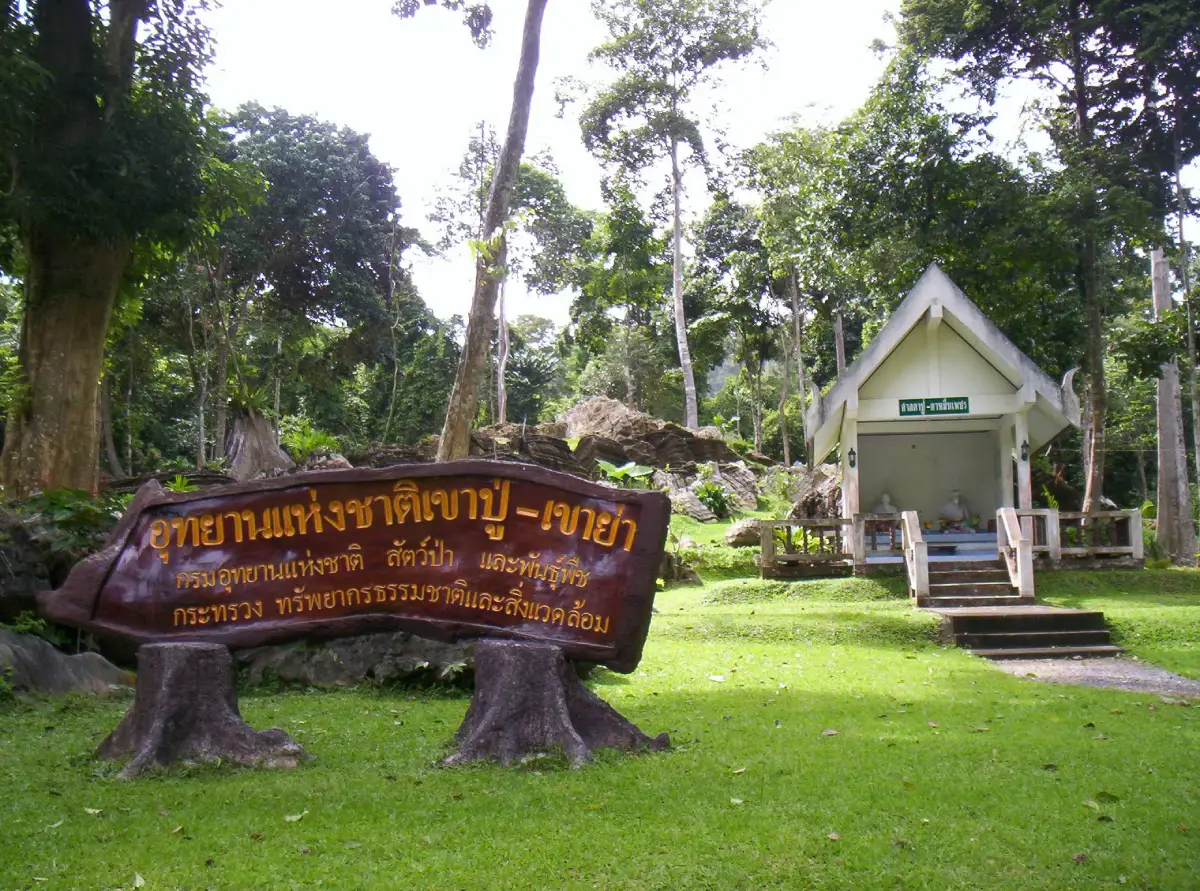
Open Days: Daily, except for the annual recovery closure from 15 November to 25 December
Opening Hours: 08.00 – 16.00
Khao Pu–Khao Ya National Park in Phatthalung Province is a large tropical rainforest protected area on the Banthat Mountain Range. It covers parts of Phatthalung, Nakhon Si Thammarat, and Trang Provinces and was declared Thailand’s 42nd national park on 27 May 1982. The park covers approximately 433,750 rai, or about 694 square kilometers. Its main attractions are rainforest mountains, watershed forests, caves, waterfalls, limestone cliffs, nature trails, wildlife diversity, park accommodation, and a cool forest atmosphere that remains green throughout much of the year.
The name Khao Pu–Khao Ya comes from mountains that local people in Phatthalung have long known and respected. Khao Pu, in particular, is regarded by local communities as a sacred mountain associated with Ta Pu, a revered ancestral or guardian spirit. This gives the park both natural and cultural meaning. Visitors experience not only rainforest scenery, but also a landscape connected with local belief, memory, and respect for the mountains.
The park’s terrain is dominated by the Banthat Mountain Range, with complex ridges, valleys, streams, caves, and waterfalls. One of the most important peaks is Khao Hin Thaen, which rises to about 877 meters above sea level. The forest is mainly tropical evergreen rainforest, with high humidity, dense vegetation, and shaded stream valleys. This deep green character has led the park to be described as a pristine or untouched forest landscape.
Ecologically, Khao Pu–Khao Ya National Park is highly important because it is a watershed for both the Trang River and the Pak Phanang River. On the Phatthalung side, streams such as Khlong Lamai, Khlong Mai Siap, and Khlong Nam Sai originate in the park before flowing into downstream waterways. Protecting this forest therefore helps maintain water sources for communities, agriculture, and ecosystems below the mountains.
The rainforest includes many important tree species such as yang, takhian, lumpho, krabak, wild champak, pikun, and other large evergreen trees. The dense forest canopy keeps the ground moist, supports stream flow, reduces soil erosion, and provides habitat for many organisms. Ferns, mosses, orchids, herbs, and understory plants can be seen along suitable nature trails, making the park valuable for natural-history learning as well as recreation.
Wildlife diversity is another strength of the park. Public travel and natural-resource information describes about 60 mammal species, including serow, barking deer, sambar deer, small horseshoe bats, and black-bearded tomb bats. About 286 bird species have been recorded, including Asian paradise flycatcher, white-rumped shama, plain sunbird, orange-breasted flycatcher, chestnut-breasted malkoha, hornbills, green pigeons, and ruddy kingfisher. This makes the park an important birdwatching and biodiversity area in southern Thailand.
Reptiles, fish, amphibians, and insects are also diverse. Records mention around 67 reptile species, including snakes, king cobra, blue-headed flying lizard, southern forest gecko, and softshell turtle. Fish species include eel-like and stream fish, while amphibians include Malayan horned frog, forest frogs, giant river toad, and small toads. Insects include giant honeybees, cicadas, beetles, and butterflies. These species reflect the park’s role as a living rainforest ecosystem, not merely a scenic destination.
Tham Matcha Pla Won, or Matcha Pla Won Cave, is one of the key attractions near park headquarters. Located about 2 km from the office, it is a medium-sized cave with 3 large chambers, stalagmites, stalactites, limestone curtains, and many bats. Toward the end of the cave, a water pool supports small aquatic animals such as shrimp, shellfish, and fish. The cave combines limestone geology with a small cave-water ecosystem, making it interesting for both nature visitors and geology learners.
Visitors entering the cave should walk carefully because some surfaces may be wet, uneven, or dark. It is important not to touch stalagmites or stalactites, disturb bats, write on cave walls, or leave rubbish behind. Limestone formations take a very long time to develop, and small damage can permanently reduce the cave’s natural value.
Pha Phueng, or Bee Cliff, is another important highlight located only about 300 meters from park headquarters. It is a limestone cliff where giant honeybees build many nests during certain seasons, especially from February to April or sometimes into the middle of the year depending on natural conditions. The upper area also works as a short-distance viewpoint where visitors can see the surrounding forest and mountain scenery.
Pha Phueng should be visited quietly and from a safe distance. Honeybees are ecologically important pollinators, and their cliff nests should not be disturbed. Visitors should not throw objects, use smoke, make loud noise, climb near the nests, or attempt to get closer without guidance from park staff. Observing from the proper area is the best way to appreciate this natural phenomenon safely.
The park’s nature trails are located around the headquarters area and include 2 routes suitable for learning about rainforest plants, herbs, streams, and small wildlife. These trails are useful for families, students, first-time forest visitors, and travelers who want to experience the rainforest without long trekking. Walking slowly allows visitors to notice leaves, roots, insects, bird calls, moss, and the changing light beneath the canopy.
Riang Thong Waterfall is one of the park’s notable waterfalls. Its source comes from the Banthat and Nakhon Si Thammarat mountain systems, and the water cascades down multiple rock levels. The upper area includes a viewpoint where visitors can see Thale Noi, Khao Pu, and Khao Ya in suitable weather. The waterfall is best visited after checking weather and route conditions, because water volume and safety depend strongly on rainfall.
Other natural sites within the broader park area include Tham Wang Nai Phut, Khuan Pra Waterfall, Pak Chaem Waterfall, Nan Plio Waterfall, Tharawarin Waterfall, Huai Nam Sai Reservoir, and Tham Ruen Thep Nimit, also known as Tham Ta Pu. Since the national park covers a wide area across 3 provinces, these attractions are not all close to the Phatthalung headquarters. Visitors should ask park staff before planning routes, especially during the rainy season.
Activities suitable for Khao Pu–Khao Ya National Park include short nature walks, cave visits, waterfall trips, viewpoint stops, birdwatching, plant study, nature photography, camping, and staying in park accommodation. The park is best suited for travelers who enjoy quiet forest atmosphere rather than crowded commercial attractions. Its appeal lies in shaded streams, forest sounds, cool air, and the feeling of being deep within southern Thai rainforest.
The best time to visit is during periods of stable weather and safe trail conditions. Morning to afternoon is the most suitable time for general sightseeing, because there is enough daylight for walking and checking weather. February to April is suitable for Pha Phueng, while waterfall visits are best after moderate rainfall but not during heavy rain or flood risk. Visitors should avoid entering stream or waterfall areas when there is prolonged rain.
The park provides visitor facilities such as a visitor center, park accommodation, camping area, nature trails, meeting spaces, youth-camp areas, and interpretation areas near the headquarters. Travelers planning to stay overnight should book in advance, check the annual closure period, and prepare personal items such as flashlights, medicine, rain gear, insect protection, and bags for taking rubbish back out.
Current public tourism information lists entrance fees as 20 baht for Thai adults, 10 baht for Thai children, 100 baht for foreign adults, and 50 baht for foreign children. Accommodation and camping should be checked directly with the park or the Department of National Parks reservation system. The park has an annual tourism and overnight-stay closure from 15 November to 25 December to allow nature to recover and to support visitor safety.
Getting There is easiest by private car or rental car. From Phatthalung town, take Highway 41 for about 20 km, then turn onto Highway 4164 on the Khuan Khanun–Khao Pu route near Pho Thong junction. Continue for about 17 km, then turn left at the national park sign and drive about 4 km to the park headquarters. The road passes through community and mountain areas, so careful driving is recommended, especially when raining.
Travelers using public transport should first reach Phatthalung town, then arrange local transport to Si Banphot District and Khao Pu Subdistrict. A private vehicle is more convenient because attractions in and around the park are spread out and are not always served by regular public transport. With a car, visitors can connect the park with Khuan Khanun, Wat Khao Or, local waterfalls, and Phatthalung town more easily.
A good half-day route focuses on the headquarters area: visit the visitor center, walk the nature trail, stop at Pha Phueng, and continue to Tham Matcha Pla Won. This route is suitable for families, first-time visitors, and travelers who want a manageable rainforest experience without a long trek.
A full-day route can include Pha Phueng in the morning, Tham Matcha Pla Won, and then Riang Thong Waterfall or another route recommended by park staff according to season and weather. Visitors should allow enough time for travel between points and should not enter remote trails without guidance.
Overnight stays allow visitors to experience the forest atmosphere in the evening and early morning. Guests should follow park rules strictly, avoid loud noise, avoid leaving food waste, use only designated fire areas, and stay within approved accommodation or camping zones. Responsible overnight behavior helps reduce wildlife disturbance and keeps the park peaceful for other visitors.
Responsible travel is essential in the park. Visitors should not feed wildlife, collect plants, catch animals, write on rocks or cave walls, litter, or walk outside designated trails. Tropical rainforest ecosystems contain many small organisms on the ground, in leaf litter, on tree bark, and in streams. Careful walking and quiet behavior protect the forest and make the experience better for everyone.
Khao Pu–Khao Ya National Park is suitable for many types of visitors. Short-distance hikers will appreciate Pha Phueng and the nature trails. Cave lovers can visit Tham Matcha Pla Won. Waterfall travelers can explore Riang Thong and other waterfalls in the broader park area. Birdwatchers can observe southern rainforest birdlife. Families and students can learn about watershed forests and conservation through accessible routes near the headquarters.
The value of the park lies in its role as a major watershed forest and biodiversity refuge in southern Thailand. Within one protected area, visitors can experience mountains, caves, waterfalls, streams, rainforest, wildlife, and local sacred-mountain belief. Visiting Khao Pu–Khao Ya is therefore not just a nature trip, but a way to understand why forests matter to people, rivers, wildlife, and downstream communities.
Overall, Khao Pu–Khao Ya National Park adds an essential dimension to Phatthalung travel. The province is not only Thale Noi, Khao Ok Thalu, or historic temples; it also contains a vast rainforest landscape that protects headwaters and supports biodiversity. Visitors who travel respectfully will find a deep, quiet, and meaningful forest experience in one of southern Thailand’s important national parks.
| Name | Khao Pu–Khao Ya National Park |
| Location | Khao Pu Subdistrict, Si Banphot District, Phatthalung Province, with protected areas extending into Nakhon Si Thammarat and Trang Provinces |
| Headquarters Address | 60 Moo 9, Khao Pu Subdistrict, Si Banphot District, Phatthalung Province 93190, Thailand |
| Approximate Coordinates | 7.680448, 99.872176 |
| Highlights | Thailand’s 42nd national park, Banthat Range rainforest, Khao Hin Thaen, Pha Phueng, Tham Matcha Pla Won, Riang Thong Waterfall, nature trails, park accommodation, and camping area. |
| History | Declared a national park on 27 May 1982 and recognized as Thailand’s 42nd national park. |
| Total Area | About 433,750 rai, or about 694 square kilometers, covering parts of Phatthalung, Nakhon Si Thammarat, and Trang Provinces. |
| Natural Characteristics | Tropical evergreen rainforest, complex mountain terrain, streams, waterfalls, limestone caves, dense vegetation, and an important watershed for the Trang and Pak Phanang river systems. |
| Important Wildlife | Around 60 mammal species, 286 bird species, 67 reptile species, fish, amphibians, insects, and southern rainforest butterflies. |
| Travel Information | From Phatthalung town, take Highway 41 for about 20 km, then Highway 4164 on the Khuan Khanun–Khao Pu route for about 17 km, and continue about 4 km to park headquarters. |
| Current Status | Open as a national park, rainforest learning area, nature destination, and important watershed conservation area in southern Thailand. |
| Open Days | Daily, except for the annual recovery closure from 15 November to 25 December. |
| Opening Hours | 08.00 – 16.00 |
| Entrance Fee | Thai adults 20 baht, Thai children 10 baht / Foreign adults 100 baht, foreign children 50 baht |
| Facilities / Activity Areas | Visitor center, park accommodation, camping area, nature trails, meeting areas, youth-camp area, streams, and recreation areas near park headquarters. |
| Main Areas / Zones | Park headquarters, visitor center, Pha Phueng, Tham Matcha Pla Won, nature trails, Riang Thong Waterfall, Tham Ruen Thep Nimit, Khuan Pra Waterfall, Pak Chaem Waterfall, and Huai Nam Sai Reservoir. |
| Caretaker / Related Agency | Department of National Parks, Wildlife and Plant Conservation and Khao Pu–Khao Ya National Park Office. |
| Contact Number | 074-689-194, 093-578-9749 |
| Key Activities | Nature walks, cave visits, waterfall trips, Pha Phueng viewpoint, birdwatching, plant study, nature photography, park accommodation, and camping in designated areas. |
| Visitor Etiquette | Do not feed wildlife, collect plants, catch animals, litter, write on cave walls, leave designated trails, start fires outside approved areas, or ignore park staff guidance. |
| Nearby Tourist Attractions | 1. Pha Phueng, about 300 m 2. Tham Matcha Pla Won, about 2 km 3. Nature Trails, about 500 m 4. Riang Thong Waterfall, about 12 km 5. Tham Ruen Thep Nimit / Tham Ta Pu, about 15 km |
| Nearby Restaurants | 1. Sathani Kuai Tiao by Phi Nut, about 10 km, Tel. 093-580-1618 2. Kuai Tiao Tom Yum Thale Mo Khiao Si Banphot Branch, about 11 km, Tel. 081-477-0502 3. Cha Jai Yen Sut Jai Dee Huai Sai Intersection Branch, about 12 km, Tel. 084-356-8206 4. 279 Home Cafe Si Banphot, about 12 km 5. Ban Khun Ta Restaurant, about 13 km |
| Nearby Accommodations | 1. Khao Pu–Khao Ya National Park Bungalows, about 0 km, Tel. 074-689-194, 093-578-9749 2. Khao Pu–Khao Ya National Park Camping Area, about 0 km, Tel. 074-689-194, 093-578-9749 3. Supanan Resort, about 28 km, Tel. 062-239-3933 4. Siva Royal Hotel Phatthalung, about 40 km, Tel. 074-673-999 5. Sitthinard Grandview Hotel, about 40 km, Tel. 074-614-194 |
Frequently Asked Questions (FAQ)
Q: Where is Khao Pu–Khao Ya National Park located?
A: The main headquarters is in Khao Pu Subdistrict, Si Banphot District, Phatthalung Province, while the protected area extends into Nakhon Si Thammarat and Trang Provinces.
Q: Why is Khao Pu–Khao Ya National Park important?
A: It is Thailand’s 42nd national park, a major tropical rainforest area on the Banthat Range, and an important watershed for the Trang and Pak Phanang river systems.
Q: What are the opening days and hours?
A: The park is open daily from 08.00 to 16.00, except for the annual recovery closure from 15 November to 25 December.
Q: What is the entrance fee?
A: Thai adults 20 baht, Thai children 10 baht, foreign adults 100 baht, and foreign children 50 baht.
Q: What are the main attractions inside the park?
A: Major attractions include Pha Phueng, Tham Matcha Pla Won, nature trails, Riang Thong Waterfall, Tham Ruen Thep Nimit, Khuan Pra Waterfall, and Pak Chaem Waterfall.
Q: When is the best time to visit?
A: Visit during stable weather and avoid heavy rain. February to April is suitable for Pha Phueng, while waterfalls are best after moderate rainfall but not during flood-risk conditions.
Q: Is accommodation available inside the park?
A: Yes. The park has bungalows and a camping area, but visitors should book in advance and check the annual closure period before traveling.
Q: How do visitors get there from Phatthalung town?
A: Take Highway 41 for about 20 km, turn onto Highway 4164 on the Khuan Khanun–Khao Pu route for about 17 km, then turn left and continue about 4 km to the park headquarters.
 Category: ●Nature and Wildlife
 Group: ●National Parks and Marine Reserves
Last Update : 3 WeekAgo
 Last Update : 3 WeekAgo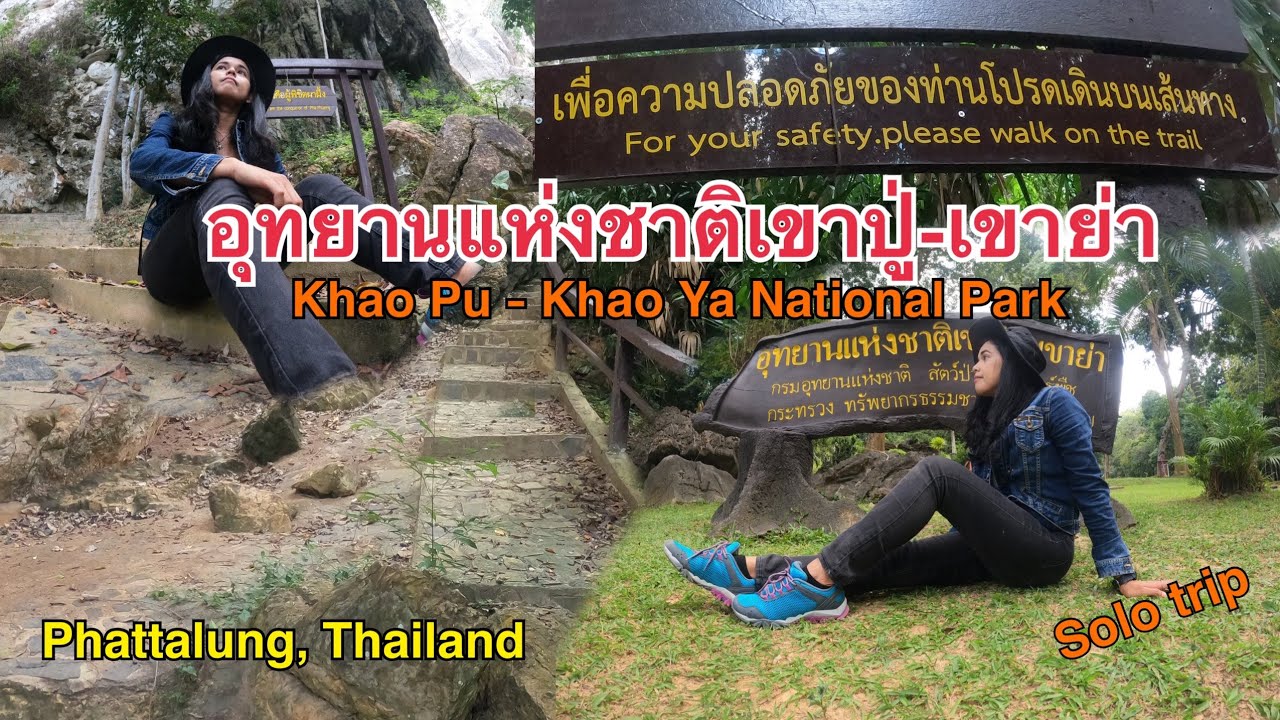
 Click to Access the Navigation Map GPS
Khao Pu–Khao Ya National Park Map
Recommend

 Art, Culture and Heritage
 Historical Sites and Monuments(1)
 Landmarks and Memorials(1)
 Art, Craft Centres, Tradition(6)
 Historic Homes and Cities(1)
 Educational Places
 Educational Gardens, Farm(1)
 Places of Worship
 Temple(25)
 Other Sacred Sites(3)
 Research and Development
 Royal Project(2)
 Suburban Living
 Village, Community(3)
National Parks and Marine Reserves(3)
Village, Community(3)
National Parks and Marine Reserves(3)
 Mountain (Doi)(4)
 Dam, Reservoir, Lake(7)
 Waterfalls(16)
 Hot Springs(2)
 Caves(12)
 River, Canal(5)
 Bays and Beaches(6)
 Islands(2)
 Other natural attractions(4)
 Entertainment and Agricultural
 Farms, Parks and Ecotourism(4)


