
lovethailand home >South Travel Attractions >Narathiwat Travel Attractions >Tak Bai >Che He > Wat Chon Thara Singhe
TL;DR: Wat Chon Thara Singhe is located at Moo 3, Che He Subdistrict, Tak Bai District, Narathiwat 96110, Thailand, on the bank of the Tak Bai River, open Open Daily, hours Old Ubosot And Temple Grounds 08.00 - 17.00 / Wat Chon Thara Singhe Museum.
Wat Chon Thara Singhe
Open Days: Open Daily
Opening Hours: Old Ubosot And Temple Grounds 08.00 - 17.00 / Wat Chon Thara Singhe Museum 09.00 - 16.00
Wat Chon Thara Singhe, also known as “Wat Phithak Phaen Din Thai,” or the Temple That Protected Thai Territory, is located in Moo 3, Che He Subdistrict, Tak Bai District, Narathiwat Province, on the bank of the Tak Bai River. It is one of the most historically significant temples in Southern Thailand, combining Buddhist faith, national border history, local southern art, and the cultural landscape of the Thai-Malaysian border. The temple is not only a spiritual center for the people of Tak Bai but also a cultural landmark that played a role in the Anglo-Siamese boundary settlement during the reign of King Rama V.
Wat Chon Thara Singhe is an essential destination for anyone who wants to understand Narathiwat beyond ordinary travel images. Within one temple compound, visitors can see an old ubosot, Buddhist murals, a principal Buddha image, a reclining Buddha hall, old Sangkhalok ware, a temple museum, traditional wooden architecture, a royal riverside pavilion, and a peaceful open space by the Tak Bai River. The temple rewards careful observation because each building carries a historical, artistic, or community meaning.
The temple was founded through the initiative of Phra Khru Opas Buddhakhun, also known as Than Phut. In the early period, Tak Bai was still connected with the Kelantan state, so land for building the temple had to be requested from the ruler of Kelantan. This background makes the temple’s origin more than a religious story. It is also tied to the political and cultural conditions of a borderland where Thai Buddhist communities needed a stable place for worship and communal identity.
Earlier names associated with the temple include Wat Tha Phru and Wat Che He, reflecting its relationship with the local community. The name “Chon Thara Singhe” evokes the river setting and the dignity of the temple, while the later name “Wat Phithak Phaen Din Thai” reflects its role in national history. During the boundary negotiations between Siam and British-controlled Malaya, Siam used the temple, Buddhism, and Thai Buddhist art within the temple as evidence of long-standing Thai cultural presence in the area.
The temple became historically important during the boundary settlement in the reign of King Rama V. British surveyors had initially drawn a boundary line that reached an area north of Wat Chon Thara Singhe. If that line had remained, Tak Bai and nearby districts might have been separated from Siam. The Siamese side argued that Wat Chon Thara Singhe was an important Thai Buddhist temple with Thai architecture, Buddhist art, and a long-established local Buddhist community. This cultural evidence helped support the claim that the area should remain within Siamese territory.
Eventually, the British side accepted the argument and moved the boundary southward to the Golok River. As a result, Tak Bai and neighboring border districts remained part of Thailand. This is why the temple became known as “Wat Phithak Phaen Din Thai.” Its buildings and Buddhist art were not only sacred objects; they also became cultural evidence that helped protect territory and preserve the historical identity of the region.
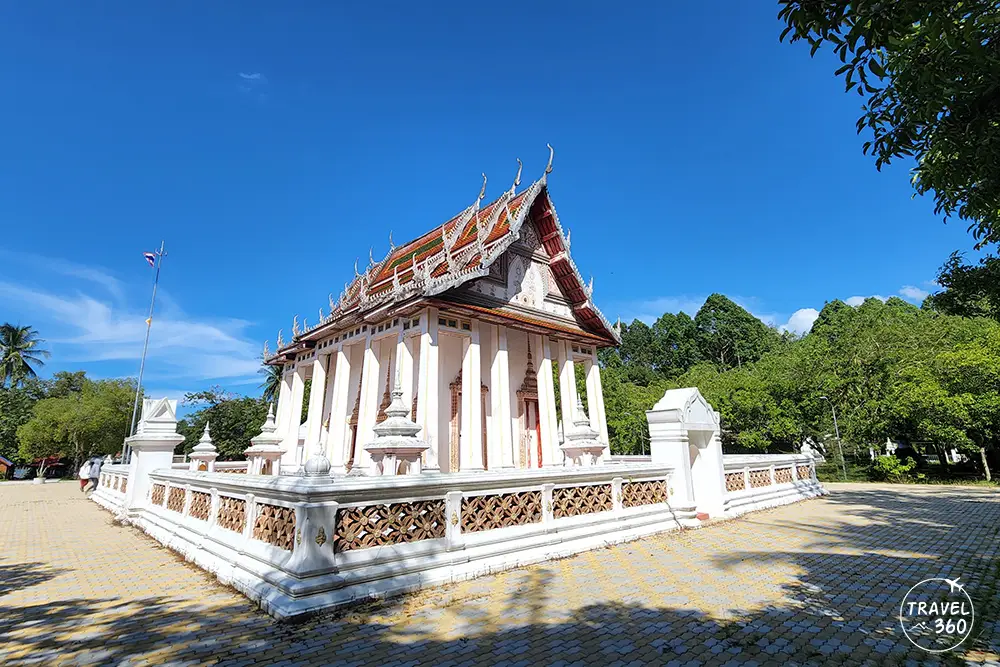
The old ubosot is the most important architectural highlight. It was built during the reign of King Chulalongkorn, Rama V, and faces the Tak Bai River. The structure reflects early Rattanakosin Buddhist architectural influence, with tiered roofing, traditional roof ornaments, boundary stones, a surrounding wall, and a formal entrance. The ubosot stands within a quiet courtyard and remains one of the best places to appreciate the temple’s historical atmosphere.
Inside the ubosot is the principal Buddha image, known locally as Luang Pho Yai. The image is now fully covered in gold leaf, concealing earlier details such as the red lips and black hair. The image sits on a tall tapering busabok base, approximately 1.5 meters high. Its form and pedestal suggest artistic influence associated with Mon or Raman Buddhist traditions, adding another layer of cultural interpretation to the temple’s art.
The murals inside the ubosot are among the temple’s most important features. They depict episodes from the life of the Buddha, Traiphum cosmology, celestial assemblies, and scenes of local life in old Tak Bai. These include images of Chinese merchants carrying goods, raft houses, animals, local people, and riverside community activities. The murals therefore function both as religious art and as a visual record of social life in the Tak Bai area.
The murals were painted by a monk from Songkhla, which gives them additional value as southern local craftsmanship. Religious stories are presented alongside everyday scenes, allowing visitors to see both Buddhist teaching and local social history in the same space. This combination makes the ubosot a rare and valuable cultural document, not merely a place of worship.
The reclining Buddha hall is another important part of the temple. It houses a reclining Buddha image, and its walls are decorated with old Sangkhalok ware. These ceramic decorations give the hall a distinctive character and suggest the temple’s connection with older trade networks and artistic taste. The ceramics are not just decorative. They are part of the temple’s material history.
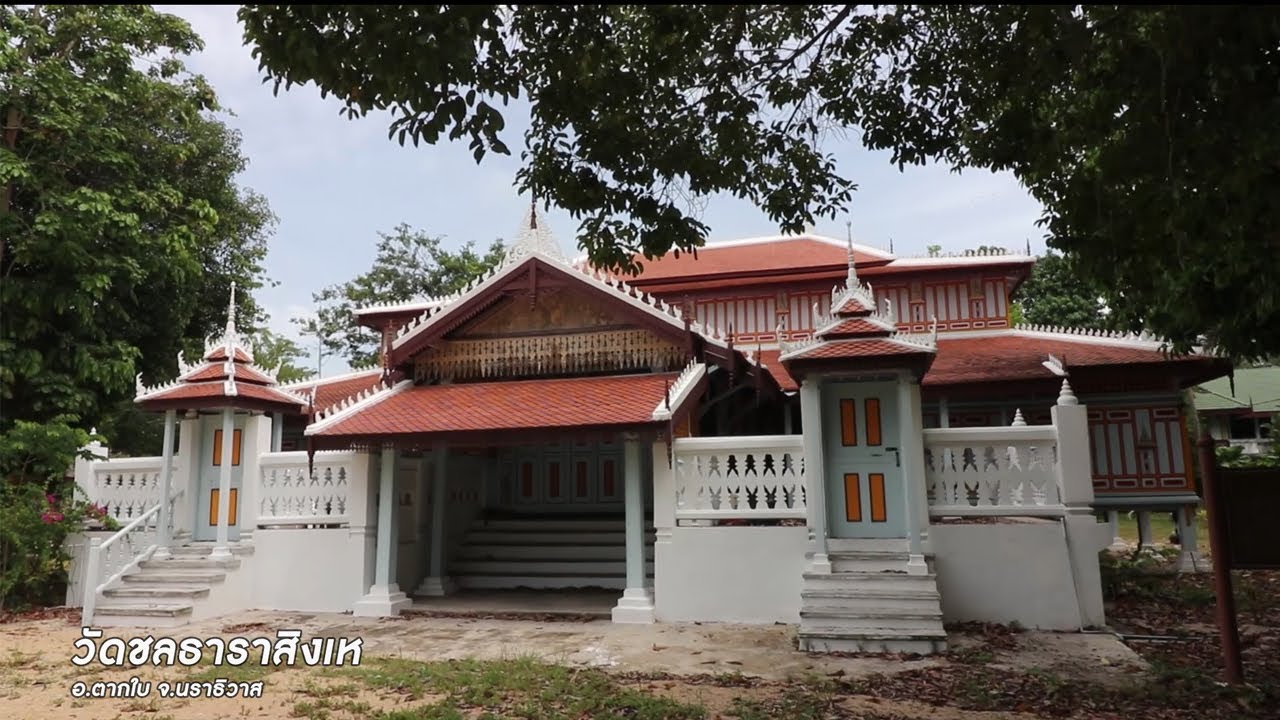
Wat Chon Thara Singhe also has its own museum, located in the former Kuti Sitisan Pradit building. This wooden building, built in 1955, was originally a monastic residence before becoming the Wat Chon Thara Singhe Museum. It displays important temple antiques, household objects, occupational tools, weapons, and a historical reconstruction related to the Thai-British treaty and boundary settlement.
Kuti Sitisan Pradit is significant as architecture in its own right. It is a raised wooden building with a multi-tiered hipped roof, decorative carved woodwork, stucco ornament, and roof-end details resembling naga or hong forms. The building reflects local southern craftsmanship with Thai, Chinese, and some Western-influenced decorative elements, especially the carved wood patterns often associated with gingerbread-style decoration.
The riverside royal pavilion is another meaningful feature. The temple preserves a pavilion associated with King Rama VI’s visit to Wat Chon Thara Singhe. Its location by the Tak Bai River adds to the temple’s royal and historical significance. This shows that the temple was not only a local religious site but also a place connected with royal travel and state history.
The temple’s artistic character is shaped by the blending of Buddhist, Muslim, Chinese, and southern border influences. Its buildings, roof forms, carved details, murals, ceramic decoration, and riverside setting all reflect a multicultural border environment. Wat Chon Thara Singhe is therefore an important example of how religious and artistic traditions can coexist in a region shaped by many communities.
The temple remains a living Buddhist site. Local Buddhists in Tak Bai and nearby areas continue to use it for merit-making, religious activities, and community gatherings. Visitors should therefore treat the temple with respect. Modest dress, quiet behavior, and proper care around murals and antiques are essential, especially inside the old ubosot and the museum building.
The surrounding Wat Chon Thara Singhe community adds another layer to the visit. The community is associated with the Che He dialect, a distinctive local speech variety in Tak Bai. It is also known for local foods such as khao yam kue ya, tom yum kai bai kue sem, khanom khonthi, and the famous Tak Bai salted threadfin fish. A visit to the temple can therefore be combined with community-based tourism and local food experiences.
From the temple, visitors can continue to Ko Yao and the 100-Year Waiting Bridge. Ko Yao is a quiet island community connected with fishing, coconut groves, and the Tak Bai River. The bridge is a popular place for walking and seeing local riverside life, especially in the evening. This route allows visitors to experience both Thai Buddhist heritage and Muslim fishing-community life in one Tak Bai trip.
Art and history lovers can also continue to Wat Khok Mafueang, another important heritage site in Tak Bai District. It preserves old buildings, an abbot’s residence, wooden paintings, carved objects, and local Buddhist art. Together, Wat Chon Thara Singhe and Wat Khok Mafueang form a strong route for studying old temples and local art in Tak Bai.
Getting There from Mueang Narathiwat is straightforward. Take Highway 4085 on the Narathiwat - Tak Bai route. At the Tak Bai market intersection, turn left and continue for about 100 meters to the temple entrance. Public transport options include songthaew, van, and bus services to Tak Bai. Travelers can get off at the Tak Bai intersection and walk to the temple, while some van services may enter closer to the temple area.
Traveling by private car is the most convenient option because visitors can continue to nearby attractions such as Ko Yao, the 100-Year Waiting Bridge, the Tak Bai border area, Wat Khok Mafueang, and restaurants in Tak Bai town. A half-day visit is possible from Narathiwat town, but visitors who want to see the museum, murals, and community surroundings should plan for at least half a day.
Visitors should allow at least 1 - 2 hours at the temple. The main points include the old ubosot, murals, Luang Pho Yai, the reclining Buddha hall, the museum, Kuti Sitisan Pradit, the royal riverside pavilion, and the open space by the river. Rushing through the temple can cause visitors to miss the details that make the site historically important.
Photography is possible in many areas, including the ubosot exterior, entrance gate, temple courtyard, old wooden buildings, and riverside setting. However, visitors should avoid using flash around murals and antiques, keep quiet inside sacred spaces, and ask permission before photographing people or ceremonies. Respectful photography helps protect both the site and the people who still use it for religious life.
Wat Chon Thara Singhe is especially suitable for students, historians, conservationists, cultural travelers, and visitors interested in Southern Thailand’s border history. It explains boundary politics, Thai Buddhist identity, southern art, community language, and multicultural coexistence in one place. Its importance lies not only in its architecture but also in the layered story it preserves.
The charm of Wat Chon Thara Singhe lies in its quiet strength. It is not a commercial tourist site built for spectacle. Its power comes from real history: a monk seeking land to build a temple, a Buddhist community maintaining its place in a borderland, murals recording local life, and a temple becoming cultural evidence in a historic boundary negotiation.
Preserving the temple requires attention to buildings, murals, antiques, community context, and the temple’s living religious function. Visitors can help by not touching murals or old objects, avoiding damage, following temple rules, and supporting community activities respectfully. Good tourism here should protect the heritage rather than disturb it.
For cultural travel in Narathiwat, Wat Chon Thara Singhe is one of the province’s most important stops. It brings together national history, Buddhist art, local architecture, riverside life, and community identity. A visit here reveals that the southern border is not only a place of political difference, but also a place of refined cultural memory and deeply meaningful heritage.
Wat Chon Thara Singhe is therefore an old temple, a heritage site, a museum, a historical learning space, and a peaceful riverside sanctuary at the same time. Visitors who come with patience and respect will understand why this temple is called the Temple That Protected Thai Territory, and why it remains one of the most important cultural landmarks in Narathiwat.
| Name | Wat Chon Thara Singhe, or Wat Phithak Phaen Din Thai |
| Type | Old Temple / Historic Site / National History Learning Site / Southern Thai Art Site |
| Location | Moo 3, Che He Subdistrict, Tak Bai District, Narathiwat 96110, Thailand, on the bank of the Tak Bai River |
| Coordinates | 6.26232, 102.04944 |
| Current Status | Still active as a Buddhist temple and an important learning site in Tak Bai, with monks in residence and key areas open to visitors during visiting hours |
| Open Days | Open Daily |
| Opening Hours | Old ubosot and temple grounds 08.00 - 17.00 / Wat Chon Thara Singhe Museum 09.00 - 16.00 |
| Admission Fee | Free Admission |
| Contact Number | 073-542346 |
| Abbot | Phra Phai San Prachamat |
| Founder | Phra Khru Opas Buddhakhun (Than Phut) |
| Key Historical Period | Founded in the late Rama IV to early Rama V period; temple establishment recorded in 1870, with royal boundary recognition in 1883 |
| Important Name | Known as Wat Phithak Phaen Din Thai because it was used as cultural evidence in the Thai-British boundary settlement during the reign of King Rama V |
| Highlights | Old ubosot, murals, Luang Pho Yai, reclining Buddha hall, Sangkhalok ware, Kuti Sitisan Pradit, temple museum, and riverside royal pavilion |
| Main Areas / Zones | Old ubosot, mural area, reclining Buddha hall, Wat Chon Thara Singhe Museum, Kuti Sitisan Pradit, riverside pavilion, temple courtyard, and Wat Chon Thara Singhe community area |
| What To See | Buddha-life murals, Traiphum paintings, local Tak Bai life scenes, gilded principal Buddha image, reclining Buddha, Sangkhalok ceramic decoration, and old wooden architecture |
| Nearby Community Activities | Learning the Che He dialect, exploring the Wat Chon Thara Singhe community, tasting Tak Bai local food, seeing salted threadfin fish production, local weaving, and walking across the 100-Year Waiting Bridge to Ko Yao |
| Travel Information | From Mueang Narathiwat, take Highway 4085 on the Narathiwat - Tak Bai route. At the Tak Bai market intersection, turn left and continue about 100 meters to the temple entrance |
| Visitor Guidelines | Dress modestly, keep quiet, do not touch murals or antiques, avoid flash photography inside old buildings, and ask permission before entering restricted areas |
| Nearby Tourist Attractions | 1. Ko Yao and the 100-Year Waiting Bridge, about 3 km 2. Tak Bai Border Checkpoint, about 3 km 3. Wat Khok Mafueang, about 4 km 4. Wat Khok Mamuang, about 5 km 5. Sadet Beach, about 15 km |
| Nearby Restaurants | 1. Old Tak Bai Satay, about 1 km 2. Tababo, about 1 km, Tel. 092-6146746 3. Chani Tak Bai, about 2 km, Tel. 098-0397073 4. AyamBoy Tak Bai Branch, about 2 km, Tel. 084-9674594 5. Wat Chon Thara Singhe Community Food Stalls, about 1 km |
| Nearby Accommodations | 1. Tak Bai Lagoon Resort, about 4 km, Tel. 073-571478 2. Taba Plaza, about 3 km, Tel. 073-642232 3. Din Khao Apartment, about 2 km 4. The Imperial Narathiwat Hotel, about 33 km, Tel. 073-515041 5. Tanyong Hotel Narathiwat, about 33 km, Tel. 073-511477 |
Frequently Asked Questions (FAQ)
Q: Where is Wat Chon Thara Singhe located?
A: Wat Chon Thara Singhe is located in Moo 3, Che He Subdistrict, Tak Bai District, Narathiwat Province, on the bank of the Tak Bai River near the Tak Bai market intersection.
Q: Why is Wat Chon Thara Singhe called Wat Phithak Phaen Din Thai?
A: During the reign of King Rama V, the temple was used as Buddhist and cultural evidence in the boundary negotiation with the British, helping keep Tak Bai and nearby border districts within Thai territory.
Q: What are the opening hours?
A: The old ubosot and temple grounds are open daily from 08.00 to 17.00, while Wat Chon Thara Singhe Museum is open from 09.00 to 16.00.
Q: Is there an admission fee?
A: No. Admission is free, but visitors should respect the temple rules, keep the area clean, and behave quietly in sacred spaces.
Q: What are the main highlights inside the temple?
A: Highlights include the old ubosot, Buddhist murals showing both religious stories and local life, Luang Pho Yai, the reclining Buddha hall, Sangkhalok ceramic decoration, Kuti Sitisan Pradit, the museum, and the riverside pavilion.
Q: How can visitors travel to the temple?
A: From Mueang Narathiwat, take Highway 4085 toward Tak Bai. At the Tak Bai market intersection, turn left and continue about 100 meters to the temple entrance. Public transport to Tak Bai is also available.
Q: What nearby places can visitors see after the temple?
A: Visitors can continue to Ko Yao and the 100-Year Waiting Bridge, Tak Bai Border Checkpoint, Wat Khok Mafueang, Wat Khok Mamuang, and Sadet Beach.
Q: How long should visitors spend at Wat Chon Thara Singhe?
A: Visitors should allow at least 1 - 2 hours for the old ubosot, murals, museum, and riverside areas. A half-day is better if combined with the surrounding community.
 Category: ●Places of Worship
 Group: ●Temple
Last Update : 3 MonthAgo
 Last Update : 3 MonthAgo
 Click to Access the Navigation Map GPS
Wat Chon Thara Singhe Map

 Art, Culture and Heritage
 Landmarks and Memorials(8)
 Royal Palace(1)
 Art, Craft Centres, Tradition(7)
 Museums(4)
 Art Gallery(1)
 University
 Public university(1)
Temple(16)
 Mosque(23)
 Other Sacred Sites(5)
 Research and Development
 Royal Project(1)
 Suburban Living
 Village, Community(9)
 Local Market(1)
 Nature and Wildlife
 National Parks and Marine Reserves(5)
 Mountain (Doi)(2)
 Dam, Reservoir, Lake(2)
 Waterfalls(16)
 River, Canal(3)
 Bays and Beaches(5)
 Islands(1)
 Other natural attractions(4)
 Entertainment and Agricultural
 Stadium(1)
 Farms, Parks and Ecotourism(7)
 Shopping
 Shopping and Night Market(1)
 Travel Articles, Recipes
 Travel Review, Food Review(1)


