
lovethailand home >South Travel Attractions >Narathiwat Travel Attractions >Waeng >Lo Chut > Sirindhorn Waterfall
TL;DR: Sirindhorn Waterfall is located at Hala-Bala Wildlife Sanctuary, Lo Chut Subdistrict, Waeng District, Narathiwat Province, open Daily, hours 08.30 – 16.00.

Sirindhorn Waterfall
Open Days: Daily
Opening Hours: 08.30 – 16.00
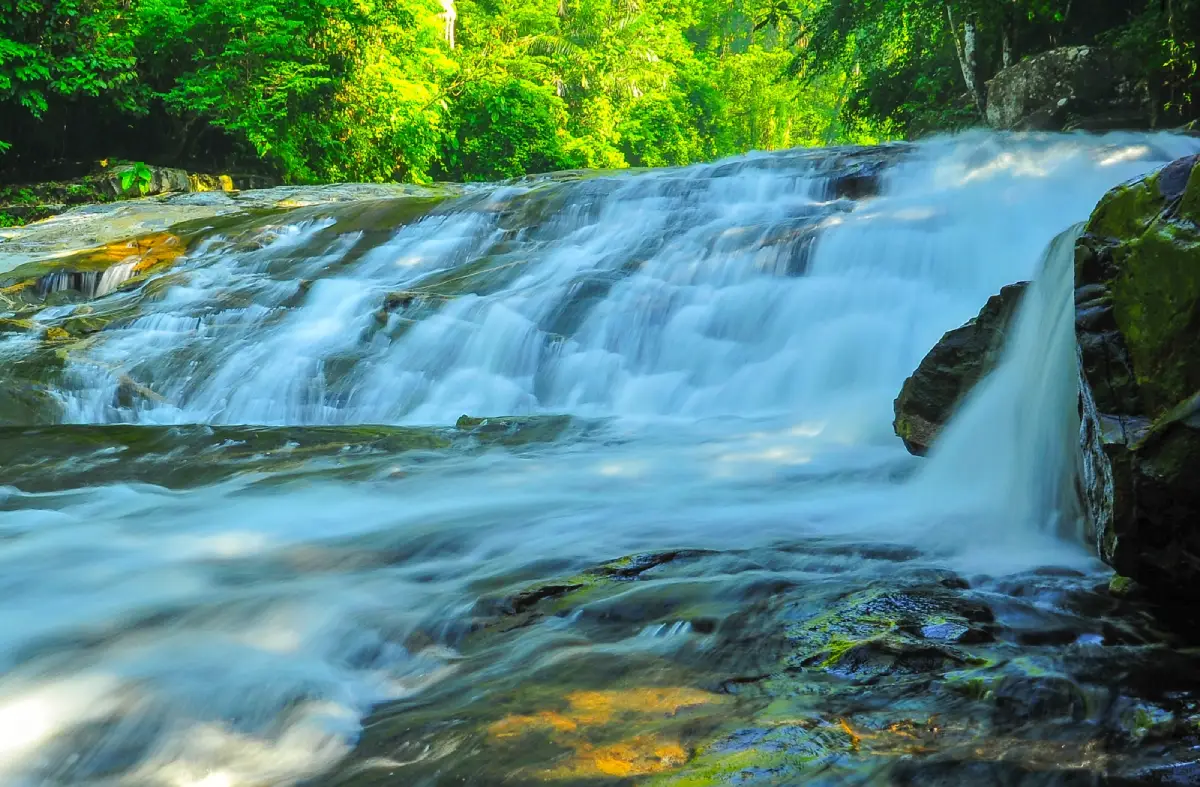
Sirindhorn Waterfall in Narathiwat Province is located inside Hala-Bala Wildlife Sanctuary in Lo Chut Subdistrict, Waeng District. Unlike a high-cliff waterfall, it is a gentle stream that flows down from the upper forest over sloping rock terraces, forming small pools and resting areas before joining Khlong Ai Ka Ding. Its calm water, shaded forest, and natural rock platforms make it a peaceful destination for local visitors and nature travelers who want to experience the Hala-Bala forest in an accessible way.
The charm of Sirindhorn Waterfall lies in the gentle character of its water. Instead of falling sharply from a tall cliff, the stream moves gradually over broad rock surfaces, pools, and shaded sections of forest. Visitors can sit by the water, listen to the sound of the stream, observe the surrounding forest, and enjoy a slower kind of nature travel. This makes the waterfall especially suitable for relaxation rather than rushed sightseeing.
The waterfall was formerly known as Namtok La To Yue Ra. On 5 September 1982, Her Royal Highness Princess Maha Chakri Sirindhorn visited the site and graciously gave it the name “Sirindhorn Waterfall.” This royal name gives the waterfall historical and cultural significance beyond its natural beauty. It is now remembered as both a natural attraction and a meaningful local landmark of Waeng District and Narathiwat Province.
The waterfall is about 2.4 km from the office of Hala-Bala Wildlife Sanctuary. Because of this, it is easier to access than many deeper forest sections of the sanctuary. Visitors can travel along the route into the Bala forest area through Waeng District, passing local communities, forest roads, viewpoints, and nature-study areas. The journey itself introduces visitors to the landscape of Thailand’s lower southern border forest.
One of the most important features of Sirindhorn Waterfall is its connection with the Southern Forest Wild Flower and Ornamental Plant Collection Project. More than 200 species of southern wild flowers and ornamental forest plants have been collected and planted in grouped sections according to natural conditions. Name signs and information on traditional uses help visitors learn about local plants, botany, and the potential of forest species for ornamental and economic plant development.
A visit to the waterfall is therefore not only about seeing water. It is also a walk through a living nature classroom. Visitors can observe streamside plants, wild flowers, native ornamental species, and plants connected with local botanical knowledge. The plant-name signs make the experience informative and accessible for general travelers, students, families, and anyone interested in the flora of the Hala-Bala forest.
The waterfall has the form of a sloping rocky stream, with several small pools and rock platforms along the flow. In some sections, the water moves gently over smooth rock. In other areas, it becomes a clearer stream with the sound of water touching natural stone. The broad rock platforms can be used as resting points, while safer shallow areas may be suitable for sitting near the water when conditions are calm.
Sirindhorn Waterfall is also part of an important watershed landscape. The stream comes from the upper forest of Hala-Bala and eventually joins Khlong Ai Ka Ding. The cool, clear water and the shaded surroundings reflect the richness of the forest. This makes the site an effective place to understand the relationship between forest, stream, rock terrace, watershed, and local community life.
The atmosphere around the waterfall is quiet and natural. In the morning, the air is cool and the forest shade is pleasant. From late morning to early afternoon, the light is suitable for walking, plant observation, and photography. Visitors should plan to leave the area before closing time so that they can return safely while there is still enough daylight.
The waterfall is open daily from 08.30 to 16.00. It is suitable for either a half-day or a full-day route. Travelers who want an unhurried visit should arrive in the morning, spend time at the plant collection project, walk slowly around the waterfall area, rest by the stream, and then continue to nearby points in Hala-Bala Wildlife Sanctuary such as the giant Somphong tree, Si Thaksin Waterfall, wildlife-viewing points, and the Bala forest route along Highway 4062.
Suitable activities include sitting on the rock terrace, photographing the stream, observing southern forest plants, studying native ornamental species, learning about stream ecology, and spending quiet time in nature. Sirindhorn Waterfall is best for travelers who prefer calm forests and meaningful nature learning rather than crowded recreation areas.
Water play should be limited to shallow and safe areas where the current is gentle and the rock surface is not slippery. Although the waterfall looks calm because of its sloping stream form, some sections can have stronger current, especially after rain. Children should remain under adult supervision, and visitors should avoid climbing wet rocks or walking outside the established use areas.
The best time to visit is during clear weather without continuous heavy rain. Hala-Bala is a humid rainforest area, so rain and wet conditions are common in some seasons. After light rain, the forest becomes fresh and green, but the rocks can be slippery and the stream may become stronger. During drier periods, walking conditions may be easier. Visitors should check the weather before departure.
Hala-Bala Wildlife Sanctuary is one of the most important biodiversity areas in Thailand’s lower south. The Bala forest area in Waeng and Sukhirin districts is the section open for nature study. The sanctuary is known for rainforest plants, rare wildlife, hornbills, large trees, and tropical forest ecosystems. A visit to Sirindhorn Waterfall is therefore also an introduction to the broader ecological importance of Hala-Bala.
Visitors should keep noise low, avoid music, take all trash back out, avoid feeding wildlife, and never collect plants or disturb animals. The waterfall is inside a protected area, so responsible behavior is essential. The value of the site comes from its clean stream, natural forest, and educational plant collection, all of which depend on careful visitor conduct.
The Southern Forest Wild Flower and Ornamental Plant Collection Project is worth visiting together with the waterfall. Many southern forest plants are beautiful, locally useful, and ecologically important. Some species have ornamental potential, some are linked to local knowledge, and others represent the biological richness of the Hala-Bala rainforest. The display signs help visitors see plants as part of a meaningful living system, not simply as background scenery.
The waterfall and the plant project together make this a strong educational destination. Visitors can read plant labels, observe leaf shapes, flowers, stems, and growing conditions, and understand how different species live near water, shade, and humid forest. This kind of slow observation gives Sirindhorn Waterfall greater value than a simple photo stop.
Getting There is most convenient by private car or rental car. From Waeng District, travel toward Lo Chut Subdistrict and Hala-Bala Wildlife Sanctuary. The route connects with the Bala forest road and Highway 4062. From the sanctuary office, the waterfall is about 2.4 km away. Drivers should be careful, especially during or after rain, because roads in forest and borderland areas can be wet and slippery.
Travelers coming from Su-ngai Kolok can travel toward Waeng District or Ban Buketa and continue into the Bala forest area. Those coming from Mueang Narathiwat should allow more travel time because the waterfall is located in the southern border forest area. Visitors who are unfamiliar with the route should contact the sanctuary or local authorities before departure and plan to leave before evening.
Before visiting, bring drinking water, shoes suitable for wet surfaces, clothes for humid forest conditions, mosquito repellent, a trash bag, and seasonal rain protection. If the goal is plant study or nature photography, allow enough time for slow walking and observation. The waterfall is best enjoyed carefully, quietly, and without rushing.
Sirindhorn Waterfall is suitable for nature lovers, families, students, and travelers interested in southern forest plants. It combines a royal-name history, a gently flowing rock-terrace stream, resting pools, native plant collections, and the biodiversity of Hala-Bala Wildlife Sanctuary. Its beauty is not in dramatic height, but in the quiet rhythm of water, shaded forest, and meaningful ecological learning.
Overall, Sirindhorn Waterfall is an important natural and educational destination in Waeng District, Narathiwat Province. It offers a peaceful stream landscape, rock terraces, more than 200 species of collected southern forest plants, and a location within the rich Hala-Bala forest. Visitors should move quietly, respect protected-area rules, and help keep the site clean so that Sirindhorn Waterfall remains one of Narathiwat’s valuable natural learning places.
| Name | Sirindhorn Waterfall |
| Location | Hala-Bala Wildlife Sanctuary, Lo Chut Subdistrict, Waeng District, Narathiwat Province |
| Address | Ban Bala, Village No. 5, Lo Chut Subdistrict, Waeng District, Narathiwat Province 96160 |
| Coordinates | 5.802000, 101.828000 |
| Highlights | A sloping rock-terrace stream with pools and resting areas, located beside a southern forest wild flower and ornamental plant collection of more than 200 species |
| Distinctive Features | The water flows gently from the upper forest over rock terraces rather than dropping from a high cliff, and the stream joins Khlong Ai Ka Ding |
| History / Significance | Formerly known as Namtok La To Yue Ra, the waterfall received the royal name “Sirindhorn Waterfall” on 5 September 1982 |
| Travel Information | Best reached by private car or rental car via Lo Chut Subdistrict and Hala-Bala Wildlife Sanctuary. The waterfall is about 2.4 km from the sanctuary office |
| Current Status | Open as a natural attraction and plant-learning area inside Hala-Bala Wildlife Sanctuary |
| Open Days | Daily |
| Opening Hours | 08.30 – 16.00 |
| Main Areas / Zones | Waterfall stream, rock terraces and pools, streamside resting areas, southern forest wild flower and ornamental plant collection, and plant-label learning area |
| Caretaker / Local Contact | Hala-Bala Wildlife Sanctuary, Department of National Parks, Wildlife and Plant Conservation |
| Main Contact Number | 093-648-6457, 087-969-8155 |
| Nearby Tourist Attractions | 1. Hala-Bala Wildlife Sanctuary Office, about 2 km 2. Southern Forest Wild Flower And Ornamental Plant Collection Project, within the same area 3. Giant Somphong Tree, about 3 km 4. Si Thaksin Waterfall, about 3 km 5. Hala-Bala Wildlife-Viewing Point, about 7 km |
| Nearby Restaurants | 1. Tamnan Isan Sausage, Waeng Branch, about 24 km, Tel. 089-465-9505 2. Nua D Halal @ Waeng Narathiwat, about 24 km, Tel. 089-504-5496 3. Nai Nan Pad Thai Kung Sod, about 24 km, Tel. 080-629-8020 4. D2Hi Restaurant Su-ngai Kolok, about 35 km, Tel. 093-660-8199, 081-542-4117, 086-957-7977 5. Kap Khao Mae Su-ngai Kolok, about 35 km, Tel. 095-429-9978, 089-466-5517 |
| Nearby Accommodations | 1. The Sekret Hotel Su-ngai Kolok, about 35 km, Tel. 073-700-181 2. Krung Tong Hotel Kolok, about 35 km, Tel. 064-042-0362 3. Genting Hotel Su-ngai Kolok, about 35 km, Tel. 073-613-231 4. Golok Golf Club And Resort, about 37 km, Tel. 081-898-0470 5. Bird Of Paradise Su-ngai Kolok, about 35 km, Tel. 093-093-5696 |
Frequently Asked Questions (FAQ)
Q: Where is Sirindhorn Waterfall located?
A: Sirindhorn Waterfall is located inside Hala-Bala Wildlife Sanctuary, Lo Chut Subdistrict, Waeng District, Narathiwat Province.
Q: What is special about Sirindhorn Waterfall?
A: It is a sloping rock-terrace stream rather than a high-cliff waterfall, with pools, resting rock platforms, and a nearby southern forest plant collection of more than 200 species.
Q: What are the opening hours of Sirindhorn Waterfall?
A: Sirindhorn Waterfall is open daily from 08.30 to 16.00.
Q: What was the former name of Sirindhorn Waterfall?
A: The waterfall was formerly known as Namtok La To Yue Ra before receiving the royal name “Sirindhorn Waterfall” on 5 September 1982.
Q: What kind of trip is Sirindhorn Waterfall suitable for?
A: It is suitable for streamside relaxation, rock-terrace viewing, southern forest plant study, nature photography, and learning about the Hala-Bala rainforest ecosystem.
Q: Can visitors play in the water at Sirindhorn Waterfall?
A: Visitors can enter only shallow and safe areas where the current is gentle and the rocks are not slippery. Avoid entering the water after rain or when the stream is strong.
Q: What should visitors prepare before visiting Sirindhorn Waterfall?
A: Visitors should bring drinking water, shoes suitable for wet surfaces, humid-weather clothing, mosquito repellent, a trash bag, and should check the weather before departure.
Q: What nearby attractions can be combined with Sirindhorn Waterfall?
A: Nearby attractions include Hala-Bala Wildlife Sanctuary Office, the Southern Forest Wild Flower and Ornamental Plant Collection Project, the giant Somphong tree, Si Thaksin Waterfall, and the Hala-Bala wildlife-viewing point.
 Category: ●Nature and Wildlife
 Group: ●Waterfalls
Last Update : 3 MonthAgo
 Last Update : 3 MonthAgo

 Click to Access the Navigation Map GPS
Sirindhorn Waterfall Map

 Art, Culture and Heritage
 Landmarks and Memorials(8)
 Royal Palace(1)
 Art, Craft Centres, Tradition(7)
 Museums(4)
 Art Gallery(1)
 University
 Public university(1)
 Places of Worship
 Temple(16)
 Mosque(23)
 Other Sacred Sites(5)
 Research and Development
 Royal Project(1)
 Suburban Living
 Village, Community(9)
 Local Market(1)
 National Parks and Marine Reserves(5)
 Mountain (Doi)(2)
 Dam, Reservoir, Lake(2)
Waterfalls(16)
 River, Canal(3)
 Bays and Beaches(5)
 Islands(1)
 Other natural attractions(4)
 Entertainment and Agricultural
 Stadium(1)
 Farms, Parks and Ecotourism(7)
 Shopping
 Shopping and Night Market(1)
 Travel Articles, Recipes
 Travel Review, Food Review(1)


