
lovethailand home >South Travel Attractions >Nakhon Si Thammarat Travel Attractions >Mueang NaKhon Si Thammarat >Tha Ngiw > Nakhon Si Thammarat Rajabhat University
TL;DR: Nakhon Si Thammarat Rajabhat University is located at Tha Ngio Subdistrict, Mueang Nakhon Si Thammarat District, Nakhon Si Thammarat Province, Thailand.
Nakhon Si Thammarat Rajabhat University
Open Days (Office of Academic Promotion and Registration): Monday – Sunday, except government holidays
Opening Hours (Office of Academic Promotion and Registration): 08:30 – 16:30
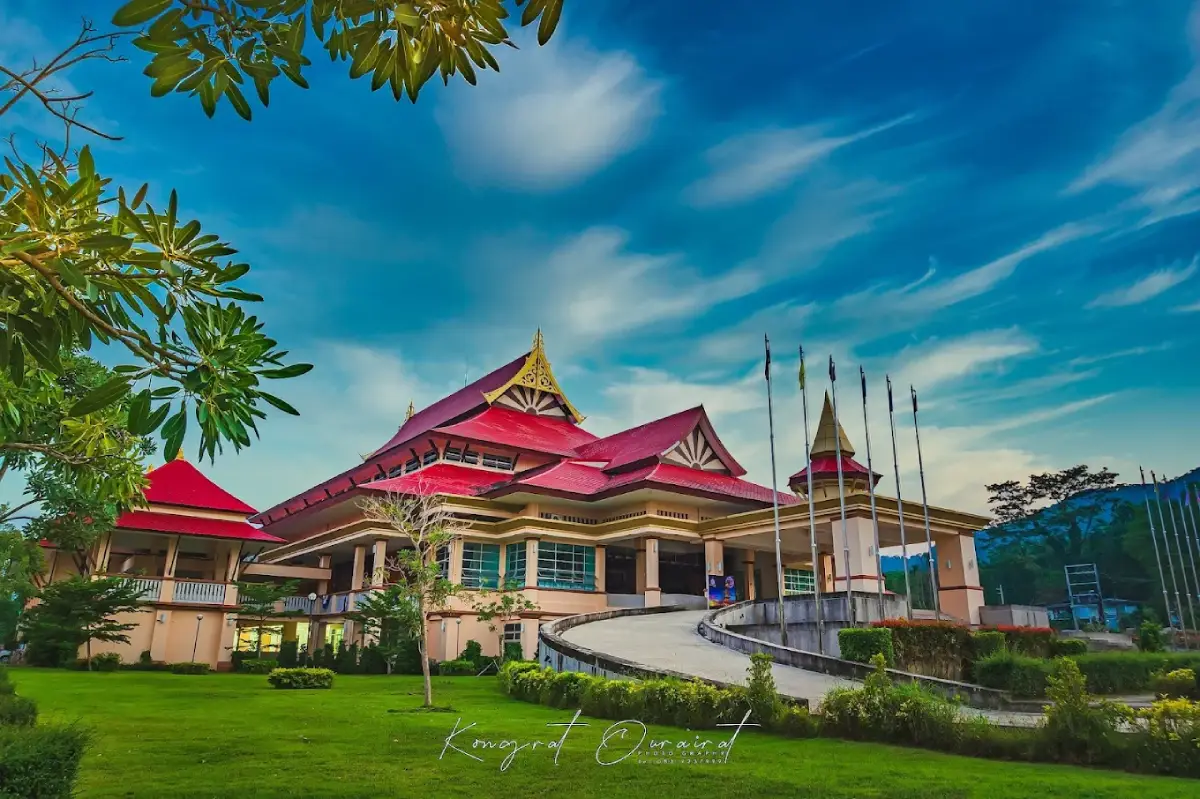
Nakhon Si Thammarat Rajabhat University (NSTRU), known in Thai as มหาวิทยาลัยราชภัฏนครศรีธรรมราช, is a public university located at 1 Moo 4, Tha Ngio Subdistrict, Mueang Nakhon Si Thammarat District, Nakhon Si Thammarat Province 80280, southern Thailand. The campus lies at the foot of Khao Mahachai, approximately 13 kilometers from central Nakhon Si Thammarat. The institution was founded on 9 January 1957 as Nakhon Si Thammarat Teachers Training School and began teaching on 17 May 1957. It became Nakhon Si Thammarat Teachers College in 1969, Nakhon Si Thammarat Rajabhat Institute in 1995, and Nakhon Si Thammarat Rajabhat University on 15 June 2004. In 2026, the institution celebrated its 69th anniversary. Dr. Sompong Raksatham became University President on 10 February 2026. The university currently has six faculties: Education; Humanities and Social Sciences; Science and Technology; Management Science; Engineering and Industrial Technology; and Nursing. Its distinctive character reflects a longstanding commitment to teacher education, research, local development, and the preservation of southern Thai cultural heritage. The green mountain landscape, annual early-morning Tham Bun Hai Than Fai merit-making tradition, Khao Mahachai shrine, and traditional Nora performances make the university an important center of both higher education and regional culture.
Nakhon Si Thammarat Rajabhat University has played an important role in the development of higher education in upper southern Thailand. Originally established to prepare teachers for local schools, it has gradually expanded into a multidisciplinary public university offering professional education, scientific and technological studies, research, and community services. Its development reflects the changing responsibilities of Thai universities as educational institutions supporting schools, businesses, public organizations, and regional economic growth.
The university's setting is one of its most recognizable characteristics. The campus occupies land at the foothills of Khao Mahachai in Tha Ngio Subdistrict, surrounded by green mountain scenery and mature trees. Historical records describe its original grounds as approximately 300 rai. The campus has developed over time to include academic buildings, administrative offices, auditoriums, libraries, student residences, and recreation facilities. Its natural environment remains closely connected with the university's identity and student experience.
The history of teacher education in Nakhon Si Thammarat reaches back further than the modern university. In 1905, during the reign of King Chulalongkorn (King Rama V), a teachers training school known as Nakhon Si Thammarat Town Teachers Training School was established at Wat Tha Pho. Classes were held in monks' residential quarters within the temple, and the first cohort consisted of 22 students. This early school illustrates the close relationship between Buddhist temples, local communities, and the introduction of modern education in southern Thailand.
Using a Buddhist temple as an educational venue reflected a long-established Thai tradition in which temples supported literacy, moral instruction, and community learning. Before modern schools were available throughout the country, temples frequently provided places where children could study and where future teachers could receive elementary training. The establishment of the early teachers training school at Wat Tha Pho was therefore an important milestone in the educational history of Nakhon Si Thammarat, even though the present university officially dates its foundation to 1957.
By the middle of the twentieth century, Thailand was expanding its public education system and required more professionally trained teachers, particularly outside Bangkok. Establishing a new teachers training school in Nakhon Si Thammarat was part of a national effort to provide qualified educators for schools throughout southern Thailand. The institution was intended to prepare teachers who could work effectively in their home provinces and contribute to the improvement of local education.
General Mangkorn Promyothi, Thailand's Minister of Education during the government of Field Marshal Plaek Phibunsongkhram, played an important role in selecting the site of the new school. After inspecting the area at the foot of Khao Mahachai, he decided that it was suitable for a permanent educational institution. The location offered space for classrooms, dormitories, and other facilities while remaining accessible from Nakhon Si Thammarat city.
On 9 January 1957, the Ministry of Education formally established Nakhon Si Thammarat Teachers Training School. The university continues to recognize this date as its foundation anniversary. Although the institution has undergone several changes of name and legal status, the 1957 foundation remains central to its institutional identity and annual commemorations.
Teaching began on 17 May 1957 with the Certificate in Education program. Students were admitted from six upper southern provinces: Krabi, Phang Nga, Phuket, Ranong, Chumphon, and Nakhon Si Thammarat. This regional intake established the institution as an important center for preparing teachers who would later work in schools throughout southern Thailand.
Because the permanent buildings at Khao Mahachai were not yet complete, the school initially operated in the Public Library building at Sanam Na Mueang, the ceremonial ground in central Nakhon Si Thammarat. This temporary arrangement allowed instruction to begin without waiting for the construction of classrooms and residential facilities. The early experience reflected the determination to expand educational opportunities despite limited resources.
In 1959, after classrooms and dormitory buildings were completed, the school transferred to its permanent site at the foot of Khao Mahachai in Tha Ngio Subdistrict. The move established the geographical setting that remains the university's home today. Academic facilities, teaching resources, and student services subsequently developed around this location.
Khao Mahachai became more than the landscape behind the campus. The mountain is also associated with local beliefs, traditions, and the memories of generations of university students. Its name appears in community landmarks and university-related activities, including the Chao Pho Mahachai Shrine and nature-oriented activities in the surrounding area. The university's physical setting therefore connects academic life with the cultural and natural history of Tha Ngio.
On 13 February 1969, the Ministry of Education upgraded the school to Nakhon Si Thammarat Teachers College. The new status supported higher-level teacher training, including the Advanced Certificate in Education. This milestone reflected the institution's growing academic capacity and the increasing professional expectations placed upon teachers.
Following the enactment of the Teachers College Act in 1975, the college was able to develop bachelor's degree education programs. Degree-level study improved opportunities for future teachers to gain advanced knowledge of their subjects, teaching methodology, curriculum development, and educational practice. This helped strengthen the professional preparation of teachers in Nakhon Si Thammarat and surrounding provinces.
In subsequent decades, the demand for skilled professionals extended beyond the teaching profession. Economic development created needs in business, science, technology, administration, and other fields. Teachers colleges across Thailand gradually expanded their educational responsibilities, and Nakhon Si Thammarat Teachers College followed this national transition toward broader higher education.
On 14 February 1992, King Bhumibol Adulyadej (King Rama IX) bestowed the name Rajabhat upon Thailand's teachers colleges. Following the enactment of the Rajabhat Institute Act in 1995, the institution became Nakhon Si Thammarat Rajabhat Institute. Its responsibilities expanded to include undergraduate and postgraduate education, research, academic services, technology transfer, and the preservation of arts and culture.
The term Rajabhat has a historical meaning associated with serving the monarch. Within the context of Thailand's Rajabhat universities, the name also conveys a public responsibility to promote education and contribute to society. The new institutional name therefore connected the college's academic development with its broader mission of supporting local communities.
From 1995 to the early 2000s, Nakhon Si Thammarat Rajabhat Institute prepared for university status through improvements in academic programs, personnel development, financial management, research, and quality assurance. Postgraduate education and community-focused academic activities became increasingly important, reflecting the institution's intention to contribute to social development through both teaching and research.
On 15 June 2004, the Rajabhat University Act B.E. 2547 came into force, and Nakhon Si Thammarat Rajabhat Institute became Nakhon Si Thammarat Rajabhat University. This transition provided a stronger legal foundation for multidisciplinary education, research, professional development, public academic services, and cultural preservation.
In 2026, the university celebrated 69 years since the establishment of the teachers training school in 1957 and 22 years since gaining Rajabhat university status in 2004. When the history of the earlier teachers training school at Wat Tha Pho is also considered, teacher education in Nakhon Si Thammarat can be traced back more than 120 years. These different historical periods help explain the university's continuing connection with education and local society.
Dr. Sompong Raksatham became President of Nakhon Si Thammarat Rajabhat University on 10 February 2026 following a royal appointment announced through the Office of the Prime Minister. The university's priorities in 2026 included educational quality, curriculum development, digital administration, research, and the practical use of academic knowledge to support local communities and economic development.
The university's philosophy is commonly expressed in Thai as Prathip Thin, Prathueang Thai, Kao Klai Su Sakon, meaning a guiding light for local communities, contributing to Thailand's progress, and extending toward international development. The philosophy reflects the institution's mission to provide knowledge and educational opportunities to the region while encouraging wider academic cooperation.
The official colors of Nakhon Si Thammarat Rajabhat University are yellow and red. Yellow represents Buddhism, religious faith, and commitment to moral principles, reflecting Nakhon Si Thammarat's historical importance as a center of Theravada Buddhism. Red represents courage, initiative, leadership, and the determination to take action. Together, the colors symbolize ethical responsibility and the confidence to contribute to society.
The university emblem is based on the royal seal of King Rama IX, granted for use by Rajabhat institutions in 1995. It includes five significant colors: blue, green, gold, orange, and white. These represent the monarchy, the natural environment, intellectual development, local arts and culture, and purity of thought. The emblem continues to be used with the university's Thai and English names in official institutional settings.
The university's symbolic flower is Nakabut, also known as Bunnak, scientifically identified as Mesua ferrea L. The tree bears fragrant white flowers with golden-yellow stamens and has a longstanding place in Thai cultural beliefs concerning auspiciousness and prosperity. Its traditional name also resonates with cultural symbolism associated with Nakhon Si Thammarat and the region's Buddhist heritage.
In 2026, Nakhon Si Thammarat Rajabhat University had six principal faculties: the Faculty of Education; Faculty of Humanities and Social Sciences; Faculty of Science and Technology; Faculty of Management Science; Faculty of Engineering and Industrial Technology; and Faculty of Nursing. The Graduate School, Office of Academic Promotion and Registration, Office of Academic Resources and Information Technology, Research and Development Institute, Office of Arts and Culture, and other administrative units support its teaching, research, and public-service responsibilities.
The Faculty of Education continues the institution's original mission of preparing professional teachers. Its published fields include Mathematics, Thai, English, Social Studies, Early Childhood Education, Physical Education, General Science, Physics, Computer Education, Music Education, Art Education, and Digital Technology for Education. Teacher preparation combines specialist subject knowledge, educational psychology, teaching methodology, and practical experience in schools.
Teacher education remains particularly important for schools throughout Nakhon Si Thammarat and southern Thailand. Future teachers need not only academic knowledge but also the ability to communicate, use educational technology, understand individual learners, and design learning activities appropriate to their communities. The Faculty of Education therefore contributes directly to the preparation of professionals responsible for developing the region's next generation.
The Faculty of Humanities and Social Sciences offers education related to languages, arts, tourism, law, government, and community development. Its published fields include Thai, Business English, Community Development, Tourism, Information Management, Law, Public Administration, Local Government, and Cultural Management for the Creative Economy. These areas help graduates develop communication skills, cultural understanding, analytical thinking, and the ability to work with communities and public institutions.
Cultural Management for the Creative Economy is particularly relevant to Nakhon Si Thammarat, which is known for Nora performing arts, Nang Talung shadow puppetry, the Sart Duan Sip merit-making festival, traditional niello silverwork, and other forms of local knowledge. Studying cultural resources through contemporary economic and management approaches can help younger generations preserve traditions while exploring responsible opportunities in tourism, creative industries, and community enterprises.
The Faculty of Science and Technology develops academic knowledge in fundamental and applied sciences. Published study areas include Chemistry, Biology, Physics, Mathematics, Computer Science, Environmental Science, Information Technology, Agriculture, Fisheries, and Biological Innovation. These disciplines support scientific research, technological development, environmental management, and the improvement of local products and production processes.
Nakhon Si Thammarat contains agricultural areas, mountainous forests, freshwater resources, and coastal communities. Scientific research related to environmental protection, agriculture, and natural resources is therefore closely connected with local livelihoods. Developing expertise in these areas can support more effective resource management, occupational development, biodiversity conservation, and sustainable economic activity.
The Faculty of Management Science offers education in business administration, accountancy, communication arts, economics, and organizational management. Its published fields include Management, Marketing, Human Resource Management, Retail Business, Service Industry Management, Business Computing, Accountancy, and Communication Arts. These subjects prepare graduates for careers in business, public organizations, and service industries, with an emphasis on planning, professional communication, and modern management practices.
The Faculty of Engineering and Industrial Technology provides education in electrical engineering, mechanical engineering, civil technology, computer and digital industrial technology, industrial arts, and industrial management and logistics. Practical learning in laboratories and workshops helps students develop technical competence, design skills, and the ability to solve engineering and production problems.
The Faculty of Nursing is one of the university's newest academic units. The University Council approved its establishment on 15 November 2024, after which a new Bachelor of Nursing Science curriculum was prepared for 2026. The faculty was developed to help address regional healthcare workforce needs and expand the university's contribution to the health and wellbeing of local communities.
The Bachelor of Nursing Science program admitted its first student cohort in the 2026 academic year. Building 39, the Practical Training and Learning Center, was designated for nursing-related facilities. Preparations included clinical training equipment, teaching resources, nursing textbooks, and other educational materials required for professional study. The faculty's development marked an important expansion of the university into health professional education.
At postgraduate level, the university operates a Graduate School that coordinates master's and doctoral education and research. Published fields include Educational Administration, Educational Sciences and Innovation Management, Digital Communication Innovation, and disciplines connected with local development. These programs support advanced professional development and research among teachers, administrators, academics, and specialists in different sectors.
The university also provides a Graduate Diploma in Teaching Profession for eligible individuals seeking further professional preparation in education. Admissions follow the requirements and application periods published by the Graduate School. This type of program contributes to the professional development of teachers and educators with different academic backgrounds.
Important campus facilities include the Promyothi Building, associated with academic and registration services, the Office of the President, Building 30 for the Faculty of Science and Technology, Building 18 for the Faculty of Engineering and Industrial Technology, and Building 39 for nursing and practical learning. The university also has a main auditorium and the Phakdi Damrongrit Auditorium, which accommodate important ceremonies, conferences, and student activities.
The Office of Academic Resources and Information Technology provides access to educational resources and digital services. Its Central Library offers books, journals, academic databases, and study spaces for students and staff. The university's digital systems also support registration, student records, communication, and academic administration, helping improve the efficiency of educational services.
On 8 October 2026, the university held discussions concerning the development of personnel administration under the NSTRU CONNECT digital platform. Planned functions included leave management, official travel requests, and the recording of overtime work. The initiative forms part of the university's wider movement toward digital administration and more efficient internal services.
Student dormitories provide accommodation for learners arriving from different areas. Another important facility is the Khiang Khiri Professional Experience Training Center, which offers guest accommodation for university visitors and participants in selected activities. These residential services support students, parents, visiting lecturers, and guests attending university conferences or events.
Khao Mahachai, the mountain rising behind the campus, has a longstanding connection with the university and nearby communities. It is a recognizable natural landmark in Mueang Nakhon Si Thammarat District and is associated with hiking, nature study, and student memories. Visitors interested in climbing the mountain should check access conditions, weather, and trail safety before beginning a hike.
The Chao Pho Mahachai Shrine is an important site associated with local beliefs and the university community. Stories passed down by residents describe a protective spiritual presence associated with Khao Mahachai and the surrounding villages. Several versions of these traditions exist, reflecting the area's rich folklore. The shrine is therefore significant as a place for understanding local religious beliefs, oral history, and the relationship between communities and their natural environment.
Each year, the university's foundation anniversary on 9 January includes acts of respect at the Chao Pho Mahachai Shrine alongside Buddhist ceremonies. These practices reflect the coexistence of modern higher education with the local cultural traditions that continue to hold meaning for members of the university community.
The university's Office of Arts and Culture is another important educational resource. Its history is connected with the Southern Cultural Center of Nakhon Si Thammarat Teachers College, established in 1988. The center has worked to collect, study, preserve, and communicate knowledge of southern Thai history, performing arts, traditions, local crafts, and community practices.
Cultural exhibitions associated with the center introduce the history of Nakhon Si Thammarat and the wider southern region. They help visitors understand the area's historical connections with Buddhism, maritime trade, traditional craftsmanship, and community life. Groups interested in cultural educational visits should coordinate with the responsible university unit in advance.
One of the university's most distinctive traditions is Tham Bun Hai Than Fai, an early-morning merit-making ceremony associated with Nakhon Si Thammarat. It is traditionally observed during the cooler period of January, when people prepare hot food and local sweets before dawn to offer to Buddhist monks and share with participants. The tradition emphasizes generosity, religious merit, mutual care, and community solidarity.
On 9 January 2026, Nakhon Si Thammarat Rajabhat University celebrated its 69th foundation anniversary. Preparations began at 04:00, with lecturers, staff, and students gathering to prepare savory dishes and traditional sweets for Tham Bun Hai Than Fai. The celebration also included southern Thai cultural performances and educational presentations explaining the history and significance of this distinctive local tradition.
The anniversary program included offerings of breakfast and alms to 69 Buddhist monks, as well as ceremonies honoring the Phra Phuttha Sihing Buddha image and Chao Pho Mahachai. At 11:09, a formal foundation commemoration took place in the university's main auditorium, chaired by Associate Professor Dr. Wichai Waenphet, President of the University Council. These activities connected Buddhist practices, institutional history, and local beliefs within a single celebration.
Nora, a traditional southern Thai performing art, is another important element of the university's cultural activities. During the 2026 foundation anniversary, students from the Cultural Management for the Creative Economy program in the Faculty of Humanities and Social Sciences presented a Nora performance. Nora combines distinctive dance movements, musical accompaniment, storytelling, and traditional knowledge passed down between generations. University performances help students learn and preserve the art through practical participation.
Wai Khru, the traditional ceremony honoring teachers, is particularly meaningful at a university founded as a teachers training school. On 18 June 2026, the university organized its annual Wai Khru ceremony under the theme Under Royal Benevolence, Honoring Teachers at the main auditorium. Dr. Sompong Raksatham, the University President, presided over the ceremony, which was attended by administrators, lecturers, and first-year students.
The 2026 Wai Khru activities included traditional floral offerings, expressions of respect for teachers, student scholarships, and certificates recognizing good conduct. The ceremony emphasized gratitude, perseverance, respect for knowledge, and the relationship between teachers and students. Its continued importance reflects the university's historical commitment to teacher education.
Local development is another central responsibility of Nakhon Si Thammarat Rajabhat University. Through its academic faculties and the Center for Royal Initiative Continuation and Local Development, the university supports community projects related to livelihoods, value-added products, environmental protection, and the responsible use of local resources. Such initiatives aim to translate academic knowledge into practical benefits for residents and businesses.
On 23 July 2026, the university held a meeting to monitor local development projects for fiscal year 2026 and prepare the seventh Southern Local Development Showcase. The event took place from 22 to 24 August 2026 at Central Nakhon Si shopping center and presented community products, research, and innovations. It provided opportunities for academic knowledge to be shared with businesses, communities, government agencies, and other partners.
Local development research also includes work related to native plant resources, such as torch ginger and black-boned chicken plant, known locally as kraduk kai dam. Studying the characteristics, uses, and potential value of these plants can help strengthen scientific knowledge of local biodiversity while supporting responsible community-based economic development and conservation.
The university's Research and Development Institute supports academic research proposals, scientific studies, creative work, and innovation. On 4 August 2026, the institute organized a practical workshop on developing research questions and research instruments for proposals under the Fundamental Fund framework for fiscal year 2028. The training helped researchers improve their project designs and connect academic research with relevant scientific and social needs.
Student development is supported through sports, scholarships, residential services, volunteering, and campus organizations. Participating in these activities helps students build teamwork, communication, responsibility, and leadership skills. Sports and recreational facilities contribute to a balanced university experience alongside classroom learning and professional training.
Prospective students can apply through the university's admissions system administered by the Office of Academic Promotion and Registration. Undergraduate education is provided through the six faculties, while postgraduate admissions are coordinated by the Graduate School. Applicants should check the academic year, specific admission round, eligibility requirements, tuition fees, and program availability using the official admissions announcements.
The Office of Academic Promotion and Registration is located on the first floor of the Promyothi Building. It provides services related to academic registration, student records, and educational documentation. Its published service schedule lists Monday through Sunday, from 08:30 to 16:30, except government holidays. These are the office's service hours and should not be interpreted as the opening and closing times of the university's gates or every other campus facility.
Visitors can explore appropriate public areas of the campus, enjoy the green mountain scenery, and participate in public university events when announced. Visits to the cultural center, research laboratories, specialist facilities, or restricted areas should be arranged with the relevant department in advance to ensure suitable access and visitor safety.
Getting There to Nakhon Si Thammarat Rajabhat University is straightforward by private car from central Nakhon Si Thammarat along Highway 4016, commonly known as the Nakhon Si Thammarat–Nopphitam Road. Continue toward Tha Ngio Subdistrict and the Khao Mahachai foothills. The university is approximately 13 kilometers from the city center. Visitors can use the official address, 1 Moo 4, Tha Ngio, Mueang Nakhon Si Thammarat, Nakhon Si Thammarat 80280, in a navigation application.
Travelers arriving from Bangkok can reach Nakhon Si Thammarat by air, train, interprovincial bus, or private vehicle. From the city, onward travel is possible by private car or locally arranged transport along the Nakhon Si Thammarat–Nopphitam route. Visitors attending examinations, admissions interviews, conferences, or university events should check the correct building and campus entrance before their journey.
Attractions in the wider area include Khao Mahachai, Phrom Lok Waterfall, Wat Phrom Lok, Somdet Phra Srinagarindra 84 Park, also known as Thung Tha Lat, and Wat Phra Mahathat Woramahawihan. These sites offer different experiences, from nature walks and mountain scenery to Buddhist heritage, regional history, and urban recreation.
Khao Mahachai is closely connected with the university's landscape and local identity. Phrom Lok Waterfall in Phrom Khiri District is a well-known natural attraction associated with forest and freshwater ecosystems, while Wat Phrom Lok reflects the religious life of nearby communities. Such destinations offer opportunities to combine an educational visit with an understanding of the natural and cultural history of Nakhon Si Thammarat.
Nakhon Si Thammarat Rajabhat University therefore represents an important combination of educational development, historical continuity, and cultural preservation. From its establishment as a teachers training school on 9 January 1957 to its later development as a teachers college, Rajabhat institute, and public university, it has continued to expand access to higher education and contribute to regional society. Its location beneath Khao Mahachai connects generations of students with the distinctive environment and traditions of southern Thailand.
In 2026, the university continued its work in professional education, research, community development, and cultural preservation. Its academic expansion, including the first intake of nursing students, demonstrates its response to changing workforce needs. At the same time, traditions such as Tham Bun Hai Than Fai, Wai Khru, and the commemoration of Chao Pho Mahachai preserve the historical and cultural identity that has shaped the institution for 69 years.
| University Name | Nakhon Si Thammarat Rajabhat University (NSTRU) |
| Thai Name | มหาวิทยาลัยราชภัฏนครศรีธรรมราช |
| Institution Type | Public University in Thailand's Rajabhat University System |
| Location | Tha Ngio Subdistrict, Mueang Nakhon Si Thammarat District, Nakhon Si Thammarat Province, Thailand |
| Full Address | 1 Moo 4, Tha Ngio, Mueang Nakhon Si Thammarat, Nakhon Si Thammarat 80280, Thailand |
| Campus Setting | At the foot of Khao Mahachai, along the Nakhon Si Thammarat–Nopphitam Road, approximately 13 kilometers from central Nakhon Si Thammarat |
| Original Campus Area | Approximately 300 rai |
| Earlier Local Teacher-Education Heritage | 1905, Nakhon Si Thammarat Town Teachers Training School at Wat Tha Pho |
| Foundation Date of the Present Institution | 9 January 1957, as Nakhon Si Thammarat Teachers Training School |
| First Teaching Date | 17 May 1957 |
| Transfer to Khao Mahachai Campus | 1959 |
| Teachers College Status | 13 February 1969 |
| Rajabhat Institute Status | 1995 |
| Rajabhat University Status | 15 June 2004 |
| Institutional Age in 2026 | 69 years since the 1957 foundation |
| Former Names | 1. Nakhon Si Thammarat Teachers Training School 2. Nakhon Si Thammarat Teachers College 3. Nakhon Si Thammarat Rajabhat Institute |
| Important Historical Figures | 1. General Mangkorn Promyothi, Minister of Education, who played a significant role in selecting the school's permanent location 2. Mr. Waew Ninphayak, the school's first principal 3. King Bhumibol Adulyadej (King Rama IX), who bestowed the Rajabhat name and royal emblem upon Rajabhat institutions |
| University President in 2026 | Dr. Sompong Raksatham, appointed from 10 February 2026 |
| University Philosophy | A Guiding Light for Local Communities, Contributing to Thailand's Progress, and Reaching Toward International Development |
| University Colors | Yellow and Red |
| University Emblem | Royal Seal of King Rama IX, incorporating Blue, Green, Gold, Orange, and White, with the University's Thai and English Names |
| University Flower | Nakabut or Bunnak (Mesua ferrea L.) |
| Faculties | 1. Faculty of Education 2. Faculty of Humanities and Social Sciences 3. Faculty of Science and Technology 4. Faculty of Management Science 5. Faculty of Engineering and Industrial Technology 6. Faculty of Nursing |
| Academic and Support Units | 1. Graduate School 2. Office of Academic Promotion and Registration 3. Office of Academic Resources and Information Technology 4. Research and Development Institute 5. Office of Arts and Culture 6. Student Development Division 7. Center for Royal Initiative Continuation and Local Development |
| Academic Levels | Bachelor's Degrees, Graduate Diplomas, Master's Degrees, and Doctoral Degrees according to the University's Published Programs |
| Academic Strengths | Education, Science and Technology, Community Development, Southern Thai Cultural Studies, Business Administration, Communication Arts, Engineering and Industrial Technology, Nursing, and Research for Local Development |
| Important Campus Facilities | 1. Promyothi Building 2. Office of the President Building 3. Main Auditorium 4. Phakdi Damrongrit Auditorium 5. Building 30, Faculty of Science and Technology 6. Building 18, Faculty of Engineering and Industrial Technology 7. Building 39, Practical Training and Learning Center 8. Central Library and Academic Resources Services 9. Office of Arts and Culture 10. Chao Pho Mahachai Shrine 11. Khiang Khiri Professional Experience Training Center 12. Student Dormitories and Sports Facilities |
| Important Traditions and Activities | 1. University Foundation Anniversary on 9 January 2. Tham Bun Hai Than Fai Merit-Making Tradition 3. Ceremonies Honoring Chao Pho Mahachai 4. Wai Khru and New Student Orientation 5. Traditional Nora Performances 6. Southern Local Development Showcase 7. Research and Community Academic Services |
| Office of Academic Promotion and Registration — Open Days | Monday – Sunday, except government holidays |
| Office of Academic Promotion and Registration — Opening Hours | 08:30 – 16:30 |
| Educational Visits | Contact the relevant university department before visiting laboratories, research centers, and specialized cultural exhibition areas |
| Facilities | Academic Buildings, Laboratories, Library, Auditoriums, Sports Facilities, Dormitories, Training Accommodation, Food and Beverage Outlets, and Parking |
| Getting There | Travel approximately 13 kilometers from central Nakhon Si Thammarat via Highway 4016 toward Tha Ngio Subdistrict and the Khao Mahachai foothills |
| Attractions and Learning Destinations in the Area | 1. Khao Mahachai, Tha Ngio 2. Phrom Lok Waterfall, Phrom Khiri District 3. Wat Phrom Lok, Phrom Khiri District 4. Somdet Phra Srinagarindra 84 Park (Thung Tha Lat), Mueang District 5. Wat Phra Mahathat Woramahawihan, Mueang District |
| Restaurants and Cafés on or Near Campus | 1. PE' KUNG COFFEE, On Campus, Tel. +66 84 463 8094 2. Café Amazon, Nakhon Si Thammarat Rajabhat University Branch, Tel. +66 93 582 2336 3. Jaranya Pa Kap Lung Noodle Shop, Opposite the University, Tel. +66 95 247 1993 4. Chatree Boat Noodles, Near the University, Tel. +66 80 698 8578 5. Nam Cha Wan Suk, Tha Ngio, Tel. +66 90 215 7779 |
| Accommodation on Campus and in Nakhon Si Thammarat | 1. Khiang Khiri Professional Experience Training Center, On Campus, Tel. +66 75 845 530 2. Mahachai Grand View Hotel, Tha Ngio, Tel. +66 98 157 4889 3. Mahachai Resort, Tha Ngio, Tel. +66 75 466 509 4. Pura Nakhon Hotel, Central Nakhon Si Thammarat, Tel. +66 75 314 888 5. Mandy Nok Hotel, Central Nakhon Si Thammarat, Tel. +66 75 830 666 |
| University Telephone | +66 75 392 039, +66 75 392 040 |
| Office of Academic Promotion and Registration Telephone | +66 75 845 527 |
| Faculty of Nursing Telephone | +66 75 845 519 |
| Graduate School Telephone | +66 75 377 438 |
| Office of Academic Resources and Information Technology Telephone | +66 75 845 500 |
| Official Website | www.nstru.ac.th |
| Undergraduate Admissions Website | admis.nstru.ac.th |
| Graduate School Website | grad.nstru.ac.th |
| Current Status | Active Public University offering education, research, academic services, and local development activities in the 2026 academic year |
Academic Programs and Fields of Study at Nakhon Si Thammarat Rajabhat University, Academic Year 2026 (B.E. 2569)
| Faculty / Academic Unit | Programs and Fields Published in the University's Academic Information Systems |
| Faculty of Education | Bachelor's Degree Fields 1. Bachelor of Education in Mathematics 2. Bachelor of Education in Physical Education 3. Bachelor of Education in Social Studies 4. Bachelor of Education in Computer Education 5. Bachelor of Education in Physics 6. Bachelor of Education in English 7. Bachelor of Education in General Science 8. Bachelor of Education in Thai 9. Bachelor of Education in Early Childhood Education 10. Bachelor of Education in Music Education 11. Bachelor of Education in Art Education 12. Bachelor of Education in Digital Technology for Education 1. Master of Education in Educational Administration 2. Doctoral Program in Educational Sciences and Innovation Management 3. Doctoral Program in Educational Administration 4. Graduate Diploma in Teaching Profession |
| Faculty of Humanities and Social Sciences | Bachelor's Degree Fields 1. Bachelor of Laws in Law 2. Bachelor of Public Administration in Public Administration 3. Bachelor of Political Science in Local Government 4. Bachelor of Fine Arts in Visual Communication Design 5. Bachelor of Arts in Community Development 6. Bachelor of Arts in Tourism 7. Bachelor of Arts in Thai 8. Bachelor of Arts in Information Management 9. Bachelor of Arts in Business English 10. Bachelor of Arts in Cultural Management for the Creative Economy |
| Faculty of Science and Technology | Bachelor's Degree Fields and Study Groups 1. Bachelor of Science in Agriculture, Sustainable Agricultural Development track 2. Bachelor of Science in Agriculture, Fisheries track 3. Bachelor of Science in Environmental Science 4. Bachelor of Science in Computer Science 5. Bachelor of Science in Mathematics 6. Bachelor of Science in Mathematics, Statistics track 7. Bachelor of Science in Physics 8. Bachelor of Science in Chemistry 9. Bachelor of Science in Biology 10. Bachelor of Science in Public Health 11. Bachelor of Science in Information Technology 12. Bachelor of Science in Biological Innovation |
| Faculty of Management Science | Bachelor's Degree Fields and Study Groups 1. Bachelor of Communication Arts, Digital Mass Communication track 2. Bachelor of Communication Arts, Modern Advertising and Public Relations track 3. Bachelor of Business Administration in Management 4. Bachelor of Business Administration in Marketing 5. Bachelor of Business Administration in Service Industry Management 6. Bachelor of Business Administration in Business Computing 7. Bachelor of Business Administration in Retail Business 8. Bachelor of Business Administration in Human Resource Management 9. Bachelor of Accountancy in Accountancy 10. Bachelor of Economics in Economics 1. Master of Communication Arts in Digital Communication Innovation 2. Doctoral Degree in Communication Arts, Digital Communication Innovation |
| Faculty of Engineering and Industrial Technology | Bachelor's Degree Fields 1. Bachelor of Industrial Education in Industrial Arts 2. Bachelor of Industrial Technology in Civil Technology 3. Electrical Engineering, Electric Power Engineering track 4. Electrical Engineering, Electronics and Telecommunications Engineering track 5. Mechanical Engineering 6. Bachelor of Science in Computer Technology and Digital Industry 7. Bachelor of Technology in Industrial Technology 8. Bachelor of Technology in Industrial Management and Logistics Technology 1. Doctor of Philosophy in Industrial Technology Innovation |
| Faculty of Nursing | Bachelor's Degree 1. Bachelor of Nursing Science, New Curriculum 2026, with the first student cohort admitted in the 2026 academic year |
Frequently Asked Questions (FAQ)
Q: What days is Nakhon Si Thammarat Rajabhat University open, and what are its opening hours?
A: The Office of Academic Promotion and Registration publishes service hours of 08:30 to 16:30, Monday through Sunday, except government holidays. Other departments and campus gates may have different schedules.
Q: Where is Nakhon Si Thammarat Rajabhat University located?
A: The university is located at 1 Moo 4, Tha Ngio Subdistrict, Mueang Nakhon Si Thammarat District, Nakhon Si Thammarat Province 80280, Thailand, at the foot of Khao Mahachai, approximately 13 kilometers from the city center.
Q: When was Nakhon Si Thammarat Rajabhat University founded?
A: It was founded on 9 January 1957 as Nakhon Si Thammarat Teachers Training School and became a Rajabhat university on 15 June 2004.
Q: When did teacher education first begin in Nakhon Si Thammarat?
A: An earlier teachers training school was established at Wat Tha Pho in 1905. The present institution was founded separately in 1957.
Q: Who was the President of Nakhon Si Thammarat Rajabhat University in 2026?
A: Dr. Sompong Raksatham, who was appointed from 10 February 2026.
Q: How many faculties does Nakhon Si Thammarat Rajabhat University have?
A: It has six faculties: Education; Humanities and Social Sciences; Science and Technology; Management Science; Engineering and Industrial Technology; and Nursing.
Q: When did the Faculty of Nursing admit its first students?
A: The Faculty of Nursing admitted the first cohort of students to its Bachelor of Nursing Science program in the 2026 academic year.
Q: What are the university's official colors and symbolic flower?
A: The official colors are yellow and red, and the university flower is Nakabut or Bunnak, scientifically known as Mesua ferrea L.
Q: When is the university's Tham Bun Hai Than Fai ceremony held?
A: The university holds the traditional early-morning merit-making ceremony in connection with its foundation anniversary on 9 January. In 2026, preparations began at 04:00 and were followed by Buddhist ceremonies and cultural activities.
Q: Why is Khao Mahachai important to the university?
A: Khao Mahachai is the mountain directly behind the campus. It has natural, historical, and cultural significance and is closely associated with the Chao Pho Mahachai Shrine and the memories of generations of students.
Q: Does Nakhon Si Thammarat Rajabhat University offer master's and doctoral degrees?
A: Yes. Published postgraduate fields include Educational Administration, Educational Sciences and Innovation Management, and Digital Communication Innovation. Applicants should consult the Graduate School for current admissions requirements.
Q: How can visitors get to Nakhon Si Thammarat Rajabhat University?
A: From central Nakhon Si Thammarat, follow Highway 4016 toward Tha Ngio Subdistrict and the foot of Khao Mahachai. The university is accessible by private vehicle or locally arranged transportation from the city's transport terminals.
 Category: ●University
 Group: ●Rajabhat University
Last Update : 5 DayAgo
 Last Update : 5 DayAgo
 Click to Access the Navigation Map GPS
Nakhon Si Thammarat Rajabhat University Map
Recommend

 Art, Culture and Heritage
 Historical Sites and Monuments(9)
 Landmarks and Memorials(9)
 Royal Palace(1)
 Art, Craft Centres, Tradition(12)
 Museums(5)
 Educational Places
 Educational Gardens, Farm(2)
 Public university(1)
 Autonomous Universities(3)
 Rajamangala University of Technology(2)
Rajabhat University(1)
 Private University(1)
 Places of Worship
 Temple(44)
 Mosque(2)
 Other Sacred Sites(17)
 Research and Development
 Royal Project(2)
 Suburban Living
 Village, Community(8)
 Local Market(1)
 Floating Market(1)
 Nature and Wildlife
 National Parks and Marine Reserves(6)
 Mountain (Doi)(11)
 Dam, Reservoir, Lake(10)
 Waterfalls(43)
 Hot Springs(1)
 Caves(13)
 River, Canal(3)
 Bays and Beaches(29)
 Islands(2)
 Other natural attractions(3)
 Entertainment and Agricultural
 Farms, Parks and Ecotourism(3)
 Outdoor and Adventure Activities(4)
 Travel Articles, Recipes
 Travel Review, Food Review(5)
 Southern Food Menu, Southern Food Recipes(18)


