
lovethailand home >South Travel Attractions >Nakhon Si Thammarat Travel Attractions >Hua Sai >Ram Kaeo > Klongdaen Floating Market
TL;DR: Klongdaen Floating Market is located at Khlong Daen Subdistrict, Ranot District, Songkhla Province, connected with Ram Kaeo Subdistrict, Hua Sai District, Nakhon Si Thammarat, open Saturday, hours 12.00 – 20.00.
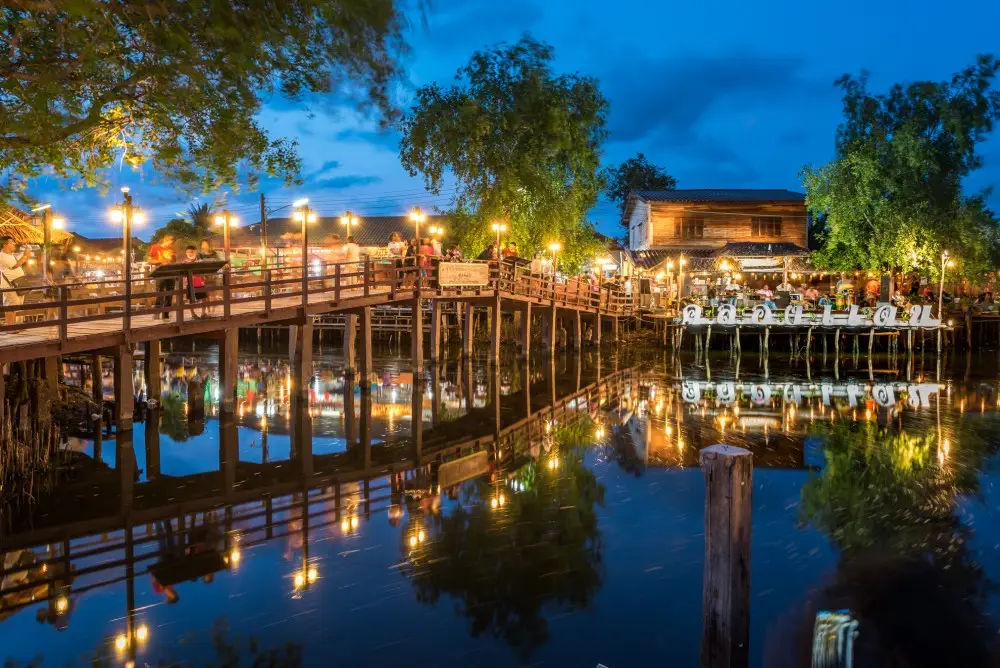
Klongdaen Floating Market
Open Days: Saturday
Opening Hours: 12.00 – 20.00
Klongdaen Floating Market, also known as Khlong Daen Riverside Market, is a cultural and conservation-based community attraction located at the border area between Nakhon Si Thammarat and Songkhla in southern Thailand. The market is centered on Khlong Daen, a small canal formed by the meeting of several waterways and long regarded as a natural boundary between the two provinces. What makes this market special is not only its local food and Saturday riverside atmosphere, but also the way the community uses nature, history, wooden riverside houses, southern Thai performing arts, local products, and community participation to create sustainable tourism.
Klongdaen Floating Market is best suited to travelers who enjoy slow travel, riverside communities, traditional markets, cultural learning, and local food. The place is not designed as a large commercial attraction separated from its surroundings. Instead, it uses the canal, old wooden houses, timber walkways, community shops, Buddhist way of life, and local stories as the core of the travel experience. Visitors can walk along the water, taste southern Thai snacks, buy community products, watch cultural performances, and experience a small canal-side settlement that still preserves its relationship with water.
The market is closely associated with the phrase “Three Canals, Two Towns.” This refers to the meeting of three important waterways: Khlong Ranot, Khlong Cha-uat, and Khlong Pak Phanang. These waterways come together and form the smaller canal known as Khlong Daen. The canal acts as a natural line between Ranot District in Songkhla Province and the Hua Sai side of Nakhon Si Thammarat Province. Because of this geography, Khlong Daen has a distinctive border identity, connecting two provinces through water, trade, culture, and everyday life.
Historically, Khlong Daen was an important waterway trading community. Before road transport became dominant, boats were the main form of travel and trade between communities around Songkhla Lake and Nakhon Si Thammarat. The bend where several canals met became an ideal settlement and commercial area. Thai and Chinese residents established homes and businesses along the waterways, and Khlong Daen grew into a prosperous trading community with wooden houses, gold shops, tailor shops, grocery stores, traditional pharmacies, barber shops, rice mills, and busy water transport.
As roads gradually became more important, especially major routes connecting districts and provinces, water transport declined. Some residents moved away, and parts of the old riverside community became quieter. Later, the community and related organizations helped restore the market and revive its old atmosphere. Wooden houses, riverside walkways, bridges, and canal-side trading spaces were preserved or brought back into use. This revival did not turn Khlong Daen into a completely new artificial market; instead, it helped the old community return to life through conservation tourism, local culture, and community-based economic activity.
Walking through Klongdaen Floating Market is like walking through a living local history. Visitors can see wooden houses facing the canal, small bridges, waterside seating areas, food stalls, local shops, and community spaces. In the late afternoon, the market becomes more atmospheric as people arrive, vendors prepare food, lights reflect on the water, and the sound of conversation and music fills the canal-side area. This gradual change from afternoon to evening is one of the most enjoyable aspects of visiting the market.
One of the strongest values of Klongdaen Floating Market is community participation. Local residents are involved as vendors, caretakers, storytellers, homestay hosts, cultural performers, and community coordinators. Tourism here is not only about selling food or souvenirs. It is also about preserving local identity, supporting household income, maintaining the canal environment, and passing on stories about the community. This gives the market a deeper meaning than ordinary weekend markets.
Food is a major reason to visit the market. Every Saturday, visitors can find local dishes, southern Thai snacks, desserts, herbal drinks, community products, and simple riverside meals. The food reflects the taste of the local community rather than luxury dining. Many items are connected with household cooking and canal-side life. Eating here is therefore part of the cultural experience, allowing travelers to taste the community while walking through the market.
The market also features local cultural performances such as Nora dance, shadow puppetry, Thai music, and community shows depending on the occasion. These performances help turn the market into a small cultural stage. Travelers can walk, eat, rest by the canal, and watch southern Thai performing arts in the same visit. This keeps local arts visible in everyday community spaces rather than limiting them to formal ceremonies or cultural halls.
Boat trips are another meaningful activity at Klongdaen Floating Market. Seeing the community from the water allows visitors to understand the relationship between houses, walkways, trees, shops, and the canal. The canal is not just a scenic background; it is the reason the community developed in the first place. A boat ride helps travelers experience the market from the perspective of the waterway that once supported travel, trade, and community life.
Khlong Daen is also known as a Buddhist way-of-life community. Visitors can observe a simple, calm, and community-oriented atmosphere where houses, temples, the market, and the canal remain closely connected. The Buddhist character of the community is not limited to formal rituals. It appears in the way people live together, support one another, care for the environment, and organize tourism in a way that respects local values.
There are also homestays and old houses around the market area, including the 100-Year-Old House of Khlong Daen. This place functions as both accommodation and a small cultural space displaying old household objects used by earlier generations. Travelers who want to understand the community more deeply can stay overnight and experience the village beyond the busy market hours. The quiet morning and nighttime atmosphere reveal a different side of Khlong Daen from the lively Saturday market.
For travelers interested in local history, Klongdaen Floating Market is valuable as a living example of a southern Thai waterway trading settlement. The area reflects the relationship between Khlong Ranot, Khlong Cha-uat, Khlong Pak Phanang, Hua Sai, Ranot, and Songkhla Lake. The community once grew through boat travel and water trade, later declined with changes in transportation, and then revived through conservation-based community tourism. Its old wooden houses, walkways, canal bends, and stories from local residents all help preserve this history.
The best time to visit is from late afternoon to evening on Saturday. The market officially opens from 12.00 to 20.00, but the late afternoon offers a better balance of daylight, food stalls, people, and riverside atmosphere. Around sunset, the lights along the canal become more attractive, the reflections on the water are beautiful, and the market feels more alive. Travelers who want the full experience should arrive in the afternoon and stay into the evening.
Responsible travel is important here. Visitors should walk carefully on wooden bridges and waterside paths, avoid throwing rubbish into the canal, keep noise at a respectful level, ask permission before taking close photographs of people, and support local vendors directly. The market is also a living community, so respectful behavior helps ensure that tourism benefits local people without disturbing their way of life.
Klongdaen Floating Market can be reached from both Hua Sai District in Nakhon Si Thammarat and Ranot District in Songkhla. Travelers from the Nakhon Si Thammarat side can travel through Hua Sai toward the border area, while those coming from Songkhla or Ranot can use Highway 408 and continue toward Khlong Daen Subdistrict. Private car travel is the most convenient because visitors can combine the market with nearby coastal, temple, and lakeside attractions.
The market is also suitable for family travel. It offers local food, waterside walking areas, cultural shows, wooden houses, and activities that different generations can enjoy together. Older visitors may appreciate the old community atmosphere and traditional food, while younger travelers can enjoy photography, local snacks, cultural performances, and boat activities. This makes the market a relaxed and meaningful destination for families.
What makes Klongdaen Floating Market memorable is that it does not try to be like every other floating market in Thailand. Its identity comes from its own geography, its three-canals-and-two-provinces setting, old wooden houses, Buddhist community life, southern Thai performances, and the revival of a historic waterway settlement. The market is not only a place to buy food on Saturday. It is a place that tells the story of how people, water, trade, faith, and culture remain connected.
A visit to Klongdaen Floating Market reminds travelers that canals are more than waterways. They can be memory, economy, border, route, and cultural identity at the same time. Walking along the wooden paths, watching boats on the canal, tasting local food, and listening to music in the evening allows travelers to understand Khlong Daen through direct experience rather than only through written history.
For travelers looking for a cultural side of southern Thailand, Klongdaen Floating Market is a strong choice. It combines food, scenery, history, community life, conservation, and local culture in one compact riverside setting. It shows how sustainable tourism can help a community earn income while protecting its identity. For this reason, Khlong Daen remains one of the most meaningful riverside markets in the Nakhon Si Thammarat and Songkhla border area.
Getting There is most convenient by private car. The market is located in Khlong Daen Subdistrict, Ranot District, Songkhla Province, and connects with the Ram Kaeo and Hua Sai side of Nakhon Si Thammarat Province. From Hua Sai, travel along the coastal route toward Khlong Daen. From Ranot or Songkhla, use Highway 408 and follow local signs to Klongdaen Floating Market. Visitors should plan to arrive in the afternoon to walk around, take photos of the wooden riverside houses, enjoy local food, and stay until the evening when the market atmosphere is at its best.
| Name | Klongdaen Floating Market / Khlong Daen Riverside Market |
| Location | Khlong Daen Subdistrict, Ranot District, Songkhla Province, connected with Ram Kaeo Subdistrict, Hua Sai District, Nakhon Si Thammarat Province |
| Address | Khlong Daen Community, Khlong Daen Subdistrict, Ranot District, Songkhla 90140, Thailand, near the Nakhon Si Thammarat and Songkhla border area |
| Coordinates | 7.9141281, 100.3065602 |
| Highlights | Cultural riverside market in a three-canals-and-two-provinces setting, with old wooden houses, timber walkways, local food, community products, cultural performances, and boat activities |
| History | Khlong Daen developed as a waterway trading community where Khlong Ranot, Khlong Cha-uat, and Khlong Pak Phanang meet. It was once a prosperous riverside trading settlement before being revived as a conservation-based community market |
| Name Origin | Khlong Daen refers to the canal that acts as a natural boundary between two provinces. The area is known for the phrase “Three Canals, Two Towns” |
| Distinctive Features | Buddhist way-of-life canal community with old wooden riverside houses, timber bridges, local food stalls, community products, and a Saturday evening market atmosphere |
| Travel Information | Accessible by private car from Hua Sai District in Nakhon Si Thammarat or Ranot District in Songkhla, using Highway 408 and local roads toward Khlong Daen Subdistrict |
| Current Status | Open as a riverside cultural market and community tourism attraction every Saturday |
| Open Days | Saturday |
| Opening Hours | 12.00 – 20.00 |
| Best Time To Visit | Late afternoon to evening, when the market becomes lively and the riverside atmosphere is at its most attractive |
| Main Areas / Zones | Timber riverside walkway, wooden bridge, old wooden houses, local food stalls, community product shops, cultural performance area, boat activity area, and the 100-Year-Old House of Khlong Daen |
| Caretaker / Coordinator | Khlong Daen Community / Mr. Kriangkrai Anantapong, Community Chairman |
| Main Contact Number | 089-231-5281, 086-958-2776, 074-396-930 |
| Official Page | Klongdaen Floating Market |
| Nearby Tourist Attractions | 1. 100-Year-Old House of Khlong Daen, about 0.1 km 2. Khlong Daen Buddhist Way-of-Life Community, about 0.1 km 3. Khlong Daen Boat Activity Point, about 0.2 km 4. Pak Bang Ranot, about 16 km 5. Wat Pak Trae, Ranot, about 16 km 6. Chan Chaeng Beach, Hua Sai, about 18 km |
| Nearby Restaurants | 1. Nam Samunphrai Khlong Daen, about 0.05 km 2. Pa Phon Yam Sahray, about 0.06 km 3. Seaman Cafe & Seafood, about 4 km 4. Sathanai Hua Sai, about 6 km 5. Dawee Chip Fae Lae Kanghan, about 9 km 6. Khiang Le Seafood Ranot, about 16 km, Tel. 088-784-8301 |
| Nearby Accommodations | 1. 100-Year-Old House of Khlong Daen, about 0.1 km, Tel. 084-747-2281 2. Ban Rim Nam Homestay Khlong Daen, about 0.3 km, Tel. 089-975-6970, 092-516-4488 3. Baan Le Beach Resort, about 6 km 4. Khiang Le Resort Hua Sai, about 17 km, Tel. 089-876-9336 5. Baan Rai Chay Khao Farm Stay, about 20 km, Tel. 061-426-1556 6. Baan Ton Lamphu Pak Pra Pier, about 27 km |
Frequently Asked Questions (FAQ)
Q: Which province is Klongdaen Floating Market in?
A: Klongdaen Floating Market is located in Khlong Daen Subdistrict, Ranot District, Songkhla Province, and directly connects with the Hua Sai side of Nakhon Si Thammarat Province, making it a distinctive border-area community attraction.
Q: When is Klongdaen Floating Market open?
A: The market is open every Saturday from 12.00 to 20.00.
Q: What can visitors see and do at Klongdaen Floating Market?
A: Visitors can walk along the wooden riverside paths, see old wooden houses, taste local food, buy community products, watch Nora dance or shadow puppet performances, enjoy music, and take a boat ride along the canal.
Q: Why is Khlong Daen called Three Canals, Two Towns?
A: The name refers to the meeting of Khlong Ranot, Khlong Cha-uat, and Khlong Pak Phanang, as well as the market’s position at the natural border between Songkhla and Nakhon Si Thammarat.
Q: What is the best time to visit Klongdaen Floating Market?
A: Late afternoon to evening is the best time because the market becomes livelier, the riverside light is attractive, and the evening atmosphere is more memorable.
Q: Is Klongdaen Floating Market suitable for families?
A: Yes. It is suitable for families because it offers local food, canal-side walking areas, cultural activities, old wooden houses, and a relaxed environment that different generations can enjoy together.
Q: Are there homestays near Klongdaen Floating Market?
A: Yes. Nearby options include the 100-Year-Old House of Khlong Daen and Ban Rim Nam Homestay Khlong Daen, both suitable for travelers who want to experience the community more deeply.
Q: How can visitors contact Klongdaen Floating Market?
A: Visitors can contact the community coordinators at 089-231-5281, 086-958-2776, or 074-396-930.
 Category: ●Suburban Living
 Group: ●Floating Market
Last Update : 3 MonthAgo
 Last Update : 3 MonthAgo

 Click to Access the Navigation Map GPS
Klongdaen Floating Market Map
Recommend

 Art, Culture and Heritage
 Historical Sites and Monuments(9)
 Landmarks and Memorials(9)
 Royal Palace(1)
 Art, Craft Centres, Tradition(12)
 Museums(5)
 Educational Places
 Educational Gardens, Farm(2)
 University
 Public university(1)
 Autonomous Universities(3)
 Rajamangala University of Technology(2)
 Rajabhat University(1)
 Private University(1)
 Places of Worship
 Temple(45)
 Mosque(2)
 Other Sacred Sites(17)
 Research and Development
 Royal Project(2)
 Village, Community(8)
 Local Market(1)
Floating Market(1)
 Nature and Wildlife
 National Parks and Marine Reserves(6)
 Mountain (Doi)(11)
 Dam, Reservoir, Lake(10)
 Waterfalls(43)
 Hot Springs(1)
 Caves(13)
 River, Canal(3)
 Bays and Beaches(29)
 Islands(2)
 Other natural attractions(3)
 Entertainment and Agricultural
 Farms, Parks and Ecotourism(3)
 Outdoor and Adventure Activities(4)
 Shopping
 Department Store(2)
 Travel Articles, Recipes
 Travel Review, Food Review(6)
 Southern Food Menu, Southern Food Recipes(18)


