
lovethailand home >South Travel Attractions >Nakhon Si Thammarat Travel Attractions >Khanom >Thong Nian > Coral Pagoda
TL;DR: Coral Pagoda is located at Wat Chan Thattharam, Ban Tha Chan, Moo 4, Thong Nian Subdistrict, Khanom District, Nakhon Si Thammarat Province, open Daily, hours Open throughout the day; recommended visiting hours are 08.00 – 17.00.

Coral Pagoda
Open Days: Daily
Opening Hours: Open throughout the day; recommended visiting hours are 08.00 – 17.00
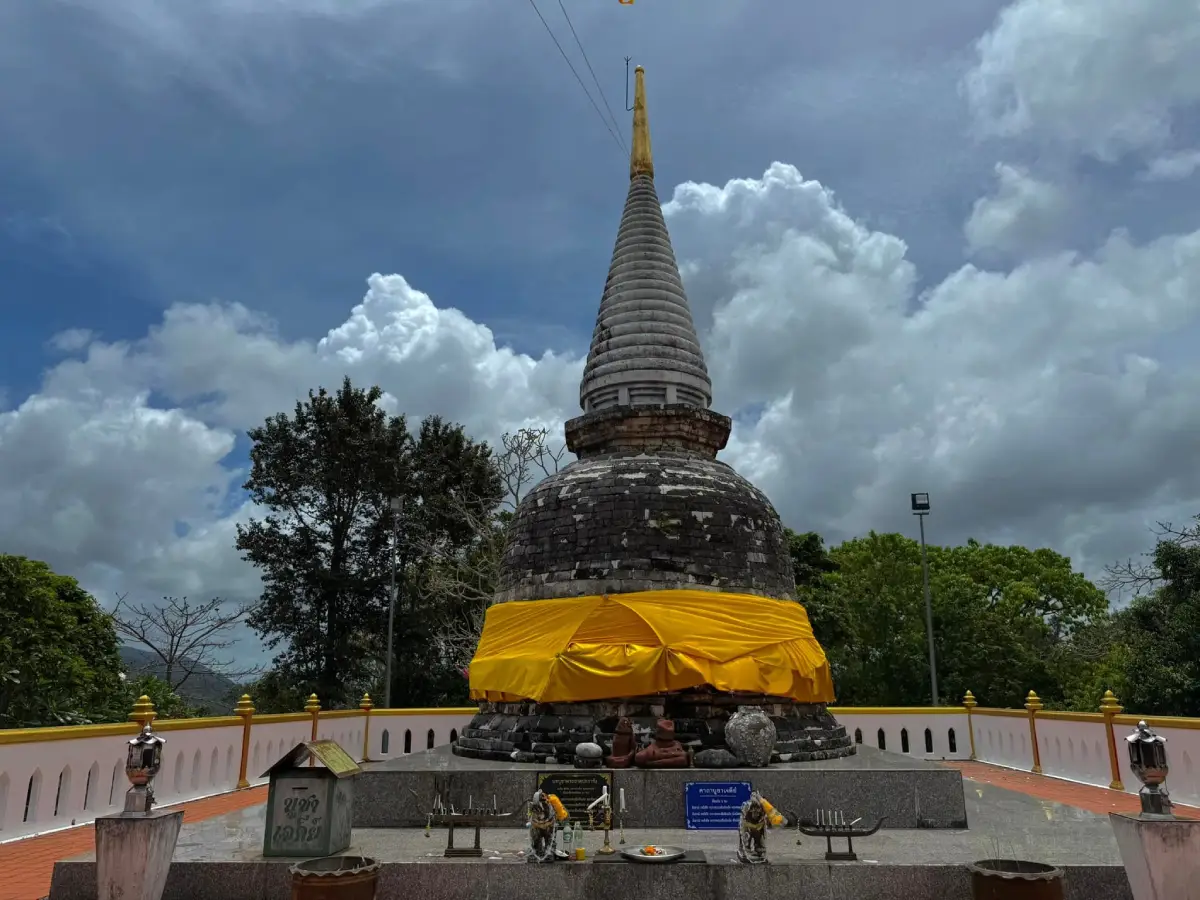
Coral Pagoda in Nakhon Si Thammarat Province is one of Khanom’s most distinctive ancient monuments. It stands on the summit of Khao That within Wat Chan Thattharam, also known locally as Wat Khao That, in Thong Nian Subdistrict, Khanom District. The pagoda is known for its inverted-bowl shape, measuring approximately 5–6 meters in diameter, and for its outer surface built with coral stone. Around the pagoda are red sandstone Buddha images, and from the hilltop visitors can enjoy a sweeping view of Thong Nian Bay. The site combines Buddhist heritage, local legend, coastal geography, and a quiet hilltop viewpoint in one meaningful destination.
Coral Pagoda, or Chedi Pakarang in Thai, is located inside Wat Chan Thattharam at Ban Tha Chan, Moo 4, Thong Nian Subdistrict, Khanom District, Nakhon Si Thammarat Province. It is one of the most important cultural landmarks of Khanom because it shows a side of the district that goes beyond beaches, pink dolphins, and coastal scenery. Visitors who come here encounter an ancient Buddhist monument, a local temple, a hilltop sacred space, and a viewpoint overlooking the sea. This combination makes Coral Pagoda one of the best places to understand Khanom’s older cultural landscape.
The pagoda stands on Khao That, a hill behind Wat Chan Thattharam. Although the hill is not extremely high, its position gives the site a strong sense of sacred elevation. In many Buddhist communities, a hilltop location gives a shrine both visibility and symbolic importance. At Coral Pagoda, that meaning becomes even clearer because the monument is connected with both religious devotion and the maritime environment of Khanom. The coral stone used on the pagoda’s outer surface reflects the coastal setting, while the panoramic view from the summit connects the monument visually with Thong Nian Bay below.
The structure is commonly described as an inverted-bowl-shaped pagoda, about 5–6 meters in diameter. Its form is compact, solid, and visually distinctive. Unlike many Buddhist stupas built mainly with brick and plaster, Coral Pagoda is famous for the use of coral stone on its exterior. The rough, porous surface of the coral gives the monument a texture that is rarely seen in Thai religious architecture. This material makes the pagoda immediately recognizable and gives it a direct connection with the natural environment of Khanom’s coastline.
Archaeological descriptions indicate that the pagoda is not made entirely of coral stone from core to exterior. Its inner core is brick, while the outer surface is formed with coral stones shaped into architectural components such as lotus elements and spire segments. This method shows how ancient craftsmen used local material creatively. The coral surface, with its naturally rough texture and weight, helped form the monument’s outer appearance without making it look like ordinary plastered masonry. The result is a rare coastal Buddhist monument with strong local identity.
Around the pagoda are Buddha images carved from red sandstone. These images are important because they show that the hilltop was not merely a scenic viewpoint, but a Buddhist sacred space. The presence of carved Buddha images helps reinforce the religious meaning of the site and suggests that this area once served as an active place of worship. For visitors, the red sandstone images add another layer of historical and artistic interest to the pagoda.
The Fine Arts Department registered the site as an ancient monument on 21 September 1998 under the name Chedi Khao That Ancient Monument, Ban Tha Chan, Thong Nian Subdistrict, Khanom District, Nakhon Si Thammarat Province. The protected ancient monument area covers 56 square wah. This registration confirms the heritage value of Coral Pagoda and makes it an important cultural site for both local residents and visitors. Anyone visiting the site should therefore treat it both as a sacred place and as a protected historical monument.
Local belief often describes Coral Pagoda as more than 1,000 years old. Archaeological dating by the Fine Arts Department places the monument broadly around the 19th–22nd Buddhist centuries. These two ways of describing the age of the pagoda reflect different but complementary perspectives. Local memory emphasizes the deep antiquity and spiritual value of the monument, while archaeological interpretation places it within a historical framework of Buddhist monuments along the Gulf of Thailand coastline.
Excavations and objects found around the pagoda and within its relic chamber reveal the importance of the site. The finds include Chinese ceramics from the Yuan and Ming dynasties, Sukhothai ceramics from the Si Satchanalai kilns, local pottery, small votive tablets, and ornaments such as gold rings, gold sheets, and gemstones. These objects show that Coral Pagoda was not an isolated local shrine. It was connected with wider networks of travel, exchange, devotion, and coastal culture.
One well-known legend says that a group of faithful people from Chaiya gathered wealth and valuable objects to enshrine in Phra Borommathat in Nakhon Si Thammarat. When they reached the area, they learned that Phra Borommathat had already been completed. Instead of continuing with the original plan, they decided to build a pagoda on Khao That, a resting point before reaching Nakhon Si Thammarat. They used coral stone found in the area to build the pagoda. This legend gives Coral Pagoda the meaning of fulfilled devotion, even though the original destination had changed.
Another legend tells of nobles and devotees from Chumphon, Prachuap Khiri Khan, and Surat Thani who traveled with jewels, gold, and precious objects to enshrine in Phra Borommathat Nakhon Si Thammarat. During the sea journey, their boat was wrecked. Some survivors were washed ashore in this area. They then built a coral-stone pagoda to enshrine the valuables that remained, instead of taking them onward to Nakhon Si Thammarat. This story connects the pagoda with faith, the sea, shipwreck, survival, and the coastal identity of Khanom.
Together, these legends show that Coral Pagoda is deeply connected with the pilgrimage route to Phra Borommathat Nakhon Si Thammarat. Whether the story begins in Chaiya or in the upper southern coast, the central meaning is the same: people carried faith, wealth, and offerings toward one of the great Buddhist centers of southern Thailand, and Coral Pagoda became the place where that faith was transformed into a local monument. The pagoda therefore stands as a symbol of devotion along the Gulf of Thailand.
Wat Chan Thattharam, where the pagoda is located, is a local Buddhist temple in the Mahanikaya tradition. It is situated in Thong Nian Subdistrict, Khanom District, Nakhon Si Thammarat Province. The temple has a calm and simple atmosphere, suitable for merit-making, quiet worship, and cultural visits. The abbot listed in recent temple information is Phra Palat Siwarit Sutthimano, who serves as the abbot of Wat Chan Thattharam and oversees the religious life of the temple community.
Coral Pagoda is also connected with a living local tradition. During Visakha Bucha, the community has held a ceremony known as Hae Pha Khuen That, or the procession of cloth to wrap the pagoda. This activity brings together local residents and devotees who carry cloth up to the hilltop pagoda as an act of Buddhist merit. The tradition shows that Coral Pagoda is not only an archaeological monument, but also a living place of worship that continues to connect people through faith.
One of the strongest reasons to visit Coral Pagoda is the view from Khao That. From the hilltop, visitors can see Thong Nian Bay and the surrounding coastal landscape of Khanom. This view helps explain why the site feels so meaningful. The pagoda is not hidden away from the world; it stands above the coastal community, looking out toward the sea. The visual connection between the ancient monument and the bay below gives the site a special atmosphere that combines spirituality and landscape.
The area around the pagoda is quiet and suitable for slow observation. Visitors should take time to look at the coral surface, the shape of the stupa, the base, the spire, and the red sandstone Buddha images. These details reveal craftsmanship, local material use, and Buddhist symbolism. A quick visit may be enough for a photograph, but a slower visit allows the monument to communicate its real historical and cultural value.
Visitors should wear comfortable shoes because the pagoda is located on a hill behind the temple. The path to the summit requires care, especially for older visitors or anyone with mobility concerns. Morning and late afternoon are the best times to visit because the weather is more comfortable and the light is better for photography. Midday can be hot because parts of the hilltop area are open to sunlight.
For photography, Coral Pagoda offers several strong angles. Close-up images show the coral texture and weathered surface of the monument. Wider shots capture the stupa against the sky. Hilltop views show Thong Nian Bay and the surrounding Khanom coastline. The combination of a rare coral-stone monument and sea views makes this site visually different from most other temple attractions in southern Thailand.
For travelers interested in history and archaeology, Coral Pagoda is valuable because it connects religious architecture with coastal trade and pilgrimage. The objects found in and around the pagoda, including Chinese ceramics, Sukhothai wares, local pottery, votive tablets, gold ornaments, and gemstones, suggest that the site was linked to broader networks of culture and exchange. It was not simply a local hilltop shrine, but part of a coastal Buddhist world shaped by travel and devotion.
The site is suitable for cultural travelers, families, students, photographers, and visitors who want to understand Khanom more deeply. Khanom is often known for beaches and pink dolphins, but Coral Pagoda shows that the district also has a long cultural memory. Visiting the pagoda helps balance a coastal holiday with historical meaning. It also gives foreign travelers a clearer sense of how Buddhism, maritime routes, and local materials shaped southern Thai heritage.
Getting There can be done by private car, rental car, public van, or local transport. From Highway 401 on the Surat Thani–Nakhon Si Thammarat route, turn at Khlong Leng junction, which is easily recognized by the dolphin sculpture, onto Highway 4014 toward Khanom town. After entering Khanom, continue through the town area, pass the district office and Bang Nod Market, cross the bridge over Khlong Khanom, and continue to the Ban Bang Phaeng junction. From there, follow Highway 4044 on the Ban Nam Cho–Ban Bang Phaeng route toward Wat Chan Thattharam. The path to Coral Pagoda is on the hill behind the temple.
Another convenient route from central Khanom is to drive from the market intersection toward the Khanom District Office for about 4 km, cross Bang Phaeng Bridge, and turn left at the junction for about 2 km. The temple will be on the right-hand side, and the route up to the pagoda begins beside the temple area. Visitors using public transport can take the Nakhon Si Thammarat–Khanom route and continue by local motorcycle taxi or hired vehicle from Khanom Market. A private car or rental car is the most convenient option because nearby beaches, restaurants, and viewpoints are spread across the district.
After arriving at Wat Chan Thattharam, visitors can park within the temple area and walk up to Khao That to worship at the pagoda. Modest clothing is recommended because this is both a temple and an ancient monument. Visitors should not climb on the pagoda, move stones, touch fragile objects unnecessarily, litter, or disturb the peaceful atmosphere of the temple. Respectful behavior helps preserve the site for future visitors and supports the temple community.
There is no admission fee for Coral Pagoda. Visitors may make voluntary donations to support the temple. A typical visit takes about 1–2 hours, including walking up the hill, paying respect at the pagoda, observing the red sandstone Buddha images, taking photographs, and enjoying the view over Thong Nian Bay. The recommended visiting hours are 08.00–17.00 for comfort and safety, especially because the hilltop area is best visited in daylight.
Coral Pagoda can be included in several Khanom itineraries. For a cultural route, visitors can begin at the pagoda and continue to nearby temples or local communities. For a nature-focused trip, it can be paired with Thong Ching Bay, Khanom Beach, the pink dolphin viewing area, and coastal viewpoints. For a slow half-day trip, visitors can climb to the pagoda in the morning, then enjoy local seafood or check in to a seaside accommodation in the afternoon.
Culturally, Coral Pagoda helps explain Khanom as more than a beach destination. The monument links coastal material, Buddhist faith, pilgrimage legends, maritime travel, and the heritage of Nakhon Si Thammarat. Its connection with Phra Borommathat Nakhon Si Thammarat gives it a wider religious meaning, while its hilltop location and coral construction make it strongly local to Khanom. This balance between regional faith and local identity is the core value of the site.
For foreign travelers, Coral Pagoda is a useful introduction to the cultural depth of southern Thailand. It shows that the region is not only about tropical scenery, but also about ancient movement, Buddhist devotion, local craftsmanship, and sacred landscapes. A visit here adds historical context to a Khanom journey and gives travelers a more complete understanding of the place they are exploring.
In conclusion, Coral Pagoda is one of Khanom’s most meaningful ancient monuments. It offers history, Buddhist devotion, unusual coral-stone construction, red sandstone Buddha images, local legends, and a beautiful view of Thong Nian Bay. For anyone planning a cultural trip in Khanom, this hilltop pagoda should be included as a key stop. It is a compact site, but its historical and spiritual value is substantial.
| Name | Coral Pagoda / Chedi Khao That Ancient Monument |
| Location | Wat Chan Thattharam, Ban Tha Chan, Moo 4, Thong Nian Subdistrict, Khanom District, Nakhon Si Thammarat Province |
| Address | 125 Ban Tha Chan, Moo 4, Khao That, Thong Nian Subdistrict, Khanom District, Nakhon Si Thammarat 80210, Thailand |
| Highlights | An ancient hilltop pagoda with a coral-stone exterior, views over Thong Nian Bay, and local legends connected with Phra Borommathat Nakhon Si Thammarat |
| History | Locally believed to be more than 1,000 years old; archaeologically dated broadly to the 19th–22nd Buddhist centuries and registered as an ancient monument on 21 September 1998 |
| Distinctive Features | Inverted-bowl-shaped pagoda, about 5–6 meters in diameter, with a brick core and coral-stone exterior; surrounded by red sandstone Buddha images |
| Key Evidence | Coral stone, red sandstone Buddha images, Yuan and Ming dynasty ceramics, Sukhothai wares from Si Satchanalai kilns, local pottery, votive tablets, gold rings, gold sheets, and gemstones found in the relic chamber |
| Name Origin | Known as Coral Pagoda because coral stone was used on the outer surface of the stupa; also registered as Chedi Khao That Ancient Monument after its hilltop location |
| Travel Information | Take Highway 401 to Khlong Leng junction, turn onto Highway 4014 toward Khanom, continue through Khanom town and Ban Bang Phaeng, then follow Highway 4044 to Wat Chan Thattharam; the pagoda is on the hill behind the temple |
| Current Status | Open to visitors for worship, cultural sightseeing, and historical learning as an important ancient monument of Khanom District |
| Open Days | Daily |
| Opening Hours | Open throughout the day; recommended visiting hours are 08.00–17.00 for comfort and safety on the hill path |
| Fees | No admission fee; voluntary temple donations are welcome |
| Facilities | Temple parking area, hill path, pagoda worship area, viewpoint, and temple grounds |
| Main Areas / Zones | Khao That hill and path to the pagoda Hilltop Coral Pagoda terrace Coral Pagoda Red sandstone Buddha images around the pagoda Thong Nian Bay viewpoint Lower temple area of Wat Chan Thattharam |
| Abbot / Caretaker | Phra Palat Siwarit Sutthimano, Abbot of Wat Chan Thattharam |
| Main Contact Number | 083-173-5338 |
| Tradition / Main Activity | Hae Pha Khuen That ceremony at Coral Pagoda during Visakha Bucha, a Buddhist merit-making tradition of the Khanom community |
| Nearby Tourist Attractions | 1. Ao Thong Ching, about 3 km 2. Ko Tha Rai, about 6 km 3. Ko Phi, about 8 km 4. Hat Khanom National Park Area, about 8 km 5. Pink Dolphin Viewing Area, Khanom Bay, about 9 km 6. Nai Phlao Beach, about 15 km |
| Nearby Restaurants | 1. Klang Ao Seafood, about 3 km 2. Krua Tangke Khanom, about 7 km, Tel. 089-288-9099 3. Jum Seafood, about 10 km, Tel. 084-053-7109 4. Khanom Seafood, Nai Phlao Branch, about 15 km, Tel. 092-989-3353, 075-300-202 5. BLUE SURF CAFE by Sichon Cabana, about 42 km, Tel. 063-525-7177 |
| Nearby Accommodations | 1. Chalam Pool Villa Khanom, about 3 km 2. Manee Pool Villa, about 3 km 3. Khwang Pao Resort, about 3 km 4. The Nin Resort, about 3 km 5. Ban Thong Ching Resort, about 3 km 6. Anavilla Tangke Resort, about 7 km, Tel. 086-280-9222 7. Khanom Golden Beach Hotel, about 12 km, Tel. 075-326-690 |
Frequently Asked Questions (FAQ)
Q: Where is Coral Pagoda located?
A: Coral Pagoda is located on Khao That hill inside Wat Chan Thattharam at Ban Tha Chan, Moo 4, Thong Nian Subdistrict, Khanom District, Nakhon Si Thammarat Province.
Q: What are the opening days and recommended visiting hours?
A: The site is open daily. The recommended visiting hours are 08.00–17.00 because the hill path is safer and more comfortable in daylight.
Q: Is there an admission fee for Coral Pagoda?
A: There is no admission fee. Visitors may make voluntary donations to support the temple.
Q: Why is Coral Pagoda important?
A: It is an ancient monument of Khanom with a coral-stone exterior, red sandstone Buddha images, local pilgrimage legends, and official registration as an ancient monument by the Fine Arts Department in 1998.
Q: Why is it called Coral Pagoda?
A: It is called Coral Pagoda because coral stone was used to form the outer surface of the stupa, giving the monument a rare texture and appearance.
Q: What view can visitors see from Coral Pagoda?
A: From Khao That hill, visitors can see Thong Nian Bay, the Khanom coastline, and the surrounding coastal community.
Q: How can travelers get to Coral Pagoda?
A: Take Highway 401 to Khlong Leng junction, turn onto Highway 4014 toward Khanom, continue through Khanom town and Ban Bang Phaeng, then follow Highway 4044 to Wat Chan Thattharam.
Q: What nearby places can be visited after Coral Pagoda?
A: Nearby places include Ao Thong Ching, Ko Tha Rai, the Hat Khanom National Park area, the pink dolphin viewing area in Khanom Bay, and Nai Phlao Beach.
 Category: ●Art, Culture and Heritage
 Group: ●Historical Sites and Monuments
Last Update : 1 MonthAgo
 Last Update : 1 MonthAgo
 Click to Access the Navigation Map GPS
Coral Pagoda Map
Recommend
 Historical Sites and Monuments(9)
 Landmarks and Memorials(9)
 Royal Palace(1)
 Art, Craft Centres, Tradition(12)
 Museums(5)
 Educational Places
 Educational Gardens, Farm(2)
 Places of Worship
 Temple(44)
 Mosque(2)
 Other Sacred Sites(17)
 Research and Development
 Royal Project(2)
 Suburban Living
 Village, Community(8)
 Local Market(1)
 Floating Market(1)
 Nature and Wildlife
 National Parks and Marine Reserves(6)
 Mountain (Doi)(11)
 Dam, Reservoir, Lake(10)
 Waterfalls(43)
 Hot Springs(1)
 Caves(13)
 River, Canal(3)
 Bays and Beaches(29)
 Islands(2)
 Other natural attractions(3)
 Entertainment and Agricultural
 Farms, Parks and Ecotourism(3)
 Outdoor and Adventure Activities(4)
 Travel Articles, Recipes
 Travel Review, Food Review(1)
 Southern Food Menu, Southern Food Recipes(18)


