
lovethailand home >South Travel Attractions >Nakhon Si Thammarat Travel Attractions >Mueang NaKhon Si Thammarat >Khlang > Chedi Yak
TL;DR: Chedi Yak is located at Sri Prat Road, beside the Nakhon Si Thammarat City Municipality Office, Mueang Nakhon Si Thammarat District, Nakhon Si Thammarat Province, open Daily, hours Open 24 Hours.
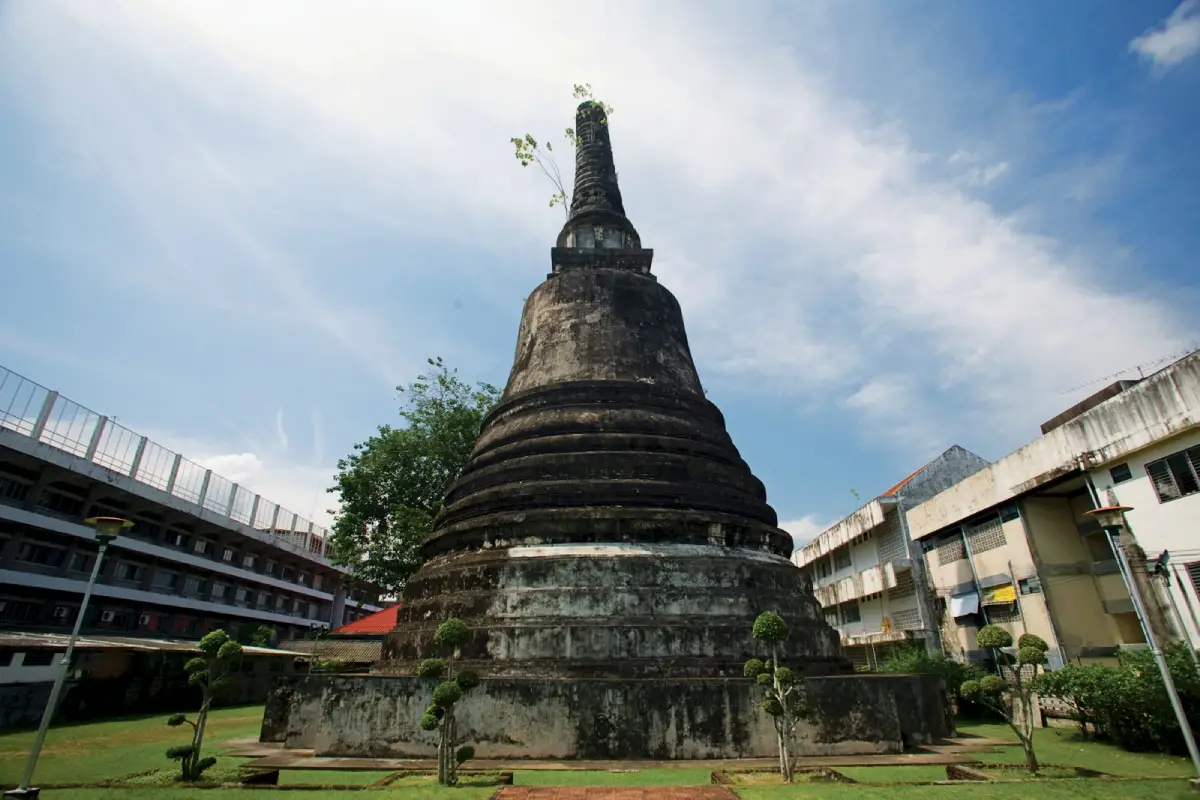
Chedi Yak
Open Days: Daily
Opening Hours: Open 24 Hours
Chedi Yak, or the Giant Chedi of Nakhon Si Thammarat, is one of the most important archaeological landmarks in the historic city center of Nakhon Si Thammarat. It stands on Sri Prat Road beside the Nakhon Si Thammarat City Municipality Office, within the old urban area connected to Ratchadamnoen Road, Wat Phra Mahathat Woramahawihan, the City Pillar Shrine, the Old City Wall, and other cultural landmarks. This large Sri Lankan-style chedi is considered the second largest chedi in the city after the great Phra Borommathat Chedi at Wat Phra Mahathat Woramahawihan. Its massive square base, large white body, and broken upper section make it visually distinctive and deeply memorable. For both Thai and international travelers, Chedi Yak is a compact but meaningful place to understand the history, Buddhist heritage, local legend, and urban identity of Nakhon Si Thammarat.
The site is easy to visit and requires no admission fee. Visitors can view the exterior of the chedi at any time, and the surrounding area is accessible daily. The best time to visit is during daylight, especially in the morning or late afternoon, when the structure, base, surrounding shrine area, and the image hall of Luang Pho Ngoen can be seen clearly. Although the site is open 24 hours for exterior viewing, travelers who want to appreciate the details of the architecture should visit during the day.
Chedi Yak is remarkable because it stands directly within the present-day city. It is not hidden in a forest, on a mountain, or inside a large active temple complex. Instead, it rises near roads, public offices, local traffic, and everyday city life. This setting makes the monument especially meaningful. It shows how ancient heritage remains part of the living urban landscape of Nakhon Si Thammarat, rather than being separated from the modern city.
Architecturally, Chedi Yak reflects the Sri Lankan-style Buddhist influence that played a major role in southern Thailand. The structure is associated with the period around the 18th to 19th Buddhist centuries, or approximately 1800 to 1900 B.E. This was an important era for Nakhon Si Thammarat as a center of Theravada Buddhism linked to the Lanka tradition. The scale of the chedi suggests strong religious devotion, a high level of urban prosperity, and the technical ability of builders who worked within a regional Buddhist architectural network.
The term Sri Lankan-style chedi refers to a Buddhist architectural form that emphasizes the main body, base, and symbolic vertical structure of the monument. At Chedi Yak, the square base gives the structure a strong and grounded appearance, while the large chedi body conveys weight, stability, and sacred presence. The missing upper section is one of the most recognizable features of the monument. Rather than reducing its significance, the broken top has become part of the identity of the site and is closely connected to the famous local legend of the giant.
The history of Chedi Yak is closely related to the wider religious and cultural history of Nakhon Si Thammarat. The city has long been one of the most important Buddhist centers in southern Thailand. Wat Phra Mahathat Woramahawihan, the Phra Borommathat Chedi, old city walls, shrines, and archaeological remains all show that Nakhon Si Thammarat was not only a regional city but also a major religious and cultural center. Chedi Yak should therefore be understood as part of a broader sacred landscape rather than as an isolated monument.
One of the most memorable aspects of Chedi Yak is its legend. According to local tradition, a giant once came to Nakhon Si Thammarat and threatened to eat the townspeople. At that time, the people of the city were building the Phra Borommathat Chedi. The townspeople asked the giant to wait until the chedi was finished. A man then challenged the giant to build a chedi in competition with the people of the city. The giant built quickly and was close to finishing his monument. The townspeople then used a clever trick, making it appear from a distance that the Phra Borommathat Chedi had already been completed. Believing that he had lost, the giant became furious, struck the top of his own chedi until it broke, and left the city in shame. This story explains the name Chedi Yak, meaning Giant Chedi, and connects the monument to the cultural memory of the city.
The legend does more than entertain. It helps explain the relationship between Chedi Yak and the Phra Borommathat Chedi. One represents the great sacred center of Nakhon Si Thammarat, while the other preserves the story of competition, cleverness, anger, and the triumph of the city. Through this legend, the broken top of the chedi becomes meaningful. It is no longer only a damaged architectural feature; it becomes part of the cultural identity of the monument.
Before restoration, Chedi Yak was in poor condition, with the top broken and the structure affected by age and deterioration. The Fine Arts Department carried out an important restoration between 1975 and 1979. This restoration helped stabilize the monument and allowed it to remain visible as one of the city’s most important archaeological landmarks. Without conservation work, a monument of this scale and age could have been lost or severely damaged over time.
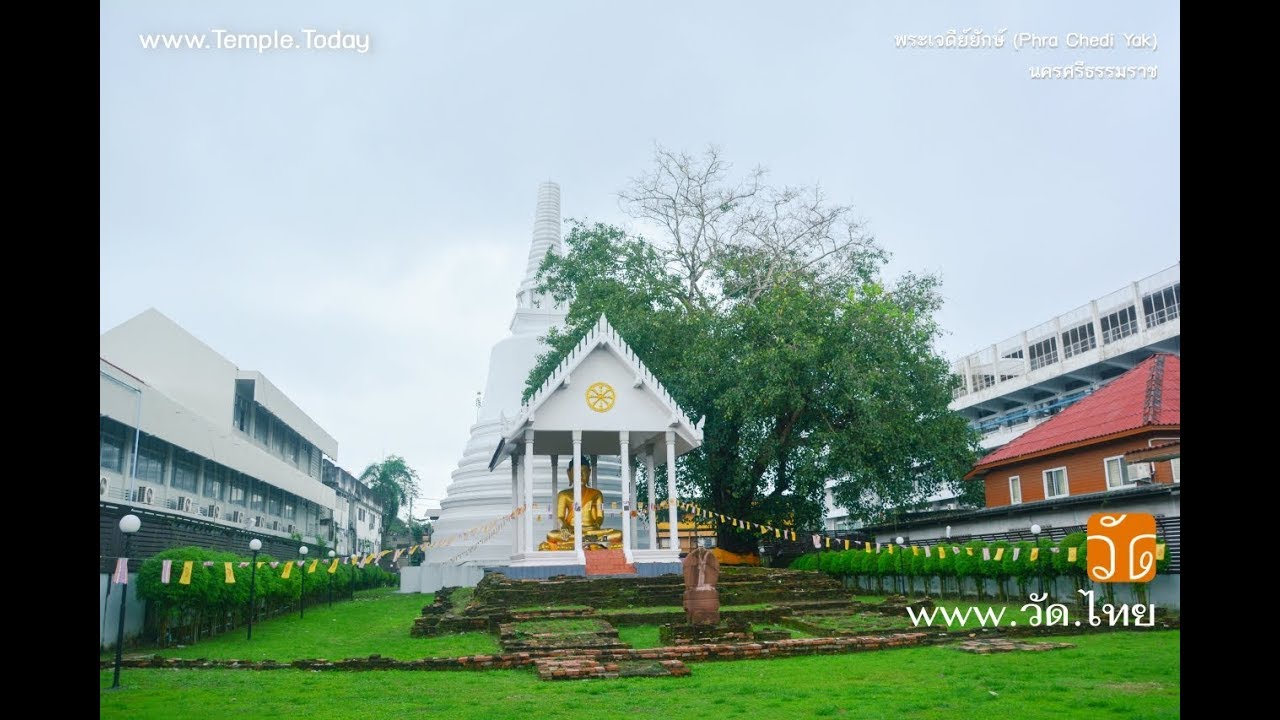
In front of the chedi is a hall enshrining a large seated Buddha image known as Phra Ngoen or Luang Pho Ngoen. This Buddha image is associated with Ayutthaya-period craftsmanship and remains an important object of devotion for local people and visitors. The presence of Luang Pho Ngoen gives the site a living religious dimension. Travelers who visit Chedi Yak do not only see an archaeological structure; they also encounter an active place of worship connected to local faith.
The name Luang Pho Ngoen reflects the way local communities relate to sacred images. The Buddha image is not treated merely as an art object but as a revered presence. Visitors who wish to pay respect should behave appropriately, dress modestly, speak quietly, and avoid disturbing others. This is especially important because the site combines archaeological value with religious devotion.
The archaeological context around Chedi Yak adds further depth to the site. The area has been associated with sandstone boundary markers, local ceramics, and imported wares such as Sukhothai ceramics, Chinese Ming-period ceramics, and Vietnamese ceramics. These findings help illustrate the wider historical role of Nakhon Si Thammarat as a city connected to trade, religion, craftsmanship, and cultural exchange. Chedi Yak is therefore not only a large chedi but also a gateway to understanding the city’s position in a broader regional network.
The location of Chedi Yak beside the municipality office is also important. It places an ancient Buddhist monument directly next to modern civic administration. This close relationship between old and new is one of the defining qualities of Nakhon Si Thammarat. History is not confined to museums; it stands beside roads, offices, schools, temples, markets, and daily life. Visitors can see how the past remains embedded in the present city.
The site is associated with an abandoned temple area, so it does not have a resident abbot in the same way as an active monastery. Relevant public bodies include the Nakhon Si Thammarat Provincial Office of Buddhism, Nakhon Si Thammarat City Municipality, and heritage-related agencies responsible for archaeological sites and conservation. Visitors should treat the area with care and respect. They should not climb, touch, mark, or move any part of the monument or archaeological setting.
Although exterior viewing is possible 24 hours a day, morning and late afternoon are the most suitable times to visit. Daylight reveals the form of the base, the large chedi body, the broken upper section, the shrine hall, and the surrounding urban setting. Nighttime visits are possible from outside, but detailed observation is better during the day. Travelers who want photographs should also choose softer light for clearer images and better texture.
When visiting, the first feature to observe is the overall proportion of the chedi. The square base, large body, and missing upper section should be viewed together. The broken top is strongly linked to the local legend of the giant striking the monument. By observing the structure in this way, visitors can understand Chedi Yak through both architecture and folklore at the same time.
Chedi Yak is an excellent starting point for understanding Nakhon Si Thammarat as a Buddhist and historical city. Wat Phra Mahathat Woramahawihan represents the great sacred center. The City Pillar Shrine represents civic faith. The Old City Wall represents ancient urban planning. Chedi Yak represents a large Buddhist monument, a local legend, and a surviving archaeological landmark within the modern city. Together, these sites form a coherent cultural route.
Travelers planning a city itinerary can easily combine Chedi Yak with nearby attractions. The City Pillar Shrine, the Old City Wall, Ho Phra Isuan, Wat Wang Tawan Tok, Wat Phra Mahathat Woramahawihan, and the Nakhon Si Thammarat National Museum can all be visited within the same urban route. This makes the site suitable for both half-day and full-day cultural travel.
For photography, visitors should look for angles that show the chedi in relation to the city. Images that include the monument, road, surrounding buildings, and municipal area can communicate the special character of the site. Chedi Yak is not a remote ruin; it is a heritage monument embedded in the city. Photographers should avoid blocking traffic, disturbing worshippers, or entering restricted areas.
A short visit may take 20 to 40 minutes, but travelers interested in history should allow more time. A slower visit makes it possible to observe the chedi, Luang Pho Ngoen, the surrounding abandoned temple area, and the relationship between the monument and the old city route. The value of Chedi Yak is not only in its size but also in the layers of history, legend, religion, conservation, and urban life that surround it.
Getting to Chedi Yak is convenient because it is located in central Nakhon Si Thammarat. Visitors can arrive by private car, local taxi, motorized tricycle, or local songthaew on the Hua Thanon – Stadium route. From the railway station, bus terminal, or central city areas, local transport can reach the municipality area without difficulty. Travelers staying in the city center can also connect the visit with restaurants, hotels, and other nearby cultural attractions.
There is no admission fee, making the site accessible to all types of travelers, including families, students, elderly visitors, solo travelers, and cultural groups. However, free access does not reduce the need for respectful behavior. Chedi Yak is a heritage site. Visitors should keep the area clean, avoid climbing, avoid touching the old structure, and help preserve the monument for future generations.
The simplicity of the site is one of its strengths. There are no elaborate visitor facilities or large-scale tourist activities. Instead, visitors are invited to observe, think, and understand. The monument raises important questions: Why was such a large chedi built here? Why does it follow the Lanka-style form? Why does the legend of the giant remain so powerful? These questions make the site a meaningful stop for cultural travelers.
For local residents, Chedi Yak is a familiar part of the cityscape. Many people pass the site regularly, but a closer look reveals its significance. It is a major surviving monument of the old city and a visible reminder of Nakhon Si Thammarat’s religious importance. For younger generations, the site offers an opportunity to learn local history directly from the urban environment.
For international travelers, Chedi Yak provides a useful introduction to the diversity of Thai Buddhist architecture. Many visitors are familiar with central Thai stupas or northern Lanna temples, but Chedi Yak shows a southern form influenced by the Lanka Buddhist tradition. The site helps travelers understand that Thai Buddhist art is regionally diverse and shaped by maritime connections, religious networks, and local history.
Luang Pho Ngoen, the large seated Buddha image in front of the chedi, adds an important devotional dimension to the visit. Visitors should approach the shrine with respect. The image represents continuity of faith in an area that is otherwise associated with an abandoned temple. It shows that religious meaning can remain alive even when the original temple institution has changed over time.
Compared with Wat Phra Mahathat Woramahawihan, Chedi Yak plays a different role. Wat Phra Mahathat is the great living religious center of the city, with active worship, architecture, rituals, and community devotion. Chedi Yak is quieter, more archaeological, and more closely tied to legend. Visiting both sites gives travelers a fuller understanding of Nakhon Si Thammarat’s Buddhist heritage.
Several travel routes can be built around Chedi Yak. A history-focused route can include the City Pillar Shrine, the Old City Wall, and the National Museum. A faith-focused route can include Wat Phra Mahathat Woramahawihan and nearby temples. A city-life route can combine the chedi with local restaurants, roti shops, tea shops, and old-style coffee houses. This flexibility makes Chedi Yak a practical stop for different travel styles.
The legend of the giant also makes the site valuable for understanding how stories preserve place memory. The tale explains the broken top, the name of the chedi, the connection to the Phra Borommathat Chedi, and the wider ritual imagination of the city. Folklore helps people remember monuments, and Chedi Yak is a strong example of how architecture and storytelling support each other.
In cultural terms, Chedi Yak is an archaeological site, a devotional space, a historical landmark, and a place of local legend at the same time. Travelers who stop only briefly may see a large white chedi, but those who take time to understand it will see a much deeper story of Nakhon Si Thammarat. The monument helps explain the city’s identity as a Buddhist, historical, and cultural center of southern Thailand.
Conservation is an ongoing responsibility. A monument located in the middle of a city faces pressure from traffic, pollution, weather, and human activity. Every visitor can help protect the site by behaving carefully, not touching the structure, not leaving waste, and sharing accurate information. Preserving Chedi Yak is part of preserving the wider memory of Nakhon Si Thammarat.
For families and educational groups, Chedi Yak is a useful outdoor learning site. It can be used to explain Buddhist architecture, local history, archaeology, urban heritage, and folklore. Children and students can see that history does not exist only in books. It exists in real places, along roads, within cities, and in monuments that communities continue to recognize.
A good way to visit is to begin at the shrine of Luang Pho Ngoen, pay respects quietly, then walk around the chedi to observe its base, main body, and broken top. After that, visitors can look at the surroundings and consider how the monument relates to the municipality office, roads, and other parts of the old city. This route gives a balanced understanding of religion, archaeology, and urban context.
Travelers creating content or planning navigation should use the correct name: Chedi Yak or Phra Chedi Yak in Nakhon Si Thammarat. It should not be confused with Wat Chedi or Wat Ai Khai in Sichon District, which is a different site. Using the correct name and location helps readers and travelers reach the right place.
After visiting Chedi Yak, travelers can continue to nearby restaurants in the city center. Nakhon Si Thammarat is known for southern Thai food, roti, tea shops, old-style coffee, and local street food. Combining a heritage visit with local food creates a fuller travel experience because food is also part of the culture of the city.
Visitors who want to stay nearby should choose accommodation in central Nakhon Si Thammarat. Hotels in the city make it easy to visit Chedi Yak, Wat Phra Mahathat Woramahawihan, the City Pillar Shrine, the Old City Wall, restaurants, railway station, and other services. Staying in the city center is practical for travelers who want to explore cultural landmarks in one day.
Overall, Chedi Yak is a heritage site that should not be overlooked. It is a large Lanka-style chedi, a monument linked to local legend, a site associated with Luang Pho Ngoen, and a landmark located in the heart of Nakhon Si Thammarat. A respectful visit reveals the city’s Buddhist depth, historical continuity, and cultural identity in a compact but powerful way.
Visiting Chedi Yak with context makes the experience far more meaningful. The monument brings together Lanka Buddhist influence, archaeological remains, local legend, restoration history, a revered Buddha image, and modern city life. These layers make Chedi Yak one of the most important cultural stops for anyone who wants to understand Nakhon Si Thammarat beyond its most famous attractions.
| Name | Chedi Yak, or Phra Chedi Yak |
| Location | Sri Prat Road, beside the Nakhon Si Thammarat City Municipality Office, Mueang Nakhon Si Thammarat District, Nakhon Si Thammarat Province |
| Address | Khlang Subdistrict, Mueang Nakhon Si Thammarat District, Nakhon Si Thammarat 80000, Thailand |
| Coordinates | 8.4342956065, 99.9672522128 |
| Highlights | A large Sri Lankan-style chedi, the second largest chedi in Nakhon Si Thammarat after the Phra Borommathat Chedi at Wat Phra Mahathat Woramahawihan, with Luang Pho Ngoen enshrined in front |
| History | Built around 1800–1900 B.E. under the influence of Lanka Buddhist tradition, repaired in the Ayutthaya and early Rattanakosin periods, and restored by the Fine Arts Department between 1975 and 1979 |
| Name Origin | The name Chedi Yak comes from the local legend of a giant who built a chedi in competition with the people of Nakhon Si Thammarat and broke the top of his own chedi after believing he had lost. |
| Distinctive Features | Brick archaeological monument with a square base, twelve indented corners, Sri Lankan-style form, and a partially missing upper section |
| Important Elements | Luang Pho Ngoen, or Phra Ngoen, a large seated Buddha image associated with Ayutthaya-period craftsmanship, enshrined in the hall in front of the chedi |
| Travel Information | Accessible by private car, local taxi, motorized tricycle, or local songthaew on the Hua Thanon – Stadium route within central Nakhon Si Thammarat |
| Current Status | An archaeological monument in an abandoned temple area. Exterior viewing and respectful worship at Luang Pho Ngoen are available. The site is not permanently closed. |
| Open Days | Daily |
| Opening Hours | Open 24 Hours For Exterior Viewing |
| Fees | No Admission Fee |
| Facilities | Exterior viewing area, roadside access, worship area for Luang Pho Ngoen, and city services around the Nakhon Si Thammarat City Municipality area |
| Main Areas / Zones | 1. Main Sri Lankan-Style Chedi 2. Chedi Base And Archaeological Area 3. Luang Pho Ngoen Image Hall 4. Front Worship Area 5. Former Abandoned Temple Area 6. Exterior Viewing Area Around The Monument |
| Abbot / Caretaker | No resident abbot, as the site is an abandoned temple area. Relevant bodies include the Nakhon Si Thammarat Provincial Office of Buddhism, Nakhon Si Thammarat City Municipality, and heritage-related agencies. |
| Relevant Contact Numbers | Nakhon Si Thammarat City Municipality Tel. 075-809571 Nakhon Si Thammarat Provincial Office of Buddhism Tel. 075-357800, 075-357856, 075-344714 |
| Nearby Tourist Attractions | 1. Nakhon Si Thammarat City Pillar Shrine, about 1 km 2. Old City Wall of Nakhon Si Thammarat, about 1 km 3. Ho Phra Isuan and the City Swing Area, about 2 km 4. Wat Wang Tawan Tok, about 2 km 5. Wat Phra Mahathat Woramahawihan, about 3 km 6. Nakhon Si Thammarat National Museum, about 4 km |
| Nearby Restaurants | 1. Ka Jeab Khao Mok Kai In Front Of Wat Wang, about 1 km, Tel. 081-2718756 2. Nam Tao Hu Kratha Thong At Wat Wang Tawan Tok Intersection, about 1 km 3. Kopi, Provincial Hall Branch, about 1 km, Tel. 089-4319999 4. Roti Pa Nom, Branch 1 On Ratchadamnoen Road, about 2 km, Tel. 080-5212913 5. Day & Night Of Nakhon Si Thammarat, about 2 km, Tel. 075-808386 |
| Nearby Accommodations | 1. Thai Hotel, about 0.2 km, Tel. 075-356505, 075-356451, 075-341509 2. Grand Park Hotel, about 1 km, Tel. 075-317666 3. Mandy Nok Hotel, about 2 km, Tel. 075-830666 4. Navakitel Design Hotel, about 2 km, Tel. 075-450959, 075-450969 5. The Twin Lotus Hotel, about 4 km, Tel. 075-323777 |
Frequently Asked Questions (FAQ)
Q: Where is Chedi Yak located?
A: Chedi Yak is located on Sri Prat Road beside the Nakhon Si Thammarat City Municipality Office in Khlang Subdistrict, Mueang Nakhon Si Thammarat District, Nakhon Si Thammarat Province.
Q: What are the opening days and hours of Chedi Yak?
A: Chedi Yak is open daily for exterior viewing 24 hours a day. Daytime, especially morning or late afternoon, is the best time to see architectural details and take photographs.
Q: Is there an admission fee for Chedi Yak?
A: No. There is no admission fee to view the monument and pay respect at Luang Pho Ngoen.
Q: Does Chedi Yak have an abbot?
A: No. The site is an abandoned temple area and archaeological monument, so it does not have a resident abbot like an active monastery.
Q: What makes Chedi Yak special?
A: It is a large Sri Lankan-style chedi, the second largest in Nakhon Si Thammarat after the Phra Borommathat Chedi, and it is linked to the famous legend of the giant who broke the top of his own chedi.
Q: What is Luang Pho Ngoen?
A: Luang Pho Ngoen, also called Phra Ngoen, is a large seated Buddha image associated with Ayutthaya-period craftsmanship, enshrined in the hall in front of Chedi Yak.
Q: Can travelers reach Chedi Yak by public transport?
A: Yes. Travelers can use local songthaews on the Hua Thanon – Stadium route, motorized tricycles, or local taxis from the railway station, bus terminal, and central city areas.
Q: What nearby attractions can be visited after Chedi Yak?
A: Nearby attractions include the Nakhon Si Thammarat City Pillar Shrine, the Old City Wall, Ho Phra Isuan, Wat Wang Tawan Tok, Wat Phra Mahathat Woramahawihan, and the Nakhon Si Thammarat National Museum.
 Category: ●Art, Culture and Heritage
 Group: ●Historical Sites and Monuments
Last Update : 3 MonthAgo
 Last Update : 3 MonthAgo
 Click to Access the Navigation Map GPS
 Historical Sites and Monuments(9)
 Landmarks and Memorials(9)
 Royal Palace(1)
 Art, Craft Centres, Tradition(12)
 Museums(5)
 Educational Places
 Educational Gardens, Farm(2)
 University
 Public university(1)
 Autonomous Universities(3)
 Rajamangala University of Technology(2)
 Rajabhat University(1)
 Private University(1)
 Places of Worship
 Temple(45)
 Mosque(2)
 Other Sacred Sites(17)
 Research and Development
 Royal Project(2)
 Suburban Living
 Village, Community(8)
 Local Market(1)
 Floating Market(1)
 Nature and Wildlife
 National Parks and Marine Reserves(6)
 Mountain (Doi)(11)
 Dam, Reservoir, Lake(10)
 Waterfalls(43)
 Hot Springs(1)
 Caves(13)
 River, Canal(3)
 Bays and Beaches(29)
 Islands(2)
 Other natural attractions(3)
 Entertainment and Agricultural
 Farms, Parks and Ecotourism(3)
 Outdoor and Adventure Activities(4)
 Shopping
 Department Store(3)
 Travel Articles, Recipes
 Travel Review, Food Review(6)
 Southern Food Menu, Southern Food Recipes(18)


