
lovethailand home >South Travel Attractions >Krabi Travel Attractions >Muang >Krabi Noi > Tham Suea Khao Kaeo Ao Luk Thanu
TL;DR: Tham Suea Khao Kaeo Ao Luk Thanu is located at Ban Tham Suea, Krabi Noi Subdistrict, Mueang Krabi District, Krabi Province, open Daily, hours 06:00 – 18:00.

Tham Suea Khao Kaeo Ao Luk Thanu
Open Days: Daily
Opening Hours: 06:00 – 18:00
Tham Suea Khao Kaeo Ao Luk Thanu, better known as Wat Tham Suea or Tiger Cave Temple Krabi, is one of the most important religious, natural, and historical attractions in Krabi Province. Located in Ban Tham Suea, Krabi Noi Subdistrict, Mueang Krabi District, the temple combines limestone caves, a forest valley, meditation areas, archaeological evidence, Buddhist worship sites, and a famous 1,237-step staircase leading to the summit of Khao Kaeo. For many visitors, it is one of the clearest examples of inland Krabi: a place where faith, forest, cliffs, caves, and panoramic views all meet in one destination.
The name “Tham Suea”, or Tiger Cave, comes from local stories that the caves at the front of the Ao Luk Thanu mountain range, also called Khao Kaeo, were once used by large tigers. Local people believed that tigers lived and rested in the cave area. Inside the cave, a natural rock formation resembling a tiger’s paw also became part of the site’s identity. These stories and physical features gave the temple its name and continue to shape how the place is remembered today.
The temple is set in a forested limestone valley known for large old trees, cave openings, rock shelters, and steep mountain formations. Its atmosphere is very different from urban temples in Krabi Town. Visitors entering the temple grounds will notice shade, forest sounds, cave walls, and a sense of stillness. This makes Wat Tham Suea suitable not only for sightseeing, but also for worship, meditation, slow walking, and understanding Krabi beyond its beaches and islands.
Wat Tham Suea covers approximately 200 rai and includes lowland areas, valleys, caves, and summit terrain. The temple grounds contain several natural caves and rock shelters, including Tham Khon Than, Tham Lot, Tham Chang Kaeo, Tham Luk Thanu, and Tham Phra. Some caves are associated with meditation practice, some reveal Krabi’s limestone landscape, and some connect with archaeological evidence from much earlier periods of human use.
The temple’s development is closely linked with forest monks and the search for peaceful places for meditation. Before becoming widely known as a temple, the area was a natural forest and cave setting suitable for solitude. Luang Pho Chamniarn Silasettho played an important role in the temple’s spiritual reputation. His connection with meditation practice attracted followers, and over time the cave and forest area developed into one of Krabi’s best-known Buddhist sites.
Wat Tham Suea is an active Buddhist temple, not merely a tourist viewpoint. Monks, lay practitioners, and local worshippers continue to use parts of the temple for religious practice. Visitors should therefore treat the site as a living place of worship. Modest clothing, quiet behavior, and respect for meditation areas are essential. The temple is popular with travelers, but its religious function remains central.
Beyond religion, the Tiger Cave area is also an important archaeological site. Evidence has been found from both prehistoric and early historic periods, including stone tools, pottery fragments, raw votive tablets, and other ancient remains. These discoveries show that the caves and rock shelters around Khao Kaeo were meaningful long before the area became a modern temple. The site therefore carries historical value as well as spiritual value.
The natural geography helps explain why ancient people used this area. Limestone caves and shelters provided shade, protection from rain, and access to forest resources. The surrounding valley and hills made the area suitable for temporary occupation, ritual activity, and movement through the landscape. Archaeological evidence here should be understood as part of a long relationship between people, caves, forest, and belief.
As the area became a Buddhist temple, its meaning expanded rather than disappeared. The cave remained part of local legend, the forest became a meditation landscape, the archaeological value remained visible, and the summit became a place of worship and panoramic viewing. This layered identity is what makes Wat Tham Suea more than a staircase attraction. It is a temple, a cave system, a forest retreat, an archaeological site, and a viewpoint in one place.
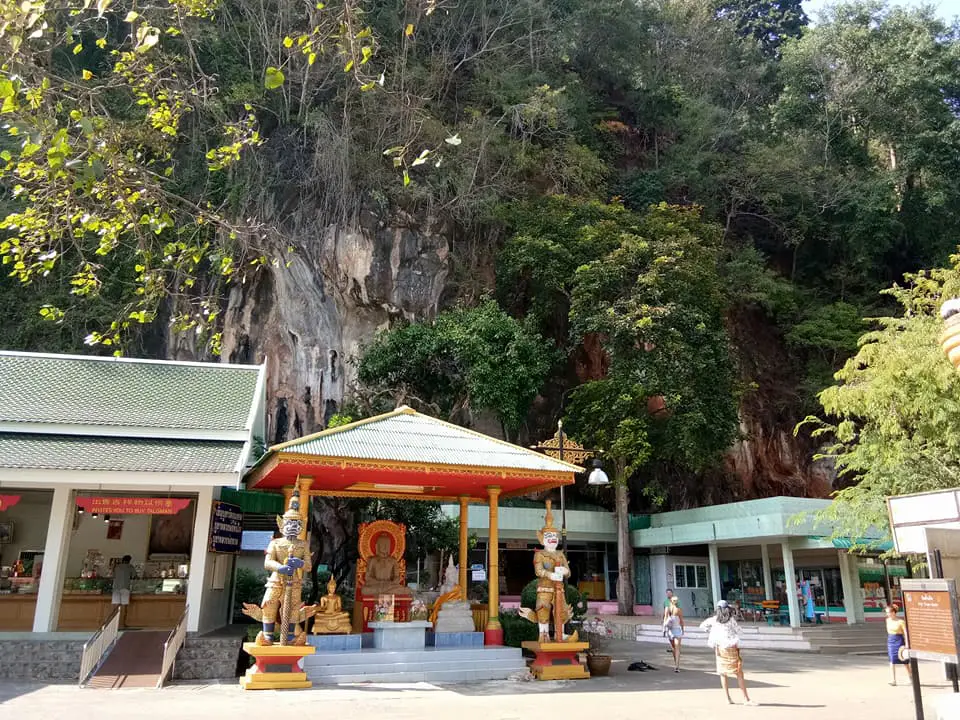
The lower temple area contains important worship spaces and religious structures, including the ordination hall, bell-shaped chedi, meeting hall, Guanyin Bodhisattva statue, and other Buddhist features. Visitors who do not plan to climb the summit can still enjoy a meaningful visit by walking around the lower grounds, paying respect, exploring the cave area, and experiencing the shaded forest atmosphere. This makes the temple accessible to families, older visitors, and travelers with limited time.
The cave that gives the temple its name deserves special attention. It connects the tiger legend, the tiger-paw-like rock formation, and the atmosphere of limestone solitude. The air inside is cooler and quieter than the open temple grounds. Visitors should walk carefully, avoid touching rock formations or archaeological material, and keep noise low, especially where people are worshipping or meditating.
The forest trails and lower valley paths are often overlooked because many visitors focus only on the 1,237-step climb. However, the lower area has its own value. Shaded paths pass through large trees, limestone walls, smaller caves, and roots growing over rock. These areas show why the temple developed as a forest meditation site and why the landscape itself is central to the identity of Wat Tham Suea.
The most famous feature of Wat Tham Suea is the staircase to the top of Khao Kaeo. The climb consists of 1,237 concrete steps. Some sections are steep, high, and physically demanding. The climb requires stamina, patience, and caution. Visitors should assess their physical condition before starting. Anyone with knee problems, heart conditions, blood-pressure concerns, or limited fitness should consider whether the climb is suitable, because the descent uses the same stairs and can be hard on the knees.
The climb should not be rushed. A safe approach is to move in stages, rest at suitable points, drink small amounts of water, and avoid climbing during the hottest part of the day. Proper footwear is important. Sneakers or shoes with good grip are much safer than slippery sandals. After rain, the stairs can become more difficult and the descent requires extra care.
The best times to climb are early morning and late afternoon. Morning offers cooler air and a quieter atmosphere, with a chance of mist in some seasons. Late afternoon offers softer light and a dramatic view over Krabi’s landscape. Visitors should allow enough time to descend before dark. Starting too late is not recommended because the stairs are steep and some sections require full attention.
At the summit of Khao Kaeo, visitors find a large Buddha image, a replica Buddha footprint, and an open viewpoint overlooking Krabi. On clear days, the view includes Krabi Town, forested plains, limestone hills, farmland, and distant parts of the Andaman coast. This viewpoint is the reward for the climb and one reason Tiger Cave Temple is widely known among both Thai and international travelers.
The view from Wat Tham Suea is valuable because it shows the structure of Krabi’s landscape. Instead of seeing only sea and islands, visitors can observe limestone hills rising from flat land, forest patches surrounding communities, roads connecting districts, and the gradual spread of the town. The summit helps visitors understand Krabi as a province of mountains, plains, forests, rivers, and coastlines.
For photography, the temple offers many different scenes. The lower area is suitable for cave, forest, religious architecture, and shrine photography. The summit is ideal for wide landscape views, the golden Buddha, the open platform, and limestone panoramas. Photography should always respect the temple setting. Visitors should not climb unsafe areas, disturb monks or worshippers, or use drones without permission.
Visitors should also be aware of monkeys around the temple and along the staircase. The monkeys are used to people and may approach food, plastic bags, drink bottles, or loose items. Food should be kept hidden, bags should be closed, and visitors should not feed, tease, touch, or approach the animals. Calm behavior is the safest way to move through areas where monkeys are present.
Dress code matters because Wat Tham Suea is an active Buddhist temple. Visitors should wear shirts with sleeves and clothing that covers the shoulders and knees. Those planning to climb should choose clothing that is both modest and practical for exercise. A light cover-up can be useful for moving between the climb and the temple’s worship areas.
Useful items include good walking shoes, drinking water, a hat, a small towel, mosquito repellent, and a secure bag. Those climbing the summit should carry only what is necessary. Carrying too many loose items makes the climb harder and increases the risk of monkeys grabbing belongings. Families with children and older travelers should decide in advance whether to remain in the lower temple area or attempt part of the stairs.
There is generally no entrance fee for Wat Tham Suea. Visitors may enter the temple, explore the grounds, visit the cave area, and climb to the summit without buying a ticket. Donation boxes are available for those who wish to support temple maintenance and religious activities. Bringing some cash is still useful for donations, local shops, or food near the entrance.
The temple is generally open daily from 06:00 to 18:00. For the summit climb, visitors should stay within daylight hours and avoid beginning the ascent close to sunset unless they are confident they can return safely before dark. Weather, heat, and rain can all affect the difficulty of the staircase, so safety should come before reaching the top.
A short visit can take 1–2 hours if visitors focus on the lower temple area, cave, and worship sites. Those climbing to the summit should allow at least 3–4 hours for the ascent, rest, photography, and safe descent. A slower and more complete visit covering the cave, forest area, religious structures, and summit can easily fill half a day.
Wat Tham Suea is easy to combine with attractions in and around Krabi Town. A practical route can include Wat Tham Suea in the morning, followed by Khao Khanab Nam, Wat Kaew Korawaram, the Mud Crab Sculpture, or the Andaman Cultural Center. This route gives travelers a balanced view of Krabi’s temple culture, archaeology, riverfront scenery, and town life.
Nature-focused travelers may combine Wat Tham Suea with Khao Phanom Bencha National Park or Huai To Waterfall, but this should be planned carefully. Climbing the Tiger Cave Temple stairs is physically demanding. Adding another strenuous nature activity on the same day may be too much for some visitors.
For spiritual travel, Wat Tham Suea is an excellent starting point in Krabi because it is relatively close to Krabi Town and Krabi International Airport. Visitors arriving in the province can make merit, experience the forest temple atmosphere, and see the inland landscape before continuing to Ao Nang, Khlong Thom, or island routes.
Wat Tham Suea differs from other well-known temples in Krabi. Wat Kaew Korawaram is known for its urban temple setting and white architecture in Krabi Town. Wat Mahathat Wachiramongkol is known for its large pagoda in Ao Luek District. Wat Tham Suea is distinctive because it combines forest, caves, archaeology, meditation, and a demanding summit viewpoint within one temple complex.
The best way to understand Wat Tham Suea is through three dimensions: religion, nature, and history. If visitors see only the 1,237-step staircase, the temple becomes just a physical challenge. But when the caves, forest valley, tiger legend, archaeological evidence, and meditation tradition are considered together, the site becomes a deeper record of how people, landscape, and belief have shaped one another over time.
Responsible visiting is essential. Visitors should not litter, write on rocks, touch fragile formations, remove natural objects, feed monkeys, or disturb meditation areas. A successful visit is not only about reaching the summit or taking photos; it is also about respecting a living temple and a landscape with cultural and archaeological value.
In summary, Tham Suea Khao Kaeo Ao Luk Thanu, or Wat Tham Suea Krabi, is a destination worth visiting at least once for anyone traveling to Krabi. It offers tiger legends, limestone caves, ancient evidence, forest paths, meditation spaces, Buddhist worship, and one of the province’s most famous viewpoints. With proper preparation, modest clothing, and enough time, the temple gives visitors a richer understanding of Krabi beyond the familiar image of beaches and islands.
Getting There is easiest by private car, rental car, motorcycle, or hired vehicle. From Krabi Town, follow Phet Kasem Road, Highway 4, toward Nuea Khlong, then turn left onto Rat Phatthana Road, Highway 4037, and continue for about 9 kilometers toward Ban Tham Suea in Krabi Noi Subdistrict. The temple is about 7–9 kilometers from Krabi Town. Travelers coming from Krabi International Airport can also reach the temple via Krabi Noi. Because the place may appear under several names, including Wat Tham Suea, Tiger Cave Temple, Tham Suea Khao Kaeo Ao Luk Thanu, or Wat Tham Sua, checking the map before departure is recommended.
| Name | Tham Suea Khao Kaeo Ao Luk Thanu / Wat Tham Suea Krabi |
| Common English Name | Wat Tham Suea / Tiger Cave Temple Krabi |
| Type | Forest Temple, Meditation Site, Natural Cave Area, Archaeological Site, And Mountain Viewpoint |
| Location | Ban Tham Suea, Krabi Noi Subdistrict, Mueang Krabi District, Krabi Province |
| Address | 35 Krabi Noi, Mueang Krabi District, Krabi 81000, Thailand |
| Coordinates | 8.1229727, 98.9277877 |
| Highlights | Tiger legend, tiger-paw-like rock formation, limestone caves, forest valley, archaeological evidence, and the 1,237-step climb to Khao Kaeo summit |
| Approximate Area | About 200 Rai |
| History | Originally a forest and natural cave area suitable for meditation, the site developed into a well-known forest temple associated with Luang Pho Chamniarn Silasettho and the meditation tradition of Krabi. |
| Abbot / Monastic Authority | Phra Thep Wachirakon |
| Open Days | Daily |
| Opening Hours | 06:00 – 18:00 |
| Entrance Fee | Free Entry; Donations Are Welcome |
| Contact Number | +66 88 792 6519 |
| Main Areas / Zones | 1. Tiger Cave And Tiger-Paw Rock Area 2. Natural Cave Group, Including Tham Khon Than, Tham Lot, Tham Chang Kaeo, Tham Luk Thanu, And Tham Phra 3. Forest Valley And Khiri Wong Landscape 4. Meditation And Forest Retreat Areas 5. Ordination Hall, Chedi, Meeting Hall, And Guanyin Bodhisattva Statue 6. Lower Forest Walking Trail 7. 1,237-Step Staircase To Khao Kaeo Summit 8. Khao Kaeo Summit With Buddha Image, Replica Buddha Footprint, And Viewpoint |
| Key Evidence | Stone Tools, Pottery Fragments, Raw Votive Tablets, And Archaeological Evidence From Prehistoric And Early Historic Periods |
| Recommended Activities | Pay Respect, Explore The Cave Area, Walk Through The Forest Valley, Learn About The Archaeological Site, Practice Quiet Reflection, Enjoy The Krabi View, And Climb The 1,237 Steps To The Summit |
| Facilities | Parking, Toilets, Worship Areas, Rest Areas, Shops, And Food Stalls Near The Temple Entrance |
| Visitor Cautions | The summit stairs are steep and physically demanding. Bring water, wear suitable shoes, assess your fitness, beware of monkeys, and avoid carrying visible food or plastic bags. |
| Travel Information | From Krabi Town, take Highway 4 toward Nuea Khlong, then turn left onto Rat Phatthana Road, Highway 4037, and continue for about 9 kilometers to Ban Tham Suea in Krabi Noi. |
| Nearby Tourist Attractions | 1. Khao Khanab Nam, About 9 Km 2. Wat Kaew Korawaram, About 9 Km, Tel. +66 75 611 252 3. Mud Crab Sculpture Krabi, About 10 Km 4. Andaman Cultural Center, About 10 Km 5. Khao Phanom Bencha National Park, About 22 Km, Tel. +66 75 660 716, +66 61 232 4901 |
| Nearby Restaurants | 1. Tiger Cafe Restaurant, About 0.1 Km, Tel. +66 84 707 1775 2. Esan Banna Tham Suea, About 0.3 Km, Tel. +66 99 357 8717 3. Hop Chafe’ Wat Tham Suea, About 0.4 Km, Tel. +66 92 610 5194 4. Kuai Tiao Tin Kai Tham Suea, About 0.5 Km, Tel. +66 62 238 4542 5. Kraprao Boran Than Khun, About 0.6 Km, Tel. +66 96 857 4195 |
| Nearby Accommodations | 1. Thip Thip Resort Wat Tham Suea, About 0.8 Km, Tel. +66 63 045 7395 2. Phuhi Hotel, About 2 Km, Tel. +66 75 701 085 3. B2 Krabi Premier Hotel, About 2 Km, Tel. +66 75 810 088 4. Wanarom Residence Hotel, About 3 Km, Tel. +66 75 810 361, +66 99 093 4598 5. K.M. House, About 4 Km, Tel. +66 95 262 4625 |
Frequently Asked Questions (FAQ)
Q: Is Tham Suea Khao Kaeo Ao Luk Thanu the same place as Wat Tham Suea Krabi?
A: Yes. Tham Suea Khao Kaeo Ao Luk Thanu refers to the cave and mountain area connected with the older place name, while Wat Tham Suea is the well-known temple name used today.
Q: How many steps are there at Tiger Cave Temple Krabi?
A: The climb to Khao Kaeo summit has 1,237 steps. The staircase is steep and physically demanding, so visitors should bring water, wear suitable shoes, and allow enough time for both ascent and descent.
Q: What are the opening hours of Wat Tham Suea Krabi?
A: The temple is generally open daily from 06:00 to 18:00. Visitors planning to climb the summit should go during daylight and descend before dark.
Q: Is there an entrance fee?
A: There is generally no entrance fee. Visitors may enter the temple and climb to the viewpoint for free, while donations are welcomed for temple maintenance and religious activities.
Q: What is Wat Tham Suea best known for?
A: It is known for the tiger legend, limestone caves, tiger-paw-like rock formation, forest valley, archaeological evidence, meditation tradition, and the 1,237-step climb to a panoramic viewpoint.
Q: Can older visitors or children visit Wat Tham Suea?
A: Yes, they can visit the lower temple area, caves, and worship sites. However, the 1,237-step summit climb may not be suitable for people with knee problems, heart conditions, or limited fitness.
Q: What should visitors be careful about?
A: Visitors should be careful on the steep stairs, avoid climbing in heavy rain or strong heat, keep food hidden because of monkeys, dress modestly, and respect monks and meditation areas.
Q: What nearby attractions can be combined with Wat Tham Suea?
A: Nearby options include Khao Khanab Nam, Wat Kaew Korawaram, the Mud Crab Sculpture, the Andaman Cultural Center, and Khao Phanom Bencha National Park, depending on available time and fitness level.
 Category: ●Nature and Wildlife
 Group: ●Caves
Last Update : 2 MonthAgo
 Last Update : 2 MonthAgo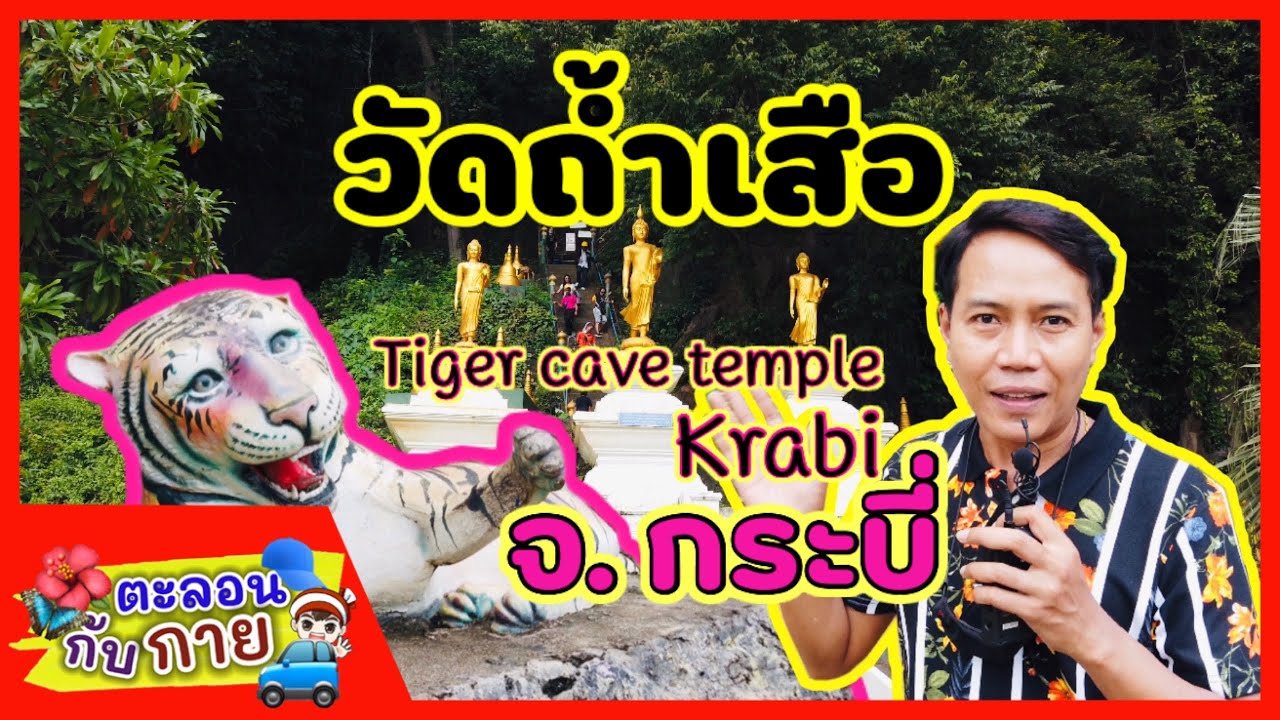
 Click to Access the Navigation Map GPS
Tham Suea Khao Kaeo Ao Luk Thanu Map
Recommend

 Art, Culture and Heritage
 Historical Sites and Monuments(1)
 Landmarks and Memorials(7)
 Art, Craft Centres, Tradition(2)
 Museums(2)
 Educational Places
 Educational Gardens, Farm(1)
 Places of Worship
 Temple(3)
 Mosque(2)
 Other Sacred Sites(2)
 Research and Development
 Royal Project(1)
 Suburban Living
 Village, Community(6)
 National Parks and Marine Reserves(5)
 Mountain (Doi)(2)
 Dam, Reservoir, Lake(3)
 Waterfalls(12)
 Hot Springs(3)
Caves(20)
Hot Springs(3)
Caves(20)
 River, Canal(2)
 Bays and Beaches(36)
 Islands(23)
 Other natural attractions(7)
 Entertainment and Agricultural
 Farms, Parks and Ecotourism(1)
 Outdoor and Adventure Activities(1)
 Travel Articles, Recipes
 Travel Review, Food Review(2)
 Southern Food Menu, Southern Food Recipes(1)


