
lovethailand home >Northeastern Travel Attractions >Yasothon Travel Attractions >Maha Chana Chai >Hua Muang > Wat Phra Phutthabat Yasothon
TL;DR: Wat Phra Phutthabat Yasothon is located at Moo 3, Ban Nong Yang, Hua Mueang Subdistrict, Maha Chana Chai District, Yasothon Province, open Daily, hours 07.00 – 18.00.
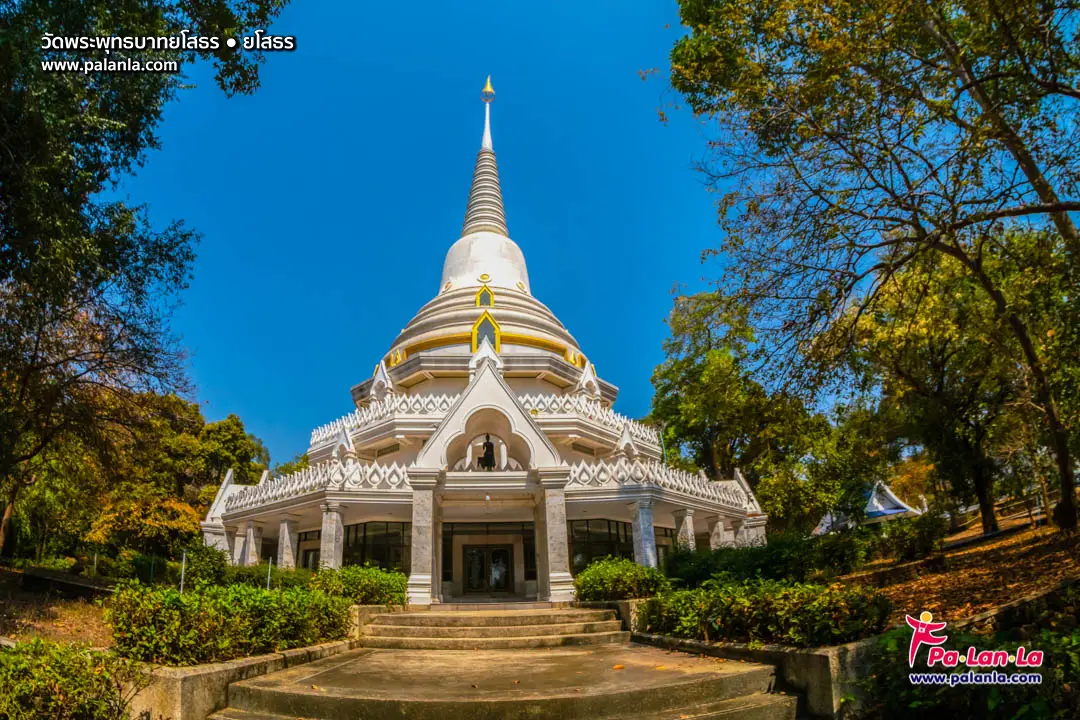
Wat Phra Phutthabat Yasothon
Open Days: Daily
Opening Hours: 07.00 – 18.00
Wat Phra Phutthabat Yasothon is located in Moo 3, Ban Nong Yang, Hua Mueang Subdistrict, Maha Chana Chai District, Yasothon Province. It is one of the most important Buddhist sites in the district, combining sacred heritage, religious architecture, meditation practice, riverside scenery, and local history in one temple complex. The temple is best known for its Buddha footprint shrine on a sandy mound by the Chi River, the large Maha Chai Chana Chedi, the white ordination hall with a blue roof, the graceful white jade Buddha image, and a calm natural setting shaded by trees. Because the temple stands near the Chi River, the area also has a peaceful waterside atmosphere and many fish, making it suitable for worship, cultural sightseeing, family visits, meditation, and quiet reflection.
Wat Phra Phutthabat Yasothon is open daily from 07.00 to 18.00 and has no admission fee. Visitors can pay respect to the Buddha footprint, worship the white jade Buddha image, walk around the ordination hall, visit Maha Chai Chana Chedi, observe important antiquities, and enjoy the shaded temple grounds near the Chi River. The temple is suitable for Thai visitors, international travelers, cultural tourists, elderly visitors, families, and those who want to experience a meaningful Buddhist site outside the main city of Yasothon.
The history of Wat Phra Phutthabat Yasothon is closely connected with the Buddha footprint, a laterite Naga-protected Buddha image, and a laterite inscription. Local historical accounts state that these sacred objects were brought from Ayutthaya by Phra Maha Uttama Panya and his disciples in 835 CE. The site later became abandoned before Phra Ratchamuni, also known as Luang Pu Home Sophano, discovered it during his forest pilgrimage and restored it as a temple. Wat Phra Phutthabat Yasothon later received its Wisungkhamsima boundary on 1 June 1978, with a boundary area measuring 40 meters wide and 80 meters long. The temple covers about 55 rai and belongs to the Dhammayuttika order.
The Buddha footprint is the spiritual heart of the temple. It is enshrined in a dedicated building on the sandy rise near the Chi River. In Buddhist culture, a Buddha footprint represents the presence, teaching, and path of the Buddha. Worshipping the footprint is therefore an act of devotion and a reminder to follow the path of dhamma. Many visitors begin their visit here before continuing to other parts of the temple, because the footprint is the sacred object from which the temple’s name and identity are derived.
Near the Buddha footprint are other important antiquities, including a laterite Naga-protected Buddha image and a laterite inscription. The Buddha image is about one sok across the lap, while the inscription is about 1 meter high and 50 centimeters wide. The inscription records the story of the sacred objects brought from Ayutthaya. Although parts of the writing have faded over time, the inscription remains an important historical link between the temple, Ayutthaya, and the Buddhist heritage of Yasothon.
The white ordination hall with a blue roof is one of the most striking architectural features of Wat Phra Phutthabat Yasothon. The building is designed in an applied Thai style, using clean white surfaces, a vivid blue roof, decorative railings, and distinctive stucco details. The contrast between the white walls and blue roof gives the ordination hall a memorable appearance. Its calm visual character also suits the temple’s atmosphere as a place of meditation and Buddhist practice.
Inside the ordination hall is the white jade Buddha image, one of the temple’s most admired sacred objects. The image measures 2.31 meters across the lap and 3.7 meters in height. Its white jade surface gives the image a calm, luminous, and peaceful presence. Many visitors regard the hall as one of the best places in the temple for quiet worship and contemplation because the atmosphere is simple, bright, and deeply serene.
Maha Chai Chana Chedi is another major landmark within the temple. It is an octagonal bell-shaped stupa built in honor of His Majesty King Bhumibol Adulyadej on the occasion of the 50th anniversary of his accession to the throne. The chedi has three levels. The first level displays traditional Isan tools, handicrafts, and household objects and also includes a library for Buddhist texts and Vinaya study. The second level displays wax figures of respected Buddhist teachers. The top level enshrines relics of the Buddha. This makes the chedi not only a religious monument, but also a place of learning, memory, and devotion.
The meaning of Maha Chai Chana Chedi is layered. The lower level connects visitors with the everyday life and wisdom of old Isan communities. The middle level honors Buddhist teachers and spiritual lineage. The top level brings visitors into contact with the highest object of devotion, the relics of the Buddha. Walking through the chedi is therefore like moving from local culture to Buddhist learning and finally to sacred reverence.
Wat Phra Phutthabat Yasothon is also known as a center for meditation and Buddhist training. One of the most important figures in the temple’s development was Phra Winai Sunthorn Methee, also known as Luang Pho Banlang Chinnantho, the former abbot of Wat Phra Phutthabat Yasothon. He was a respected meditation monk and a major developer of the temple. Under his guidance, the temple became a meditation training center and a recognized provincial dhamma practice center. His work also extended to education, public health, and social benefit projects in the local area.
The temple landscape is one of its strongest qualities. Trees cover much of the temple area, creating a cool and quiet atmosphere. The nearby Chi River adds a natural setting that is rare among larger temple complexes. Visitors can walk through shaded areas, rest after worship, and experience how forest, river, temple, and rural community fit together. The natural environment makes the temple suitable not only for sightseeing, but also for meditation and peaceful reflection.
The Chi River is an important part of the temple’s identity. Temples near rivers often have long relationships with settlement, agriculture, travel, and community life. At Wat Phra Phutthabat Yasothon, the river gives the temple a calm riverside landscape and supports the presence of many fish. This setting helps visitors understand that the temple is not separated from its environment. It belongs to a wider cultural landscape shaped by water, faith, and village life.
Every year between March and April, many people from Maha Chana Chai District and nearby areas come to worship the Buddha footprint. This annual period of devotion shows that the temple remains a living sacred site. People visit to make merit, pay respect, pray, and join local Buddhist activities. The worship of the Buddha footprint continues to connect the temple with the faith of surrounding communities.
A good visit should begin at the Buddha footprint shrine, followed by the laterite Naga-protected Buddha image and the inscription. Visitors can then continue to the white ordination hall to pay respect to the white jade Buddha image. After that, Maha Chai Chana Chedi should be visited for its architecture, exhibits, wax figures, and relic chamber. Finally, visitors can walk through the shaded grounds and riverside area. This sequence gives a complete understanding of the temple’s sacred, historical, architectural, educational, and natural dimensions.
Wat Phra Phutthabat Yasothon is suitable for several types of visitors. Buddhist visitors can worship the Buddha footprint and the white jade Buddha image. Cultural travelers can study the ordination hall, chedi, inscription, and antiquities. Visitors interested in meditation can experience the calm temple environment and the legacy of the meditation tradition. Families can enjoy a quiet temple visit in a shaded riverside setting. This range of experiences makes the temple one of the most complete cultural destinations in Maha Chana Chai District.
For international travelers, Wat Phra Phutthabat Yasothon is a clear example of how Buddhism in northeastern Thailand combines sacred objects, architecture, meditation, local history, and natural landscape. The temple shows that Thai Buddhist culture is not limited to ceremonies. It is also expressed through footprints, inscriptions, Buddha images, relic stupas, forest settings, river landscapes, and community devotion.
Getting There is easiest by private car, rental car, or local hired vehicle. From Maha Chana Chai town, take the road toward Phanom Phrai District in Roi Et Province for about 5 km, then turn onto Highway 2083 and continue for about 2.5 km to reach the temple. From Yasothon town, the distance is about 35 to 45 km, depending on the chosen route. The temple can be visited as a half-day trip or combined with other cultural attractions in Maha Chana Chai District.
Nearby attractions include Ban Song Pueai archaeological site, the Malai Khao Tok tradition area, Wat Maha That in Maha Chana Chai District, Fa Yat town area, Wat Pa Don That, and several attractions in Yasothon town. Travelers who want a broader cultural route can continue to Ban Sing Tha Old Town, Wat Maha That Yasothon, Phaya Thaen Public Park, and the Giant Toad Museum. This route connects sacred heritage, old-town history, riverside culture, and modern provincial identity.
Restaurants near the temple are mostly located in Maha Chana Chai town and Fa Yat Subdistrict. Visitors can find cafés, local restaurants, made-to-order food, Thai food, and riverside dining options before or after visiting the temple. Planning meal stops in the district town is practical, especially for families or travelers visiting during the annual worship period.
Accommodation near the temple includes local homestays in Hua Mueang and Fa Yat, resorts in Maha Chana Chai District, and hotels in Yasothon town. Visitors who want a local experience can choose homestays or small local accommodations, while those who prefer more hotel options, restaurants, and transport services may stay in Yasothon town and visit the temple as a day trip. During festivals and long holidays, contacting accommodation in advance is recommended because rooms in rural districts are more limited than in the provincial town.
Visitors should dress respectfully, speak quietly inside religious areas, remove shoes before entering sacred buildings, avoid touching the Buddha footprint, antiquities, inscription, or Buddha images inappropriately, and help keep the temple clean. Families visiting with children or elderly visitors should take care when walking around steps, halls, and open temple areas. Respectful behavior helps preserve both the sacred atmosphere and the cultural value of the temple.
The best time to visit is in the morning or late afternoon. Morning is suitable for worship, merit-making, and quiet observation. Late afternoon offers softer light for viewing the white ordination hall, the blue roof, the chedi, and the riverside atmosphere. Visitors who come between March and April can experience the annual worship atmosphere around the Buddha footprint, when local devotion is especially visible.
Wat Phra Phutthabat Yasothon is one of the most meaningful cultural and religious destinations in Maha Chana Chai District. It brings together a Buddha footprint, important antiquities, an inscription, a white jade Buddha image, a large chedi, meditation history, forest shade, and the Chi River landscape. Its value lies not only in its beauty, but also in its continuity of faith, learning, and community identity. A visit to this temple gives travelers a deeper understanding of Yasothon beyond its well-known festivals and reveals the province’s strong Buddhist heritage along the Chi River.
| Name | Wat Phra Phutthabat Yasothon |
| Location | Moo 3, Ban Nong Yang, Hua Mueang Subdistrict, Maha Chana Chai District, Yasothon Province |
| Address | Ban Nong Yang, Moo 3, Hua Mueang Subdistrict, Maha Chana Chai District, Yasothon 35130, Thailand |
| Highlights | Buddha footprint shrine, white ordination hall with blue roof, white jade Buddha image, Maha Chai Chana Chedi, antiquities, inscription, shaded forest atmosphere, and Chi River scenery |
| History / Period | Originally an abandoned temple site associated with the Buddha footprint, a laterite Naga-protected Buddha image, and an inscription believed to have been brought from Ayutthaya in 835 CE. The temple was later restored after being found by Luang Pu Home Sophano and received Wisungkhamsima on 1 June 1978 |
| Name Origin | The name comes from the Buddha footprint, the temple’s principal sacred object and the main focus of local devotion |
| Distinctive Features | Large Dhammayuttika temple on a sandy rise by the Chi River, covering about 55 rai, with sacred buildings, antiquities, meditation facilities, training areas, and a shaded natural landscape |
| Sacred Objects | Buddha footprint, laterite Naga-protected Buddha image, laterite inscription, white jade Buddha image, and Buddha relics inside Maha Chai Chana Chedi |
| White Jade Buddha Image | Main Buddha image in the ordination hall, carved from white jade, measuring 2.31 meters across the lap and 3.7 meters high |
| Maha Chai Chana Chedi | Octagonal bell-shaped chedi built in honor of His Majesty King Bhumibol Adulyadej on the 50th anniversary of his accession to the throne; the three levels contain Isan cultural exhibits and a Buddhist library, wax figures of respected teachers, and Buddha relics |
| Traditions / Rituals | Every year between March and April, many people from nearby districts and subdistricts come to worship the Buddha footprint |
| Travel Information | From Maha Chana Chai town, take the Maha Chana Chai – Phanom Phrai road for about 5 km, then turn onto Highway 2083 and continue for about 2.5 km. From Yasothon town, the distance is about 35 – 45 km |
| Current Status | Open to visitors and used as a temple for worship, meditation, Buddhist training, seminars, and religious activities in Hua Mueang Subdistrict |
| Open Days | Daily |
| Opening Hours | 07.00 – 18.00 |
| Admission Fee | No Admission Fee |
| Facilities | Parking, worship areas, Buddha footprint shrine, ordination hall, Maha Chai Chana Chedi, meditation area, training and seminar facilities, temple walking area, and Chi River scenery |
| Main Areas / Zones | 1. Buddha Footprint Shrine 2. Laterite Naga-Protected Buddha Image And Inscription 3. White Ordination Hall With Blue Roof 4. White Jade Buddha Image 5. Maha Chai Chana Chedi 6. Isan Cultural Exhibit And Buddhist Library Area 7. Meditation, Training And Seminar Area 8. Forest And Chi River Area |
| Caretaker | Sangha Community Of Wat Phra Phutthabat Yasothon |
| Former Abbot Who Developed The Temple | Phra Winai Sunthorn Methee, also known as Luang Pho Banlang Chinnantho, former abbot of Wat Phra Phutthabat Yasothon and a key developer of the temple as a meditation training center and recognized provincial dhamma practice center |
| Local Contact Number | Hua Mueang Subdistrict Administrative Organization, Tel. 045-970359 |
| Nearby Tourist Attractions | 1. Malai Khao Tok Tradition Area, about 6 – 7 km 2. Ban Song Pueai Archaeological Site, about 10 km 3. Wat Maha That, Maha Chana Chai District, about 8 – 10 km 4. Fa Yat Area, Maha Chana Chai District, about 8 – 10 km 5. Wat Pa Don That, Song Yang Subdistrict, about 18 – 22 km 6. Ban Sing Tha Old Town, about 40 – 45 km 7. Wat Maha That Yasothon And Phra That Anon, about 40 – 45 km 8. Phaya Thaen Public Park And Giant Toad Museum, about 40 – 45 km |
| Nearby Restaurants | 1. Nang Len Maha Chana Chai, about 8 – 10 km, Tel. 098-642-1674 2. Sri Charoen Cafe Maha Chana Chai, about 8 – 10 km, Tel. 083-662-4663 3. Fang Daeng Cafe, Fa Yat Subdistrict, about 8 – 10 km 4. Aun Pochana, Fa Yat, about 8 – 10 km, Tel. 081-660-8915 5. Rai Yat Fa, Fa Yat Subdistrict, about 9 – 12 km 6. Newton Shop, Ban Phra Sao, about 15 – 20 km, Tel. 098-584-4679 7. Phonsawan Moo Kratha, Ban Phra Sao, about 15 – 20 km, Tel. 092-731-6935 |
| Nearby Accommodations | 1. Hua Mueang Homestay Group, Maha Chana Chai District, about 5 – 8 km, Tel. 061-0798993 2. Huean Nuat Homestay Ban Fa Yat, about 8 – 10 km, Tel. 092-3873219 3. Tongsuphatchot Resort Maha Chana Chai, about 8 – 10 km, Tel. 085-779-8857 4. Sanshine Place, about 18 km 5. The Greenpark Grand Hotel Yasothon, about 40 – 45 km, Tel. 045-714-700-1 6. B.M. Grand Hotel Yasothon, about 40 – 45 km, Tel. 045-712-333 7. JP Emerald Hotel Yasothon, about 40 – 45 km, Tel. 045-714-456 |
Frequently Asked Questions (FAQ)
Q: Where is Wat Phra Phutthabat Yasothon located?
A: Wat Phra Phutthabat Yasothon is located in Moo 3, Ban Nong Yang, Hua Mueang Subdistrict, Maha Chana Chai District, Yasothon Province.
Q: What are the opening hours of Wat Phra Phutthabat Yasothon?
A: The temple is open daily from 07.00 to 18.00.
Q: Is there an admission fee for Wat Phra Phutthabat Yasothon?
A: No. There is no admission fee. Visitors can enter during opening hours for worship, merit-making, and cultural sightseeing.
Q: What are the main highlights of Wat Phra Phutthabat Yasothon?
A: The main highlights are the Buddha footprint, the white jade Buddha image, the white ordination hall with blue roof, Maha Chai Chana Chedi, important antiquities, inscription, and the shaded riverside atmosphere by the Chi River.
Q: How large is the white jade Buddha image?
A: The white jade Buddha image in the ordination hall measures 2.31 meters across the lap and 3.7 meters high.
Q: What is inside Maha Chai Chana Chedi?
A: The chedi has three levels: the first level displays old Isan objects and a Buddhist library, the second level displays wax figures of respected teachers, and the top level enshrines Buddha relics.
Q: When do people usually come to worship the Buddha footprint?
A: Many people from nearby districts and subdistricts come to worship the Buddha footprint every year between March and April.
Q: How can travelers get there from Maha Chana Chai town?
A: From Maha Chana Chai town, take the Maha Chana Chai – Phanom Phrai road for about 5 km, then turn onto Highway 2083 and continue for about 2.5 km to reach the temple.
 Category: ●Places of Worship
 Group: ●Temple
Last Update : 3 MonthAgo
 Last Update : 3 MonthAgo

 Click to Access the Navigation Map GPS
Wat Phra Phutthabat Yasothon Map

 Art, Culture and Heritage
 Historical Sites and Monuments(6)
 Landmarks and Memorials(1)
 Art, Craft Centres, Tradition(4)
 Museums(1)
 Historic Homes and Cities(1)
Temple(22)
 Church(1)
 Other Sacred Sites(10)
 Research and Development
 Royal Project(2)
 Suburban Living
 Village, Community(3)
 Local Market(1)
 Nature and Wildlife
 National Parks and Marine Reserves(2)
 Mountain (Doi)(2)
 Dam, Reservoir, Lake(7)
 River, Canal(2)
 Bays and Beaches(1)
 Other natural attractions(2)
 Entertainment and Agricultural
 Farms, Parks and Ecotourism(1)
 Travel Articles, Recipes
 Travel Review, Food Review(2)


