
lovethailand home >Northeastern Travel Attractions >Yasothon Travel Attractions >Muang Yasothon >Na Samai > Ban Na Samai Village
TL;DR: Ban Na Samai Village is located at Na Samai Subdistrict, Mueang Yasothon District, Yasothon Province, open Daily, hours 08.30 – 16.30.
Ban Na Samai Village
Open Days: Daily
Opening Hours: 08.30 – 16.30
Ban Na Samai Village in Yasothon is an important handicraft community in Mueang Yasothon District, Yasothon Province. Located in Na Samai Subdistrict near Ban Thung Nang Ok, the village is known for bamboo weaving, sticky rice baskets, wood carving, miniature cart carving, and local craftsmanship that reflects the practical wisdom of rural Isan. This is not only a place to buy souvenirs, but also a living community where visitors can learn how natural materials, agricultural life, and local skills come together in everyday culture.
Ban Na Samai is recognized as an old rural community with an agricultural background. It has the character of a semi-rural, semi-urban settlement where family life, farming, craft production, and local trade remain closely connected. The village plays an important cultural tourism role because it preserves the skills of cart making and bamboo weaving. These are not decorative traditions separated from real life. They are skills that grew from the needs of households, farms, food culture, and community memory.
The most visible craft in Ban Na Samai is bamboo weaving. Bamboo is one of the most useful natural materials in rural Thailand. It can be used for houses, farming tools, household containers, kitchen items, and handicrafts. Local artisans split bamboo into strips, smooth them carefully, and weave them into products such as sticky rice baskets, trays, baskets, containers, household tools, and souvenirs. The beauty of these products comes from both function and form. They are designed to be useful, durable, lightweight, and visually pleasing.
The sticky rice basket is one of the most meaningful products of the village. Sticky rice is central to Isan food culture, and the basket used to hold it is an essential household object. A good sticky rice basket must keep rice warm, allow enough ventilation, prevent excess moisture, and remain strong enough for daily use. Making one requires knowledge of bamboo selection, strip preparation, weaving density, rim finishing, and overall proportion. A sticky rice basket from a craft village is therefore more than a container. It is a piece of Isan food culture made by hand.
Ban Na Samai is also known for wood carving. Local carving groups produce a variety of carved items, and the craft has roots in the skills of artisans who carved wooden windows and temple doors. This background gives the village a strong connection with both household craft and religious woodwork. Wood carving requires patience, accuracy, and an understanding of patterns, depth, rhythm, and surface. Each stroke of the chisel must be controlled carefully. If the cut is too deep, the wood can split; if it is too shallow, the pattern loses dimension.
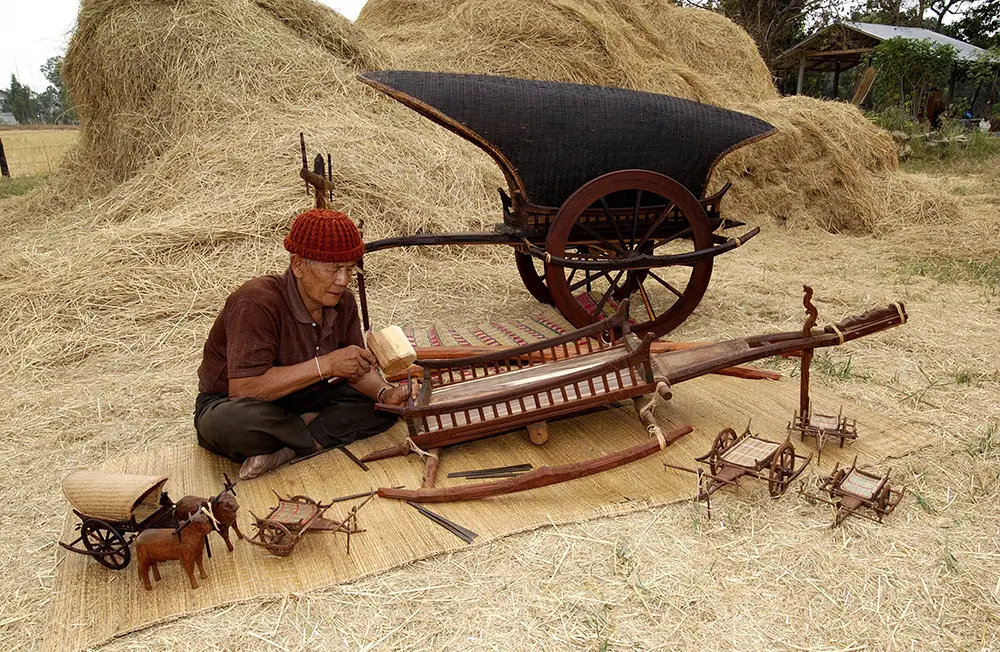
The miniature cart is one of the most distinctive souvenirs associated with Ban Na Samai. In the past, carts were essential vehicles in rural Isan. They were used to carry rice, crops, firewood, farming tools, and household goods before modern vehicles became common. A miniature cart preserves this memory in the form of a crafted object. Artisans must understand the structure of real carts, including wheels, axles, cart bodies, beams, and decorative details. The result is both a souvenir and a cultural record of agricultural life.
The beauty of Ban Na Samai’s miniature carts lies in their proportion and detail. The wheels must look balanced, the wooden frame must be properly assembled, and the carved or shaped parts must express the feeling of a traditional Isan cart. A well-made miniature cart does not simply imitate an object. It tells a story about farming, transportation, rural movement, and the way people once lived with animals, fields, and seasonal work. For visitors, it is a small object with deep cultural meaning.
Craft knowledge in Ban Na Samai is passed through families and community practice. Bamboo weaving and wood carving are not skills that can be fully learned from books. They require observation, repeated practice, correction, and direct experience. Many people in craft communities grow up seeing older family members split bamboo, weave baskets, carve wood, and assemble products. Over time, these images and movements become part of community memory. This is why Ban Na Samai is valuable as a living learning site, not just a sales point for handmade goods.
A visit to Ban Na Samai should be approached with respect. This is a real community where people live and work. Visitors should walk calmly, avoid entering private areas without permission, and ask before taking close photographs of artisans or workspaces. The most meaningful experience comes from observing the craft process, talking politely with local people, and understanding the time and skill behind each product. Handmade work deserves careful handling and fair appreciation.
The bamboo weaving process begins with selecting suitable bamboo. The bamboo should not be too young or too brittle. It is cut, split, and shaped into strips of different widths. Larger strips may be used for strong structural parts, while finer strips are used for detailed patterns or flexible forms. After weaving, artisans finish the rim, trim loose ends, and check the balance of the product. Every stage requires hand control and experience. Even a simple basket carries many decisions made by the artisan.
The wood carving process begins with selecting wood that has the right texture and strength. The artisan then prepares a design, marks the pattern, and uses chisels to create depth and form. Fine carving depends on steady hands and good judgment. The artisan must know where to remove wood, where to leave volume, and how to make the final form look balanced. This skill is especially important when making decorative objects or miniature carts, where small details create the overall character of the piece.
Ban Na Samai is also important because it represents a rural agricultural community that has adapted local knowledge into income-generating products. The village economy is not based only on tourism. It remains connected with agriculture, local production, and community trade. Craft products add value to local knowledge and create supplementary income for households. This helps the community maintain its identity while responding to the changing economy around Yasothon city.
The relationship between materials, nature, and culture is clear in Ban Na Samai. Bamboo is not just raw material. It is a plant that local people understand, process, and transform into useful objects. Wood is not just timber. It becomes a surface for memory, pattern, and skill. These crafts show how local communities create value from familiar materials. They also demonstrate that rural wisdom can become both practical household products and cultural souvenirs.
For visitors who enjoy local souvenirs, Ban Na Samai is a strong destination. Bamboo baskets and sticky rice containers are suitable for those who appreciate natural household items. Carved wood and miniature carts are suitable for those who want decorative objects with cultural meaning. Buying directly from local artisans or community groups helps income return to the people who make the products. It also supports the continuation of traditional skills.
Ban Na Samai can be visited together with Ban Thung Nang Ok, another well-known bamboo craft village near Yasothon city. The two communities are connected by their bamboo weaving identity. Ban Thung Nang Ok is especially known for bamboo household items and sticky rice baskets, while Ban Na Samai adds wood carving and miniature cart craftsmanship to the route. Visiting both communities gives travelers a fuller picture of Yasothon’s craft network.
After visiting Ban Na Samai, travelers can continue into Yasothon city to explore Ban Sing Tha Old Quarter, Singha Tha Museum, Wat Mahathat Yasothon, Phaya Thaen Public Park, the Toad Museum, and Phra That Kong Khao Noi. This makes Ban Na Samai a practical part of a half-day or full-day cultural route. The route can combine craft villages, old-town architecture, local history, Buddhist heritage, and modern city landmarks in one trip.
Getting There is most convenient by private car. From Yasothon city, travel toward Na Samai Subdistrict in Mueang Yasothon District. The village is near Ban Thung Nang Ok and can be included in the same craft route. A private vehicle allows visitors to stop at workshops, buy local products, and continue to nearby attractions easily. Groups planning a study visit should contact Na Samai Subdistrict Municipality or local craft groups in advance.
The recommended visiting hours are from 08.30 to 16.30. This is the most suitable time to see community craft activities and contact local groups. The general community area can be visited daily, but organized demonstrations or study visits should be arranged beforehand. Morning visits are comfortable for walking and observing craft work, while afternoon visits can be combined with Yasothon city attractions.
There is no admission fee for general community visits. Visitors can walk around appropriate community areas and buy local products during visiting hours. Special demonstrations, workshops, or group study activities may depend on arrangements with the community. Since this is a living village, visitors should respect local rules, avoid disturbing private homes, and handle handmade products carefully.
For photography, Ban Na Samai offers many meaningful subjects: bamboo strips, artisan hands, weaving patterns, carved wood, miniature carts, household craft tools, and rural community scenes. Visitors should ask permission before photographing people or close-up work processes. The best photographs are those that show respect for the makers and the craft, rather than interrupting the work for staged images.
For families, Ban Na Samai works well as an outdoor cultural classroom. Children can learn how bamboo becomes a useful household object, why sticky rice baskets are important in Isan food culture, and how miniature carts preserve memories of agricultural life. Seeing real artisans at work helps children understand culture more clearly than reading about it from a book.
For students and study groups, the village offers lessons in local wisdom, community economy, occupational groups, product development, cultural tourism, intergenerational skill transfer, and rural identity. Bamboo weaving and wood carving demonstrate how traditional knowledge can be developed into both income and cultural value. Ban Na Samai is therefore suitable for study visits related to community development, design, handicrafts, and cultural heritage.
For international travelers, Ban Na Samai is a clear example of a living Isan craft village. Bamboo weaving helps explain sticky rice culture and the use of natural materials in northeastern Thai households. Miniature cart carving helps explain the agricultural past, when carts and animal power were central to rural life. The village gives foreign visitors a grounded understanding of Yasothon through hands, tools, materials, and everyday objects.
The importance of Ban Na Samai lies in the continuity of its craft traditions. In the past, bamboo containers were essential household objects. Today, plastic and factory-made goods are widely available, but Ban Na Samai continues to keep bamboo weaving alive by developing it into community products and souvenirs. This adaptation allows traditional skills to remain relevant and helps younger generations see value in local knowledge.
The same is true for wood carving and miniature cart making. Real carts are no longer used in daily life as widely as before, but miniature carts preserve the memory of that way of life. Wood carving turns ordinary timber into cultural objects through skill and time. These crafts protect stories that might otherwise disappear as rural life changes. In this sense, Ban Na Samai is a place where objects carry memory.
Overall, Ban Na Samai adds depth to Yasothon’s travel identity. The province is often known for festivals, temples, and city landmarks, but this village shows another layer: the hands of local artisans, agricultural roots, bamboo wisdom, wood carving, and community-based production. Travelers who spend time here will see a quieter but highly meaningful side of Yasothon.
Ban Na Samai is ideal for travelers interested in bamboo crafts, local souvenirs, wood carving, miniature carts, rural community life, and cultural travel in Yasothon. The value of the village does not come from large buildings or spectacular scenery. It comes from the precision of handmade work and the continuity of local wisdom. Visiting Ban Na Samai is a way to understand Isan culture through bamboo, wood, sticky rice baskets, and miniature carts that speak for the community.
In summary, Ban Na Samai Village in Yasothon is a valuable community tourism destination that combines bamboo weaving, sticky rice baskets, wood carving, miniature carts, agricultural identity, and old rural community character. Visitors can learn from local craftsmanship, support community products, and connect the trip with Ban Thung Nang Ok, Ban Sing Tha Old Quarter, Wat Mahathat Yasothon, Phaya Thaen Public Park, the Toad Museum, and other attractions in Yasothon city. It is a meaningful stop for anyone who wants to understand Yasothon through real community life and inherited craftsmanship.
| Name | Ban Na Samai Village |
| Type | Handicraft Village, Old Rural Community, Bamboo Weaving Learning Area, Wood Carving Community, And Miniature Cart Craft Site |
| Location | Na Samai Subdistrict, Mueang Yasothon District, Yasothon Province |
| Address | Na Samai Subdistrict, Mueang Yasothon District, Yasothon 35000, Thailand |
| Coordinates | 15.8805552513, 104.243802871 |
| Highlights | Bamboo weaving, sticky rice baskets, household bamboo products, wood carving, miniature cart carving, and rural agricultural community atmosphere |
| Community Importance | An old rural agricultural community with a tourism role in cart making and bamboo weaving. The village preserves craft groups and passes down bamboo weaving and cart-making skills within the community. |
| Main Products | Sticky Rice Baskets Bamboo Woven Products Baskets, Trays, And Household Containers Wood Carvings Miniature Carts Community Handicraft Souvenirs |
| Main Occupational Groups | Na Samai Bamboo Weaving Group Na Samai Wood Carving Group Local Cart-Making Craft Group Ban Na Samai Brass Product Group |
| Suitable Activities | Observing bamboo weaving, learning about sticky rice basket making, seeing wood carving, viewing miniature carts, buying community products, photographing local craft, and studying rural community life |
| Travel Information | From Yasothon city, travel to Na Samai Subdistrict in Mueang Yasothon District. A private car is the most convenient option for visiting the craft village, buying community products, and continuing to nearby attractions. |
| Current Status | Open as a handicraft community, bamboo weaving and wood carving learning area, and cultural tourism destination in Mueang Yasothon District |
| Open Days | Daily |
| Opening Hours / Recommended Visiting Hours | 08.30 – 16.30 |
| Fees | No admission fee for general community areas |
| Facilities | Road access to the community, community product areas, local craft groups, Na Samai Subdistrict Municipality contact point, restaurants in Na Samai and Yasothon city, and hotels in Yasothon city |
| Main Areas / Zones | Ban Na Samai Community Zone Bamboo Weaving Group Zone Sticky Rice Basket And Bamboo Household Product Zone Wood Carving Group Zone Miniature Cart Zone Community Product And Souvenir Zone Rural Community And Agricultural Lifestyle Zone Na Samai Subdistrict Municipality Coordination Zone |
| Caretaker / Related Agencies | Na Samai Subdistrict Municipality, Na Samai Bamboo Weaving Group, Na Samai Wood Carving Group, and Na Samai local community |
| Local Contact Number | Na Samai Subdistrict Municipality, Tel. 045-756959 |
| Nearby Tourist Attractions | 1. Ban Thung Nang Ok, about 9 km 2. Ban Sing Tha Old Quarter, about 17 km 3. Singha Tha Museum, about 17 km 4. Wat Mahathat Yasothon, about 17 km 5. Phaya Thaen Public Park, about 18 km 6. Toad Museum, about 18 km 7. Phra That Kong Khao Noi, about 23 km |
| Nearby Restaurants | 1. Ban Khun Ya Yasothon, about 17 km, Tel. 045-721141 2. Samrit Restaurant Yasothon, about 17 km, Tel. 086-2492508 3. Rasniyom Boat Noodles Yasothon, about 17 km, Tel. 098-7997269 4. Rai Hug Kuk Yasothon, about 18 km, Tel. 099-2896554, 061-9501942 5. Jib Fae Ban Nuea, about 17 km, Tel. 085-0241324 6. Oi 3 Korean BBQ, about 19 km, Tel. 090-8239100, 085-6310918, 088-1291200 |
| Nearby Accommodations | 1. The Green Park Grand Hotel Yasothon, about 17 km, Tel. 045-714700-1 2. JP Emerald Hotel Yasothon, about 17 km, Tel. 045-714456 3. The Zen Hotel Yasothon, about 17 km, Tel. 045-711455 4. BM Grand Hotel Yasothon, about 17 km, Tel. 045-712333 5. RP City Hotel, about 17 km, Tel. 045-711648 6. Botanic Garden Hotel, about 19 km, Tel. 045-712064 |
Frequently Asked Questions (FAQ)
Q: Where is Ban Na Samai Village located?
A: Ban Na Samai is located in Na Samai Subdistrict, Mueang Yasothon District, Yasothon Province, near Ban Thung Nang Ok and not far from Yasothon city.
Q: What is Ban Na Samai known for?
A: Ban Na Samai is known for bamboo weaving, sticky rice baskets, wood carving, and finely crafted miniature carts.
Q: What are the recommended visiting hours?
A: The recommended visiting hours are 08.30 to 16.30, suitable for seeing local craft activities and contacting community groups.
Q: Is there an admission fee?
A: There is no admission fee for general community areas. Visitors can walk around appropriate areas and buy local products during visiting hours.
Q: What souvenirs should visitors buy from Ban Na Samai?
A: Recommended souvenirs include sticky rice baskets, bamboo woven products, household bamboo items, wood carvings, miniature carts, and other community handicrafts.
Q: Who is Ban Na Samai suitable for?
A: It is suitable for travelers interested in bamboo crafts, wood carving, rural community life, handmade souvenirs, photography, and cultural tourism in Yasothon.
Q: How can travelers get to Ban Na Samai?
A: Travelers can drive from Yasothon city to Na Samai Subdistrict. A private car is the most convenient option because it allows visitors to combine Ban Na Samai with Ban Thung Nang Ok and Yasothon city attractions on the same day.
Q: What nearby attractions can be visited on the same trip?
A: Nearby attractions include Ban Thung Nang Ok, Ban Sing Tha Old Quarter, Singha Tha Museum, Wat Mahathat Yasothon, Phaya Thaen Public Park, the Toad Museum, and Phra That Kong Khao Noi.
 Category: ●Suburban Living
 Group: ●Village, Community
Last Update : 1 MonthAgo
 Last Update : 1 MonthAgo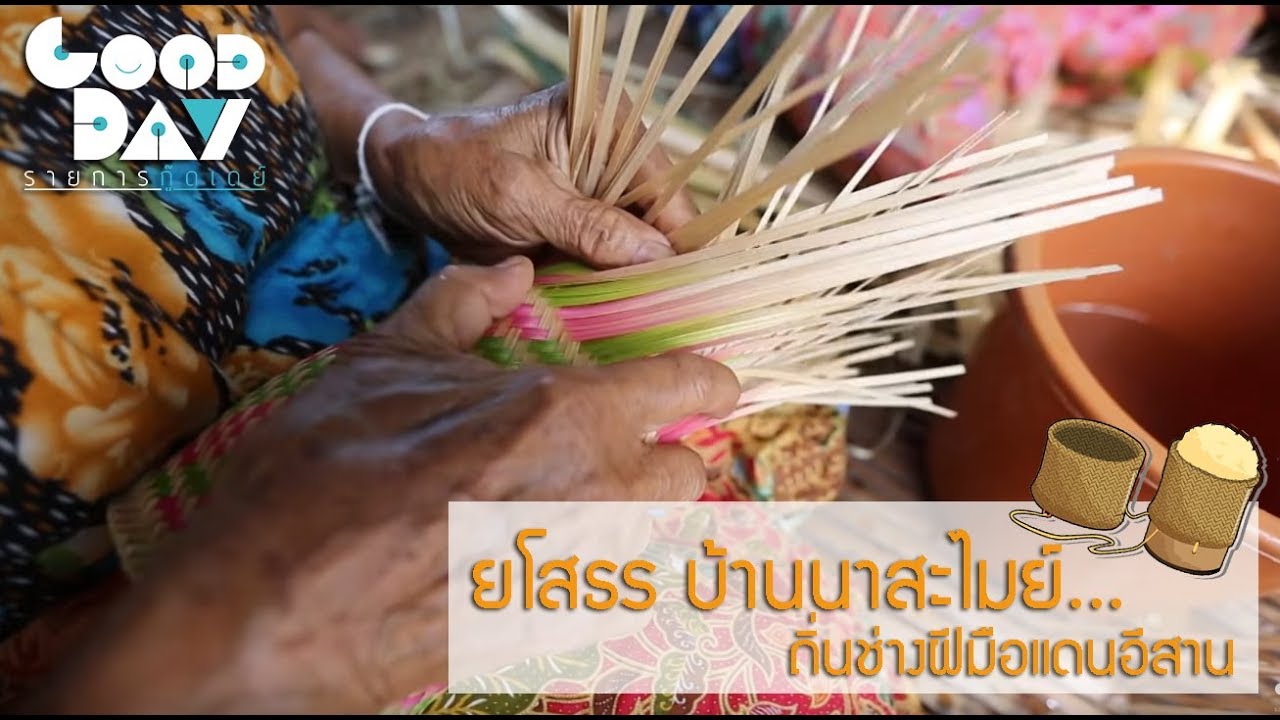
 Click to Access the Navigation Map GPS
Ban Na Samai Village Map

 Art, Culture and Heritage
 Historical Sites and Monuments(6)
 Landmarks and Memorials(1)
 Art, Craft Centres, Tradition(4)
 Museums(1)
 Historic Homes and Cities(1)
 Places of Worship
 Temple(22)
 Church(1)
 Other Sacred Sites(9)
 Research and Development
 Royal Project(2)
Village, Community(3)
Royal Project(2)
Village, Community(3)
 Local Market(1)
 Nature and Wildlife
 National Parks and Marine Reserves(2)
 Mountain (Doi)(2)
 Dam, Reservoir, Lake(7)
 River, Canal(2)
 Bays and Beaches(1)
 Other natural attractions(2)
 Entertainment and Agricultural
 Farms, Parks and Ecotourism(1)


