
lovethailand home >Northeastern Travel Attractions >Yasothon Travel Attractions >Muang Yasothon >Tat Thong > Phra That Kong Khao Noi
TL;DR: Phra That Kong Khao Noi is located at Thammaphinan Road, Tat Thong Subdistrict, Mueang Yasothon District, Yasothon Province, open Daily, hours 08.00 – 17.00.
Phra That Kong Khao Noi
Open Days: Daily
Opening Hours: 08.00 – 17.00
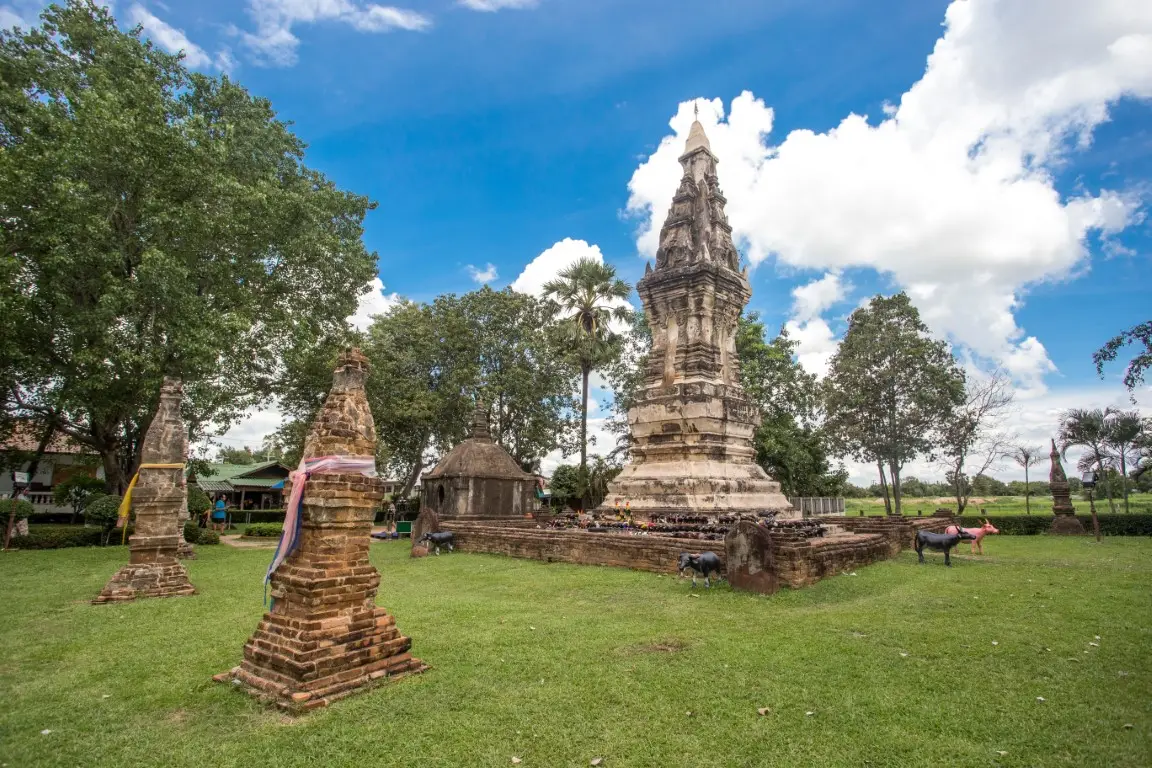
Phra That Kong Khao Noi in Yasothon Province, also known in archaeological records as Phra That Tad Thong, Phra That Thad Thong, and That Luk Kha Mae, is one of the most meaningful ancient monuments in Mueang Yasothon District. It is located on Thammaphinan Road in Tat Thong Subdistrict, only about 9 km from Yasothon city. The monument is an old brick-and-mortar stupa with an unusual form that resembles a traditional Isan rice container, or kong khao. This distinctive shape has made the site widely remembered through the local legend of Kong Khao Noi Kha Mae, a moral tale about gratitude, anger, remorse, and the bond between a mother and her child. For both Thai visitors and foreign travelers, Phra That Kong Khao Noi offers history, Buddhist faith, folk storytelling, archaeology, architecture, and rural Isan identity in one place.
The monument stands in the area of Ban Tat Thong, a community with deep historical and archaeological importance. The surrounding landscape is not only the setting of the stupa, but also part of an ancient settlement zone. Archaeological evidence in the Tat Thong area includes traces of old habitation, burial sites, pottery, and painted ceramics associated with early communities in northeastern Thailand. This makes a visit to Phra That Kong Khao Noi more than a simple temple stop. It is a chance to understand how a sacred monument, an old village, rice fields, local memory, and archaeological heritage are connected in the cultural landscape of Yasothon.
The stupa is built of brick and mortar on a square plan. Its architectural form includes a base, a central body, and a tapering upper section. The lower base rises in stacked layers, supporting the main body of the monument. The middle section has false niches on all four sides, decorated with stucco details and local artistic motifs. The upper section gradually narrows toward the top in a balanced and elegant form. Unlike the bell-shaped stupas seen in many parts of Thailand, Phra That Kong Khao Noi has the character of a square mandapa-like stupa with a lotus-bud-style upper form. Its appearance reflects local Isan craftsmanship, Lan Xang artistic influence, and the cultural taste of communities in the northeastern region.
One of the most important artistic features of the stupa is its detailed composition. Although the monument is not extremely large, its proportions are strong and visually memorable. The central body has recessed niches on all four sides, with arched forms and stucco decorations. The pillars of the niches contain solar-like motifs known locally as saeng ta wen, while floral stucco patterns add elegance to the old brick surface. These details are not merely decorative. They express local devotion, artistic skill, and the desire to create a sacred structure that carries both visual beauty and religious meaning.
A low boundary wall surrounds the stupa, marking the sacred area around the monument. Within the archaeological site are later small stupas, red sandstone boundary stones, and other elements that show the continued religious use of the space. These features reveal that the site was not important in only one historical moment. It continued to be used, repaired, worshipped, and remembered by local people over several periods. The monument therefore represents both ancient heritage and living local devotion.
In front of the stupa stands a small brick structure known locally as an up mung, built in a local Isan style. Inside is a stucco Buddha image in the posture of subduing Mara, made by local craftsmen. This small building helps complete the sacred atmosphere of the site because it gives visitors a direct place for worship. The Buddha image is respected by local people, and in April the community holds a tradition of bathing the Buddha image and applying gold leaf. This custom is connected with local beliefs about seasonal blessing, rainfall, and agricultural fertility.
The legend of Kong Khao Noi Kha Mae is the story that makes the site famous throughout Thailand. The story tells of a young farmer who worked in the rice fields from morning until midday. His mother brought him food later than usual. Tired and extremely hungry, he became angry when he saw the small rice container she carried. Believing that the food would not be enough, he lost control of his temper and killed his mother. After eating, he realized that the rice was still not finished because his mother had packed it tightly out of love for him. Overcome with remorse, he built the stupa to dedicate merit to his mother, ask for forgiveness, and atone for the grave sin of killing his own mother.
The emotional power of this legend lies not in violence, but in its moral lesson. It warns people about the danger of anger, impatience, and misunderstanding. A single moment of uncontrolled emotion can create a loss that cannot be repaired. The story also teaches gratitude toward parents and elders. Because the legend is connected with an actual monument whose shape resembles a rice container, the lesson becomes concrete and memorable. Visitors do not only hear a folktale; they stand before a place that has carried that tale in local memory for generations.
Phra That Kong Khao Noi is also linked with another tradition involving Phra That Phanom. According to this account, people from the Rattanaburi area once gathered valuables and sacred objects to be placed inside Phra That Phanom during its restoration. When they reached the Tat Thong area, they learned that the restoration of Phra That Phanom had already been completed. They therefore decided to build a stupa at Tat Thong and enshrine the objects there instead. Local people used a golden tray associated with sacred offerings, giving rise to the names Phra That Thad Thong and Phra That Tad Thong. This tradition gives the monument an additional layer of meaning beyond the more famous mother-and-son legend.
The existence of several names for the same place is important. Phra That Tad Thong and Phra That Thad Thong emphasize the relationship with Ban Tat Thong and the tradition of sacred objects prepared for Phra That Phanom. Phra That Kong Khao Noi and That Luk Kha Mae emphasize the local moral tale of a son who killed his mother and built a stupa in remorse. These names show that a historic site can hold more than one memory. Archaeology, local legend, Buddhist devotion, and village identity all exist together at this monument.
Archaeological information places the monument around the 24th Buddhist century, while tourism sources often describe it as belonging to the 23rd to 25th Buddhist centuries and associate it with the late Ayutthaya period. Its artistic features show strong links with Lan Xang-style religious architecture found across northeastern Thailand. These historical layers make the site valuable for cultural travelers because it demonstrates how monuments in Isan are often understood through both academic evidence and living folk traditions. The stupa is therefore an excellent place to learn about the relationship between history, art, and oral storytelling.
Phra That Kong Khao Noi has been officially registered as an ancient monument by the Fine Arts Department, and its protected area has been legally defined. This status is important because it protects the stupa, boundary wall, small shrines, boundary stones, and surrounding archaeological environment from inappropriate change or damage. Visitors should therefore understand that this is not only a place of worship, but also a protected cultural heritage site. Respectful behavior helps preserve the site for future generations.
The monument has undergone several restorations. An important local restoration took place in the 1920s, when community leaders, monks, and villagers cleared vegetation from the damaged stupa and repaired it using traditional materials. Later, after storm damage in 1963, the Fine Arts Department sent specialists to repair the upper part of the stupa. Another restoration was carried out in 2002. These restorations show that both the community and state agencies have recognized the importance of the monument and have worked to keep it standing.
The wider Ban Tat Thong area adds further significance to the site. Evidence of prehistoric and early historic occupation has been found in this area, including human skeletons and painted pottery. This means the stupa stands in a landscape that had human activity long before the monument itself was built. For visitors, this creates a deeper understanding of Tat Thong as an old settlement area, not simply a place with one isolated stupa. The site is part of a long chain of human life, belief, and community development in Yasothon.
Visitors interested in architecture should take time to walk slowly around all four sides of the stupa. Important details include the base, the recessed niches, stucco floral motifs, solar designs, the tapering lotus-bud upper form, the low boundary wall, sandstone boundary stones, the small up mung shrine, and the later small stupas around the area. Viewing the stupa from close range reveals the texture of brick and stucco, while viewing it from farther away shows how the monument sits within the surrounding rural landscape.
For worshippers, the visit should begin with respectful homage to the Buddha image and the stupa. The site is associated with merit-making, remorse, forgiveness, and gratitude. Visitors may pay respect, make offerings, and reflect on the moral lesson of the legend. Offerings should be placed only in appropriate areas so that the ancient structure is not damaged. Climbing, touching fragile stucco, writing on surfaces, or placing heavy objects on the monument should be avoided.
The moral meaning of Phra That Kong Khao Noi is especially strong. The legend reminds people to be grateful to parents and to control anger before it becomes destructive. For Thai visitors, the story is often familiar from childhood. For foreign travelers, it offers a clear example of how Thai and Isan communities use storytelling to teach ethical values. The monument transforms an oral tale into a physical place of memory, making the lesson more powerful than words alone.
The April tradition of bathing the Buddha image and applying gold leaf shows that the site remains connected with local religious life. This custom is related to seasonal blessing and the hope for sufficient rain. In rural Isan culture, Buddhist worship, agriculture, rainfall, and community well-being are closely connected. At Phra That Kong Khao Noi, visitors can see how a monument, a Buddha image, local belief, and rice-farming culture support one another in the life of the community.
Getting There is easiest by private car or rental car. From Yasothon city, take Chaeng Sanit Road or Highway 23 toward Tat Thong Subdistrict and Ubon Ratchathani. After about 9 km, look for Thammaphinan Road on the left and the gateway sign for That Kong Khao Noi. Turn in and continue for about 750 meters to the visitor parking area. The route is short and convenient from Yasothon city, making the site suitable for a half-day visit or for inclusion in a full-day cultural route.
Travelers coming from Bangkok can take the main northeastern route toward Nakhon Ratchasima, Buriram, Maha Sarakham, Roi Et, and Yasothon, then continue from Yasothon city to Tat Thong Subdistrict. Travelers coming from Ubon Ratchathani or Roi Et can also use Highway 23 to reach the area. Daytime travel is recommended because the local gateway, side road, and signage are easier to see.
The site has practical visitor facilities, including a large parking area, toilets, local shops, worship areas, and walking space around the monument. It is suitable for families, elderly visitors, students, cultural travelers, and foreign visitors. The walking area is generally manageable, but visitors should take care during rainy weather because some surfaces may become slippery. Comfortable footwear, sun protection, and drinking water are useful, especially during hot periods.
The best time to visit is in the morning or late afternoon. Morning is good for worship and quiet exploration, while late afternoon gives softer light for photography. The old brick surface, the saffron cloth often wrapped around the stupa, the surrounding trees, and the rural landscape create a calm visual atmosphere. Photography should remain respectful. Visitors should not climb the boundary wall or use sacred areas as casual photo props.
Temple and archaeological-site etiquette should both be followed. Visitors should dress modestly, speak quietly, avoid climbing on the structure, avoid touching old stucco or brickwork, avoid placing objects on the boundary wall, and keep the area clean. These practices help protect both the sacred atmosphere and the physical integrity of the monument.
For foreign travelers, Phra That Kong Khao Noi is a strong introduction to Isan culture. It brings together Buddhism, local legend, moral teaching, brick-and-mortar architecture, rural landscape, and archaeological history. Unlike grand state monuments, this site feels intimate and human. Its story is about a family, a mistake, remorse, and the search for forgiveness. This makes it easy for visitors from any culture to understand its emotional meaning.
For Thai travelers, the site offers a chance to revisit one of the best-known moral folktales of northeastern Thailand in the place where the story is remembered. Seeing the actual stupa gives the tale greater force. It becomes more than a story for children; it becomes a living cultural memory preserved through architecture, worship, and local identity.
Phra That Kong Khao Noi can be combined with several attractions in Yasothon city. Nearby places include the ancient settlement area of Ban Tat Thong, Phaya Kan Khak Museum, Phaya Thaen Public Park, Wat Mahathat, Phra That Anon, Ban Singha Tha old town, and Wat Si Thammaram. This route allows visitors to experience archaeology, Buddhist architecture, Yasothon legends, the Rocket Festival tradition, old urban communities, and local religious life in one day.
Restaurants near the site include local food shops in Tat Thong Subdistrict, cafes, Isan restaurants, and restaurants in Yasothon city. Travelers can eat near Tat Thong before returning to the city or continue into the town center for more options. Those traveling as a family or group should plan meals in advance because some local shops may have varying hours. A private car makes it easier to connect the monument with restaurants and accommodation.
Accommodation options are available both near Tat Thong and in Yasothon city. Visitors who want to stay close to the attraction can choose places in or near Tat Thong, while those who prefer more restaurants, shops, and city services can stay in Mueang Yasothon. Staying in the city makes it easy to visit Phra That Kong Khao Noi in the morning and continue to Phaya Kan Khak Museum, Wat Mahathat, and Ban Singha Tha later in the day.
What makes Phra That Kong Khao Noi important is not only its rice-container-like shape. Its value comes from many layers: the ancient community of Ban Tat Thong, archaeological evidence, the Phra That Phanom-related tradition, the legend of a son who killed his mother, Lan Xang and Isan architecture, the small local shrine, the April worship tradition, official heritage protection, and community-led restoration. These layers make the site one of the richest cultural landmarks in Yasothon Province.
A meaningful visit should take at least 45 minutes to 1.5 hours. Visitors can pay respect, walk around the monument, read information signs, observe architectural details, and photograph the site respectfully. Students and foreign travelers may need more time to understand the legend, the archaeological background, the restoration history, and the relationship between the monument and the Tat Thong community. With enough time, the site becomes an open-air classroom of Isan history and culture.
In summary, Phra That Kong Khao Noi is an important ancient monument in Tat Thong Subdistrict, Mueang Yasothon District. It is open daily from 08.00 to 17.00 and has no entrance fee. The site is known for its unusual brick-and-mortar stupa shaped like a rice container, the powerful legend of Kong Khao Noi Kha Mae, its archaeological and artistic value, the small up mung shrine, sandstone boundary stones, local worship traditions, and the ancient settlement landscape of Ban Tat Thong. It is one of the best places in Yasothon for visitors who want to understand faith, morality, history, architecture, and the cultural memory of rural northeastern Thailand.
| Name | Phra That Kong Khao Noi / That Kong Khao Noi / Phra That Tad Thong / Phra That Thad Thong / That Luk Kha Mae |
| Location | Thammaphinan Road, Tat Thong Subdistrict, Mueang Yasothon District, Yasothon Province |
| Coordinates | 15.763606, 104.207092 |
| Highlights | Brick-and-mortar stupa shaped like a rice container, Kong Khao Noi Kha Mae legend, local Buddha shrine, red sandstone boundary stones, low boundary wall, small later stupas, and the ancient Ban Tat Thong community landscape |
| History / Importance | An important ancient monument in Yasothon Province, associated with the Kong Khao Noi Kha Mae legend, Phra That Phanom-related tradition, and the ancient community of Ban Tat Thong. It has been officially protected as an archaeological site by the Fine Arts Department |
| Period | Generally placed between the 23rd and 25th Buddhist centuries, with archaeological information emphasizing around the 24th Buddhist century and links to late Ayutthaya to Thonburi-period cultural contexts |
| Name Origin | The name Kong Khao Noi comes from the stupa’s rice-container-like form and the local legend of a son who killed his mother in anger. The names Phra That Tad Thong and Phra That Thad Thong connect the site with Ban Tat Thong and the tradition of sacred valuables intended for Phra That Phanom |
| Architectural Features | Square brick-and-mortar stupa with a mandapa-like form, four recessed niches, floral stucco patterns, solar motifs, lotus-bud-style upper section, low boundary wall, small local shrine, and red sandstone boundary stones |
| Travel Information | From Yasothon city, take Chaeng Sanit Road or Highway 23 toward Tat Thong Subdistrict for about 9 km. Turn left into Thammaphinan Road at the Kong Khao Noi gateway and continue for about 750 meters to the visitor parking area |
| Current Status | Open as an ancient monument, religious site, and cultural-historical attraction in Tat Thong Subdistrict, Mueang Yasothon District |
| Open Days | Daily |
| Opening Hours | 08.00 – 17.00 |
| Entrance Fee | Free admission |
| Facilities | Large parking area, toilets, local shops, worship area, archaeological-site viewing area, and walking space around the stupa |
| Main Areas / Zones | Main stupa, low boundary wall, local Buddha shrine, red sandstone boundary stones, small later stupas, worship courtyard, parking area, local shops, and the surrounding Ban Tat Thong ancient community area |
| Site Caretakers | Fine Arts Department and Tat Thong Subdistrict Municipality |
| Visitor Information Contact | 045-711-510 |
| Main Tradition | Buddha image bathing and gold-leaf offering tradition in April |
| Nearby Tourist Attractions | 1. Ban Tat Thong Ancient Community And Moat Area, about 1 km, Tel. 045-711-510 2. Phaya Kan Khak Museum, about 13 km, Tel. 045-714-212 3. Phaya Thaen Public Park, about 13 km 4. Wat Mahathat And Phra That Anon, Mueang Yasothon, about 13 km 5. Ban Singha Tha Old Town, about 14 km 6. Wat Si Thammaram Royal Temple, about 14 km |
| Nearby Restaurants | 1. Tat Thong Ahan Tam Sang Je Paula, about 3 km, Tel. 097-339-7272 2. Ueng Po Restaurant, Tat Thong, about 3 km, Tel. 084-588-4171 3. Cafe Amazon PTT Tat Thong, about 4 km, Tel. 093-337-3624 4. Som Tam Yok Khrok, Ban Eua Athon Tat Thong, about 5 km, Tel. 065-984-6342, 065-715-3473 5. Khao Wan By Chef Ouan, Tat Thong, about 5 km, Tel. 062-885-7227, 082-308-1927 6. Rider One Motorcycle Cafe Shop, about 8 km, Tel. 045-971-201 |
| Nearby Accommodations | 1. Chatphiman Resort Yasothon, Tat Thong, about 7 km, Tel. 045-713-989 2. JP Emerald Hotel Yasothon, about 12 km, Tel. 045-714-456 3. The Green Park Grand Hotel Yasothon, about 14 km, Tel. 045-714-700-4 4. BM Grand Hotel Yasothon, about 13 km, Tel. 045-712-333 5. The Zen Hotel Yasothon, about 14 km, Tel. 045-711-455 6. The Colour Hotel Yasothon, about 14 km, Tel. 045-971-794 |
Frequently Asked Questions (FAQ)
Q: Where is Phra That Kong Khao Noi located?
A: Phra That Kong Khao Noi is located on Thammaphinan Road, Tat Thong Subdistrict, Mueang Yasothon District, Yasothon Province, about 9 km from Yasothon city.
Q: What are the opening days and hours of Phra That Kong Khao Noi?
A: The site is open daily from 08.00 to 17.00.
Q: Is there an entrance fee?
A: There is no entrance fee. Visitors can enter respectfully during opening hours.
Q: What is the main highlight of Phra That Kong Khao Noi?
A: The main highlight is the unusual brick-and-mortar stupa shaped like a traditional rice container, along with the Kong Khao Noi Kha Mae legend, the local Buddha shrine, red sandstone boundary stones, the low boundary wall, and the ancient Ban Tat Thong community landscape.
Q: What is the meaning of the Kong Khao Noi Kha Mae legend?
A: The legend teaches gratitude toward parents and warns against uncontrolled anger. It tells of a young farmer who killed his mother in anger, later realized his mistake, and built the stupa to ask forgiveness and dedicate merit to her.
Q: Is Phra That Kong Khao Noi a registered ancient monument?
A: Yes. Phra That Kong Khao Noi, also known as Phra That Tad Thong, has been protected as an ancient monument by the Fine Arts Department.
Q: How can travelers get to Phra That Kong Khao Noi?
A: From Yasothon city, take Chaeng Sanit Road or Highway 23 toward Tat Thong Subdistrict for about 9 km. Turn left into Thammaphinan Road at the Kong Khao Noi gateway and continue for about 750 meters to the visitor parking area.
Q: What nearby attractions can be visited with Phra That Kong Khao Noi?
A: Nearby places include Ban Tat Thong Ancient Community, Phaya Kan Khak Museum, Phaya Thaen Public Park, Wat Mahathat, Ban Singha Tha Old Town, and Wat Si Thammaram Royal Temple.
 Category: ●Places of Worship
 Group: ●Other Sacred Sites
Last Update : 1 MonthAgo
 Last Update : 1 MonthAgo
 Click to Access the Navigation Map GPS
Phra That Kong Khao Noi Map

 Art, Culture and Heritage
 Historical Sites and Monuments(6)
 Landmarks and Memorials(1)
 Art, Craft Centres, Tradition(4)
 Museums(1)
 Historic Homes and Cities(1)
 Temple(22)
 Church(1)
Other Sacred Sites(9)
Church(1)
Other Sacred Sites(9)
 Research and Development
 Royal Project(2)
 Suburban Living
 Village, Community(3)
 Local Market(1)
 Nature and Wildlife
 National Parks and Marine Reserves(2)
 Mountain (Doi)(2)
 Dam, Reservoir, Lake(7)
 River, Canal(2)
 Bays and Beaches(1)
 Other natural attractions(2)
 Entertainment and Agricultural
 Farms, Parks and Ecotourism(1)


