
lovethailand home >Northeastern Travel Attractions >Yasothon Travel Attractions >Kham Khuan Kaeo >Ku Chan > Ku Chan
TL;DR: Ku Chan is located at Ban Ngio, Ku Chan Subdistrict, Kham Khuean Kaeo District, Yasothon Province, open Daily, hours 06.00 – 18.00.
Ku Chan
Open Days: Daily
Opening Hours: 06.00 – 18.00
Ku Chan, also known as Phra That Ku Chan, is one of the most meaningful sacred and historical sites in Yasothon Province. Located in Ban Ngio, Ku Chan Subdistrict, Kham Khuean Kaeo District, this old lotus-shaped stupa stands within Wat Ku Chan and has long served as a spiritual landmark for the local community. Its overall form resembles Phra That Phanom in Nakhon Phanom Province, although Ku Chan is smaller, quieter, and deeply rooted in the everyday faith of a rural Isan village.
For travelers, Ku Chan is a compact but rewarding cultural destination. It is suitable for visitors who want to explore old temples in Yasothon, learn about northeastern Thai Buddhist heritage, and experience a sacred place that remains closely connected to local life. The site is not a large commercial attraction. Its value lies in its stupa, archaeological traces, boundary stones, old inscriptions, sacred community forest, and annual worship tradition that still brings people together every year.
Ku Chan is situated about 12 km from Kham Khuean Kaeo District center. The usual route follows Highway 23, the Yasothon-Ubon Ratchathani road, before turning into the local road toward Ku Chan Subdistrict for about 7 km. Traveling by private car is the most convenient option, especially for those who wish to combine the visit with nearby attractions, local restaurants, and small accommodations around Kham Khuean Kaeo.
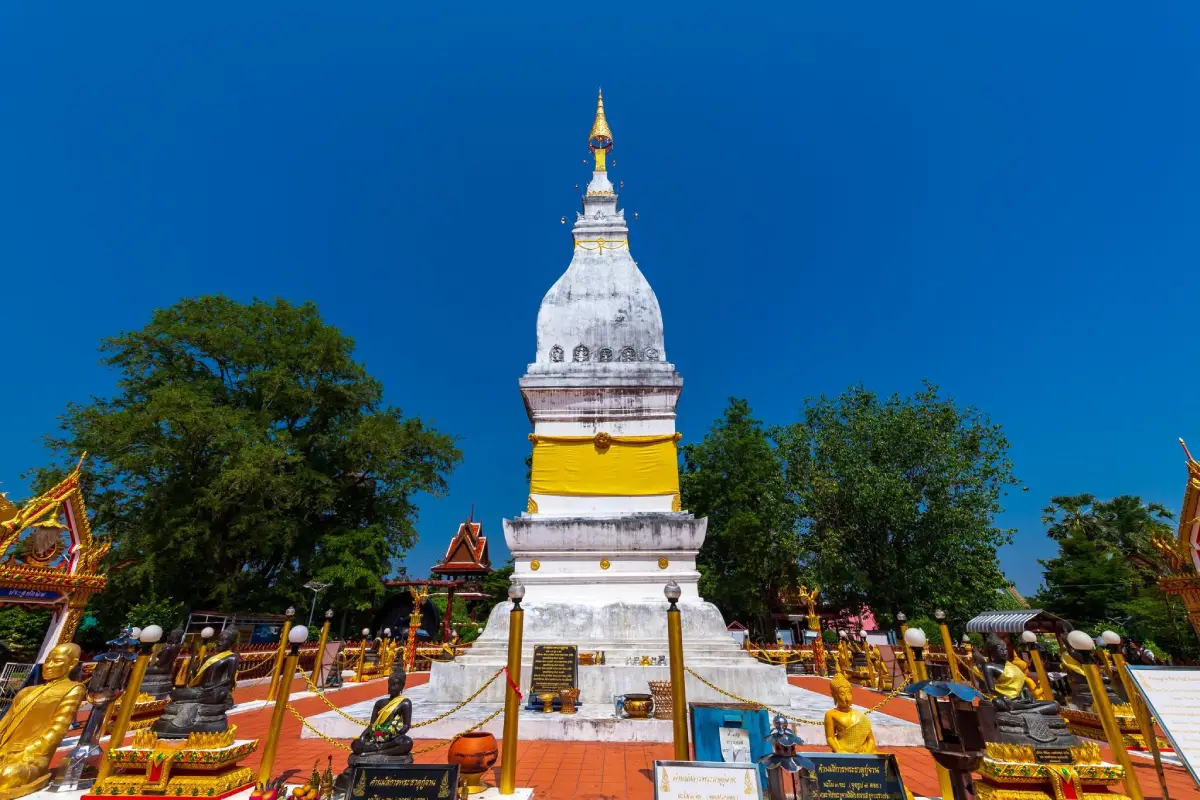
The main stupa, Phra That Ku Chan, is approximately 5.10 meters wide and 15 meters high. It has a square lotus-shaped structure, with a low lotus base supporting a plain square platform, followed by a lotus-form body decorated with traditional motifs. The upper part rises into a square spire supporting a ceremonial finial. Although modest in scale, the stupa has a calm and dignified appearance. Its white surface, vertical outline, and quiet temple setting create a strong impression for visitors who appreciate understated religious architecture.
Local tradition connects Ku Chan with the period associated with the construction of Phra That Phanom. This belief gives the site a broader cultural meaning, linking it to the sacred geography of the Mekong region and northeastern Thailand. For local people, the stupa is not simply an old structure. It is a place of memory, faith, and continuity, where stories about the past are preserved through worship, seasonal ceremonies, and community participation.
Ku Chan is also important as an archaeological and cultural site. The area around Wat Ku Chan and Don Pu Ta, also known as Ku Ban Ngio, contains several historical elements: the main stupa, inscribed boundary stones, other sandstone and laterite sema stones, old stone remains that resemble the base of a viharn or ancient stupa, Nong Sa Phang pond, and an octagonal laterite pillar near the village. These features show that Ban Ku Chan has been a significant ritual and settlement area for a long time.
One of the most important pieces of evidence from the area is the Ban Ku Chan inscription, found on a sema stone and associated with Mahayana Buddhism around the 12th Buddhist century. This inscription gives Ku Chan additional historical depth. It shows that the area was linked to older Buddhist traditions before becoming the community temple site seen today. For travelers interested in archaeology, epigraphy, and the spread of Buddhism in Isan, Ku Chan offers a valuable field context beyond the stupa itself.
Don Pu Ta, or Ku Ban Ngio, should be understood together with Phra That Ku Chan. In Isan culture, a Don Pu Ta area is a sacred community space connected with guardian spirits and village protection. Around this area, visitors may find old stones, laterite blocks, sandstone pieces, and sema stones in a natural setting. Because of its religious and cultural meaning, the area should be visited respectfully. Visitors should not move stones, touch archaeological remains, or treat the site as an ordinary photo spot.
Phra That Ku Chan remains an active place of worship for people in Yasothon and nearby provinces. The annual Phra That Ku Chan worship festival is one of the most important local events. It includes Buddhist ceremonies, candlelight procession, merit-making, ordination-style devotional activities, and community cultural performances. During the festival period, Wat Ku Chan becomes lively and crowded, showing how the stupa continues to function as a living center of faith rather than a silent monument.
The water-pouring ceremony for Phra That Ku Chan is especially meaningful. Local villagers bring scented water and water from Nong Sa Phang to perform ritual bathing of the stupa and sema stones. This tradition is closely connected with agricultural life and the belief in seasonal rain, fertility, and communal well-being. The ceremony reveals the relationship between Buddhism, nature, rainfall, farming, and village identity in northeastern Thailand.
Upon arrival at Wat Ku Chan, visitors will find the white stupa standing prominently in the temple courtyard. The atmosphere is calm and local, with temple buildings, worship areas, and open space around the stupa. A typical visit may include paying respect, walking around the stupa, observing its architectural details, and spending time quietly in the temple grounds. The site is best appreciated slowly, without rushing.
The charm of Ku Chan is its authenticity. It has not been transformed into a large-scale tourist complex. Instead, it remains a local sacred site where community life, Buddhist practice, and historical memory exist together. Travelers who enjoy lesser-known cultural destinations will find Ku Chan especially rewarding. It offers a view of Isan heritage that is intimate, grounded, and closely tied to local devotion.
Architecturally, Phra That Ku Chan is a good example of a lotus-shaped stupa in northeastern Thailand. Its lotus base supports the structure visually and symbolically, while the square body gives the stupa a stable, grounded appearance. The vertical movement toward the finial creates a sense of sacred ascent. Although the stupa is not large, its proportions make it visually balanced and spiritually dignified.
When compared with Phra That Phanom, Ku Chan is smaller and less monumental, but it has its own distinctive value. Its resemblance to Phra That Phanom reflects shared religious ideas and architectural influence in the region, while its village setting gives it a different emotional quality. Ku Chan is a stupa of the community. Its importance is measured not only by size, but by the depth of local belief and the continuity of annual worship.
For those interested in Buddhist boundary stones, the Ku Chan area is particularly significant. Sema stones mark sacred space and are important features in the study of Buddhist archaeology in Isan. The presence of an inscribed sema stone adds scholarly value to the site, while the surrounding stones and remains help visitors understand how sacred landscapes were shaped in the past.
Visitors should treat both the temple area and the archaeological remains with care. Modest clothing is appropriate. Shoes should be removed where required. Photography is acceptable when done respectfully, but visitors should avoid disturbing monks, ceremonies, or local worshippers. Ancient stones, sema stones, and other remains should not be touched, climbed on, or moved. These objects are part of the religious and historical heritage of the community.
The best time to visit Ku Chan is in the morning or late afternoon, when the light is softer and the weather is more comfortable. Morning visits are especially suitable for photography and quiet worship. Travelers who want to experience the local festival atmosphere should plan their visit during the annual Phra That Ku Chan worship festival. During that period, the temple becomes more active, and visitors can see how local faith is expressed through rituals and community gatherings.
There is no admission fee to visit Ku Chan. This makes it suitable for budget travelers, families, elderly visitors, cultural travelers, and foreign visitors who want to explore beyond the main tourist routes. A short visit can take less than an hour, but those interested in history and community traditions may want to spend more time exploring the temple grounds and nearby heritage areas.
For a wider travel route, Ku Chan can be combined with other attractions in Kham Khuean Kaeo and Yasothon. Nearby points of interest include Ku Chan Museum, Don Pu Ta or Ku Ban Ngio, Ban Song Pueai archaeological site, Dong Mueang Toei archaeological site, Wat Phra Phutthabat Yasothon, Phra That Kong Khao Noi, and Phaya Thaen Public Park. This route works well for travelers who want to understand Yasothon through sacred sites, archaeological remains, and local traditions.
Thai travelers will find Ku Chan meaningful because it preserves the connection between temple, village, ritual, and local memory. Foreign travelers will find it valuable as an example of a living rural temple in northeastern Thailand, where Buddhist worship and archaeological heritage coexist in a modest but powerful setting. It is a place for respectful observation, cultural learning, and quiet appreciation.
Ku Chan also supports community-based travel. Visitors can stop at local restaurants, cafes, and small hotels around Kham Khuean Kaeo, helping distribute tourism benefits outside the main provincial center. This makes the trip more meaningful, especially for travelers who want their visit to support local communities while exploring lesser-known cultural heritage.
In summary, Ku Chan is one of Yasothon’s most worthwhile sacred heritage sites for travelers who appreciate history, faith, and local culture. Its lotus-shaped stupa, connection to Phra That Phanom traditions, Mahayana-related inscription, sema stones, Don Pu Ta area, and annual worship festival make it much more than a small rural temple. It is a living cultural landscape where the past remains visible and the community’s faith continues to shape the present.
| Name | Ku Chan / Phra That Ku Chan |
| Location | Ban Ngio, Ku Chan Subdistrict, Kham Khuean Kaeo District, Yasothon Province |
| Address | Moo 5, Ban Ngio, Ku Chan Subdistrict, Kham Khuean Kaeo District, Yasothon 35110, Thailand |
| Coordinates | 15.682314, 104.385019 |
| Highlights | An old lotus-shaped stupa resembling Phra That Phanom, serving as an important sacred landmark of Ku Chan community |
| History | Local tradition links Ku Chan to the period associated with the construction of Phra That Phanom. The area also contains an inscription related to Mahayana Buddhism around the 12th Buddhist century. |
| Name Origin | The name is connected with Ban Ku Chan and its ancient sacred remains. In Isan usage, “ku” often refers to an old sacred structure or archaeological monument. |
| Distinctive Features | The stupa is about 5.10 meters wide and 15 meters high, with a lotus base, square body, traditional decorative motifs, and a finial at the top. |
| Travel Information | From Yasothon city, follow Highway 23 toward Kham Khuean Kaeo District, then turn into the local road toward Ku Chan Subdistrict for about 7 km. The site is about 12 km from Kham Khuean Kaeo District center. |
| Current Status | Open for worship and visits during temple hours, with an annual Phra That Ku Chan worship festival still held by the local community |
| Open Days | Daily |
| Opening Hours | 06.00 – 18.00 |
| Fees | No admission fee |
| Facilities | Temple courtyard, worship area, parking area within the temple grounds, and temple restroom |
| Main Areas / Zones | Phra That Ku Chan stupa in the temple courtyard Inscribed sema stone behind the ordination hall Sema stone group in Don Pu Ta sacred grove Ancient stone remains resembling the base of a viharn or old stupa Nong Sa Phang pond related to the water-pouring ceremony Octagonal laterite pillar near the village |
| Abbot / Caretaker | Phra Khru Sut Chediyapirak |
| Cultural Information Contact | Yasothon Provincial Cultural Office, Tel. 045-715137 |
| Official Website / Official Page | Yasothon Provincial Website and Visit Yasothon Website |
| Nearby Tourist Attractions | 1. Ku Chan Museum, about 0.1 km 2. Don Pu Ta / Ku Ban Ngio, about 0.5 km 3. Ban Song Pueai Archaeological Site, about 17 km 4. Dong Mueang Toei Archaeological Site, about 21 km 5. Wat Phra Phutthabat Yasothon, about 33 km 6. Phra That Kong Khao Noi, about 35 km 7. Phaya Thaen Public Park, about 38 km |
| Nearby Restaurants | 1. Kai Yang Pa Win Restaurant, about 8 km, Tel. 062-8958375, 099-9269504 2. Kalam Organic Sugar Cane Ice Cream Cafe, about 13 km, Tel. 090-2575081 3. Krua Kan Eng Kham Khuean Kaeo, about 13 km, Tel. 094-8570422 4. KAO NA COFFEE Yasothon, about 14 km, Tel. 083-8054169 5. Grilled Chicken Opposite PTT Kham Khuean Kaeo / Kai Yang Luem Mai Long, about 14 km, Tel. 088-6358355 6. Kuay Tiao Ruea Khun Pluem, about 14 km, Tel. 088-0805550 |
| Nearby Accommodations | 1. Ruen Lamool Hotel Kham Khuean Kaeo, about 14 km, Tel. 063-0236989 2. Chamchuri Resort Kham Khuean Kaeo, about 14 km, Tel. 080-2085723 3. Namthip Resort, about 14 km, Tel. 093-5317435 4. Sukhon Nakhon Hotel, about 14 km, Tel. 081-7254262 5. Huai Chan Resort, about 15 km |
Frequently Asked Questions (FAQ)
Q: Where is Ku Chan located?
A: Ku Chan is located in Ban Ngio, Ku Chan Subdistrict, Kham Khuean Kaeo District, Yasothon Province, within the grounds of Wat Ku Chan.
Q: Why is Ku Chan important?
A: Ku Chan is an old sacred stupa and an important community landmark. The area also contains archaeological evidence such as sema stones, an inscription, and the Don Pu Ta sacred grove.
Q: What are the opening days and hours of Ku Chan?
A: Ku Chan is open daily from 06.00 to 18.00.
Q: Is there an admission fee at Ku Chan?
A: No. Visitors can enter, worship, and explore the site without an admission fee.
Q: How can travelers get to Ku Chan?
A: The most convenient route is by private car from Yasothon city along Highway 23 toward Kham Khuean Kaeo District, then turning into the local road toward Ku Chan Subdistrict for about 7 km.
Q: What happens during the annual Phra That Ku Chan worship festival?
A: The festival includes Buddhist worship, candlelight procession, merit-making, community activities, and ritual bathing of the stupa and sema stones.
Q: What nearby places can be visited together with Ku Chan?
A: Nearby places include Ku Chan Museum, Don Pu Ta, Ban Song Pueai Archaeological Site, Dong Mueang Toei Archaeological Site, Wat Phra Phutthabat Yasothon, Phra That Kong Khao Noi, and Phaya Thaen Public Park.
Q: How should visitors behave at Ku Chan?
A: Visitors should dress modestly, keep a respectful manner, avoid disturbing ceremonies, and should not touch, climb on, or move sema stones, ancient stones, or archaeological remains.
 Category: ●Places of Worship
 Group: ●Other Sacred Sites
Last Update : 3 MonthAgo
 Last Update : 3 MonthAgo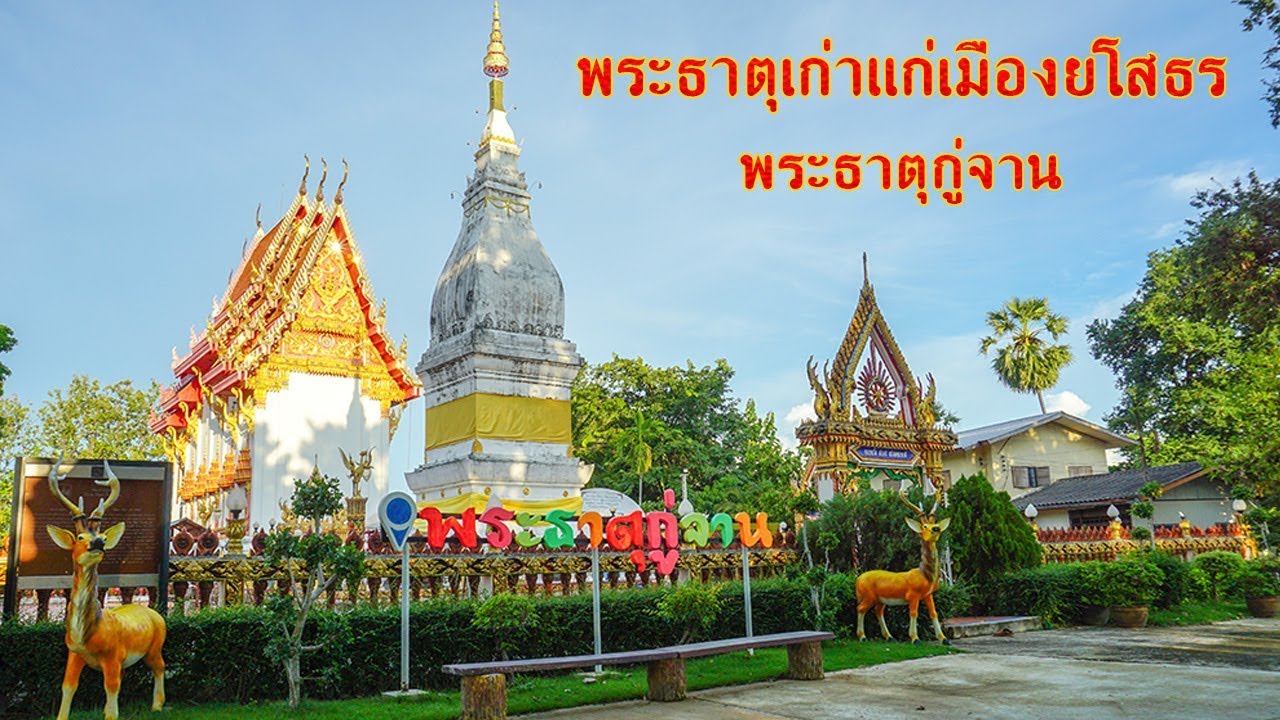
 Click to Access the Navigation Map GPS
 Art, Culture and Heritage
 Historical Sites and Monuments(6)
 Landmarks and Memorials(1)
 Art, Craft Centres, Tradition(4)
 Museums(1)
 Historic Homes and Cities(1)
 Temple(22)
 Church(1)
Other Sacred Sites(10)
Church(1)
Other Sacred Sites(10)
 Research and Development
 Royal Project(2)
 Suburban Living
 Village, Community(3)
 Local Market(1)
 Nature and Wildlife
 National Parks and Marine Reserves(2)
 Mountain (Doi)(2)
 Dam, Reservoir, Lake(7)
 River, Canal(2)
 Bays and Beaches(1)
 Other natural attractions(2)
 Entertainment and Agricultural
 Farms, Parks and Ecotourism(1)
 Travel Articles, Recipes
 Travel Review, Food Review(2)


