
lovethailand home >Northeastern Travel Attractions >Ubon Ratchathani Travel Attractions >Khong Chiam >Napho Klang > Saeng Chan Waterfall (Namtok Long Ru)
TL;DR: Saeng Chan Waterfall (Namtok Long Ru) is located at Ban Thung Na Mueang, Na Pho Klang Subdistrict, Khong Chiam District, Ubon Ratchathani Province, inside Pha Taem National Park, open Daily, hours 08.00 – 17.00.

Saeng Chan Waterfall (Namtok Long Ru)
Open Days: Daily
Opening Hours: 08.00 – 17.00
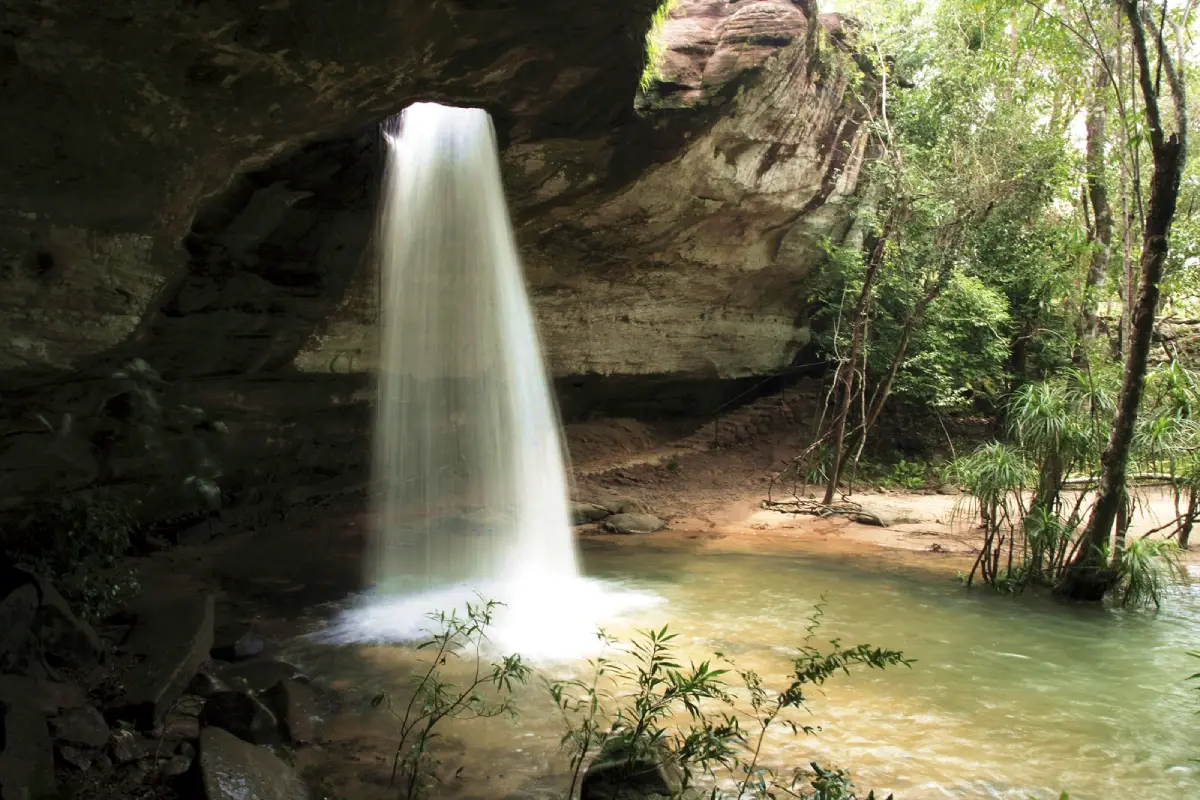
Saeng Chan Waterfall, also known as Long Ru Waterfall, is one of the most distinctive natural attractions inside Pha Taem National Park in Khong Chiam District, Ubon Ratchathani Province. Its Thai nickname “Long Ru” means a waterfall that drops through a hole, and this name describes the place very accurately. Instead of falling directly over a cliff edge like a typical waterfall, the stream flows through a round opening in the sandstone roof of a rocky overhang and drops into a natural pool below. This rare formation creates a dramatic scene of water, rock, light, and mist in one compact natural amphitheater.
The name “Saeng Chan” means moonlight. It comes from the soft white appearance of the water as it falls through the stone opening and spreads into fine spray. When light touches the falling water, the stream appears pale and luminous, similar to moonlight. Local descriptions also connect the name with the full moon, when moonlight can shine toward the rock opening and create a delicate glow through the water mist. This combination of natural structure and poetic meaning makes Saeng Chan Waterfall one of Ubon Ratchathani’s most memorable unseen natural sites.
The waterfall is located in the Ban Thung Na Mueang area of Na Pho Klang Subdistrict, Khong Chiam District, within Pha Taem National Park. This park is famous for sandstone cliffs, prehistoric rock paintings, Sao Chaliang rock formations, seasonal wildflowers, dry dipterocarp forest, waterfalls, and Mekong River viewpoints. Saeng Chan Waterfall is therefore not an isolated waterfall; it is part of a wider sandstone landscape that defines the eastern edge of Thailand near the Mekong River.
In simple terms, Saeng Chan Waterfall is a natural waterfall where water from Huai Tha Long stream passes through a hole in sandstone and falls from the roof of a cliff-like overhang. Visitors standing below can see the water dropping from above, framed by rock, trees, and the shadow of the overhang. The view is different from most waterfalls because the water appears to emerge from the ceiling of the rock shelter. This makes the site highly photogenic and especially interesting for travelers who enjoy geology, nature, and unusual landscapes.
The stone hole was created by natural erosion. Sandstone is strong enough to form cliffs and rock shelters, but it can still be worn down by water over a long period of time. As water flowed repeatedly across the rock surface, sand, sediment, and current gradually carved the stone. Over time, a natural opening formed in the rock, allowing the stream to fall through it. This process makes Saeng Chan Waterfall a clear example of how water and sandstone can create extraordinary natural forms.
The waterfall’s beauty lies in the relationship between the roof-like rock, the hole, the falling water, and the pool below. The overhang gives the place a cave-like atmosphere, while the open hole above becomes the central point where water and light enter the scene. The water falls in a narrow white column, strikes the pool below, and spreads into mist. Around the pool, rocks and trees create a sheltered, cool, and quiet atmosphere.
Saeng Chan Waterfall changes with the season. From the rainy season to the early cool season, the water flow is stronger and the surrounding forest becomes greener. This is the best time to see the waterfall in its most complete form. In drier periods, the flow may decrease, but the shape of the sandstone overhang, the rock hole, and the eroded surface become easier to observe. Each season gives visitors a different way to understand the site.
The best period to visit is during the rainy season and early cool season, especially after safe rainfall. During this time, the stream has enough water to create a clear waterfall, and the forest around the site looks fresh. Visitors should avoid days of heavy rain or strong water flow because natural waterfalls in sandstone landscapes can change quickly. Slippery rocks, sudden runoff, and wet paths require caution.
For photography, Saeng Chan Waterfall offers several strong compositions. A wide-angle view can capture the rock overhang, the hole, the falling water, and the pool below. A closer view can focus on the white water column, spray, rock texture, and light passing through the opening. Morning and early afternoon are generally good times for photography because the light is softer and the walking conditions are more comfortable.
The site is also valuable as a natural classroom. It helps visitors understand erosion, stream flow, sandstone structure, and seasonal water systems. The waterfall shows clearly that water is not only a flowing element; it is also a force that shapes rock over time. For students and travelers interested in geology, Saeng Chan Waterfall is easy to understand because the result of erosion can be seen directly in the rock hole and the falling stream.
The surrounding area includes forest plants, streamside vegetation, small rocks, natural pools, and damp surfaces created by water spray. Compared with the open sandstone plains and dry forest areas of Pha Taem National Park, the waterfall zone feels cooler and more humid. This contrast helps visitors understand the diversity of micro-landscapes within the same national park.
Saeng Chan Waterfall is suitable for travelers who enjoy light nature walking. The route to the waterfall is not as demanding as remote forest treks, but it is still a natural site with uneven ground, rocks, moisture, and seasonal conditions. Visitors should walk carefully, wear shoes with good grip, and avoid stepping on wet sloping stones. Families with children should supervise them closely around the pool and rock surfaces.
The waterfall can be visited together with Thung Na Mueang Waterfall, which is located nearby. The two waterfalls are often discussed together because they both show unusual water-and-rock formations within the same general area. Thung Na Mueang has a different character, with water flowing through hidden rock channels and appearing beneath large stone formations, while Saeng Chan Waterfall is defined by water falling directly through a hole in the rock roof.
Soi Sawan Waterfall is another nearby attraction that pairs well with Saeng Chan Waterfall. Soi Sawan is larger and is formed by two streams joining below a cliff like a necklace. Saeng Chan is more compact and more unusual because of its hole-in-the-rock formation. Visiting both gives travelers a broader understanding of Pha Taem’s waterfall landscapes, from large cliff waterfalls to rare sandstone-hole waterfalls.
Pha Taem Cliff and Sao Chaliang are important places to include in the same route. Pha Taem is known for prehistoric rock paintings and Mekong River views, while Sao Chaliang shows mushroom-like sandstone formations shaped by erosion. When combined with Saeng Chan Waterfall, these places reveal the shared theme of the park: sandstone, water, time, natural erosion, and human history.
For international visitors, Saeng Chan Waterfall offers a side of Thailand that is very different from beaches, islands, or urban attractions. It represents the natural identity of lower Isan through sandstone cliffs, seasonal streams, dry forest, rural roads, and protected landscapes. The experience is quiet, visual, and place-specific. It helps foreign travelers understand that northeastern Thailand has many subtle and rare natural formations beyond the better-known Mekong viewpoints.
The waterfall is also suitable for travelers who prefer meaningful nature stops rather than crowded commercial attractions. The main value of the site is not built infrastructure but the rare natural formation itself. Visitors who spend time observing the rock, water, light, and surrounding forest will gain a deeper appreciation than those who stop only for a quick photograph.
Basic visitor facilities are available in the broader Pha Taem National Park system and around local access areas, including parking, toilets, walking paths, and visitor services depending on the section and season. Services directly at natural waterfall points can be limited, so travelers should prepare drinking water, simple supplies, and enough time before entering the waterfall route.
The entrance fee follows the Pha Taem National Park rate. Thai adults pay 40 Baht and Thai children pay 20 Baht. Foreign adults pay 200 Baht and foreign children pay 100 Baht. Vehicle fees apply according to the type of vehicle. Travelers should carry cash because some national park areas may have limited mobile signal or payment options.
Getting There to Saeng Chan Waterfall follows the Pha Taem and Khong Chiam route. From the junction toward Khong Chiam, take Highway 2173 for about 40 km, then turn right onto Highway 2112 for about 30 km. After that, turn right for about 10 km to reach the waterfall access area. A private car or rental car is the most convenient option because it allows visitors to combine Saeng Chan Waterfall with Thung Na Mueang Waterfall, Soi Sawan Waterfall, Pha Taem Cliff, and Sao Chaliang in one route.
Travelers starting from Khong Chiam town can follow Highway 2112 toward the Pha Taem National Park waterfall route. The distance makes the waterfall suitable for a half-day or full-day trip, depending on how many nearby attractions are included. Since different points in Pha Taem are spread out, planning travel time is important.
Travelers coming from Ubon Ratchathani city should leave early. The drive to Khong Chiam and the Pha Taem area takes time, and it is better to visit natural attractions during daylight. A practical plan is to visit Saeng Chan Waterfall first or second, then continue to nearby waterfalls or rock formations before returning to Khong Chiam for food or accommodation.
Public transport requires more planning. Travelers can first go from Ubon Ratchathani city to Khong Chiam, then hire local transport to the waterfall and other Pha Taem attractions. For small groups, hiring a local vehicle is usually the most practical choice because it makes it easier to visit multiple locations in one day.
A good one-day itinerary from Khong Chiam can begin with Saeng Chan Waterfall in the morning, continue to Thung Na Mueang Waterfall, then go to Soi Sawan Waterfall or Sao Chaliang in the afternoon. After the nature route, travelers can return to Khong Chiam for riverside food and a relaxed evening by the Mekong River.
A two-day itinerary offers a deeper experience. On the first day, visitors can explore Pha Taem Cliff, prehistoric rock paintings, Sao Chaliang, and Mekong viewpoints. On the second day, they can visit Saeng Chan Waterfall, Thung Na Mueang Waterfall, Soi Sawan Waterfall, and the Khong Chiam riverside. This reduces rushing and gives more time for walking and photography.
Restaurants closest in convenience are usually found in Khong Chiam town and along the Mekong riverside. Visitors can find river fish dishes, Isan food, Thai dishes, cafés, and simple local restaurants. Because food services near the waterfall itself can be limited, it is practical to eat before entering the waterfall route or after returning to Khong Chiam.
Accommodation options include national park accommodation or camping areas in Pha Taem National Park where available, as well as hotels and resorts in Khong Chiam. Staying in Khong Chiam is convenient for travelers who want private rooms, restaurants, Mekong views, and easy access to multiple attractions in Pha Taem National Park.
Safety is important at Saeng Chan Waterfall. Visitors should not climb the rock overhang, stand under unstable or restricted areas, walk on slippery wet rocks, or enter water where depth and current are unclear. After heavy rain, water levels can change quickly. Following official paths and warning signs is the best way to enjoy the site safely.
Responsible travel is equally important. Visitors should take all rubbish out of the area, avoid using soap or chemicals in the water, avoid writing on rocks, avoid picking plants, and avoid disturbing wildlife. The waterfall’s beauty depends on the natural condition of the rock, water, forest, and pool. Keeping the area clean helps preserve it for future visitors.
Saeng Chan Waterfall is more than a scenic photo stop. It tells the story of sandstone shaped by water, a stream transformed by erosion, and light passing through a natural opening to create a memorable waterfall scene. For travelers who want to understand Ubon Ratchathani beyond the usual route, this waterfall is one of the strongest examples of the province’s deep natural identity.
Overall, Saeng Chan Waterfall is a remarkable destination for Thai and international travelers who appreciate nature, geology, photography, and quiet landscapes. Its water-through-stone formation, moonlight-like appearance, forest setting, and connection to Pha Taem National Park make it one of the most meaningful waterfalls in Ubon Ratchathani. The best experience comes from visiting in the right season, walking carefully, and allowing enough time to observe the details of water, stone, and light.
| Name | Saeng Chan Waterfall / Long Ru Waterfall |
| Location | Ban Thung Na Mueang, Na Pho Klang Subdistrict, Khong Chiam District, Ubon Ratchathani Province, inside Pha Taem National Park |
| Address | Pha Taem National Park area, Ban Thung Na Mueang, Na Pho Klang Subdistrict, Khong Chiam District, Ubon Ratchathani 34220 |
| Coordinates / Navigation Point | GH8Q+9V8, Na Pho Klang, Khong Chiam District, Ubon Ratchathani |
| Distinctive Features | A natural waterfall where water flows through a sandstone hole in the roof of a rocky overhang and drops into a pool below, creating a soft white stream that resembles moonlight |
| Name Origin | The name Long Ru refers to water falling through a rock hole. The name Saeng Chan refers to the pale white appearance of the falling water, similar to moonlight. |
| Natural Formation | The rock hole was formed by long-term water erosion on sandstone. Water from Huai Tha Long stream flows through the opening and falls into the lower pool. |
| Travel Information | From the junction toward Khong Chiam, take Highway 2173 for about 40 km, continue on Highway 2112 for about 30 km, then turn right for about 10 km to reach the waterfall access route. |
| Current Status | Open as a natural attraction inside Pha Taem National Park |
| Open Days | Daily |
| Opening Hours | 08.00 – 17.00 |
| Fees | Thai visitors: Adult 40 Baht, Child 20 Baht Foreign visitors: Adult 200 Baht, Child 100 Baht Car: 30 Baht per vehicle Motorcycle: 20 Baht per vehicle |
| Facilities | Parking area, visitor service points, toilets, walking route to the waterfall, resting areas, and basic Pha Taem National Park services in designated zones |
| Main Areas / Zones | Parking Zone Walking Trail Zone Sandstone Overhang Zone Rock Hole And Waterfall Stream Zone Lower Pool Zone Rock And Stream Zone Nature Photography Zone Forest Resting Zone |
| Caretaker | Pha Taem National Park, Department of National Parks, Wildlife and Plant Conservation |
| Main Contact Number | Pha Taem National Park, Tel. 0 4525 2581 Fax 0 4525 2582 Tel. 089-810-5532 |
| Best Time To Visit | Rainy season to early cool season for waterfall flow; after safe rainfall for a clear water curtain; late rainy to early cool season for nearby rock plains and seasonal wildflowers in Pha Taem National Park |
| Safety Notes | Be careful of slippery rocks after rain, do not climb the rock overhang, avoid strong-current areas, do not enter restricted water zones, and stay on official walking routes. |
| Nearby Tourist Attractions | 1. Thung Na Mueang Waterfall, 2 km 2. Soi Sawan Waterfall, 8 km 3. Pha Taem Cliff And Prehistoric Rock Paintings, 41 km, Tel. 0 4525 2581 4. Sao Chaliang, Pha Taem, 40 km, Tel. 0 4525 2581 5. Pha Taem Mekong Viewpoint, 41 km, Tel. 0 4525 2581 6. Two-Color River, Khong Chiam, 42 km 7. Wat Tham Khuha Sawan, 43 km |
| Nearby Restaurants | 1. Khrua Khong Chiam, 42 km, Tel. 045-351-027, 062-829-3697 2. Larb Pla Khong Chiam, 42 km, Tel. 045-351-283 3. Phae Araya Khong Chiam, 42 km, Tel. 045-351-015 4. Boeng Tawan Restaurant, 42 km, Tel. 089-717-7627 5. Chandara Khong Chiam, 43 km, Tel. 098-242-4464 6. Mae Nam Song Si Khong Chiam Restaurant, 42 km, Tel. 083-720-7706 |
| Nearby Accommodations | 1. Pha Taem National Park Accommodation And Camping Area, 41 km, Tel. 0 4525 2581 2. Khong Chiam Hotel, 42 km, Tel. 086-468-7431 3. View Khong Khong Chiam Hotel, 42 km, Tel. 065-242-3392 4. Baan Kieng Tawan Khong Chiam, 43 km, Tel. 099-039-4290 5. Tohsang Heritage Khongjiam, 47 km, Tel. 081-860-5905, 045-351-174-6 6. Khong Chiam Orchid Riverside Resort, 48 km, Tel. 098-916-8771 |
Frequently Asked Questions (FAQ)
Q: Where is Saeng Chan Waterfall located?
A: Saeng Chan Waterfall is located at Ban Thung Na Mueang, Na Pho Klang Subdistrict, Khong Chiam District, Ubon Ratchathani Province, inside Pha Taem National Park.
Q: What are the opening days and hours?
A: Saeng Chan Waterfall is open daily from 08.00 to 17.00.
Q: Is there an entrance fee?
A: Yes. The Pha Taem National Park entrance fee is 40 Baht for Thai adults, 20 Baht for Thai children, 200 Baht for foreign adults, and 100 Baht for foreign children.
Q: Why is Saeng Chan Waterfall called Long Ru Waterfall?
A: It is called Long Ru Waterfall because the stream falls through a natural hole in a sandstone overhang before dropping into the pool below.
Q: When is the best time to visit Saeng Chan Waterfall?
A: The rainy season to early cool season is the best time, especially after safe rainfall, because the waterfall has stronger flow and the surrounding forest looks fresh.
Q: What attractions can be visited together with Saeng Chan Waterfall?
A: Nearby attractions include Thung Na Mueang Waterfall, Soi Sawan Waterfall, Pha Taem Cliff, Sao Chaliang, Mekong viewpoints, the Two-Color River, and Wat Tham Khuha Sawan.
Q: How can travelers get to Saeng Chan Waterfall?
A: Take Highway 2173 toward Khong Chiam, continue on Highway 2112, and turn into the waterfall access route. A private car or rental car is the most convenient option.
Q: What should visitors prepare before going?
A: Visitors should bring non-slip shoes, drinking water, a hat, mosquito repellent, a personal trash bag, and waterproof protection for phones or cameras, especially during the rainy season.
 Category: ●Nature and Wildlife
 Group: ●Waterfalls
Last Update : 3 MonthAgo
 Last Update : 3 MonthAgo
 Click to Access the Navigation Map GPS
Saeng Chan Waterfall (Namtok Long Ru) Map
Gellery
Recommend

 Art, Culture and Heritage
 Historical Sites and Monuments(5)
 Landmarks and Memorials(2)
 Royal Palace(1)
 Art, Craft Centres, Tradition(7)
 Museums(3)
 Places of Worship
 Temple(37)
 Other Sacred Sites(4)
 Research and Development
 Royal Project(2)
 Suburban Living
 Village, Community(2)
 Local Market(4)
 National Parks and Marine Reserves(5)
 Mountain (Doi)(6)
 Dam, Reservoir, Lake(8)
Waterfalls(12)
Dam, Reservoir, Lake(8)
Waterfalls(12)
 Hot Springs(1)
 Caves(2)
 River, Canal(11)
 Bays and Beaches(8)
 Islands(2)
 Other natural attractions(6)
 Entertainment and Agricultural
 Zoos and Aquariums(2)
 Animal camps and shows(1)
 Farms, Parks and Ecotourism(1)
 Waterpark(1)
 Travel Articles, Recipes
 Travel Review, Food Review(1)


