
lovethailand home >Northeastern Travel Attractions >Ubon Ratchathani Travel Attractions >Muang Ubon Ratchathani >Chae Ra Mae > Kudea Beach
TL;DR: Kudea Beach, Ubon Ratchathani attractions : Nature and Wildlife, Bays and Beaches.

Kudea Beach
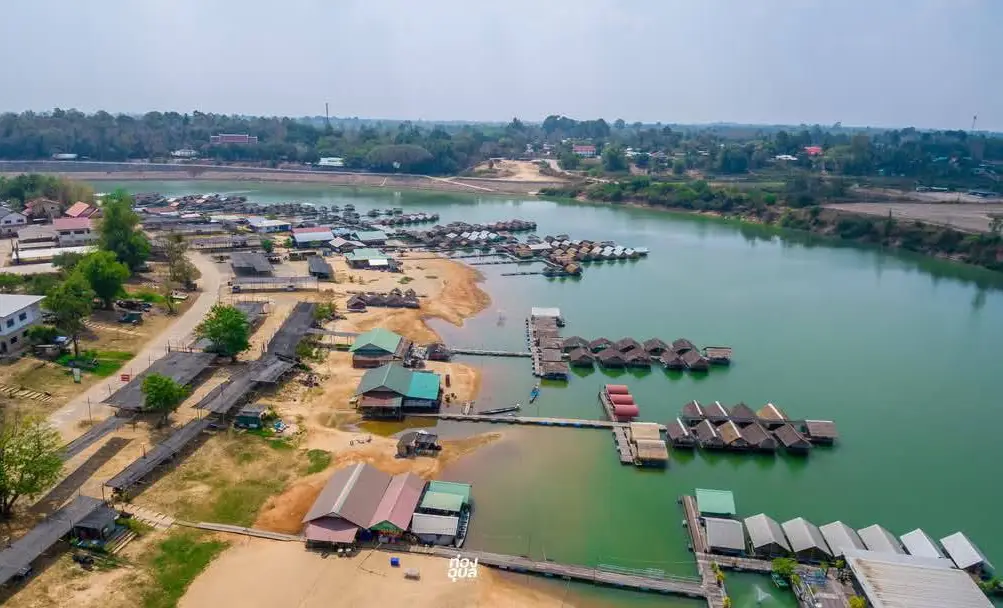
Open Days: Khu Duea Beach opens daily; Baan Pa Ao Brass Craft Conservation Center opens Monday – Saturday
Opening Hours: Khu Duea Beach 10.30 – 21.30; Baan Pa Ao Brass Craft Conservation Center 09.00 – 17.00
Khu Duea Beach and Baan Pa Ao form one of the most rewarding cultural travel routes in Ubon Ratchathani. Khu Duea Beach offers a riverside sandy beach, floating-style restaurants, local food, and relaxed views of the Mun River. Baan Pa Ao adds cultural depth through traditional brass casting, silk weaving, and the living heritage of an old craft village with more than 200 years of community history.
Khu Duea Beach and Baan Pa Ao in Ubon Ratchathani are best understood as a paired travel route rather than two unrelated attractions. Together, they reveal two important sides of Ubon Ratchathani: the easygoing riverside lifestyle along the Mun River and the deep-rooted craft heritage of an old northeastern Thai village. Khu Duea Beach, located in Chaeramae Subdistrict of Mueang Ubon Ratchathani District, lies about 12 km from the city center and is known for its sandy riverbank, riverside dining rafts, local food, and relaxed atmosphere. Baan Pa Ao, located in Mueang Ubon Ratchathani District on the route toward Yasothon, is famous for traditional brass craft, lost-wax casting, silk weaving, and a community history that has been passed down through generations.
This route is especially suitable for travelers who want to experience Ubon Ratchathani beyond a short photo stop. In one day, visitors can enjoy lunch beside the Mun River, taste local northeastern Thai dishes, sit on riverside rafts, and then continue to Baan Pa Ao to learn how brass objects are made by hand using an old casting technique. For Thai visitors, the route offers a familiar yet meaningful look at local food, community life, and craft identity. For foreign travelers, it gives a clear introduction to Isan culture through real places, real people, and living traditions that still matter to the local community today.
Khu Duea Beach is a freshwater beach along the Mun River. It is not a sea beach, but this is precisely what makes it distinctive. During the dry season, when the water level drops, the sandy riverbank becomes more visible and creates the beach-like scenery that locals have enjoyed for years. The surrounding area is lined with many restaurants and riverside dining platforms where visitors can eat, relax, and enjoy the view. The atmosphere is informal and local. It feels more like a place where families, friends, and local residents spend real leisure time than a polished tourist site built only for photography.
The main activity at Khu Duea Beach is riverside dining. Many visitors come specifically for food, especially dishes associated with the river and northeastern Thai flavors. Popular choices include dancing shrimp salad, grilled fish, shrimp baked with glass noodles, papaya salad, spicy minced dishes, freshwater fish dishes, and Thai-style shared meals. The experience is not only about the flavor of the food, but also about the setting. Eating beside the river, feeling the breeze, watching the rafts and the water, and hearing the sounds of a busy local restaurant area all help create the memory of Khu Duea Beach.
The best time to visit Khu Duea Beach is from late morning to early evening. Visitors who arrive before lunch can choose a restaurant more comfortably, order local dishes, and spend the afternoon relaxing by the river. During the dry season, the sandy bank is more clearly visible, making the place especially photogenic. Late afternoon is a good time for softer light and a calmer mood. Families traveling with children should choose restaurants with stable walkways and safe seating areas, and children should always be supervised near the water because the Mun River is a natural waterway with seasonal changes in depth and current.
Khu Duea Beach also reflects the relationship between local people and the Mun River. The river is not simply a scenic background. It supports food culture, riverside businesses, local recreation, and community-based income. The many food rafts and restaurants create a lively atmosphere on weekends and holidays. Visitors who spend time here with attention will notice that the beach is more than a place to sit by the water. It is a local meeting point, a family leisure space, and a place where Ubon Ratchathani’s food culture is experienced in a natural riverside setting.
After spending time at Khu Duea Beach, travelers can add cultural depth to the trip by continuing to Baan Pa Ao. The village lies about 18 km from the city center, along Highway 23 toward Yasothon, with a local road leading into the village near the 273 km marker. Baan Pa Ao is an old community known for brass craft and silk weaving. The travel distance is manageable, making it possible to combine the beach and the craft village in the same day without a long detour.
The history of Baan Pa Ao is connected with migration stories across the Mekong region and northeastern Thailand. Local accounts describe ancestors who moved from Vientiane and later passed through places such as Nong Bua Lamphu before settling in what is now Baan Pa Ao. Some local explanations connect the name “Pa Ao” with an Isan phrase referring to leaving a younger brother in this place. Whether approached through oral history, community memory, or cultural interpretation, Baan Pa Ao is a village with a strong sense of identity. It is not only a production site for handicrafts; it is a place where history, family memory, and craftsmanship remain closely connected.
The best-known heritage of Baan Pa Ao is traditional brass craft. The village has preserved brass casting for more than 200 years, using a method commonly described as lost-wax casting. This process requires skill and patience. Artisans shape a model, create surface patterns, prepare the mold, burn out the wax, melt brass, pour the molten metal, wait for the object to cool, and then break the mold before refining the final piece. Because each mold is used only once, each finished object has its own character. Products include bells, small animal bells, lidded containers, bowls, trays, betel sets, ritual objects, and souvenirs.
The beauty of Baan Pa Ao brassware lies not only in the golden shine of the metal, but also in its handmade details. Patterns inspired by nature and local aesthetics appear on many objects, including lotus-petal motifs, fishbone-like lines, pine-like patterns, dotted textures, rolling lines, and other traditional decorative forms. These patterns are not merely decoration. They are part of a craft language that expresses the skill, patience, and memory of the artisan. Buying a brass object from Baan Pa Ao means supporting not just a product, but a living knowledge system that has been kept alive through community practice.
The Baan Pa Ao Brass Craft Conservation Center is the key place for visitors who want to understand this craft in detail. The center functions as a learning space, a demonstration area, and a sales point for community products. Visitors can see examples of brassware, observe tools and working methods, and learn about the old casting process. A meaningful visit should take at least 45 minutes to 1 hour. Groups that want a formal demonstration should contact the center in advance so that the community can prepare the visit properly.
In addition to brass craft, Baan Pa Ao is also known for silk weaving. In earlier generations, local households grew mulberry trees, raised silkworms, and wove silk for household use. Over time, weaving developed into a community product and an additional source of income. Baan Pa Ao silk includes traditional patterns, tie-dye-style woven designs, raised patterns, and designs adapted for contemporary markets. Seeing brass craft and silk weaving in the same village helps travelers understand how local communities build resilience through multiple forms of craft knowledge.
Travelers should visit Baan Pa Ao at a slow pace. It is worth taking time to look carefully at the tools, ask respectful questions, and observe the details of handmade products. Some parts of brass casting involve heat, metal, and tools, so visitors should stand only in safe areas recommended by local staff or artisans. Photographs should be taken respectfully, especially when people are working. For foreign travelers, Baan Pa Ao is an excellent place to understand the Thai idea of local wisdom because the craft is not presented as an empty performance. It is a real practice rooted in the daily life and history of the community.
A practical one-day itinerary can begin at Baan Pa Ao in the morning, when the weather is usually more comfortable for walking and learning. Visitors can explore the craft center, see brass products, learn about the lost-wax method, and buy local souvenirs. After that, they can return toward the city or the bypass route and continue to Khu Duea Beach for lunch and a relaxed afternoon by the river. Another option is to start with lunch at Khu Duea Beach and visit Baan Pa Ao in the afternoon, but travelers should be mindful that the brass craft center closes at 17.00.
Getting There is most convenient by private car, rental car, or hired local transport. Khu Duea Beach is about 12 km from central Ubon Ratchathani and can be reached via the city bypass route toward the Chaeramae area. Baan Pa Ao is about 18 km from the city center, reached by Highway 23 toward Yasothon, with a turn into the village for about 3 km near the 273 km marker. Travelers without their own vehicle should arrange a hired car or taxi in advance, especially if visiting both places in one day, because return transport may be less convenient outside the city center.
Travelers arriving from Ubon Ratchathani Airport can create a loop itinerary. From the airport, they can enter the city, visit Wat Phra That Nong Bua or Ubon Ratchathani National Museum, continue to Baan Pa Ao for cultural learning, and then end the day at Khu Duea Beach with riverside dining. Visitors staying in the city can also make this a relaxed half-day route by choosing only one main activity and adding the other if time allows.
The strength of Khu Duea Beach is its accessibility and relaxed riverside character. Travelers do not need to go far from the city to experience the Mun River, local food, and a casual Ubon-style leisure atmosphere. The strength of Baan Pa Ao is cultural depth. The village helps visitors understand how craft, migration history, family memory, and local economy are connected. Together, the two places create a balanced travel experience that includes nature, food, community, history, and handmade products.
For travelers interested in deeper cultural tourism, Khu Duea Beach should be understood as a river-life destination, while Baan Pa Ao should be understood as a living craft village. The most meaningful details are not found only in scenery or objects. They are found in conversations with local people, the smell of grilled food beside the river, the sound of tools in a workshop, and the handmade marks on each brass object. This is what makes the route valuable for visitors who want more than a checklist of attractions.
Visitors to Khu Duea Beach should bring some cash, even though many businesses may accept digital payment. It is useful for small purchases, drinks, parking, or small local services. Before ordering food, it is practical to ask about prices, especially for fish, shrimp, or seasonal dishes that may vary by size and availability. At Baan Pa Ao, visitors should take time when choosing brassware because each item differs in weight, design, pattern, and price. Purchasing directly from the community helps support local artisans and encourages the continuation of traditional skills.
The route is also excellent for photography. Khu Duea Beach offers scenes of riverside rafts, the Mun River, local food, and people enjoying their leisure time. Baan Pa Ao offers details of tools, brass textures, handmade objects, workshop spaces, and village life. Photographers should avoid disturbing restaurant guests or artisans at work. When photographing people, it is always better to ask permission first. Respectful photography helps maintain a good relationship between visitors and the community.
For foreign visitors, Khu Duea Beach is easy to appreciate because the experience of eating by the river is direct and enjoyable. Baan Pa Ao requires more explanation, but it can be even more memorable. Understanding the lost-wax casting process, the migration stories of the village, and the value of handmade brassware allows travelers to see that each object is not just a souvenir. It is a result of history, skill, and community knowledge.
Families with children can enjoy both places with proper planning. At Khu Duea Beach, families should choose restaurants with safe access and supervise children carefully near the water. At Baan Pa Ao, children can learn how handmade objects are created step by step and understand the value of craft labor. Elderly travelers should visit during cooler hours, use vehicles that can stop close to the main areas, and choose restaurants or learning spaces with easy walking access.
Overall, Khu Duea Beach and Baan Pa Ao are suitable for travelers who want a complete and meaningful Ubon Ratchathani experience. The route offers practical travel information, local food, riverside scenery, community history, traditional craft, and cultural insight in one trip. It can be planned as a half-day trip, a full-day itinerary, or part of a broader Ubon Ratchathani route that also includes temples, museums, city parks, and other cultural landmarks.
If there is one clear reason to visit, Khu Duea Beach offers the taste and atmosphere of life by the Mun River, while Baan Pa Ao offers the living heritage of Isan craftsmanship. Together, they show Ubon Ratchathani as a province where nature, food, history, and community wisdom exist side by side. For travelers who want to understand the province in depth, this is one of the most rewarding routes near the city.
| Name | Khu Duea Beach and Baan Pa Ao, Ubon Ratchathani |
| Location | Khu Duea Beach: Chaeramae Subdistrict, Mueang Ubon Ratchathani District, Ubon Ratchathani Baan Pa Ao: Pa Ao Subdistrict, Mueang Ubon Ratchathani District, Ubon Ratchathani |
| Address | Khu Duea Beach, Chaeramae Subdistrict, Mueang Ubon Ratchathani District, Ubon Ratchathani 34000 Baan Pa Ao Traditional Brass Craft Conservation Center, 170 Moo 5, Pa Ao Subdistrict, Mueang Ubon Ratchathani District, Ubon Ratchathani 34000 |
| Coordinates / Location Code | Khu Duea Beach: 6Q6V+CCC, Chaeramae, Mueang Ubon Ratchathani District |
| Highlights | Freshwater sandy beach along the Mun River, riverside raft restaurants, local food, traditional brass casting, lost-wax craft, silk weaving, and community products |
| History | Khu Duea Beach is a riverside leisure area of Ubon Ratchathani. Baan Pa Ao is an old craft village with more than 200 years of community history and inherited brass-making knowledge. |
| Name Origin | Khu Duea Beach is named after the local Khu Duea area by the Mun River. The name Pa Ao is associated with local Isan oral tradition referring to leaving a younger brother in the settlement area. |
| Distinctive Features | Khu Duea Beach is known for riverside dining and Mun River views. Baan Pa Ao is known for handmade brassware, traditional patterns, silk weaving, and craft demonstrations. |
| Travel Information | Khu Duea Beach is about 12 km from central Ubon Ratchathani via the city bypass toward Chaeramae. Baan Pa Ao is about 18 km from the city center via Highway 23 toward Yasothon, with a local turn into the village for about 3 km near the 273 km marker. |
| Current Status | Open for visitors as a riverside food and leisure destination and as a community craft learning route in Ubon Ratchathani |
| Open Days | Khu Duea Beach: Daily Baan Pa Ao Brass Craft Conservation Center: Monday – Saturday |
| Opening Hours | Khu Duea Beach: 10.30 – 21.30 Baan Pa Ao Brass Craft Conservation Center: 09.00 – 17.00 |
| Fees | No general admission ticket for Khu Duea Beach or Baan Pa Ao village. Food, drinks, boat activities, workshops, products, and other services are charged by individual operators. |
| Facilities | Riverside restaurants, parking areas, restrooms at restaurants, river-view seating, community product shops, craft demonstration areas, and souvenir sales points |
| Main Areas / Zones | 1. Mun River sandy beach zone 2. Khu Duea riverside restaurant zone 3. River-view relaxation zone 4. Baan Pa Ao Brass Craft Conservation Center zone 5. Lost-wax brass casting demonstration zone 6. Brassware, silk, and community product sales zone |
| Caretaker | Khu Duea Beach is within the administrative area of Jaeramae Municipality and local riverside operators. Baan Pa Ao is cared for by the community and the Baan Pa Ao Brass Craft Conservation Center. |
| Main Contact Number | Jaeramae Municipality Tel. 045-841624 Baan Pa Ao Traditional Brass Craft Conservation Center Tel. 092-176-9467 |
| Official Website / Official Page | Jaeramae Municipality website Pa Ao Subdistrict Administrative Organization website Facebook: Baan Pa Ao Brass Craft Conservation Center |
| Nearby Tourist Attractions | 1. Wat Khu Duea, about 2 km from Khu Duea Beach 2. Wat Phra That Nong Bua, about 8 km from Khu Duea Beach 3. Ubon Ratchathani National Museum, about 10 km from Khu Duea Beach, Tel. 045-251015 4. Thung Si Mueang, about 10 km from Khu Duea Beach 5. Ubon Ratchathani Zoo, about 16 km from Khu Duea Beach, Tel. 045-252761, 093-3209369 6. Wat Burapha Pa Ao Nuea, about 2 km from Baan Pa Ao Brass Craft Center |
| Nearby Restaurants | 1. Pathumma at Hat Khu Duea, about 0.1 km, Tel. 089-578-3751 2. Kan Eng Hat Khu Duea, about 0.2 km, Tel. 080-739-7064 3. Khon Lue Lap Ped Rim Mun, about 0.2 km, Tel. 094-519-2544 4. Phae Suan Nam Hat Khu Duea Restaurant, about 0.5 km, Tel. 087-704-2621 5. KIKU DON Khu Duea, about 1 km, Tel. 082-901-6562, 096-252-3667 6. Him River Hat Khu Duea, about 2 km, Tel. 099-415-2546, 045-950299 |
| Nearby Accommodations | 1. Hadkudua View Resort / Mini Golf & Resort Ubon Ratchathani, about 3 km, Tel. 084-549-9266, 045-950147 2. Ban Maingam Resort, about 4 km, Tel. 045-206191, 086-648-3544 3. Central Park Ville Resort, about 5 km, Tel. 092-949-9939 4. Centara Ubon, about 6 km, Tel. 045-319556 5. De Proud Hotel, about 8 km, Tel. 095-620-1919 6. Nam Fa Resort, about 12 km, Tel. 045-313211 |
Frequently Asked Questions (FAQ)
Q: Where is Khu Duea Beach located?
A: Khu Duea Beach is located in Chaeramae Subdistrict, Mueang Ubon Ratchathani District, Ubon Ratchathani. It is about 12 km from the city center and sits along the Mun River.
Q: What is Baan Pa Ao famous for?
A: Baan Pa Ao is famous for traditional brassware made with the lost-wax casting method, as well as silk weaving and community craft products.
Q: Can Khu Duea Beach and Baan Pa Ao be visited in one day?
A: Yes. Travelers can visit Baan Pa Ao in the morning and continue to Khu Duea Beach for lunch or a late-afternoon riverside meal. The route is practical for a half-day or full-day trip from Ubon Ratchathani city.
Q: Is there an admission fee for Khu Duea Beach?
A: There is no general admission ticket for the beach area. Visitors pay separately for food, drinks, boat activities, or services offered by local operators.
Q: What are the opening hours of Baan Pa Ao Brass Craft Conservation Center?
A: The center opens Monday to Saturday from 09.00 to 17.00. It is best to visit during the daytime, especially if you want to learn about brass craft or buy community products.
Q: When is the best time to visit Khu Duea Beach?
A: The dry season is the best time to see the sandy riverbank clearly. Late morning to early evening is suitable for riverside dining and enjoying the Mun River atmosphere.
Q: What souvenirs should travelers buy from Baan Pa Ao?
A: Recommended souvenirs include handmade brass bells, small containers, bowls, trays, betel sets, decorative brass objects, and locally woven silk products.
Q: Is this route suitable for foreign travelers?
A: Yes. Khu Duea Beach is easy to enjoy as a local riverside food destination, while Baan Pa Ao is ideal for travelers interested in craft heritage, village culture, and traditional Isan knowledge.
 Category: ●Nature and Wildlife
 Group: ●Bays and Beaches
Last Update : 1 WeekAgo
 Last Update : 1 WeekAgo
 Click to Access the Navigation Map GPS
Kudea Beach Map
Recommend

 Art, Culture and Heritage
 Historical Sites and Monuments(5)
 Landmarks and Memorials(2)
 Royal Palace(1)
 Art, Craft Centres, Tradition(7)
 Museums(3)
 Places of Worship
 Temple(37)
 Other Sacred Sites(4)
 Research and Development
 Royal Project(2)
 Suburban Living
 Village, Community(2)
 Local Market(4)
 National Parks and Marine Reserves(5)
 Mountain (Doi)(6)
 Dam, Reservoir, Lake(8)
 Waterfalls(12)
 Hot Springs(1)
 Caves(2)
 River, Canal(11)
Bays and Beaches(8)
River, Canal(11)
Bays and Beaches(8)
 Islands(2)
 Other natural attractions(6)
 Entertainment and Agricultural
 Zoos and Aquariums(1)
 Animal camps and shows(1)
 Farms, Parks and Ecotourism(1)


