
lovethailand home >Northeastern Travel Attractions >Ubon Ratchathani Travel Attractions >Muang Ubon Ratchathani >Chae Ra Mae > Wat Supattanaram Worawihan
TL;DR: Wat Supattanaram Worawihan is located at Supat Road, Nai Mueang Subdistrict, Mueang Ubon Ratchathani District, Ubon Ratchathani Province, on the bank of the Mun River south of the, open Daily, hours 06.00 – 18.00.
Wat Supattanaram Worawihan
Open Days: Daily
Opening Hours: 06.00 – 18.00
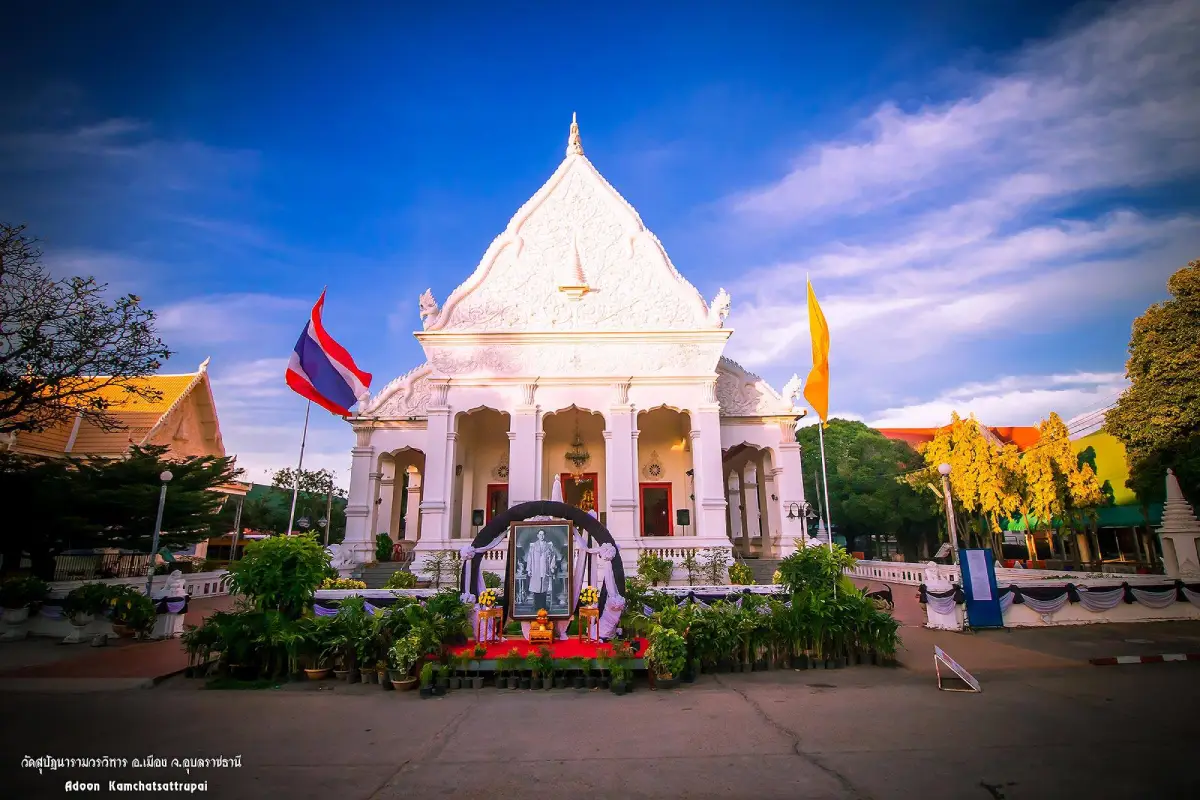
Wat Supattanaram Worawihan in Ubon Ratchathani, commonly called Wat Supat by local people, is one of the most important royal Buddhist temples on the bank of the Mun River in Ubon Ratchathani city. Located on Supat Road in Nai Mueang Subdistrict, Mueang Ubon Ratchathani District, the temple is historically significant as the first Dhammayut temple in Ubon Ratchathani and in northeastern Thailand. It was established through the royal faith of King Mongkut, Rama IV, and became a major religious centre for the Dhammayut order in the region. The temple is best known for its elegant white ordination hall, which combines Thai, Western and ancient Khmer artistic elements, and for Phra Sapphanyu Chao, the revered principal Buddha image enshrined inside. Its riverside location, old landing place, fish sanctuary, museum, historic objects and peaceful atmosphere make Wat Supattanaram Worawihan one of the most meaningful cultural stops in central Ubon Ratchathani.
The importance of Wat Supattanaram Worawihan comes from several layers of value. First, it is a major Buddhist site because it introduced the Dhammayut monastic tradition to the northeastern region. Second, it is connected with the early religious and administrative history of Ubon Ratchathani because its establishment involved royal command, local rulers, senior monks and the city community. Third, it is architecturally distinctive because its ordination hall brings together a Thai roof, a Western-influenced body and a Khmer-inspired base in a single building. Fourth, it is geographically meaningful because the temple stands beside the Mun River, at a good landing point that gave the temple its name. These combined values make the temple much more than an ordinary city temple.
The name Supattanaram is directly related to the temple’s riverside setting. In Thai Buddhist interpretation, su means good or auspicious, pattana refers to a landing place or river port, and aram means monastery or temple. The name therefore means a temple with a good landing place. This is not only a symbolic name. The temple was built on a deep bend of the Mun River, an area suitable for water travel, monastic movement, almsgiving by boat and river-based religious activities. In the past, the Mun River was one of the main routes of movement in Ubon Ratchathani. A major temple beside the river naturally became important for both religious and civic life.
The history of Wat Supattanaram Worawihan began during the reign of King Rama IV. The King had a strong royal intention to establish a Dhammayut temple in Ubon Ratchathani, and Phra Phrom Ratchawong, also known as Kuthong Suwannakut, the ruler of Ubon Ratchathani at that time, was instructed to arrange the construction. The city ruler and local committee selected a site on the Mun River between the city and Ban Bung Kasaeo because it was a deep and convenient river landing. Construction began in 1850 and was completed in 1853. King Rama IV then gave the temple the name Wat Supattanaram, reflecting the excellent location by the river.
In the early period of the temple, several important Dhammayut monks were connected with its foundation. Monks such as Than Phanthulo (Di) and Than Thewathammi (Mao) were invited to reside at the temple, while later senior monks continued to shape its role in religious education and monastic practice. Establishing a Dhammayut temple in Ubon Ratchathani was a major development because the region had long been part of a Thai-Lao cultural landscape connected with Lan Xang, the Mekong world and local Buddhist traditions. Wat Supattanaram became a bridge between royal Buddhist reform from Bangkok and the religious life of the northeastern region.
Later, the temple was elevated in status and became Wat Supattanaram Worawihan, a third-class royal monastery of the Worawihan type under the Dhammayut order. This royal status reflects the temple’s importance in religion, history and public life. It is not only a community temple. It has served as a centre for monastic learning, religious ceremonies, provincial events and the memory of important Buddhist teachers. In the old city route of Ubon Ratchathani, Wat Supattanaram stands alongside other major temples such as Wat Si Ubon Rattanaram, Wat Maha Wanaram, Wat Thung Si Mueang and Wat Phra That Nong Bua as one of the city’s key sacred places.
The most striking structure in the temple is the ordination hall. It is large, graceful and highly distinctive. The building measures roughly 20 to 21 metres wide, 34 to 35 metres long and about 22 metres high. It was designed by Luang Sathit Nimanakan, also known as Chuan Supiyaphan, a government engineer and architect. Planning for the new ordination hall began around 1917, construction started around 1920, and the building was completed in the following decade, with the consecration ceremony held in 1936. The hall remains one of the finest examples of hybrid Buddhist architecture in Ubon Ratchathani.
The design of the ordination hall is usually understood in three major parts. The roof reflects Thai Buddhist architecture, with a gabled form and traditional decorative elements. The central body of the building shows Western influence, especially in the tall arches, proportions and open colonnaded structure. The base reflects ancient Khmer artistic influence, giving the building a strong and grounded appearance. Instead of appearing confused, these different elements work together to create a unique Ubon Ratchathani temple style. The building is elegant, balanced and instantly recognizable.
Another interesting feature is that the ordination hall does not rely on ordinary windows in the usual temple style. Instead, doors and tall openings are arranged around the building to bring in light and air. The surrounding veranda and square columns create deep shadows and a dignified rhythm around the structure. The decorative stucco, gables, archways, columns and stair guardians show careful craftsmanship. At the stairways are reclining lion figures with gentle expressions. These lions carry a symbolic Buddhist meaning: even fierce creatures become calm when they come under the influence of the Dhamma. This detail turns architectural decoration into a visual teaching.
Inside the ordination hall is Phra Sapphanyu Chao, the principal Buddha image of the temple. The name Sapphanyu refers to the Buddha as the all-knowing one, the enlightened teacher who fully understands the truth of all things. Visitors usually begin their visit by paying respect to Phra Sapphanyu Chao before walking around the hall and the temple grounds. Inside the hall are also important sacred and historic objects, including a sandstone Naga-protected Buddha image, a replica of Phra Phuttha Sihing, and images of important monks such as Phra Upali Kunupamachan (Chan Sirichanto) and Somdet Phra Maha Wirawong (Uan Tisso).
Phra Upali Kunupamachan and Somdet Phra Maha Wirawong were major Dhammayut monks whose influence extended far beyond Ubon Ratchathani. They were teachers, scholars and monastic leaders who helped shape Buddhist learning in the province and the country. Their images inside the ordination hall remind visitors that Wat Supattanaram Worawihan is not important only because of architecture or age. It is also important because it was connected with a strong lineage of learning, teaching and monastic leadership. For travelers interested in Thai Buddhism, this makes the temple especially meaningful.
Wat Supattanaram Worawihan is also connected with the wider history of the Thai forest meditation tradition. Ubon Ratchathani played a major role in the lives of Phra Ajahn Sao Kantasilo and Phra Ajahn Mun Bhuridatto, the great meditation masters associated with the forest tradition. Wat Supattanaram, as a major Dhammayut temple in the city, belongs to the religious landscape that helped shape monastic learning and practice before the forest meditation lineage expanded into rural and forest monasteries. This gives the temple a deeper spiritual context. It shows that city temples, royal temples, forest practice and monastic education were not separate worlds, but connected parts of northeastern Thai Buddhism.
The riverside landing area of Wat Supattanaram is another essential part of its identity. In the early period, this landing was associated with water-based monastic boundaries used for certain religious acts such as ordination. It was also the place where important monks and young students began river journeys to Bangkok for further education. This means the temple’s riverfront was not merely a scenic area. It was a place of movement, learning, ritual and connection between Ubon Ratchathani and the wider Buddhist world. The Mun River therefore forms part of the sacred history of the temple.
Today, the riverside area is known as a fish sanctuary or Wang Matcha. Many freshwater fish live in the protected area near the temple landing. Visitors can walk down toward the river, make merit by feeding fish and enjoy the calm atmosphere of the Mun River. This is one reason Wat Supattanaram feels different from many urban temples. It combines a refined royal ordination hall with a living riverside environment. After paying respect inside the ordination hall, visitors can spend time by the river and experience how the temple, city and Mun River remain connected.
The temple also contains a museum and cultural hall where many important objects are preserved. Because Wat Supattanaram has long been home to major monks and royal-monastery activities, many valuable religious and cultural objects have been donated to the temple. The collection includes relics, Buddha images, scripture cabinets, preaching seats, ceremonial fans, boundary stones, stone inscriptions, lintels, deity images, brassware, ceramics, porcelain, cut glass, monastic rank objects and personal items connected with Somdet Phra Maha Wirawong (Uan Tisso). These objects help visitors understand the temple as a repository of religion, history, art and education.
Important ancient objects near the ordination hall include the Tham Ma Nai inscription and old lintels connected with ancient Khmer-period culture. These objects show that the history of Ubon Ratchathani is not limited to the Rattanakosin period. The region is part of a deeper cultural landscape connected with ancient communities along the Mun River and the broader Mekong basin. A visit to Wat Supattanaram therefore reveals multiple layers of history: ancient Khmer traces, Lan Xang-related culture, royal Dhammayut Buddhism, modern monastic education and present-day temple life.
Another distinctive object inside the temple is the wooden gong, or pong mai. Unlike a metal bell, this instrument is made from wood and creates a resonant sound. It reflects local temple life and traditional craft knowledge. In northeastern temples, wooden gongs were used to call people, mark time and connect the rhythm of monastic life with the community. At Wat Supattanaram, the wooden gong adds another layer of cultural meaning. It reminds visitors that a temple is not only made of major monuments, but also of everyday objects that supported Buddhist life for generations.
Wat Supattanaram Worawihan is suitable for many types of visitors. Buddhist travelers come to worship Phra Sapphanyu Chao and make merit. History lovers come to understand the first Dhammayut temple in northeastern Thailand. Architecture enthusiasts come to study the ordination hall and its Thai, Western and Khmer elements. Cultural travelers come for the museum, ancient objects and riverside setting. Families can use the temple as a learning site for religion, architecture, riverside urban history and the role of the Mun River. Photographers will find the white ordination hall especially attractive in morning and late afternoon light.
For international visitors, Wat Supattanaram Worawihan is one of the best places to understand Buddhism in Ubon Ratchathani. It shows royal Buddhist patronage, the spread of the Dhammayut order, hybrid temple architecture, the Mun River as a sacred and practical route, and the connection between city temples and the forest meditation tradition. The temple helps explain that Buddhism in Ubon Ratchathani is not expressed in only one form. It includes royal temples, riverside ritual, monastic scholarship, forest meditation, ancient objects and local merit-making. All of these can be understood in one temple compound.
The best times to visit are morning and late afternoon. Morning offers cooler weather and a calm atmosphere for worship inside the ordination hall. Late afternoon is pleasant for walking near the river and observing the fish sanctuary. Visitors interested in photography should walk around the ordination hall to see the front, sides, arches, columns, stucco work, lion guardians and the relationship between the building and the temple courtyard. Those interested in museum objects and temple history should allow additional time to read signs and observe the cultural displays carefully.
Wat Supattanaram Worawihan is open daily from 06.00 to 18.00, and admission is free. Visitors may pay respect, walk around the temple, see the ordination hall and spend time near the riverside area without buying a ticket. Because the temple is an active royal monastery, visitors should dress modestly, remove shoes before entering religious buildings, keep voices low, avoid touching historic objects and behave respectfully when taking photographs. Groups should contact the temple in advance if they need arrangements for parking, guided visits or formal merit-making.
Getting There is easy because the temple is located in central Ubon Ratchathani, on Supat Road beside the Mun River. From Thung Si Mueang or the City Pillar Shrine, travelers can use Upparat Road, Phrom Thep Road, Somdet Road or connected old-city streets to reach the temple within a short distance of about 1 km. From Ubon Ratchathani International Airport, the journey usually takes around 10 to 15 minutes depending on traffic. From Ubon Ratchathani Railway Station in Warin Chamrap District, travelers can cross the Mun River into the city and continue to the temple by private car, taxi, songthaew, local hired vehicle or ride-hailing service.
A good sightseeing route can place Wat Supattanaram Worawihan at the beginning of an old-city and riverside itinerary. Visitors can start at Wat Supat, continue to the Immaculate Conception Cathedral, Wat Si Ubon Rattanaram, Ubon Ratchathani National Museum, Thung Si Mueang, Wat Thung Si Mueang, Wat Chaeng, Wat Maha Wanaram and the Wat Tai riverside area. This route gives a broad view of Ubon Ratchathani through Buddhism, Christianity, royal temples, local architecture, museums, riverside culture and the urban landscape of the Mun River.
Overall, Wat Supattanaram Worawihan brings together many important values in one place. It is a sacred temple because it enshrines Phra Sapphanyu Chao. It is historically important because it is the first Dhammayut temple in northeastern Thailand and was founded through the royal faith of King Rama IV. It is architecturally memorable because of its mixed Thai, Western and Khmer ordination hall. It is geographically meaningful because its name and history are tied to a good river landing on the Mun River. It is culturally rich because it preserves museum objects, ancient inscriptions, monastic memory and riverside merit-making. A visit here is therefore not simply a temple stop; it is a direct encounter with the religious and cultural depth of Ubon Ratchathani.
| Name | Wat Supattanaram Worawihan / Wat Supat, Ubon Ratchathani |
| Location | Supat Road, Nai Mueang Subdistrict, Mueang Ubon Ratchathani District, Ubon Ratchathani Province, on the bank of the Mun River south of the old city area |
| Address | Supat Road, Nai Mueang, Mueang Ubon Ratchathani, Ubon Ratchathani 34000, Thailand |
| Map Location | Search For Wat Supattanaram Worawihan Or Wat Supat On Online Maps |
| Highlights | Hybrid Thai-Western-Khmer Ordination Hall, Phra Sapphanyu Chao, Mun River Landing, Fish Sanctuary, Museum, Ancient Objects, And The First Dhammayut Temple In Northeastern Thailand |
| History | Construction began in 1850 and was completed in 1853 through the royal faith of King Rama IV. The temple later became Wat Supattanaram Worawihan, a third-class royal monastery of the Worawihan type under the Dhammayut order. |
| Name Origin | Supattanaram means a temple with a good landing place, reflecting its excellent riverside position on a deep bend of the Mun River. |
| Distinctive Features | The ordination hall measures roughly 20 – 21 metres wide, 34 – 35 metres long and about 22 metres high. It was designed by Luang Sathit Nimanakan, with a Thai roof, Western-influenced central structure and ancient Khmer-inspired base. |
| Travel Information | From Thung Si Mueang or the City Pillar Shrine, use Upparat Road, Phrom Thep Road, Somdet Road or connected old-city streets toward Supat Road. The temple is accessible by private car, taxi, songthaew, local hired vehicle or ride-hailing service. |
| Current Status | Open To Visitors And Still Used As An Active Royal Buddhist Monastery In Ubon Ratchathani City |
| Open Days | Daily |
| Opening Hours | 06.00 – 18.00 |
| Fees | Free Admission |
| Facilities | Parking Area, Worship Area For Phra Sapphanyu Chao, Ordination Hall, Temple Walkways, Mun River Landing, Fish Sanctuary, Restrooms, Riverside Rest Area And Merit-Making Spaces |
| Main Areas / Zones | Wat Supattanaram Worawihan Ordination Hall Phra Sapphanyu Chao Sandstone Naga-Protected Buddha Image Replica Of Phra Phuttha Sihing Images Of Phra Upali Kunupamachan And Somdet Phra Maha Wirawong Mun River Landing Fish Sanctuary / Merit-Making Area Museum And Cultural Hall Ancient Objects, Tham Ma Nai Inscription And Lintels Bell Tower And Wooden Gong Monastic Area And Temple Courtyard |
| Caretaker | Wat Supattanaram Worawihan Royal Monastery, The Dhammayut Monastic Community, And Buddhist Supporters In Ubon Ratchathani |
| Abbot | Phra Wiboon Thammaphorn (Chai Chakaro) |
| Main Contact Number | 0-4524-3770, 0-4525-0714 |
| Nearby Tourist Attractions | 1. Wat Si Ubon Rattanaram, About 0.3 km 2. Immaculate Conception Cathedral, About 0.5 km 3. Ubon Ratchathani National Museum, About 0.5 km 4. Thung Si Mueang, About 0.7 km 5. Wat Thung Si Mueang, About 0.8 km 6. Wat Chaeng Ubon Ratchathani, About 1.4 km 7. Wat Maha Wanaram / Wat Pa Yai, About 1.6 km 8. Wat Tai Riverside Area, About 1.6 km |
| Nearby Restaurants | 1. Guay Jub Prathueng, About 0.4 km 2. Samchai Coffee, About 1 km 3. Indochine Ubon Ratchathani, About 1.3 km, Tel. 045-245-584 4. Sabai Jai Vietnamese Food, About 1.7 km, Tel. 083-598-3246 5. SANGOB, Phrom Thep Road, About 2 km, Tel. 093-115-9604 6. The Outside Inn, About 2 km, Tel. 088-581-2069, 088-731-3964 |
| Nearby Accommodations | 1. The Ratchathani Hotel, About 0.6 km, Tel. 045-244-388 2. Bordin Hotel Ubon, About 0.8 km, Tel. 061-212-5832 3. YUU Hotel & Cafe, About 0.8 km, Tel. 085-614-1111 4. Eco Inn Ubon Ratchathani, About 1 km 5. T3 House, About 1.3 km, Tel. 045-244-911 6. Laithong Hotel, About 1.8 km, Tel. 045-264-271 |
Frequently Asked Questions (FAQ)
Q: Where is Wat Supattanaram Worawihan located?
A: Wat Supattanaram Worawihan is located on Supat Road, Nai Mueang Subdistrict, Mueang Ubon Ratchathani District, Ubon Ratchathani Province, on the bank of the Mun River near the old city area.
Q: What are the opening hours of Wat Supattanaram Worawihan?
A: The temple is open daily from 06.00 to 18.00.
Q: Is there an admission fee?
A: No. Admission to Wat Supattanaram Worawihan is free.
Q: What is Wat Supattanaram Worawihan famous for?
A: The temple is famous for its hybrid Thai-Western-Khmer ordination hall, Phra Sapphanyu Chao, riverside landing, fish sanctuary, museum and status as the first Dhammayut temple in northeastern Thailand.
Q: What does the name Supattanaram mean?
A: Supattanaram means a temple with a good landing place, referring to the temple’s excellent riverside location on the Mun River.
Q: What is the principal Buddha image of Wat Supattanaram Worawihan?
A: The principal Buddha image inside the ordination hall is Phra Sapphanyu Chao, a revered Buddha image in the subduing Mara posture.
Q: Who is the abbot of Wat Supattanaram Worawihan?
A: The abbot of Wat Supattanaram Worawihan is Phra Wiboon Thammaphorn (Chai Chakaro).
Q: What nearby attractions can be visited after Wat Supattanaram Worawihan?
A: Nearby attractions include Wat Si Ubon Rattanaram, Immaculate Conception Cathedral, Ubon Ratchathani National Museum, Thung Si Mueang, Wat Thung Si Mueang, Wat Chaeng, Wat Maha Wanaram and the Wat Tai riverside area.
 Category: ●Places of Worship
 Group: ●Temple
Last Update : 4 MonthAgo
 Last Update : 4 MonthAgo
 Click to Access the Navigation Map GPS
Wat Supattanaram Worawihan Map
Recommend

 Art, Culture and Heritage
 Historical Sites and Monuments(5)
 Landmarks and Memorials(2)
 Royal Palace(1)
 Art, Craft Centres, Tradition(7)
 Museums(3)
 University
 Public university(1)
 Autonomous Universities(1)
 Rajabhat University(1)
 Private University(2)
Temple(38)
 Other Sacred Sites(4)
 Research and Development
 Royal Project(2)
 Suburban Living
 Village, Community(2)
 Local Market(4)
 Nature and Wildlife
 National Parks and Marine Reserves(5)
 Mountain (Doi)(6)
 Dam, Reservoir, Lake(8)
 Waterfalls(12)
 Hot Springs(1)
 Caves(2)
 River, Canal(11)
 Bays and Beaches(8)
 Islands(2)
 Other natural attractions(6)
 Entertainment and Agricultural
 Zoos and Aquariums(2)
 Animal camps and shows(1)
 Farms, Parks and Ecotourism(1)
 Waterpark(1)
 Shopping
 Shopping and Night Market(1)
 Department Store(2)
 Travel Articles, Recipes
 Travel Review, Food Review(1)


