
lovethailand home >Northeastern Travel Attractions >Ubon Ratchathani Travel Attractions >Thung Si Udom >Nong Om > Prasat Ban Ben
TL;DR: Prasat Ban Ben is located at Ban Nong Om, Nong Om Subdistrict, Thung Si Udom District, Ubon Ratchathani Province, Thailand, open Daily, hours 08.30 – 16.30.
Prasat Ban Ben
Open Days: Daily
Opening Hours: 08.30 – 16.30
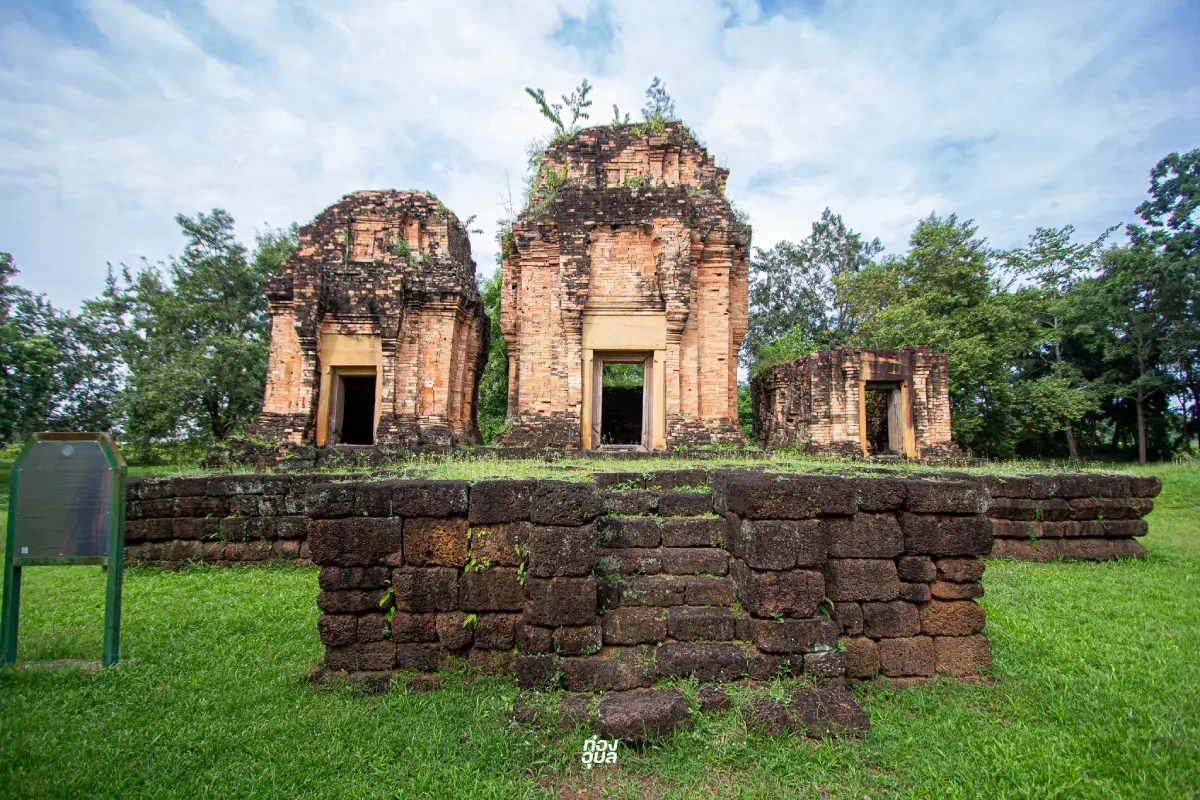
Prasat Ban Ben in Ubon Ratchathani, also written locally as Prasat Ban Benj or Prasat Ban Bèn, is a small ancient Khmer sanctuary located at Ban Nong Om, Nong Om Subdistrict, Thung Si Udom District, Ubon Ratchathani Province. It is one of the important archaeological sites that reflects the spread of ancient Khmer culture into the lower Isan region around the late 15th to early 16th Buddhist centuries. The site features 3 brick sanctuary towers arranged on a north-south axis, with laterite foundations, a laterite enclosure wall, an eastern gateway or gopura, traces of a four-sided pavilion base, a surrounding moat, and important sculptural evidence such as the Navagraha lintel and the Indra-on-Airavata lintel.
Prasat Ban Ben is open daily from 08.30 to 16.30, with no admission fee. It is suitable for travelers interested in Ubon Ratchathani history, archaeology, ancient Khmer art, architectural photography, and quiet cultural travel in a local community setting. This is not a large, crowded monument. Its charm lies in its calm atmosphere, shaded surroundings, and authentic remains of old brick, laterite, and sandstone. Visitors can experience a small but historically meaningful Khmer sanctuary that still retains the rural atmosphere of southern Ubon Ratchathani.
The monument stands in Nong Om Subdistrict, Thung Si Udom District, an area connected with the Det Udom – Nam Yuen route. From Ubon Ratchathani city, the distance is about 63 km. Travelers usually drive toward Det Udom District, continue along Highway 2192, and turn onto Highway 2214 before reaching Thung Si Udom District. The journey passes rural communities, agricultural fields, and quiet village landscapes, helping visitors understand the setting in which this ancient sanctuary remains today.
The first point to understand is that Prasat Ban Ben is a Brahmanic sanctuary, not a Buddhist stupa from a later period. Its architectural form belongs to the ancient Khmer tradition. The 3 brick towers are aligned north to south and face east, a significant orientation in Khmer religious architecture. The east is associated with first light, auspicious direction, and entry into sacred space. This orientation shows that the sanctuary was planned according to religious and cosmological ideas, not merely constructed as a functional building.
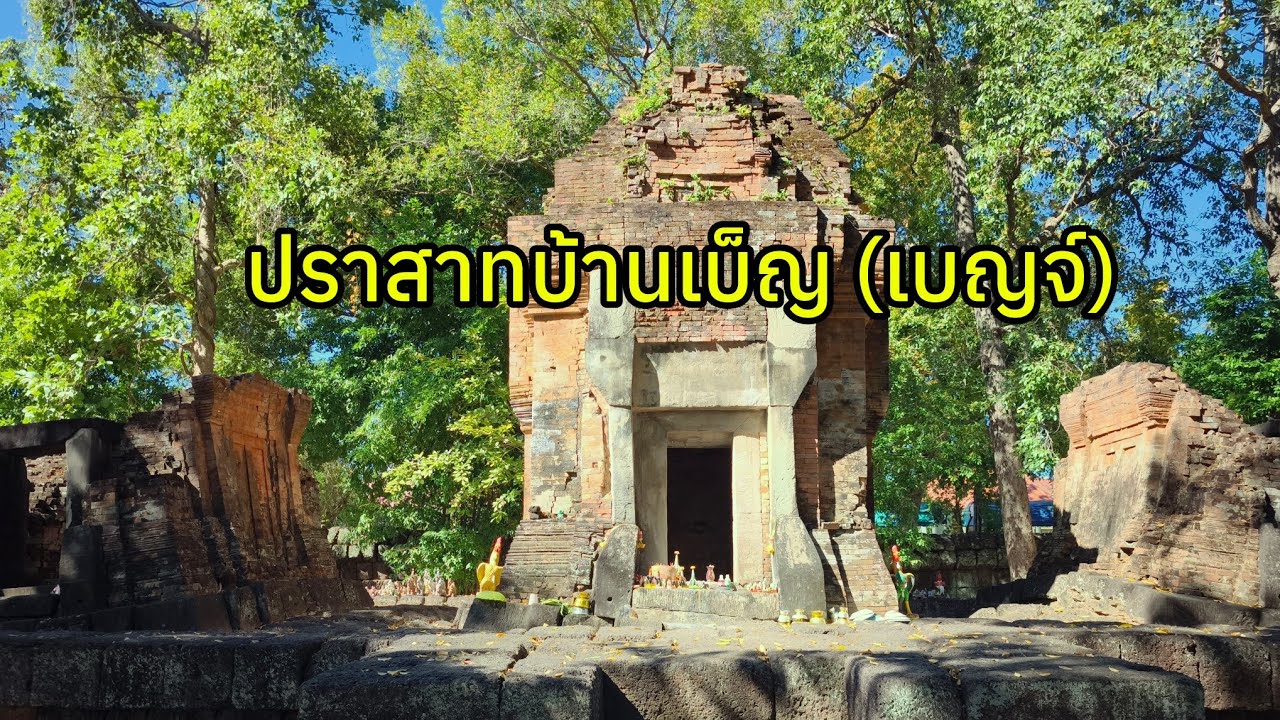
The towers were built with 3 main materials: brick, laterite, and sandstone. Brick was used for the sanctuary towers, laterite for the foundations and enclosure wall, and sandstone for finer architectural elements such as door frames, decorative door columns, and lintels. These materials are common in Khmer monuments across Northeastern Thailand because they served both structural and artistic purposes. When walking around the site, visitors can see the contrast between aged red brick, dark laterite, and sandstone fragments that once carried carved details.
The 3 brick sanctuaries are now partly ruined. The upper sections have collapsed over time, but the original layout remains clearly visible. Each tower has its main entrance on the east side, while the other sides include false doors, a common feature in Khmer sacred architecture. These false doors were not used as entrances. They completed the architectural form and carried symbolic meaning, making the sanctuary visually and spiritually complete from all directions.
A rectangular laterite enclosure wall surrounds the sanctuary group. This wall separated the sacred inner zone from the outside area. On the east side, traces of the gateway or gopura remain. This was the main entrance into the religious compound. Entering or viewing the monument from the east helps visitors understand how the sanctuary was originally approached, following the layout intended by its ancient builders.
Outside the eastern enclosure, there are traces of a four-sided pavilion base. This element shows that the site once had more than just the 3 towers. The pavilion may have served a ritual or functional role connected with the main sanctuary. Its remaining base helps modern visitors see Prasat Ban Ben as a complete religious complex rather than a simple cluster of brick ruins.
The moat surrounding the laterite wall is another important element. In Khmer religious sites, water features often held both practical and symbolic meanings. A moat marked the boundary between ordinary space and sacred space, and it also reflected cosmological ideas inherited from Indian religious thought and adapted in the Khmer world. Together with the towers, enclosure wall, eastern entrance, and pavilion base, the moat makes Prasat Ban Ben an architecturally and symbolically complete site.
In 1990, the Fine Arts Department conducted archaeological excavation and clearing at Prasat Ban Ben. Important evidence was discovered, especially a lintel depicting the Navagraha, the 9 planetary deities. Another important lintel shows Indra riding Airavata, his sacred elephant. These carved lintels confirm the sanctuary’s connection with Brahmanic belief and ancient Khmer religious art.
The Navagraha lintel from Prasat Ban Ben is especially important because of its high degree of completeness. It is now displayed at the Ubon Ratchathani National Museum, where it can be properly protected and studied. The sanctuary itself remains the original archaeological context of the discovery. Visitors who combine Prasat Ban Ben with the Ubon Ratchathani National Museum can understand both the site and the objects that once formed part of its sacred architecture.
The Indra-on-Airavata lintel also carries deep symbolic meaning. Indra is an important deity in Indian and Brahmanic tradition, while Airavata is his divine elephant mount. A lintel with this image was not just decorative. It was part of the sacred visual language of the sanctuary, linking gods, direction, power, and religious meaning with architecture.
Based on architectural planning and lintel carvings, Prasat Ban Ben is dated to around the late 15th to early 16th Buddhist centuries and is associated with the Khleang or Kleang style of ancient Khmer art. This was a period when Angkorian cultural influence expanded into the Khorat Plateau and lower Isan. Prasat Ban Ben therefore provides strong evidence that Ubon Ratchathani was connected with the wider Khmer cultural network of mainland Southeast Asia.
Compared with large restored Khmer monuments, Prasat Ban Ben feels intimate and local. The site is shaded by trees, including old lamduan trees that add atmosphere and calmness. The combination of old brick, laterite, tree roots, filtered light, and quiet surroundings creates a strong sense of history. Visitors do not encounter the monument as an isolated museum object, but as a living part of the rural landscape.
Inside the principal sanctuary, a linga base remains. This is important evidence confirming the site’s Brahmanic function, especially its connection with the worship of Shiva. The 2 secondary towers also contain traces of linga bases. These remains show that the interiors of the towers were not empty spaces, but sacred chambers used in ritual practice.
The arrangement of 3 towers is often connected with the Brahmanic concept of the Trimurti: Brahma, Vishnu, and Shiva. While ritual interpretation must always be based on evidence, the three-sanctuary layout clearly shows a structured religious plan. The value of Prasat Ban Ben does not come from its size, but from the way its architecture, orientation, materials, and symbolism work together.
Visitors should begin on the east side, where the original entrance and gopura were located. From there, the north-south alignment of the 3 brick towers can be seen clearly. After viewing the front, visitors should walk slowly around the laterite base to observe the materials, false doors, decorative wall columns, door frames, and the weathered brickwork. This slower approach reveals far more than a quick photo stop.
The laterite base is one of the most important visible features. Laterite was widely used in Khmer monuments because of its strength and suitability for foundations. It supports the brick towers and raises the sacred structures above the surrounding ground. The porous surface and dark color of laterite contrast strongly with the red brick above it, giving the monument its distinct visual identity.
The ruined condition of Prasat Ban Ben is part of its historical truth. The monument has endured rain, heat, humidity, soil movement, plant growth, and time for many centuries. Some walls lean, upper sections have collapsed, and brickwork has deteriorated. Yet the surviving remains still clearly communicate the original layout. Visitors should avoid climbing, sitting, stepping on, or touching fragile parts of the structure.
Prasat Ban Ben is ideal for photography and careful observation. Morning and late afternoon are the best times because the light is softer and the texture of brick and laterite becomes more visible. Doorways, sandstone frames, the laterite base, and the 3-tower alignment all offer strong photographic compositions. Photographers should keep a respectful distance and never move bricks, stones, or fragments.
Historically, Prasat Ban Ben shows that Thung Si Udom was not merely a rural agricultural area in the present day. It was once part of a cultural landscape connected with ancient Khmer religious architecture. The sanctuary, moat, enclosure wall, and carved lintels show a community that understood religious planning, sacred space, specialized materials, and artistic expression. The site therefore works like a document made of brick and stone.
The monument is also important to the identity of Thung Si Udom District. Its name is closely associated with local heritage and cultural tourism. The existence of an ancient Khmer sanctuary in the community gives local residents a source of pride and gives visitors a deeper understanding of Ubon Ratchathani’s historical diversity. The province is not only known for the Mekong River, Buddhist temples, and natural sites. It also contains important evidence of ancient Khmer culture.
The main zones inside the site include the principal sanctuary, the northern sanctuary, the southern sanctuary, the laterite base, the laterite enclosure wall, the eastern gopura zone, the four-sided pavilion base, the surrounding moat, and the shaded area around the ruins. Each zone tells a different part of the story. The central tower represents sacred focus, the wall marks the boundary, the moat expresses spatial and symbolic separation, and the pavilion base shows that ritual activity once extended beyond the towers themselves.
Prasat Ban Ben can be visited as a single historical stop or combined with nearby attractions. Travelers interested in archaeology can combine it with Prasat Thong Lang, another Khmer-influenced ancient monument in southern Ubon Ratchathani. Visiting both sites in one day helps visitors compare layout, materials, preservation, and the relationship between Khmer monuments and rural landscapes.
For a broader local trip, visitors can continue to the Det Udom Tree Tunnel, Yang Reservoir, Wat Pa Sai Ngam, Wat Saeng Kasem, and Wat Wet Wan Witthayaram. These places add natural scenery, community atmosphere, local temples, and recreational stops to the route. A one-day trip from Ubon Ratchathani city can begin at Prasat Ban Ben in the morning and continue through Det Udom before returning to the city or staying overnight in the district.
Prasat Ban Ben is also valuable as an outdoor classroom. Students and researchers can study ancient Khmer art, building materials, sanctuary planning, Brahmanic symbolism, local geography, and cultural heritage conservation at the actual site. Seeing the brickwork, laterite, door frames, and layout directly gives a deeper understanding than reading about the monument alone.
For international travelers, Prasat Ban Ben helps explain the history of lower Isan within the wider context of Southeast Asia. The site connects Ubon Ratchathani with ancient Khmer culture, Brahmanic religion, and Angkorian artistic networks. Even without reading Thai, visitors can understand the meaning of the brick towers, laterite wall, moat, and carved lintel tradition as architectural evidence of a former sacred landscape.
The site is protected as a cultural heritage property under the Fine Arts Department, with local support from Nong Om authorities and the surrounding community. Conservation requires cooperation from government agencies, local residents, and visitors. Visitors should keep the area clean, avoid climbing on the ruins, never scratch or write on surfaces, and never remove bricks or stone fragments. These simple actions help preserve the monument for future generations.
Facilities at Prasat Ban Ben are simple. Visitors can expect an open-air ancient monument, information signs, open ground around the sanctuary, shaded areas, and nearby parking. Because the site is outdoors, visitors should bring drinking water, a hat or umbrella, and comfortable shoes. During the hot season, the sun can be strong. During the rainy season, the ground may be wet or slippery.
The best times to visit are morning and late afternoon. Morning offers a calm atmosphere, while late afternoon provides softer light for photography. Visitors who want to study the site carefully should allow at least 45 minutes to 1 hour to walk around the front, sides, rear, moat, enclosure wall, and pavilion base. A slower visit makes the monument more meaningful.
From a travel perspective, the strength of Prasat Ban Ben lies in its quietness and authenticity. The 3 brick towers standing under trees, the laterite base, and the old enclosure wall create a memorable atmosphere. Its beauty does not come from complete restoration. It comes from time, material, weathering, and the connection between the ruins and the rural community around them.
Prasat Ban Ben deserves clear recognition as an important cultural heritage site of Ubon Ratchathani. It shows that the province has many historical layers, from ancient Khmer cultural influence and Brahmanic religious practice to modern community identity. For travelers who want to understand Ubon Ratchathani beyond its better-known attractions, Prasat Ban Ben offers a quiet but powerful encounter with the art, belief, and history of lower Isan.
Visiting Prasat Ban Ben is not only about seeing old ruins. It is about reading civilization through material, proportion, orientation, and landscape. Every brick, laterite block, doorway, and remaining structure is a fragment of ancient belief and craftsmanship. When explored with attention, this small Khmer sanctuary becomes a bridge between the Angkorian past and the living communities of Ubon Ratchathani today.
| Name | Prasat Ban Ben / Prasat Ban Benj / Prasat Ban Bèn |
| Location | Ban Nong Om, Nong Om Subdistrict, Thung Si Udom District, Ubon Ratchathani Province, Thailand |
| Address | Nong Om Subdistrict, Thung Si Udom District, Ubon Ratchathani 34160, Thailand |
| Coordinates | 14.787797, 104.929149 |
| Highlights | Small ancient Khmer sanctuary with 3 brick towers, laterite enclosure wall, gopura, four-sided pavilion base, moat, and traces of ancient Khmer art |
| History | Brahmanic sanctuary in the ancient Khmer tradition, dated to the late 15th to early 16th Buddhist centuries and associated with the Khleang or Kleang style |
| Key Evidence | Navagraha lintel, Indra-on-Airavata lintel, linga bases, sandstone door-frame columns, and brick-laterite architectural remains |
| Excavation | The Fine Arts Department excavated and cleared the site in 1990. A highly complete Navagraha lintel was found and is now displayed at the Ubon Ratchathani National Museum. |
| Distinctive Features | Three brick towers aligned north to south, facing east, standing on a laterite base, with a rectangular laterite enclosure and a main eastern entrance |
| Travel Information | From Ubon Ratchathani city, travel toward Det Udom District, continue on Highway 2192, and turn onto Highway 2214 before Thung Si Udom District. The distance is about 63 km. |
| Current Status | Open as an outdoor ancient monument for public visits |
| Open Days | Daily |
| Opening Hours | 08.30 – 16.30 |
| Fees | No admission fee |
| Facilities | Open-air monument area, information signs, open grounds around the sanctuary, shaded areas, and nearby parking |
| Main Areas / Zones | Principal sanctuary, northern sanctuary, southern sanctuary, laterite base, laterite enclosure wall, eastern gopura zone, four-sided pavilion base, moat, and shaded area around the ruins |
| Caretaker | Fine Arts Department, Ministry of Culture / The 9th Regional Office of Fine Arts, Ubon Ratchathani, with local support from Nong Om authorities |
| Local Administrative Office | Nong Om Subdistrict Administrative Organization, Tel. 045-905-291 |
| Heritage Office | The 9th Regional Office of Fine Arts, Ubon Ratchathani, Tel. 045-312-846 |
| Nearby Tourist Attractions | 1. Prasat Thong Lang, about 23 km 2. Det Udom Tree Tunnel, about 24 km 3. Yang Reservoir, about 25 km 4. Wat Pa Sai Ngam, about 25 km 5. Wat Saeng Kasem, about 24 km 6. Wat Wet Wan Witthayaram, about 24 km |
| Nearby Restaurants | 1. Khrua Ban Thung, Khok Chamrae, about 10 km, Tel. 083-721-5059 2. Khom Daeng Noodle Soup, Det Udom Branch, about 24 km, Tel. 095-898-4547 3. Shabu Shogun Det Udom, about 24 km, Tel. 092-614-9362, 080-269-6515 4. Phor Kan Det Udom, about 24 km, Tel. 088-822-6478 5. Dib Dee Det Udom, about 25 km, Tel. 083-248-3617 6. Tractor Moo Kratha Det Udom Branch, about 24 km, Tel. 062-914-6966 |
| Nearby Accommodations | 1. Pruksa Resort Det Udom, about 24 km, Tel. 065-554-6256 2. Ruean Thong Sin Resort Det Udom, about 24 km, Tel. 082-687-7617 3. The Orange Grand Resort, about 24 km, Tel. 084-584-9168 4. Ruean Rak Resort Det Udom, about 24 km, Tel. 064-296-3265 5. Ha Dao Resort, about 25 km, Tel. 080-795-0679 |
Frequently Asked Questions (FAQ)
Q: Where is Prasat Ban Ben located?
A: Prasat Ban Ben is located at Ban Nong Om, Nong Om Subdistrict, Thung Si Udom District, Ubon Ratchathani Province, Thailand.
Q: What are the opening hours of Prasat Ban Ben?
A: Prasat Ban Ben is open daily from 08.30 to 16.30.
Q: Is there an admission fee for Prasat Ban Ben?
A: No. There is no admission fee, but visitors should keep the site clean and avoid climbing on the ancient structures.
Q: What is special about Prasat Ban Ben?
A: The site features 3 brick sanctuary towers aligned north to south on a laterite base, facing east, with a laterite wall, gopura, four-sided pavilion base, and surrounding moat.
Q: How old is Prasat Ban Ben?
A: Prasat Ban Ben is dated to around the late 15th to early 16th Buddhist centuries and is associated with the Khleang or Kleang style of ancient Khmer art.
Q: What important evidence was found at Prasat Ban Ben?
A: Important evidence includes the Navagraha lintel, the Indra-on-Airavata lintel, linga bases, sandstone door-frame columns, and brick-laterite architectural remains.
Q: Who takes care of Prasat Ban Ben?
A: Prasat Ban Ben is protected by the Fine Arts Department under the Ministry of Culture, with involvement from the 9th Regional Office of Fine Arts in Ubon Ratchathani and local Nong Om authorities.
Q: What places can be visited after Prasat Ban Ben?
A: Nearby places include Prasat Thong Lang, the Det Udom Tree Tunnel, Yang Reservoir, Wat Pa Sai Ngam, Wat Saeng Kasem, and Wat Wet Wan Witthayaram.
 Category: ●Art, Culture and Heritage
 Group: ●Historical Sites and Monuments
Last Update : 4 MonthAgo
 Last Update : 4 MonthAgo
 Click to Access the Navigation Map GPS
Prasat Ban Ben Map
Recommend
 Historical Sites and Monuments(5)
 Landmarks and Memorials(2)
 Royal Palace(1)
 Art, Craft Centres, Tradition(7)
 Museums(3)
 University
 Public university(1)
 Autonomous Universities(1)
 Rajabhat University(1)
 Private University(2)
 Places of Worship
 Temple(38)
 Other Sacred Sites(4)
 Research and Development
 Royal Project(2)
 Suburban Living
 Village, Community(2)
 Local Market(4)
 Nature and Wildlife
 National Parks and Marine Reserves(5)
 Mountain (Doi)(6)
 Dam, Reservoir, Lake(8)
 Waterfalls(12)
 Hot Springs(1)
 Caves(2)
 River, Canal(11)
 Bays and Beaches(8)
 Islands(2)
 Other natural attractions(6)
 Entertainment and Agricultural
 Zoos and Aquariums(2)
 Animal camps and shows(1)
 Farms, Parks and Ecotourism(1)
 Waterpark(1)
 Shopping
 Shopping and Night Market(1)
 Department Store(2)
 Travel Articles, Recipes
 Travel Review, Food Review(1)


