
lovethailand home >Northeastern Travel Attractions >Ubon Ratchathani Travel Attractions >Khuang Nai >Chi Thuan > Lion Pulpit at Ban Chi Thuan
TL;DR: Lion Pulpit at Ban Chi Thuan is located at Sermon Hall of Wat Si Nuan Saeng Sawang Arom, Ban Chi Thuan, Cheethuan Subdistrict, Khueang Nai District, Ubon Ratchathani Province, open Daily, hours 08.00 – 17.00.
Lion Pulpit at Ban Chi Thuan
Open Days: Daily
Opening Hours: 08.00 – 17.00
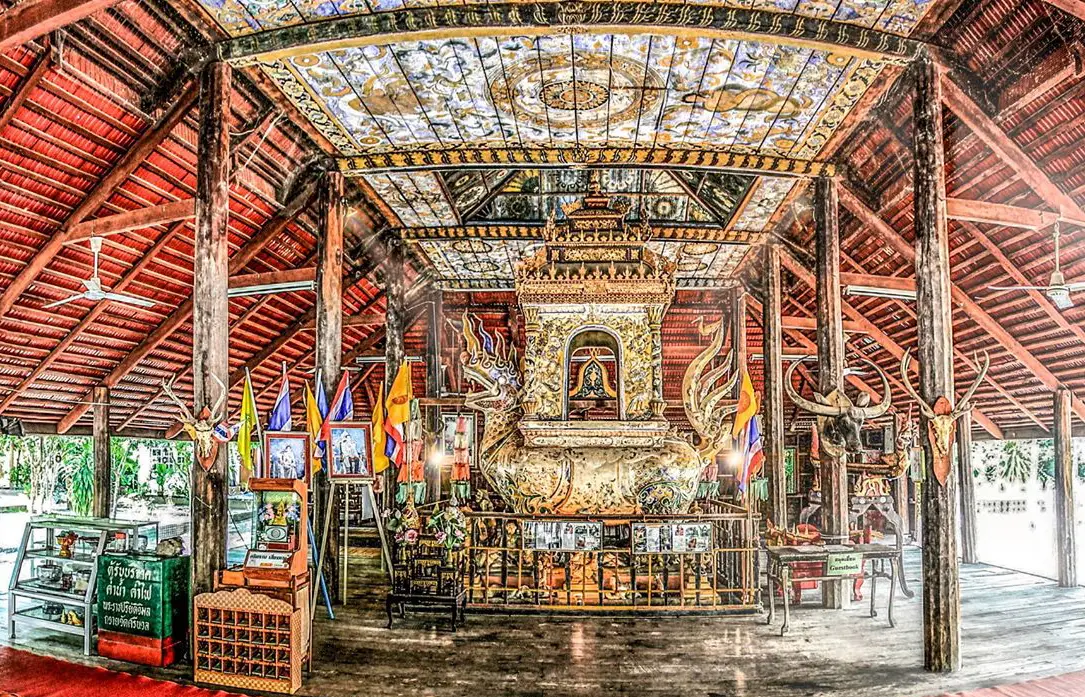
The Vietnamese-Style Lion Pulpit at Ban Chi Thuan, Ubon Ratchathani is one of the most distinctive local cultural treasures in Cheethuan Subdistrict, Khueang Nai District. It is housed inside the sermon hall, locally called Ho Chaek, of Wat Si Nuan Saeng Sawang Arom in Ban Chi Thuan. Unlike ordinary Thai Buddhist pulpits, this one takes the form of a standing mythical lion supporting a busabok, or sacred pavilion-like sermon seat, above its back. The lion body was built with brick and plaster, while the upper pavilion was constructed with tiered wooden elements. The entire structure is decorated with stucco reliefs, colored paintings, mirrored glass, and Vietnamese-style ornamentation blended with Thai, Isan, Chinese, and Buddhist artistic ideas.
The Vietnamese-Style Lion Pulpit is open daily from 08.00 to 17.00, with no admission fee. It is suitable for travelers interested in local Isan art, Vietnamese-influenced craftsmanship, old temple architecture, community history, and traditional Buddhist sermon culture. The site is not a large commercial attraction. Its value lies in the rare artistry of the pulpit, the quiet atmosphere of the wooden sermon hall, and the living village-temple setting that still surrounds it. Visitors can closely observe the pulpit, the Ho Chaek, ceiling paintings, temple grounds, and the cultural context of Ban Chi Thuan in one visit.
Wat Si Nuan Saeng Sawang Arom is located in Ban Chi Thuan, Cheethuan Subdistrict, Khueang Nai District, Ubon Ratchathani Province. The temple belongs to the Mahanikaya order of Thai Buddhism. According to local records, it was established in 1797 by Ya Khru Kom, who led local villagers in founding the temple. Later, a woman named Si Nuan donated additional land for the temple expansion, which led villagers to call it Wat Si Nuan. The name Saeng Sawang Arom was later added, and the full name Wat Si Nuan Saeng Sawang Arom has been used ever since. The temple received its royal consecrated boundary in 1804.
The lion pulpit was created between 1925 and 1927. A Vietnamese craftsman named Wiang, locally known as Kaeo Wiang, built the lion base and the pulpit structure from brick and plaster. The naga stairway, surrounding railing, and swan pillars were created by Phra Upatcha Wong Phrommasaro, the abbot at that time, together with Khamma Saeng-ngam, later recognized as a National Artist in visual arts. This cooperation between a Vietnamese craftsman, a monk-artisan, and local Isan craftsmen gave the pulpit its unique artistic identity.
The main feature of the pulpit is the standing lion supporting a busabok. The lion is large, built with brick and plaster, and decorated with stucco reliefs, colored glass, and painted motifs. Its head is powerful, with an open mouth and striking eyes. Yet the creature is not limited to a conventional Thai lion form. Its tail and some details resemble a Chinese or Vietnamese mythical bird, while the claws look more bird-like than lion-like. This hybrid form gives the sculpture movement, character, and a highly distinctive visual presence.
The busabok above the lion serves as the monk’s sermon seat. It has an enclosed square chamber with arched openings on all 4 sides. The walls are decorated with low-relief stucco and painted motifs, including deities, celestial figures, birds, animals, plants, dragons, Chinese-style figures, Thai-style figures, and people dressed in Western clothing. These images show that the craftsmen were not restricted to a single artistic tradition. Instead, they created a visual record of cultural exchange in a rural Isan Buddhist temple.
The upper part of the busabok is made of tiered woodwork. It is carved and decorated with mythical animals, deities, birds, floral patterns, Thai-style motifs, gilding, red-background painting, and mirrored glass in some sections. From a distance, the pulpit appears as a lion carrying a small sacred palace. From close range, the viewer discovers many layers of detail, each showing careful craftsmanship and symbolic meaning.
The materials and construction method make this pulpit especially unusual. Many Thai temple pulpits are made from carved wood, lacquer, gilding, or painted wooden panels. This pulpit, however, uses brick-and-plaster construction for the lion body and sermon chamber, with a wooden tiered top. The result is both sculpture and architecture. It has the weight and permanence of a built structure, while also preserving the decorative richness of local religious art.
In Buddhist practice, a pulpit is the elevated seat from which monks deliver sermons. In Isan, it is strongly connected with Thet Mahachat, Bun Phawet, and other sermon traditions. The lion pulpit therefore is not merely decorative. It once functioned as a sacred speaking platform where Buddhist teachings were presented to the community. The lion represents strength, protection, and dignity, while the busabok represents an elevated seat for the Dhamma. Together, they form a powerful image of the Dhamma being upheld and protected.
The pulpit is closely connected with Ban Chi Thuan’s traditional Pathom Somphot sermon and Mahachat sermon culture. In earlier times, monks used palm-leaf manuscripts written in traditional Dhamma script and delivered sermons in Isan melodic style. The pulpit therefore connects sound, scripture, monks, villagers, and Buddhist ritual in one cultural setting. It is a stage for faith, language, memory, and performance.
The pulpit later became the focus of serious conservation. In 1993, local villagers recognized its value and joined with the Fine Arts Department to support restoration and preservation. The pulpit was registered as a national cultural heritage object, and its active use was discontinued to protect its original condition. Because of this conservation work, Wat Si Nuan Saeng Sawang Arom received an Outstanding Architectural Conservation Award in 2013 from the Association of Siamese Architects under Royal Patronage.
The sermon hall that houses the pulpit is also important. Known locally as Ho Chaek, it is a traditional Isan wooden hall raised above the ground. Its interior includes ceiling paintings on wood and metal sheets, depicting Rahu, flowers, leaves, animals, stars, nagas, swans, and other motifs. The hall is not simply a protective cover for the pulpit. It is part of the same artistic environment and preserves the atmosphere of old community religious gatherings.
When visitors enter the Ho Chaek, the lion pulpit becomes the visual center of the space. Its height relates to the wooden roof structure, while the colors, glass details, and filtered light create different visual impressions throughout the day. Some details are best viewed close up, such as dragons, birds, floral designs, and human figures. The full impact of the pulpit is best seen from the front, where the standing lion and the busabok above can be viewed together.
The northern side of the pulpit includes painted stucco images of deities, celestial figures, Chinese-style motifs, and animals among plants. The southern side includes birds, worshipping soldiers, and saluting soldiers. The eastern side includes Chinese-style figures, Thai-style figures, and people dressed in Western clothing. These details show the social and artistic imagination of the early 20th century, when local religious art absorbed many visual influences and translated them into a temple setting.
The back of the pulpit includes stucco motifs of birds on branches, a person standing on an elephant, and a deity standing on a horse. There are also gilded carved wooden windows and a 3-tiered wooden upper structure with rich carving. The stairway area includes naga elements and protective forms leading up to the sermon seat. The stairway was more than a functional access point. It was part of the ritual path used by monks ascending to preach.
The value of the Vietnamese-Style Lion Pulpit lies in the integration of form, ornament, material, and artistic philosophy. The lion belongs to mythic and religious imagination. The busabok represents the elevated seat of sacred teaching. Vietnamese and Chinese influences appear in line, color, animal forms, and decorative compositions. Thai and Isan identity appear through the Buddhist pulpit, sermon tradition, and temple context. This fusion makes the pulpit one of the most important works of local religious art in Ubon Ratchathani.
Ban Chi Thuan is an old cultural community with several important heritage sites. A visit to the lion pulpit can be combined with Wat That Suan Tan, Wat Thung Si Wilai, Khua Noi Ban Chi Thuan, the Ban Chi Thuan Tree Tunnel, and the Ancient Boat Remains at Wat Amphawan Naram. This route allows visitors to understand the wider identity of Ban Chi Thuan through temples, sacred images, old boats, local bridges, trees, waterways, and rural landscapes.
Wat That Suan Tan adds another historical dimension to the trip. It is connected with an ancient boat and the Chi River way of life. Wat Thung Si Wilai houses Luang Pho Phra Phuttha Wiset, a highly respected laterite Buddha image. When these temples are visited together, Ban Chi Thuan appears not as a village with one isolated artwork, but as a cultural landscape with many layers of Buddhist faith, local history, craftsmanship, and community memory.
Khua Noi Ban Chi Thuan and the Ban Chi Thuan Tree Tunnel add rural atmosphere to the route. Khua Noi reflects older patterns of local movement and agricultural life, while the tree tunnel creates a shaded and pleasant village route. Combining these places with the lion pulpit gives travelers a balanced experience of art, religion, history, and rural Isan scenery. The area is suitable for a half-day or full-day cultural trip from Ubon Ratchathani city.
Getting There is straightforward by private car, rental car, or hired vehicle. From Ubon Ratchathani city, take Highway 23 on the Ubon Ratchathani – Yasothon route for about 22 km to Ban Tha Waree, then turn onto Highway 2412 and continue about 5 km into Ban Chi Thuan. The total distance from the city is about 26 km. This makes the site one of the most accessible community-based cultural attractions near Ubon Ratchathani city.
The best times to visit are morning and late afternoon. Morning is suitable for paying respect at the temple, viewing the sermon hall, and photographing the pulpit in a calm atmosphere. Late afternoon is good for continuing to nearby temples and village sites. Visitors should dress politely because the site is inside an active Buddhist temple. Shoes should be removed where required, and visitors should not touch the pulpit, climb onto it, or use flash close to painted and stucco surfaces.
The best way to view the pulpit is to first stand in front and observe the overall form: the lion body, the busabok, and the relationship with the hall. Then visitors can slowly move to the sides and rear, keeping a respectful distance. Important details include the lion head, body, wings, tail, naga stairway, swan pillars, arched openings, upper tiers, painted panels, mirrored glass, and ceiling paintings. Each part helps explain the craftsmanship and cultural fusion behind the work.
The pulpit is also suitable for students, researchers, and local studies. It connects many topics: Ban Chi Thuan history, Vietnamese-influenced art, stucco work, folk painting, Ho Chaek architecture, Buddhist sermon traditions, Bun Phawet, and cultural heritage conservation. Seeing the actual work inside its original village-temple setting gives a deeper understanding than learning about it from text alone.
For international travelers, the Vietnamese-Style Lion Pulpit at Ban Chi Thuan is an excellent introduction to the cultural diversity of Isan. In one work, visitors can see Buddhism, Vietnamese craftsmanship, Chinese motifs, Thai-Isan temple culture, and rural community heritage. It shows that Thai temple art is not a single uniform tradition. It has many local forms created through migration, craftsmanship, belief, and cultural exchange.
The Vietnamese-Style Lion Pulpit at Ban Chi Thuan is therefore more than a beautiful temple object. It is a living record of a community that understood the value of its own heritage. Wat Si Nuan Saeng Sawang Arom preserves faith and memory, while the pulpit preserves the skill of Vietnamese artisans, monk-artisans, local craftsmen, and the Buddhist sermon tradition of Ban Chi Thuan. For travelers who want to understand Ubon Ratchathani beyond major landmarks, this quiet cultural site offers one of the most distinctive and meaningful experiences in the province.
| Name | Vietnamese-Style Lion Pulpit at Ban Chi Thuan |
| Location | Sermon Hall of Wat Si Nuan Saeng Sawang Arom, Ban Chi Thuan, Cheethuan Subdistrict, Khueang Nai District, Ubon Ratchathani Province, Thailand |
| Address | Moo 2, Ban Chi Thuan, Cheethuan Subdistrict, Khueang Nai District, Ubon Ratchathani 34150, Thailand |
| Coordinates | 15.28269, 104.66156 |
| Highlights | A lion-shaped Buddhist pulpit supporting a busabok, built with brick and plaster, topped with tiered woodwork, and decorated with stucco reliefs, painted motifs, mirrored glass, and Vietnamese-Isan artistic fusion |
| History | Created between 1925 and 1927 by a Vietnamese craftsman named Wiang, or Kaeo Wiang, together with Phra Upatcha Wong Phrommasaro and Khamma Saeng-ngam |
| Cultural Significance | A rare local religious artwork connected with Isan sermon traditions, Thet Mahachat, Bun Phawet, Vietnamese-influenced craftsmanship, and Ban Chi Thuan community heritage |
| Distinctive Features | Large standing lion body, arched sermon chamber, tiered wooden upper structure, deities, celestial figures, dragons, birds, animals, plants, mirrored glass, and multi-cultural painted scenes |
| Travel Information | From Ubon Ratchathani city, take Highway 23 for about 22 km to Ban Tha Waree, then turn onto Highway 2412 and continue about 5 km to Ban Chi Thuan. The total distance is about 26 km. |
| Current Status | Open as a cultural learning site inside Wat Si Nuan Saeng Sawang Arom and one of the key heritage attractions of Ban Chi Thuan |
| Open Days | Daily |
| Opening Hours | 08.00 – 17.00 |
| Fees | No admission fee |
| Facilities | Temple grounds, sermon hall, worship area, pulpit viewing area, shaded areas, and parking space in or near the temple area |
| Main Areas / Zones | Lion pulpit area, Ho Chaek sermon hall, ceiling-painting area, ordination hall, temple courtyard, and community merit-making area |
| Abbot / Caretaker | Phra Athikan Wan Thanuttaro / Wat Si Nuan Saeng Sawang Arom, together with Ban Chi Thuan community and local authorities |
| Local Administrative Office | Cheethuan Subdistrict Administrative Organization, Tel. 045-210-624 |
| Cultural Activity | Traditional Pathom Somphot sermon, Thet Mahachat, Bun Phawet, and local Buddhist merit-making ceremonies of Ban Chi Thuan |
| Nearby Tourist Attractions | 1. Wat Thung Si Wilai, about 1 km 2. Wat That Suan Tan, about 2 km 3. Ban Chi Thuan Tree Tunnel, about 2 km 4. Khua Noi Ban Chi Thuan, about 3 km 5. Ancient Boat Remains at Wat Amphawan Naram, about 4 km 6. Wat Phra That Nong Bua, Mueang Ubon Ratchathani, about 30 km |
| Nearby Restaurants | 1. Khrua Rim Nam Khueang Nai, about 16 km, Tel. 081-997-5145 2. Khrua Rim Thang Khueang Nai, about 17 km, Tel. 099-757-5998 3. O Saep Khueang Nai, about 17 km, Tel. 093-454-9566 4. Fish Cafe Khueang Nai, about 18 km, Tel. 088-348-5351 5. Sao Mi Haeng Thai Restaurant, about 19 km, Tel. 087-375-6859 |
| Nearby Accommodations | 1. Somprarthana Resort, about 27 km, Tel. 083-128-6330 2. YUU HOTEL & Cafe Ubon Ratchathani, about 30 km, Tel. 085-614-1111 3. Tohsang Heritage Ubon Hotel, about 31 km, Tel. 045-245-531 4. V Hotel Ubon, about 33 km, Tel. 097-334-4480 5. Laithong Hotel, about 32 km, Tel. 098-118-0194 |
Frequently Asked Questions (FAQ)
Q: Where is the Vietnamese-Style Lion Pulpit at Ban Chi Thuan located?
A: It is located inside the sermon hall of Wat Si Nuan Saeng Sawang Arom in Ban Chi Thuan, Cheethuan Subdistrict, Khueang Nai District, Ubon Ratchathani Province, Thailand.
Q: What are the opening hours?
A: The site is open daily from 08.00 to 17.00.
Q: Is there an admission fee?
A: No. There is no admission fee, but visitors should dress politely and respect temple rules.
Q: When was the lion pulpit built?
A: It was created between 1925 and 1927 by a Vietnamese craftsman named Wiang, or Kaeo Wiang, together with Phra Upatcha Wong Phrommasaro and Khamma Saeng-ngam.
Q: What makes the pulpit unique?
A: It is shaped as a standing lion supporting a busabok, built with brick and plaster, topped with tiered woodwork, and decorated with Vietnamese-style stucco, painted motifs, mirrored glass, and Thai-Isan religious elements.
Q: What traditions is the pulpit connected with?
A: It is connected with the traditional Pathom Somphot sermon, Thet Mahachat, and Bun Phawet traditions of Ban Chi Thuan.
Q: What nearby places can be visited after the pulpit?
A: Nearby places include Wat Thung Si Wilai, Wat That Suan Tan, Ban Chi Thuan Tree Tunnel, Khua Noi Ban Chi Thuan, and the Ancient Boat Remains at Wat Amphawan Naram.
Q: What type of traveler is this site suitable for?
A: It is suitable for travelers interested in local art, Vietnamese-influenced craftsmanship, Isan Buddhist culture, community history, photography, and quiet cultural travel.
 Category: ●Art, Culture and Heritage
 Group: ●Landmarks and Memorials
Last Update : 2 MonthAgo
 Last Update : 2 MonthAgo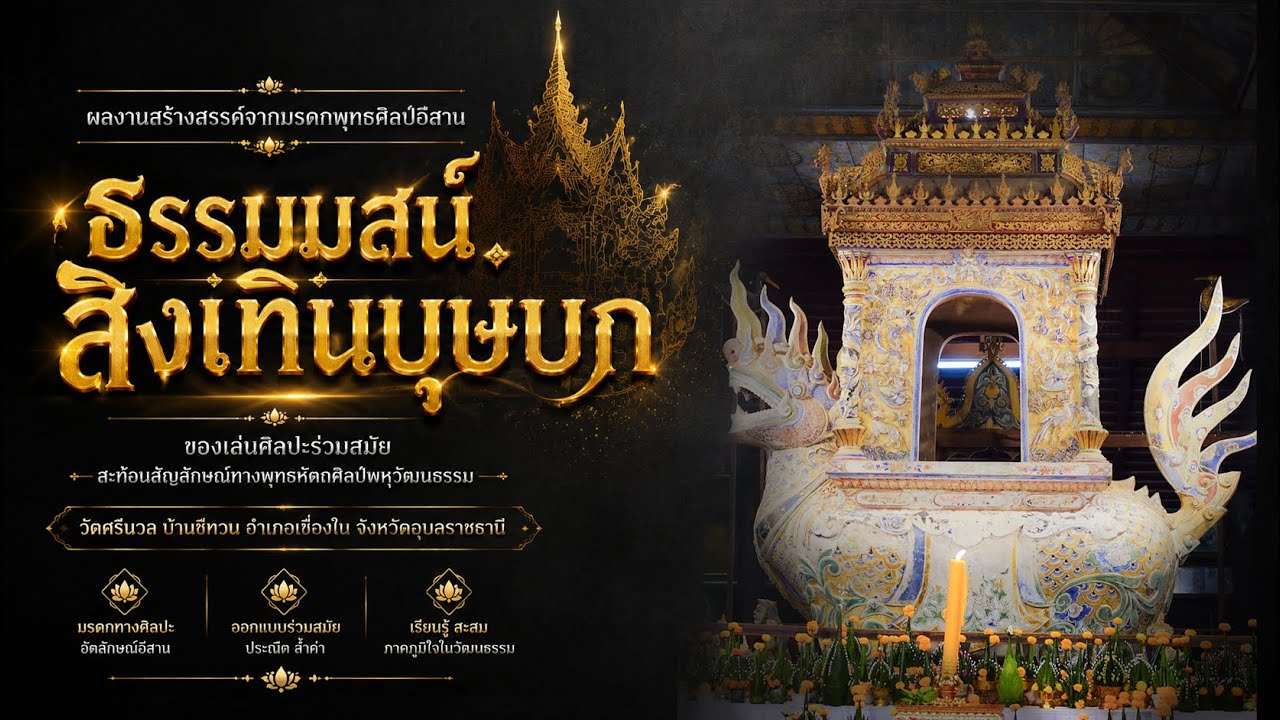
 Click to Access the Navigation Map GPS
Lion Pulpit at Ban Chi Thuan Map
Recommend

 Historical Sites and Monuments(5)
Landmarks and Memorials(2)
Historical Sites and Monuments(5)
Landmarks and Memorials(2)
 Royal Palace(1)
 Art, Craft Centres, Tradition(7)
 Museums(3)
 Places of Worship
 Temple(37)
 Other Sacred Sites(4)
 Research and Development
 Royal Project(2)
 Suburban Living
 Village, Community(2)
 Local Market(4)
 Nature and Wildlife
 National Parks and Marine Reserves(5)
 Mountain (Doi)(6)
 Dam, Reservoir, Lake(8)
 Waterfalls(12)
 Hot Springs(1)
 Caves(2)
 River, Canal(11)
 Bays and Beaches(8)
 Islands(2)
 Other natural attractions(6)
 Entertainment and Agricultural
 Zoos and Aquariums(2)
 Animal camps and shows(1)
 Farms, Parks and Ecotourism(1)
 Waterpark(1)
 Travel Articles, Recipes
 Travel Review, Food Review(1)


