
lovethailand home >Northeastern Travel Attractions >Si Sa Ket Travel Attractions >Kan Thara Rom >Nong Waeng > Fon Klong Tum
TL;DR: Fon Klong Tum, open Fon Klong Tum is performed according to the Bun Bang Fai, or Rocket Festival, hours Fon Klong Tum is traditionally performed during the daytime procession of the.
Fon Klong Tum
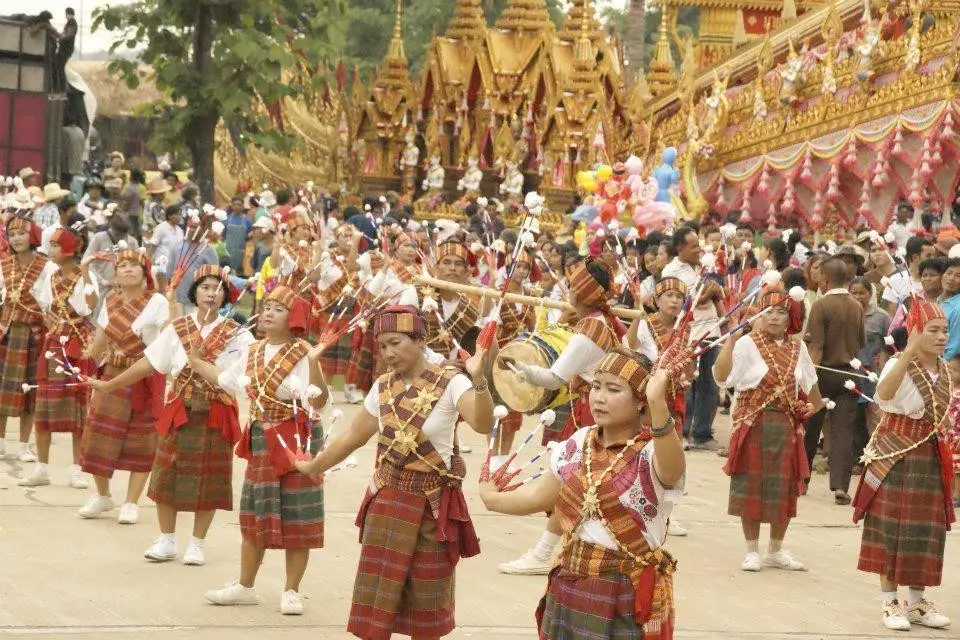
Open Days: Fon Klong Tum is performed according to the Bun Bang Fai, or Rocket Festival, schedule of Ban Nong Kaew community, usually around the 6th lunar month. It is not a permanent attraction with a fixed daily opening schedule.
Opening Hours: Fon Klong Tum is traditionally performed during the daytime procession of the Rocket Festival. At night, the local festival may include Fon Ngu Kin Khiat, a playful courtship-style folk dance between men and women.
Fon Klong Tum is a distinctive folk dance heritage of Ban Nong Kaew, Nong Kaew Subdistrict, Kanthararom District, Si Sa Ket Province. It is closely associated with the Isan Rocket Festival, locally held around the 6th lunar month, the time when agricultural communities prepare for the rainy season and the rice-growing cycle. The dance is accompanied by the deep sound of the Klong Tum drum and the sharp metallic rhythm of the Phang Hat. It is performed to honor Phaya Thaen, the sky deity believed in Isan folklore to control rainfall. For this reason, Fon Klong Tum is not simply a folk performance. It is a ritualized community expression of faith, rain-seeking, agricultural hope, and village solidarity.
Ban Nong Kaew is a community connected with the Mun and Chi river basin landscape, agriculture, local water systems, seasonal merit-making, and village cooperation. Fon Klong Tum developed within this environment. The Rocket Festival is a community event in which villagers symbolically send rockets to the sky to request rain from Phaya Thaen. The dance supports this ritual atmosphere by inviting people into the festival, energizing the procession, and expressing the unity of the community before the beginning of a new farming season.
The most important visual quality of Fon Klong Tum is its simplicity, strength, and collective rhythm. The dance does not emphasize the delicate refinement of classical court dance. Instead, it uses clear arm movements, body rhythm, and steps that match the drum pattern. Dancers move in a procession led by the drum and Phang Hat players. In some parts, they dance backward, creating a unique visual rhythm. The beauty of the dance comes from group coordination, colorful costume, the sound of the drum, and the visible energy of the community.
In the past, Fon Klong Tum was performed only by men. This reflected the older character of the Rocket Festival, which was strongly associated with male youth, physical energy, and village ritual excitement. Over time, women joined the dance, and in the present day both men and women can participate depending on the community context. This change shows that the tradition has adapted while preserving its central identity. The dance remains alive because it allows new generations and wider groups of villagers to take part.
The key period for Fon Klong Tum is the daytime of the Rocket Festival in the 6th lunar month. The dance is performed in procession, led by the Klong Tum and Phang Hat. At night, the same local festival may include Fon Ngu Kin Khiat, a courtship-style folk dance that creates playful interaction between men and women. Together, these activities show that the Rocket Festival includes devotion, humor, entertainment, social bonding, and ritual meaning. Fon Klong Tum should therefore be understood as part of the complete Rocket Festival tradition, not as an isolated stage performance.
The belief in Phaya Thaen is central to the meaning of Fon Klong Tum. In Isan cosmology, Phaya Thaen is a powerful sky being associated with rain, fertility, and the well-being of agricultural communities. When villagers launch rockets and perform festival dances, they are symbolically communicating with the sky, asking for rain to nourish the fields. Fon Klong Tum is a bodily language through which villagers express hope for seasonal balance, fertile rice fields, and a successful farming year.
Unlike some formal performance traditions, Fon Klong Tum does not begin with a separate wai khru ceremony. When the time comes, the dancers begin according to the drum rhythm and the inherited style of the community. This does not mean that teachers are unimportant. Respect for teachers and elders is embedded in the way the tradition is transmitted. Older dancers teach younger dancers by direct practice, rehearsal, observation, and participation in real village festivals.
Fon Klong Tum has three main dance movements, each carrying symbolic meaning. The first is the invitation gesture. Dancers lift both arms with elbows open and move the arms up and down beside the body in alternating left-right rhythm. This gesture invites relatives, neighbors, and guests to join the joyful merit-making event. It opens the festival space and signals that everyone in the community has a place in the celebration.
The second movement represents unity. Dancers raise both open hands and cross them at forehead level with bent elbows. This movement expresses the solidarity of villagers who come together to prepare and celebrate the Rocket Festival. A successful festival requires many forms of cooperation: preparing rockets, arranging the event area, cooking, welcoming guests, managing the procession, and maintaining safety. The symbolic meaning of this movement therefore reflects the real work of the community.
The third movement expresses the idea of moving toward a shared goal. Dancers extend both arms forward with the palms parallel to each other. This gesture represents the community’s shared intention to preserve good traditions and continue the inherited cultural path. The backward movement seen in the dance adds a unique visual character. It shows discipline, coordination, and confidence in the drum rhythm.
Academic research on Fon Klong Tum in Ban Nong Kaew describes the development of the dance in two periods. In the first period, around 1807–1897, the movements were not yet fixed into a formal pattern. In the second period, from around 1897 onward, the dance developed into a clearer structure with three major movements: invitation, pledge or unity, and courtship. This development shows how a village folk practice gradually became a recognizable local performing-arts heritage with its own identity.
The two key musical instruments are Klong Tum and Phang Hat. Klong Tum is a double-headed drum made from hardwood, traditionally with drumheads of cowhide or buffalo hide. It produces a deep, grounded sound. The drumstick is made of solid hardwood without padding, giving the sound a raw and direct quality. Phang Hat resembles a gong without a boss and is struck to add a bright rhythmic accent. Together, they create the pulse of the dance.
The musical arrangement is highly distinctive. The Klong Tum drum and Phang Hat are carried on the same pole by two people facing each other. One person plays the drum while the other strikes the Phang Hat. The carriers lead the dance procession. The memorable rhythm is often heard as “tum-pae-tum.” When the dance movement changes, the Phang Hat player gives the signal. This creates a close relationship between music, movement, and procession leadership.
The beauty of Fon Klong Tum lies in collective coordination rather than delicate solo technique. The movements are simple, but when many dancers move together in the same rhythm, the procession becomes powerful. The viewer sees not only dance but community order. The sound of the drum, the colored costumes, the rhythm of footsteps, and the shared gesture of the dancers combine into one cultural image of village unity.
The costume is an important part of the dance’s visual identity. Dancers commonly wear white shirts or colors chosen by the community, silk sarongs, Khid-patterned shoulder cloth, Khid-patterned head cloth, waist cloth, traditional earrings, Tum Pe or old-style ornaments, wrist and ankle bracelets, a small mirror necklace, and long finger extensions called Suay Mue. These elements make the procession bright and ceremonial, especially under the daylight of the Rocket Festival.
Khid cloth plays a major role in the costume. It may be used for the head wrap, shoulder cloth, cross-body decoration, and waist tie. Khid weaving reflects local textile skill and village aesthetics. When the dancer moves, the cloth gives the body color, line, and rhythm. The costume therefore connects Fon Klong Tum with another form of local wisdom: traditional weaving.
Traditional ornaments such as Tum Pe, arm ornaments, bracelets, anklets, and ear ornaments strengthen the ritual character of the dance. A small mirror may be worn around the neck. It is used practically for dressing but also creates flashes of light during movement. Local explanation links this brightness with the wish for heaven and earth to see the hardship of human beings and respond with rain. This gives the costume a deeper symbolic layer.
Suay Mue, or long finger extensions, are another outstanding feature. They are made from woven bamboo attached to the fingers, often with white cloth tied at the tips. When dancers lift and move their hands, the Suay Mue lengthens the visual line of the fingers and arms. Although Fon Klong Tum is not a delicate court dance, the long finger extensions make the arm movements more striking and beautiful in procession.
The tradition is transmitted through community teaching rather than formal classroom instruction. Older dancers teach younger dancers by rehearsal and participation. Children see the costumes, hear the drum, follow the procession, and gradually learn the movements. As they grow up, they may become dancers, musicians, costume helpers, or festival organizers. This direct transmission keeps the dance alive as a living practice rather than a museum record.
At the social level, Fon Klong Tum creates village unity. Before the Rocket Festival, the community prepares instruments, costumes, dance groups, procession order, food, welcoming areas, and ritual elements. Rehearsals allow elders, working-age villagers, youth, and children to meet and work together. The dance becomes a social mechanism through which Ban Nong Kaew renews its identity every year.
The participation of children and youth is especially important. When young people dress in local costume, dance in the procession, hear praise from elders, and feel the excitement of the festival, they come to see the tradition as part of their own life. Cultural transmission becomes successful because it is joyful and participatory. The children do not merely hear about tradition; they perform it.
Fon Klong Tum is also a cultural identity marker for Nong Kaew Subdistrict and Kanthararom District. It helps distinguish the community from other areas. The local slogan that mentions the drum tradition shows that Klong Tum is part of the public identity of Nong Kaew. Travelers who learn about Fon Klong Tum gain a deeper understanding of the community beyond landscape, agriculture, and local attractions.
In cultural tourism, Fon Klong Tum should be presented together with the Rocket Festival context. It should not be separated completely from its ritual meaning. The dance was born from belief in Phaya Thaen, the need for rain, rice agriculture, and community cooperation. Watching Fon Klong Tum is therefore not only watching movement and costume. It is learning how Isan villagers use sound, dance, and festival to speak to the sky and the land.
Visitors who want to learn about Fon Klong Tum should use Ban Nong Kaew, Nong Kaew Subdistrict, Kanthararom District, Si Sa Ket Province, as the cultural starting point. Because the dance is not performed daily, visitors should contact Nong Kaew Subdistrict Administrative Organization or the local community before traveling. This helps confirm the Rocket Festival schedule, visitor rules, parking areas, and proper conduct.
Getting There to Nong Kaew can be done from Si Sa Ket city toward Kanthararom District, then onward to Ban Nong Kaew by local roads. Travelers arriving by train can get off at Kanthararom Railway Station and continue by local transport to Nong Kaew. A cultural route can include Hua Na Dam, Wat Champa Folk Museum, Mun River and Chi River community landscapes, and local longboat-racing heritage sites within Nong Kaew Subdistrict.
Visitors should observe the dance respectfully. They should dress politely, avoid walking across the procession, avoid touching instruments or costumes without permission, avoid disturbing dancers, and ask before taking close-up photographs of performers, children, elders, or people preparing costumes. Drones or recording equipment should not be used in ways that disturb safety or ritual order. Respecting the host community is part of understanding the tradition.
Today, Fon Klong Tum remains a living cultural heritage of Ban Nong Kaew. Some forms have adapted to modern contexts: dancers may be men and women, costumes may be organized for public presentation, and the dance may be demonstrated at cultural events. Still, the central identity remains: the Rocket Festival, Phaya Thaen, Klong Tum, Phang Hat, the three main movement patterns, and the unity of the community. Preserving these elements keeps the dance meaningful.
Fon Klong Tum is therefore more than a folk dance. It is the memory of Ban Nong Kaew, a lesson in Isan cooperation, a ritual expression of rain belief, and a bridge between older and younger generations. The sound “tum-pae-tum” is not only a musical rhythm. It is the sound of a community declaring that its tradition is still alive, its people still work together, and its faith in rain, rice, sky, and homeland remains strong.
| Tradition Name | Fon Klong Tum |
| Other Names | Ban Nong Kaew Klong Tum Dance, Fon Klong Tum, Rocket Festival Drum Dance, Isan Klong Tum Procession Dance |
| Cultural Area | Ban Nong Kaew, Nong Kaew Subdistrict, Kanthararom District, Si Sa Ket Province, Thailand |
| Local Contact Address | Nong Kaew Subdistrict Administrative Organization, Moo 1, Ban Nong Kaew, Nong Kaew Subdistrict, Kanthararom District, Si Sa Ket 33130, Thailand |
| Cultural Type | Intangible Cultural Heritage Related To Folk Dance, Local Music, Rocket Festival Ritual, Isan Agricultural Life, Rain Belief, And Community Performance |
| Main Meaning | A Rocket Festival dance performed to honor Phaya Thaen, request seasonal rain, create festival joy, and express the unity of Ban Nong Kaew community |
| Ritual Period | Around the 6th lunar month each year during the local Rocket Festival |
| Performance Time | Performed during the daytime procession of the Rocket Festival; nighttime activities may include Fon Ngu Kin Khiat according to local custom |
| Current Status | Still preserved as a local folk dance and community performance tradition of Nong Kaew, used in the Rocket Festival and local cultural activities |
| Open Days | No fixed daily opening schedule. Viewing depends on the Rocket Festival or cultural activities organized by the community. |
| Opening Hours | Determined by the annual festival or community event schedule |
| Fees | No fixed tourist admission fee. Participation depends on the community festival format and host regulations. |
| Main Dance Movements | 1. Invitation gesture 2. Unity or pledge gesture 3. Shared-goal or courtship gesture connected with preserving the tradition |
| Musical Instruments | Klong Tum and Phang Hat. Klong Tum is a double-headed hardwood drum with cowhide or buffalo-hide drumheads. Phang Hat resembles a gong without a central boss and is used for rhythmic accents and movement-change signals. |
| Signature Rhythm | The “tum-pae-tum” rhythm from Klong Tum and Phang Hat leads the procession and controls the dancers’ movement |
| Costume | White shirt or community-selected color, silk sarong, Khid-patterned shoulder cloth, Khid head cloth, waist cloth, traditional earrings, Tum Pe ornaments, bracelets, anklets, small mirror necklace, and Suay Mue finger extensions made from woven bamboo |
| Performers | Formerly male performers only; later women joined the dance, and in the present both men and women may participate depending on the community and cultural activity |
| Caretakers / Knowledge Holders | Ban Nong Kaew villagers, elder dancers, local knowledge holders, youth groups, musicians, Rocket Festival organizers, Nong Kaew Subdistrict Administrative Organization, and the community preserving the Klong Tum tradition |
| Local Contact | Nong Kaew Subdistrict Administrative Organization, Tel. 045-826167-8 Office Of The Permanent Secretary, Tel. 045-826168 Finance Division, Tel. 045-826167 |
| Main Areas / Activity Zones | 1. Fon Klong Tum procession zone 2. Klong Tum and Phang Hat instrument zone 3. Drum-and-Phang-Hat carrier zone 4. Male and female dancer zone 5. Costume and Suay Mue preparation zone 6. Rocket Festival procession zone 7. Phaya Thaen worship zone 8. Nighttime Fon Ngu Kin Khiat zone 9. Merit-making food and guest-welcoming zone 10. Youth cultural transmission zone |
| Visitor Etiquette | Dress politely, do not walk across the procession, do not disturb dancers, do not touch instruments, costumes, or Suay Mue without permission, ask before photographing individuals, and follow the host community’s instructions |
| Travel Information | Travel from Si Sa Ket city toward Kanthararom District, then continue to Ban Nong Kaew, Nong Kaew Subdistrict. By train, visitors can get off at Kanthararom Railway Station and continue by local transport to the community. |
| Nearby Tourist Attractions | 1. Ban Nong Kaew Community / Klong Tum Cultural Area, about 0 km 2. Hua Na Dam, Ban Kok, Nong Kaew Subdistrict, about 9 km 3. Wat Champa Folk Museum, Ban Hua Na, about 10 km 4. Ban Kok–Ban Hua Na Longboat-Racing Heritage Area, about 10 km 5. Kanthararom Railway Station, about 14 km 6. Kanthararom Town Center, about 15 km 7. Si Sa Ket Provincial Cultural Center, about 40 km |
| Nearby Restaurants | 1. Slow Life Cafe & Bistro, Dun Subdistrict, Kanthararom District, about 15 km, Tel. 064-086-5529 2. Jungle Cafe Kanthararom Branch, Dun Subdistrict, Kanthararom District, about 15 km, Tel. 085-055-0445 3. Lop Mum Restaurant Kanthararom, about 16 km, Tel. 086-582-7332 4. The Wine Room Cafe, Mueang Si Sa Ket, about 40 km, Tel. 082-678-7468 5. The Cup Cafe, Mueang Si Sa Ket, about 41 km, Tel. 095-742-6323 6. Jiree Cafe, Mueang Si Sa Ket, about 41 km, Tel. 080-799-1890 |
| Nearby Accommodations | 1. B2 Sisaket Boutique & Budget Hotel, about 40 km, Tel. 052-009-161, 088-263-2897 2. Boonsiri Boutique Hotel, about 41 km, Tel. 045-622-222, 045-622-555 3. Prompiman Hotel, about 41 km, Tel. 045-612-667, 045-612-696, 045-612-150 4. The Impress Sisaket, about 42 km, Tel. 045-961-566 5. Tree House Hotel Si Sa Ket, about 44 km, Tel. 045-611-563, 080-477-7854 |
Frequently Asked Questions (FAQ)
Q: What is Fon Klong Tum?
A: Fon Klong Tum is a folk dance of Ban Nong Kaew, Nong Kaew Subdistrict, Kanthararom District, Si Sa Ket Province. It is performed during the Isan Rocket Festival to honor Phaya Thaen and ask for seasonal rain.
Q: When is Fon Klong Tum performed?
A: It is usually performed around the 6th lunar month during the Rocket Festival. The dance takes place during the daytime procession, while nighttime activities may include Fon Ngu Kin Khiat according to local custom.
Q: How many main movements does Fon Klong Tum have?
A: It has three main movements: the invitation gesture, the unity or pledge gesture, and the shared-goal or courtship gesture connected with preserving the tradition.
Q: What musical instruments are used in Fon Klong Tum?
A: The main instruments are Klong Tum and Phang Hat. Klong Tum is a double-headed drum, while Phang Hat is a gong-like instrument without a central boss, used to add rhythm and signal movement changes.
Q: What do the dancers wear?
A: Dancers usually wear a white shirt or community-selected color, silk sarong, Khid-patterned cloth, head wrap, waist cloth, traditional ornaments, bracelets, anklets, small mirror necklace, and bamboo finger extensions called Suay Mue.
Q: Is there an admission fee to watch Fon Klong Tum?
A: There is no fixed tourist admission fee because it is a community tradition performed during local festivals. Viewing depends on the annual Rocket Festival or cultural activity schedule.
Q: Who should visitors contact before going to see Fon Klong Tum?
A: Visitors should contact Nong Kaew Subdistrict Administrative Organization or Ban Nong Kaew community before traveling to confirm festival dates, visitor rules, parking, and local arrangements.
Q: Why is Fon Klong Tum important to the community?
A: It preserves the Rocket Festival tradition, the belief in Phaya Thaen, local music, community unity, youth participation, and the cultural identity of Ban Nong Kaew in Kanthararom District.
 Category: ●Art, Culture and Heritage
 Group: ●Art, Craft Centres, Tradition
Last Update : 2 WeekAgo
 Last Update : 2 WeekAgo

 Historical Sites and Monuments(12)
 Landmarks and Memorials(1)
Art, Craft Centres, Tradition(8)
Landmarks and Memorials(1)
Art, Craft Centres, Tradition(8)
 Places of Worship
 Temple(13)
 Other Sacred Sites(3)
 Suburban Living
 Village, Community(2)
 Nature and Wildlife
 National Parks and Marine Reserves(2)
 Dam, Reservoir, Lake(7)
 Waterfalls(5)
 River, Canal(5)
 Bays and Beaches(2)
 Entertainment and Agricultural
 Zoos and Aquariums(1)
 Farms, Parks and Ecotourism(3)


