
lovethailand home >Northeastern Travel Attractions >Si Sa Ket Travel Attractions >Bueng Bun >Bueng Bun > Wat Si Bueng Burapha
TL;DR: Wat Si Bueng Burapha is located at Ban Non Sao Suai, Moo 4, Bueng Burapha Subdistrict, Bueng Burapha District, Si Sa Ket Province 33220, Thailand, open Daily, hours 08.00 - 17.00.
Wat Si Bueng Burapha
Open Days: Daily
Opening Hours: 08.00 - 17.00
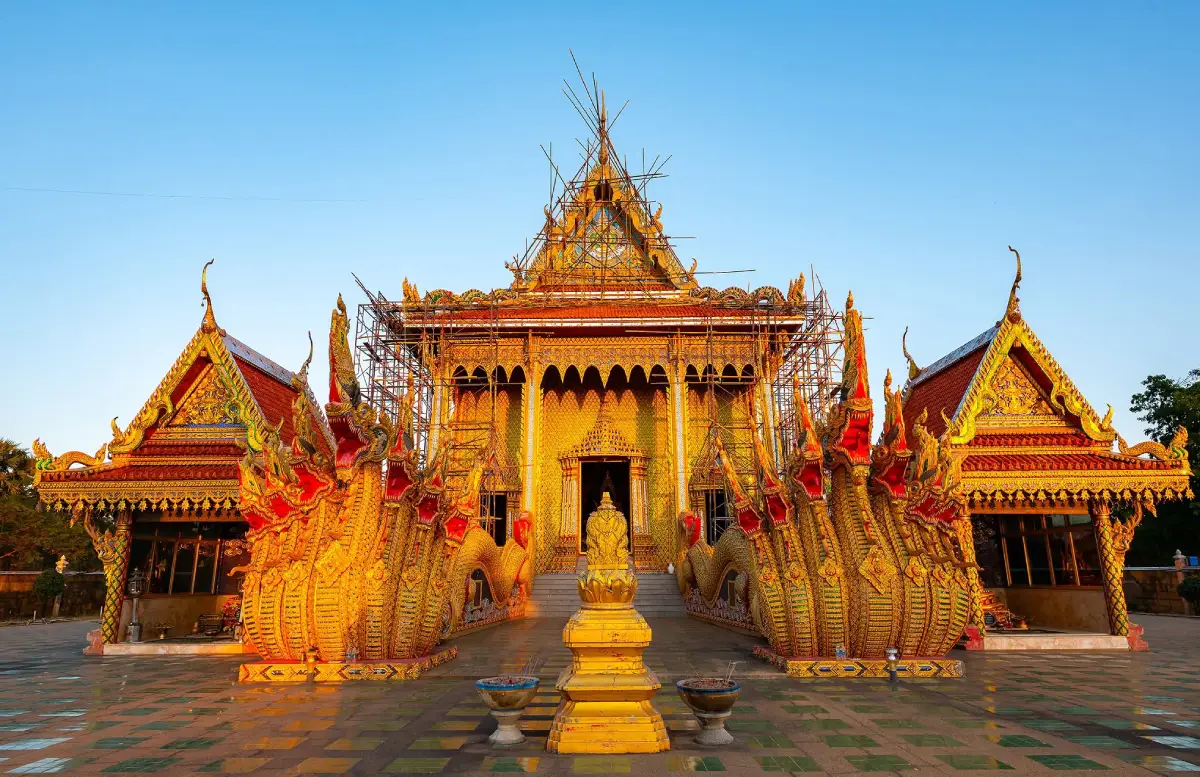
Wat Si Bueng Burapha, Si Sa Ket, is an important Buddhist temple in Ban Non Sao Suai, Moo 4, Bueng Burapha Subdistrict, Bueng Burapha District, Si Sa Ket Province. The temple stands on the bank of the Huai Thap Than waterway and is widely known for its golden ordination hall, the second replica of Phra Buddha Chinnarat in Thailand, the Rainbow Castle or Phra That Si Bueng Burapha, the Reuan Kaeo pavilion, the shrine of Chao Pho Upparat, and the long-boat tradition of the local community. This temple is one of the most distinctive faith-based and cultural destinations in Lower Isan because it combines Buddhism, local belief, Khmer-influenced visual language, riverside culture, and contemporary sacred architecture in one place.
The temple was developed through the vision of Phra Achan Si Chantasaro, a respected monk who intended to create a Buddhist and sacred complex for monastic practice, meditation, and public devotion. His intention was to make Wat Si Bueng Burapha a Buddhist heritage site of Lower Isan, a place where monks could practice and laypeople could gather in faith. The temple therefore should not be understood only as a beautiful temple for photography. It is a sacred landscape built to support religious practice, local identity, and community unity.
The setting of Wat Si Bueng Burapha gives it a special atmosphere. Because the temple is located beside Huai Thap Than, visitors experience both sacred architecture and riverside scenery. The open space, water, wind, and quiet surroundings make the temple feel peaceful and spacious. In local life, waterways are not only natural features. They support settlement, farming, ceremonies, and community memory. For this reason, the riverside setting of Wat Si Bueng Burapha is an important part of its identity.
The approach to the temple is visually striking. At the entrance, visitors see a gateway influenced by ancient Khmer art. The pediment features the image of Shiva, and large naga sculptures stand on both sides. This combination shows the layered culture of Lower Isan, where Buddhist temples often preserve visual references to Hindu and Khmer artistic traditions. The gateway prepares visitors for a temple landscape where Buddhist faith, local belief, and regional art are interwoven.
The central highlight of the temple is the golden ordination hall. It is built with an architectural language that blends Ayutthaya, Rattanakosin, and Lower Isan styles. The building is bright, elegant, and highly detailed. It has 32 pillars and 5 carved teakwood doors. These wooden doors are especially impressive because they reflect careful craftsmanship and respect for the sacred function of the building. The hall is not only an architectural landmark but also the main spiritual space of the temple.
Inside the golden ordination hall is the second replica of Phra Buddha Chinnarat in Thailand. Phra Buddha Chinnarat is one of the most revered Buddha images in Thai Buddhist art, and its replica at Wat Si Bueng Burapha gives the temple major spiritual significance. Visitors come to pay respect, offer flowers and garlands, and pray for blessings. The Buddha image gives the temple its devotional center and attracts both local worshippers and travelers from other areas.
The interior of the ordination hall is also decorated with mural paintings depicting Jataka stories and episodes from the life of the Buddha. These murals serve as visual Dhamma lessons. They teach moral values, compassion, effort, wisdom, and the working of karma through narrative art. Visitors who take time to observe the murals will understand that the hall is not only beautiful but also educational. It uses art as a way to communicate Buddhist teachings.
Another major sacred structure is the Rainbow Castle, also known as Phra That Si Bueng Burapha. This building blends Rattanakosin art with regional Isan forms and is decorated with ornate patterns and crystal details. Its surface changes in light and color, giving it the name Rainbow Castle. Inside is an image of Phra Sri Ariya Maitreya carved from seven-colored jade. This sacred image represents the future Buddha and carries the meaning of compassion, hope, and spiritual continuity in Buddhist belief.
Phra That Si Bueng Burapha stands about 35 meters high and is positioned toward the northeast side of the temple. It was built as a sacred stupa-like castle for the Bueng Burapha community and for the Huai Thap Than riverside landscape. The structure creates a strong visual identity for the temple. Together with the golden ordination hall, the Reuan Kaeo pavilion, and the river, it forms one of the most recognizable temple landscapes in Si Sa Ket Province.
Phra Achan Si Chantasaro remains central to the temple’s story. His vision was to create a place where sacred architecture could support Dhamma practice and community faith. The temple’s buildings are therefore not merely decorative. They are intended to provide places for worship, reflection, meditation, and merit-making. The temple’s identity as Buddhist heritage of Lower Isan comes directly from this combination of faith, practice, and artistic creation.
Wat Si Bueng Burapha is a local Buddhist temple with resident monks. The current abbot is Phra Khru Mongkhon Burapha Kit (Suthon), who oversees the temple together with the resident monastic community, the Bueng Burapha community, and related local agencies. The temple continues to function as an active religious site where people make merit, pay respect to the Buddha image, join Buddhist ceremonies, and take part in community traditions.
The Chao Pho Upparat shrine is another important place inside the temple. Chao Pho Upparat is a local protective spirit respected by the people of Bueng Burapha. The shrine shows how local belief and Buddhism coexist naturally in Lower Isan. In many communities, temples are not only places for formal Buddhist practice. They also preserve local protective beliefs, ancestral memory, and shared respect for the unseen guardians of the community.
The Reuan Kaeo pavilion is another beautiful area of the temple. Between the golden ordination hall and the Reuan Kaeo pavilion is the huea suang, or racing long boat. Phra Achan Si Chantasaro brought this boat from Ban Pong District as a symbolic lesson for the people of Bueng Burapha. A long boat cannot move successfully unless all rowers work in the same rhythm. It therefore teaches unity, discipline, shared effort, and cooperation.
The meaning of the long boat is deeply connected with community life. Bueng Burapha is a riverside area, and water, boats, and local festivals are part of its identity. Placing the racing boat inside the temple turns a cultural object into a moral teaching. It reminds people that a community can move forward only when its members act together. In this way, the temple uses local culture to communicate Buddhist and social values.
Wat Si Bueng Burapha is also known for its annual royal-trophy long-boat race. This event links the temple, the Huai Thap Than waterway, and the wider community. During the festival period, the temple becomes both a religious and cultural center. Local people gather for merit-making, ceremonies, boat racing, food, and community activities. The long-boat tradition shows that the temple is not a static attraction. It is a living social space that brings people together.
Other annual activities include worship of Phra Buddha Chinnarat, an elephant-feeding ritual, an underwater rocket festival tradition, and related local events. These activities show the cultural richness of Bueng Burapha. The temple serves as a place where Buddhist devotion, local belief, seasonal celebration, and community identity are preserved and renewed. For visitors, the annual festival period offers the clearest view of the temple’s living role.
The riverside landscape is essential to the experience of the temple. Huai Thap Than gives the temple a calm and open atmosphere. The water reflects light, carries wind through the temple grounds, and connects the sacred area with local ways of life. A temple beside water often feels more spacious and contemplative, and Wat Si Bueng Burapha uses this natural setting to strengthen its role as a place of worship and rest.
The ordination hall faces the Huai Thap Than waterway, and the opposite side is connected with the wider regional landscape toward Surin Province. This gives the temple a borderland character, both geographically and culturally. It stands in Si Sa Ket but is shaped by neighboring cultural currents. Visitors can see Thai Buddhist practice, Khmer-influenced art, local spirit belief, Isan aesthetics, and riverside community life together in one temple.
The route to the temple is convenient. From Si Sa Ket city, travel on the Si Sa Ket–Bueng Burapha route for about 20 kilometers. From Bueng Burapha town, continue about 3 kilometers to the temple. The road is paved throughout. Private car or hired local transport is the most convenient option, especially for visitors who wish to combine the temple with nearby restaurants, cafés, riverside areas, or other destinations in Bueng Burapha and nearby districts.
Getting There is simple enough for a half-day trip. Visitors can begin with worship inside the golden ordination hall, pay respect to the second replica of Phra Buddha Chinnarat, see the murals, walk to the Reuan Kaeo pavilion, visit the Chao Pho Upparat shrine, see the racing long boat, and then continue to the riverside area. The temple can also be combined with local restaurants and cafés in Bueng Burapha or routes toward Uthumphon Phisai, Rasi Salai, and Si Sa Ket city.
There is no fixed tourist admission fee at Wat Si Bueng Burapha. Visitors may enter during opening hours to pay respect, make merit, admire the architecture, and enjoy the riverside atmosphere. Donations, flowers, garlands, candles, incense, and merit-making offerings are voluntary according to personal faith. This keeps the temple accessible to villagers, pilgrims, students, Thai travelers, and international visitors.
The best time to visit is in the morning or late afternoon before closing. Morning is suitable for worship and a peaceful walk. Late afternoon is especially good for observing the golden ordination hall and the riverside setting under softer light. During annual festival periods, visitors can experience the temple as a lively community space, especially when the long-boat race and local ceremonies take place.
Photography is popular at Wat Si Bueng Burapha because the temple has many visually impressive points: the Khmer-style gateway, naga sculptures, golden ordination hall, wide courtyard, Reuan Kaeo pavilion, Rainbow Castle, racing boat, and riverside scenery. Visitors should photograph respectfully, avoid disturbing worshippers, avoid climbing on temple structures or naga bases, and avoid entering monks’ private areas without permission.
Proper etiquette is important. Visitors should dress modestly, remove shoes where required, speak quietly inside sacred buildings, avoid touching Buddha images or sacred objects without permission, keep the temple clean, and behave carefully near the riverside. Since the temple is an active place of worship, visitors should always remember that local people come here to pray, make merit, and participate in religious life.
For those interested in art and culture, Wat Si Bueng Burapha is a valuable place to understand Lower Isan. The temple presents Khmer-influenced gateway art, Ayutthaya-Rattanakosin-inspired architecture, Isan Buddhist devotion, local protective belief through Chao Pho Upparat, and riverside boat culture through the racing long boat. These layers make the temple a compact cultural map of Bueng Burapha and Si Sa Ket.
For international travelers, Wat Si Bueng Burapha is a strong example of a living Thai temple in Lower Northeastern Thailand. It shows that Thai Buddhism is not separated from community life, local spirit belief, art, festivals, and natural surroundings. The temple combines sacred architecture, a revered Buddha image, mural painting, riverside landscape, and long-boat culture in a way that is easy to understand and visually memorable.
Wat Si Bueng Burapha is therefore suitable for worship, photography, cultural learning, and quiet travel. The second replica of Phra Buddha Chinnarat is the spiritual heart of the temple. The golden ordination hall is the architectural heart. The Rainbow Castle is the contemporary sacred landmark. The Chao Pho Upparat shrine represents local belief. The racing long boat represents unity. Huai Thap Than provides the natural heart of the landscape. Together, these elements make the temple one of the most meaningful destinations in Bueng Burapha District.
In summary, Wat Si Bueng Burapha is one of the important faith-based attractions of Si Sa Ket Province. It brings together the second replica of Phra Buddha Chinnarat, the golden ordination hall, the Rainbow Castle, the Reuan Kaeo pavilion, Chao Pho Upparat shrine, racing long boat, and the Huai Thap Than riverside atmosphere in one place. It is beautiful to the eye and meaningful in cultural depth. Visitors gain not only photographs but also an understanding of faith, community, art, nature, and unity in Lower Isan.
| Place Name | Wat Si Bueng Burapha, Si Sa Ket |
| Related Names | Wat Si Bueng Burapha, Second Replica Of Phra Buddha Chinnarat, Phra That Si Bueng Burapha, Rainbow Castle, Reuan Kaeo Pavilion, Chao Pho Upparat Shrine, Wat Si Bueng Burapha Long Boat |
| Place Type | Local Buddhist Temple, Meditation And Devotional Site, Lower Isan Buddhist Heritage Site, Faith-Based Cultural Attraction, And Riverside Community Landmark Of Bueng Burapha District |
| Location | Ban Non Sao Suai, Moo 4, Bueng Burapha Subdistrict, Bueng Burapha District, Si Sa Ket Province 33220, Thailand |
| Setting | Located beside the Huai Thap Than waterway, with a peaceful riverside atmosphere connected to the local community life of Bueng Burapha |
| Distance From Key Points | About 20 km from Si Sa Ket city and about 3 km from Bueng Burapha town by paved road |
| Significance | A Lower Isan Buddhist heritage site developed through the vision of Phra Achan Si Chantasaro as a place for monastic practice, devotion, and community faith |
| Historical Summary | The temple was developed through the intention of Phra Achan Si Chantasaro to create a Buddhist and sacred complex on the bank of Huai Thap Than for meditation, worship, and the spiritual unity of the Bueng Burapha community. |
| Important Founder Figure | Phra Achan Si Chantasaro, the respected monk who initiated the creation of Wat Si Bueng Burapha as a Lower Isan Buddhist heritage site |
| Abbot / Caretaker | Phra Khru Mongkhon Burapha Kit (Suthon), Abbot Of Wat Si Bueng Burapha, together with resident monks, the Bueng Burapha community, and related local agencies |
| Resident Monks | 5 Resident Monks |
| Main Sacred Objects | The second replica of Phra Buddha Chinnarat in Thailand, the seven-colored jade image of Phra Sri Ariya Maitreya inside the Rainbow Castle, Chao Pho Upparat Shrine, and the principal Buddha image inside the ordination hall |
| Architectural Highlights | Golden ordination hall blending Ayutthaya and Rattanakosin styles, 32 pillars, 5 carved teakwood doors, Khmer-influenced entrance gate, paired naga sculptures, Reuan Kaeo pavilion, and the Rainbow Castle / Phra That Si Bueng Burapha |
| Main Annual Traditions | Worship of Phra Buddha Chinnarat, elephant-feeding ritual, underwater rocket festival tradition, and royal-trophy traditional long-boat race |
| Current Status | Active Buddhist temple and faith-based cultural destination where visitors can pay respect, see the golden ordination hall, Rainbow Castle, Reuan Kaeo pavilion, and riverside landscape during opening hours |
| Open Days | Daily |
| Opening Hours | 08.00 - 17.00 |
| Admission Fee | Free Admission. Donations, flowers, garlands, candles, incense, and merit-making offerings are voluntary according to personal faith. |
| Main Areas / Zones | 1. Khmer-Influenced Entrance Gate And Naga Zone 2. Golden Ordination Hall Zone 3. Second Replica Of Phra Buddha Chinnarat Zone 4. Jataka And Buddha Life Mural Zone 5. Rainbow Castle / Phra That Si Bueng Burapha Zone 6. Seven-Colored Jade Phra Sri Ariya Maitreya Zone 7. Reuan Kaeo Pavilion Zone 8. Chao Pho Upparat Shrine Zone 9. Huea Suang / Racing Long-Boat Zone 10. Temple Courtyard And Merit-Making Area 11. Huai Thap Than Riverside Zone 12. Traditional Long-Boat Festival Area |
| Facilities | Temple courtyard, Phra Buddha Chinnarat worship area, ordination hall, pavilion, riverside walking area, photo spots, parking in areas arranged by the temple or community, and basic services in Bueng Burapha District |
| Related Contact | Wat Si Bueng Burapha, Tel. 045-689-506 Bueng Burapha District / Community Development Office, Tel. 081-822-6192, 045-689-521 Bueng Burapha Hospital, Tel. 045-689-043, 045-689-317 |
| Travel Information | From Si Sa Ket city, use the Si Sa Ket - Bueng Burapha route for about 20 km. From Bueng Burapha town, continue about 3 km to the temple. The road is paved throughout and is suitable for private car, van, or hired local transport. |
| Visitor Etiquette | Dress modestly, keep quiet, remove shoes where required, do not touch Buddha images or sacred objects without permission, do not climb on naga bases or temple structures, respect monks and worshippers, and be careful near the riverside. |
| Nearby Tourist Attractions | 1. Huai Thap Than Riverside Area At Wat Si Bueng Burapha, about 0 km 2. Paninja Rafting, Bueng Burapha, about 3 km 3. Bueng Burapha Town, about 3 km 4. Wat Si Bueng Burapha Golden Ordination Hall, about 0 km 5. Wat Pa Neranchara / Ku Sombun, Po Subdistrict, about 18 km 6. Wat Samrong Phlan, Phrai Bueng District, about 32 km 7. Wat Prasat Yoe Nuea, Phrai Bueng District, about 35 km 8. Prasat Wat Sa Kamphaeng Yai, about 40 km 9. Wat Maha Phuttharam / Luang Pho To, Mueang Si Sa Ket, about 25 km 10. Si Sa Ket City, about 20 km |
| Nearby Restaurants | 1. De La Pla Bakery & Restaurant, Bueng Burapha, about 3 km, Tel. 081-063-4881 2. Ban Boon Thawee Cafe, Bueng Burapha, about 4 km, Tel. 099-205-0448 3. Paninja Rafting, Bueng Burapha, about 3 km 4. Aloca Cafe, Bueng Burapha, about 4 km, Tel. 088-718-4408 5. Restaurants In Bueng Burapha Town, about 3 km 6. Restaurants In Si Sa Ket City, about 20 - 25 km |
| Nearby Accommodations | 1. Bueng Burapha Resort, about 3 km, Tel. 088-586-2124 2. Boon Thawee Resort, Bueng Burapha, about 4 km, Tel. 089-718-9012 3. Onanong Resort, Uthumphon Phisai, about 28 km, Tel. 081-910-7046, 089-012-7059 4. KaewKwan Resort, Mueang Si Sa Ket, about 24 km, Tel. 062-496-6156, 086-450-1859, 081-977-5516 5. Tree House Hotel, Mueang Si Sa Ket, about 25 km, Tel. 045-611-563, 080-477-7854 6. B2 Sisaket Boutique & Budget Hotel, Mueang Si Sa Ket, about 25 km, Tel. 052-009-161, 088-263-2897 |
Frequently Asked Questions (FAQ)
Q: Where is Wat Si Bueng Burapha located?
A: Wat Si Bueng Burapha is located in Ban Non Sao Suai, Moo 4, Bueng Burapha Subdistrict, Bueng Burapha District, Si Sa Ket Province. It stands beside the Huai Thap Than waterway, about 3 km from Bueng Burapha town and about 20 km from Si Sa Ket city.
Q: What are the opening days and hours?
A: Wat Si Bueng Burapha is open daily from 08.00 to 17.00. Visitors can pay respect to the second replica of Phra Buddha Chinnarat, see the golden ordination hall, Rainbow Castle, Reuan Kaeo pavilion, and riverside area during these hours.
Q: Is there an admission fee?
A: There is no fixed tourist admission fee. Donations, flowers, garlands, candles, incense, and merit-making offerings are voluntary according to personal faith.
Q: Who is the current abbot of Wat Si Bueng Burapha?
A: The current abbot is Phra Khru Mongkhon Burapha Kit (Suthon). The temple is also supported by resident monks, the Bueng Burapha community, and related local agencies.
Q: Why is Phra Achan Si Chantasaro important to Wat Si Bueng Burapha?
A: Phra Achan Si Chantasaro is the important monk whose vision shaped Wat Si Bueng Burapha as a Buddhist and sacred heritage site of Lower Isan, created for monastic practice, devotion, and community faith.
Q: What are the main highlights inside Wat Si Bueng Burapha?
A: Main highlights include the golden ordination hall, the second replica of Phra Buddha Chinnarat in Thailand, the Rainbow Castle or Phra That Si Bueng Burapha, the seven-colored jade Phra Sri Ariya Maitreya, Reuan Kaeo pavilion, Chao Pho Upparat shrine, racing long boat, and the Huai Thap Than riverside setting.
Q: What annual traditions are associated with the temple?
A: Important traditions include worship of Phra Buddha Chinnarat, an elephant-feeding ritual, an underwater rocket festival tradition, and the royal-trophy traditional long-boat race, which connects the temple with the Huai Thap Than riverside community.
Q: How can visitors get to Wat Si Bueng Burapha?
A: From Si Sa Ket city, take the Si Sa Ket - Bueng Burapha route for about 20 km. From Bueng Burapha town, continue about 3 km to the temple. The road is paved throughout, and private car or hired local transport is the most convenient option.
 Category: ●Places of Worship
 Group: ●Temple
Last Update : 2 MonthAgo
 Last Update : 2 MonthAgo
 Click to Access the Navigation Map GPS
Wat Si Bueng Burapha Map

 Art, Culture and Heritage
 Historical Sites and Monuments(12)
 Landmarks and Memorials(1)
 Art, Craft Centres, Tradition(8)
Temple(13)
Art, Craft Centres, Tradition(8)
Temple(13)
 Other Sacred Sites(3)
 Suburban Living
 Village, Community(2)
 Nature and Wildlife
 National Parks and Marine Reserves(2)
 Dam, Reservoir, Lake(7)
 Waterfalls(5)
 River, Canal(5)
 Bays and Beaches(2)
 Entertainment and Agricultural
 Zoos and Aquariums(1)
 Farms, Parks and Ecotourism(3)


