
lovethailand home >Northeastern Travel Attractions >Si Sa Ket Travel Attractions >Muang Si Sa Ket >Ya Plong > Phra That Rueang Rong
TL;DR: Phra That Rueang Rong is located at Wat Ban Sang Rueang, Ban Sang Rueang, Ya Plong Subdistrict, Mueang Si Sa Ket District, Si Sa Ket Province 33000, Thailand, open Daily, hours 08.00 - 17.00.
Phra That Rueang Rong
Open Days: Daily
Opening Hours: 08.00 - 17.00
Phra That Rueang Rong, Si Sa Ket, is located inside Wat Ban Sang Rueang in Ban Sang Rueang, Ya Plong Subdistrict, Mueang Si Sa Ket District, Si Sa Ket Province. It is one of the most important Buddhist and cultural landmarks near Si Sa Ket city, standing about 7.5 kilometers north of the city along Highway 2373, the Si Sa Ket - Yang Chum Noi route. The site is both a sacred Buddhist stupa and a local museum, bringing together religious devotion, Lower Isan art, four-ethnic-group heritage, folk objects, meditation space, and a panoramic viewpoint in one building.
Phra That Rueang Rong is 49 meters high and was created as a place to enshrine sacred Buddhist relics. Its strongest visual and cultural identity comes from the artistic combination of four ethnic traditions of southern Isan: Lao, Suai or Kui, Khmer, and Yoe. These groups are deeply connected with the cultural identity of Si Sa Ket Province. The colors, forms, decorative details, murals, and exhibitions inside the building all reflect the diversity of local people, language, belief, craft, and way of life.
The stupa was built in 1982 by Luang Pu Thamma Phithaksa, a respected monk who was born in Ban Sang Rueang. His intention was to create a sacred Buddhist place where people in southern Isan could pay respect to Buddhist relics without having to travel far to other provinces. For local people, the construction of Phra That Rueang Rong was therefore not only an architectural project. It was an act of faith, a gift to the community, and a way to make Ban Sang Rueang an important Buddhist destination.
The history of Wat Ban Sang Rueang is closely connected with the transformation of local land into sacred space. The temple area was developed from an old cemetery area of Ban Sang Rueang. Luang Pu Thamma Phithaksa returned to his birthplace and led the development of the site into a village temple. The land was gradually expanded through donations and additional purchases until the temple became large enough to support the stupa, museum, worship areas, and community activities. This transformation from an old unused area into a living temple reflects the faith and cooperation of monks and villagers.
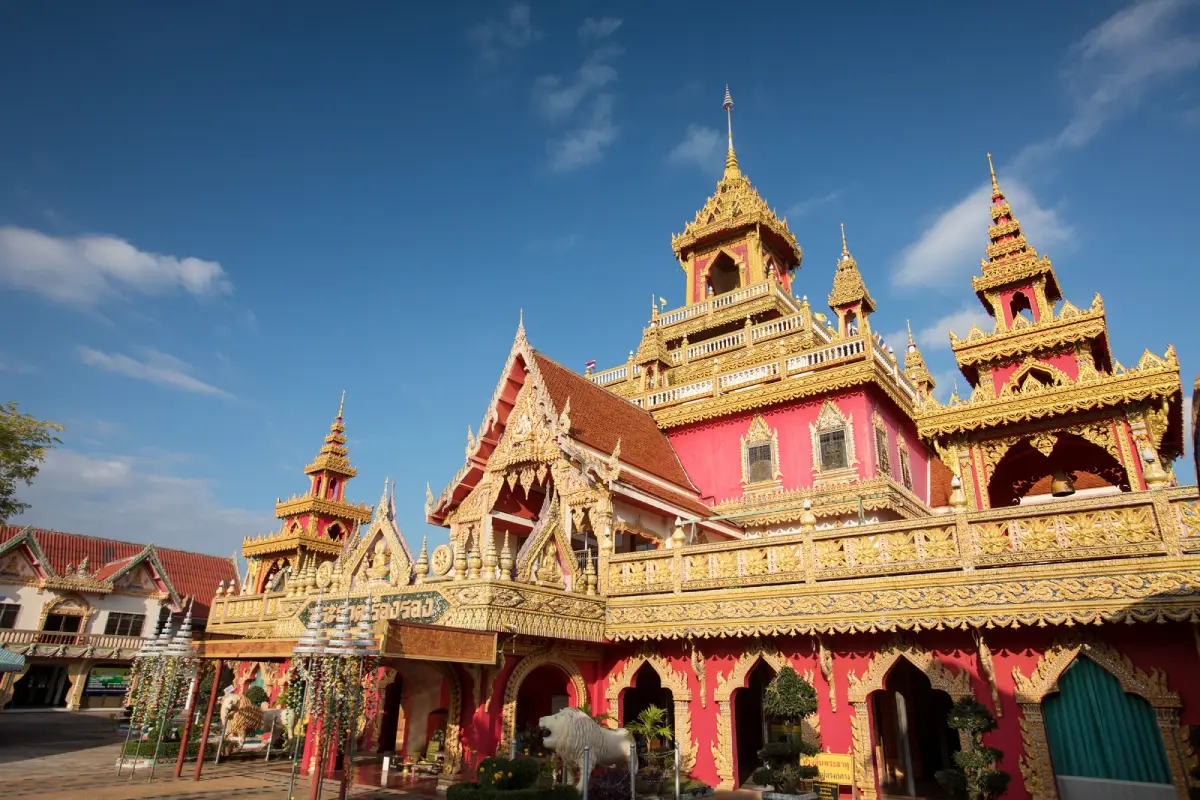
From the outside, Phra That Rueang Rong is immediately memorable. Its red walls and gold decorations create a vivid and powerful appearance. The rooflines, spires, entrance forms, and ornamental details give the building the character of a stupa combined with Lower Isan sacred architecture. It does not simply imitate central Thai temple design. Instead, it builds its own language from the cultural elements of Si Sa Ket’s ethnic communities. This is why the stupa has a strong local identity and remains visually distinct from many other Buddhist monuments in Thailand.
The building has six floors, and each floor has a different purpose. The first floor is a folk museum presenting the lives of Lao, Suai or Kui, Khmer, and Yoe communities. It includes life-sized displays, objects, and visual storytelling related to customs, traditions, work, and local culture. This first level is important because it introduces visitors to the people who form the cultural foundation of Si Sa Ket before they continue upward toward the more sacred levels of the stupa.
The second and third floors serve as additional folk museum spaces. They display old household items and tools such as pottery, hunting and fishing tools, lamps, records, books, traditional weapons, and many other objects used in daily life. These items are valuable not merely because they are old, but because they show how people in Si Sa Ket lived, worked, farmed, fished, prepared food, transmitted knowledge, and adapted to their environment before modern convenience changed local life.
The museum walls are also decorated with paintings that tell stories of Si Sa Ket Province. These include local attractions, historical events, district histories, legends, natural sites, archaeological places, Jataka stories, and local narratives. The paintings connect the displayed objects with a broader picture of the province. Visitors are therefore not only looking at old tools; they are learning how people, places, stories, and Buddhist ideas are woven together within the cultural memory of Si Sa Ket.
The fourth floor is a resting level before visitors continue to the higher floors. This space is useful because the six-level building requires time and energy to explore. Visitors, especially elderly people, children, and families, can pause here before continuing. The resting floor also marks a shift in the experience: from the museum of daily life below to the quieter, more inward levels above.
The fifth floor is used for meditation. This floor gives Phra That Rueang Rong a spiritual depth beyond museum display and sightseeing. It is a quiet place where visitors may sit, breathe, and turn attention inward. This level reminds visitors that the stupa is first and foremost a Buddhist place. It is not only a museum or a viewpoint. It is a place where people can slow down, become quiet, and reflect on Dhamma.
The sixth and highest floor is the main sacred level. It enshrines Buddhist relics and is also a viewpoint from which visitors can see surrounding houses, rice fields, and the green rural landscape of Ya Plong Subdistrict. Reaching the top floor gives visitors both a devotional and visual experience. They can pay respect to the relics and then look outward across the land that supports the temple and its community.
The six-floor structure gives the visit a clear symbolic sequence. Visitors begin with the daily lives of local people, continue through folk objects and cultural history, pause, enter meditation, and finally reach the sacred relic level and viewpoint. The journey upward becomes a movement from community life to spiritual reflection. In this way, the building teaches through its structure as much as through its exhibitions.
One of the most important aspects of Phra That Rueang Rong is its role as a Four Thai Ethnic Groups Museum. Lao, Suai or Kui, Khmer, and Yoe people have all shaped Si Sa Ket’s identity. Lao culture connects with Isan language, music, food, and Buddhist merit-making traditions. Suai or Kui heritage is often associated with forest knowledge, elephants, and local wisdom. Khmer culture is connected with language, ancient Khmer art, borderland belief, and ritual life. Yoe communities preserve their own riverine and local traditions. Presenting these groups together makes the stupa a cultural map of Si Sa Ket.
Visitors should take time to explore the museum slowly. Each section helps explain clothing, tools, livelihood, customs, belief, and local knowledge. Si Sa Ket cannot be understood as a single-culture province. Its identity comes from many communities living together across time. Phra That Rueang Rong makes this diversity visible and understandable. For Thai and international visitors, this is one of the clearest places to learn about the ethnic and cultural richness of the province.
Around the stupa, there are sculptural displays of Buddhist moral teachings, local traditions, and important Isan ceremonies. These outdoor displays turn the temple grounds into an open learning area. Visitors can see Dhamma lessons, folk rituals, and symbolic scenes in a form that is easy to understand. The site therefore functions not only through the main building but through the entire temple environment.
Another point of interest is the worship area of Luang Pho Rom Yen and the elevated walkway around the temple. After descending from the stupa, visitors can continue walking, pay respect at additional sacred points, and photograph the stupa from different angles. The red and gold building is especially beautiful when seen against a clear sky. The walkway and surrounding courtyard give visitors more time to appreciate the architecture and the temple atmosphere.
Phra That Rueang Rong also connects Buddhist devotion with cultural preservation. Inside the temple are donation points, offerings, sacred objects, and souvenirs. Contributions support the maintenance and development of the stupa. In this way, visitors can take part in preserving the site according to their faith. The temple remains a living place where worship, museum learning, community care, and cultural preservation continue together.
The current monastic caretaker identified in recent public information is Phra Khru Santi Thammanuwat, the ecclesiastical chief of Mueang Si Sa Ket District, serving as acting abbot of Wat Phra That Rueang Rong. The temple is cared for by the monastic community, Ban Sang Rueang villagers, Ya Plong Subdistrict community, and related local agencies. Activities such as merit-making, almsgiving, and ceremonies honoring Luang Pu Thamma Phithaksa continue to show that the temple remains active.
Phra That Rueang Rong is suitable for many kinds of visitors. Families can bring children to learn about local culture. Students can study folk objects and ethnic heritage. Cultural travelers can observe Lower Isan art. Buddhist visitors can pay respect to the relics. Meditation practitioners can use the quiet floor for inner reflection. Elderly visitors can explore at a gentle pace. The layered design allows each visitor to find a meaningful experience.
Getting There from Si Sa Ket city is easy. Drive out from the city toward the Si Sa Ket - Uthumphon Phisai route, then turn onto Highway 2373, the Si Sa Ket - Yang Chum Noi route. Road signs lead to Phra That Rueang Rong. The distance from the city is about 7.5 kilometers. From Bangkok, visitors can travel via Highway 1 to Saraburi, continue on Highway 2 to Nakhon Ratchasima, then use Highway 226 through Buri Ram and Surin to reach Si Sa Ket before continuing to Ya Plong Subdistrict.
Private car is the most convenient option because the stupa can be combined with nearby places in Si Sa Ket city, such as Wat Maha Phuttharam, Khun Ampai Panich Building, Sisaket Aquarium, Somdet Phra Srinagarindra Park, and the city market area. Visitors without private transport can arrive in Si Sa Ket by train or bus and continue to Ya Plong by local vehicle. Because the distance is short, Phra That Rueang Rong is suitable for a half-day trip from the city.
The best time to visit is in the morning or late afternoon before closing. Morning is comfortable for worship and museum exploration. Late afternoon gives beautiful natural light on the red and gold building and is suitable for viewing the surrounding countryside from the upper floor. Visitors who want to study the museum in detail should allow at least one to two hours.
There is no fixed admission fee at Phra That Rueang Rong. Visitors may enter during opening hours to worship, see the museum, walk around the temple, meditate, and enjoy the viewpoint. Donations, flowers, candles, incense, garlands, sacred objects, and souvenirs are voluntary according to personal faith. This makes the site open and accessible for local residents, Thai travelers, students, and international visitors.
Proper etiquette is important. Visitors should dress modestly, keep quiet inside the stupa, remove shoes where required, avoid touching museum objects without permission, avoid climbing on sculptures or railings, keep the temple clean, and use stairways carefully. Families with children and elderly visitors should take extra care on the upper floors and viewpoint areas.
For international visitors, Phra That Rueang Rong is one of the best places to understand Si Sa Ket in a single visit. It combines Buddhist relic worship, stupa architecture, four-ethnic-group heritage, folk museum displays, murals, meditation, and a rural viewpoint. The site shows that Si Sa Ket is not only a transit province. It is a province with deep Buddhist faith, multi-ethnic identity, local wisdom, and strong cultural memory.
In summary, Phra That Rueang Rong is more than a place to pay respect. It is a stupa, folk museum, meditation space, viewpoint, and cultural learning center. Its 49-meter height and six-level structure give it clear architectural presence. Its four-ethnic-group art gives it a unique identity. Visitors receive peace from worship, knowledge from the museum, and a memorable view of Ya Plong’s rural landscape. For travelers seeking the cultural heart of Si Sa Ket, Phra That Rueang Rong is one of the province’s essential destinations.
| Place Name | Phra That Rueang Rong, Si Sa Ket / Wat Ban Sang Rueang |
| Related Names | Phra That Rueang Rong, Wat Ban Sang Rueang, Wat Phra That Rueang Rong, Four Thai Ethnic Groups Museum, Phra That Rueang Rong Ban Sang Rueang |
| Place Type | Buddhist Temple, Sacred Stupa, Folk Museum, Four-Ethnic-Group Cultural Learning Site, And Faith-Based Cultural Destination In Si Sa Ket Province |
| Location | Wat Ban Sang Rueang, Ban Sang Rueang, Ya Plong Subdistrict, Mueang Si Sa Ket District, Si Sa Ket Province 33000, Thailand |
| Coordinates | 15.1658, 104.298865 |
| Distance From Key Points | About 7.5 km north of Si Sa Ket city via Highway 2373, the Si Sa Ket - Yang Chum Noi route |
| Significance | A sacred stupa enshrining Buddhist relics and a folk museum presenting the life and culture of Lao, Suai or Kui, Khmer, and Yoe communities in Si Sa Ket Province |
| Historical Summary | Phra That Rueang Rong was built in 1982 by Luang Pu Thamma Phithaksa at Wat Ban Sang Rueang to provide a sacred relic-worship site for Buddhists in southern Isan and to preserve the cultural heritage of Si Sa Ket. |
| Important Founder Figure | Luang Pu Thamma Phithaksa, founder of Phra That Rueang Rong and former abbot of Wat Ban Sang Rueang |
| Abbot / Caretaker | Phra Khru Santi Thammanuwat, Ecclesiastical Chief Of Mueang Si Sa Ket District and Acting Abbot Of Wat Phra That Rueang Rong, together with the temple’s monastic community, Ban Sang Rueang community, and Ya Plong local agencies |
| Artistic Identity | A blend of four Lower Isan ethnic art traditions: Lao, Suai or Kui, Khmer, and Yoe, expressed through stupa form, ornament, color, murals, and folk museum displays |
| Height | 49 meters |
| Number Of Floors | 6 floors |
| First Floor | Folk museum showing the life of Lao, Suai or Kui, Khmer, and Yoe groups through models, traditions, cultural scenes, and local narratives |
| Second - Third Floors | Folk museum displays of old household objects, traditional tools, pottery, fishing and hunting tools, lamps, records, books, local weapons, and paintings related to Si Sa Ket Province |
| Fourth Floor | Resting area before continuing to the meditation and relic levels |
| Fifth Floor | Meditation area for quiet reflection and Buddhist practice |
| Sixth Floor | Sacred relic level enshrining Buddhist relics and offering panoramic views of local houses, fields, and the Ya Plong landscape |
| Main Sacred Objects | Buddhist relics, sacred hair relics, Luang Pho Rom Yen, and Buddhist devotional objects within Wat Ban Sang Rueang |
| Current Status | Active Buddhist temple, sacred stupa, folk museum, and faith-based cultural attraction where visitors can worship, make merit, see the museum, meditate, and enjoy the viewpoint during opening hours |
| Open Days | Daily |
| Temple Opening Hours | 08.00 - 17.00 |
| Recommended Museum Visiting Hours | 08.30 - 16.30 |
| Admission Fee | Free Admission. Donations, flowers, candles, incense, garlands, sacred-object offerings, and contributions for stupa maintenance are voluntary according to personal faith. |
| Main Areas / Zones | 1. Six-Floor Phra That Rueang Rong Stupa Zone 2. Four Thai Ethnic Groups Folk Museum Zone 3. Old Household Object And Traditional Tool Display Zone 4. Si Sa Ket History, Mural, And Jataka Painting Zone 5. Meditation Zone Inside The Stupa 6. Buddhist Relic And Sacred Hair Relic Worship Zone 7. Upper-Floor Viewpoint Zone 8. Outdoor Buddhist Moral Sculpture Zone 9. Isan Ceremony And Tradition Sculpture Zone 10. Luang Pho Rom Yen Worship Zone 11. Elevated Walkway And Photo Courtyard Zone 12. Merit-Making, Sacred Object, And Souvenir Zone |
| Facilities | Free parking, worship areas, museum spaces, viewpoint, walkway around the stupa, merit-making area, sacred-object offering points, and basic services in Ya Plong Subdistrict |
| Related Contact | Wat Ban Sang Rueang / Phra That Rueang Rong, Tel. 063-181-5217, 081-977-3078 Museum Information, Tel. 042-811-895 Ya Plong Subdistrict Administrative Organization, Tel. 045-960257 |
| Travel Information | From Si Sa Ket city, take the Si Sa Ket - Uthumphon Phisai route, then turn onto Highway 2373, the Si Sa Ket - Yang Chum Noi route. The distance is about 7.5 km. Private car, van, or hired local transport is convenient. |
| Visitor Etiquette | Dress modestly, keep quiet, remove shoes where required, do not touch museum objects without permission, do not climb on sculptures or railings, use stairways carefully, and keep the temple clean. |
| Nearby Tourist Attractions | 1. Ban Sang Rueang Community / Ya Plong Subdistrict, about 0 km 2. Wat Maha Phuttharam / Luang Pho To, Mueang Si Sa Ket, about 9 km 3. Khun Ampai Panich Building, about 9 km, Tel. 045-644-375 4. Si Sa Ket City Pillar Shrine, about 10 km 5. Somdet Phra Srinagarindra Park, Si Sa Ket, about 11 km, Tel. 094-581-4357 6. Sisaket Aquarium, about 12 km, Tel. 045-612-686, 087-450-7484 7. Wat Nong Takhian, Chan Subdistrict, about 22 km 8. Prasat Wat Sa Kamphaeng Yai, about 31 km 9. Wat Mueang Chan / Phra That Mueang Chan, about 45 km 10. Wat Pa Maha Chedi Kaew / Million Bottle Temple, about 67 km, Tel. 084-524-3770 |
| Nearby Restaurants | 1. Suthee Pochana, Ya Plong, about 5 km, Tel. 045-634-044 2. Rice Shop, Ya Plong, about 5 km, Tel. 099-402-4134 3. Tid Nom Om Mook, Nong Ya Plong Branch, about 5 km, Tel. 064-025-9370 4. Craft Cup Sisaket, about 6 km, Tel. 093-942-6110, 098-519-9222 5. Mikka Coffee Roasters Sisaket, about 7 km, Tel. 093-320-5831, 087-258-8566 6. JIS Gourmet Na Mee Tee Mor Thepha-Rajabhat, about 7 km, Tel. 063-852-3291 7. The Wine Room Cafe, about 10 km, Tel. 082-678-7468 8. Jiree Cafe, about 10 km, Tel. 080-799-1890 |
| Nearby Accommodations | 1. Yanika Dormitory, Ya Plong, about 5 km, Tel. 061-931-1172 2. Peakpoint Home 24-Hour Rooms, Ya Plong, about 5 km, Tel. 084-628-9145 3. Boonsiri Boutique Hotel, Mueang Si Sa Ket, about 9 km, Tel. 045-622-222, 045-622-555 4. Gallery Design Hotel, Mueang Si Sa Ket, about 10 km, Tel. 045-611-999 5. B2 Sisaket Boutique & Budget Hotel, Mueang Si Sa Ket, about 10 km, Tel. 052-009-161, 088-263-2897 6. Tree House Hotel, Mueang Si Sa Ket, about 13 km, Tel. 045-611-563, 080-477-7854 |
Frequently Asked Questions (FAQ)
Q: Where is Phra That Rueang Rong located?
A: Phra That Rueang Rong is located inside Wat Ban Sang Rueang in Ban Sang Rueang, Ya Plong Subdistrict, Mueang Si Sa Ket District, Si Sa Ket Province. It is about 7.5 km north of Si Sa Ket city along Highway 2373.
Q: What are the opening days and hours?
A: Phra That Rueang Rong is open daily from 08.00 to 17.00. The recommended museum visiting period is 08.30 to 16.30.
Q: Is there an admission fee?
A: There is no fixed admission fee. Donations, flowers, candles, incense, garlands, sacred-object offerings, and contributions for stupa maintenance are voluntary according to personal faith.
Q: Who built Phra That Rueang Rong?
A: Phra That Rueang Rong was built by Luang Pu Thamma Phithaksa, the former abbot of Wat Ban Sang Rueang, to enshrine sacred Buddhist relics and provide a major worship site for Buddhists in southern Isan.
Q: Who is the current caretaker of Phra That Rueang Rong?
A: The current monastic caretaker identified in public information is Phra Khru Santi Thammanuwat, Ecclesiastical Chief of Mueang Si Sa Ket District and Acting Abbot of Wat Phra That Rueang Rong, together with the temple community and local agencies.
Q: What is the main highlight of Phra That Rueang Rong?
A: The main highlight is the 49-meter, six-floor stupa that combines the art and culture of four Lower Isan ethnic groups: Lao, Suai or Kui, Khmer, and Yoe. It includes a folk museum, meditation floor, sacred relic floor, and viewpoint.
Q: What can visitors see inside the stupa?
A: Visitors can see the Four Thai Ethnic Groups Folk Museum, life models, old household tools, murals about Si Sa Ket, Jataka paintings, a meditation area, Buddhist relics, sacred hair relics, and a panoramic viewpoint on the upper floor.
Q: How can visitors get to Phra That Rueang Rong?
A: From Si Sa Ket city, take the Si Sa Ket - Uthumphon Phisai route and turn onto Highway 2373, the Si Sa Ket - Yang Chum Noi route. The distance is about 7.5 km, with signs along the way. Private car, van, or hired local transport is convenient.
 Category: ●Places of Worship
 Group: ●Other Sacred Sites
Last Update : 1 MonthAgo
 Last Update : 1 MonthAgo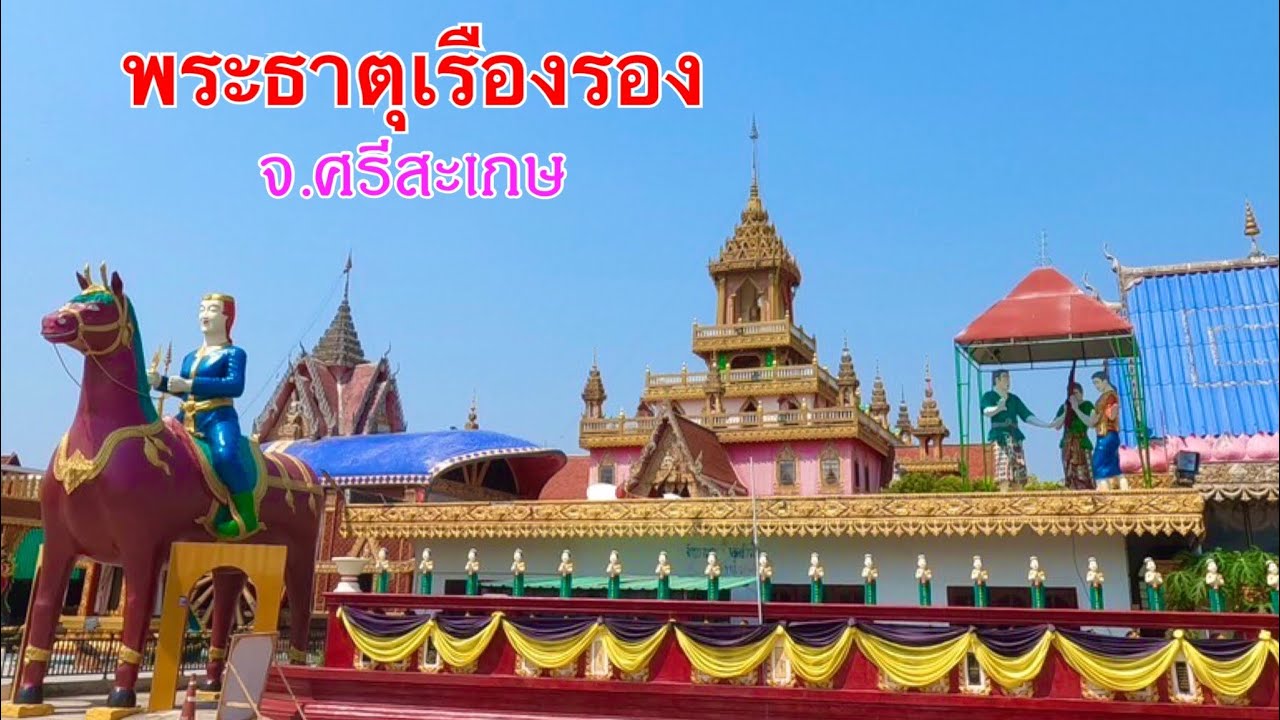
 Click to Access the Navigation Map GPS
Phra That Rueang Rong Map

 Art, Culture and Heritage
 Historical Sites and Monuments(12)
 Landmarks and Memorials(1)
 Art, Craft Centres, Tradition(8)
 Temple(13)
Other Sacred Sites(3)
Temple(13)
Other Sacred Sites(3)
 Suburban Living
 Village, Community(2)
 Nature and Wildlife
 National Parks and Marine Reserves(2)
 Dam, Reservoir, Lake(7)
 Waterfalls(5)
 River, Canal(5)
 Bays and Beaches(2)
 Entertainment and Agricultural
 Zoos and Aquariums(1)
 Farms, Parks and Ecotourism(3)


