
lovethailand home >Northeastern Travel Attractions >Si Sa Ket Travel Attractions >Prang Ku >Samo > Prasat Ban Samo
TL;DR: Prasat Ban Samo is located at Ban Tham Chan, Samo Subdistrict, Prang Ku District, Si Sa Ket Province, open Daily, hours 08.30 – 16.30.
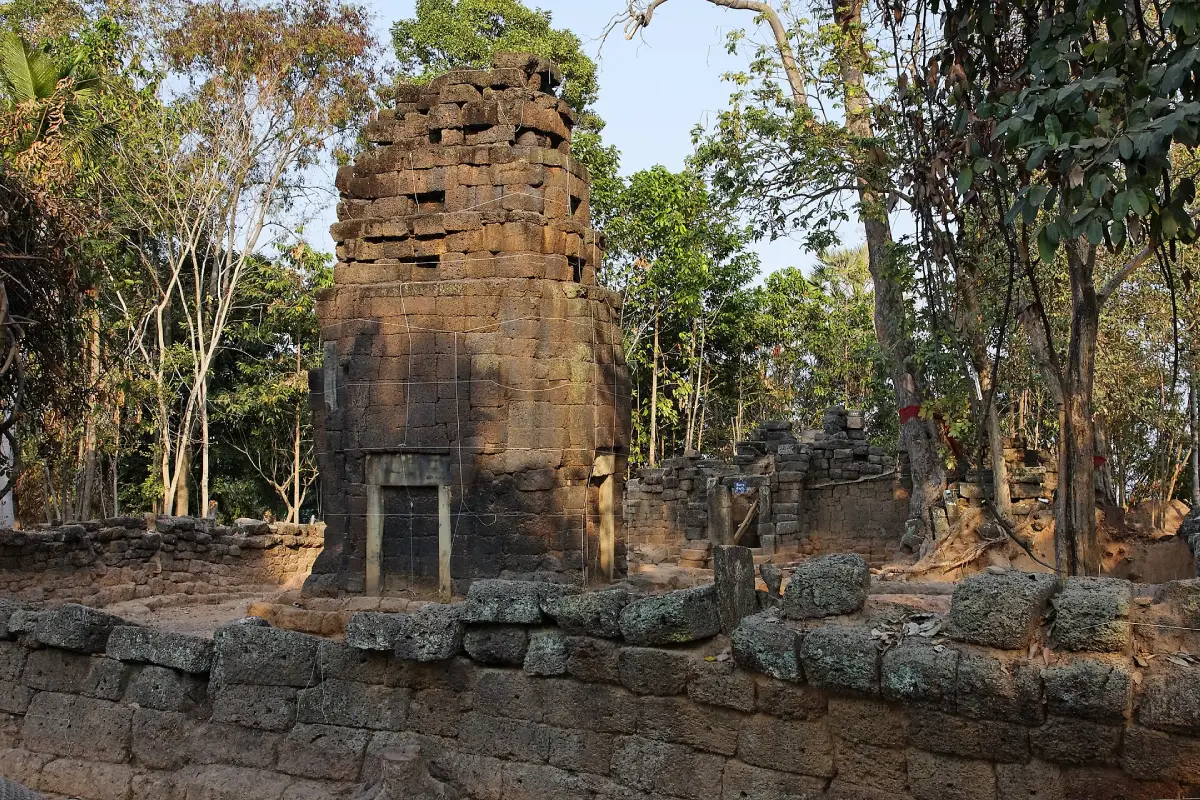
Prasat Ban Samo
Open Days: Daily
Opening Hours: 08.30 – 16.30
Prasat Ban Samo, also known as Prasat Tham Chan, is a small but historically significant ancient Khmer sanctuary located at Ban Tham Chan, Samo Subdistrict, Prang Ku District, Si Sa Ket Province. The monument is built mainly of laterite with sandstone architectural elements and faces east, following the sacred orientation commonly found in Khmer religious architecture. Its layout, carved lintel, laterite sanctuary, rectangular vihara, enclosing wall, gopura, and nearby ponds connect the site with the tradition of the ancient Khmer arokayasala, or hospital chapel, associated with the reign of King Jayavarman VII. Open daily to visitors, Prasat Ban Samo is a rewarding cultural destination for travelers who want to understand the Bayon-style Khmer heritage of Lower Northeastern Thailand.
Prasat Ban Samo is not a large monument, but its historical value is considerable. The site represents a type of Khmer religious structure that was closely connected with healing, Buddhist devotion, and community welfare. During the reign of King Jayavarman VII, the Khmer Empire built a network of hospital chapels across its territories. These sacred spaces were not merely architectural statements; they reflected a worldview in which religion, medicine, compassion, royal authority, and local communities were linked together. Prasat Ban Samo helps modern visitors see how that system reached into what is now Si Sa Ket Province.
The site stands in Ban Tham Chan within Samo Subdistrict, an area of Prang Ku District that contains several traces of ancient Khmer cultural influence. The monument is known by more than one name because local heritage sites often preserve several layers of identity. The name Prasat Ban Samo connects the site to Samo Subdistrict, while the name Prasat Tham Chan or Prasat Ban Tham Chan reflects the village where the monument is located. These names preserve both administrative memory and local community identity.
The main sanctuary of Prasat Ban Samo is built of laterite and has an indented square plan. It faces east and has a small projecting porch on the eastern side, which serves as the only real entrance into the sanctuary. The other 3 sides contain false doors, a typical feature of Khmer religious architecture. False doors were not designed for everyday movement; they completed the sacred symmetry of the building and reflected the cosmological order embedded in Khmer temple design. The door frames and lintel are made of sandstone, a material suitable for detailed carving.
Inside the sanctuary and around the doorway, visitors can observe carved elements that reveal the religious character of the site. One of the most important remains is the lintel above the southern doorway. The carving was not fully completed, yet its main composition remains visible. It shows a kala face releasing a garland, with hands holding the garland and scrolling foliage patterns. Above the kala is a seated figure in a meditative posture resembling a Buddha image, accompanied by 2 kneeling figures with hands pressed together in reverence. This composition is closely associated with the healing symbolism of the Buddha of Medicine, or Bhaisajyaguru, in Mahayana Buddhist belief.
The incomplete state of the lintel is one of the site’s most fascinating details. Many ancient monuments present visitors with finished works of art, but Prasat Ban Samo allows travelers to see traces of the working process of ancient artisans. The unfinished carving shows how forms were planned, shaped, and refined on sandstone. For visitors interested in Khmer art, this is especially valuable because it reveals not only the final religious image but also the craftsmanship behind it.
Prasat Ban Samo is generally dated to around the 18th Buddhist century and belongs to the Bayon-style Khmer artistic tradition. The Bayon period is strongly associated with King Jayavarman VII, who supported Mahayana Buddhism and sponsored many religious, public, and welfare-related constructions. Arokayasala sites are among the most important architectural expressions of this period. They were connected with healing and spiritual protection, and many are believed to have been dedicated to the Buddha of Medicine. Prasat Ban Samo fits this cultural and architectural pattern.
To the southeast of the main sanctuary is a rectangular laterite vihara with an entrance on the western side. Around the main sanctuary and the vihara are traces of an enclosing laterite wall. On the eastern side stands the position of the gopura, or entrance gateway, which marked the transition from the outer area into the sacred precinct. These elements are important because they show that the site was not just a single tower. It was a planned religious compound with a sanctuary, auxiliary building, boundary wall, gateway, and water features.
Outside the enclosing wall, on the northeastern side, is a small pond edged with laterite. Another larger pond is also part of the surrounding landscape. Water was an essential element in Khmer sacred sites. It was connected with purification, fertility, healing, and ritual order. In the context of an arokayasala, water features are especially meaningful because they reinforce the connection between religious practice and healing. The ponds at Prasat Ban Samo therefore help visitors understand the site as a sacred landscape, not simply an isolated ruin.
Prasat Ban Samo was registered as a national ancient monument on March 8, 1935, and its protected boundary was later defined. This official status confirms the importance of the site as a cultural heritage asset. Although the monument is small and modest in scale, it preserves significant evidence of Khmer art and Mahayana Buddhist belief in Lower Northeastern Thailand. It also helps connect Si Sa Ket Province with the wider historical network of Khmer religious architecture.
Another important piece of evidence is the inscription known as the Prasat Tham Chan inscription. It was discovered during archaeological excavation and conservation work in 2008. The discovery of an inscription at an archaeological site is highly significant because inscriptions provide direct historical evidence that can support the study of language, religion, people, rituals, and administrative systems. This makes Prasat Ban Samo more than a monument interpreted only from architecture; it is a site with textual evidence that deepens its historical value.
The atmosphere at Prasat Ban Samo is quiet and shaded. The surrounding trees, open ground, and village setting make the site suitable for slow cultural travel. Visitors can walk around the monument, observe the laterite walls, inspect the sandstone doorway, and consider how the sanctuary, vihara, enclosing wall, gopura, and ponds relate to each other. The site is especially rewarding for travelers who enjoy archaeological places that remain closely connected to local communities.
A good way to explore Prasat Ban Samo is to begin at the eastern side, where the main axis of the sanctuary is easiest to understand. From there, visitors can observe the gopura area and the laterite enclosing wall before moving toward the main sanctuary. The eastern porch, sandstone doorway, false doors, and southern lintel should be viewed carefully. After that, visitors can continue to the rectangular vihara to the southeast and then to the pond area on the northeastern side. This route helps reveal the complete layout of the ancient hospital chapel.
For travelers interested in Khmer iconography, the most important details are the kala face, the garland, the scrolling foliage, and the seated figure above the kala. In Khmer art, the kala often functions as a protective and powerful motif, while garlands and foliage represent abundance, sacred vitality, and continuity. When these motifs appear together with a meditative figure associated with healing, they express the religious meaning of an arokayasala. The monument therefore speaks not only through its structure but through its visual language.
Prasat Ban Samo is also useful for understanding the difference between Hindu Khmer sanctuaries and Mahayana Buddhist hospital chapels. Many Khmer monuments in Si Sa Ket and nearby provinces contain Hindu symbolism connected with Shiva, Indra, or directional deities. Prasat Ban Samo, however, is linked with the Buddha of Medicine and the arokayasala system. This makes it a valuable site for comparing the diversity of Khmer religious architecture in Thailand’s lower northeast.
Getting There from Si Sa Ket city is convenient by private car. Travelers can take Highway 220 and Highway 2167 for about 52 km. The site is located before reaching Prang Ku town by about 8 km. Another route is to follow the Si Sa Ket-Prang Ku road, turn right at Ban Kratai Don junction for about 3 km, and then turn right again for about 500 m to reach the site. A private car or rental car is the most practical option because it allows travelers to combine Prasat Ban Samo with nearby cultural attractions.
Travelers using public transport should first reach Prang Ku District or a nearby local center and then arrange local transport to Ban Tham Chan. The site is located within a rural community area and is not served by frequent public transport throughout the day. Visiting during daylight hours is recommended because it is easier to see the entrance route, read the landscape, and observe the monument’s artistic details.
The best time to visit is in the morning or late afternoon, when the sunlight is softer and the laterite and sandstone surfaces are easier to see clearly. Visitors should wear comfortable shoes because the ground may be uneven in places. A hat, drinking water, and sun protection are useful on hot days. A general visit usually takes 30–60 minutes, but travelers who want to study the lintel, layout, vihara, enclosing wall, and ponds should allow around 1–1.30 hours.
Responsible behavior is important when visiting Prasat Ban Samo. Ancient laterite blocks, sandstone carvings, and architectural fragments are irreplaceable. Visitors should not climb on the sanctuary, move stones, step on architectural fragments, write on the surface, touch carvings unnecessarily, or leave litter in the area. Respectful travel helps preserve the monument and shows respect for the local community that has lived with this heritage site for generations.
Prasat Ban Samo can be included in a wider Khmer heritage route in Si Sa Ket. Nearby attractions include Prasat Prang Ku, Prang Ku District City Pillar Shrine, Wat Prang Ku, Prasat Ta Leng in Khukhan District, and Wat Khian Burapharam. Travelers can plan a half-day or full-day cultural route that links several monuments and temples, gaining a broader understanding of the Khmer artistic and religious landscape of the province.
For photography, the best angles include the eastern entrance, sandstone door frame, southern lintel, laterite wall, rectangular vihara, and pond area. Morning and late afternoon light help reveal the texture of the laterite and the carved details of the sandstone. Photographs should be taken without climbing on the monument or moving any stones. The quiet surroundings make the site suitable for calm, respectful heritage photography.
In the wider context of Si Sa Ket Province, Prasat Ban Samo adds an important dimension to the province’s Khmer heritage. Si Sa Ket contains several ancient Khmer sites, including Prasat Sa Kamphaeng Yai, Prasat Sa Kamphaeng Noi, Prasat Prang Ku, Prasat Ta Leng, and Prasat Ban Samo. Each has a different character. Prasat Ban Samo is especially valuable because of its connection with the arokayasala tradition and the symbolism of the Buddha of Medicine.
Visiting Prasat Ban Samo is therefore not simply a stop at a small ruin. It is an opportunity to read an ancient system of belief through architecture, stone, water, inscription, and community landscape. The laterite sanctuary shows construction technique. The sandstone lintel reveals religious imagery. The pond reflects the sacred role of water. The inscription provides historical depth. The village setting shows how heritage continues to exist within everyday life. For foreign travelers seeking a deeper understanding of Si Sa Ket, Prasat Ban Samo is a compact but meaningful destination.
What makes Prasat Ban Samo memorable is its quiet depth. It is not impressive because of size, but because of the story preserved in its details. The monument shows how ancient Khmer society connected healing, faith, architecture, and local community space. For travelers interested in archaeology, Khmer art, Buddhist history, or the cultural routes of Lower Northeastern Thailand, Prasat Ban Samo deserves a place in a Si Sa Ket travel itinerary.
| Name | Prasat Ban Samo, also known as Prasat Tham Chan |
| Location | Ban Tham Chan, Samo Subdistrict, Prang Ku District, Si Sa Ket Province |
| Address | Moo 2, Ban Tham Chan, Samo Subdistrict, Prang Ku District, Si Sa Ket 33170, Thailand |
| Coordinates | 14.816938, 104.109847 |
| Highlights | Small Khmer arokayasala-style sanctuary, laterite main tower, sandstone lintel, seated Buddha-like figure above a kala face, laterite vihara, enclosing wall, gopura, and sacred pond landscape |
| History | Built around the 18th Buddhist century in the Bayon-style Khmer tradition and associated with the arokayasala system of King Jayavarman VII |
| Name Origin | The name Prasat Ban Samo refers to Samo Subdistrict, while Prasat Tham Chan refers to Ban Tham Chan, the village where the monument is located |
| Distinctive Features | Laterite main sanctuary with an indented square plan, east-facing projecting porch, one real entrance, 3 false doors, and sandstone door frames |
| Key Evidence | Southern lintel with kala face, garland, scrolling foliage, seated meditative figure, 2 kneeling worshippers, laterite vihara, enclosing wall, gopura, ponds, and Prasat Tham Chan inscription |
| Travel Information | From Si Sa Ket city, take Highway 220 and Highway 2167 for about 52 km. The site is about 8 km before Prang Ku town. Another route is via the Si Sa Ket-Prang Ku road, turning at Ban Kratai Don junction for about 3 km, then turning right for another 500 m. |
| Current Status | Open to visitors as a national ancient monument and Bayon-style Khmer art learning site in Prang Ku District, Si Sa Ket Province |
| Open Days | Daily |
| Opening Hours | 08.30 – 16.30 |
| Facilities | Open walking area, shaded surroundings, and parking area near the archaeological site |
| Main Areas / Zones | 1. Eastern entrance area 2. Gopura or main gateway 3. Laterite enclosing wall 4. Main sanctuary and eastern projecting porch 5. Sandstone doorway and lintel area 6. Laterite vihara to the southeast 7. Northeastern pond and surrounding sacred landscape |
| Caretaker | Fine Arts Department as the national ancient monument authority, with Samo Subdistrict Administrative Organization as the local administrative body for the area |
| Local Contact | Samo Subdistrict Administrative Organization, Tel. 045-920472 |
| Nearby Tourist Attractions | 1. Prasat Prang Ku, about 14 km 2. Prang Ku District City Pillar Shrine, about 9 km 3. Wat Prang Ku, about 10 km 4. Prasat Ta Leng in Khukhan District, about 23 km 5. Wat Khian Burapharam in Khukhan District, about 25 km |
| Nearby Restaurants | 1. Phu Pha Boat Noodles, Prang Ku Branch, about 9 km, Tel. 083-385-3138 2. Fin Noodle, about 10 km, Tel. 089-896-4936 3. Krua Khun Nai, about 10 km, Tel. 081-618-6219, 081-491-4407 4. Baan Coffee, about 9 km, Tel. 045-697-499 5. Ru Coffee Prangku, about 9 km, Tel. 086-872-2008 |
| Nearby Accommodations | 1. Prang Khiang Na Resort, about 8 km, Tel. 092-227-9409 2. Bansuan Khunyay Prangku, about 9 km, Tel. 021641001 3. Padaya Resort & Restaurant Prangku, about 10 km 4. Huai Saeng Chan Resort, about 20 km, Tel. 044-569-375 5. Meechai Smart Resort, about 20 km |
Frequently Asked Questions (FAQ)
Q: Where is Prasat Ban Samo located?
A: Prasat Ban Samo is located at Ban Tham Chan, Samo Subdistrict, Prang Ku District, Si Sa Ket Province, about 52 km from Si Sa Ket city.
Q: What are the opening hours of Prasat Ban Samo?
A: Prasat Ban Samo is open daily from 08.30 to 16.30. Morning and late afternoon are suitable times for seeing the laterite and sandstone details clearly.
Q: Does Prasat Ban Samo have another name?
A: Yes. It is also known as Prasat Tham Chan or Prasat Ban Tham Chan because it is located in Ban Tham Chan, Samo Subdistrict.
Q: Why is Prasat Ban Samo important?
A: Prasat Ban Samo is a Bayon-style Khmer monument dating to around the 18th Buddhist century and is associated with the arokayasala, or ancient Khmer hospital chapel, tradition of King Jayavarman VII.
Q: What should visitors not miss at Prasat Ban Samo?
A: Key highlights include the laterite main sanctuary, sandstone doorway, southern lintel with a kala and garland motif, seated meditative figure, laterite vihara, gopura, enclosing wall, and pond landscape.
Q: How can travelers get to Prasat Ban Samo?
A: From Si Sa Ket city, take Highway 220 and Highway 2167 for about 52 km. The site is about 8 km before Prang Ku town. Private car or rental car is the most convenient option.
Q: How long should travelers spend at Prasat Ban Samo?
A: A general visit takes around 30–60 minutes. Travelers interested in the lintel, arokayasala layout, vihara, enclosing wall, and ponds should allow 1–1.30 hours.
Q: What nearby places can be visited with Prasat Ban Samo?
A: Nearby places include Prasat Prang Ku, Prang Ku District City Pillar Shrine, Wat Prang Ku, Prasat Ta Leng, and Wat Khian Burapharam.
 Category: ●Art, Culture and Heritage
 Group: ●Historical Sites and Monuments
Last Update : 2 MonthAgo
 Last Update : 2 MonthAgo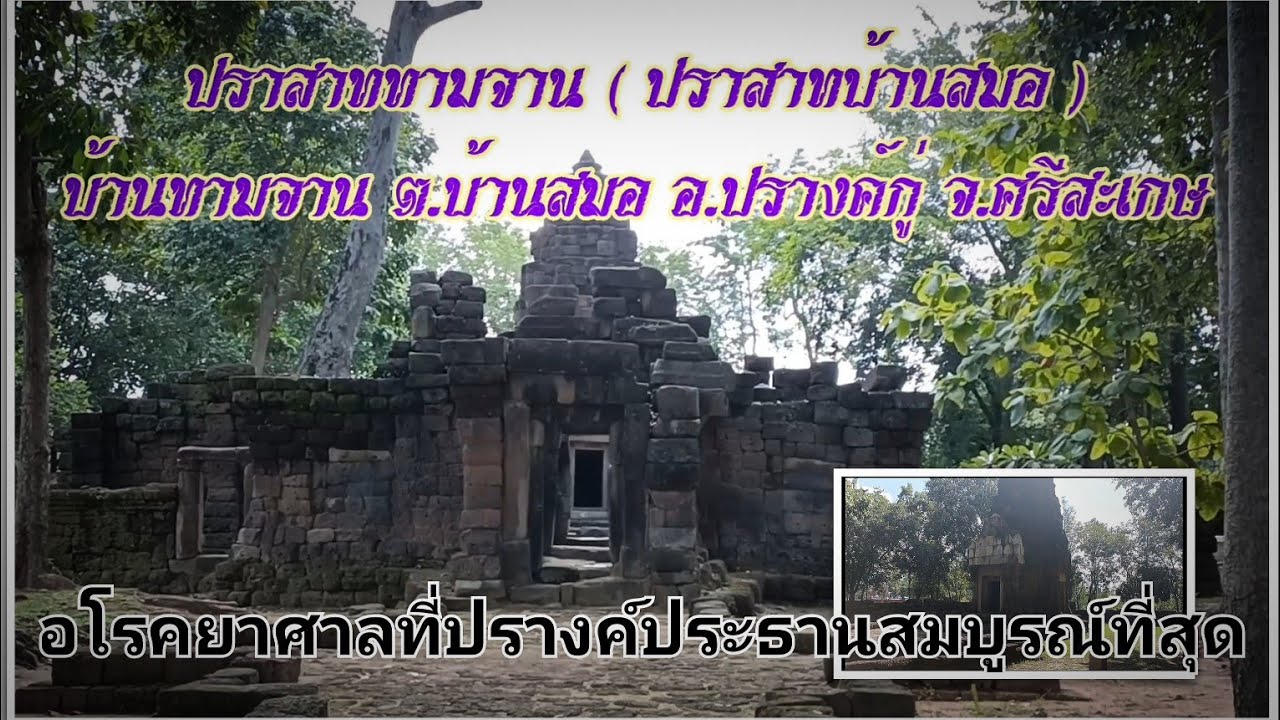
 Click to Access the Navigation Map GPS
 Historical Sites and Monuments(12)
 Landmarks and Memorials(1)
 Art, Craft Centres, Tradition(8)
 Places of Worship
 Temple(13)
 Other Sacred Sites(3)
 Suburban Living
 Village, Community(2)
 Nature and Wildlife
 National Parks and Marine Reserves(2)
 Dam, Reservoir, Lake(7)
 Waterfalls(5)
 River, Canal(5)
 Bays and Beaches(2)
 Entertainment and Agricultural
 Zoos and Aquariums(1)
 Farms, Parks and Ecotourism(3)


