
lovethailand home >Northeastern Travel Attractions >Si Sa Ket Travel Attractions >Khu Khan >Kan Thra Rom > Prasat Ta Leng
TL;DR: Prasat Ta Leng is located at Ban Prasat, Prasat Subdistrict, Khukhan District, Si Sa Ket Province, open Daily, hours 08.30 – 16.30.
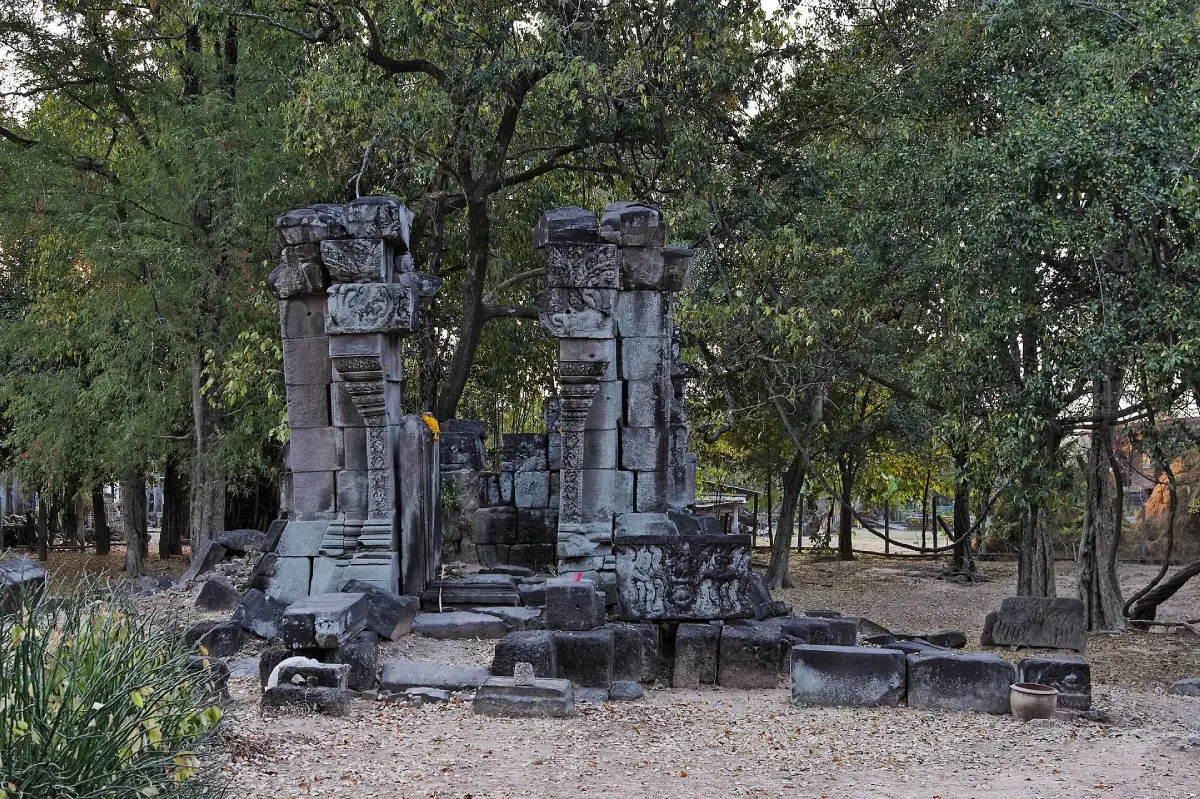
Prasat Ta Leng
Open Days: Daily
Opening Hours: 08.30 – 16.30
Prasat Ta Leng in Si Sa Ket Province is a small but highly valuable Khmer archaeological site located at Ban Prasat, Prasat Subdistrict, Khukhan District. The site is known for its single sanctuary tower, laterite base, square plan with indented corners, east-facing entrance, finely carved sandstone door pillars, and several lintel fragments that reveal the artistic language of the ancient Khmer Baphuon style. Open daily and free to visit, Prasat Ta Leng is an excellent destination for travelers who want to understand the cultural heritage of Lower Northeastern Thailand, especially the Khmer legacy that remains visible across Si Sa Ket and nearby provinces.
Prasat Ta Leng is also known locally as Prasat Lumpuk. Unlike large and heavily visited Khmer monuments, this site offers a quiet and intimate encounter with history. The sanctuary is now partly ruined, with only the front wall, some side walls, the doorway, architectural fragments, and carved stone pieces remaining. Even in this condition, the site still communicates a strong sense of place. Its surviving elements show how architecture, religious symbolism, craftsmanship, and local memory are connected in one compact archaeological landscape.
The sanctuary stands within a rural community landscape at Ban Prasat. Large trees and the surrounding village atmosphere give the site a calm character. Visitors can begin at the eastern entrance, which is the only actual doorway into the sanctuary. From this point, the architectural plan becomes clear: the main tower faces east, while the other 3 sides contain false doors. This layout reflects a common feature of ancient Khmer religious architecture, where symmetry and sacred orientation were central to the design of the shrine.
The main tower is built on a laterite base and composed of sandstone with brick reinforcement in some sections. Its square plan with indented corners is an important architectural feature. The tower’s orientation toward the east reflects the symbolic importance of the direction of sunrise, light, renewal, and ritual entry. Although the upper structure has collapsed, the remaining doorway, wall sections, and base still allow visitors to understand the original form of the monument. The site is compact, but it rewards careful observation.
One of the most remarkable features of Prasat Ta Leng is the pair of decorative door pillars at the eastern entrance. These sandstone pillars are carved with scrolling foliage patterns, floral motifs, and symbolic animal forms. The carving is refined and detailed, showing the skill of Khmer artisans during the Baphuon period. These pillars are among the most important reasons to visit the site, because they preserve visual evidence of artistic style, stone-carving technique, and religious symbolism from roughly the 11th to 12th century Buddhist era in Thailand’s chronological system.
The decorative elements around the doorway and pediment also include motifs associated with naga, makara, and other sacred creatures. A 5-headed naga motif reflects the protective and cosmological meaning of serpents in Khmer art. In Khmer religious architecture, naga imagery is strongly associated with water, fertility, protection, and sacred thresholds. When this symbolism is viewed together with traces of the U-shaped moat, an ancient embankment, and a large pond nearby, Prasat Ta Leng can be understood not simply as a small stone shrine but as part of a sacred landscape that combined architecture, ritual, water, and community space.
Several lintel and architectural fragments lie around the sanctuary. One of the most important lintels depicts Indra riding the elephant Airavata within an ornamental arch above a kala face. The kala releases a garland from its mouth and holds the garland with both hands, a motif closely associated with ancient Khmer art. Other carved pieces are related to directional deities and symbolic figures, including Varuna on a swan and Shiva on a bull. These details make Prasat Ta Leng especially meaningful for travelers interested in Khmer iconography, Hindu-Brahmanical symbolism, and the artistic connections between Thailand’s lower northeast and the wider Khmer cultural sphere.
Based on its architectural form and decorative carving, Prasat Ta Leng belongs to the Khmer Baphuon style and dates to around the 16th–17th Buddhist centuries, approximately 1017–1087 CE when converted to the Common Era range. This period was marked by the strong presence of Khmer culture across the Khorat Plateau and the Mun River basin. Many monuments from this period used laterite, sandstone, and brick as primary materials. They served religious, ritual, and symbolic functions while also expressing the cultural authority of the communities that built and maintained them.
The name Ta Leng is connected with local memory and community narratives at Ban Prasat. The older name Prasat Lumpuk comes from a nearby old settlement known as Ban Lumpuk, while the name Prasat Ta Leng became more widely used in relation to local stories and the remembered identity of the village. This connection gives the monument another layer of meaning. It is not only an archaeological site; it is also a place where community history, local identity, and regional heritage remain intertwined.
The atmosphere at Prasat Ta Leng is one of its strongest qualities. It is not a large commercialized tourist attraction. Instead, it feels like a heritage site embedded within everyday village life. The quiet surroundings allow travelers to slow down and notice details that are easily overlooked at larger sites: the texture of sandstone, the curve of carved foliage, the weight of the lintel fragments, the way the entrance frames the interior, and the traces of a ritual landscape that once extended beyond the sanctuary tower itself.
For photography, the best subjects are the eastern doorway, the carved door pillars, the remaining wall sections, the lintel fragments, and the overall view of the sanctuary beneath the shade of trees. Morning and late afternoon light are especially suitable because angled sunlight makes the carving details more visible. Visitors should avoid climbing, sitting on, touching, or moving any ancient stone pieces. The best way to photograph the site is to respect its fragile condition while allowing the textures and shadows of the old stone to speak for themselves.
The site can be explored through 5 main areas: the eastern entrance area, the carved door-pillar zone, the sanctuary tower and remaining wall sections, the area containing lintels and architectural fragments, and the surrounding landscape with traces of moat, embankment, and water features. Following this sequence helps visitors understand the monument from its overall layout to its fine artistic details. It also helps foreign travelers appreciate how even a small Khmer sanctuary can contain complex religious and architectural meanings.
Prasat Ta Leng is suitable for a half-day cultural trip or as part of a broader Khmer heritage route in Si Sa Ket. Travelers can combine the visit with Khukhan City Pillar Shrine, Wat Khian Burapharam, Wat Klang Amarintrawat, Prasat Prang Ku, and Prasat Ban Samo. A full-day route through these sites provides a broader view of Khmer influence, local Buddhist heritage, and the cultural landscape of Khukhan District and nearby areas.
Getting There from Si Sa Ket city is straightforward by private car. Take Highway 220 toward Khukhan District, then continue on local roads to Ban Prasat in Prasat Subdistrict. The site is around 20 km from Khukhan town. The journey from Si Sa Ket city generally takes about 1–1.30 hours depending on road conditions and stops along the way. Private car, rental car, or a hired local vehicle is the most convenient option, especially for travelers who want to combine Prasat Ta Leng with other nearby attractions.
Travelers without private transport should first reach Khukhan town and then arrange local transport or a hired vehicle to Ban Prasat. Public transport directly to the site is limited, so planning ahead is important. Because the site is located in a rural community, it is best to visit during daylight hours, dress comfortably, bring drinking water, and wear shoes suitable for uneven ground. The area contains ancient stones, roots, and natural surfaces that require careful walking.
A standard visit takes around 30–60 minutes, while travelers interested in art history, lintel carving, and photography may want to spend 1–1.30 hours. The site is small, but its details are rich. Taking time to observe the pillars, lintels, sanctuary plan, and surrounding landscape will make the visit much more meaningful than a quick stop for photographs alone.
Respectful behavior is essential when visiting Prasat Ta Leng. Ancient monuments cannot be replaced once damaged. Visitors should not climb the sanctuary, step on lintels, write on stones, remove fragments, or touch carved details unnecessarily. A responsible visit helps preserve the site for future generations and supports the community’s role in safeguarding its cultural heritage.
Prasat Ta Leng represents the depth of Si Sa Ket’s cultural landscape. The province is not only known for temples, traditions, and natural attractions; it is also one of Thailand’s important areas for Khmer archaeological heritage. Visiting this small sanctuary helps travelers understand how Lower Northeastern Thailand served as a cultural meeting ground where religion, art, architecture, language, and local identity developed together over many centuries.
What makes Prasat Ta Leng worth visiting is its balance of modest scale, quiet atmosphere, and deep artistic value. The monument is not complete, yet the surviving remains are highly informative. Its plan, materials, carved pillars, lintels, and symbolic motifs provide a clear window into the Khmer world of the Baphuon period. For foreign travelers seeking a meaningful cultural stop in Si Sa Ket, Prasat Ta Leng is a rewarding site that combines archaeology, local memory, and the peaceful rhythm of rural Thailand.
| Name | Prasat Ta Leng, also known as Prasat Lumpuk |
| Location | Ban Prasat, Prasat Subdistrict, Khukhan District, Si Sa Ket Province |
| Address | Prasat Subdistrict, Khukhan District, Si Sa Ket 33140, Thailand |
| Coordinates | 14.729319, 104.021775 |
| Highlights | Single Khmer sanctuary in the Baphuon style, carved door pillars, scrolling foliage motifs, Indra on Airavata lintel, and a peaceful village setting |
| History | Built around the 16th–17th Buddhist centuries, approximately 1017–1087 CE, in the Khmer Baphuon artistic tradition |
| Name Origin | The name Ta Leng is linked with local community memory, while Prasat Lumpuk refers to an old nearby settlement associated with the site |
| Distinctive Features | Square sanctuary plan with indented corners, east-facing entrance, one real doorway, and 3 false doors |
| Key Evidence | Sandstone door pillars, scrolling foliage carvings, swan motifs, 5-headed naga pediment, Indra on Airavata lintel, Varuna on a swan, Shiva on a bull, and traces of a U-shaped moat |
| Travel Information | From Si Sa Ket city, take Highway 220 toward Khukhan District, then continue on local roads to Ban Prasat. The site is about 20 km from Khukhan town. |
| Current Status | Open to visitors as an archaeological site and Khmer art learning destination in Khukhan District |
| Open Days | Daily |
| Opening Hours | 08.30 – 16.30 |
| Fees | Free Admission |
| Facilities | Parking area near the site; suitable for short cultural visits and heritage photography |
| Main Areas / Zones | 1. Eastern entrance area 2. Carved door-pillar zone 3. Sanctuary tower and remaining wall sections 4. Lintel and architectural fragment area 5. Surrounding moat, embankment, and water-landscape traces |
| Caretaker | Fine Arts Department, through the 10th Regional Office of Fine Arts, Nakhon Ratchasima |
| Tourist Information Contact | 0 4451 4447 |
| Nearby Tourist Attractions | 1. Khukhan City Pillar Shrine, about 19 km 2. Wat Khian Burapharam, about 20 km 3. Wat Klang Amarintrawat, about 20 km 4. Prasat Prang Ku, about 23 km 5. Prasat Ban Samo, about 43 km |
| Nearby Restaurants | 1. Loft House Café Khukhan, about 21 km, Tel. 086-364-9492 2. CAFFINE cafe roaster Khukhan, about 21 km, Tel. 096-610-3331 3. 199 Coffee Lab Khukhan, about 22 km, Tel. 094-242-9417 4. Jeab Taban Tam, about 23 km, Tel. 061-034-9564 5. Dunkin' Lotus Khukhan, about 22 km, Tel. 065-940-7897 |
| Nearby Accommodations | 1. Bansuan Srisuparb Hotel, about 22 km, Tel. 087-245-9125, 080-240-7090 2. Chai-An Resort, about 21 km, Tel. 085-024-4829 3. Waewwao Garden Resort, about 25 km, Tel. 088-351-1419, 093-532-3261 4. Suk Samoe Guesthouse Khukhan, about 22 km, Tel. 083-894-9899 5. Sawatdi Resort Khukhan, about 27 km |
Frequently Asked Questions (FAQ)
Q: Where is Prasat Ta Leng located?
A: Prasat Ta Leng is located at Ban Prasat, Prasat Subdistrict, Khukhan District, Si Sa Ket Province. It is a Khmer archaeological site set within a local rural community.
Q: What are the opening days and opening hours of Prasat Ta Leng?
A: Prasat Ta Leng is open daily from 08.30 to 16.30. Daytime visits are recommended because the carved stone details are easier to see clearly.
Q: Is there an admission fee for Prasat Ta Leng?
A: No. Admission is free. Visitors should respect the archaeological remains and avoid climbing, touching, or moving any ancient stone fragments.
Q: Why is Prasat Ta Leng important?
A: Prasat Ta Leng is an ancient Khmer sanctuary in the Baphuon style, dating to around the 16th–17th Buddhist centuries. Its carved door pillars and lintels preserve important evidence of Khmer religious art in Lower Northeastern Thailand.
Q: What should visitors not miss at Prasat Ta Leng?
A: Key highlights include the eastern doorway, carved sandstone door pillars, scrolling foliage motifs, swan details, 5-headed naga motif, and the lintel depicting Indra riding Airavata.
Q: How can travelers get to Prasat Ta Leng?
A: From Si Sa Ket city, take Highway 220 toward Khukhan District and continue on local roads to Ban Prasat. The site is about 20 km from Khukhan town, and traveling by private car or rental car is the most convenient option.
Q: How long should visitors spend at Prasat Ta Leng?
A: A general visit takes around 30–60 minutes. Travelers interested in art history, lintels, and photography should allow 1–1.30 hours.
Q: What nearby places can be visited on the same trip?
A: Nearby places include Khukhan City Pillar Shrine, Wat Khian Burapharam, Wat Klang Amarintrawat, Prasat Prang Ku, and Prasat Ban Samo.
 Category: ●Art, Culture and Heritage
 Group: ●Historical Sites and Monuments
Last Update : 2 MonthAgo
 Last Update : 2 MonthAgo
 Click to Access the Navigation Map GPS
 Historical Sites and Monuments(12)
 Landmarks and Memorials(1)
 Art, Craft Centres, Tradition(8)
 Places of Worship
 Temple(13)
 Other Sacred Sites(3)
 Suburban Living
 Village, Community(2)
 Nature and Wildlife
 National Parks and Marine Reserves(2)
 Dam, Reservoir, Lake(7)
 Waterfalls(5)
 River, Canal(5)
 Bays and Beaches(2)
 Entertainment and Agricultural
 Zoos and Aquariums(1)
 Farms, Parks and Ecotourism(3)


