
lovethailand home >Northeastern Travel Attractions >Sakon Nakhon Travel Attractions >Phanna Nikhom >Rai > Wat Tham Kham (Phu Kham)
TL;DR: Wat Tham Kham (Phu Kham) is located at Rai Subdistrict, Phanna Nikhom District, Sakon Nakhon 47130, Thailand, open Open Daily, hours 08.00 - 17.00.
Wat Tham Kham (Phu Kham)
Open Days: Open Daily
Opening Hours: 08.00 - 17.00
Wat Tham Kham (Phu Kham) In Sakon Nakhon is a forest meditation temple located on Phu Kham, also locally known as Phu Kham Kham, in the Ban Kham Pa area of Rai Subdistrict, Phanna Nikhom District, Sakon Nakhon Province. The temple stands on one of the hills of the Phu Phan mountain range and is one of the important sacred sites connected with Thailand’s Forest Tradition. It was formerly a meditation retreat of Phra Ajahn Fan Acharo, who spent the rainy-season retreat here before later moving to Wat Pa Udom Somphon when his health declined. The temple is also deeply connected with Luang Pu Thet Thetrangsi, one of the great meditation masters of Thailand, who later stayed at Wat Tham Kham and passed away here in 1994. For visitors, this temple is not only a mountain temple with beautiful scenery. It is a place where the memory of great forest masters, meditation practice, sacred architecture, caves, cliffs, and the quiet atmosphere of the Phu Phan mountains come together.
Wat Tham Kham has a character that is different from large city temples. It is set on a mountain, surrounded by forest, rocks, slopes, and natural quietness. The journey to the temple gives visitors the feeling of gradually leaving the town behind and entering a place of seclusion. This environment explains why forest monks valued the area as a place for meditation. The temple’s physical landscape is part of its spiritual meaning: the cave, the mountain, the old kuti, the chedi, the stone terraces, and the viewpoint all support the experience of stillness and reflection.
The temple’s importance is closely tied to Phra Ajahn Fan Acharo. According to local temple history, Ajahn Fan once had a vision of a cave on the western side of the Phu Phan range. The cave appeared bright, calm, and suitable for meditation. After the end of Buddhist Lent, he traveled through several places until local villagers told him about a large cave on the mountain known as Tham Kham. When he reached the cave and explored the area, he recognized it as the place seen in his vision. This became the beginning of Tham Kham’s role as a meditation site in the life of Ajahn Fan.
Ajahn Fan Acharo is one of the most respected monks in the Thai Forest Tradition. His disciplined practice, devotion to Dhamma, and close connection with the lineage of Ajahn Mun Bhuridatto made him an important teacher for many Buddhists in Northeastern Thailand. Wat Tham Kham preserves an important chapter of his life. The old kuti associated with him allows visitors to understand forest-monk practice not as an abstract idea, but as something lived in real places: caves, simple huts, difficult paths, and quiet mountain forests.
The temple is also central to the memory of Luang Pu Thet Thetrangsi, another highly revered master of the Thai Forest Tradition. Luang Pu Thet later stayed at Wat Tham Kham and passed away at this temple on 17 December 1994. This connection gives the temple profound meaning for disciples and worshippers. Wat Tham Kham is therefore a place where 2 major forest masters are remembered: Ajahn Fan Acharo and Luang Pu Thet Thetrangsi. This makes the temple one of the most meaningful Dhamma destinations in Sakon Nakhon for those following the history of forest meditation practice.
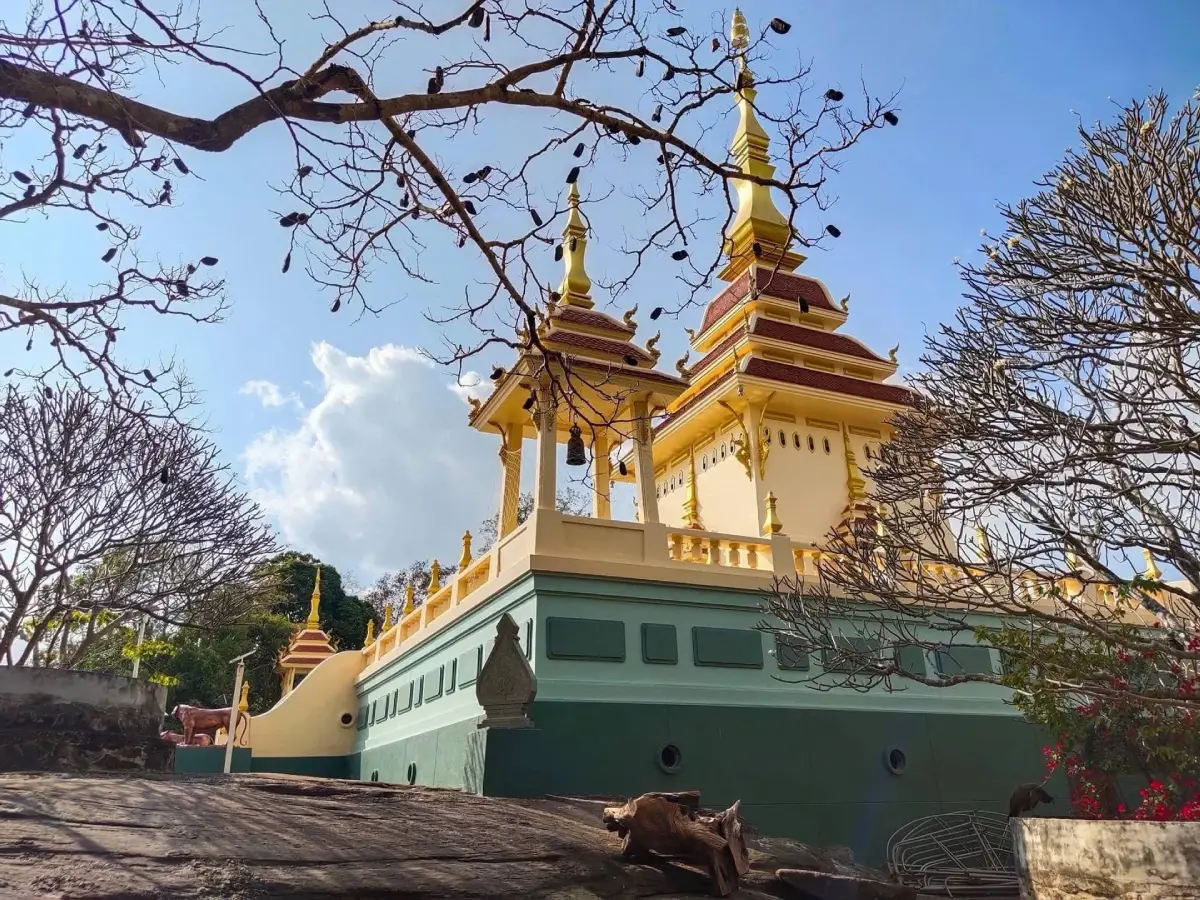
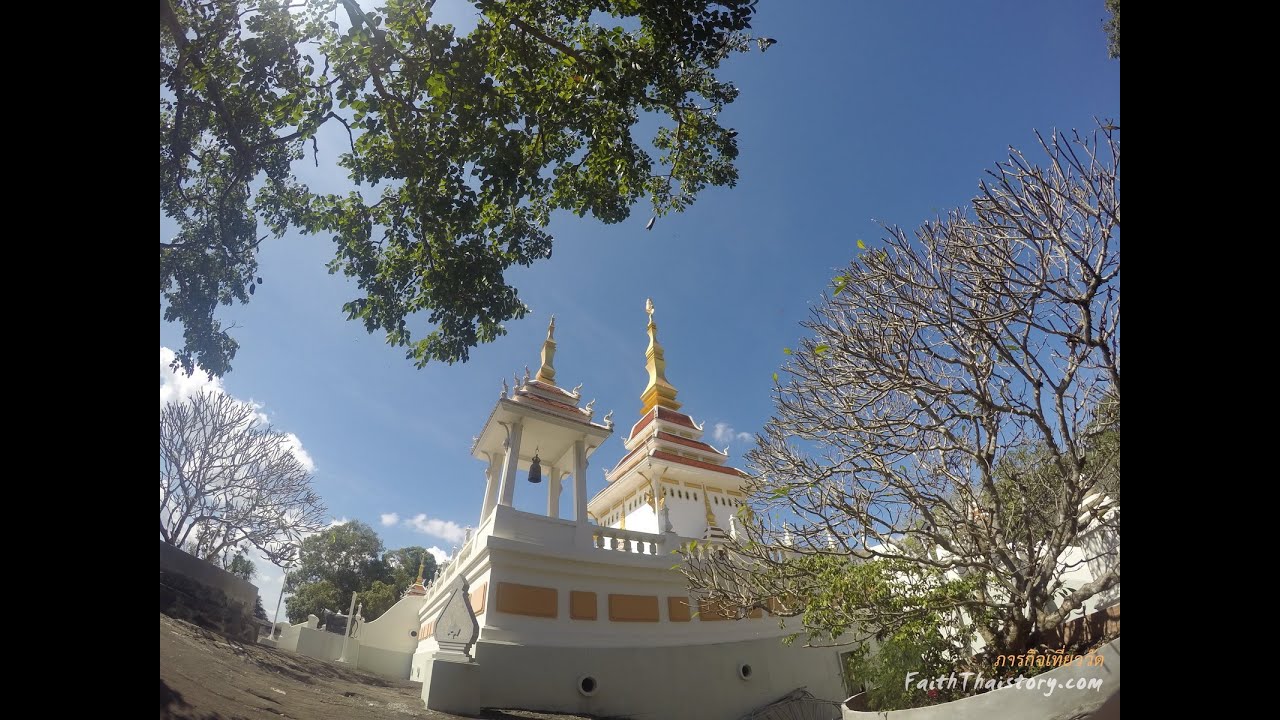
The main sacred structure of the temple is Thetsaka Chedi Thetrangsi Memorial. The chedi is built in a square-based form with 4 directional porches, combining Northeastern Thai and Ayutthaya-inspired architectural elements. Inside is a bronze statue of Luang Pu Thet Thetrangsi. The chedi functions as both a place of worship and a memorial to his life and teachings. It is not merely a beautiful building on a mountain. It is a sacred monument preserving the memory, practice, and spiritual influence of one of Thailand’s great meditation masters.
The design of the chedi creates a powerful visual impression. Its white body, golden details, and multi-tiered roof stand above the mountain terrace, giving a sense of dignity and serenity. Visitors walking up the staircase toward the chedi experience both a physical ascent and a symbolic movement toward reverence. The higher setting emphasizes the temple’s connection with mountain seclusion and the elevated discipline of forest meditation.
The old kuti of Ajahn Fan is another important site within the temple. Forest monks traditionally lived with very few possessions. A kuti was not built for comfort but for simplicity, discipline, and meditation. Seeing the old kuti helps visitors understand that the power of the Thai Forest Tradition lies in restraint, solitude, and direct practice. It also shows how the lives of great monks were rooted in modest spaces rather than large ceremonial buildings.
Tham Kham cave is the natural heart of the temple. It is part of the mountain landscape that first made the site suitable for meditation. In the past, reaching the cave required effort, walking through forest, climbing slopes, and relying on local villagers who helped improve the path. That original difficulty reflects the determination of forest monks who sought places far from distraction. Today access is easier, but the cave remains a sacred meditation space and should be approached with quiet respect.
The stone terraces and viewpoints on Phu Kham add another layer to the visit. From the upper areas, visitors can see the forested hills, open plains, and the wider landscape of Phanna Nikhom District. This view helps explain why mountain temples are powerful places for contemplation. Elevation creates distance from ordinary concerns, and the wide landscape encourages a wider view of life. At Wat Tham Kham, the scenery is not separate from the temple experience. It supports the mind in becoming quiet and reflective.
Another related destination nearby is Wat Acharo Rangsi, in Ban Kham Kha, Rai Subdistrict. It houses the 100-Year Memorial Museum of Luang Pu Thet Thetrangsi. The museum displays his life history, photographs, personal requisites, and stories of his ordination, meditation training, and connection with other forest masters. Visitors to Wat Tham Kham can continue to Wat Acharo Rangsi to understand Luang Pu Thet’s life more fully. The name Acharo Rangsi itself honors 2 great monks: “Acharo” from Ajahn Fan Acharo and “Thetrangsi” from Luang Pu Thet Thetrangsi.
Together, Wat Tham Kham and Wat Acharo Rangsi form an important route for visitors interested in the Thai Forest Tradition. Wat Tham Kham preserves the actual mountain setting, cave, old kuti, chedi, and memorial atmosphere. Wat Acharo Rangsi provides a more structured museum experience, with historical displays and objects connected with Luang Pu Thet. Visiting both sites gives a more complete understanding of the spiritual heritage of Phanna Nikhom and the Phu Phan range.
Wat Tham Kham also helps explain why Sakon Nakhon is known as a province of Dhamma. The province is closely connected with Ajahn Mun Bhuridatto, Ajahn Fan Acharo, Luang Pu Thet Thetrangsi, and many other meditation masters. When Wat Tham Kham is viewed together with Wat Pa Udom Somphon, Wat Pa Sutthawat, Wat Tham Pha Daen, Wat Acharo Rangsi, and other forest temples, visitors can see how deeply Sakon Nakhon is tied to meditation practice and forest monastic life.
This temple is suitable for travelers interested in Buddhist meditation, forest temples, Thai religious history, mountain scenery, and the lives of revered monks. It is not a place designed for loud tourism or quick entertainment. Its value lies in quietness, simplicity, historical depth, and the continuing reverence for the forest masters who practiced here. Visitors who take time to walk slowly, pay respect, and observe the place with care will gain a deeper experience than those who only come for photographs.
The temple is open daily from 08.00 to 17.00 for general visits, main worship areas, and the memorial structures. There is no admission fee, and visitors may make voluntary donations according to their faith. The safest and most meaningful time to visit is during the morning or early afternoon, when there is enough time to walk around the temple, pay respect at the chedi, visit the old kuti, and enjoy the viewpoint before returning down the mountain.
The temple grounds include stairs, rock surfaces, slopes, and outdoor walking areas. Visitors should wear suitable footwear, move carefully during the rainy season, and stay on the paths arranged by the temple. Because this is a meditation temple, visitors should speak softly, avoid unnecessary noise, and respect monks, practitioners, and worshippers. The mountain setting is beautiful, but it is also a sacred place.
Getting There from Sakon Nakhon city begins on Highway 22, the Sakon Nakhon - Udon Thani route, toward Phanna Nikhom District. Travel about 22 km, then turn left onto the same route that leads toward Phra That Phu Phek for another 10 km. Before continuing to Phra That Phu Phek, there is a right-side route toward Wat Tham Kham, about 30 km further. The route includes rural and mountain sections, so private cars, rental cars, or local drivers familiar with the area are recommended. When using online maps, search for Wat Tham Kham, Phu Kham, or Wat Tham Kham Rai Subdistrict, Phanna Nikhom.
Visitors already in Phanna Nikhom District can combine the temple with Wat Pa Udom Somphon, the Ajahn Fan Acharo Museum, Wat Acharo Rangsi, the 100-Year Memorial Museum of Luang Pu Thet Thetrangsi, Phra That Phu Phek, and Nam Un Dam. This creates a meaningful half-day or full-day route connecting forest monks, memorial museums, mountain temples, ancient sites, and reservoirs.
Those following the life of Ajahn Fan should connect Wat Tham Kham with Wat Pa Udom Somphon. Wat Tham Kham represents his mountain meditation period, while Wat Pa Udom Somphon preserves his later legacy through the Ajahn Fan Acharo Museum. Seeing both places helps visitors understand the path of a forest master through practice, illness, remembrance, and continuing devotion.
Those interested in Luang Pu Thet should connect Thetsaka Chedi at Wat Tham Kham with the memorial museum at Wat Acharo Rangsi. Wat Tham Kham is the place where he stayed and passed away. Wat Acharo Rangsi provides historical displays, photographs, and personal objects connected with his life. Together, these places present both the lived space and the documented memory of Luang Pu Thet Thetrangsi.
Restaurants and accommodation are not concentrated directly in front of Wat Tham Kham. Most practical options are in Phanna Nikhom District, Phang Khon District, or Sakon Nakhon city. Travelers who want to stay closer to the forest-temple route can choose small resorts and homestays in Phanna Nikhom. Those who prefer wider choices of food, hotels, and city services can stay in Sakon Nakhon city and visit the temple as a day trip.
Respectful conduct is essential. Visitors should dress modestly, remove shoes in designated areas, avoid touching relics, statues, monk requisites, or museum objects without permission, avoid loud conversation in the cave and chedi areas, and never disturb meditation practitioners. The temple is a sacred site of the Thai Forest Tradition, and visiting it properly means preserving its atmosphere of quiet dignity.
For international visitors, Wat Tham Kham is an important introduction to the Thai Forest Tradition. It shows how Buddhist practice in Northeastern Thailand is connected with mountains, caves, solitude, respected teachers, simple huts, memorial chedis, and local communities. It is not only a temple to see. It is a place to understand how meditation practice shaped the spiritual identity of Sakon Nakhon.
Overall, Wat Tham Kham is one of Sakon Nakhon’s most meaningful mountain temples. Its importance comes from Ajahn Fan Acharo, Luang Pu Thet Thetrangsi, Thetsaka Chedi, the old meditation cave, the old kuti, the Phu Phan landscape, and the continuing faith of visitors. It represents the quieter and deeper side of Sakon Nakhon: a province where forests, mountains, temples, and meditation masters are woven into a living Buddhist heritage.
Wat Tham Kham (Phu Kham) should be visited slowly and respectfully. It rewards visitors who come not only for scenery, but also for reflection. The temple allows travelers to encounter a sacred mountain landscape shaped by meditation, memory, and devotion. For anyone who wants to understand Sakon Nakhon as a province of Dhamma and forest meditation, Wat Tham Kham is an essential destination.
| Place Name | Wat Tham Kham (Phu Kham), Sakon Nakhon |
| Place Type | Local Dhammayut Buddhist Temple, Forest Meditation Temple, And Sacred Site Connected With Thai Forest Tradition Masters |
| Main Location | Ban Kham Pa, Rai Subdistrict, Phanna Nikhom District, Sakon Nakhon Province, On Phu Kham Of The Phu Phan Mountain Range |
| Address | Rai Subdistrict, Phanna Nikhom District, Sakon Nakhon 47130, Thailand |
| Highlights | Thetsaka Chedi Thetrangsi Memorial, Bronze Statue Of Luang Pu Thet Thetrangsi, Old Kuti Of Ajahn Fan Acharo, Tham Kham Cave, Stone Terraces, Mountain Viewpoint, And Peaceful Forest-Meditation Atmosphere |
| History / Importance | Formerly A Meditation Site Of Ajahn Fan Acharo, Who Stayed Here Until Around 1964. Later, Luang Pu Thet Thetrangsi Stayed At Wat Tham Kham And Passed Away Here On 17 December 1994. The Temple Is An Important Site In The History Of The Thai Forest Tradition |
| Name Origin | The Name Tham Kham Refers To The Natural Cave On Phu Kham, While Phu Kham Or Phu Kham Kham Is The Local Mountain Name Used By Villagers |
| Important Forest Masters Connected With The Temple | Ajahn Fan Acharo Luang Pu Thet Thetrangsi The Lineage Of Ajahn Mun Bhuridatto And Northeastern Thai Forest Meditation Masters |
| Main Sacred And Historical Areas | Thetsaka Chedi Thetrangsi Memorial Bronze Statue Of Luang Pu Thet Thetrangsi Old Kuti Of Ajahn Fan Acharo Tham Kham Cave Stone Terraces And Viewpoint Worship And Meditation Areas Within The Temple |
| Travel Information | From Sakon Nakhon City, Take Highway 22 Toward Phanna Nikhom For About 22 km, Then Turn Left Onto The Route Toward Phra That Phu Phek For About 10 km. Before The Route To Phra That Phu Phek, Turn Toward Wat Tham Kham For About 30 km. Private Cars, Rental Cars, Or Local Drivers Familiar With The Area Are Suitable |
| Current Status | Open As A Buddhist Temple, Forest Meditation Site, And Spiritual Tourism Destination In Phanna Nikhom District, Sakon Nakhon Province |
| Open Days | Open Daily |
| Opening Hours | 08.00 - 17.00 For General Visits, The Main Chedi, And Worship Areas |
| Fees | No Admission Fee; Donations Can Be Made Voluntarily |
| Facilities | Parking Area, Worship Areas, Memorial Chedi, Walking Paths, Restrooms In Or Near The Temple Area, Viewpoint, And Quiet Rest Areas In A Forest-Temple Setting |
| Main Areas / Zones | Thetsaka Chedi Thetrangsi Memorial Luang Pu Thet Thetrangsi Statue Area Old Kuti Of Ajahn Fan Acharo Tham Kham Cave And Stone Terrace Area Phu Phan Viewpoint Area Merit-Making And Worship Areas Forest Meditation Atmosphere Route Connecting To Wat Acharo Rangsi And The 100-Year Memorial Museum Of Luang Pu Thet Thetrangsi |
| Caretaker / Related Responsible Community | Dhammayut Sangha In The Wat Tham Kham Area, Wat Acharo Rangsi, And The Ban Kham Pa / Ban Kham Kha Communities Of Rai Subdistrict, Phanna Nikhom District |
| Important Monk Connected With The Nearby Museum | Phra Athikan Songwut Dhammavaro, Abbot Of Wat Acharo Rangsi, Connected With The 100-Year Memorial Museum Of Luang Pu Thet Thetrangsi |
| Contact Numbers | Wat Tham Kham Tel. 042-713-756 100-Year Memorial Museum Of Luang Pu Thet Thetrangsi / Wat Acharo Rangsi Tel. 042-981-087 |
| Visitor Guidelines | Dress Respectfully, Speak Softly, Remove Shoes In Designated Areas, Do Not Touch Relics, Monk Requisites, Statues, Or Displayed Objects Without Permission, Do Not Climb Rocks Outside Designated Areas, And Preserve The Quiet Atmosphere Of The Meditation Temple |
| Nearby Tourist Attractions | 1. Wat Acharo Rangsi And The 100-Year Memorial Museum Of Luang Pu Thet Thetrangsi, About 8 km 2. Phra That Phu Phek, About 30 km 3. Wat Pa Udom Somphon And Ajahn Fan Acharo Museum, About 32 km 4. Phra Ajahn Fan Acharo Hospital, Phanna Nikhom, About 30 km 5. Nam Un Dam, About 40 km 6. Wat Pa Bhuridatta Thirawat, About 45 km 7. Wat Phra That Choeng Chum Worawihan, Mueang Sakon Nakhon, About 60 km |
| Nearby Restaurants | 1. Jungle Cafe Phanna Nikhom Branch, About 28 km, Tel. 092-984-1412 2. Tiger Basil Pure Beef, Phanna Nikhom, About 28 km, Tel. 093-485-7266 3. Tam Zab, Phanna Nikhom, About 29 km, Tel. 099-614-4956 4. Khrua Rung Rueang, Phanna Nikhom, About 29 km, Tel. 082-312-0746, 098-745-1722 5. Pern Traditional Coffee, Phanna Nikhom Branch, About 30 km, Tel. 087-224-2242 6. Ran 3 Or, Phanna Nikhom, About 30 km, Tel. 081-049-3051 7. Cafe MA-NA, Akat Amnuai, About 45 km, Tel. 084-953-1972, 089-572-1533, 092-969-4042 |
| Nearby Accommodations | 1. Wana Phu Thai Resort, Phanna Nikhom, About 28 km, Tel. 081-873-5411 2. Na Khwan Resort, Phanna Nikhom, About 29 km, Tel. 081-964-6996 3. L & L Resort, Phanna Nikhom, About 30 km, Tel. 085-355-4113 4. Ban Suan Phanna, Phanna Nikhom, About 30 km, Tel. 081-954-0874 5. Maleemintra Homestay, Phanna Nikhom, About 31 km, Tel. 085-660-6411 6. Thawiphan Resort, Phanna Nikhom, About 31 km, Tel. 080-179-7456 7. Naki Resort, Phanna Nikhom, About 32 km, Tel. 083-131-0628 |
Frequently Asked Questions (FAQ)
Q: Where Is Wat Tham Kham (Phu Kham) Located?
A: Wat Tham Kham is located on Phu Kham, also known locally as Phu Kham Kham, in Ban Kham Pa, Rai Subdistrict, Phanna Nikhom District, Sakon Nakhon Province, on part of the Phu Phan mountain range.
Q: What Are The Opening Days And Hours?
A: The temple is open daily from 08.00 to 17.00 for general visits, the main chedi, and worship areas.
Q: Is There An Admission Fee?
A: No. There is no admission fee. Visitors may make voluntary donations according to their faith.
Q: How Is Wat Tham Kham Connected With Ajahn Fan Acharo?
A: Wat Tham Kham was a meditation site where Ajahn Fan Acharo stayed and spent rainy-season retreats before later moving to Wat Pa Udom Somphon. His old kuti remains one of the important worship points at the temple.
Q: How Is Wat Tham Kham Connected With Luang Pu Thet Thetrangsi?
A: Luang Pu Thet Thetrangsi stayed at Wat Tham Kham and passed away at the temple on 17 December 1994. The temple contains Thetsaka Chedi Thetrangsi Memorial and a bronze statue of him.
Q: What Are The Main Highlights Inside Wat Tham Kham?
A: Highlights include Thetsaka Chedi Thetrangsi Memorial, the bronze statue of Luang Pu Thet, the old kuti of Ajahn Fan, Tham Kham cave, stone terraces, mountain viewpoints, and the peaceful atmosphere of a forest meditation temple.
Q: How Can Visitors Get There From Sakon Nakhon City?
A: Take Highway 22 toward Phanna Nikhom for about 22 km, turn left toward the Phra That Phu Phek route for about 10 km, then follow the right-side route toward Wat Tham Kham for about 30 km. Private cars, rental cars, or local drivers familiar with the area are suitable.
Q: What Nearby Places Can Visitors See After Wat Tham Kham?
A: Nearby places include Wat Acharo Rangsi, the 100-Year Memorial Museum of Luang Pu Thet Thetrangsi, Phra That Phu Phek, Wat Pa Udom Somphon, Ajahn Fan Acharo Museum, Nam Un Dam, and Wat Phra That Choeng Chum Worawihan.
 Category: ●Places of Worship
 Group: ●Temple
Last Update : 4 MonthAgo
 Last Update : 4 MonthAgo
 Click to Access the Navigation Map GPS
Wat Tham Kham (Phu Kham) Map
Recommend

 Art, Culture and Heritage
 Historical Sites and Monuments(9)
 Landmarks and Memorials(2)
 Royal Palace(1)
 Art, Craft Centres, Tradition(8)
 Museums(3)
 Educational Places
 Educational Gardens, Farm(2)
 University
 Public university(1)
 Rajamangala University of Technology(1)
 Rajabhat University(1)
Temple(18)
 Church(2)
 Other Sacred Sites(4)
 Research and Development
 Royal Project(3)
 Suburban Living
 Village, Community(7)
 Nature and Wildlife
 National Parks and Marine Reserves(4)
 Mountain (Doi)(3)
 Dam, Reservoir, Lake(14)
 Waterfalls(4)
 Caves(4)
 River, Canal(9)
 Bays and Beaches(1)
 Islands(1)
 Other natural attractions(5)
 Entertainment and Agricultural
 Zoos and Aquariums(1)
 Farms, Parks and Ecotourism(4)
 Outdoor and Adventure Activities(1)
 Shopping
 Department Store(2)
 Travel Articles, Recipes
 Travel Review, Food Review(1)


