
lovethailand home >Northeastern Travel Attractions >Sakon Nakhon Travel Attractions >Khok Si Suphan >Tong Khop > Wat Doi Thamma Chedi
TL;DR: Wat Doi Thamma Chedi is located at Ban Na Si Nuan, Village No. 3, Tong Khop Subdistrict, Khok Si Suphan District, Sakon Nakhon Province, open Daily, hours 08.00 – 17.00.
Wat Doi Thamma Chedi
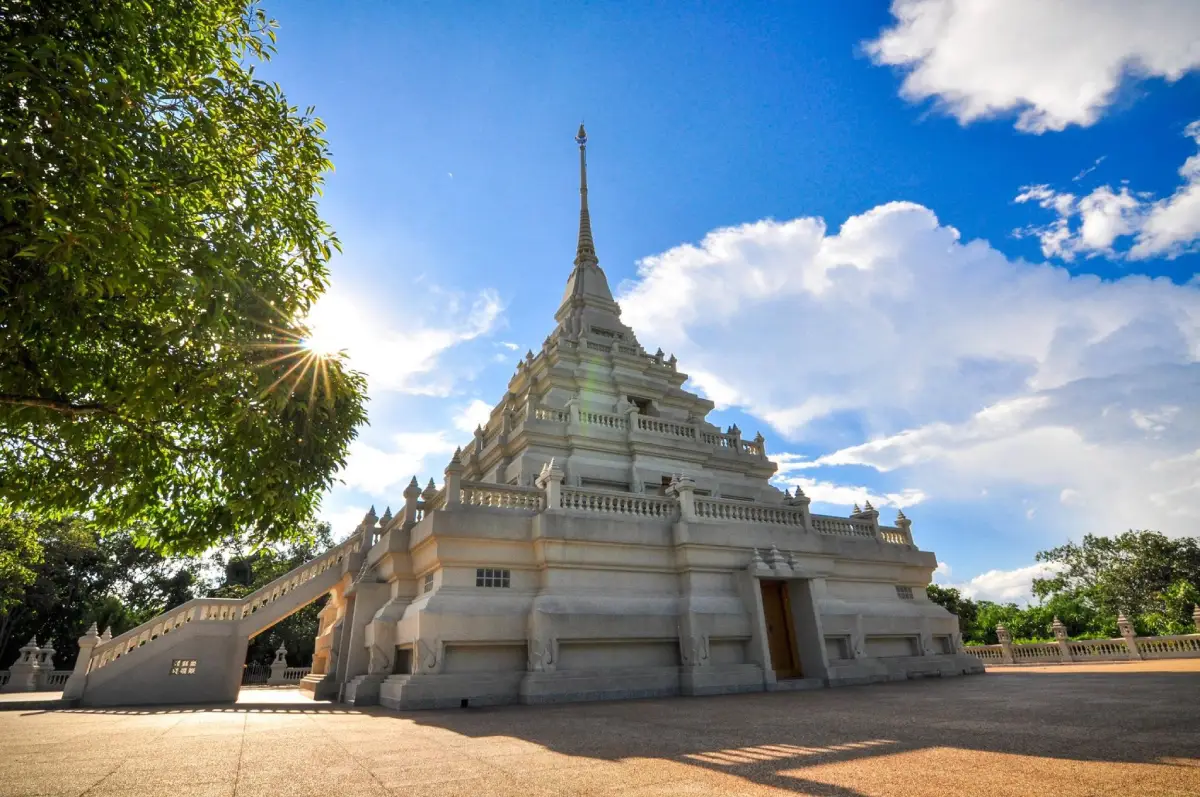
Open Days: Daily
Opening Hours: 08.00 – 17.00
Wat Doi Tham Chedi in Sakon Nakhon is a Dhammayut forest meditation temple located at Ban Na Si Nuan, Village No. 3, Tong Khop Subdistrict, Khok Si Suphan District, Sakon Nakhon Province. The temple is deeply connected with the Thai Forest Tradition and the lineage of Luang Pu Mun Bhuridatta. It is associated with Luang Pu Kongma Chirapunyo and Phra Phawana Wisutthiyan Thera, also known as Luang Pu Baen Thanakaro. Today, one of the main highlights is the Chinese-style memorial pavilion museum of Luang Pu Baen, which enshrines his relics, monastic requisites, and a standing metal statue. The temple offers a calm forest-monastery atmosphere on a hill landscape and is suitable for worship, Buddhist learning, meditation heritage, and cultural travel in Khok Si Suphan District.
Wat Doi Tham Chedi Sakon Nakhon is an important temple in Khok Si Suphan District. It is located at Ban Na Si Nuan, Village No. 3, Tong Khop Subdistrict, Sakon Nakhon Province, and belongs to the Dhammayut order. The temple is significant as a Thai forest meditation monastery connected with senior masters in the lineage of Luang Pu Mun Bhuridatta. It is also a spiritual landmark for local people in Khok Si Suphan, where Buddhism, rural community life, and the forest-monk tradition remain closely connected.
The temple has a calm and restrained atmosphere. Unlike urban temples that are often known for large buildings or busy tourist activity, Wat Doi Tham Chedi is valued for its stillness, forest surroundings, and connection with serious meditation practice. Its hill setting near the Phu Phan mountain landscape gives the temple a natural sense of seclusion. This makes the place suitable for paying respect, walking quietly, reflecting on the teachings of forest masters, and learning about the spiritual identity of Sakon Nakhon.
Wat Doi Tham Chedi is strongly tied to the identity of Khok Si Suphan District. The district motto includes the phrase referring to a distinguished temple on a hill, reflecting the importance of this temple as a local symbol. For local people, the temple is not merely a place of worship. It is a landmark of faith, a cultural memory site, and a place where the history of forest meditation practice continues to be respected.
The origin of the temple name is connected with an important event in the temple’s early history. After Phra Ajahn Mun Bhuridatta and his disciples practiced Dhamma in the area around Tong Khop Subdistrict, disciples would stay in the area from time to time. Later, Phra Ajahn Kongma Chirapunyo, one of Phra Ajahn Mun’s disciples, brought monks and novices to stay and observe the rains retreat at the site. In 1949, Phra Tham Chedi (Chum Phanthulo) from Wat Phothisomphon in Udon Thani visited and stayed at the temple for a period. Local villagers regarded this as an auspicious sign and named the temple Wat Doi Tham Chedi.
Wat Doi Tham Chedi was established in 1941 and later received its royal boundary for monastic acts on 10 January 1985. The consecrated boundary measures 40 meters wide and 80 meters long. The temple developed from a quiet meditation place into a functioning monastery with important temple structures such as an ordination hall, monks’ residences, a reclining Buddha image hall, a walking Buddha image hall, and a multipurpose hall. These elements show how the temple grew from a forest practice site into a religious center for monks and lay devotees.
Important sacred objects at the temple include the principal Buddha image in the ordination hall, seated in the Mara-subduing posture with a lap width of 3.2 meters, lacquered and gilded, created in 1959. Other sacred images include a Buddha image in the Palilayaka posture, created in 1958, a reclining Buddha image created in 1959, and a walking Buddha image created in 1975. These Buddha images give the temple a complete religious character while preserving the quiet spirit of a forest monastery.
The figure most strongly associated with Wat Doi Tham Chedi in modern memory is Phra Phawana Wisutthiyan Thera, or Luang Pu Baen Thanakaro. His original name was Suwan Kongchinda. He was born on 2 July 1928 at Ban Nong Bua, Nong Bua Subdistrict, Mueang District, Chanthaburi Province. He was ordained as a monk on 24 May 1950 at Wat Ko Takhian in Chanthaburi. After developing strong faith in the practice of Luang Pu Kongma Chirapunyo, he followed Luang Pu Kongma to Wat Doi Tham Chedi. After Luang Pu Kongma passed away, Luang Pu Baen continued the responsibility of caring for the temple and preserving the teacher’s practice tradition.
Luang Pu Baen Thanakaro was known for discipline, firmness, simplicity, and his strict preservation of the forest meditation practice of Luang Pu Mun Bhuridatta. He was respected by monks, disciples, and laypeople because his life emphasized monastic discipline, meditation, restraint, and direct practice. He did not seek luxury or outward display. His teaching and conduct encouraged people to maintain morality, develop mindfulness, and live with inner strength. For many devotees, Wat Doi Tham Chedi became a place to hear Dhamma, pay respect to a teacher, and practice in the spirit of the Thai Forest Tradition.
Luang Pu Baen Thanakaro passed away peacefully on 16 January 2020 at his residence in Wat Doi Tham Chedi. He was 91 years old, with 69 rains retreats. His passing was deeply felt among devotees of the forest meditation tradition because he was regarded as one of the major elders preserving the lineage of Luang Pu Mun. After his cremation, the temple continued to preserve his memory through important sacred spaces, especially the Chinese-style memorial pavilion museum built according to his wish before passing away.
The Chinese-Style Memorial Pavilion Museum Of Luang Pu Baen Thanakaro is now one of the most important places within Wat Doi Tham Chedi. The building stands on the cremation site of Luang Pu Baen’s body. It enshrines his relics, monastic requisites, and serves as a memorial representing the teacher. The pavilion is built of wood in an octagonal Chinese-style form. Its architecture carries Buddhist meaning: the octagonal form refers to the Noble Eightfold Path, the three-tiered roof refers to the Triple Gem, and the top point symbolizes Nibbana, the highest goal of Buddhist practice.
The details of the memorial pavilion reflect deep devotion to Luang Pu Baen. At the entrance is a Chinese character meaning gold, connected with his original name Suwan, which means gold in Thai. Around the eight directions are Chinese characters associated with virtue. Inside the pavilion is a metal statue of Luang Pu Baen standing on a rock, symbolizing firmness, stability in practice, and an unshaken mind amid worldly conditions. His relics and monastic requisites are enshrined inside for devotees to pay respect.
The pavilion museum is more than a memorial building. It is also a place for contemplation and practice. Visitors can pay respect to the relics and view the monastic requisites with a calm and respectful mind. The place shows how the memory of a forest master can be preserved not only through written biography, but also through objects, sacred space, architecture, and the atmosphere of practice maintained by the temple community.
On 13 July 2023, Her Royal Highness Princess Maha Chakri Sirindhorn privately presided over the opening of the Chinese-style memorial pavilion museum of Luang Pu Baen Thanakaro at Wat Doi Tham Chedi. This event reflects the importance of the temple and of Luang Pu Baen beyond the local level. Wat Doi Tham Chedi is not only a temple of Ban Na Si Nuan or Tong Khop Subdistrict, but also a place respected by devotees from many regions who honor the legacy of a senior forest meditation master.
The temple is currently led by Phra Ajahn Jetsada Thiwangkaro, also known as Phra Ajahn Waen, identified in provincial public relations information as the abbot of Wat Doi Tham Chedi. He has explained the background and meaning of the Chinese-style memorial pavilion museum of Luang Pu Baen and continues the responsibility of maintaining the temple after Luang Pu Baen’s passing. Under his care, the temple continues as a place of worship, practice, teacher remembrance, and community faith.
Wat Doi Tham Chedi can be understood in three main dimensions. First, it is a forest meditation temple in the Dhammayut order connected with the lineage of Luang Pu Mun Bhuridatta. Second, it is a teacher memorial site, especially through the Chinese-style pavilion museum, relics, monastic requisites, and statue of Luang Pu Baen. Third, it is a local spiritual landmark of Khok Si Suphan District, serving as a place of faith for Ban Na Si Nuan, Tong Khop Subdistrict, and the surrounding area.
Important areas within the temple include the ordination hall, monks’ residences, reclining Buddha image hall, walking Buddha image hall, multipurpose hall, meditation areas, shaded forest grounds, hill areas, and the Chinese-style memorial pavilion museum of Luang Pu Baen Thanakaro. Each area has its own purpose. The ordination hall supports formal monastic acts. The image halls are places of worship. The multipurpose hall supports religious activities. The pavilion museum serves as a sacred memory space for the teacher.
A respectful visit can begin with paying homage to the main Buddha images, then continuing to the Chinese-style memorial pavilion museum of Luang Pu Baen Thanakaro. Visitors should walk quietly, dress modestly, and maintain awareness of the temple’s meditation atmosphere. Monastic zones should not be entered without permission, and relics, monastic requisites, or displayed objects should not be touched. This is a living forest monastery, not only a sightseeing site.
The atmosphere of Wat Doi Tham Chedi is one of its strongest features. Located on a hill near the Phu Phan mountain landscape, the temple carries a natural calmness. The sound of wind, trees, and the quiet movement of visitors creates an environment suitable for reflection. A forest temple like this does not seek entertainment or spectacle. Its value lies in silence, restraint, respect, and the ability to bring the mind back to simplicity.
Khok Si Suphan District itself gives the temple additional context. The district is largely agricultural, with the Phung River forming part of its landscape and the Phu Phan range to the south. Its local identity includes Phu Thai communities, silk weaving, rural settlement, and mountain scenery. Wat Doi Tham Chedi stands within this wider environment where nature, rural culture, and Buddhist faith support one another.
Getting There is most convenient by private car or rental car. From Sakon Nakhon city, travel toward Khok Si Suphan District, then continue to Tong Khop Subdistrict and Ban Na Si Nuan. The temple is located on a hill area, so daytime travel is recommended. Visitors unfamiliar with the route should use navigation together with local signs and allow enough time for worship, the pavilion museum, and a calm walk through the temple grounds.
From Khok Si Suphan town, the temple can be visited as a half-day trip. A practical route may begin at Wat Doi Tham Chedi, then continue to local community areas, Khok Si Suphan Forest Park, Wat Khok Na Di in Mad Na Thom Subdistrict, or onward routes toward Sakon Nakhon city and Phu Phan District. This kind of route connects the temple with local culture, rural scenery, and nearby forest landscapes.
The best time to visit is in the morning or early afternoon during the opening hours from 08.00 to 17.00. Morning visits offer cooler weather and a calmer atmosphere. Early afternoon visits are convenient for travelers coming from other places in Sakon Nakhon. Evening visits should be avoided because the temple is a forest monastery and should remain quiet after visiting hours.
Visitors should dress modestly and respectfully. Shoulders and knees should be covered, and shoes should be comfortable and easy to remove. Elderly visitors should allow extra time because the temple is on a hill and some areas may require careful walking. Visitors entering the pavilion museum should behave with particular restraint because the building enshrines relics and monastic requisites of a respected forest master.
For families, Wat Doi Tham Chedi can be a meaningful Buddhist learning destination. Children can learn about the Thai Forest Tradition, Luang Pu Baen Thanakaro, the meaning of relics and monastic requisites, and the symbolism of the Chinese-style memorial pavilion. They should be guided to walk calmly, keep voices low, and respect monks, devotees, and sacred areas.
For those interested in forest meditation masters, Wat Doi Tham Chedi is an important destination in Sakon Nakhon. The temple connects with Phra Ajahn Mun Bhuridatta, Phra Ajahn Kongma Chirapunyo, Luang Pu Baen Thanakaro, and Phra Tham Chedi (Chum Phanthulo). These names form part of a network of teachers who helped preserve and transmit the forest meditation practice in northeastern Thailand.
The temple also helps visitors understand that a forest monastery is not only a peaceful natural place. It is a disciplined way of life shaped by monastic conduct, meditation, restraint, teacher-student relationships, and lay devotion. Luang Pu Baen’s life shows how spiritual strength can be cultivated through simplicity and firm practice. The temple preserves that example through its atmosphere and sacred spaces.
Nearby places in Khok Si Suphan District can be combined with a visit to Wat Doi Tham Chedi. Khok Si Suphan Forest Park reflects the green landscape of the district. Wat Khok Na Di in Mad Na Thom Subdistrict preserves a local Isan ordination hall influenced by Vietnamese craftsmanship, built in 1942. Travelers may also continue to Sakon Nakhon city, Wat Pa Sutthawat, or Phu Phan National Park depending on their route.
Dining options are available around Khok Si Suphan town. Publicly listed places include PunThai Coffee Khok Si Suphan, MED-SAI CAFE & EATERY, Lamphu Nuea Yang Korean BBQ, and other local restaurants in the district center. Visitors who want more variety can continue to Sakon Nakhon city. Planning meals before or after the temple visit makes the trip smoother, especially because the temple itself is a forest monastery rather than a commercial tourist area.
Accommodation is available in Khok Si Suphan District. Publicly listed options include Ban Suan Resort, Rabiang Khao Park View, Med Sai Riverside, Ban Tho Fan Resort, Darin Resort, Si Suphan, and Ban Charoen Suk. Staying in Khok Si Suphan is suitable for visitors who want to reach the temple early or explore the district at a slower pace. Travelers who prefer more services and restaurant options may stay in Sakon Nakhon city and visit the temple as a day trip.
Most visitors should allow about 1.5 to 3 hours for Wat Doi Tham Chedi. A shorter visit is enough for paying respect and visiting the memorial pavilion museum. A longer visit allows time to walk calmly through the temple grounds, read details, sit quietly, and absorb the forest-monastery atmosphere. The value of this temple is not measured by the number of photo spots, but by the depth of its history, teacher legacy, and stillness.
Photography should be done respectfully. Suitable subjects include the temple grounds, hill landscape, trees, the exterior of the pavilion museum, and areas where photography is permitted. Visitors should not take close photographs of monks or practitioners without permission. Poses that do not respect a sacred Buddhist site should be avoided. This is a living temple and a meditation monastery, so respectful behavior is essential.
For international visitors, Wat Doi Tham Chedi offers a clear view of Thai Buddhism through the forest-monastery tradition. The temple does not focus on grand spectacle. It emphasizes peace, teacher remembrance, meditation lineage, relic veneration, and the natural setting of a hill temple. The Chinese-style memorial pavilion of Luang Pu Baen shows how disciples and local communities preserve the memory of a forest master through relics, monastic objects, symbolic architecture, and ongoing practice.
Wat Doi Tham Chedi is therefore one of the most meaningful places to visit in Khok Si Suphan District for travelers interested in forest monasteries, meditation masters, Luang Pu Baen Thanakaro, and the quiet religious landscape of Sakon Nakhon. Visitors can pay respect to Buddha images, honor the relics of Luang Pu Baen, learn about the temple’s connection with Phra Ajahn Mun and Phra Ajahn Kongma, and experience the calm atmosphere of a forest temple that local people regard as a distinguished spiritual landmark of the district.
| Name | Wat Doi Tham Chedi |
| Location | Ban Na Si Nuan, Village No. 3, Tong Khop Subdistrict, Khok Si Suphan District, Sakon Nakhon Province |
| Place Type | Forest Temple / Dhammayut Temple / Meditation Monastery / Faith-Based Cultural Destination |
| Buddhist Affiliation | Dhammayut Order |
| Abbot | Phra Ajahn Jetsada Thiwangkaro, also known as Phra Ajahn Waen |
| Important Figures | Phra Ajahn Mun Bhuridatta, Phra Ajahn Kongma Chirapunyo, Phra Tham Chedi (Chum Phanthulo), and Phra Phawana Wisutthiyan Thera, also known as Luang Pu Baen Thanakaro |
| Highlights | Chinese-style memorial pavilion museum of Luang Pu Baen Thanakaro, wooden octagonal pavilion, relics, monastic requisites, and a metal statue of Luang Pu Baen standing on a rock |
| History / Significance | Established in 1941, the temple is connected with the meditation practice of Phra Ajahn Mun Bhuridatta and his disciples. Later, Phra Ajahn Kongma Chirapunyo brought monks and novices to stay here, and Luang Pu Baen Thanakaro continued the forest meditation tradition at the temple |
| Name Origin | In 1949, Phra Tham Chedi (Chum Phanthulo) visited and stayed at the temple. Villagers regarded this as auspicious and named the temple Wat Doi Tham Chedi |
| Important Sacred Objects | Principal Buddha image in the Mara-subduing posture, 3.2 meters in lap width, lacquered and gilded; Palilayaka Buddha image; reclining Buddha image; and walking Buddha image |
| Main Temple Structures | Ordination hall, monks’ residences, reclining Buddha image hall, walking Buddha image hall, and multipurpose hall |
| Main Areas / Zones | Ordination hall area, monks’ residence area, Buddha image halls, multipurpose hall, meditation areas, hill forest-temple grounds, and Chinese-style memorial pavilion museum of Luang Pu Baen Thanakaro |
| Current Status | Open for worship and respectful visits during temple hours |
| Open Days | Daily |
| Opening Hours | 08.00 – 17.00 |
| Travel Information | From Sakon Nakhon city, travel to Khok Si Suphan District, then continue to Tong Khop Subdistrict and Ban Na Si Nuan. The temple is best reached by private car or rental car, with daytime travel recommended because it is located on a hill forest-temple site |
| Facilities | Parking area, halls, Buddha worship areas, Chinese-style pavilion museum, meditation areas, and shaded forest-temple grounds |
| Visitor Guidelines | Dress modestly, keep voices low, respect meditation areas, do not enter monastic zones without permission, do not touch relics or monastic requisites, and preserve the quiet atmosphere of the temple |
| Nearby Tourist Attractions | 1. Khok Si Suphan Forest Park, about 8 km 2. Khok Si Suphan town community area, about 10 km 3. Wat Khok Na Di, Mad Na Thom Subdistrict, about 18 km 4. Sakon Nakhon city and Wat Phra That Choeng Chum Worawihan, about 35 km 5. Wat Pa Sutthawat and Luang Pu Mun Bhuridatta Museum, about 38 km 6. Phu Phan National Park, about 40 km |
| Nearby Restaurants | 1. PunThai Coffee Khok Si Suphan, about 10 km, Tel. 098-270-6792 2. MED-SAI CAFE & EATERY Khok Si Suphan, about 10 km, Tel. 095-616-9119 3. Lamphu Nuea Yang Korean BBQ Khok Si Suphan, about 10 km 4. Kung Pen Tom Yum Noodle Branch 2 Khok Si Suphan, about 10 km 5. Local restaurants in Khok Si Suphan town, about 10 km |
| Nearby Accommodations | 1. Ban Suan Resort, about 10 km, Tel. 089-577-1738 2. Rabiang Khao Park View, about 10 km, Tel. 082-444-9777 3. Med Sai Riverside, about 10 km, Tel. 042-766-121 4. Ban Tho Fan Resort, about 10 km, Tel. 088-326-0669 5. Darin Resort, about 10 km, Tel. 089-575-3981 6. Si Suphan, about 10 km, Tel. 095-672-7609 7. Ban Charoen Suk, about 10 km, Tel. 095-495-3465 |
Frequently Asked Questions (FAQ)
Q: Where Is Wat Doi Tham Chedi Located?
A: Wat Doi Tham Chedi is located at Ban Na Si Nuan, Village No. 3, Tong Khop Subdistrict, Khok Si Suphan District, Sakon Nakhon Province.
Q: What Are The Opening Days And Hours?
A: Wat Doi Tham Chedi is open daily from 08.00 to 17.00.
Q: What Is The Main Highlight Of Wat Doi Tham Chedi?
A: The main highlight is the Chinese-style memorial pavilion museum of Luang Pu Baen Thanakaro, which enshrines his relics, monastic requisites, and a metal statue inside a symbolic octagonal wooden pavilion.
Q: How Is Luang Pu Baen Thanakaro Connected With This Temple?
A: Luang Pu Baen Thanakaro followed Luang Pu Kongma Chirapunyo to Wat Doi Tham Chedi and later became an important forest meditation elder who continued the temple’s practice tradition.
Q: Who Is The Abbot Of Wat Doi Tham Chedi?
A: The abbot is Phra Ajahn Jetsada Thiwangkaro, also known as Phra Ajahn Waen.
Q: Why Is The Chinese-Style Memorial Pavilion Important?
A: The pavilion was built on the cremation site of Luang Pu Baen. It enshrines his relics and monastic requisites, while its octagonal form symbolizes the Noble Eightfold Path.
Q: How Should Visitors Behave At Wat Doi Tham Chedi?
A: Visitors should dress modestly, keep voices low, respect meditation areas, avoid entering monastic zones without permission, and not touch relics or monastic requisites.
Q: What Nearby Places Can Be Visited On The Same Trip?
A: Nearby places include Khok Si Suphan Forest Park, Khok Si Suphan town, Wat Khok Na Di, Sakon Nakhon city, Wat Pa Sutthawat, and Phu Phan National Park.
 Category: ●Places of Worship
 Group: ●Temple
Last Update : 2 MonthAgo
 Last Update : 2 MonthAgo
 Click to Access the Navigation Map GPS
Wat Doi Thamma Chedi Map
Recommend

 Art, Culture and Heritage
 Historical Sites and Monuments(9)
 Landmarks and Memorials(2)
 Royal Palace(1)
 Art, Craft Centres, Tradition(8)
 Museums(3)
 Educational Places
 Educational Gardens, Farm(2)
Temple(18)
Educational Gardens, Farm(2)
Temple(18)
 Church(2)
 Other Sacred Sites(4)
 Research and Development
 Royal Project(3)
 Suburban Living
 Village, Community(7)
 Nature and Wildlife
 National Parks and Marine Reserves(4)
 Mountain (Doi)(3)
 Dam, Reservoir, Lake(14)
 Waterfalls(4)
 Caves(4)
 River, Canal(9)
 Bays and Beaches(1)
 Islands(1)
 Other natural attractions(5)
 Entertainment and Agricultural
 Zoos and Aquariums(1)
 Farms, Parks and Ecotourism(4)
 Outdoor and Adventure Activities(1)


