
lovethailand home >Northeastern Travel Attractions >Sakon Nakhon Travel Attractions >Phanna Nikhom >Rai > Wat Pa Non Klang Phu
TL;DR: Wat Pa Non Klang Phu is located at Ban Kut Kom, Moo 7, Rai Subdistrict, Phanna Nikhom District, Sakon Nakhon 47130, Thailand, open Open Daily, hours 08.00 - 17.00.
Wat Pa Non Klang Phu
Open Days: Open Daily
Opening Hours: 08.00 - 17.00
Wat Pa Non Klang Phu In Sakon Nakhon, also known as Wat Pa Klang Non Phu, is a Dhammayut forest temple located at Ban Kut Kom, Moo 7, Rai Subdistrict, Phanna Nikhom District, Sakon Nakhon Province. The temple is one of the most meaningful places for anyone interested in the Thai Forest Tradition because it is where Ajahn Mun Bhuridatto, the great master of the modern Thai forest meditation lineage, stayed during his final illness for 11 days before being taken to Wat Pa Sutthawat in Sakon Nakhon city, where he later passed away. The temple is not a large tourist complex. Its importance lies in its quiet forest atmosphere, its preserved pavilion connected with Ajahn Mun’s final journey, and its museum displaying objects associated with his illness and transfer from Wat Pa Ban Nong Phue.
The temple stands in Phanna Nikhom District, not far from Sakon Nakhon city. It is surrounded by a rural and forest-like setting that still reflects the character of a traditional forest monastery. Wat Pa Klang Non Phu was founded by Phra Ajahn Chaloei Sudhammo and Nai On Morarat, who donated land for the temple. The place was once a quiet forest area with simple monastic facilities. Over time, it became a forest temple where monks and lay supporters preserved the memory of Ajahn Mun and the forest meditation lineage. Phra Ajahn Chaloei served as the first abbot, followed by important forest monks such as Phra Ajahn Gu Dhammadinnno and Phra Ajahn Kwa Sumano.
The name Non Klang Phu, or Klang Non Phu, reflects the local landscape. In Northeastern Thai usage, “non” refers to a raised area or mound, while “phu” is connected with the local name of the area. The name suggests a quiet elevated place in a rural community, suitable for a forest monastery. This simplicity matches the spirit of the temple. Wat Pa Non Klang Phu is not known for elaborate decoration, but for its atmosphere of stillness, restraint, and direct connection with the lives of forest meditation masters.
The temple became especially important during the final days of Ajahn Mun Bhuridatto. After his illness worsened at Wat Pa Ban Nong Phue, his disciples arranged to move him toward Sakon Nakhon. The journey was difficult and deeply significant. Ajahn Mun was carried using a litter and supported by disciples and lay devotees who cared for him with great reverence. The route passed through several villages before reaching Wat Pa Klang Non Phu at Ban Kut Kom. The temple became the place where he rested during the last stage of his journey before moving to Wat Pa Sutthawat.
Ajahn Mun’s stay at Wat Pa Klang Non Phu for 11 days gives the temple profound spiritual meaning. It was a moment when disciples gathered around their teacher with deep respect, aware that his physical life was reaching its final phase. The atmosphere surrounding his illness was one of quietness, discipline, and reverence. For visitors today, the temple offers a direct encounter with that history. It is a place where impermanence, devotion, and the calm dignity of a great forest master can be contemplated through the actual location associated with his final illness.
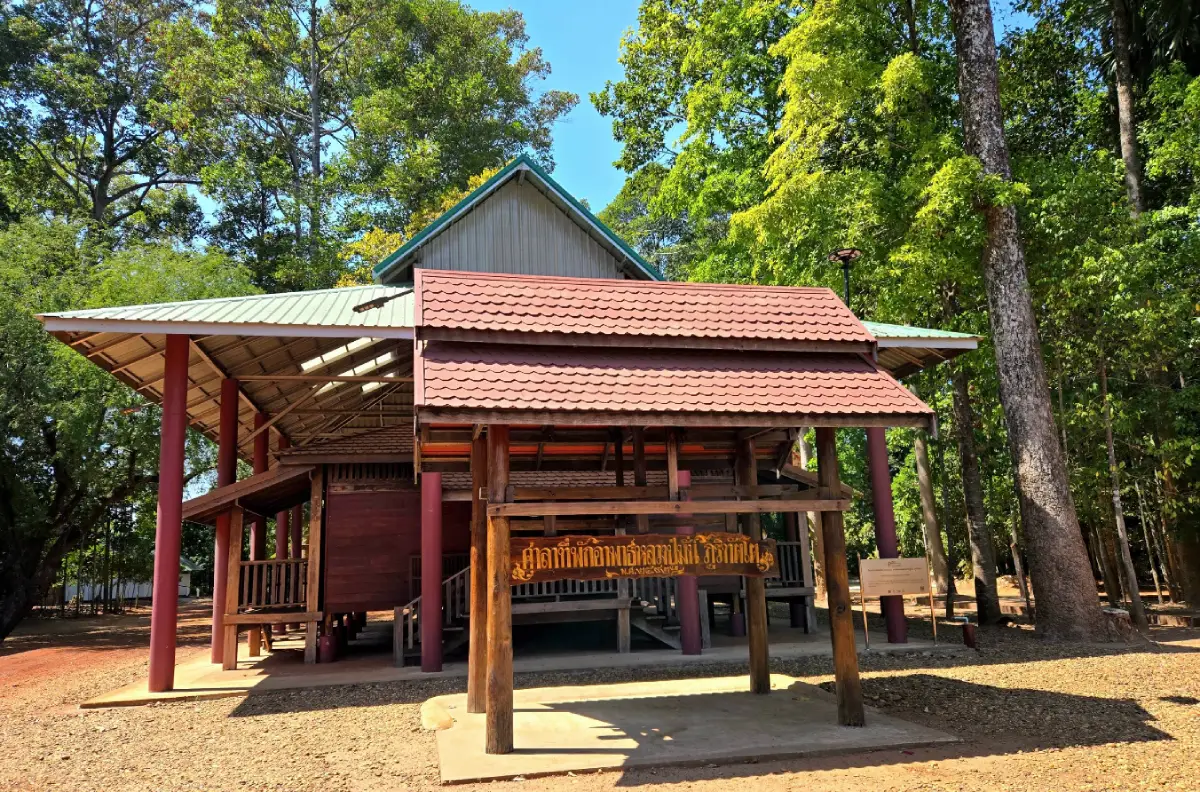
The most important structure in the temple is the old wooden pavilion where Ajahn Mun stayed during his illness. Today, this building has been preserved as the Ajahn Mun Bhuridatto Museum, often described as the memorial pavilion of his illness. Inside are objects connected with his final journey, including the litter, carrying frame, mosquito net, bed, umbrella tent, bedding, covering, and other requisites used during the period when he was brought from Wat Pa Ban Nong Phue to Wat Pa Klang Non Phu. These objects are not valuable because of luxury. They are valuable because they reveal the simplicity and austerity of forest-monastic life.
The museum also displays Ajahn Mun’s life history, important photographs, Buddha relics, Ajahn Mun’s relics, relics of other forest masters, and relics of former abbots connected with the temple, including Phra Ajahn Gu Dhammadinnno and Phra Ajahn Kwa Sumano. The museum therefore functions as a sacred learning space, not merely a collection room. Visitors can pay respect, study the story of Ajahn Mun, and understand the continuity of the Thai Forest Tradition through physical objects, images, and the atmosphere of the temple itself.
The museum building is simple and dignified. It is a single-storey rectangular structure with the appearance of an adapted Thai-style house. The front wall includes high-relief terracotta artwork depicting scenes related to Ajahn Mun’s forest-monk practices. Inside, the display is calm and focused. The space encourages slow viewing and respectful contemplation. Visitors should treat the museum as both a historical display and a sacred memorial.
Wat Pa Non Klang Phu is part of an important route tracing the final period of Ajahn Mun’s life. Wat Pa Ban Nong Phue represents his late years as a teacher surrounded by disciples. Wat Pa Klang Non Phu represents the period of illness and transition toward Sakon Nakhon city. Wat Pa Sutthawat is the place where he passed away and where a major museum dedicated to him now stands. Visiting these places together allows travelers to understand Ajahn Mun’s final journey in sequence, rather than seeing each temple as an isolated site.
Ajahn Mun Bhuridatto is one of the most influential Buddhist monks in modern Thai history. He restored and strengthened the practice of forest meditation, strict Vinaya discipline, dhutanga observances, mindfulness, and direct mental cultivation. Many of his disciples became major teachers in their own right, including Ajahn Fan Acharo, Luang Pu Thet Thetrangsi, Luang Pu Khao Analayo, Luang Pu Lui Chandasaro, and Luang Ta Maha Bua Nyanasampanno. Wat Pa Non Klang Phu is one of the places where visitors can encounter this lineage not through theory alone, but through preserved objects and lived history.
The temple’s atmosphere is quiet and shaded. It has trees, open ground, monastic buildings, the museum pavilion, worship areas, and forest-monastery space arranged without unnecessary display. This simplicity is part of its value. Visitors will not find the atmosphere of a crowded commercial attraction. Instead, they will find a place meant for paying respect, learning, and reflecting on the life of a great teacher. The best way to experience the temple is to walk slowly, speak softly, and spend time with the museum objects and the story they carry.
The temple also preserves the memory of former abbots and forest monks who helped maintain its monastic life after its founding. Phra Ajahn Gu Dhammadinnno and Phra Ajahn Kwa Sumano are remembered through relics and temple history. This makes Wat Pa Klang Non Phu more than a site connected only with Ajahn Mun. It is also a living memorial to the group of forest monks and lay supporters who helped preserve the tradition in Phanna Nikhom District.
The role of lay supporters is central to the temple’s story. Nai On Morarat, who donated land and supported the establishment of the temple, represents the important relationship between forest monks and local lay communities. Forest monasteries often grew from this cooperation. Monks provided Dhamma, discipline, and spiritual guidance, while laypeople offered land, food, medicine, shelter, and practical support. Wat Pa Non Klang Phu is a clear example of this mutual relationship.
The temple is open daily from 08.00 to 17.00 for general visits and museum viewing. There is no admission fee, and visitors may make donations voluntarily. Morning is the most suitable time to visit because the atmosphere is cooler and quieter. Visitors coming as a group or for educational purposes should arrange their visit respectfully so that the temple’s quiet atmosphere is preserved.
Getting There from Sakon Nakhon city is convenient by private car, rental car, or local hired vehicle. Travel on Highway 22, the Nittayo Road route, toward Phanna Nikhom District, then continue into Rai Subdistrict and Ban Kut Kom. The total distance from the city is about 25 - 35 km depending on the starting point and route, and the journey usually takes around 40 - 50 minutes. When using online maps, search for Wat Pa Klang Non Phu or Wat Pa Non Klang Phu, Ban Kut Kom, Rai Subdistrict, Phanna Nikhom District.
Visitors who want to follow Ajahn Mun’s final journey can connect Wat Pa Non Klang Phu with Wat Pa Bhuridatta Thirawat at Ban Nong Phue and Wat Pa Sutthawat in Sakon Nakhon city. Ban Nong Phue represents Ajahn Mun’s final teaching period, Wat Pa Non Klang Phu represents his stay during his final illness, and Wat Pa Sutthawat is where he passed away. This route gives a complete understanding of the final chapter of one of Thailand’s greatest meditation masters.
Phanna Nikhom District also offers other important forest-monk destinations. Nearby places include Wat Pa Udom Somphon and the Ajahn Fan Acharo Museum, Wat Tham Kham, Wat Acharo Rangsi and the 100-Year Memorial Museum of Luang Pu Thet Thetrangsi, Phra That Phu Phek, and Nam Un Dam. Together, these places show that Sakon Nakhon is not only a province of sacred monuments, but also one of the most important provinces for the Thai Forest Tradition.
Visitors should allow at least 45 minutes to 1 hour for the temple. Those who want to read the displays carefully and spend time reflecting should allow 1 - 2 hours. The museum should be entered with respect. Visitors should not touch the relics, requisites, litter, photographs, statues, or displayed objects without permission. The space should be treated as both a museum and a sacred memorial.
Proper conduct is essential. Visitors should dress modestly, speak softly, remove shoes in designated areas, avoid entering monastic or restricted areas without permission, and keep the temple clean. Since this temple is connected with the final illness of a highly revered teacher, respectful behavior is especially important.
Food and accommodation are available mainly in Phanna Nikhom District and Sakon Nakhon city. There are restaurants and cafés in Phanna Nikhom town, including Jungle Cafe, Tiger Basil Pure Beef, Tam Zab, Khrua Rung Rueang, and other local shops. Accommodation options in Phanna Nikhom include small resorts and homestays, while visitors who prefer more services can stay in Sakon Nakhon city and visit the temple as a day trip.
For international visitors, Wat Pa Non Klang Phu provides a strong introduction to the Thai Forest Tradition. It shows that Buddhism in Northeastern Thailand is not limited to temple buildings or public rituals. It is deeply connected with forest practice, simple living, teacher-disciple relationships, disciplined meditation, and the careful preservation of monastic memory. The objects in the museum help foreign visitors understand the physical simplicity and spiritual intensity of forest monastic life.
The requisites displayed in the museum are simple: a litter, mosquito net, bed, umbrella tent, bedding, and related objects. Their simplicity is their message. They show that the heart of forest practice is not accumulation, but renunciation, restraint, mindfulness, and direct cultivation of the mind. For visitors living in a fast and material world, this temple offers a quiet lesson in spiritual simplicity.
Overall, Wat Pa Non Klang Phu is one of Sakon Nakhon’s most meaningful Dhamma destinations. Its importance does not come from size or architectural grandeur. It comes from its connection with Ajahn Mun Bhuridatto’s final illness, the preserved museum pavilion, the display of sacred requisites and relics, and the quiet forest atmosphere of Phanna Nikhom. It is a place for worship, learning, remembrance, and reflection.
Wat Pa Non Klang Phu should be visited slowly and respectfully. It is not only a stop for photographs. It is a place to pay homage to a great teacher, study the final journey of Ajahn Mun, and encounter the calm dignity of the Thai Forest Tradition. For anyone who wants to understand why Sakon Nakhon is one of Thailand’s most important provinces for forest Buddhism, this temple is an essential destination.
| Place Name | Wat Pa Non Klang Phu Sakon Nakhon / Wat Pa Klang Non Phu / Ajahn Mun Bhuridatto Illness Pavilion Museum |
| Place Type | Dhammayut Forest Temple, Meditation Site, And Memorial Museum Connected With Ajahn Mun Bhuridatto |
| Main Location | Ban Kut Kom, Moo 7, Rai Subdistrict, Phanna Nikhom District, Sakon Nakhon Province |
| Address | Ban Kut Kom, Moo 7, Rai Subdistrict, Phanna Nikhom District, Sakon Nakhon 47130, Thailand |
| Highlights | Ajahn Mun’s Illness Pavilion Museum, Requisites From His Final Journey, Carrying Litter, Mosquito Net, Umbrella Tent, Historical Photographs, Buddha Relics, Ajahn Mun’s Relics, Former Abbots’ Relics, And Quiet Dhammayut Forest-Temple Atmosphere |
| History / Importance | Founded By Phra Ajahn Chaloei Sudhammo And Nai On Morarat. The Temple Is Where Ajahn Mun Bhuridatto Stayed During His Final Illness For 11 Days Before Being Taken To Wat Pa Sutthawat, Where He Passed Away |
| Name Origin | The Name Non Klang Phu Or Klang Non Phu Refers To A Local Raised Area In Ban Kut Kom, Rai Subdistrict, A Quiet Setting Suitable For A Forest Monastery |
| Important Forest Masters Connected With The Temple | Ajahn Mun Bhuridatto Phra Ajahn Chaloei Sudhammo Phra Ajahn Gu Dhammadinnno Phra Ajahn Kwa Sumano The Thai Forest Tradition Lineage Of Ajahn Mun |
| Main Sacred And Historical Objects | Carrying Litter And Frame Used For Ajahn Mun’s Transfer Mosquito Net, Bed, Umbrella Tent, Bedding, And Covering From His Illness Period Ajahn Mun Life-History Exhibition Historical Photographs Buddha Relics Relics Of Ajahn Mun Bhuridatto Relics Of Former Abbots And Forest Masters Statues And Worship Areas Inside The Museum |
| Museum Building | A Single-Storey Adapted Thai-Style Building In A Forest-Temple Setting, With Terracotta High-Relief Artwork Depicting Ajahn Mun’s Forest-Monk Practices And Interior Displays Of Requisites And Sacred Objects |
| Travel Information | From Sakon Nakhon City, Take Highway 22 / Nittayo Road Toward Phanna Nikhom District, Then Continue To Rai Subdistrict And Ban Kut Kom. The Distance Is About 25 - 35 km And The Journey Usually Takes About 40 - 50 Minutes By Private Car, Rental Car, Or Local Hired Vehicle |
| Current Status | Open As A Dhammayut Forest Temple, Meditation Site, And Memorial Museum Connected With Ajahn Mun Bhuridatto |
| Open Days | Open Daily |
| Opening Hours | 08.00 - 17.00 For General Visits And The Ajahn Mun Illness Pavilion Museum |
| Fees | No Admission Fee; Donations Can Be Made Voluntarily |
| Facilities | Parking Area, Worship Areas, Museum Building, Walking Paths, Temple Halls, Quiet Rest Areas, Restrooms In Or Near The Temple Area, And Donation Points Arranged By The Temple |
| Main Areas / Zones | Ajahn Mun Illness Pavilion Museum Requisites And Carrying-Litter Display Area Ajahn Mun History And Photograph Exhibition Area Buddha Relics And Forest-Master Relics Area Forest-Master Worship Area Forest-Monastery Buildings And Temple Halls Meditation And Quiet Forest Atmosphere Route Connected With Wat Pa Bhuridatta Thirawat And Wat Pa Sutthawat |
| Annual Merit-Making / Important Activities | Buddhist Holy Days, Forest-Master Memorial Merit-Making, Ajahn Mun Pilgrimage Activities, Worship Of Sacred Requisites, And Meditation Activities According To The Temple’s Schedule |
| Caretaker / Related Responsible Community | Dhammayut Sangha Of Wat Pa Klang Non Phu And Ban Kut Kom Community, Rai Subdistrict, Phanna Nikhom District, Sakon Nakhon Province |
| Visitor Guidelines | Dress Respectfully, Speak Softly, Remove Shoes In Designated Areas, Do Not Touch Buddha Relics, Ajahn Mun’s Relics, Statues, Requisites, Or Displayed Objects Without Permission, Do Not Enter Monastic Areas Without Permission, And Preserve The Quiet Atmosphere Of The Forest Temple |
| Nearby Tourist Attractions | 1. Wat Pa Bhuridatta Thirawat, Ban Nong Phue, About 8 km 2. Phanna Nikhom Town, About 18 km 3. Wat Pa Udom Somphon And Ajahn Fan Acharo Museum, About 22 km 4. Phra That Phu Phek, About 28 km 5. Wat Acharo Rangsi And The 100-Year Memorial Museum Of Luang Pu Thet Thetrangsi, About 30 km 6. Wat Tham Kham / Phu Kham, About 35 km 7. Wat Pa Sutthawat And Ajahn Mun Bhuridatto Museum, Mueang Sakon Nakhon, About 35 km |
| Nearby Restaurants | 1. Jungle Cafe Phanna Nikhom Branch, About 18 km, Tel. 092-984-1412 2. Tiger Basil Pure Beef, Phanna Nikhom, About 18 km, Tel. 093-485-7266 3. Tam Zab, Phanna Nikhom, About 19 km, Tel. 099-614-4956 4. Khrua Rung Rueang, Phanna Nikhom, About 19 km, Tel. 082-312-0746 5. Pern Traditional Coffee, Phanna Nikhom Branch, About 20 km, Tel. 087-224-2242 6. Ran 3 Or, Phanna Nikhom, About 20 km, Tel. 081-049-3051 7. Café Amazon PTT Pratu Mueang Sakon Nakhon, About 35 km, Tel. 084-031-4920 |
| Nearby Accommodations | 1. Wana Phu Thai Resort, Phanna Nikhom, About 18 km, Tel. 081-873-5411 2. Na Khwan Resort, Phanna Nikhom, About 19 km, Tel. 081-964-6996 3. L & L Resort, Phanna Nikhom, About 20 km, Tel. 085-355-4113 4. Ban Suan Phanna, Phanna Nikhom, About 20 km, Tel. 081-954-0874 5. Thawiphan Resort, Phanna Nikhom, About 21 km, Tel. 080-179-7456 6. Maleemintra Homestay, Phanna Nikhom, About 21 km, Tel. 085-660-6411 7. Naki Resort, Phanna Nikhom, About 22 km, Tel. 083-131-0628 |
Frequently Asked Questions (FAQ)
Q: Where Is Wat Pa Non Klang Phu Located?
A: Wat Pa Non Klang Phu, also known as Wat Pa Klang Non Phu, is located at Ban Kut Kom, Moo 7, Rai Subdistrict, Phanna Nikhom District, Sakon Nakhon Province.
Q: What Are The Opening Days And Hours?
A: The temple is open daily from 08.00 to 17.00 for general visits and the Ajahn Mun illness pavilion museum.
Q: Is There An Admission Fee?
A: No. There is no admission fee. Visitors may pay respect, visit the museum, and make voluntary donations according to their faith.
Q: How Is Wat Pa Non Klang Phu Connected With Ajahn Mun Bhuridatto?
A: The temple is where Ajahn Mun Bhuridatto stayed during his final illness for 11 days before his disciples took him to Wat Pa Sutthawat, where he passed away.
Q: What Is Displayed In The Ajahn Mun Museum At Wat Pa Non Klang Phu?
A: The museum displays the carrying litter, mosquito net, bed, umbrella tent, bedding, historical photographs, Buddha relics, Ajahn Mun’s relics, and relics of forest meditation masters.
Q: Who Should Visit This Temple?
A: The temple is suitable for visitors interested in Ajahn Mun, the Thai Forest Tradition, meditation history, quiet forest temples, and Buddhist heritage in Sakon Nakhon.
Q: How Can Visitors Get There From Sakon Nakhon City?
A: Travel on Highway 22 / Nittayo Road toward Phanna Nikhom District, then continue to Rai Subdistrict and Ban Kut Kom. The distance is about 25 - 35 km and the trip usually takes about 40 - 50 minutes.
Q: What Nearby Places Can Visitors See After Wat Pa Non Klang Phu?
A: Nearby places include Wat Pa Bhuridatta Thirawat, Wat Pa Udom Somphon, the Ajahn Fan Acharo Museum, Phra That Phu Phek, Wat Acharo Rangsi, Wat Tham Kham, and Wat Pa Sutthawat.
 Category: ●Places of Worship
 Group: ●Temple
Last Update : 2 MonthAgo
 Last Update : 2 MonthAgo
 Click to Access the Navigation Map GPS
Wat Pa Non Klang Phu Map
Recommend

 Art, Culture and Heritage
 Historical Sites and Monuments(9)
 Landmarks and Memorials(2)
 Royal Palace(1)
 Art, Craft Centres, Tradition(8)
 Museums(3)
 Educational Places
 Educational Gardens, Farm(2)
Temple(18)
Educational Gardens, Farm(2)
Temple(18)
 Church(2)
 Other Sacred Sites(4)
 Research and Development
 Royal Project(3)
 Suburban Living
 Village, Community(7)
 Nature and Wildlife
 National Parks and Marine Reserves(4)
 Mountain (Doi)(3)
 Dam, Reservoir, Lake(14)
 Waterfalls(4)
 Caves(4)
 River, Canal(9)
 Bays and Beaches(1)
 Islands(1)
 Other natural attractions(5)
 Entertainment and Agricultural
 Zoos and Aquariums(1)
 Farms, Parks and Ecotourism(4)
 Outdoor and Adventure Activities(1)
 Travel Articles, Recipes
 Travel Review, Food Review(1)


