
lovethailand home >Northeastern Travel Attractions >Sakon Nakhon Travel Attractions >Song Dao >Pathum Wapi > Wat Tham Aphai Damrongtham (Wat Tham Phuang)
TL;DR: Wat Tham Aphai Damrongtham (Wat Tham Phuang) is located at Ban Tha Wat, Village No. 1, Pathum Wapi Subdistrict, Song Dao District, Sakon Nakhon Province 47190, open Daily, hours 08.00 – 17.00.
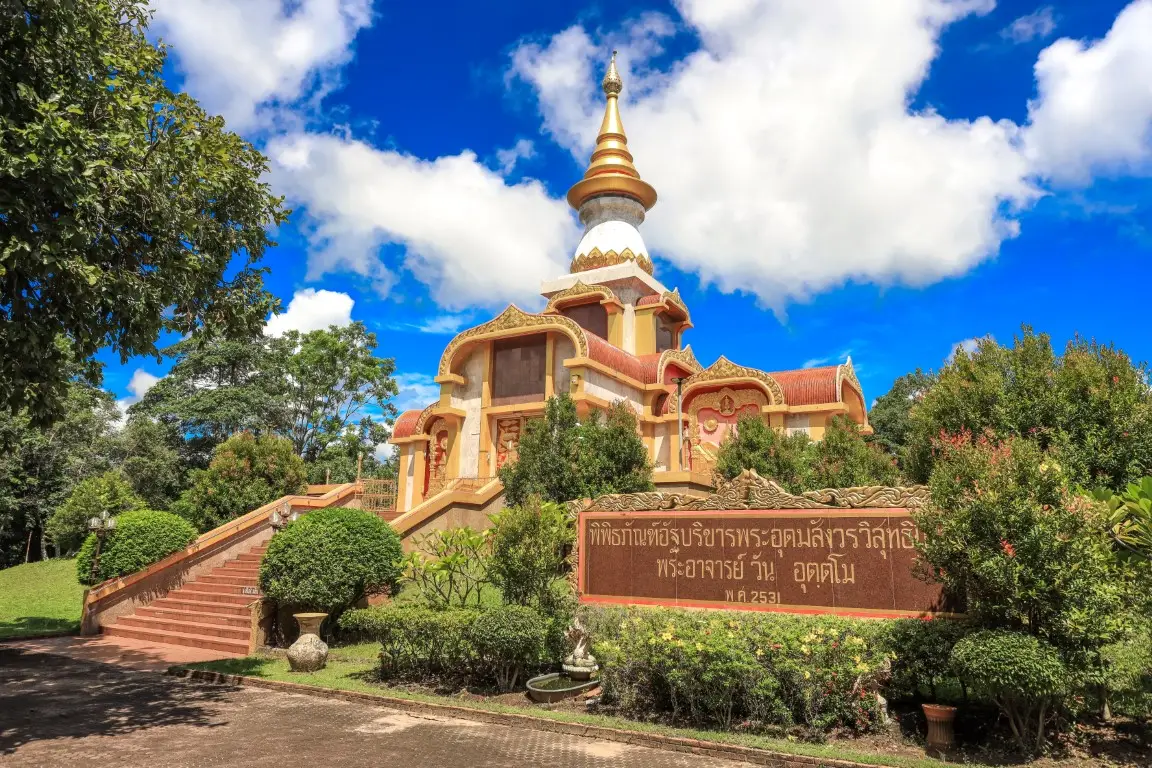
Wat Tham Aphai Damrongtham (Wat Tham Phuang)
Open Days: Daily
Opening Hours: 08.00 – 17.00
Wat Tham Aphai Damrongtham (Wat Tham Phuang) in Sakon Nakhon is a Dhammayut forest meditation temple located at Ban Tha Wat, Village No. 1, Pathum Wapi Subdistrict, Song Dao District, Sakon Nakhon Province. Set on Phu Pha Lek, part of the Phu Phan mountain range, the temple is closely associated with Phra Ajahn Wan Uttamo, also known as Phra Udom Sangwon Wisutthithera. Major highlights include the two-storey marble memorial museum of Phra Ajahn Wan Uttamo, Tham Phuang Cave, the large Naga-protected Buddha image known as Phra Mongkhon Mucalinda, and replicas of the four major Buddhist holy sites in India: the Buddha’s birthplace, enlightenment site, first sermon site, and final passing-away site. The temple is suitable for worship, Buddhist learning, meditation heritage, mountain scenery, and cultural travel in Song Dao District.
Wat Tham Aphai Damrongtham (Wat Tham Phuang) is one of the most important Buddhist sites in Song Dao District, Sakon Nakhon Province. It is located at Ban Tha Wat, Village No. 1, Pathum Wapi Subdistrict, in a mountainous area of Phu Pha Lek, which forms part of the Phu Phan range. The temple is known both as a Thai forest meditation monastery and as a place that preserves the memory of Phra Ajahn Wan Uttamo, a respected meditation monk in the Thai Forest Tradition. For visitors, the temple offers a complete experience that includes a teacher’s memorial museum, a sacred cave, a large Buddha image, Buddhist holy-site replicas, and the quiet atmosphere of a forest temple on a mountain.
The formal name of the temple is Wat Tham Aphai Damrongtham, while Wat Tham Phuang is the name widely used by local people and visitors. The name Tham Phuang comes from the old local name of the cave area. The land around the cave is associated with iron-rich stones; local accounts describe small stones clinging together in clusters when a magnet is placed on the ground. Another explanation connects the name with the shape of the cave, which reminded villagers of a cart frame or clustered structure. Through long local usage, the name Tham Phuang became strongly associated with the temple and the mountain site.
The temple sits near the meeting area of Sakon Nakhon, Udon Thani, and Kalasin provinces, giving it a distinct geographical character. Tham Phuang is located high on Phu Pha Lek, with the cave area reaching around 2,000 feet above sea level. The surrounding landscape includes mountains, cliffs, forested slopes, and a sense of seclusion that is very different from lowland temples. This setting supports the identity of the temple as a forest meditation place, where nature, silence, effort, and Buddhist practice are closely connected.
The significance of Wat Tham Aphai Damrongtham is closely linked with Phra Ajahn Wan Uttamo, or Phra Udom Sangwon Wisutthithera. He was born as Wan Silarak on 13 August 1922 in Tal Kon Subdistrict, Sawang Daen Din District, Sakon Nakhon Province. He entered monastic life at a young age and became known as a monk of discipline, patience, and serious meditation practice. His life and teachings are remembered by many devotees, especially those who value the Thai Forest Tradition and the lineage of meditation masters connected with Luang Pu Mun Bhuridatta.
Phra Ajahn Wan Uttamo was ordained as a novice on 1 May 1936, with Phra Ratchakawi (Chum Phanthulo) as his preceptor. He was fully ordained as a monk on 29 January 1942 at Wat Si Thammaram in Yasothon Province. His monastic training included both study and meditation practice, but his life became especially associated with forest practice, solitude, and direct inner training. He later played a major role in establishing and developing Wat Tham Aphai Damrongtham as a meditation monastery on Phu Pha Lek.
One of the qualities most remembered about Phra Ajahn Wan Uttamo is that he taught by example. He did not merely tell others what to do; he lived the discipline himself. He was known for endurance and restraint, rarely complaining about heat, cold, fatigue, hunger, or thirst. This practical patience reflected the heart of forest meditation practice, where a monk learns to observe body and mind under real conditions rather than seeking comfort at all times. His conduct became a living teaching for monks, novices, and lay devotees.
Around 1961, Phra Ajahn Wan Uttamo began establishing Wat Tham Aphai Damrongtham and stayed there as the temple gradually developed. As more monks, novices, and devotees came to the area, the temple became a stronger meditation center. In 1971, he led his followers in building a road up to Tham Phuang on Phu Pha Lek, a route of about 5 km. Building a mountain road in that period required strong faith, unity, and physical effort. The road later made it easier for people to reach the cave and worship at the mountain site.
After the road to Tham Phuang was completed, Phra Ajahn Wan initiated the creation of a large Buddha image in the Naga-protected posture, named Phra Mongkhon Mucalinda. This image is closely connected with the Buddhist episode in which the Naga king Mucalinda spread his hood to protect the Buddha from rain and storm after enlightenment. The Naga-protected Buddha posture therefore represents protection, stillness, spiritual strength, and the stability of Dhamma amid difficulties. Enshrining this image at Tham Phuang transformed the cave area into a sacred mountain destination.
Tham Phuang is one of the most important areas connected with a visit to Wat Tham Aphai Damrongtham. The cave is located near the temple and is associated with the presence of Phra Mongkhon Mucalinda. Visitors who travel up to the cave experience not only a natural cave setting but also a place shaped by the vision of Phra Ajahn Wan. The journey to Tham Phuang carries a sense of effort and devotion, reflecting the history of the road, the construction of the Buddha image, and the mountain’s role as a place of faith.
Another major highlight is the Phra Ajahn Wan Uttamo Museum. The museum is a two-storey building in a four-sided pavilion form, entirely decorated with marble. It is one of the most distinctive architectural features of the temple. The lower floor presents paintings that tell the life story of Phra Ajahn Wan from birth through important stages of his monastic life. These paintings help visitors understand his background, ordination, meditation training, temple development, and role as a respected forest teacher.
The upper floor of the museum enshrines a seated statue of Phra Ajahn Wan Uttamo in meditation posture. Around the statue are carefully arranged offerings and glass display cabinets containing his monastic requisites. These objects are important because they preserve the tangible memory of his simple forest-monk life. Their value does not come from luxury, but from their connection with discipline, practice, and a life dedicated to the Dhamma. For devotees, seeing these requisites can deepen respect for the teacher’s way of life.
The museum is therefore more than a storage space for objects. It functions as a memorial, a learning space, and a place of worship. Through paintings, the teacher’s statue, and his monastic requisites, visitors can understand the values of the Thai Forest Tradition: simplicity, endurance, restraint, mindfulness, and direct practice. The marble building gives the museum dignity, while the objects inside preserve the quiet spirit of a forest monk.
Wat Tham Aphai Damrongtham also contains replicas of the four major Buddhist holy sites in India. These represent the places of the Buddha’s birth, enlightenment, first sermon, and final passing away. By placing these four sacred moments within the temple grounds, the site allows visitors to reflect on the life of the Buddha in one journey. The holy-site replicas are valuable for both worship and Buddhist learning, especially for those who have not traveled to India but wish to contemplate the major events of the Buddha’s life.
The birthplace replica recalls the beginning of the Buddha’s life as a great spiritual figure. The enlightenment site recalls the victory of wisdom and effort beneath the Bodhi tree. The first sermon site recalls the turning of the Wheel of Dhamma and the beginning of the Buddhist Sangha. The final passing-away site reminds visitors of impermanence and the completion of the Buddha’s work. Together, these four areas give Wat Tham Aphai Damrongtham a strong educational and contemplative character.
Phra Ajahn Wan Uttamo passed away on 27 April 1980 in an aircraft accident in Khlong Luang District, Pathum Thani Province. His passing was a major loss for Buddhist devotees because several respected monks also died in the same event. On 25 April 1981, a royal cremation ceremony for Phra Ajahn Wan was held at Wat Tham Phuang. Before his passing, he had received the ecclesiastical title Phra Udom Sangwon Wisutthithera. He passed away at the age of 58, with 38 rains retreats. His memory remains strongly present through the temple, the museum, and the sacred sites he helped establish.
After Phra Ajahn Wan’s passing, Phra Athikan Lo Natthakaro was appointed abbot of Wat Tham Aphai Damrongtham on 1 June 1980. He later became widely known as Phra Ratchawachirasophon Wi. (Luang Pu Lo Natthakaro). He has played an important role in maintaining, developing, and preserving the temple. Through his leadership, Wat Tham Aphai Damrongtham has continued as a place of worship, meditation, memory, and Buddhist learning for monks, local people, and devotees from many areas.
Public provincial records identify Phra Ratchawachirasophon Wi., or Luang Pu Lo Natthakaro, as the abbot of Wat Tham Aphai Damrongtham. Ceremonies in his honor have brought together provincial officials, local leaders, monks, community members, and disciples. This reflects the continuing importance of the temple not only as a local monastery, but also as a respected religious site within Sakon Nakhon Province.
The role of Wat Tham Aphai Damrongtham can be understood in three main dimensions. First, it is a Dhammayut forest meditation temple that preserves a quiet practice atmosphere. Second, it is a memorial site dedicated to Phra Ajahn Wan Uttamo through the museum, statue, paintings, and monastic requisites. Third, it is a cultural and faith-based destination that combines cave worship, mountain scenery, a large Naga-protected Buddha image, and replicas of Buddhist holy sites.
Important areas within the temple include the Phra Ajahn Wan Uttamo Museum, the marble two-storey pavilion building, the worship area with the teacher’s statue, the display of his monastic requisites, Tham Phuang Cave, Phra Mongkhon Mucalinda, the four Buddhist holy-site replicas, the forest temple grounds, the mountain route, halls, and meditation areas. Each area has its own purpose and meaning. Visitors should move through the temple slowly and respectfully, keeping in mind that this is both a sacred place and a meditation monastery.
A meaningful visit can begin on the lower floor of the museum, where the paintings introduce the life story of Phra Ajahn Wan. Visitors can then move to the upper floor to pay respect to his seated statue and see his monastic requisites. After the museum, the route can continue to Tham Phuang and Phra Mongkhon Mucalinda, followed by the four holy-site replicas. This order helps visitors understand the temple through biography, practice, sacred image, cave landscape, and Buddhist history.
Getting There from Sakon Nakhon city is most convenient by private car or rental car. Use Highway 22, the Sakon Nakhon–Udon Thani route, for about 84 km to Sawang Daen Din District. Then turn left toward Song Dao District. At the Phra Wetsandon Monument roundabout, turn right and continue for about 5 km to Wat Tham Aphai Damrongtham. Because the temple is in a mountain area, daytime travel is recommended, especially for visitors who are not familiar with the local roads.
From Song Dao town, the temple can be visited as a half-day trip. Travelers may begin at Wat Tham Aphai Damrongtham and Tham Phuang, then continue to nearby natural attractions such as Phu Pha Lek National Park, Pha Dong Ko, Ho Song Dao, the prehistoric paintings at Pha Phak Wan, or other viewpoints in the Phu Pha Lek area. This route is suitable for visitors who want to combine temple worship with mountain scenery and nature-based travel.
Phu Pha Lek National Park helps complete the context of Wat Tham Phuang because both are connected with the same mountain landscape. The national park includes attractions such as Pha Suriyan, Pha Dong Ko, Pha Nam Chok, prehistoric paintings at Pha Phak Wan, Lan Usa Sawan, dinosaur fossil areas, and Ho Song Dao. The surrounding nature is therefore not merely a background to the temple. It is part of the same landscape that made the area suitable for forest meditation and mountain worship.
The best time to visit Wat Tham Aphai Damrongtham is from morning to afternoon during the opening hours of 08.00 to 17.00. Morning is suitable for worship, museum visits, and walking up to Tham Phuang before the weather becomes too hot. Afternoon visits are also convenient for travelers arriving from nearby districts or natural attractions. Evening visits should be avoided because the temple is in a mountain area and the quiet rhythm of a forest monastery should be respected.
Visitors should dress modestly and wear practical footwear. Shoulders and knees should be covered, and shoes should be comfortable for walking on temple grounds and mountain paths. Those planning to visit Tham Phuang should bring drinking water, a hat, or an umbrella depending on the weather. Elderly visitors should allow extra time and rest as needed. A visit to a cave temple requires both devotion and attention to safety.
Inside sacred areas, visitors should keep their voices low, avoid disturbing monks or meditation practitioners, and avoid touching museum displays or monastic requisites without permission. Flash photography should be avoided in areas where it may disturb worshippers or affect display objects. The monastic requisites of Phra Ajahn Wan are meaningful to devotees and should be viewed with respect rather than treated as ordinary exhibition items.
For families, Wat Tham Aphai Damrongtham offers several educational dimensions. Children can learn about the Buddha’s life through the four holy-site replicas, about a Thai forest master through the museum, about the Naga-protected Buddha posture through Phra Mongkhon Mucalinda, and about the mountain landscape of Phu Pha Lek through the route to Tham Phuang. Families should guide children to walk carefully, behave quietly, and respect sacred spaces.
For those interested in the lineage of Luang Pu Mun Bhuridatta, the temple is an important stop in Sakon Nakhon. Phra Ajahn Wan Uttamo belonged to the wider world of forest meditation practice connected with major teachers of the Thai Forest Tradition. His life connects with places such as Wat Pa Sutthawat, Wat Pa Ban Nong Phue, and other forest monasteries in the region. Visiting Wat Tham Aphai Damrongtham helps travelers understand the network of forest temples and meditation teachers in Sakon Nakhon.
In cultural terms, Wat Tham Aphai Damrongtham shows how a forest monastery, mountain landscape, and community faith can grow together. The road to Tham Phuang, the creation of Phra Mongkhon Mucalinda, the museum, and the holy-site replicas all came from devotion and the wish to make the mountain a place of worship and Buddhist learning. The temple is therefore a meditation site, a teacher’s memorial, and a Buddhist educational destination at the same time.
Food and accommodation are most convenient around Song Dao and Sawang Daen Din. In Song Dao, visitors can find local restaurants and casual dining such as Chiw Chiw Moo Kratha Buffet, Wannee Nuea Yang Restaurant, and Yai Noi Restaurant. For accommodation, Song Dao has some local options, while Sawang Daen Din offers a wider range of hotels and resorts along the Highway 22 route. Staying in Sawang Daen Din is practical for travelers who want easier access to food, shops, and onward transport.
Visitors should allow around 1.5 to 3 hours for the temple, depending on how fully they want to explore the site. A complete visit that includes the museum, the teacher’s statue, the monastic requisites, Tham Phuang, Phra Mongkhon Mucalinda, and the four holy-site replicas should be planned as a half-day experience. Moving slowly allows the temple’s meaning to become clearer, especially because its value lies in the connection between biography, meditation, faith, mountain landscape, and Buddhist history.
Good photography points include the marble museum building, the surrounding mountain scenery, the route to Tham Phuang, Phra Mongkhon Mucalinda in permitted areas, and the four holy-site replicas. Photography should be done respectfully and should not disturb people who are worshipping. Poses that are not appropriate for a Buddhist sacred site should be avoided. This is a living temple and a meditation monastery, so respectful photography is part of proper conduct.
For international visitors, Wat Tham Aphai Damrongtham offers a strong introduction to Thai Buddhism beyond famous city temples. The site combines a forest meditation teacher’s life story, monastic objects, a mountain cave, a large Naga-protected Buddha image, and replicas of the Buddha’s major life events. It shows how Thai Buddhism can be connected with practice, memory, mountain nature, and devotion in a single place.
Wat Tham Aphai Damrongtham, or Wat Tham Phuang, is therefore one of the most meaningful places to visit in Song Dao District. The Phra Ajahn Wan Uttamo Museum gives visitors a concrete way to understand a respected forest master. Tham Phuang and Phra Mongkhon Mucalinda show the power of faith on Phu Pha Lek. The holy-site replicas allow visitors to reflect on the life of the Buddha. Together, these elements create a calm, deep, and memorable travel experience for pilgrims, cultural travelers, and those interested in Buddhist heritage in Sakon Nakhon.
| Name | Wat Tham Aphai Damrongtham (Wat Tham Phuang) |
| Location | Ban Tha Wat, Village No. 1, Pathum Wapi Subdistrict, Song Dao District, Sakon Nakhon Province 47190 |
| Place Type | Dhammayut Forest Meditation Temple / Cave Temple / Teacher Memorial Museum / Faith-Based Cultural Destination |
| Buddhist Affiliation | Dhammayut Order |
| Abbot | Phra Ratchawachirasophon Wi. (Luang Pu Lo Natthakaro) |
| Important Figure | Phra Ajahn Wan Uttamo, also known as Phra Udom Sangwon Wisutthithera, the forest meditation master associated with the founding and development of Wat Tham Aphai Damrongtham |
| Highlights | Phra Ajahn Wan Uttamo Museum, two-storey marble pavilion building, Tham Phuang Cave, Phra Mongkhon Mucalinda, large Naga-protected Buddha image, and replicas of the four major Buddhist holy sites |
| History / Significance | Phra Ajahn Wan Uttamo began establishing Wat Tham Aphai Damrongtham around 1961 and in 1971 led his disciples in building a road to Tham Phuang on Phu Pha Lek, where Phra Mongkhon Mucalinda was later enshrined |
| Name Origin Of Tham Phuang | The name is connected with iron-rich stones in the area and the old local description of the cave shape, which reminded villagers of a clustered cart-like form |
| Landscape Features | Located on Phu Pha Lek near the meeting area of Sakon Nakhon, Udon Thani, and Kalasin. The Tham Phuang area is around 2,000 feet above sea level, with mountains, cliffs, and a secluded forest-temple atmosphere |
| Main Areas / Zones | Phra Ajahn Wan Uttamo Museum, lower-floor biography painting room, upper-floor teacher statue and monastic requisites, Tham Phuang Cave, Phra Mongkhon Mucalinda, four holy-site replicas, forest temple grounds, mountain route, and meditation areas |
| Open Days | Daily |
| Opening Hours | 08.00 – 17.00 |
| Current Status | Open for worship and respectful visits during temple hours |
| Travel Information | From Sakon Nakhon city, use Highway 22 toward Udon Thani for about 84 km to Sawang Daen Din District, then turn left toward Song Dao District. At the Phra Wetsandon Monument roundabout, turn right and continue about 5 km to Wat Tham Aphai Damrongtham |
| Facilities | Parking area, museum, halls, worship areas for Buddha images and teacher statue, route to Tham Phuang, and forest-temple areas for worship and meditation |
| Visitor Guidelines | Dress modestly, keep noise low, respect the forest monastery atmosphere, do not touch monastic requisites or museum displays without permission, avoid disturbing monks or practitioners, and walk carefully in mountain areas |
| Nearby Tourist Attractions | 1. Tham Phuang Cave And Phra Mongkhon Mucalinda, About 0 Km 2. Phu Pha Lek National Park, About 8 Km 3. Pha Dong Ko, About 12 Km 4. Ho Song Dao, Phu Pha Lek, About 14 Km 5. Pha Phak Wan Prehistoric Paintings, About 25 Km 6. Sawang Daen Din District, About 30 Km |
| Nearby Restaurants | 1. Chiw Chiw Moo Kratha Buffet, Song Dao District, About 8 Km, Tel. 094-282-5699 2. Wannee Nuea Yang Restaurant, Song Dao District, About 8 Km, Tel. 081-048-5307 3. Yai Noi Restaurant, Ban Tha Din Daeng Phatthana, About 18 Km, Tel. 084-844-6229 4. Local Restaurants In Song Dao Town, About 8 Km 5. Local Restaurants In Sawang Daen Din Town, About 30 Km |
| Nearby Accommodations | 1. Sasithon Resort, Song Dao District, About 8 Km, Tel. 081-873-5411 2. Pretty Hotel, Sawang Daen Din District, About 30 Km, Tel. 087-954-2991 3. Nong Khu Resort, Sawang Daen Din District, About 30 Km, Tel. 084-798-1214 4. Huai Sai Ban Phak Resort, Sawang Daen Din District, About 30 Km, Tel. 088-728-5979 5. Sirikan Hotel, Sawang Daen Din District, About 30 Km, Tel. 042-721-651, 081-380-4203 6. Mulan Resort, Sawang Daen Din District, About 30 Km, Tel. 087-949-0763 |
Frequently Asked Questions (FAQ)
Q: Where Is Wat Tham Aphai Damrongtham Located?
A: Wat Tham Aphai Damrongtham, also known as Wat Tham Phuang, is located at Ban Tha Wat, Village No. 1, Pathum Wapi Subdistrict, Song Dao District, Sakon Nakhon Province 47190.
Q: What Are The Opening Days And Hours?
A: The temple is open daily from 08.00 to 17.00.
Q: What Is The Main Highlight Of Wat Tham Aphai Damrongtham?
A: The main highlights are the Phra Ajahn Wan Uttamo Museum, the two-storey marble pavilion, Tham Phuang Cave, Phra Mongkhon Mucalinda, the large Naga-protected Buddha image, and the replicas of the four major Buddhist holy sites.
Q: How Is Phra Ajahn Wan Uttamo Connected With This Temple?
A: Phra Ajahn Wan Uttamo was the forest meditation master who began establishing and developing Wat Tham Aphai Damrongtham, led the construction of the road to Tham Phuang, and initiated the creation of Phra Mongkhon Mucalinda.
Q: Who Is The Abbot Of Wat Tham Aphai Damrongtham?
A: The abbot is Phra Ratchawachirasophon Wi., also known as Luang Pu Lo Natthakaro.
Q: What Are The Four Holy-Site Replicas Inside The Temple?
A: The four replicas represent the Buddha’s birthplace, enlightenment site, first sermon site, and final passing-away site, modeled after the major Buddhist holy places in India.
Q: How Can Travelers Get To Wat Tham Aphai Damrongtham?
A: From Sakon Nakhon city, use Highway 22 toward Udon Thani for about 84 km to Sawang Daen Din, then turn toward Song Dao District. At the Phra Wetsandon Monument roundabout, turn right and continue about 5 km to the temple.
Q: What Nearby Places Can Be Visited On The Same Trip?
A: Nearby places include Tham Phuang Cave, Phu Pha Lek National Park, Pha Dong Ko, Ho Song Dao, Pha Phak Wan prehistoric paintings, and Sawang Daen Din District.
 Category: ●Places of Worship
 Group: ●Temple
Last Update : 2 MonthAgo
 Last Update : 2 MonthAgo
 Click to Access the Navigation Map GPS
Wat Tham Aphai Damrongtham (Wat Tham Phuang) Map
Recommend

 Art, Culture and Heritage
 Historical Sites and Monuments(9)
 Landmarks and Memorials(2)
 Royal Palace(1)
 Art, Craft Centres, Tradition(8)
 Museums(3)
 Educational Places
 Educational Gardens, Farm(2)
Temple(18)
Educational Gardens, Farm(2)
Temple(18)
 Church(2)
 Other Sacred Sites(4)
 Research and Development
 Royal Project(3)
 Suburban Living
 Village, Community(7)
 Nature and Wildlife
 National Parks and Marine Reserves(4)
 Mountain (Doi)(3)
 Dam, Reservoir, Lake(14)
 Waterfalls(4)
 Caves(4)
 River, Canal(9)
 Bays and Beaches(1)
 Islands(1)
 Other natural attractions(5)
 Entertainment and Agricultural
 Zoos and Aquariums(1)
 Farms, Parks and Ecotourism(4)
 Outdoor and Adventure Activities(1)


