
lovethailand home >Northeastern Travel Attractions >Roi Et Travel Attractions >Nong Phok >Pha Nam Yoi > Wat Pha Nam Thip Thep Prasit Wanaram
TL;DR: Wat Pha Nam Thip Thep Prasit Wanaram is located at Ban Khok Klang, Pha Nam Yoi Subdistrict, Nong Phok District, Roi Et Province, open Daily, Including Public Holidays, hours 06.00 – 17.00.
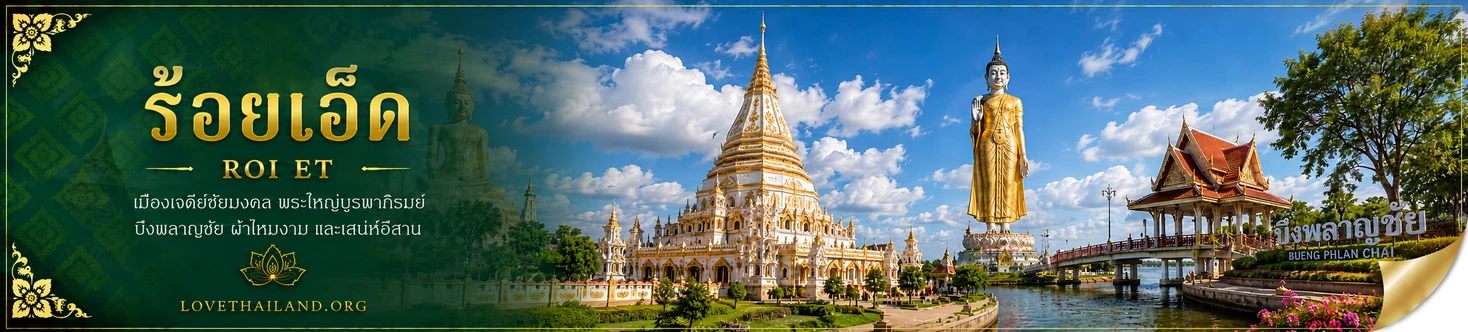
Wat Pha Nam Thip Thep Prasit Wanaram
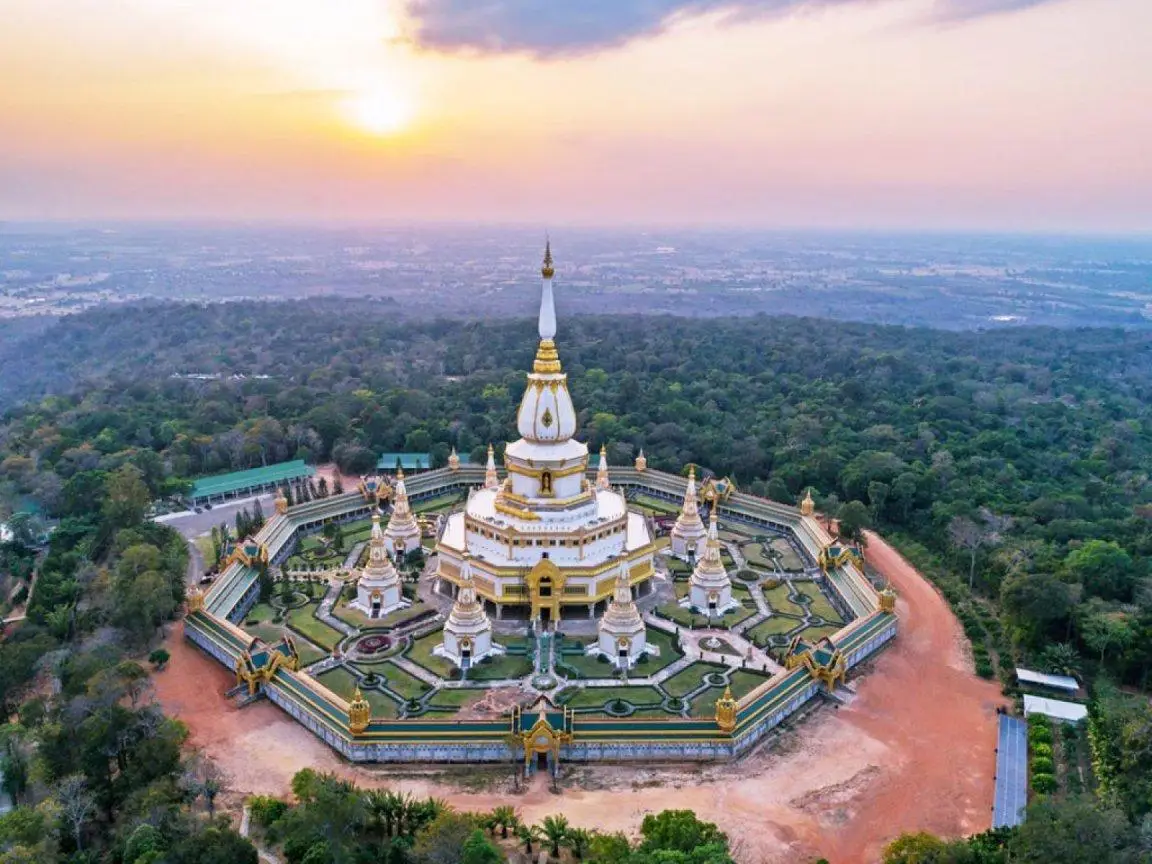
Open Days: Daily, Including Public Holidays
Opening Hours: 06.00 – 17.00
Wat Pha Nam Thip Thep Prasit Wanaram in Roi Et Province is a major Buddhist sanctuary set on Khao Khiao, part of the Phu Phan mountain range in Pha Nam Yoi Subdistrict, Nong Phok District. Its centerpiece is Phra Maha Chedi Chai Mongkol, an immense white-and-gold stupa containing sacred relics of the Buddha. The interior presents the history of the Thai Forest Tradition, displays 101 statues of highly respected meditation masters, and includes a museum devoted to the meditation heritage associated with Luang Pu Mun Bhuridatta. The temple is open daily without an admission charge and combines religious devotion, contemporary Buddhist architecture, cultural education, forest scenery, and panoramic mountain views within one extensive complex.
The temple stands near Ban Khok Klang in a forested mountain landscape historically associated with the names Pha Nam Yoi and Pha Nam Thip. Large rock faces, forested slopes, and water seeping through layers of stone shaped the identity of the area. The Thai name refers to water that slowly drips or flows from the cliff. Its distance from major urban communities, combined with the quiet mountain environment, made the area suitable for solitude, meditation, and the disciplined forest life practiced by monks in the Thai Forest Tradition.
The importance of Wat Pha Nam Thip Thep Prasit Wanaram began long before the monumental chedi dominated the skyline. Phra Thep Wisutthimongkhon, better known as Luang Pu Sri Mahaviro, traveled through this part of the Phu Phan range while practicing meditation in remote forests. Luang Pu Sri was a disciple of Luang Pu Mun Bhuridatta, one of the most influential masters of the modern Thai Forest Tradition. He recognized the site as a peaceful and secluded place where monks could train their minds and where lay Buddhists could study meditation in an authentic forest setting.
Luang Pu Mun Bhuridatta emphasized moral discipline, mindfulness, contemplation of the body and mind, simplicity, and direct meditative practice. Luang Pu Sri inherited this approach and passed it to his disciples. Wat Pha Nam Thip Thep Prasit Wanaram was consequently intended to be more than a ceremonial temple. It was created as a place where Buddhist teachings could be studied, meditation could be practiced, and the legacy of forest masters who trained in northeastern Thailand could be preserved for future generations.
The idea for Phra Maha Chedi Chai Mongkol developed from a wish to construct a permanent sacred monument for relics of the Buddha, relics associated with revered monks, and records of teachers in the meditation tradition. The complex was also intended to serve monks and lay Buddhists traveling from different parts of northeastern Thailand. Preparatory construction began around 1985, while a formal building committee was later established and the official foundation-stone ceremony was held on 30 January 1988.
The project was not the work of one person or one monastery. It grew through cooperation among senior members of the Sangha, forest monks, Luang Pu Sri’s disciples, residents of northeastern Thailand, and donors from other parts of the country. Somdet Phra Nyanasamvara, the Supreme Patriarch of Thailand, was connected with the formal organization of the project, while Luang Pu Sri guided its practical development. The result became a collective monument representing the faith and contributions of a broad Buddhist community.
The name “Phra Maha Chedi Chai Mongkol” may be understood as the Great Stupa of Auspicious Victory. Within a Buddhist context, that victory is not a triumph over other people. It represents the effort to overcome carelessness, greed, anger, delusion, and mental distraction. Visitors therefore come not only to admire the monumental architecture but also to reflect on self-discipline, mindfulness, ethical conduct, and the gradual development of inner peace.
Thailand’s Fine Arts Department designed the chedi by combining architectural ideas associated with central Thailand and the northeastern region. The massive central form recalls the commanding scale of Phra Pathom Chedi, while the upper profile and symbolic associations evoke Phra That Phanom, one of the most revered stupas in the Northeast. These references were reinterpreted as contemporary architecture rather than copied directly, giving the building a distinctive identity connected to Roi Et and the wider Isan region.
White surfaces form the principal visual background, while gold decoration emphasizes entrances, arches, columns, window frames, moldings, and the soaring pinnacle. The contrast makes the monument highly visible against the green forest. Under strong daylight, the gold ornament reflects the sun and reveals the elaborate surface treatment. During the early morning and late afternoon, softer light gives greater depth to the arches, relief work, subsidiary chedis, and layered architectural forms.
The number 101 appears repeatedly throughout the design. The main structure measures approximately 101 meters in width, 101 meters in length, and 101 meters in height. With the golden pinnacle included, its total height reaches approximately 109 meters. The landscaped area associated with the chedi covers about 101 rai, and the interior contains representations of 101 respected meditation masters. The repeated number is closely connected with Roi Et, whose Thai name is traditionally associated with the written form of 101.
The upper pinnacle is decorated with approximately 4,750 baht-weight of gold, equivalent to roughly 60 kilograms. Rising high above the forest, it serves as a visual landmark that can be seen from a considerable distance. The vertical form suggests an ascent from ordinary concerns toward mindfulness and spiritual clarity. It also directs attention upward, reinforcing the symbolic relationship between the earthly base of the monument, the relic chamber, and the open sky.
Eight smaller chedis surround the main monument and establish a balanced arrangement corresponding to the principal and intermediate directions. Enclosing walls, covered galleries, pathways, gardens, and open courtyards are aligned with the central stupa. As visitors move from the parking and reception areas through the landscaped grounds toward the main entrance, the sequence creates a gradual transition from an ordinary public space to a sacred religious environment.
The forecourt is landscaped with pathways, trimmed plants, gardens, and open areas that frame the white-and-gold architecture. These natural elements soften the enormous scale of the chedi and connect it visually with Khao Khiao and the surrounding forest. The main approach offers one of the clearest photographic perspectives, although visitors should remember that the complex remains an active place of worship. Photography should never obstruct worshippers, disturb meditation, or involve climbing and touching decorative surfaces.
The interior is arranged into several functional levels. These include a large hall for religious gatherings, areas illustrating the life of the Buddha, an ordination and worship space, displays of revered meditation teachers, a museum devoted to Luang Pu Sri and forest meditation, panoramic viewing areas, and the upper chamber containing sacred relics of the Buddha. Ascending the monument therefore becomes a progressive educational and spiritual journey rather than a simple climb to a viewpoint.
The lower level contains an expansive ceremonial hall used for meetings, merit-making events, and gatherings involving large numbers of participants. Sections of the interior record the names of donors and supporters, demonstrating how widely the construction was supported. The size of the hall allows visitors to appreciate the structural columns, ceiling, decorative patterns, and large internal volume that distinguishes the chedi from a solid stupa with no usable interior.
Another level contains a monastic meeting space and visual presentations relating to the life of the Buddha. Paintings and decorative narratives introduce key events including his birth, renunciation, enlightenment, teaching mission, and final passing into Parinibbana. This area allows visitors unfamiliar with Buddhist history to encounter the principal narrative through visual art, architectural decoration, and spatial experience rather than through written explanations alone.
A further level functions as an ordination and worship area and contains representations of respected monastic teachers. The collection of 101 meditation masters is among the most important features of the interior. These images preserve the memory of monks known for disciplined practice and ethical conduct. They also communicate that the importance of the forest tradition rests not on fame or miraculous claims, but on sustained meditation, restraint, humility, and observance of the monastic discipline.
The museum areas present material connected with Luang Pu Sri Mahaviro, monasteries, meditation sites, and the journeys of forest monks. This content reconnects the immense building with its original purpose. Phra Maha Chedi Chai Mongkol was meant to be a living center of knowledge as well as a place of worship. Travelers interested in the Thai Forest Tradition should allow time to examine the displays quietly rather than treating the interior merely as a route to the upper viewpoint.
The viewing level opens toward forests, agricultural land, mountain ridges, and communities surrounding the Phu Phan range. From this height, the relationship between the chedi and its natural setting becomes clear. The monument does not stand in a dense city but in a landscape shaped by cliffs, forest, and distant settlements. The view helps visitors understand why monks seeking seclusion selected this region as a place for meditation and spiritual training.
The highest sacred section contains relics of the Buddha and represents the spiritual center of the monument. Visitors should remain quiet, speak softly, and avoid behavior that distracts other worshippers. For Buddhists, paying respect to the relics is an opportunity to remember the Buddha, his teachings, and the possibility of liberation through disciplined practice. It should not be reduced to the pursuit of luck or immediate personal gain.
Important relics were enshrined in the chedi on 3 May 1997, the anniversary of Luang Pu Sri Mahaviro’s birth. This event strengthened the monument’s status as a sacred reliquary and a destination for Buddhists from many provinces. The act of worship connects reverence for the Buddha with gratitude toward the meditation teachers and communities that created and maintained the site.
The religious complex was formally permitted to become a temple on 17 June 2005 and received its royal grant of consecrated boundary, known as Wisungkhamsima, on 31 March 2006. These milestones marked its transition from a developing religious monument into a formally recognized monastery. Work has continued through maintenance, restoration, landscape improvement, religious activities, and services for the large number of worshippers who visit throughout the year.
Luang Pu Sri Mahaviro was the central figure behind the project. His purpose was not to construct an enormous building for personal prestige. He sought to create a common center for the Sangha, preserve the knowledge of samatha and vipassana meditation, and provide a place where laypeople could study and practice. This intention explains why the chedi incorporates meeting halls, educational displays, a museum, worship areas, and sacred relics within the same structure.
Phra Khru Palat Thong-in Katapunyo was entrusted with supervising and continuing major parts of the construction on behalf of Luang Pu Sri. His responsibilities included work connected with the central chedi, covered galleries, enclosing walls, and other facilities. The long building history demonstrates that a religious complex of this scale depends on several generations of leadership, design, fundraising, construction, artistic craftsmanship, and continuous maintenance.
Travelers interested in meditation should distinguish between the public sightseeing areas and areas used by the monastic community. The chedi is suitable for worship, short periods of mindfulness, and learning about the tradition. Participation in an extended retreat or an overnight meditation program requires direct arrangements with the temple and compliance with monastic rules. Visitors should wear modest clothing, including shirts with sleeves and trousers or skirts that cover the knees.
Shoes and hats must be removed before entering the principal interior spaces. Visitors should remain quiet, avoid touching murals and ornamental reliefs, and refrain from bringing food and drinks into the chedi. Smoking, alcohol, and inappropriate conduct are prohibited. Incense and candles should not be lit inside the monument because smoke and heat can damage paintings, decorative surfaces, and the interior environment.
Families traveling with children should supervise them carefully around staircases, balconies, and changes in floor level. Reaching every level requires time and physical effort. Older visitors and people with limited mobility can still worship and appreciate the architecture from the lower hall, forecourt, gardens, and surrounding grounds without climbing to the highest sections. Planning the visit according to individual physical ability makes the experience safer and more peaceful.
The mountain access road includes steep and winding sections. Many visitors leave their vehicles in the designated lower parking area and continue using transport arranged for access to the upper complex, particularly on busy days. This system reduces congestion near the summit and improves safety on the narrow route. Drivers should control their speed, use an appropriate low gear, and follow signs and directions provided by temple staff.
Morning is particularly suitable for visitors seeking cooler temperatures, softer light, and a quieter atmosphere. It also provides sufficient time to explore the interior without rushing. Late afternoon produces attractive light on the gold ornament and surrounding landscape, but travelers should enter well before closing because worship, movement between the levels, and the return journey down the mountain all require time.
The cool season from approximately November to February generally offers comfortable temperatures and clearer skies. During the rainy season, the surrounding forest becomes especially green and natural water sources around Pha Nam Yoi are more active, although roads and paths can be slippery and mountain fog may reduce visibility. During the hot season, an early visit is preferable, and travelers should avoid spending long periods in exposed courtyards under strong midday sun.
Photography is possible from several strong viewpoints, including the central approach, the subsidiary chedis, entrance arches, decorative doors, and the panorama from the upper level. A wide-angle lens is useful for the immense architecture and geometric layout, while a standard or short telephoto lens captures gold ornament, relief work, and architectural details. Flash should be avoided near paintings and museum objects, and worshippers should always be given priority.
Wat Pha Nam Thip Thep Prasit Wanaram can be combined with a nature and spiritual route through Nong Phok District. Nearby destinations include Tham Pha Nam Thip Non-Hunting Area, Pha Nam Yoi Forest Park, Pha Kio Lom, Pha Mok Mi Wai, Huai Phung Yai Reservoir, Tham Soda Waterfall, and Wat Tham Soda. A practical itinerary can begin with morning worship at the chedi and continue to cliffs, forest, waterfalls, and reservoirs during the remainder of the day.
Tham Pha Nam Thip Non-Hunting Area and Pha Nam Yoi Forest Park provide valuable environmental context for the temple. They form part of the forested Phu Phan landscape, containing hardwood forest, water sources, and wildlife habitats. Visiting these areas helps explain why forest monks valued the region. Solitude, natural sound, and distance from urban activity were regarded as supportive conditions for concentration and contemplation.
Tham Soda Waterfall and Wat Tham Soda are suitable for travelers with at least half a day available. The area combines rock formations, caves, water, and religious space. Conditions should be checked during the rainy season because water levels and slippery surfaces can affect access. Pha Kio Lom and Pha Mok Mi Wai provide additional mountain viewpoints and are particularly attractive in the morning. Combining these places creates a fuller understanding of the natural landscape surrounding Nong Phok.
Restaurants and cafes are distributed along the mountain approach, within Pha Nam Yoi Subdistrict, and around Nong Phok town. Huen Mai Fresh Coffee is close to the chedi and is convenient for a short stop. VR Pla Phao is situated near the entrance road and serves northeastern food. Wali Land Garden Cafe is closer to Nong Phok town and provides drinks and a landscaped seating environment. Groups should allow sufficient travel time because the route between the town and summit includes winding mountain sections.
Accommodation within Nong Phok District is limited compared with Roi Et city. Nearby options are distributed across Nong Sung District in Mukdahan, Nikhom Kham Soi, Kuchinarai in Kalasin, and Loeng Nok Tha in Yasothon. The best choice depends on the following day’s route. Travelers continuing toward Mukdahan can stay near Nong Sung or Nikhom Kham Soi, while those returning through Roi Et may prefer accommodation in Roi Et city despite the longer drive.
Getting There from Roi Et city requires following the route toward Phon Thong and Nong Phok districts, principally via Highways 2044 and 2136. Continue toward Ban Tha Sa-at and Pha Nam Yoi Subdistrict before joining Rural Road RO 4043 and the mountain approach. The complete road distance is approximately 75–80 kilometers and normally requires about 1 hour 20 minutes to 1 hour 40 minutes, depending on traffic, weather, and stops.
Travelers arriving from Mukdahan can approach through Nong Sung or Nikhom Kham Soi. From Kalasin, the route can connect through Kuchinarai, while visitors from Yasothon can travel through Loeng Nok Tha. These routes make the temple a useful stop on a multi-province itinerary. A private car or rental vehicle remains the most practical option because regular public transport does not operate directly to the upper temple complex.
Travelers using long-distance buses from Bangkok can select services passing Nong Phok or buses operating toward Mukdahan and arrange local onward transport. Services terminating in Roi Et city leave another 75–80 kilometers to cover. Local transport should be arranged in advance, including an agreed fare and collection time for the return journey, because vehicles may not be continuously available near the mountain temple.
The approximate coordinates of Phra Maha Chedi Chai Mongkol are 16.331568, 104.320196. Online map users should search for both “Wat Pha Nam Thip Thep Prasit Wanaram” and “Phra Maha Chedi Chai Mongkol.” Some map services use the temple name, others identify the chedi, and local references may use Wat Chedi Chai Mongkol. Signs and staff instructions should take priority when approaching the parking and transfer areas.
Principal visitor facilities include a lower parking area, transfer points for access to the upper complex, restrooms, waiting areas, donation points, and scenic viewing spaces. Buddhist holidays, long weekends, and festival periods can attract large crowds. Visitors should allow additional travel time, follow the temporary traffic system, avoid blocking access roads, and keep personal belongings secure in public areas.
The temple is also important to the surrounding communities as a religious center, visitor destination, and source of local economic activity. Travelers support restaurants, cafes, local drivers, shops, and accommodation providers throughout Nong Phok District. Responsible tourism includes using local services, keeping the area clean, reducing disposable plastic, and preventing rubbish from entering the forest, cliff, and water environments.
Conservation involves the monument, its decorative art, and the surrounding mountain ecosystem. Relief work and gold-colored surfaces are vulnerable to touching, moisture, dust, and smoke. The forest contributes to water sources and wildlife habitat. Visitors should remain on designated routes, avoid collecting plants, refrain from feeding wildlife, and keep noise low so that monks, meditators, other worshippers, and animals are not disturbed.
Despite its immense scale, the deepest significance of Phra Maha Chedi Chai Mongkol remains connected to meditation. Luang Pu Sri intended the complex to help people study Buddhism, remember respected teachers, and train the mind through actual practice. A meaningful visit therefore includes moments of silence and reflection. The site should be experienced not only through photographs but also through respectful awareness of the religious purpose behind the architecture.
For students of art and architecture, the chedi is a major example of large-scale Buddhist construction from the late twentieth and early twenty-first centuries. It demonstrates how forms associated with historic monuments can be reinterpreted through contemporary engineering and regional symbolism. The number 101, the eight-direction layout, white-and-gold surfaces, usable interior levels, museum functions, and relic chamber give the building architectural, symbolic, and educational significance.
For visitors interested in Isan culture, the temple illustrates the relationship between Buddhism, community cooperation, and landscape. The extensive donations that supported the project demonstrate a distributed form of popular faith rather than the work of a single institution. The preservation of forest-monk history inside the chedi also allows younger generations and international visitors to encounter an important spiritual tradition through a physical site.
The temple and chedi remain open and continue to host religious, public, and community activities. Local authorities have continued to organize visits and volunteer programs around the complex. These activities confirm its continuing role as a monastery, center of devotion, educational destination, visitor landmark, and major symbol of Nong Phok District and Roi Et Province.
A journey to Wat Pha Nam Thip Thep Prasit Wanaram therefore offers far more than a view of an impressive stupa. Visitors can learn about the meditation lineage of Luang Pu Mun, understand the collective faith behind the construction, observe contemporary Buddhist art, worship sacred relics, and see the Phu Phan landscape from above. Approached with sufficient time, quiet attention, and respect, Phra Maha Chedi Chai Mongkol becomes both a memorable destination and a place for personal reflection.
| Name | Wat Pha Nam Thip Thep Prasit Wanaram and Phra Maha Chedi Chai Mongkol |
| Location | Ban Khok Klang, Pha Nam Yoi Subdistrict, Nong Phok District, Roi Et Province |
| Address | Pha Nam Yoi Subdistrict, Nong Phok District, Roi Et 45210, Thailand |
| Coordinates | 16.331568, 104.320196 |
| Highlights | A monumental white-and-gold chedi on Khao Khiao, sacred relics of the Buddha, 101 statues of meditation masters, a Forest Tradition museum, and panoramic views of the Phu Phan range |
| History | Preparatory construction began around 1985. The formal foundation-stone ceremony was held on 30 January 1988. Public worship began in 1992, and important sacred relics were enshrined on 3 May 1997. |
| Founder | Phra Thep Wisutthimongkhon, or Luang Pu Sri Mahaviro, a disciple of Luang Pu Mun Bhuridatta |
| Continuing Construction Supervisor | Phra Khru Palat Thong-in Katapunyo |
| Name Origin | Pha Nam Yoi and Pha Nam Thip refer to water seeping or dripping from the cliff. Chai Mongkol signifies an auspicious spiritual victory over defilements and carelessness. |
| Distinctive Features | Contemporary architecture combining central Thai and Isan forms, with references to Phra Pathom Chedi and Phra That Phanom; approximately 101 meters wide, 101 meters long, and 101 meters high, or about 109 meters including the pinnacle |
| Golden Pinnacle | Approximately 4,750 baht-weight of gold, equivalent to about 60 kilograms |
| Temple Area | The wider temple covers approximately 2,500 rai, while the principal chedi grounds cover about 101 rai |
| Monastic Status | Formally permitted as a temple on 17 June 2005 and granted Wisungkhamsima on 31 March 2006 |
| Travel Information | From Roi Et city, follow Highways 2044 and 2136 through Phon Thong and Nong Phok, continue toward Ban Tha Sa-at and Pha Nam Yoi, and join Rural Road RO 4043. Total driving distance is approximately 75–80 km. |
| Current Status | Open for worship and public visits |
| Open Days | Daily, Including Public Holidays |
| Opening Hours | 06.00 – 17.00 |
| Fees | Free Admission; Voluntary Temple Donations Are Welcome |
| Facilities | Lower Parking Area, Transfer Points to the Upper Complex, Restrooms, Waiting Areas, Donation Points, and Scenic Viewing Spaces |
| Main Areas and Zones | 1. Lower Parking and Transfer Area 2. Forecourt and Gardens 3. Eight Subsidiary Chedis and Covered Galleries 4. Ceremonial and Meeting Hall 5. Life of the Buddha Display Area 6. Ordination Area and 101 Meditation-Master Statues 7. Luang Pu Sri and Meditation Museum 8. Panoramic Viewpoint 9. Sacred Relic Chamber |
| Visitor Etiquette | Dress Modestly, Remove Shoes and Hats, Remain Quiet, Do Not Touch Decorative Work, Do Not Bring Food into the Chedi, Do Not Smoke, and Do Not Light Incense or Candles Inside |
| Main Contact Number | 089-940-4443 |
| Nearby Tourist Attractions | 1. Tham Pha Nam Thip Non-Hunting Area, Approximately 1.1 km 2. Pha Nam Yoi Forest Park, Approximately 1.9 km 3. Pha Kio Lom, Approximately 6 km 4. Pha Mok Mi Wai, Approximately 7.1 km 5. Huai Phung Yai Reservoir, Approximately 7.3 km 6. Tham Soda Waterfall and Wat Tham Soda, Approximately 8.5 km |
| Nearby Restaurants | 1. Huen Mai Fresh Coffee, Approximately 0.6 km 2. VR Pla Phao, Approximately 3.5 km, Tel. 081-209-7330 3. Pha Mai Ngam Restaurant, Approximately 5 km, Tel. 089-501-5974 4. Pae Rung Tawan, Approximately 7.3 km 5. Wali Land Garden Cafe, Approximately 9.8 km, Tel. 087-221-1909 6. Big Seafood, Nong Phok, Approximately 18 km, Tel. 061-040-6854, 088-910-0627 |
| Nearby Accommodations | 1. Mee Thip Hotel, Approximately 13 km 2. Thai House-Isaan Guesthouse, Nong Sung, Approximately 20 km, Tel. 090-843-2970, 087-065-4635 3. S Family Residence, Nikhom Kham Soi, Approximately 24 km, Tel. 080-168-6710 4. Buarimpao Apartel, Kuchinarai, Approximately 28 km 5. Pudin Hotel, Loeng Nok Tha, Approximately 28 km, Tel. 045-782-345, 091-717-3439 6. P2 Natural Boutique Hotel, Kuchinarai, Approximately 33 km |
Frequently Asked Questions (FAQ)
Q: Is Wat Pha Nam Thip Thep Prasit Wanaram currently open?
A: Yes. The temple and Phra Maha Chedi Chai Mongkol are open to worshippers and visitors every day, including public holidays.
Q: What are the opening hours of Phra Maha Chedi Chai Mongkol?
A: The complex is open from 06.00 to 17.00. Visitors should arrive well before closing to allow enough time for the interior and the return journey down the mountain.
Q: Is there an admission fee?
A: Admission is free. Visitors may make a voluntary donation toward temple maintenance.
Q: Why is Phra Maha Chedi Chai Mongkol important?
A: It contains sacred relics of the Buddha, preserves the history of the Thai Forest Tradition, and displays 101 representations of respected meditation masters.
Q: Who initiated the construction of the chedi?
A: The project was initiated and led by Phra Thep Wisutthimongkhon, better known as Luang Pu Sri Mahaviro, a disciple of Luang Pu Mun Bhuridatta.
Q: What can visitors see inside the chedi?
A: The interior includes ceremonial halls, artwork illustrating the Buddha’s life, 101 meditation-master statues, a museum devoted to Luang Pu Sri and meditation, panoramic viewing areas, and the sacred relic chamber.
Q: How do travelers reach the temple from Roi Et city?
A: Follow Highways 2044 and 2136 through Phon Thong and Nong Phok, continue toward Pha Nam Yoi Subdistrict, and join Rural Road RO 4043. The complete journey is approximately 75–80 km.
Q: What should visitors wear and how should they behave?
A: Wear modest clothing, remove shoes and hats, remain quiet, avoid touching decorative work, do not bring food into the chedi, and do not light incense or candles inside.
 Category: ●Places of Worship
 Group: ●Temple
Last Update : 4 WeekAgo
 Last Update : 4 WeekAgo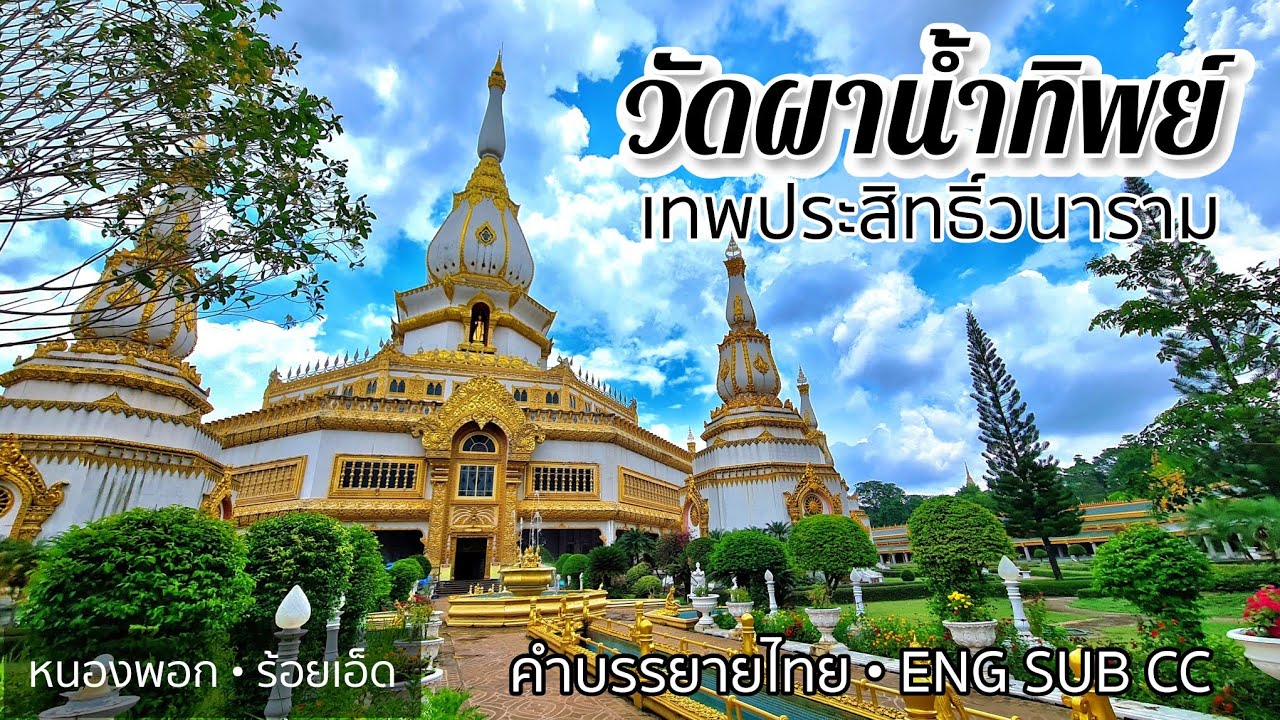
 Click to Access the Navigation Map GPS
Wat Pha Nam Thip Thep Prasit Wanaram Map
Recommend

 Art, Culture and Heritage
 Historical Sites and Monuments(3)
 Landmarks and Memorials(5)
 Art, Craft Centres, Tradition(2)
 Museums(1)
 Educational Places
 Educational Gardens, Farm(3)
Temple(35)
Educational Gardens, Farm(3)
Temple(35)
 Other Sacred Sites(6)
 Suburban Living
 Village, Community(1)
 Local Market(1)
 Nature and Wildlife
 National Parks and Marine Reserves(1)
 Mountain (Doi)(2)
 Dam, Reservoir, Lake(8)
 Waterfalls(1)
 Flower Field(1)
 River, Canal(4)
 Entertainment and Agricultural
 Zoos and Aquariums(1)
 Stadium(1)
 Farms, Parks and Ecotourism(5)
 Shopping
 Shopping and Night Market(1)


