
lovethailand home >Northeastern Travel Attractions >Roi Et Travel Attractions >Thung Kao Luang >Therd Thai > Wat Pa Non Sawan
TL;DR: Wat Pa Non Sawan is located at Ban Thoet Thai / Ban Yang Do, Thoet Thai Subdistrict, Thung Khao Luang District, Roi Et Province, open Daily, Including Public Holidays, hours 08.00 – 17.00.
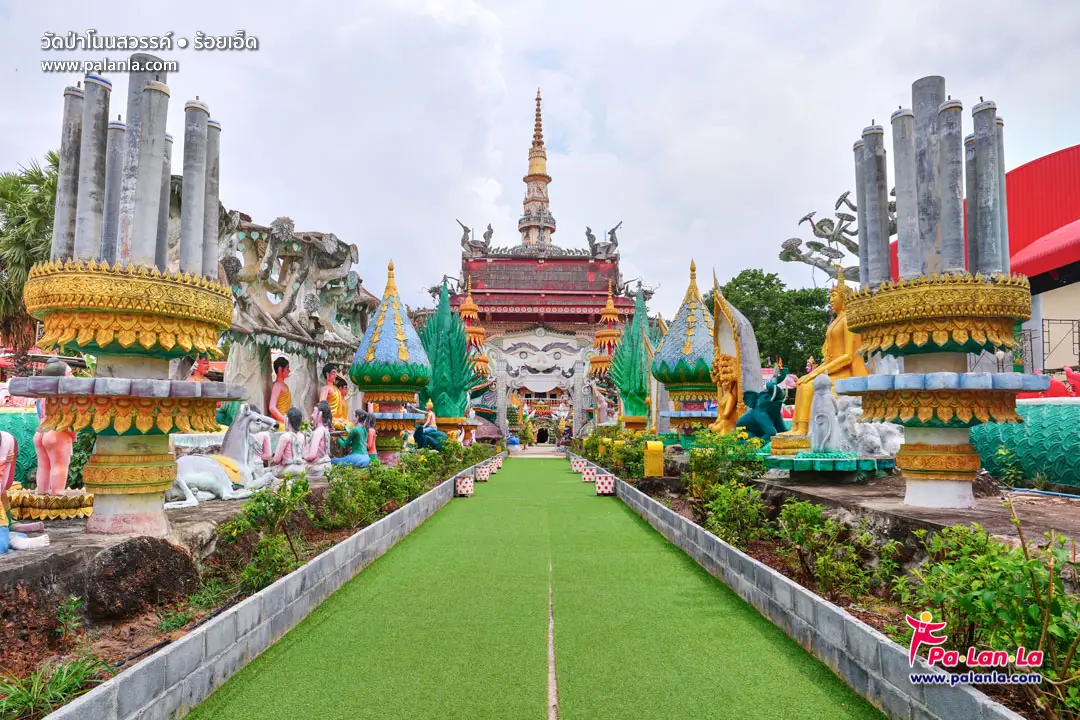
Wat Pa Non Sawan
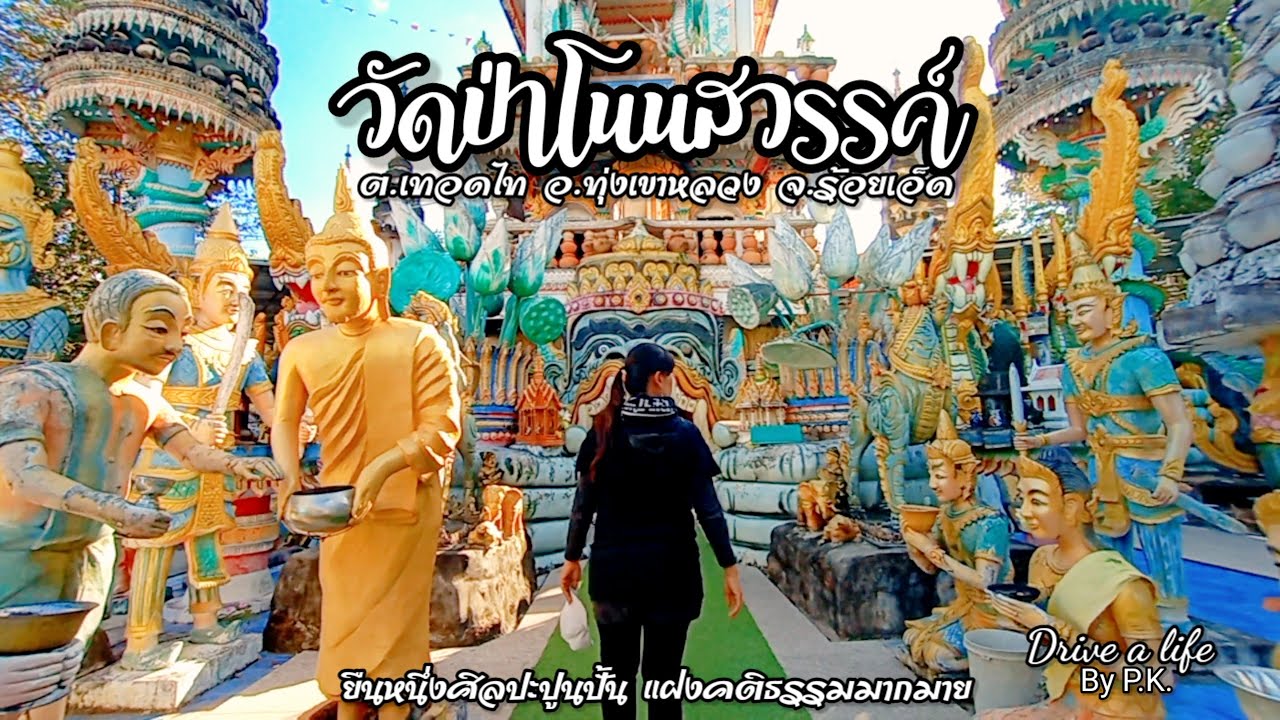
Open Days: Daily, Including Public Holidays
Opening Hours: 08.00 – 17.00
Wat Pa Non Sawan in Roi Et Province is a large and highly distinctive Buddhist temple in Thoet Thai Subdistrict, Thung Khao Luang District. It is best known for its extraordinary use of local clay pots as decorative elements throughout the temple grounds. Visitors will find a multi-tiered main stupa, an entrance shaped like Hanuman’s mouth, two giant turtle sculptures at the temple gate, large stucco figures, mythical creatures, naga serpents, dragons, guardian lions, Buddha images, heaven-and-hell scenes, Buddhist narrative murals, and visual references to Thai literature. The temple is open daily from 08.00 to 17.00, with no admission fee. It is one of the most memorable places in Roi Et for travelers who want to see faith, folk art, Buddhist teaching, and local imagination expressed in one vivid sacred space.
Wat Pa Non Sawan is located in Thoet Thai Subdistrict, Thung Khao Luang District, Roi Et Province. Some travel sources identify the area as Ban Yang Do or Ban Thoet Thai, both referring to the local community around the temple. The temple is accessible by car from Roi Et city via Highway 23, the Roi Et – Thawat Buri – Selaphum route. Around kilometer markers 139 – 140, turn off the main road and continue for about 7 km to reach the temple. The journey from Roi Et city takes roughly 35 – 45 minutes, depending on traffic and the starting point. This makes the temple suitable for a half-day trip or as part of a full-day cultural route in Roi Et.
The most famous feature of Wat Pa Non Sawan is the use of clay pots in large quantities. These pots are closely connected with local craftsmanship and the pottery traditions of nearby communities. When clay pots are used as part of temple architecture, they become more than decorative objects. They represent the link between the temple and the village, between Buddhist faith and local craft, and between everyday materials and sacred creativity. The clay pots are arranged across walls, bases, gateways, sculptural surfaces, and ornamental areas, creating a visual identity that makes the temple instantly recognizable.
Because of this distinctive style, Wat Pa Non Sawan is also known as Wat Mor Din, or The Clay Pots Temple. The name comes from the temple’s extensive use of local earthenware pots in its decorative design. The pots are not placed randomly. They are integrated with stucco, colored glass, painted surfaces, and symbolic forms. This creates a temple atmosphere that is both unusual and coherent. For many travelers, the temple feels like an outdoor spiritual art world built from local materials, Buddhist stories, and the imagination of a visionary monk.
The origin of the temple is closely connected with Phra Khru Chantasuwankhun, also known as Luang Pu Kham Pan Chanthachoto, the former abbot and creator of Wat Pa Non Sawan. The temple was built from his vision. According to local accounts, Luang Pu Kham Pan had a vision of a nine-tiered stupa of the Five Buddhas descending from the sky and stopping before him. This vision became the inspiration for the temple and its main stupa. Villagers and Buddhist devotees later worked together to build the temple, using locally made clay pots as key decorative materials. Over time, the site developed into a large Buddhist complex filled with sculptures, murals, and moral teachings.
Before the temple developed into its present form, the area was an old cremation ground used by villagers from several nearby communities. In 1967, Luang Pu Kham Pan came to the area to practice meditation and built a simple shelter for the rains retreat. The transformation of a former cremation ground into a temple filled with images of heaven, hell, Buddhist stories, and moral lessons gives Wat Pa Non Sawan deep symbolic meaning. It turns a place associated with death into a place of learning, reflection, and spiritual awareness.
The main stupa is the central point of the temple. It has multiple levels and includes an entrance shaped like Hanuman’s mouth. Inside and around the stupa, visitors can see murals related to the Buddha’s life and Buddhist teaching. The structure is not only an architectural feature. It functions as a symbolic journey. As visitors walk through or around it, they encounter Buddhist stories, moral lessons, and sculptural forms that transform the visit into a visual lesson in faith and conduct.
The Hanuman-mouth entrance is one of the temple’s most recognizable features. Hanuman is a major figure in the Thai literary epic Ramakien and symbolizes strength, loyalty, courage, and supernatural ability. By using Hanuman’s mouth as an entrance, the temple creates the feeling of entering a mythic and symbolic world. This makes the temple approachable for many kinds of visitors: Buddhist devotees, Thai literature enthusiasts, families, children, and foreign travelers who want to experience a more imaginative form of Thai temple art.
The temple gate is marked by two giant turtle sculptures. In Thai and Asian symbolic traditions, the turtle is often associated with longevity, endurance, stability, and cosmic support. The presence of giant turtles at the entrance gives the temple a powerful and unusual visual character. The overall design of the gate and surrounding sculptures blends local Isan folk art with elements that resemble Khmer, Indian, Buddhist, and mythological influences. The result cannot be placed neatly into a single artistic category. Its uniqueness lies precisely in this free and imaginative local style.
Inside the temple grounds, large stucco sculptures tell stories from Buddhism, moral teachings, Thai literature, and local cultural imagination. Some sculptures illustrate the life of the Buddha, the Buddha’s disciples, and scenes of religious teaching. Others represent heaven, hell, karma, and the consequences of good and bad actions. The temple also includes mythical animals, naga serpents, dragons, guardian figures, and creatures drawn from the Himmapan forest tradition. Together, these elements create a rich visual landscape that teaches Buddhist ideas through image and experience.
Wat Pa Non Sawan is therefore an excellent place to understand Buddhist teaching through visual symbols. Instead of relying only on sermons or written texts, the temple uses sculptures, murals, gateways, pathways, clay pots, colors, and architectural forms as a language of teaching. Visitors can walk through the temple and interpret the messages for themselves. Images of hell remind viewers of the consequences of harmful actions. Images of heaven suggest the fruit of merit. Scenes from the Buddha’s life point toward enlightenment. Clay pots, once ordinary village objects, become offerings of faith and creativity.
The temple’s beauty lies not only in its strangeness but also in its transformation of local materials. A clay pot is normally an everyday household object. At Wat Pa Non Sawan, it becomes a sacred decorative material. When arranged across temple surfaces and combined with stucco work, it changes from a simple container into a cultural and religious symbol. This transformation reflects an important Buddhist idea: ordinary things can become meaningful when shaped by intention, mindfulness, and faith. The temple shows how local craftsmanship can become Buddhist art without losing its village roots.
For photographers, Wat Pa Non Sawan offers many strong visual compositions. The giant turtle gate, the Hanuman-mouth entrance, the sculpture-lined walkway, the multi-tiered stupa, naga and dragon figures, guardian lions, large mythic creatures, and clay-pot decorations provide highly distinctive photo opportunities. The best times for photography are morning and late afternoon, when the light is softer and the colors and stucco details appear more balanced. Midday visits are still possible, but visitors should prepare sun protection and drinking water because several parts of the temple are open-air areas.
Families can also enjoy the temple as an educational visit. Children are often drawn to the large sculptures, bright colors, animal forms, and mythological figures. Parents can use the visual scenes to explain Buddhist ideas such as karma, generosity, mindfulness, heaven, hell, and moral conduct in simple terms. Learning in an actual temple setting can make Buddhist stories and Thai cultural ideas easier to understand than reading them from a book alone.
For foreign travelers, Wat Pa Non Sawan offers a rare view of the diversity of Thai temple culture. Many visitors expect Thai temples to be defined by golden stupas, classical ordination halls, or polished urban temple architecture. This temple presents another side of Thailand: a folk-art temple shaped by local pottery, visionary imagination, Buddhist storytelling, and community participation. It shows that Thai temples are not all the same. They can be formal, ancient, forest-based, urban, royal, or deeply local and imaginative, as this temple clearly demonstrates.
From the perspective of Isan culture, Wat Pa Non Sawan is more than a religious site. It is a place where local craft, pottery, stucco work, painting, sculpture, and community labor come together. Each part of the temple reflects traces of local people, local materials, and local faith. Although the original vision came from Luang Pu Kham Pan, the temple became real through the participation of villagers and devotees. This shared effort is one reason the temple feels so strongly connected to its community.
Wat Pa Non Sawan is registered as a local Buddhist temple in Thung Khao Luang District. Current temple registry information identifies Phra Atthaphon Atthaphalo as the abbot and notes that monks reside at the temple. This confirms that Wat Pa Non Sawan remains an active religious site, not merely a tourist attraction. Visitors should therefore behave respectfully. The colorful sculptures and unusual forms invite photography, but the temple remains a sacred place where monks and local people carry out Buddhist activities.
Temple etiquette is important. Visitors should dress modestly, avoid loud behavior, avoid climbing on sculptures, and never scratch, touch, or damage clay pots, stucco figures, glass decoration, or painted surfaces. Photography should not block walkways or disturb worshippers. Visitors should also avoid playful or disrespectful poses with religious images and symbolic figures. Respectful behavior helps preserve both the physical art and the sacred atmosphere of the temple.
A good way to explore the temple is to begin at the front gate, where the giant turtles and decorative details introduce the temple’s visual language. From there, visitors can walk along the sculpture-lined path toward the main stupa. The Hanuman-mouth entrance and the multi-level stupa should be observed slowly. Each level and corner contains details related to Buddhist stories, local imagination, and moral teaching. After visiting the stupa, visitors can continue around the temple grounds to see additional sculptures of naga, dragons, mythical creatures, heaven-and-hell scenes, and clay-pot decoration.
Wat Pa Non Sawan can be planned as a half-day trip from Roi Et city. Travelers can leave the city in the morning, spend 1 – 2 hours walking around the temple, and return to visit Bueng Phalan Chai, Roi Et Tower 101, Wat Burapha Phiram, or Roi Et National Museum in the afternoon. Those who want a longer Buddhist route can combine the temple with Wat Pa Kung, Wat Burapha Phiram, or Phra Maha Chedi Chai Mongkhon. This route shows different forms of Roi Et’s Buddhist heritage, from city temples and forest temples to large stupas and local folk-art temples.
Getting There is convenient by private car, rental car, or local hired transport. From Roi Et city, take Highway 23 toward Thawat Buri and Selaphum. Around kilometer markers 139 – 140, turn right onto the local road and continue for about 7 km. The distance from Roi Et city is about 30 km, and the drive normally takes around 35 – 45 minutes. When using a navigation app, search for Wat Pa Non Sawan, Thoet Thai Subdistrict, Thung Khao Luang District, Roi Et Province, to avoid confusion with temples of similar names in other provinces.
The temple can be visited throughout the year. The cool season and the period after the rains are especially comfortable for walking and photography. The hot season is also possible, but visitors should bring sun protection and water. During the rainy season, check the weather before traveling because some outdoor areas and walkways may become wet and slippery. Morning visits are the most comfortable for those who want to explore the temple in detail.
The best way to experience Wat Pa Non Sawan is to see it as an open-air museum of faith. The temple does not display art in a conventional museum building. Instead, the entire temple ground becomes a storytelling space. Clay pots represent the memory of local craft. Stucco figures become a visual language of Buddhist teaching. The stupa acts as a spiritual center. The sculptures around the temple serve as lessons about action, consequence, and moral awareness. Seen this way, the temple is not strange merely for the sake of being strange. Its unusual design helps lead visitors toward reflection.
The temple is also important for preserving folk craftsmanship. Clay pots were once common household objects and local products. As daily life changes and traditional earthenware becomes less central to everyday use, Wat Pa Non Sawan keeps this craft visible in a new form. By placing clay pots across a Buddhist temple, the community turned a practical object into sacred art. Younger generations can therefore see that local pottery is not only a domestic object but also part of cultural memory and religious expression.
Symbolically, Wat Pa Non Sawan presents a Buddhist worldview through images of heaven, hell, the human world, mythic animals, Thai literature, and the Buddha’s life. These elements help visitors understand ideas of karma, merit, wrongdoing, virtue, and liberation through direct visual experience. For visitors who are not familiar with Buddhism, the imagery makes basic concepts more accessible. For those already familiar with Thai temples, the temple offers a powerful and direct form of Buddhist visual storytelling.
The beauty of Wat Pa Non Sawan is not quiet symmetry alone. It is abundant, intense, colorful, and full of belief. The temple overwhelms the eye at first, but the details become more meaningful when seen slowly. A first visit may impress visitors with scale and color, while a slower walk reveals small moral and symbolic messages placed throughout the grounds. The combination of clay pots, mythic sculpture, painted surfaces, and Buddhist narrative gives the temple a personality unlike any other place in Roi Et.
Wat Pa Non Sawan is suitable for many types of travelers. Cultural travelers can study the relationship between the temple and local pottery. Photographers can find unusual and memorable scenes. Families can use the temple as an educational stop. Buddhist visitors can pay respect and reflect on the teachings represented through art. Foreign travelers can experience a unique form of Thai temple creativity rooted in local life. This ability to serve many kinds of visitors while remaining a functioning temple makes Wat Pa Non Sawan one of Roi Et’s most rewarding cultural destinations.
In summary, Wat Pa Non Sawan in Roi Et Province brings together clay-pot art, large stucco sculptures, Buddhist murals, the life of the Buddha, Thai literature, moral teaching, and community faith in one extraordinary temple. The multi-tiered stupa, Hanuman-mouth entrance, two giant turtles, and extensive clay-pot decoration make it one of the most distinctive temples in Roi Et. The temple is open daily from 08.00 to 17.00, with no admission fee, and is easily reached from Roi Et city. For travelers who want to understand Roi Et beyond its city landmarks, Wat Pa Non Sawan offers a memorable encounter with local faith, folk art, and Buddhist imagination.
| Name | Wat Pa Non Sawan |
| Alternative Name | Wat Mor Din / The Clay Pots Temple |
| Location | Ban Thoet Thai / Ban Yang Do, Thoet Thai Subdistrict, Thung Khao Luang District, Roi Et Province |
| Address | Thoet Thai Subdistrict, Thung Khao Luang District, Roi Et Province 45170, Thailand |
| Highlights | A clay-pot temple with a multi-tiered main stupa, Hanuman-mouth entrance, two giant turtle sculptures, large stucco figures, and murals related to the life of the Buddha |
| History | The temple was created from the vision of Phra Khru Chantasuwankhun, or Luang Pu Kham Pan Chanthachoto, former abbot of the temple. The main stupa of the Five Buddhas was founded in 1969 through the faith of monks, villagers, and Buddhist devotees. |
| Name Origin | Wat Pa Non Sawan reflects the idea of a forest temple connected with heavenly symbolism, while Wat Mor Din refers to the local clay pots used to decorate much of the temple. |
| Distinctive Features | A mixed local Isan, Khmer-like, Indian-like, Buddhist, Thai literary, and folk-imaginative art style using clay pots, stucco, colored glass, murals, and large symbolic sculptures |
| Important Sacred And Cultural Objects | Multi-tiered main stupa, Hanuman-mouth entrance, two giant turtle sculptures, naga, dragons, guardian lions, Himmapan-style figures, heaven-and-hell scenes, and Buddhist murals |
| Travel Information | From Roi Et city, take Highway 23 on the Roi Et – Thawat Buri – Selaphum route. Around kilometer markers 139 – 140, turn right and continue for about 7 km. The temple is about 30 km from Roi Et city. |
| Current Status | Open for worship, photography, and walking visits during operating hours |
| Open Days | Daily, Including Public Holidays |
| Opening Hours | 08.00 – 17.00 |
| Fees | No Admission Fee |
| Facilities | Worship Area, Stupa Walkway, Sculpture Viewing Area, Photo Areas, Temple Courtyard, And Buddhist Activity Space |
| Main Areas / Zones | 1. Giant Turtle Gate Zone 2. Sculpture Walkway Zone 3. Multi-Tiered Main Stupa Zone 4. Hanuman-Mouth Entrance Zone 5. Buddha Life Mural Zone 6. Heaven, Hell, And Thai Literature Sculpture Zone 7. Clay Pot Art Zone |
| Founder / Important Former Abbot | Phra Khru Chantasuwankhun, Luang Pu Kham Pan Chanthachoto |
| Abbot | Phra Atthaphon Atthaphalo |
| Resident Monks | 5 Monks |
| Main Contact Number | 081-060-0723 |
| Local Administrative Office | Thung Khao Luang Subdistrict Administrative Organization, Tel. 043-658044, 043-557135 |
| Nearby Tourist Attractions | 1. Wat Pa Non Khao Luang, About 12 km 2. Thawat Buri Market, About 17 km 3. Wat Burapha Phiram, About 30 km 4. Bueng Phalan Chai, About 31 km 5. Roi Et Tower 101, About 32 km 6. Roi Et National Museum, About 32 km |
| Nearby Restaurants | 1. Na-Hong Cafe, About 14 km, Tel. 081-292-3687 2. Nutcha Coffee, About 17 km, Tel. 094-265-5912 3. Krua Thammachat Southern Food, About 18 km, Tel. 093-758-8379 4. Krua Erawan 101, About 18 km, Tel. 092-804-1429 5. Krua Rabiang Suan Thawat Buri, About 19 km, Tel. 082-889-1430 6. Guichai Ama Roi Et, Selaphum Branch, About 20 km, Tel. 085-900-5430 |
| Nearby Accommodations | 1. The Hi Place Hotel, About 29 km, Tel. 093-556-5445 2. HOP INN Roi Et, About 30 km, Tel. 02-080-2222 3. M Grand Hotel Roi Et, About 31 km 4. Lita Place, About 31 km, Tel. 043-524-606 5. The Premium Residence, About 31 km |
Frequently Asked Questions (FAQ)
Q: Where is Wat Pa Non Sawan located?
A: Wat Pa Non Sawan is located in Thoet Thai Subdistrict, Thung Khao Luang District, Roi Et Province, about 30 km from Roi Et city.
Q: What are the opening days and opening hours of Wat Pa Non Sawan?
A: The temple is open daily, including public holidays, from 08.00 to 17.00.
Q: Is there an admission fee to visit Wat Pa Non Sawan?
A: No. Visitors can enter the temple, pay respect, walk around the stupa, and see the sculptures without an admission fee.
Q: What is the main highlight of Wat Pa Non Sawan?
A: The temple is famous for its clay-pot decoration, multi-tiered main stupa, Hanuman-mouth entrance, two giant turtle sculptures, and large stucco figures with Buddhist moral themes.
Q: Who created Wat Pa Non Sawan?
A: The temple was created from the vision of Phra Khru Chantasuwankhun, also known as Luang Pu Kham Pan Chanthachoto, with support from villagers and Buddhist devotees.
Q: Who is the abbot of Wat Pa Non Sawan?
A: The abbot is Phra Atthaphon Atthaphalo.
Q: When is the best time to visit Wat Pa Non Sawan?
A: Morning or late afternoon is recommended because the weather is more comfortable and the light is ideal for viewing the sculptures, stupa, and murals.
Q: What nearby places can be visited with Wat Pa Non Sawan?
A: Nearby and connected places include Wat Pa Non Khao Luang, Thawat Buri Market, Wat Burapha Phiram, Bueng Phalan Chai, Roi Et Tower 101, and Roi Et National Museum.
 Category: ●Places of Worship
 Group: ●Temple
Last Update : 4 MonthAgo
 Last Update : 4 MonthAgo
 Click to Access the Navigation Map GPS
Wat Pa Non Sawan Map
Recommend

 Art, Culture and Heritage
 Historical Sites and Monuments(3)
 Landmarks and Memorials(6)
 Art, Craft Centres, Tradition(2)
 Museums(1)
 Educational Places
 Educational Gardens, Farm(3)
 University
 Autonomous Universities(1)
 Rajabhat University(1)
Temple(35)
 Other Sacred Sites(6)
 Suburban Living
 Village, Community(1)
 Local Market(1)
 Nature and Wildlife
 National Parks and Marine Reserves(1)
 Mountain (Doi)(2)
 Dam, Reservoir, Lake(8)
 Waterfalls(1)
 Flower Field(1)
 River, Canal(4)
 Entertainment and Agricultural
 Zoos and Aquariums(1)
 Stadium(1)
 Farms, Parks and Ecotourism(5)
 Shopping
 Shopping and Night Market(1)
 Department Store(2)
 Travel Articles, Recipes
 Travel Review, Food Review(1)


